




Abstract
Status conflicts, conflicts about members’ relative positions in a team’s status hierarchy, generally harm group performance. We integrate research on status conflicts and social information processing and find in two longitudinal survey studies that the disruptive effects of status conflicts depend on the extent to which members agree about the group’s status hierarchy. Specifically, status conflicts in teams with high-status agreement disrupt team performance by producing lower status agreement after the conflict. Status conflicts that occur in teams with low-status agreement, however, benefit performance by helping members clarify the hierarchy, leading to higher subsequent status agreement. In a third study, we examine how status conflict and status agreement interactively impact teams’ use of task-relevant cues to assign status. By contextualizing status conflicts in terms of the teams’ status agreement, we identify conditions in which the dysfunctional effects of status conflicts counterintuitively enhance team performance.
Keywords
For 15 days in 2013, the U.S. Federal government was partially shut down in an effort to undermine implementation of the Affordable Care Act, a move initiated by the Congressional Tea Party caucus in direct defiance of the leadership of the Republican Party. The shutdown cost US$24 billion and resulted in the lowest ever-recorded Congressional job approval rating of 9% (Gallup, 2014), yet the action seems to have legitimated its architects rather than undermined them. John Boehner, then Speaker of the House and establishment stalwart, was ousted in October 2015 and Ted Cruz, one of the leaders of the Tea Party, was among the leading Republican primary presidential candidates in 2016. Viewed retrospectively, the government shutdown can be interpreted as a successful attempt by the Tea Party to disrupt the status hierarchy of the Republican Party.
This event provides a real-world example of a status conflict—conflicts about members’ relative positions in a status hierarchy (Bendersky & Hays, 2012). They occur when group members assert that they deserve more status than they currently have or that other group members are overestimating their status and need to be put in their place (Anderson, Srivastava, Beer, Spataro, & Chatman, 2006; Anicich, Fast, Halevy, & Galinsky, 2016; Bendersky & Hays, 2012; Faris, 2012; Martorana, Galinsky, & Rao, 2005; Owens & Sutton, 2001; Roy, 1959). The distinguishing feature of status conflicts is that they are about relative social positions rather than differing perspectives about tasks, processes, or personal values (Bendersky & Hays, 2012).
Status conflicts generally disrupt team performance because they reduce information sharing and distract members from the team’s task (Bendersky & Hays, 2012; Greer & Van Kleef, 2010; Groysberg, Polzer, & Elfenbein, 2011; Loch, Huberman, & Stout, 2000). Yet, just as task conflict can help or harm performance depending on whether or not it facilitates collaboration and information sharing (DeChurch, Mesmer-Magnus, & Doty, 2013; Tsai & Bendersky, 2016) and when it occurs in a team’s life (Farh, Lee, & Farh, 2010), there may be situations in which status conflicts also can be helpful. Based on contingency theories about the functions of status hierarchies (Anderson & Brown, 2010; Anderson & Willer, 2014), we posit that a key determinant of when status conflicts may be harmful or helpful is the level of agreement about a group’s status hierarchy, a mental model that we call “status agreement.” Our research is the first to examine the conditions under which the dysfunctional effects of status conflict may instead enhance team performance by facilitating a more shared understanding of the status hierarchy. This enhances our understanding of the role that status conflicts play in team development and performance.
Status Conflict, Status Agreement, and Performance
Members of groups use cues to form expectations about each other’s potential contributions to organize themselves into social hierarchies that structure their social and task-related interactions (Anderson & Kilduff, 2009; Berger, Connor, & Fisek, 1974; Berger, Rosenholtz, & Zelditch, 1980; Bunderson, 2003). When members know little about one another, status is conferred to individuals through a heuristic, imprecise process that can lead to varying degrees of collective agreement about a group’s status hierarchy (“preliminary status agreement;” Anderson & Kilduff, 2009; Kilduff, Willer, & Anderson, 2016). High preliminary status agreement may emerge from this heuristic process if status cues are easily recognized by all members, considered to be legitimate indices of merit, and clearly differentiate members from each other (e.g., identifiable expertise; Anderson & Willer, 2014; Berger, Ridgeway, Fisek, & Norman, 1998; Tost, 2011). However, when such legitimate status cues are not accessible (e.g., undeclared credentials) or do not clearly differentiate members’ expected contributions (e.g., many “star” members; Groysberg et al., 2011; Overbeck, Correll, & Park, 2005), team members may use a variety of alternate cues (e.g., gender, ethnicity, personality) and may develop different initial perceptions of each other’s status. This generates low preliminary status agreement.
Despite this potential variance in status agreement, group members generally assume that everyone in the group tacitly agrees about the hierarchy (Walker, Thomas, & Zelditch, 1986). Therefore, in the absence of a shock to the system—a “jolt”—initial status assessments and levels of status agreement are likely to persist (Berger et al., 1998; Magee & Galinsky, 2008). For instance, teams may have persistent states of low-status agreement in the absence of jolts if they have fluid hierarchies or shared leadership structures (Carson, Tesluk, & Marrone, 2007; Klein, Ziegert, Knight, & Xiao, 2006). When jolts do occur, however, they shift individuals from a heuristic social information processing mode, in which they rely on easily accessible cues, to a more deliberative processing mode (Tost, 2011), in which they may articulate and negotiate the bases for legitimately assigning status (Owens & Sutton, 2001; Strauss, Schatzman, Bucher, Ehrlich, & Sabshin, 1963; Sutton & Hargadon, 1996). We argue that status conflicts act as such jolts.
Importantly, status conflicts may occur in groups regardless of the level of preliminary status agreement. In some cases, status conflicts may be motivated by low preliminary status agreement; for example, because inconsistent dominance and deference patterns caused by the lack of consensus about who is higher in status than whom create confusion (Tiedens, Unzueta, & Young, 2007) or when there is disagreement between two people who both think they have higher status than the other (Kilduff et al., 2016). However, even when preliminary status agreement is high, the perceived mutability of status hierarchies can motivate individuals to engage in self-interested competition to increase their status (Hays & Bendersky, 2015), which can turn into status conflicts as others defend their status against potential threats (Anicich, Fast, Halevy, & Galinsky, 2016; Henry, 2009; Pettit, Yong, & Spataro, 2010). Thus, we argue that status conflict and preliminary status agreement are orthogonal constructs.
Regardless of whether status conflicts occur in the context of high- or low-status agreement, they are dramatic violations of the assumption of hierarchy endorsement that draw people’s attention to the basis on which status is assigned (Tost, 2011). The jolt created by a status conflict is likely to shift group members into a more deliberative information processing mode as they make claims about what cues are the most legitimate bases for conferring status. This may lead them to modify their initial perceptions of members’ status, which collectively alters the shared mental model of the status hierarchy (“subsequent status agreement”). 1 We posit that the effects of status conflict on a group’s subsequent status agreement are contingent on the level of preliminary status agreement.
Specifically, we predict that when the level of preliminary status agreement is high, status conflict may decrease the level of subsequent status agreement by introducing uncertainty and disagreement about the hierarchy where none existed before. For preliminary status agreement to be high, members needed to have converged heuristically around an accessible cue that was generally considered a valid competence indicator. As individuals deliberatively reevaluate the status hierarchy in response to a status conflict jolt, they are likely to have different reactions that, on net, create less status agreement than there was initially. That is, the status reevaluations triggered by status conflicts could lead some individual members to reject the status claim and reinforce their reliance on the initial cues but lead others to reassign status based on different cues that they now believe are more valid merit indicators. Aggregated to the group level, these various reactions to status conflicts disrupt the shared mental model members previously had about the hierarchy, lowering subsequent status agreement.
In contrast, when status conflicts occur in teams with low preliminary status agreement—where members had not converged upon a particular cue—status conflicts may help members increase their agreement about which bases should be used to confer status. By shifting members into a more deliberative processing mode and creating an opportunity for them to articulate the rationale for who deserves more or less status, group members may surface information about task-relevant abilities that had otherwise been too subtle to detect consistently. This could allow members to converge around legitimate cues in a way that eluded them prior to the status conflict. Thus, in groups with low preliminary status agreement, we predict that status conflict will increase subsequent status agreement.
Furthermore, we predict that status agreement is functionally beneficial for collective performance. Status agreement should enhance the functional benefits of hierarchy by clarifying roles, facilitating communication, and enhancing coordination (Anderson & Brown, 2010; Anderson & Willer, 2014; Magee & Galinsky, 2008). Moreover, members tend to endorse status differences that are associated with valid, task-relevant criteria (Anderson, Willer, Kilduff, & Brown, 2012; Walker et al., 1986), making members particularly likely to accept and carry out their roles in the group (Tyler & Blader, 2003). While status agreement is likely to be beneficial at any point, the existence of a clear, legitimate hierarchy is particularly important for performance as the team moves into task execution mode when coordination requirements intensify (Gersick, 1991; McGrath, 1991). Thus, we predict that higher subsequent status agreement results in more functional teams with better performance. In sum, we predict that status conflict and preliminary status agreement interactively affect subsequent status agreement and, consequently, team performance.
Empirical Overview
We test our model in three studies. In the first, Study 1a, we test the primary hypothesis about the interactive effects of preliminary status agreement and status conflict on team performance. In the second, Study 1b, we replicate that interactive effect and extend it by examining the mediating role of subsequent status agreement. In Study 2, we test the logic of our theoretical explanation for the group-level findings observed in Study 1 by determining the status weights given to a legitimate, task-relevant cue (perceived competence) in teams characterized by varying levels of status agreement and status conflict. 2
Study 1a
We conducted this study at a West Coast business school with master of business administration (MBA) students during their final team project in their last year of the program. The sample included 100 teams that were similar in size, whose members conducted strategic business plan analyses and made recommendations for external, corporate clients over a 6-month period.
Participants
In this study, 511 students were invited to participate in the research project, of which 419 from 100 groups agreed (M responses/team = 4.63, SD =.77). We retained 99 groups for which at least 50% of the team members completed the surveys.
Procedure
We conducted two surveys of the teams as part of a general program evaluation, one at the beginning when students first met in their teams (Time 1) and a second at the end of the 6-month project (Time 2), after the students submitted their deliverables. Projects were graded by the teams’ faculty advisors, who were unaware of the study or its hypotheses, 2 weeks after the second survey, thus minimizing potential same source bias (Podsakoff & Organ, 1986).
Measures
Our dependent variable, team performance, is the teams’ project grades (on a 20-point scale). We measured status conflict (Bendersky & Hays, 2012) in the Time 2 survey (sample item: “My team members competed for influence”; α = .80), intraclass correlation coefficient, ICC, (1) = .25, F = 2.43, p < .001; ICC(2) = .59. We measured preliminary status agreement by asking members to rate each teammate’s status based on how much respect, prestige, and esteem each person has in the team (α = .91; Bendersky & Shah, 2013) in the Time 1 survey and then calculated the within-team agreement index (Rwg ; James, Demaree, & Wolf, 1984). The agreement in individual-level status perceptions aggregates to the team level additively (Chan, 1998), with average agreement among members indicating status agreement.
Results
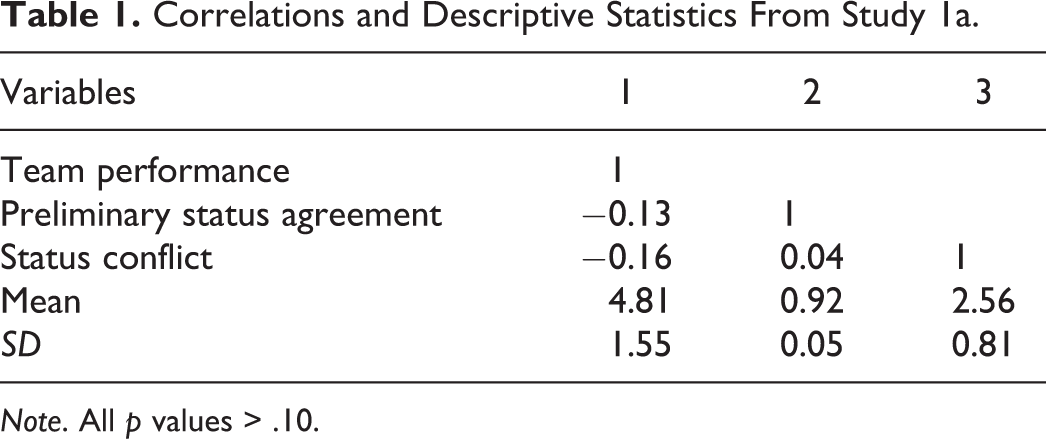
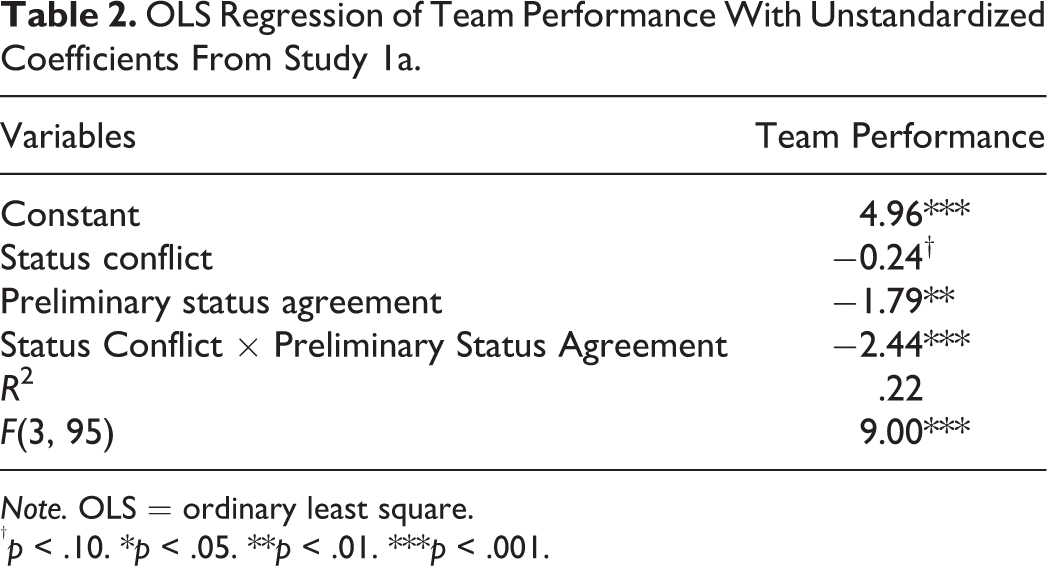
We first confirmed that, as expected, preliminary status agreement and status conflict are orthogonal (r = .04, p = .66; see Table 1). Results of ordinary least square regression analysis of team performance (Table 2) indicate that there is a significant interaction between preliminary status agreement and status conflict (B = −2.44, p < .001, η2 = .18). As predicted, status conflict is negatively related to performance when preliminary status agreement is high (B = −2.69, p < .001) and positively related to performance when preliminary status agreement is low (B = 2.20, p < .001; Figure 1).
Correlations and Descriptive Statistics From Study 1a.
Note. All p values > .10.
OLS Regression of Team Performance With Unstandardized Coefficients From Study 1a.
Note. OLS = ordinary least square.
† p < .10. *p < .05. **p < .01. ***p < .001.
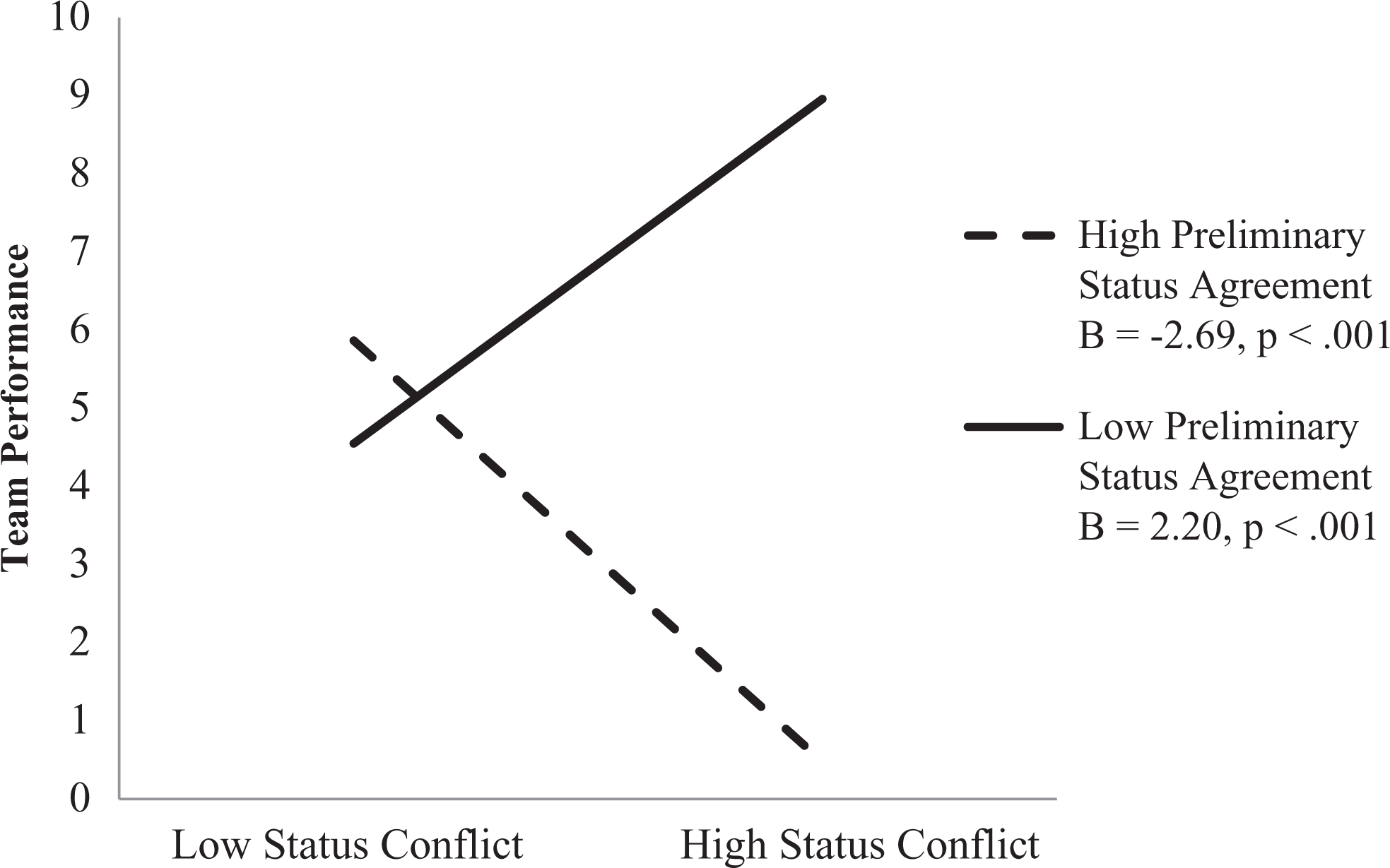
Interactive effects of preliminary status agreement and status conflict on team performance, Study 1a (variables graphed at ±1 SD).
In sum, the results of Study 1a provide evidence that the effects of status conflicts on group performance depend on the level of preliminary status agreement in teams. As predicted, when preliminary status agreement was high, status conflict was detrimental to group performance. Conversely, when preliminary status agreement was low, status conflict was beneficial to group performance. Although this study provides empirical evidence for the interactive effects of status conflict and status agreement on performance, we were unable to examine our proposed mechanism, change in status agreement. Furthermore, it is possible that although group performance was measured at the very end of the project when the groups submitted their final deliverables, groups could have had preliminary indicators of their performance much earlier in the project, and these performance indicators affected the level of status conflict rather than the causal order that we predict. Therefore, we conducted Study 1b to examine the mechanism and alleviate the possibility of reverse causality among our variables.
Study 1b
We conducted this study with all first-year, part-time MBA students in a large West Coast university during their core organizational behavior course, during the first quarter of the program. This had a design benefit that the students were randomly assigned to study teams by the program office, so members did not have any preexisting relationships or reputations that could influence status perceptions. We surveyed these participants at three points in time during the quarter in which they worked together with variables measured in a temporal sequence consistent with our causal hypotheses.
Participants
Two hundred and seventy-one of the 281 students, organized in 50 teams (M responses/team = 5.32, SD = .74), participated in all three surveys. We excluded one team (five individuals) from the sample because its extremely high-leverage score indicated that it was a true outlier in the data (Chen, Ender, Mitchell, & Wells, 2003).
Procedure
We administered surveys at three points in time. The first survey (Time 1) was a round-robin survey in which each person rated all their teammates, administered in the second week of the quarter prior to receiving any team performance feedback. In the second survey (Time 2), administered in the sixth week of the quarter, students rated their perceptions of the group’s processes. The final survey (Time 3) was administered in the 10th and final week of the quarter, immediately after the teams had submitted their final team project assignment. This was another round-robin survey, where participants rated their teammates after having worked together for the entire quarter. The final team projects were evaluated by teaching assistants who were blind to the study’s hypotheses.
Measures
The dependent variable is the team grade on the final team project assignment. We measured status conflict with the same 4-item scale as in Study 1a in the Time 2 survey (α = .73), ICC(1) = .24, F = 2.62, p < .001; ICC(2) = .62. We calculated preliminary status agreement in the Time 1 survey the same way as in Study 1a, using the same 3-item measure of participant status (α = .87). We operationalized the mediator, subsequent status agreement, as the team mean Rwg of the same three round-robin status questions (α = .92) measured in the Time-3 survey following the observed status conflicts and near the end of the teams’ lifecycle. Finally, to address concerns about reverse causality, we control for the mean grade earned by team members on an individual case write-up assignment submitted in the third week of the quarter (between the first and second surveys). We reasoned that team members’ grades on an assignment similar to the team assignment we use as our outcome would provide an early indicator of team performance. As expected, the team mean grade on the individual assignment was correlated with the final team project grade (r = .31, p = .03).
Results
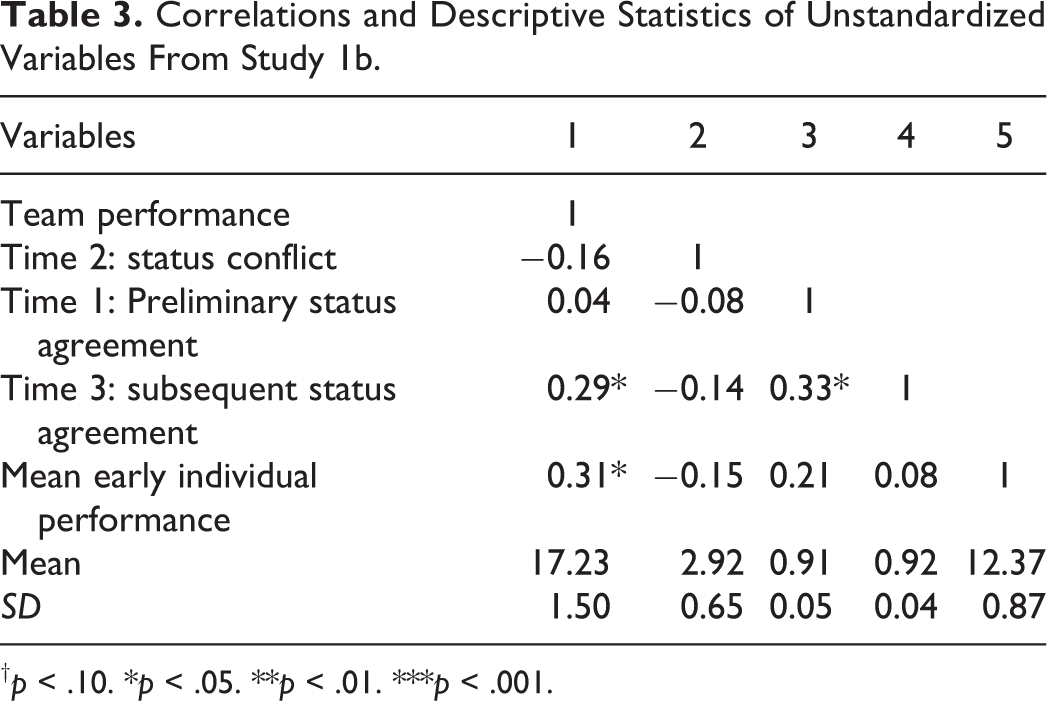
We again confirmed that preliminary status agreement and status conflict are orthogonal (r = −.08, p = .59; see Table 3). As predicted, the interaction of preliminary status agreement with status conflict on team performance is significant (β = −.28, p < .001; see Figure 2). Replicating the result from Study 1a (see Figure 3), status conflict has a significant negative effect on team performance when preliminary status agreement is high (+1 SD: B = −1.00, p < .001) and a significant positive effect when preliminary status agreement is low (−1 SD: B = .73, p = .03).
Correlations and Descriptive Statistics of Unstandardized Variables From Study 1b.
† p < .10. *p < .05. **p < .01. ***p < .001.
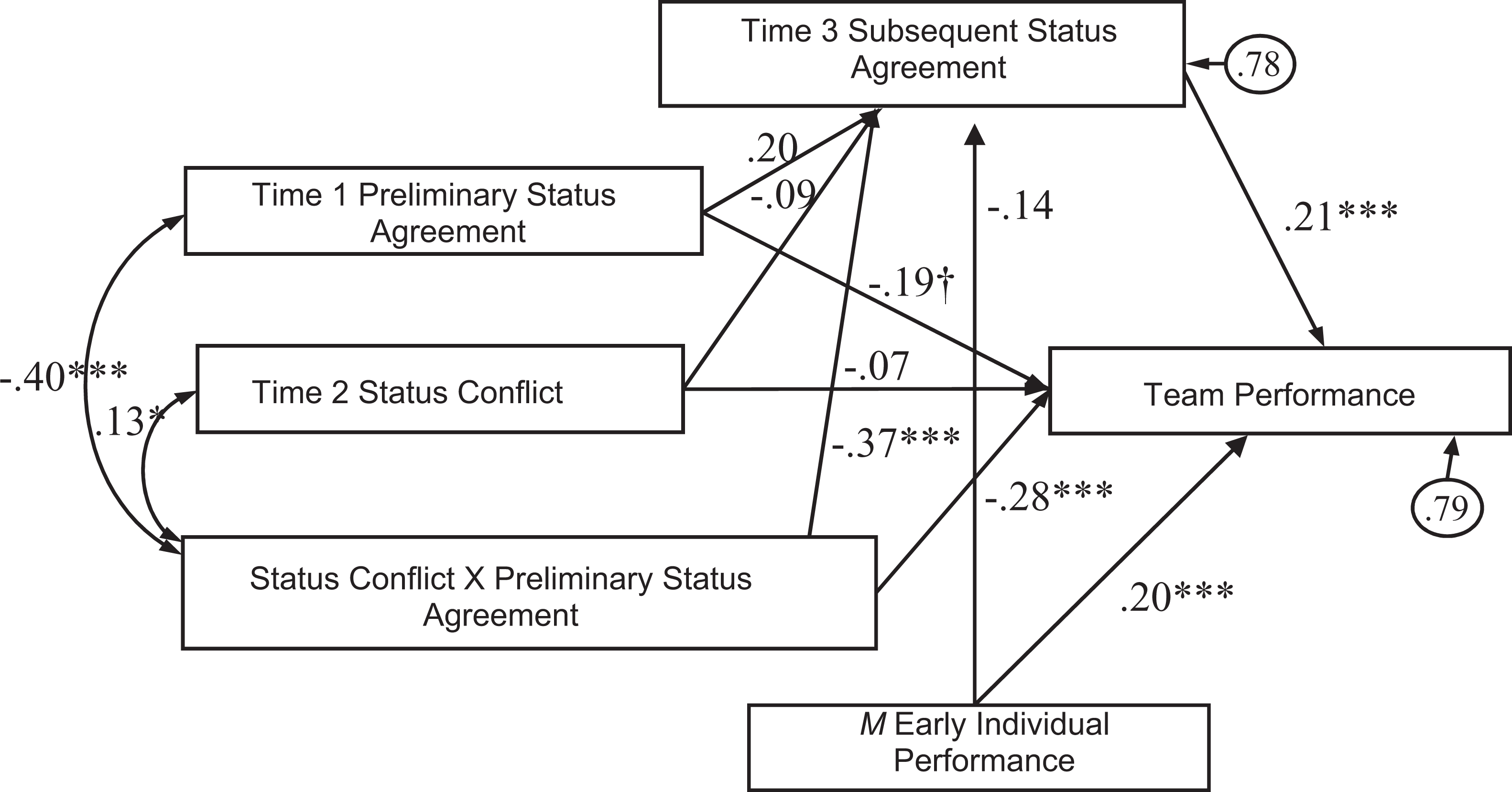
Standardized path relationships in the mediated moderation model, Study 1b. †p < .10. *p < .05. **p < .01. ***p < .001.
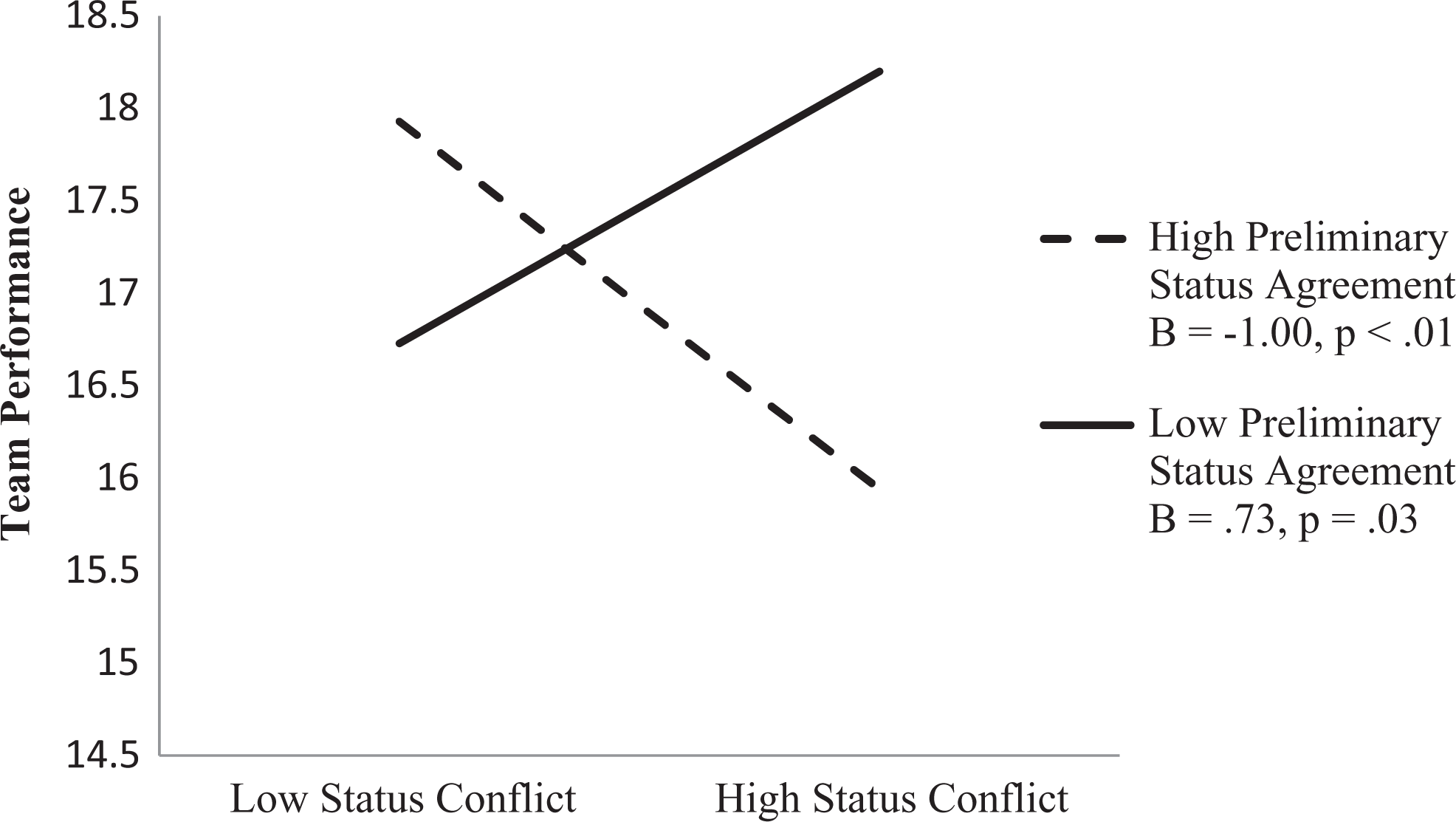
Interactive effects of preliminary status agreement and status conflict on team performance, Study 1b (preliminary status agreement graphed at ±1 SD).
Status conflict and preliminary status agreement also interactively affect subsequent status agreement (β = −.37, p < .001). Furthermore, subsequent status agreement is positively associated with team performance (β = .21, p < .001). Finally, consistent with our hypotheses, confidence intervals that do not span zero indicate that status conflict positively affects team performance through subsequent status agreement when preliminary status agreement is low (.05–.33) and negatively affects performance when preliminary status agreement is high (−.28 to −.07).
Study 1 Discussion
In two separate samples, status conflicts that occurred in groups with high preliminary status agreement were detrimental to group performance, while those that occurred in groups with low preliminary status agreement were beneficial to group performance. Furthermore, we determined in Study 1b that this pattern is due to changes in the degree of agreement about the status hierarchy after the observed status conflict compared to prior to it. Thus, we conclude that status conflicts either disrupt or facilitate consensus in the way group members assess each other’s status, depending on the level of preliminary status agreement that exists in the groups. Consistent with functional models of group hierarchy, the more subsequent status agreement there is, the better the group performs, even after controlling for performance that occurred prior to the measured status conflicts.
Although these studies provide robust evidence for our hypotheses, we have thus far been unable to examine the microprocesses that we posited would explain the group-level patterns we observed in Study 1. We, therefore, conducted an organizational field study to determine the extent to which members of teams with varying degrees of status agreement and status conflict weigh legitimate cues to allocate status.
Study 2
Recall our prediction that in the absence of status conflicts, heuristic information processing would only produce high-status agreement if a valid, task-relevant status cue is recognizable to all members (Anderson & Brown, 2010; Berger et al., 1998). If such a cue were not accessible, group members would still be motivated to construct a hierarchy (Tiedens et al., 2007) but may allocate status based on a variety of alternate cues (e.g., gender, dominance, extraversion), leading to low preliminary status agreement. When status conflicts occur, they jolt members to attend to different kinds of cues as the members make competing claims about how status should be allocated. To the extent that status conflicts surface information that facilitates members’ convergence around a valid status cue, status agreement should increase. However, to the extent that status conflicts introduce claims of alternative cues for allocating status, the conflicts could reduce status agreement and status could be reallocated in less functionally beneficial ways.
We examined these processes in a cross-sectional organizational field study with ongoing teams, which gives us a snapshot of how status is allocated at a point in time in a dynamic system. We examine the weight given to a valid, task-relevant cue, perceived competence, because it is an indicator of expertise that forms the basis for functional status allocations in task groups (Anderson & Brown, 2010; Berger et al., 1974; Bunderson, 2003). In the absence of a status conflict jolt, when status assessments are processed heuristically, we expect that groups in which perceived competence is more accessible will more heavily weigh it in their status assessments and, therefore, achieve higher status agreement than will groups for which perceived competence is less accessible. However, because we argue that status conflict jolts members into more deliberative processing of status cues, putting the level of status agreement in flux (as observed in Study 1b), we expect that status conflict will affect the weight given to perceived competence cues in different ways depending on the level of status agreement.
In groups with low-status agreement, we expect that status conflict will be associated with more weight given to competence cues in status allocation because these conflicts surface information about members’ relative competence. Although our data are cross sectional, we infer in this study that by causing groups to weigh competence cues more heavily, status conflict would increase status agreement over time by increasing the accessibility of a valid cue. In contrast, when status conflicts occur in groups with high-status agreement—groups that had already converged around a valid, task-relevant cue for status allocation—these conflicts are likely to be associated with less weight given to competence cues, as group members argue that other cues on which they are advantaged are more valid bases for status allocation. We infer that by decreasing the weight given to competence over time, status conflict in these groups would reduce status agreement.
Method
Participants
Three hundred and twenty-eight of the 358 employees of a midsized, U.S. Internet company, organized into 40 teams (M employees/team = 7.63, SD = 9.43), participated. These teams were nested in six divisions (e.g., sales, engineering).
Procedure and Measures
We measured perceived competence as a peer-rated, individual-level variable, excluding self-scores. Participants rated the extent to which their teammates were competent, knowledgeable, and capable (α = .82). Participants also rated the status of each of their teammates by responding to the same 3 items as in the previous studies (α = .83). We used the peer-rated status measures (excluding self-scores) as dependent variables to determine the status weight given to perceived competence and to calculate the group-level status agreement with the same Rwg measure as in the previous studies. Participants also rated the extent to which status conflicts occurred in their groups as in the previous studies (α = .44), and we aggregated these scores to the group level, ICC(1) = 21, F = 2.67, p < .001; ICC(2) = 62.
Analyses
To test our hypotheses about the weight teams give to perceived competence in status allocation, we conducted a two-stage multilevel analysis. We first determined the weights given to competence in assigning status by regressing peer-rated status on peer-rated competence within each team. This analysis produced group-level regression coefficients for perceived competence, which indicate the weight members of each group gave to competence in determining individual members’ status. We then used these coefficients as dependent variables in group-level analyses, in which we regressed competence weight on status agreement, status conflict, and their interaction in robust multilevel analyses with teams nested in divisions.
Results
We note that, unlike in the longitudinal data in Study 1, status conflict and status agreement are negatively associated with each other (r = −.28, p = .05; see Table 4). Regressing the team-level competence weights on status agreement, status conflict, and their interaction (Table 5) reveals a significant interaction of status agreement and status conflict (γ = −.80, p = .006, Cohen’s f 2 = .07). As predicted, status conflict is negatively associated with competence weight in teams with high-status agreement (B = −.96, p < .001) but positively associated with competence weight in teams with low-status agreement (B = .65, p = .04; see Figure 4).
Correlations and Descriptive Statistics of Unstandardized Variables From Study 2.
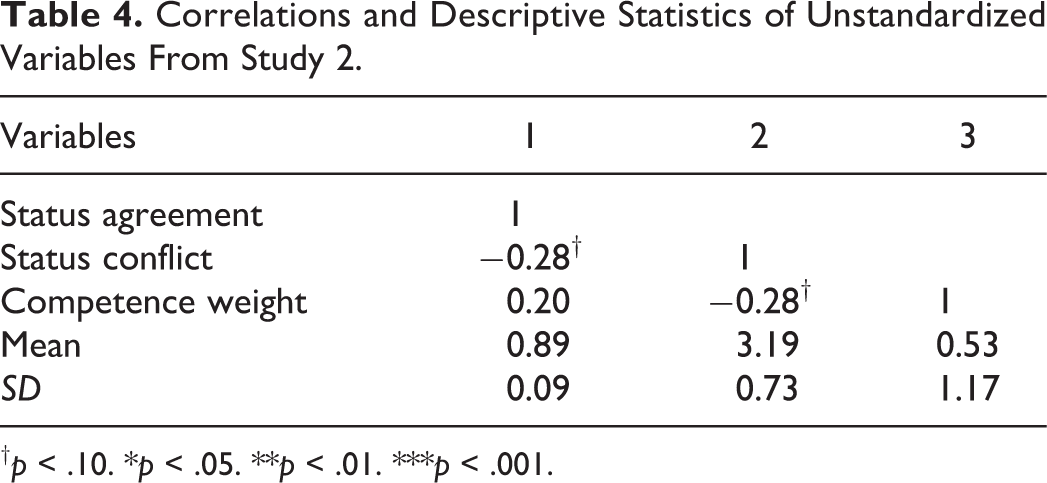
† p < .10. *p < .05. **p < .01. ***p < .001.
Multilevel Regression of Team Competence Weights Nested in Divisions, With Unstandardized Coefficients From Study 2.
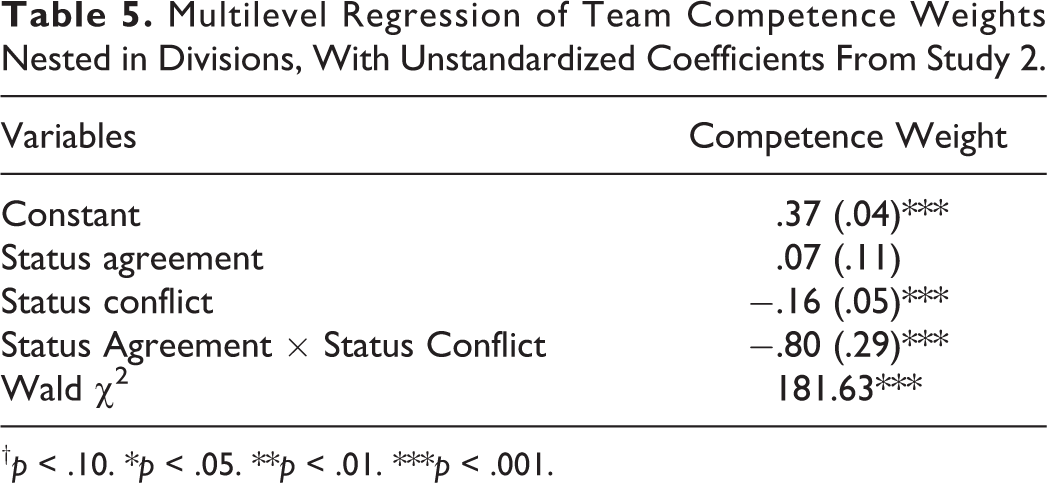
† p < .10. *p < .05. **p < .01. ***p < .001.

Interactive effects of status agreement and status conflict on competence weights (Study 2).
Study 2 Discussion
These results are consistent with our theorizing that status conflicts impact the way members process social information to make inferences about who deserves how much status in groups. In groups with low levels of status agreement, status conflict is positively associated with the weight given to perceived competence in allocating status, which indicates that status conflict may make competence more accessible to members, allowing them to converge around it as a means for assigning relative status. However, status conflicts in teams with high-status agreement are negatively associated with the weight assigned to competence in allocating status, presumably because group members are arguing that other attributes are more legitimate bases for status. We assume that higher levels of status conflict indicate groups whose status agreement is in flux and that assigning more weight to competence would lead to rising status agreement over time, whereas assigning less weigh to competence would lead to falling status agreement over time. This pattern is consistent with the effects of status conflicts on subsequent status agreement that we observed in Study 1b.
Discussion and Conclusions
We have argued that although status conflict has been shown in past research to harm team performance by reducing information sharing, status conflicts also impact team performance by increasing or decreasing status agreement, the extent to which people have shared mental models about each other’s status. These mental models affect team coordination and performance. Specifically, we have shown that when status conflicts occur in teams with high preliminary status agreement, status conflicts decrease members’ subsequent status agreement, which harms team performance. When status conflicts manifest in teams with low preliminary status agreement, status conflicts increase subsequent status agreement, which improves team performance. Looking within groups, we observed different weights assigned to a legitimate status cue, task competence, as a function of status conflict and status agreement. Status conflict was positively associated with the weight given to competence in groups with low-status agreement but negatively associated with weight given to competence in groups with high-status agreement. This is consistent with our social information processing account of the impact of status conflicts changing attentiveness to the cues members use to assign status.
An important extension to past research is that we found a dynamic mechanism for the effects of status agreement and status conflict: Changes in status agreement over time. Past research has primarily considered static mechanisms (e.g., Bendersky & Hays, 2012). Change may have a greater effect on members’ willingness to contribute than absolute levels measured at a single point in time because momentum is overweighted in social perception (Pettit, Sivanathan, Gladstone, & Marr, 2013). Thus, we contribute to the literature by identifying the contexts in which status conflicts increase or decrease congruence of perceptions about the status hierarchy dynamically over the course of teams’ development.
Our research also has a number of limitations that should be addressed in future research. First, although we observed positive effects of subsequent status agreement on group performance without specifying the basis for convergent status assignment in Study 1b, in Study 2, we only observed agreement that was based on a valid cue, perceived competence. We were not able to assess the relationship between the weight of competence and team performance. Although it makes sense that agreement based on a valid cue would produce highly functional group interactions, it is also possible that some of the high-functioning groups in Study 1b had converged around a less task relevant but highly accessible cue, such as dominance, and status agreement itself facilitated good performance. Thus, an interesting question for future research is about the relative benefits of agreement for its own sake versus agreement based only on valid cues. Second, we did not examine the antecedents of preliminary status agreement, status conflict, or combinations of the two. Finally, although we included variables measured in a temporal order consistent with our causal hypotheses and we controlled for alternative predictors (e.g., initial performance feedback in Study 1b), we cannot draw unambiguous conclusions about causality given the field nature of our data. We hope that future research pursues some of these intriguing questions.
A key practical lesson for leaders of groups and teams is to proactively increase agreement about the status hierarchy over time if they learn that members do not see each other’s status the same way. One tactic might be to highlight contributions made by certain members or move the biggest contributors into roles where their competence can be recognized more easily. Although actually fomenting status conflicts to assist the team’s process of coming to agreement about the status hierarchy poses risks, knowing the potential benefits status conflicts could generate may relieve leaders’ anxiety if those conflicts do occur.
Footnotes
Acknowledgments
The authors would like to Leigh Tost, Steve Blader, and Crystal Farh for helpful suggestions on earlier drafts of this article.
Declaration of Conflicting Interests
The author(s) declared no potential conflicts of interest with respect to the research, authorship, and/or publication of this article.
Funding
The author(s) received no financial support for the research, authorship, and/or publication of this article.
Supplemental Material
The data supplements are available in the online version of the article.
Notes
References
Supplementary Material
Please find the following supplemental material available below.
For Open Access articles published under a Creative Commons License, all supplemental material carries the same license as the article it is associated with.
For non-Open Access articles published, all supplemental material carries a non-exclusive license, and permission requests for re-use of supplemental material or any part of supplemental material shall be sent directly to the copyright owner as specified in the copyright notice associated with the article.
