



Abstract
A field experiment tested the effect of choosing a “favorite” role model on sense of fit in science among middle school girls. The girls participated in a 1-day science outreach event where they were exposed to multiple female role models. At the end of the event, participants were randomly assigned to choose and write about a favorite role model or to choose and write about their best friend. Girls in the role model choice condition experienced a significant increase in sense of fit in science, whereas girls in the control condition did not. Girls in the role model choice condition also tended to have stronger role model identification than girls in the control condition, and role model identification was correlated with sense of fit in science. Encouraging girls to actively choose and write about a favorite role model may help to maximize the impact of exposure to role models.
Girls and women face many obstacles to pursuing careers in fields related to science, technology, engineering, and mathematics (STEM; Ceci, Ginther, Kahn, & Williams, 2014; Hill, Corbett, & St. Rose, 2010). Girls and women face pervasive negative stereotypes about their science abilities, may encounter sexism in STEM contexts, and may be subtly (and not so subtly) discouraged from pursuing careers in STEM by parents and teachers (Eccles, 2011; Milkman, Akinola, & Chugh, 2015; Moss-Racusin, Dovidio, Brescoll, Graham, & Handelsman, 2012; Nosek & Smyth, 2011; Williams, Phillips, & Hall, 2014). The presence of female role models, however, can serve as a buffer and improve girls’ and women’s interest, performance, and motivation in STEM fields (e.g., Dasgupta, 2011; Liben & Coyle, 2014; Marx & Roman, 2002).
The present research examines the impact of female role models on girls’ sense of fit in science. Although research has previously demonstrated the benefits of exposure to female role models for STEM outcomes, the present study tests the novel hypothesis that identifying and choosing a favorite role model and constructing a narrative about why she is a favorite can improve girls’ sense of fit above and beyond exposure to female role models. Drawing on recent research, we define sense of fit in science as a multifaceted construct that refers to a person’s overall sense that they belong in and can succeed in science (Gilbert, O’Brien, Garcia, & Marx, 2015; Walton & Cohen, 2007).
Sense of fit is critically important to success in STEM fields. Improving feelings of fit and belonging can increase interest in pursuing careers in STEM and math grades (Cheryan, Plaut, Davies, & Steele, 2009; Good, Rattan, & Dweck, 2012). While previous research has primarily examined sense of fit in college-aged samples, the present research sought to expand research on sense of fit to middle school girls. Female role models may increase girls’ sense of fit in science by providing tangible evidence that women can succeed in science. The present study examines the impact of a brief intervention that encourages girls to choose a female role model after participating in a science outreach event.
Early adolescence may be an ideal time to intervene and encourage girls to aspire to careers in the sciences (Betz & Sekaquaptewa, 2012; Plant, Baylor, Doerr, & Rosenberg-Kima, 2009). By the time they reach college, many women have already decided not to pursue careers in math-intensive STEM fields (Ceci et al., 2014). Science attitudes become more negative between seventh and ninth grades, and this decline is steeper for girls than boys (Barmby, Kind, & Jones, 2008). Despite having similar levels of achievement, girls as young as the fourth grade have weaker math and science self-concepts than boys (Kurtz-Costes, Rowley, Harris-Britt, & Woods, 2008). In addition, cultural stereotypes begin to exert greater influence on achievement, motivation, and performance during adolescence (Ambady, Shih, Kim, & Pittinsky, 2001; Eccles, Jacobs, & Harold, 1990; Kurtz-Costes, Copping, Rowley, & Kinlaw, 2014; Muzzatti & Agnoli, 2007). Thus, middle school may be an opportune time to intervene to improve girls’ sense of fit in science.
The Impact of Female STEM Role Models
Role models are an effective mechanism to improve women’s and girls’ outcomes in STEM. Exposure to competent female role models can improve college women’s performance on math tests, STEM identification, feelings of self-efficacy, and commitment to pursue STEM careers (Cheryan, Siy, Vichayapai, Drury, & Kim, 2011; Marx & Roman, 2002; Stout, Dasgupta, Hunsinger, & McManus, 2011). Role models have a positive impact on girls as well. For example, fifth-grade girls exposed to a female role model performed better on a math test than girls exposed to a male role model (Bages & Martinot, 2011). More relevant to the current research, participating in science outreach programs featuring female role models increases middle school girls’ sense of self-efficacy and interest in science (Liben & Coyle, 2014; Weisgram & Bigler, 2006).
In the present study, we examine whether choosing and briefly writing about a favorite female role model increases girls’ sense of fit in science above and beyond exposure to female role models. We test our hypothesis in the context of a science outreach program that exposes girls to multiple female scientists. There are at least two reasons to believe choosing a role model may be especially likely to benefit girls. First, not all role models are equally effective at eliciting positive changes. For example, sixth- and seventh-grade girls who were exposed to highly feminine female STEM role models were less interested in math than girls who were exposed to more gender-neutral female STEM role models (Betz & Sekaquaptewa, 2012). Role models who are perceived as “nerdy” can also reduce college women’s interest in pursuing science, although we are unaware of research on the impact of nerdy role models on younger girls (Cheryan et al., 2011; Rosenberg-Kim, Baylor, Plant, & Doerr, 2008). Encouraging girls to choose and write about a favorite role model may increase the chance that girls will select a role model who embodies qualities that they admire.
Second, believing that one has made a free choice is a powerful motivator of attitude change (e.g., Cooper, 2007). The act of “choosing” and writing about a favorite female role model may spark exploration and increase subjective identification with the role model. Subjective identification can increase feelings of belonging, self-efficacy, commitment to pursuing STEM careers, and a host of other positive outcomes (Dasgupta, 2011). Thus, by cueing girls in the science outreach program to “choose” a favorite female role model, we may be able to increase their sense of fit in science.
Overview
In the present study, we recruited middle school girls attending the Girls in STEM at Tulane (GiST) program, a 1-day scientific outreach program modeled on the popular Expanding Your Horizons (EYH) program (EYH Network, 2016; Liben & Coyle, 2014; Weisgram & Bigler, 2006; Yanowitz & Vanderpool, 2004). EYH conferences are typically 1-day events held on a university campus where middle school girls attend various workshops led by female scientists. The workshops are designed around different topics to provide broad exposure to content areas in science. Participating in EYH conferences increases girls’ science self-efficacy and interest in science (Weisgram & Bigler, 2006). As with any intervention, there are undoubtedly multiple aspects of EYH conferences that make them effective at increasing girls’ interest in science. However, one aspect that may make these types of conferences particularly effective is that girls are typically exposed to multiple potential role models, maximizing the likelihood that girls will find a role model that inspires them and with whom they can identify.
In the present study, we recruited girls in the fifth through eighth grades who were participating in the 1-day GiST outreach program where they attended three consecutive science workshops. Women who were advanced students, postdoctoral researchers, or faculty working at a local university led the workshops. Immediately prior to participating in GiST, the girls completed a measure of sense of fit in science. At the end of the event, the girls were randomly assigned to complete a writing exercise in which they either (1) identified their favorite workshop leader and wrote about why they chose her (role model choice condition) or (2) identified their best friend and wrote about why they chose her or him (control condition). After completing the writing exercise at the end of the event, the girls completed the sense of fit in science measure again and also completed a measure of role model identification.
We predicted that the role model choice manipulation would interact with time to impact sense of fit in science such that the increase in sense of fit from pre- to postparticipation would be bigger for participants in the role model choice condition as compared to the control condition. We also predicted that participants would have higher role model identification in the role model choice condition than the control condition. In addition, we conducted an exploratory examination of role model characteristics to determine whether some types of role models are more appealing to middle school girls. For example, high expertise role models may be more dissimilar to the girls either because they are older or their high status seems personally unattainable (e.g., Marx & Ko, 2012). Therefore, we examined natural variation in role model expertise and whether it was related to girls’ role model identification and sense of fit. Finally, we also coded participants’ open-ended responses to the writing prompt to examine the role model characteristics that are most salient to girls at this age. Although the analyses of role model expertise and the open-ended responses were exploratory, we hoped they might shed light on avenues for future research and interventions to improve girls’ STEM outcomes.
Method
Participants
One hundred and seventy-five girls (M age = 11.77, SD = 1.06) from the New Orleans metropolitan area participated in the study while attending GiST, a 1-day science outreach event. Age was not correlated with any of the study variables and therefore is not discussed further. Although we did not collect data on participants’ ethnicity, participants were from over 40 local public and private schools that varied widely in their ethnic composition. GiST participants were recruited through numerous methods including disseminating information to local schools, radio announcements, Internet and social media, and word of mouth. The sample size was predetermined by the number of girls who participated in the outreach event, and therefore, we did not compute an a priori power analysis. Data were collected on two occasions (Spring 2014 and Fall 2014) in order to increase the sample size; there were no differences in any of the study variables across the two occasions. Eleven girls participated on both occasions; the responses of these 11 girls on their second occasion of participation were excluded from analyses. Degrees of freedom vary slightly across analyses due to missing data points.
Procedure
Consent forms were distributed to parents along with registration materials and were collected both in advance and on the day of the event. After participants arrived and registered for the event, they assembled for a short orientation. At the beginning of the orientation session, an experimenter briefly introduced the study, explained how to complete the questionnaires, and then administered the pretest measure of sense of fit in science.
After the orientation, girls were divided into groups and participated in three sequential science workshops. Workshop leaders were recruited through e-mails distributed to faculty, staff, and students in the Tulane University School of Science and Engineering and through word of mouth. Thirty percent of workshops were led by a leader with a PhD (i.e., a faculty member or postdoc), whereas 70% of the workshops were led by a leader without a PhD. (i.e., an advanced student or staff member). All workshop leaders were volunteers who designed their own age appropriate workshop in their area of expertise. Workshops included topics such as Using Your Brain (led by a neuroscientist); Fluids, Bubbles, and Slime (led by a physics graduate student); and Monkeys, Apes, and You (led by a biological anthropology graduate student). See Table 1 for brief descriptions of all workshops. Each workshop lasted approximately 1 hr and workshop leaders attempted to make the content fun and accessible, creating an informal learning environment. Workshop leaders were also asked to tell the girls how they came to be interested in science, what classes they took in high school to prepare them for their field, and what was their major as an undergraduate.
Workshop Descriptions.
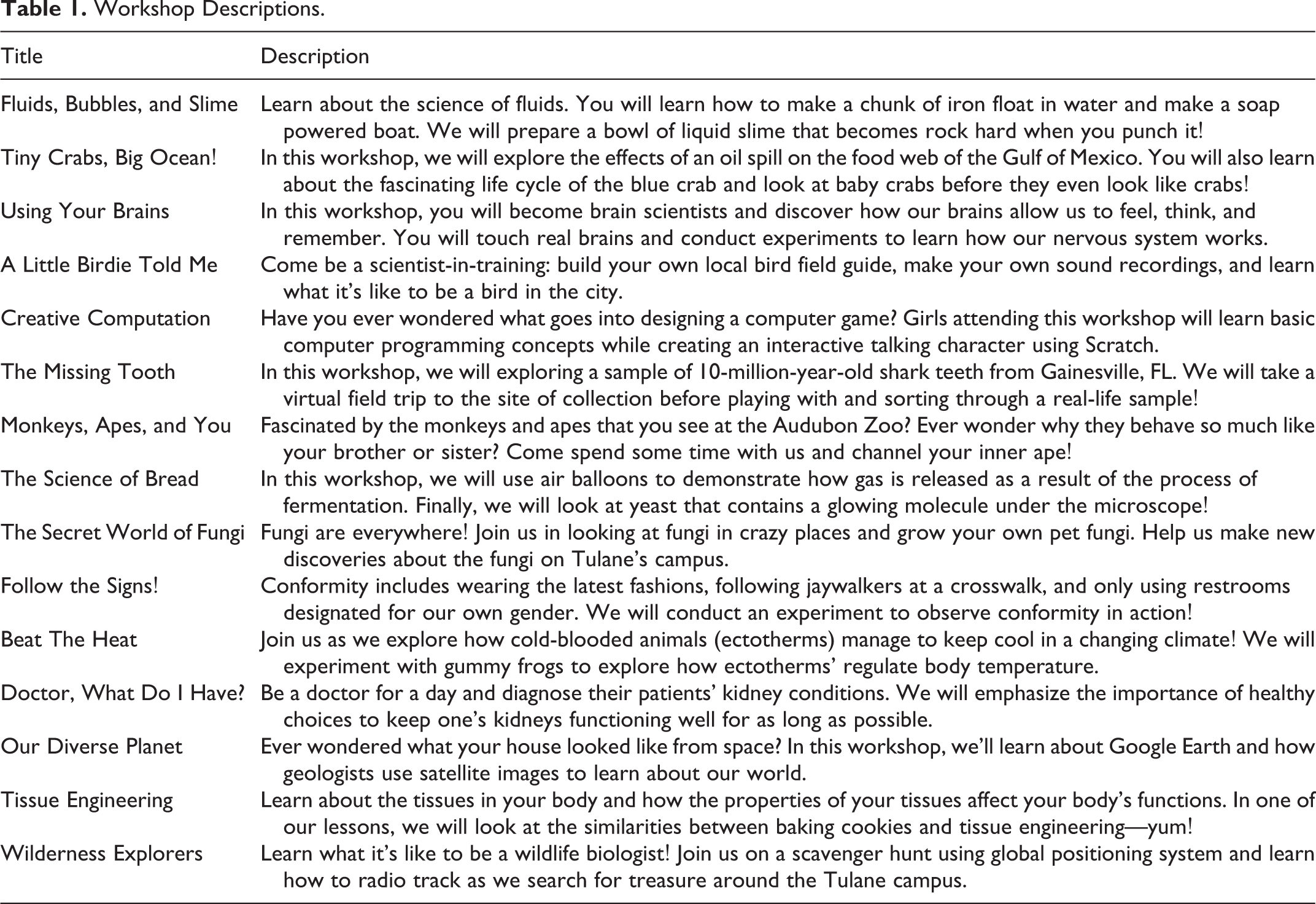
After attending three workshops, participants attended a plenary session where an experimenter introduced the second part of the study. Research assistants distributed packets to participants containing the manipulation and study measures. Participants were randomly assigned to one of the two conditions. In the role model choice condition, participants were instructed to “Take a moment to think about your favorite workshop leader. Please tell us why she is your favorite leader. Please write a few sentences about why you picked her.” In the control condition, participants were instructed to “Take a moment to think about your favorite friend. Please tell us why she or he is your favorite friend. Please write a few sentences about why you picked her or him.” Once participants completed the manipulation, they completed measures of sense of fit in science and role model identification. 1 Once all participants completed the packet, they received a thorough debriefing that explained the goals of the study.
Measures
Sense of fit in science
Participants’ sense of fit in science was assessed with a composite measure consisting of two scales: science identification and sense of social fit in science (see Gilbert et al., 2015; Walton & Cohen, 2007). Science identification was assessed with 8 items adapted from the Brown and Josephs’s (1999) math identification questionnaire (e.g., “How important is it to you to do well in science?” and “I’m bad when it comes to science”). Sense of social fit in science was measured with 12 items adapted from Walton and Cohen’s (2007) sense of social fit in computer science measure (e.g., “I feel like I belong in science classes” and “I feel left out in science class”). Participants responded to all items on a Likert-type scale ranging from 1 to 7 where higher numbers indicated stronger endorsement. Science identification and sense of social fit in science were highly correlated at both pretest, r = .64, p < .001, and posttest, r = .66, p < .001, and were aggregated into a composite sense of fit in science variable consistent with past research (Gilbert et al., 2015; Walton & Cohen, 2007). The composite measure was reliable at both pretest (α = .88) and posttest (α = .91). Pretest sense of fit in science was highly correlated with posttest sense of fit in science, r = .83, p < .001.
Role model identification
During the posttest, participants completed a 4-item measure of role model identification (this measure was not completed at the pretest because participants had not yet met the role models). Before completing the measure of role model identification, all participants were asked to select their favorite workshop leader. Sample items include “How much are you similar to the workshop leader you chose?” and “How much do you look up to the workshop leader you chose?” Participants responded to all items on a Likert-type scale ranging from 1 to 7 (α = .82).
Role model expertise
We operationalized role model expertise as whether or not role models had a PhD. We were unable to determine the identity of the selected role models for 13 participants due to the nature of their descriptions (e.g., The reason she is my favorite workshop leader is because we have the same interests. Even though my goal is to become a physician, biology seems fun too!…I loved the way she talked so passionately about what she enjoys doing most). These individuals were omitted from analyses involving role model expertise.
Coding
We coded participants’ responses to the writing prompt with several categories theoretically derived from the role model literature. For example, similarity to a role model and role model competence can be critical for eliciting positive outcomes (e.g., Cheryan et al., 2011; Marx & Ko, 2012), and therefore, we coded for whether girls spontaneously mentioned similarity and competence. Moreover, girls typically view role models positively (Betz & Sekaquaptewa, 2012), and therefore, we also coded for whether participants expressed warmth and admiration in their description of the target. Because feeling supported and encouraged can be an important aspect of a role model relationship (Stanton-Salazar & Spina, 2003), we also coded for whether participants mentioned feeling supported.
In addition, we coded for general references to personality to examine whether girls in the role model condition were describing a person or an activity. We also coded for whether participants mentioned a science activity to rule out the possibility that girls in the control condition were writing about a friend who was a science role model. Finally, we also included two additional categories based on themes that emerged in the data. Many girls spontaneously mentioned that they enjoyed the activities and learned something new, so we added these two categories. See Table 2 for examples of each category.
Examples of Coding Categories.
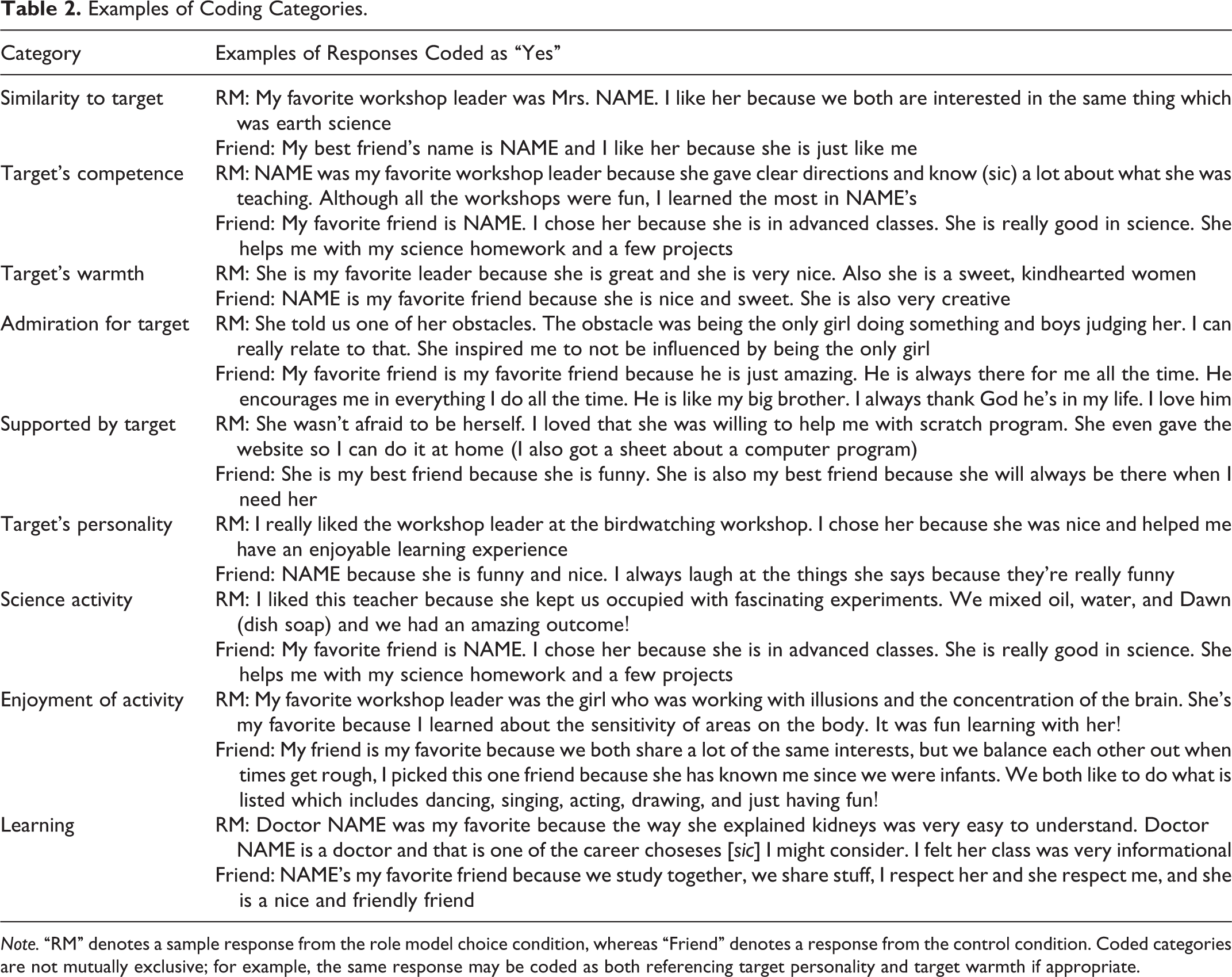
Note. “RM” denotes a sample response from the role model choice condition, whereas “Friend” denotes a response from the control condition. Coded categories are not mutually exclusive; for example, the same response may be coded as both referencing target personality and target warmth if appropriate.
One research assistant coded all written responses, and a second research assistant coded 27% of the responses. Interrater reliability ranged from κ = .70 to .97. We report the results for the primary coder.
Results
Sense of Fit
In order to examine the effect of the manipulation on changes in participants’ sense of fit, we estimated a linear mixed model to account for within-participant repeated measures. Time (0 = pretest, 1 = posttest), the manipulation (−1 = control condition, 1 = role model condition), and the time by manipulation interaction were designated as fixed effects. This analysis yielded a significant main effect of time, B = .13 (SE = .03), t(173) = 3.73, p < .001, 95% confidence interval [CI] = [.06, .19], d = .16. 2 The main effect of the manipulation was not significant, B = .01 (SE = .06), t(173) = .18, p = .85, 95% CI [−.10, .12], d = .03; however, there was a significant time by manipulation interaction, B = .07 (SE = .03), t(173) = 2.18, p = .03, 95% CI [.01, .14], d = .33 (see Table 3).
Means and Standard Deviations for Study Variables.
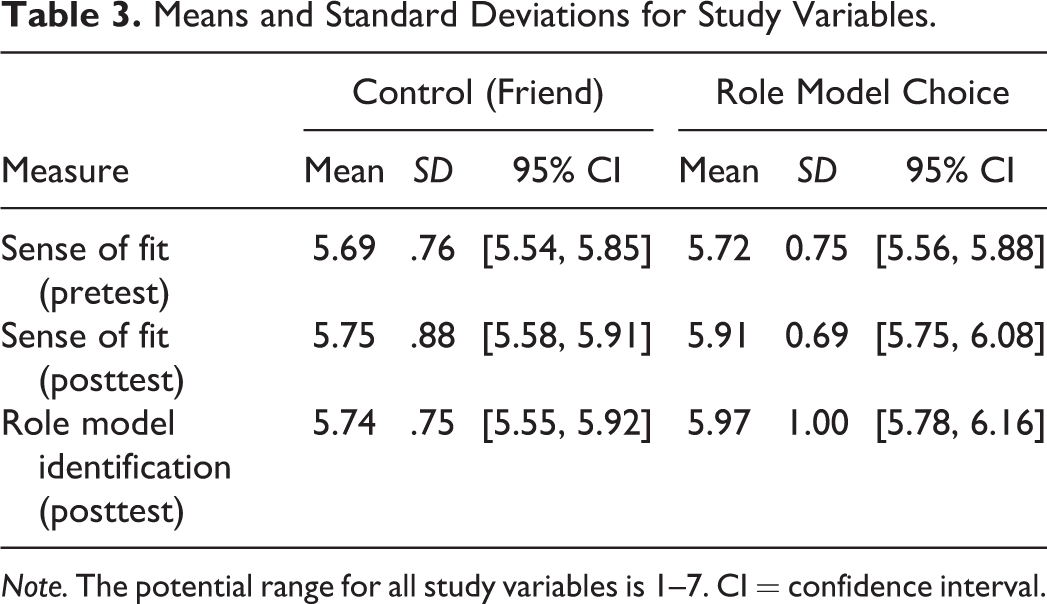
Note. The potential range for all study variables is 1–7. CI = confidence interval.
We conducted simple effects tests to decompose the significant interaction. For participants in the role model choice condition, sense of fit increased significantly from the pretest to the posttest, B = .20 (SE = .05), t(173) = 4.14, p < .001, 95% CI [.10, .29], d = .20. However, for participants in the control condition, sense of fit did not change from the pretest to the posttest, B = .05 (SE = .05), t(173) = 1.100, p = .27, 95% CI [−.04, .15], d = .04.
Role Model Identification
Participants in the role model choice condition tended to have higher levels of role model identification than participants in the control condition; however, this difference was only marginally significant, t(171) = 1.76, p = .08, 95% CI [−.03, .50], d = .27. Role model identification was correlated with both the pretest measure of sense of fit, r = .29, p < .001, and the posttest measure of sense of fit, r = .34, p < .001.
Role Model Expertise
Thirty percent of workshops were led by role models with PhDs, and 25% of girls selected a role model with a PhD as their favorite, χ 2 < 1. This finding suggests that role model expertise did not influence girls’ choice of role models. The expertise of the selected role model was unrelated to girls’ role model identity, r = −.09, p = .44, and sense of fit in science, r = .04, p = .76.
Open-Ended Responses
We compared the role model choice and control conditions for each of the coded categories (see Table 4). Despite the fact that similarity to a role model has been identified as an important attribute of effective role models in the adult literature, very few girls spontaneously mentioned their similarity to the role model. In comparison, a relatively larger percentage of girls in the control condition mentioned similarity to their friend. A substantial minority of girls wrote about the role model’s competence, whereas comparatively few girls wrote about their friend’s competence. A sizeable minority of girls also mentioned feeling supported by the role model and described the role model’s warmth; however, perhaps not surprisingly, an even larger percentage of girls mentioned feeling supported by their friend and described their friend’s warmth. Almost half of the girls in the role model condition mentioned the role model’s personality and even more girls in the control condition mentioned their friend’s personality. Relatively few girls directly expressed admiration for either the role model or their friend. Whereas the vast majority of girls in the role model condition described a science activity, almost no one who wrote about a friend focused on a science activity. Finally, girls in the role model condition focused on enjoyment of an activity and learning at much higher rates than girls in the control condition.
Open-Ended Responses in the Role Model Choice and Control (Friend) Conditions.
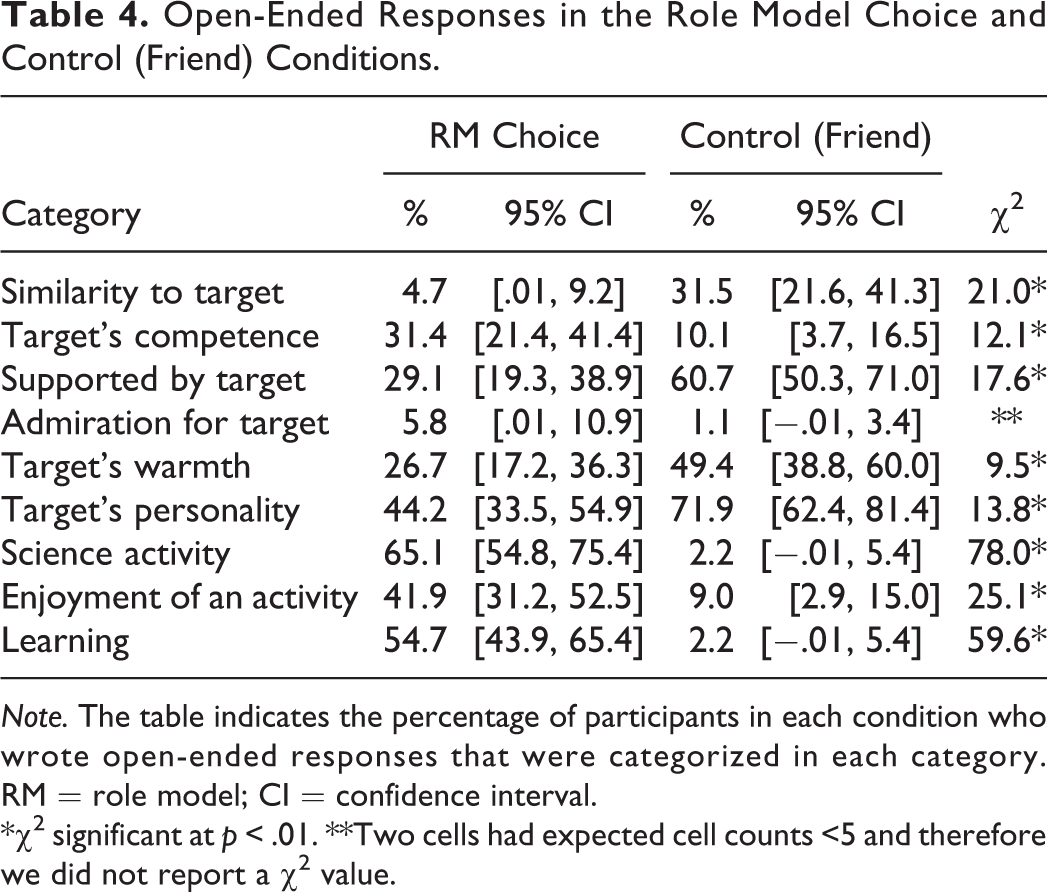
Note. The table indicates the percentage of participants in each condition who wrote open-ended responses that were categorized in each category. RM = role model; CI = confidence interval.
Discussion
The opportunity to choose and write about a favorite role model improved girls’ science outcomes in an outreach program where they were exposed to multiple female role models. Girls who attended a science outreach event where they participated in consecutive workshops led by female scientists showed a significant increase in sense of fit in science when they were encouraged to choose and briefly write about a favorite workshop leader. In comparison, girls who participated in the outreach event, but who were not encouraged to choose and write about a favorite workshop leader, did not experience an increase in sense of fit.
The present study builds upon a growing body of research on the efficacy of exposure to role models for improving girls’ STEM outcomes (e.g., Betz & Sekaquaptewa, 2012; Liben & Coyle, 2014; Plant et al., 2009; Weisgram & Bigler, 2007). In the present research, girls were exposed to multiple female role models, offering them a chance to observe the diversity that exists among female scientists. In this context, choosing and writing about a favorite role model may have a positive impact above and beyond any effects associated with being exposed to multiple female role models. It is worth noting that girls in the present study were asked to choose their favorite “workshop leader” and were not specifically asked to choose a “role model.” This suggests that it may not be essential to apply the role model label to an individual in order to experience benefits.
The manipulation may have prompted girls to further explore their favorability toward their chosen role model. Exploration is an important developmental stage in identification that often occurs around this age (Phinney & Ong, 2007). Girls who chose and wrote about a favorite role model tended to have higher levels of role model identification; however, this effect did not quite achieve statistical significance. In general, role model identification was quite high, raising the possibility of ceiling effects on this measure. The relatively high scores on role model identification may have been due to the fact that all girls spent the day in a conference focused on women in science. Role model identification was positively related to sense of fit in science, consistent with our argument that role models play an important role in making girls feel like they belong in science.
In order to identify the characteristics of role models that are salient to middle school girls, we coded participants’ open-ended written responses. Compared to the control condition, girls who wrote about a role model were significantly more likely to focus on the role model’s competence. This finding complements the existing literature on the importance of role model competence for eliciting positive STEM outcomes (Marx & Roman, 2002). A substantial minority of girls in the role model condition also spontaneously mentioned feeling supported by the role model and commented on the role model’s warmth. The percentage of girls who wrote about their best friend’s support and warmth was even greater; however, this finding may reflect the importance of peer relations during adolescence.
Surprisingly, very few girls in the role model condition spontaneously wrote about their similarity to the role model. Past research suggests similarity to role models is important; however, this research examined college women (e.g., Cheryan et al., 2011; Marx & Ko, 2012). Interestingly, Betz and Sekaquaptewa (2012) found that middle school girls’ ratings of similarity to adult role models were rather modest despite overall positivity toward role models. Middle school girls may have difficulty seeing similarities between themselves and adult female role models. Future research should address whether the characteristics of effective role models are different for college women compared to younger girls. In the present study, many girls spontaneously wrote about how much they learned from the role model and how much they enjoyed the activities that the role model planned. Thus, role models who engender enthusiasm for learning and science may be especially important for middle school girls.
Strengths, Limitations, and Future Directions
One strength of the present study is that it demonstrated the impact of the role model choice manipulation in a field setting. The experiment occurred in the context of a meaningful, real-world event that sought to have a positive impact on the girls who participated. The present study provides evidence that the manipulation is robust enough to have an impact outside of a more constrained laboratory environment. Although we view the field nature of the present research as a strength, it is not without limitations. Because the goals of GiST are to provide an enrichment experience for as many girls as possible, it was not feasible to include an additional control condition in which a group of girls were randomly assigned to abstain from the event. Thus, the present study is not able to compare girls who participated in the outreach event with girls who did not participate to determine the impact of participation on sense of fit.
Another limitation of the field setting is that, because participants were aware that they were participating in a science outreach event designed for girls, they may have felt social desirability pressures when completing the study measures. We took precautions to reduce social desirability pressures by having research assistants who were not part of the outreach event itself and who were not wearing event T-shirts administer the study. In the future, researchers may be able to further reduce social desirability concerns by administering the study outside the context of the event—however, such procedures may lower participation rates.
Girls who participate in a science outreach event may differ from a randomly selected sample of middle school girls. Although some of the girls came with larger groups from their schools, other girls more actively sought out participation. It is not clear whether the benefit of identifying a female scientist as a role model on sense of fit in science would generalize to other samples.
To our knowledge, the present study is the first to examine sense of fit in science among middle school girls. To measure sense of fit in science among middle school girls, we adapted items used in previous research with college students (e.g., Gilbert et al., 2015; Walton & Cohen, 2007). For example, items that asked college students about the extent to which they felt like they belong in the computer science department were modified to ask girls about the extent to which they belong in science classes (Walton & Cohen, 2007). Although it may be surprising that choosing a female role model at a science outreach event would increase the extent to which girls feel they belong in their science classes, one interpretation is that the manipulation creates a general sense of “fitting in” that extends beyond the context of the outreach event. Research on the long-term effects of both participating in science outreach events featuring female role models and choosing favorite role models is needed to examine whether these effects truly carry over into other science contexts.
The present study was unable to rigorously examine whether the individual characteristics of the role model that the girls chose affected the results. With 86 girls in the role model choice condition and 15 different possible role models, we lacked statistical power to thoroughly examine individual role model characteristics. However, we were able to conduct exploratory analyses of the effects of role model expertise. There was no evidence that girls were more or less likely to choose role models with or without PhD. Furthermore, the expertise of girls’ chosen role model was unrelated to their role model identification and sense of fit in science. A thorough examination of the individual characteristics of effective role models is an important area for future research.
Conclusion
Middle school is an ideal time to intervene to increase girls’ interest in STEM fields, as this is a time when they may develop more negative attitudes toward math and science (e.g., Barmby et al., 2008). Many organizations have started outreach programs targeted at middle school girls to spark their interest in science and pursuing careers in STEM (e.g., Demetry et al., 2009; Laursen, Liston, Thiry, & Graf, 2007; Yanowitz & Vanderpool, 2004). These outreach programs offer girls exposure to multiple female role models and provide tangible evidence of the diversity among women in science. The present research suggests that encouraging girls to choose and write about a favorite role model, thus prompting them to examine and explore the reasons they favor a role model, may help to increase girls’ sense of fit in science.
Footnotes
Acknowledgments
The authors would like to thank the numerous individuals who contribute to the Girls in STEM at Tulane (GiST) outreach event. The authors would also like to thank several excellent undergraduate research assistants for their contributions to data collection.
Declaration of Conflicting Interests
The author(s) declared no potential conflicts of interest with respect to the research, authorship, and/or publication of this article.
Funding
The author(s) disclosed receipt of the following financial support for the research, authorship, and/or publication of this article: This research was partially supported by a grant from the National Science Foundation: HRD0936722.