



Abstract
Disgust motivates pathogen avoidance, but it is unclear why it is also reported toward moral violations. Previous explanations have focused on identifying the type of violation specific to disgust. Here, we propose that people express disgust toward any type of moral violation in order to communicate particular motives. Unlike anger, which can be seen as self-interested, disgust communicates a more principled, moral motivation. Two experiments show that observers infer more moral motivation from an expression of disgust and more self-interested motivation from anger. Two further experiments testing participants’ own expression decisions demonstrate that disgust is chosen more to show moral concern and anger is chosen to protest harm to one’s self-interest. By shifting focus to the interpersonal effects of emotion expressions, these findings offer a new perspective for understanding the role of disgust in morality.
Research into disgust has investigated the elicitors that distinguish it from its fellow other-condemning emotions such as anger. In line with disgust’s role in pathogen avoidance (Curtis, Aunger, & Rabie, 2004; Oaten, Stevenson, & Case, 2009), it has been argued that disgust arises when a moral violation includes contamination or transgressions of bodily norms, referred to as “purity” violations (Horberg, Oveis, Keltner, & Cohen, 2009; Pizarro, Inbar, & Helion, 2011; Rozin, Lowery, Imada, & Haidt, 1999; Russell & Giner-Sorolla, 2013). However, others maintain that disgust has a wider role in condemnation of acts not involving impurity, such as cheating or stealing (Cannon, Schnall, & White, 2010; Chapman, Kim, Susskind, & Anderson, 2009; Danovitch & Bloom, 2009; Tybur, Lieberman, & Griskevicius, 2009). For example, Cannon, Schnall, and White (2010) showed facial electromyographic activation specific to disgust but not anger when participants read about unfairness. These kinds of findings have been explained by extension from pathogen defense; that is, social rule violators are seen as “contaminants” (Chapman & Anderson, 2013; Graham, Haidt, & Nosek, 2009; Inbar & Pizarro, 2014; Zhong & House, 2014).
Here, we propose that emotions do not only regulate individual behavior but also have a communication function in signaling social motivations to others. This derives from the behavioral ecology view of emotion expressions as signals of intent toward other individuals (Fridlund, 1994; Hinde, 1985) as well as perspectives on the communicative and interpersonal functions of emotions (Fischer & Manstead, 2008; Giner-Sorolla, 2012; Hareli & Hess, 2012; Parkinson, 2005; van Kleef, 2009). Specifically, we suggest that anger and disgust are distinguished by what they communicate: Observers infer more self-interested motivation from anger but more moral motivation from disgust. Thus, people express anger or disgust depending on whether they seek to communicate condemnation motivated by moral concern or by self concern. From this perspective, disgust is not just an expression of an inner reaction to impurity but a signal that advertises a moral position.
A complementary perspective on moral disgust was presented by Tybur, Lieberman, Kurzban, and DeScioli (2013). They suggested that disgust functions as a signal to recruit observers to help condemn and punish the violator of a rule that the expresser favors. Here we do not test whether disgust effectively inspires collaborative behavior but, based on the assumption that people can be motivated to communicate their moral position whether or not they expect to influence observers’ behavior, we test a compatible hypothesis: That the decision to express disgust versus anger depends on the motives the expresser seeks to communicate.
Anger Protects Direct Self-Interest
Anger arises when a person perceives their interests to be harmed (Frijda, 1994; Keltner & Haidt, 1999; Kuppens, Van Mechelen, Smits, & De Boeck, 2003). An expression of anger communicates the intention to approach and aggress and that the recipient of anger should make concessions (van Kleef, De Dreu, & Manstead, 2004), discouraging future transgressions toward the expresser (Sell, Tooby, & Cosmides, 2009).
However, a person who expressed anger too readily could suffer social and reputational damage. Anger can lead another person to exclude or distrust the expresser (Dunn & Schweitzer, 2005; Van Beest, van Kleef, & Van Dijk, 2008). Due to these potential costs, anger should only be deployed when violations that have clear, countervailing costs to the individual. Purely moral concerns that transcend an individual’s self-interest would fail this cost–benefit logic of anger.
Accordingly, although anger can be aroused by moral concerns like injustice, it is more consistently aroused by selfish concerns like goal blockage (Hutcherson & Gross, 2011; Kuppens, Van Mechelen, Smits & De Boeck, 2003). Thus, observers are likely to infer that anger is motivated by self-interest, especially in socially ambiguous situations; hence a different emotional expression might be more useful to signal unselfish moral concern.
Does Disgust Communicate Disinterested Condemnation?
Unlike anger, disgust does not prepare aggressive action (Roseman, Wiest, & Swartz, 1994), so it may be appraised as less self-serving. Furthermore, because things are usually disgusting by general consensus, at least within a cultural group (e.g., foods, sexual acts), an observer of a disgust expression would appraise, not so much that a selfish goal has been blocked, but that a consensually offensive stimulus has been encountered. These features underlie our prediction that, in contrast to anger, people will infer disgust expressions to be motivated more by moral concern than by self-interest. And if expressers have implicit knowledge that observers make motive inferences from expressions, they should strategically express anger and disgust to communicate these motives.
Present Research
Experiments 1 and 2 presented a scenario in which a target expressed anger or disgust toward a wrongdoing and participants’ inferences about the target’s moral versus self-interested motivation were measured.
Experiment 3 gave participants a scenario in which their aim was to communicate either self-interest or moral concern and measured which emotion they chose to express. For a more stringent test, Experiment 4 used a concrete scenario involving harm to the self, to see whether the aim of communicating moral motivation would increase disgust expression under conditions that would normally predict anger (Hutcherson & Gross, 2011). We report all measures, all manipulations, data exclusions, and a priori sample size rationale. Experiments 2, 3, and 4 were preregistered, 1 including all hypotheses described.
Experiment 1
Method
Participants
Based on an effect size (d = .91) in similar research on emotion communication (Hareli & Hess, 2010), a power analysis using GPower 3.1.9.2. recommended a sample size of 66 at 95% power. This was increased by 25% to allow for incomplete responses and exclusions based on an attention check question. Amazon Mechanical Turk was used to recruit 84 (34 females) participants from the United States (M age = 36.18, SD = 11.11). Allocation to anger and disgust conditions was unevenly balanced, resulting in 34 participants in the anger condition and 50 in the disgust condition.
Materials and Procedure
Scenario
The participant imagined seeing a colleague expressing either disgust or anger in response to a violation. Minimal information about the violation was given, to ensure that participants made inferences based on the emotion expressed and not on other clues about the situation. Ambiguous social situations have been used in previous research to investigate inferences based only on expressed emotion, while excluding situational clues (van Doorn, van Kleef, & van der Pligt, 2015). The scenario consisted of the following text (word changes for the disgust condition in brackets): You are at work in a job that you have only just started and you are sitting in the breakroom during your break. Two of your colleagues come into the room and sit at the table at the other end of the room. After a few minutes you overhear one of your colleagues talking and, although you do not know her well, you recognize the voice as belonging to your colleague Mary. You can’t hear all of the conversation from where you are but from what you hear, you can tell that they are talking about someone else who has done something wrong. You can tell from Mary’s voice that she sounds angry (disgusted). A minute later, you overhear the words “I am angry (disgusted).” You decide to glance up at her and when you see her face, you can tell from her expression of anger (disgust) that her feelings are strong.
Participants were then asked to complete several dependent measures.
Perceived motives
Participants were asked “Based on what you saw and heard, why do you think Mary feels this way about whatever has happened? How likely are the following to be true?” Nine items were rated on a scale from 0 = not at all likely to 6 = very likely, assessing how selfish, other-concerned, and moral the target’s motives were perceived to be. The selfish items were: “she is mainly concerned about herself,” “she is concerned about how something has affected herself,” and “she feels that she has been wronged” (α = .83). The other-concern items were: “she is concerned about something bad happening to someone else,” “she is worried someone else’s feelings might be hurt,” and “she feels this way on behalf of someone else” (α = .85). The moral concern items were: “she mainly feels this way out of principle,” “she feels that something immoral has happened,” and “she feels this way because it is always wrong to cheat.” However, these items had inadequate reliability (α = .25). Since the second item was the only one that was unambiguously about the target’s moral concern, the other 2 items were dropped.
Results
Four participants were excluded based on the attention check question. Where data violated sphericity, adjusted values are reported.
Perceived Motives
A repeated measures analysis of variance (ANOVA) with emotion as a between-subjects factor and perceived motive as a within-subjects factor revealed a main effect of motive, F(1.33, 103.80) = 17.21, p < .001,

Motives inferred by participants when the target expressed anger versus disgust (Experiment 1). Error bars represent 95% confidence intervals.
Experiment 2
Experiment 2 aimed to replicate findings from Experiment 1, including additional items for the measurement of moral concern, and also varying the gender of the target. We also investigated whether inferences about the target’s motives were extended to judgments about their character, given findings that expressed emotions are sometimes seen as diagnostic of personality characteristics (e.g., Hareli & Hess, 2010). Since we did not find that inferred motives extended to character inferences, this information is included in the Supplemental Appendix, available online.
Method
Participants
Amazon MTurk was used to recruit 200 (72 females) participants (M age = 32.49, SD = 11.01). Expecting similar effect sizes to Experiment 1 (∼d = .70), a power analysis (with desired power at .90) recommended a sample size of 176. We aimed to collect 200 participants to allow for exclusions based on an attention check question.
Materials and Procedure
Scenario
The scenario was the same as in Experiment 1, except that the gender of the target was varied. The names Robert and Mary were used because in research by Cotton, O’Neill, and Griffin (2008), they were rated equally American, Caucasian, and likable. Participants then completed the following dependent measures:
Perceived motives
Participants were asked “Based on what you saw and heard, why do you think Mary (Robert) feels this way about whatever has happened? How likely are the following to be true?” and rated items from 0 = not at all likely to 6 = very likely. Items measuring self-concern (α = .74) and other concern (α = .78) were the same as in Experiment 1. Items assessing moral motivation were divided into 3 moral concern items and 3 principled items. The moral concern items were: “she (he) thinks someone has behaved unethically,” “she (he) feels this way because someone’s behavior violated a moral principle,” and “she (he) feels this way because she (he) thinks important moral rules have been broken” (α = .79). The principled items were: “she (he) would feel this way about what happened no matter who was involved,” “she (he) thinks that people shouldn’t ever behave like that,” and “she (he) would feel this way about what happened whoever the victim was.” The reliability of the principled items was unacceptable (α = .56), so the second item was dropped and the remaining 2 items correlated well (r = .59).
Results
Sixteen participants were excluded for failing the attention check question.
Perceived Motives
An ANOVA with emotion expressed and gender of target as between-subjects factors and perceived motives as a within-subjects factor revealed a main effect of motive, F(2.55, 458.67) = 120.64, p < .001,
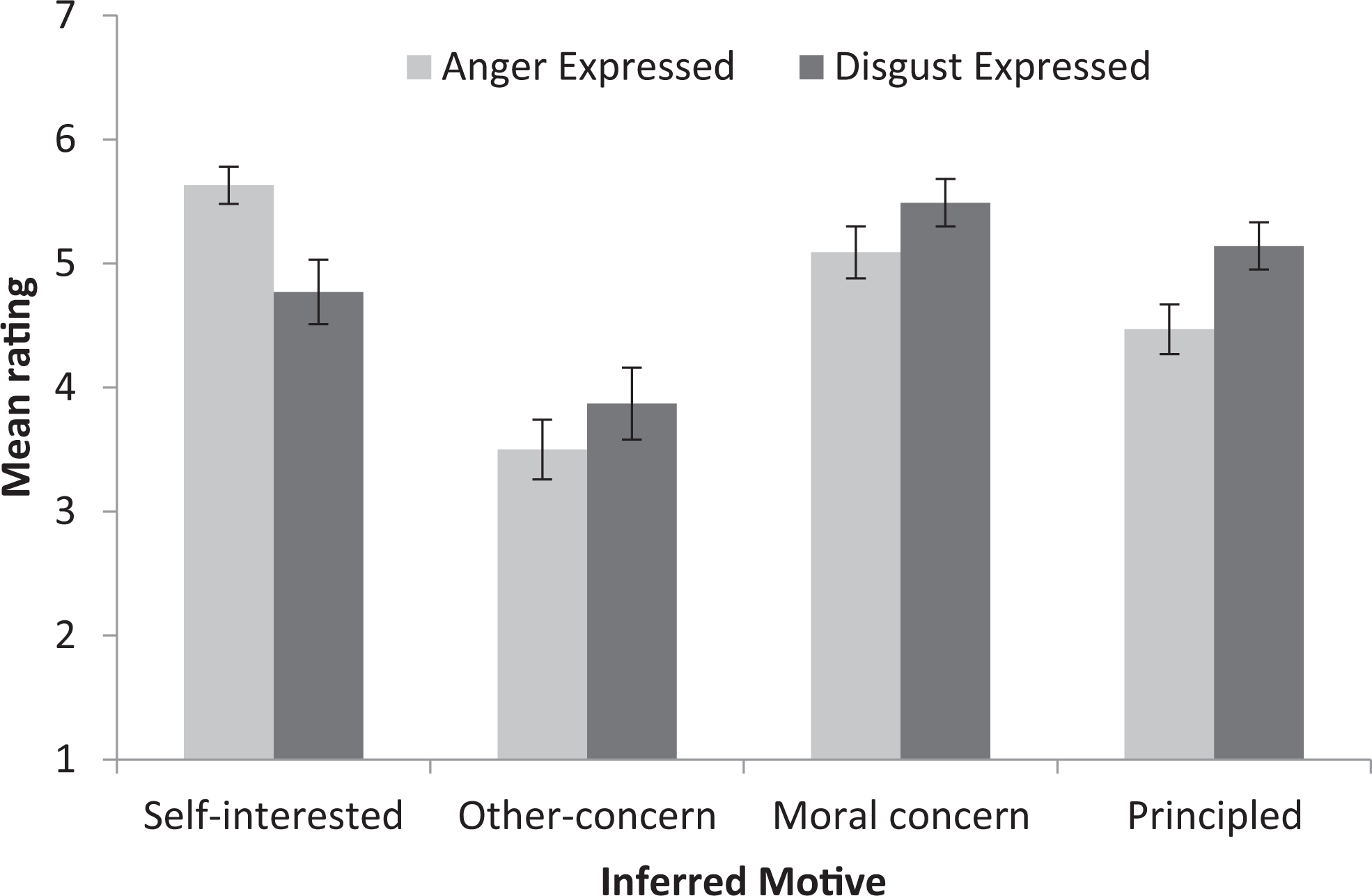
Motives inferred by participants when the target expressed anger versus disgust (Experiment 2). Error bars represent 95% confidence intervals.
Experiment 3
Experiment 3 investigated whether people strategically deploy anger and disgust depending on the motives they aim to communicate. We predicted that participants would choose to express more disgust than anger to show moral concern, but more anger than disgust to show self-concern. We also varied whether the emotion was expressed toward a second party (the moral violator) or toward a third party. This explored the possibility that, in communicating with a second party, the value of anger in moral communication might increase, because of the possibility of changing behavior directly.
Method
Participants
Amazon MTurk was used to recruit 204 participants (82 females; M age = 35.75, SD = 12.36). Although Experiment 3 investigated participants’ own expression choices rather than inferences about others’ expressions, similar effect sizes were expected (∼d = .70). A power analysis with desired power at .90 recommended a sample size of 176. We aimed to collect 220 participants to allow for incomplete responses and exclusions based on an attention check question.
Materials and Procedure
Scenario
Minimal information about the violation was given to ensure that participants chose an expression based on their communicative aim and not on other situational information. The scenario consisted of the following text (word changes for the harm-to-self condition in brackets): You are at work and you are sitting in the break room during your lunch break talking to your colleague, Mary. You are talking about another colleague you know called Robert, who has done something bad which you feel strongly about because it was immoral (harmed you). You are trying to get Mary to understand that you feel strongly about what Robert did because he broke an important moral principle (it harmed you personally).
In the second party condition, participants imagined talking directly with the person who committed the violation: You are at work in the break room during your lunch break and you are talking to your colleague, Robert. Robert has done something bad which you feel strongly about because it was immoral (harmed you personally). You want to make sure that Robert understands that you feel strongly about what he did because he broke an important moral principle (it harmed you personally).
Participants then completed several dependent measures:
Emotion label
Participants were asked: “Which emotion would you be most likely to express?” and chose from “angry,” “disgusted,” “afraid,” and “joyful.”
Emotion facial expression
Participants were asked “Which of the facial expressions shown below would you be most likely to show?” and chose from anger, fear, disgust, and joy facial expressions. Images were obtained from the Radboud faces database (Langner et al., 2010). The expressions were portrait views from the first model in the database, a Caucasian adult female.
Emotion label scale
Participants were asked “How much of each emotion do you think you would express in this situation?” and rated the four emotion labels from 0 = none to 6 = a lot.
Results
Sixteen participants were excluded due to incomplete responses and seven because they failed the attention check question. Analyses were conducted only for the emotions of interest, anger, and disgust.
Emotion Label
There was a significant association between communicative aim and emotion expression chosen, χ2(1, N = 190) = 43.44, p < .001, Cramér’s V = .48. As shown in Figure 3, when participants’ aim was to show moral concern, they chose to express disgust more frequently than anger, χ2(1, N = 96) = 21.58, p < .001, Cohen’s w = .47, but when participants’ aim was to show concern about harm to themselves, anger was chosen more frequently, χ2(1, N = 94) = 22.03, p < .001, Cohen’s w = .48. This pattern of results held across audience conditions: There was no significant difference between how often anger and disgust were chosen when communicating with a third party or a second party, χ2(1, N = 190) = 2.87, p = .09, Cramér’s V = .12.
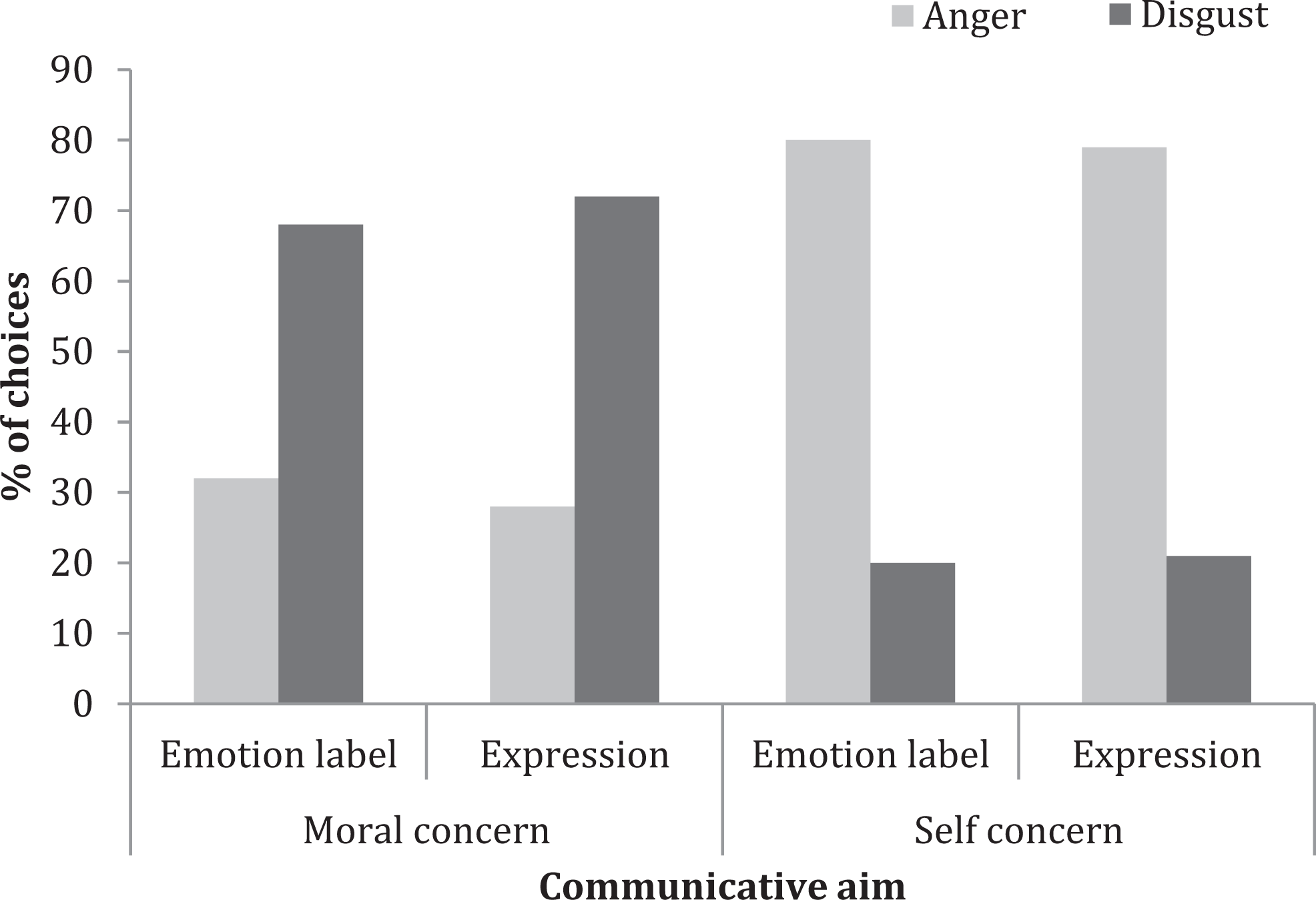
Categorical anger/disgust expression choices by communicative goal (Experiment 3).
Emotion Facial Expression
There was a significant association between communicative aim and choice of facial expression, χ2(1, N = 186) = 47.99, p < .001, Cramér’s V = .51. When participants’ aim was to show moral concern, they chose disgust more frequently than anger, χ2(1, N = 95) = 23.55, p < .001, Cohen’s w = .50, but when their aim was to show concern about harm to themselves, they chose anger more frequently, χ2(1, N = 91) = 24.58, p < .001, Cohen’s w = .52. There was no significant difference between how often anger and disgust facial expressions were chosen in the second and third party conditions, χ2(1, N = 186) = 1.50, p = .22, Cramér’s V = .09.
Emotion Scale
An ANOVA with communication aim and audience as between-subjects factors and emotion as a within-subjects variable revealed no main effects of emotion, F(1, 186) = 1.07, p = .30,
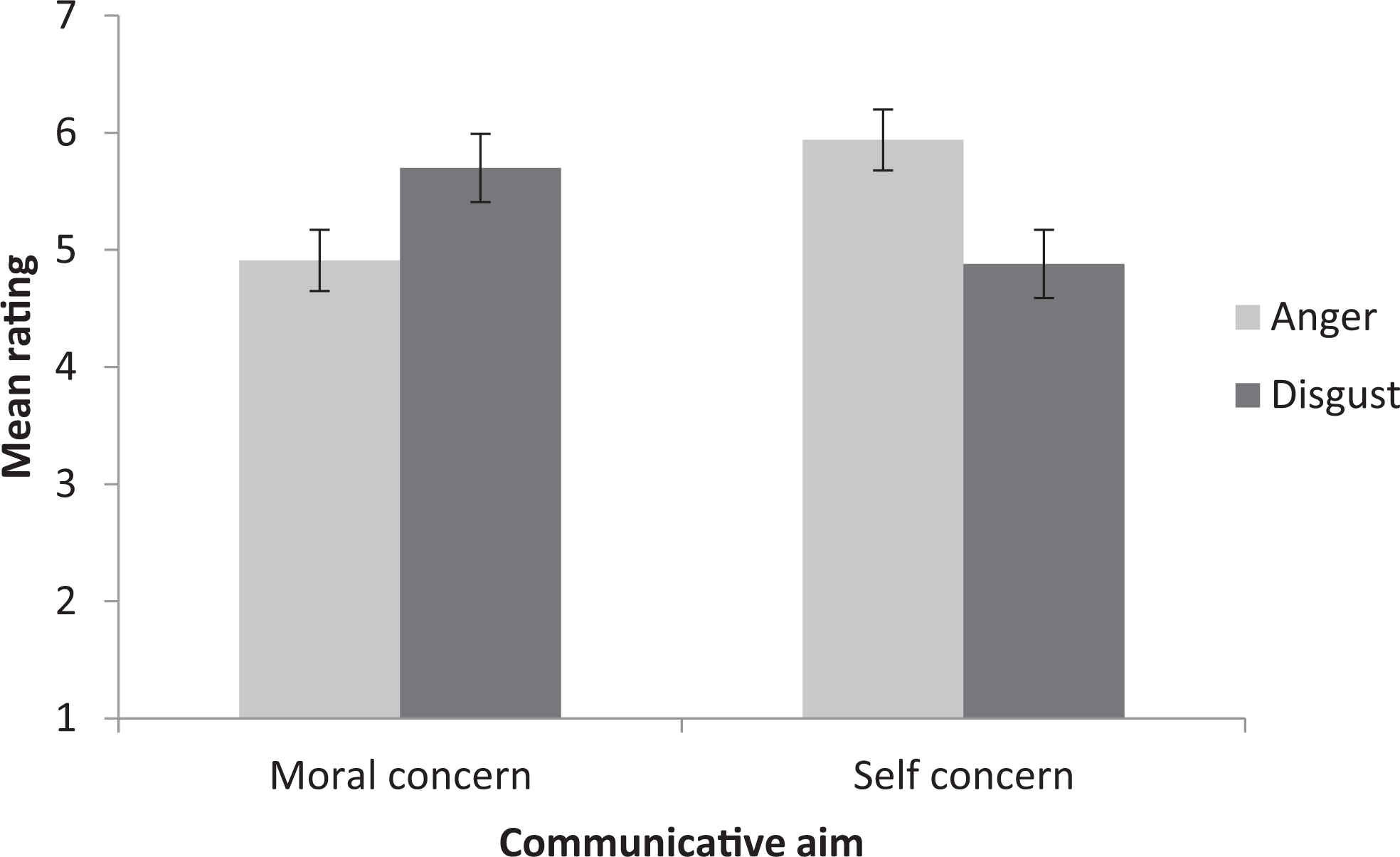
Scaled anger/disgust expression choices by communicative goal (Experiment 3). Error bars represent 95% confidence intervals.
Experiment 4
Hutcherson and Gross (2011, Study 2) found that feelings of disgust are higher when the victim of a transgression is a stranger, while feelings of anger are higher when the victim is the self and intermediate for a friend. Our scenario in Experiment 3 did not specify whether the victim was the self or a stranger but only varied participants’ communicative aim. As a more stringent test of whether the goal of communicating moral motives increases the likelihood of expressing disgust, Experiment 4 explicitly identified the self as the victim of a harm transgression, favoring feelings of anger. However, we predicted that despite feeling anger, the number of participants choosing to express disgust would increase if their communicative aim was to show morally motivated condemnation. When their communicative aim was to protest harm-to-self, they would express anger.
This design also enabled us to show whether our findings hold with a scenario that was explicitly described a harm violation. If so, this would provide one reason why disgust is sometimes reported even to harm violations, which more usually evoke anger (Chapman & Anderson, 2013): Respondents may feel the need to communicate moral motivation.
Method
Participants
Although Experiment 4 was similar in design to Experiment 3, we conservatively expected small to medium effect sizes (∼Cramér’s V = .20) due to differences in design. A power analysis with desired power at .90 recommended a sample size of 263. We aimed to collect 20% extra participants to allow for incomplete responses and exclusions based on an attention check question. From Amazon MTurk, 296 participants (156 females; M age = 37.48, SD = 11.51) completed the study.
Materials and Procedure
Scenario
The first part of the scenario was the same for the two communicative aim conditions and the felt emotion comparison condition: At your place of work you and your colleague, Robert, have recently completed a project that you have both been working on for the past few weeks. You were equal partners on the project. If anything, you feel that you worked a bit harder than Robert but you are pleased that the project was a success and you are happy to give him equal credit. However, you have just been told by another colleague that Robert presented the results of the project to the managers of the company. He made it sound as if he had done the majority of the work himself. Since he was given almost all of the credit for the work, he was awarded a significant amount of money as a bonus. If your colleague had not told you about this, you might not even have found out. When you saw Robert recently, he did not mention anything about it.
In the comparison condition, to show that anger was the predominant felt emotion, the scenario ended here and participants reported how they would feel. In the other conditions, the following text manipulated communicative aim (word changes for the harm-to-self condition in brackets): A short while after you find out about what had happened, you are in the break room during your lunch break with your colleague Mary. You still feel strongly about what happened and you are trying to make it clear to Mary that you feel this way about what Robert did because he broke an important moral principle (harmed you personally). Which emotion would you be most likely to express to show that you feel strongly about what Robert did because it was immoral (harmed you personally)?
Participants completed the following dependent measures:
Emotion label
Participants were asked: “Which emotion would you be most likely to express to show that you feel strongly about what Robert did because it was immoral (harmed you personally)?” Or in the felt emotion condition, “Which emotion would best describe how you would feel when you found out about what Robert did?” They chose from “angry,” “disgusted,” “afraid,” and “joyful.”
Emotion label scale
Participants were asked “How likely would you be to express each emotion in this situation?” or “How likely would you be to feel each emotion in this situation?”, and rated the four emotion labels from 0 = not at all to 6 = definitely.
Emotion facial expression
In the expressed emotion conditions, participants were asked “Which of the facial expressions shown below would you be most likely to show?” and choose from anger, fear, disgust, and joy expressions.
Results
Ten participants were excluded for failing the attention check question. Only the emotions of interest, anger, and disgust were analyzed.
Felt Emotion
As expected, participants chose the label angry more frequently than disgusted to describe how they would feel, χ2(1, N = 94) = 24.51, p < .001, Cohen’s w = .51. Using the scaled responses, participants also reported that they would feel anger more than disgust, t(94) = 4.59, p < .001, d = 0.95. Figures 5 and 6 display these results in comparison to the communicative aim conditions.
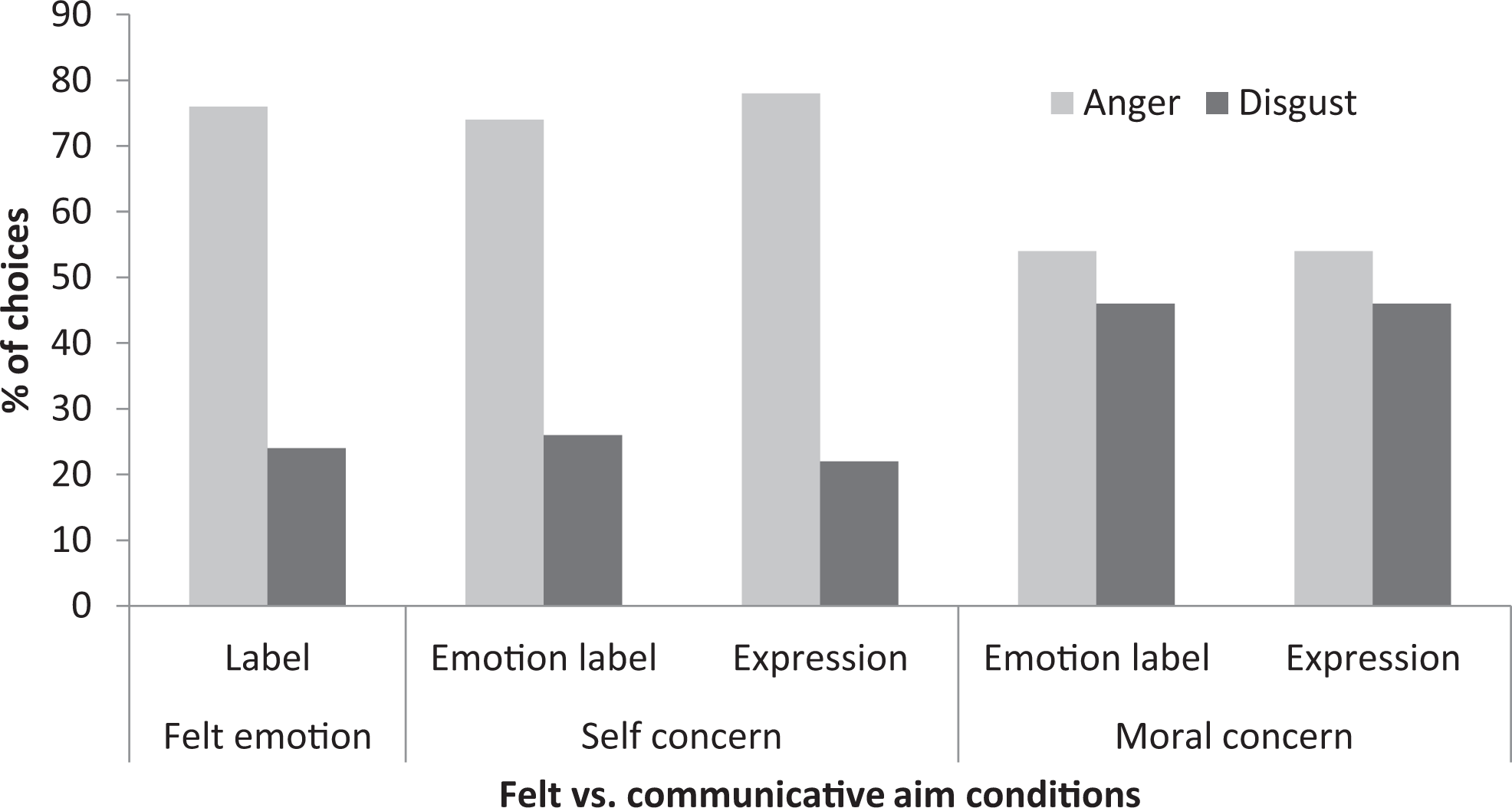
Categorical anger/disgust expression choices by communicative goal or felt emotion condition (Experiment 4).
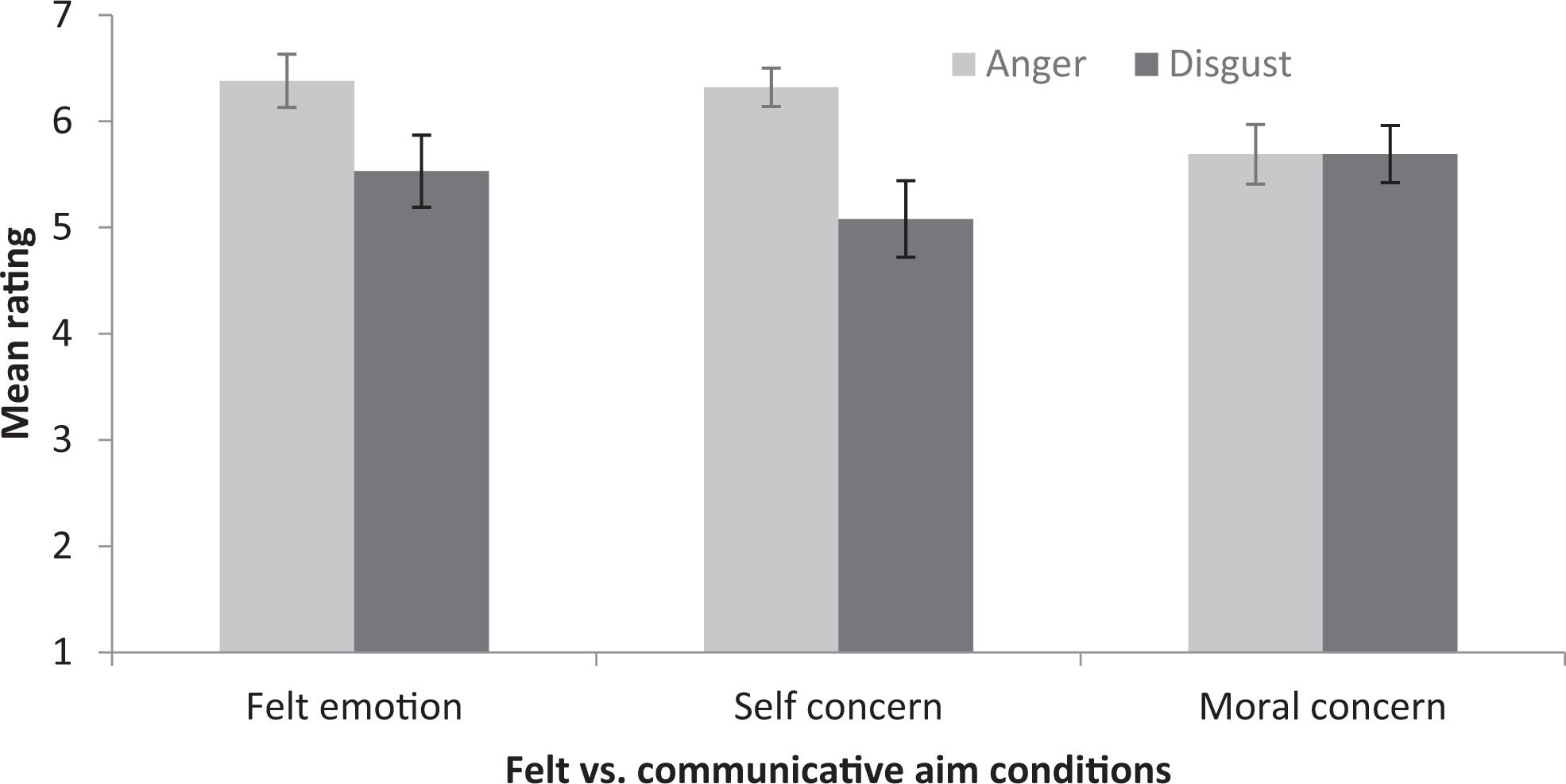
Scaled anger/disgust expression choices by communicative goal or felt emotion condition (Experiment 4). Error bars represent 95% confidence intervals.
Expressed Emotion Label
There was a significant association between communicative aim and emotion expression, χ2(1, N = 191) = 8.37, p = .004, Cramér’s V = .21. When participants were given the aim to communicate concern about harm-to-self, they chose angry more frequently than disgusted, χ2(1, N = 93) = 20.82, p < .001, Cohen’s w = .47. When they aimed to communicate moral concern, there was no significant difference in how often they chose disgusted and angry, χ2(1, N = 98) = 0.5, p = .48, Cohen’s w = .07.
Expressed Emotion Face
Similarly, there was a significant association between communicative aim and facial expression chosen, χ2(1, N = 188) = 12.15, p < .001, Cramér’s V = .25. When participants had the aim to communicate concern about harm-to-self, they chose anger more frequently than disgust, χ2(1, N = 92) = 28.28, p < .001, Cohen’s w = .55. When they aimed to communicate moral concern, there was no significant difference between anger and disgust, χ2(1, N = 96) = 0.52, p = .47, Cohen’s w = .07.
Expressed Emotion Scale
An ANOVA with communicative aim as a between-subjects factor and emotion as within-subjects factor revealed a main effect of emotion expressed, F(1, 189) = 18.24, p < .001,
In confirmation of our previous findings, when participants aimed to communicate that their condemnation was morally motivated, the relative likelihood of expressing disgust increased to the extent that they were just as likely to express disgust as anger, despite the scenario primarily inducing feelings of anger. Intentions to express disgust do not just depend on what one feels, but also on what one aims to communicate, even if the violation has no impure content. 3
General Discussion
These results show that an expression of disgust conveys more moral concern than an expression of anger (Experiments 1 and 2). Furthermore, our results indicate that people deliberately choose to express disgust to communicate that they are motivated by moral concern, and anger to communicate that they are motivated by self-concern (Experiments 3 and 4). These results support our social signaling hypothesis of moral disgust.
This perspective may explain why people often report feeling disgust toward wrongdoings such as cheating or stealing, which have no cues of contamination: Disgust is being used to communicate morally motivated condemnation. Even with actions that do involve purity violation, a question for future research is whether people respond with disgust predominantly because of an appraisal of contamination or impurity, as previous researchers have argued (e.g., Graham et al., 2009; Horberg et al., 2009; Inbar & Pizarro, 2014), or because they aim to communicate morally motivated condemnation. It could also be that the disgust expression is motivated by a combination of concerns; one might have an automatic disgust reaction toward a sexually deviant act but exaggerate the expression of disgust to make clear one’s moral basis for objection. As noted by Hinde (1985), the motives behind an emotion expression may lie somewhere on a continuum from purely expression of internal feeling to purely strategic signaling.
One question raised by the current research is how deeply communications of disgust reflect people’s spontaneous feelings. If people report disgust or even produce an expression of disgust, this may not mean that they experience the subjective feeling of disgust or its associated nausea, contamination, and withdrawal components; rather, they may express it to convey information about their motives. This is consistent with Fridlund’s (1994) view of the function of emotion expressions: They have adaptive value because they convey information about the behavioral intentions and social motives of the expresser, not information about the expresser’s internal feeling state. In the case of disgust toward wrongdoings, it seems clear that communicating information about one’s basis for disapproval of the behavior has greater adaptive value than communicating one’s feeling of literal or figurative contamination.
Equally, it is more useful for an observer to acquire information about whether the expresser’s motives are moral versus self-interested than it is to learn about their internal feelings of contamination. It is, after all, information about the social motives, disposition, and behavioral intentions of the expresser that will enable the observer to adjust their own social behavior accordingly: through trust and cooperation given the disinterested, moral inclination of the disgust expresser, or through appeasement or retaliation given the personal stakes suggested by anger. Future research may investigate whether observers do behave differently (more cooperatively) toward a person who has expressed disgust versus anger toward the same wrongdoing.
Footnotes
Declaration of Conflicting Interests
The author(s) declared no potential conflicts of interest with respect to the research, authorship, and/or publication of this article.
Funding
The author(s) received no financial support for the research, authorship, and/or publication of this article.
Supplemental Material
The supplemental material is available in the online version of the article.
Notes
References
Supplementary Material
Please find the following supplemental material available below.
For Open Access articles published under a Creative Commons License, all supplemental material carries the same license as the article it is associated with.
For non-Open Access articles published, all supplemental material carries a non-exclusive license, and permission requests for re-use of supplemental material or any part of supplemental material shall be sent directly to the copyright owner as specified in the copyright notice associated with the article.
