



Abstract
Self-control is typically viewed as a key ingredient responsible for effective self-regulation and personal goal attainment. This study used experience sampling, daily diary, and prospective data collection to investigate the immediate and semester-long consequences of effortful self-control and temptations on depletion and goal attainment. Results showed that goal attainment was influenced by experiences of temptations rather than by actively resisting or controlling those temptations. This study also found that simply experiencing temptations led people to feel depleted. Depletion in turn mediated the link between temptations and goal attainment, such that people who experienced increased temptations felt more depleted and thus less likely to achieve their goals. Critically, results of Bayesian analyses strongly indicate that effortful self-control was consistently unrelated to goal attainment throughout all analyses.
Self-control has been touted by scientists and the media alike as the great cure for today’s societal problems. It is the solution for the battle of the bulge, a way to curb corruption in politics and business, and is implicated in such diverse domains as mental health, criminality, governance, personal debt, drug abuse, and workplace productivity, to name a few.
Known colloquially as willpower, effortful self-control is the ability to restrain one’s impulses in the service of greater goals and priorities. While the immediate consequences of self-control are easily observed (e.g., ordering a salad instead of French fries), the long-term consequences are typically assumed—because self-control is implicated in resisting fatty foods, it should be implicated in reaching one’s goal of losing weight.
However, long-term goal attainment is determined not only by willpower but also by the strength and frequency of encountering temptations. If a person achieves their goal of eating healthy, is it because they are good at controlling their desire for junk food or because they do not experience frequent or strong desires for junk food in the first place? In this article, we examine the predictors of real-life goal attainment, contrasting active, effortful self-control to simply experiencing less temptation. We focus on effortful state self-control, which is distinct from trait self-control; not only does the latter involve very little effort (De Ridder, Lensvelt-Mulders, Finkenauer, Stok, & Baumeister, 2012), it has been repeatedly shown to lead to positive outcomes (e.g., Moffitt et al., 2011).
Temptation and Self-Control
Dual system models of behavior (Metcalfe & Mischel, 1999; Strack & Deutsh, 2004) suggest that behavior is a product of reflective and impulsive processes. Reflective processes are deliberate and effortful, requiring people to use knowledge and reasoning to establish the best course of action (Strack & Deutsh, 2004); critically, they are resource dependent (Metcalfe & Mischel, 1999). Self-control is most commonly considered a reflective process, requiring persons to consider their overarching goals and to override dominant impulses to allow them to reach their goals. Although researchers have recently begun challenging this point of view (Fujita, 2011; vanDellen, Hoyle, & Miller, 2012), most researchers, as well as the general public, still conceptualize self-control as requiring effort (De Ridder, Lensvelt-Mulders, Finkenauer, Stok, & Baumeister, 2012). Indeed, a series of recent papers examining in-the-moment self-control conceptualize it as resistance that “involves efforts to prevent oneself from enacting the desire” (Hofmann, Baumeister, Forester, & Vohs, 2012, p. 2; also Hofmann, Vohs, & Baumeister, 2012).
In contrast, impulsive processes are characterized by immediate affective or cognitive associations with a given stimulus and often operate outside of conscious awareness, resulting in largely automatic behaviors (Gawronski & Bodenhausen, 2006; Strack & Deutsh, 2004). Temptations are impulsive in that they have strong hedonic and motivational value (e.g., feeling of desire), become salient through stimuli in the environment (e.g., walking by an ice-cream parlor), and conflict with an overriding goal (e.g., weight loss).
Recent research has begun to investigate temptations by using experience sampling to get at in-the-moment desires and self-control (Hofmann, Baumeister et al., 2012; Milyavskaya, Inzlicht, Hope, & Koestner, 2015). In their research, Hofmann and colleagues found that people experience many desires each day; 34.6% of these desires were rated as somewhat to highly conflicting with important goals, constituting a “temptation.” Experiencing temptation led people to use self-control to restrain their impulses and override their desires; by comparison, nonconflicting (nontempting) desires were rarely resisted.
Goal Attainment
Research shows that goal striving and goal attainment depend on the interplay of both reflective and impulsive processes, including the number and strength of impulses (i.e., extent to which the alternative is tempting) and the strength and quality of reflective, deliberate processes (e.g., amount of cognitive resources available, motivation, etc.; Hofmann, Friese, & Strack, 2009; Hofmann, Friese, & Wiers, 2008). When temptations interfere with long-term goals, self-control is recruited to counteract and override these temptations, with successful goal striving depending on both the strength of the temptation and of self-control in the moment (Schmeichel, Harmon-Jones, & Harmon-Jones, 2010). However, exerting this type of self-control requires effort, which is something people are less willing to do in certain situations, for example, when they are “depleted” or mentally fatigued (Baumeister, Vohs, & Tice, 2007; cf. Inzlicht, Schmeichel, & Macrae, 2014). Increasing use of self-control processes in the service of goal pursuit could thus lead to depletion and may thereby have negative consequences on goal attainment. Given that impulses and temptations are automatic, while resistance is effortful, a more efficient path to goal success might occur when temptations are lessened (rather than when self-control is increased; see Hofmann & Kotabe, 2012).
Research has found that there are automatic ways in which the need for effortful self-control can be bypassed altogether. For example, better habits, which are automatic responses based on contextual cues, explain why some people are more successful at pursuing their goals than others (Adriaanse, Kroese, Gillebaart, & De Ridder, 2014; De Ridder et al., 2012; Galla & Duckworth, 2015). In the present study, we directly contrast the effects of effortful self-control against the mere experience of temptation on successful goal pursuit. That is, are people more likely to attain their goals when they use self-control to resist temptations or when they experience fewer temptations in the first place? Although concluding the latter may seem obvious, the amount of attention devoted to effortful self-control suggests that a predominant view among researchers and the lay public alike is that effortful self-control is the optimal way to goal attainment (but see for alternative views, Duckworth, Gendler, & Gross, 2016; Fujita, 2011; Milyavskaya & Inzlicht, in press).
Depletion
According to the dominant view of self-control as a limited inner resource (Baumeister, Heatherton, & Tice, 1994; Baumeister et al., 2007; but see Inzlicht & Schmeichel, 2012), exercising self-control results in a state known as ego depletion, whereby this resource is drained, such that further efforts at self-control are likely to fail. Indeed, over 200 studies have shown that exercising self-control on one task impairs performance on subsequent self-control tasks (Hagger, Wood, Stiff, & Chatzisarantis, 2010; however, see Hagger et al., 2016). Based on this account of self-control, depletion should result uniquely from exerting control, while temptations should only lead to depletion if they are resisted via effortful self-control. It is this effortful self-control, rather than the mere experience of temptation, that should lead to depletion; if self-control is not used, depletion should not be experienced. Alternatively, simply experiencing temptation may be cognitively taxing. This could be a result of the effort required to decide whether to exert self-control or to indulge, or, once the decision is made, of ruminating about the counterfactual. Indeed, previous research has shown that simply making a choice is depleting (Vohs et al., 2008, but see Moller, Deci, & Ryan, 2006).
In the present study, we contrasted these two competing predictions, examining whether temptations lead to depletion indirectly through self-control or whether they have a direct effect on feelings of depletion. Furthermore, since depletion is likely to interfere with successful goal pursuit, we were interested in the extent to which depletion mediates the effects of temptation and self-control on goal attainment.
Present Study
In the present study, we directly investigate how temptations and self-control affect actual goal attainment and depletion. We used experience sampling along with nightly diaries and prospective data collection as part of a semester-long study of students’ goal pursuit. This approach allowed us to investigate the influence of temptation and self-control on long-term goal progress and on daily depletion. To our knowledge, this is the first study combining these diverse methods to look at long-term consequences of in-the-moment experiences of desire and self-control.
We were especially interested in examining the role of effortful self-control and experiences of temptation in goal attainment. As this study was primarily exploratory, and multiple (contrasting) hypotheses were plausible, we did not set any specific hypotheses and instead simply examined the data to answer the following questions:
Method
Participants and Procedure
We aimed to recruit between 150 and 200 participants (based on the number of previous goal studies) during the month of September. One hundred and fifty-nine first-year McGill University students who had smartphones were recruited for a study of goal pursuit and well-being that included an experience sampling component. Participants came into the lab at the start of the fall semester to complete baseline measures including trait self-control and big five personality. They also nominated four self-selected goals and were introduced to the experience sampling protocol. 1 Three weeks later, participants completed the weeklong experience sampling and nightly diary component of the study: For 7 days, 5 times during the day at random from 10 a.m. to 10 p.m., participants received a text message with a link to a brief online survey regarding their present experience, which they were asked to complete immediately (Hofmann & Patel, 2015). They also received a nightly message with a different survey (at 10:15 p.m.). One hundred and fifty-one students completed at least one daily signal, for a total of 3,615 momentary surveys (68% response rate) and 955 nightly surveys (90% of all nightly signals sent). In the experience sampling survey, participants were first asked about whether they were currently experiencing a desire or had experienced one in the past 30 min. Only those surveys on which a current or recent desire was reported were analyzed (64.3% of occasions, N = 2,323 observations).
At the end of the semester (in late December/early January), participants were asked to complete an online questionnaire that included measures of goal progress/success; 107 students (68%) completed this questionnaire, with 399 full reports of goal progress (four goal per person, not everyone completed all the four goals). 2
Data Structure and Measures
We collected data at two levels of measurement, the observation level and the goal level, both nested within each individual participant (see Figure 1).
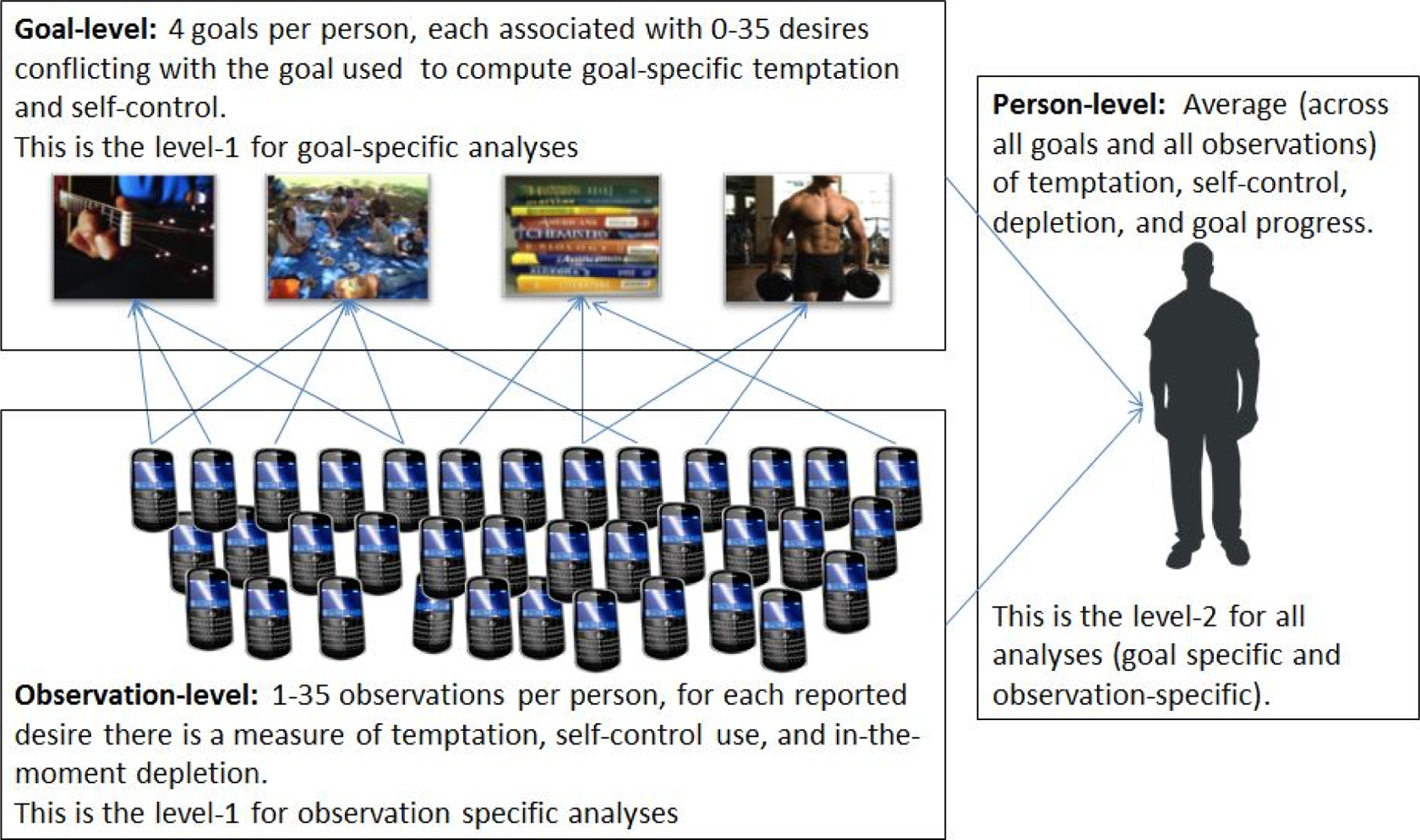
Illustration of the different levels of measurement used in the present study.
Observation level
At the observation level, we had in-the-moment reports of desire strength (on a scale of −3 [very weak] to 3 [very strong]) and the extent to which the desire conflicted with each of the goals (on a scale of 0 [not at all] to 6 [very much], averaged across the four goals to form an observation-level measure of conflict). Temptation was operationalized as the product of the strength of desire (recoded to range from 1 [very weak] to 7 [very strong]) and conflict (ranging from 0 to 6), such that only conflicting desires are considered to represent a temptation that could threaten to derail goal pursuit. Nonconflicting desires (rated as 0 on conflict) were considered nontempting (a score of 0), while conflicting desires could range in their level of temptation from 1 (for a weak desire that minimally conflicted with the goal) to 42 (for a very strong desire that also conflicted maximally with the goal). To enable an easier direct comparison of the effects of temptation and self-control, the score for temptation was divided by 7 so that the final score could have the same spread as self-control (both spanning 7 points).
In line with Hoffman and colleagues (2012), self-control at the observation level was based on 1 item asking participants whether they tried to resist or control the desire on a scale of −3 (did not try to resist at all) to 3 (tried very hard to resist). 3 Finally, depletion was assessed during the experience sampling with 1 item: “How mentally exhausted are you in the moment?” rated on a scale of 0 (not at all) to 6 (very much).
Goal level
At the goal level, we obtained the following goal-specific measures.
Goal descriptions
At the start of the semester, participants listed four personal goals that they planned to pursue during the semester. Examples of goals listed by participants include “get a 3.6GPA,” “improve my health,” and “learn French.” These goals were later funneled into both experience sampling and final questionnaires to enable tracking goal-specific information.
Goal progress/success
Goal progress was assessed at the end of the semester using 3 items for each goal: “I have made a lot of progress toward this goal,” “I feel like I am on track with my goal plan,” and “I feel like I have achieved this goal.” All ratings were made on a 7-point scale (from 1 [strongly disagree] to 7 [strongly agree]). The mean of the 3 items for each goal was used. αs for the four goals ranged from .83 to .90.
To examine our questions relating temptations and self-control to goal progress, we computed measures of goal-specific temptation and goal-specific self-control. The average temptation was calculated for each goal by averaging across all observations. We computed a goal-specific measure of self-control by using the mean resistance for those desires that conflicted with each given goal, irrespective of nonconflicting desires. So if Mark reported five desires that conflicted with his academic goal, his self-control for that goal would be the average of the resistance reported in response to those five desires only. 4 , 5
Nightly depletion
In addition to momentary depletion, in the nightly survey participants were asked the following: “Please rate the degree to which you felt this way during the course of the day today.” Two items assessed feelings of depletion/fatigue: “Mentally exhausted” and “Energized” (reversed). Both were rated on a scale of 0 (not at all) to 6 (very much).
Analytical Procedure
Multilevel analyses were conducted in MPlus (version 7.2; Muthen & Muthen, 2012) using the maximum likelihood estimation procedure. A full information maximum likelihood approach was used to deal with missing data (Enders & Bandalos, 2001). Multilevel structural equation modeling (MSEM; Preacher, Zhang, & Zephyr, 2011; Preacher, Zephyr, & Zhang, 2010) with all fixed effects was used in all analyses. Due to the structure of our data, we had two parallel nesting structures: First, to examine the role of temptation, self-control, and depletion on goal progress, we used goals nested within person, with temptation aggregated across signals, and goal progress on Level 1 (the goal level). Alternatively, to examine the effects of self-control and temptation on depletion, we used observations nested within person, with temptation (across all the four goals), self-control, and depletion as Level 1 variables. For all analyses, standardized results using the MPlus STDXY procedure are reported; unstandardized results, as well as the MPlus output for all analyses (including all model specifications), can be found on the Open Science Framework at https://osf.io/4vkhr/?view_only=df0f418474a64865be66784b86de43ba
Results
Preliminary Analyses
Table 1 presents the means, standard errors, and intraclass correlations for all the measures. It can be seen from the table that there was nonnegligible variance between and within person on all variables.
Descriptive Statistics of All Variables.
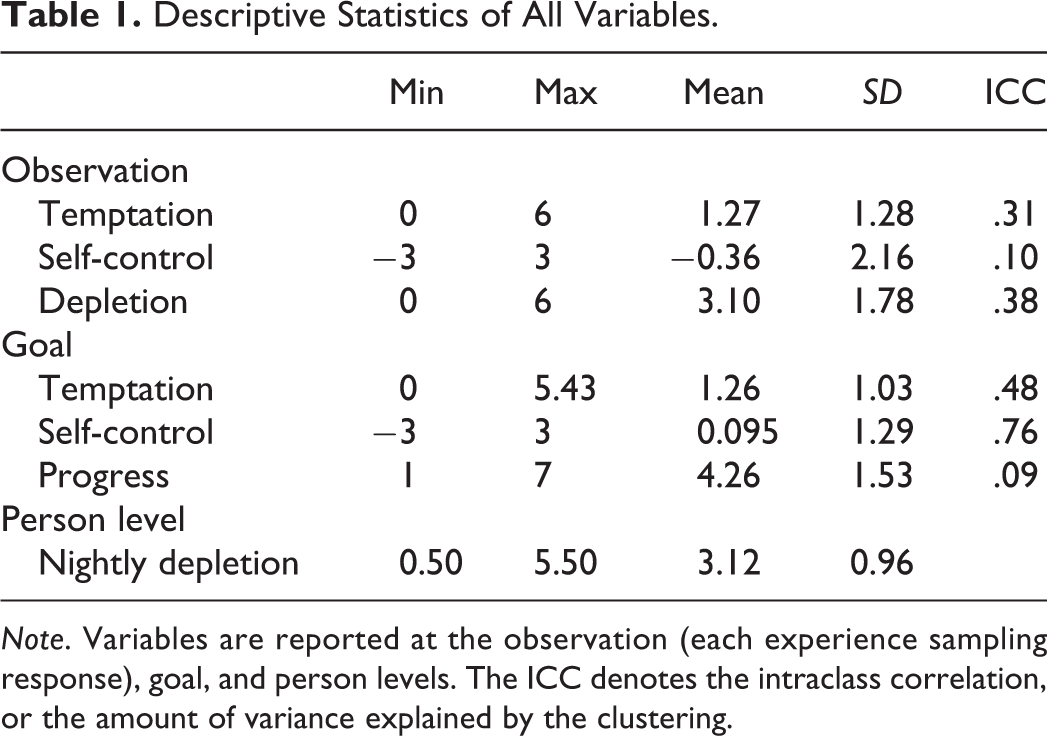
Note. Variables are reported at the observation (each experience sampling response), goal, and person levels. The ICC denotes the intraclass correlation, or the amount of variance explained by the clustering.
Temptations, Self-Control, and Goal Attainment
To examine the role of temptation and self-control in goal attainment, we ran a mediational model in MPlus using MSEM with goal-level data, including goal-specific temptation and self-control as predictors of goal progress (see Figure 2). Results show that only person-level temptation influenced goal progress significantly, while goal-level temptation and both person- and goal-level self-control did not. This indicates that people are no more or no less likely to attain specific goals where they experience less temptations; in contrast, those people who experience stronger temptations in general are less likely to make progress on all their goals. Conversely, and perhaps surprisingly, the extent to which people engage self-control did not significantly influence goal progress, analyzed at either the level of person or goal.
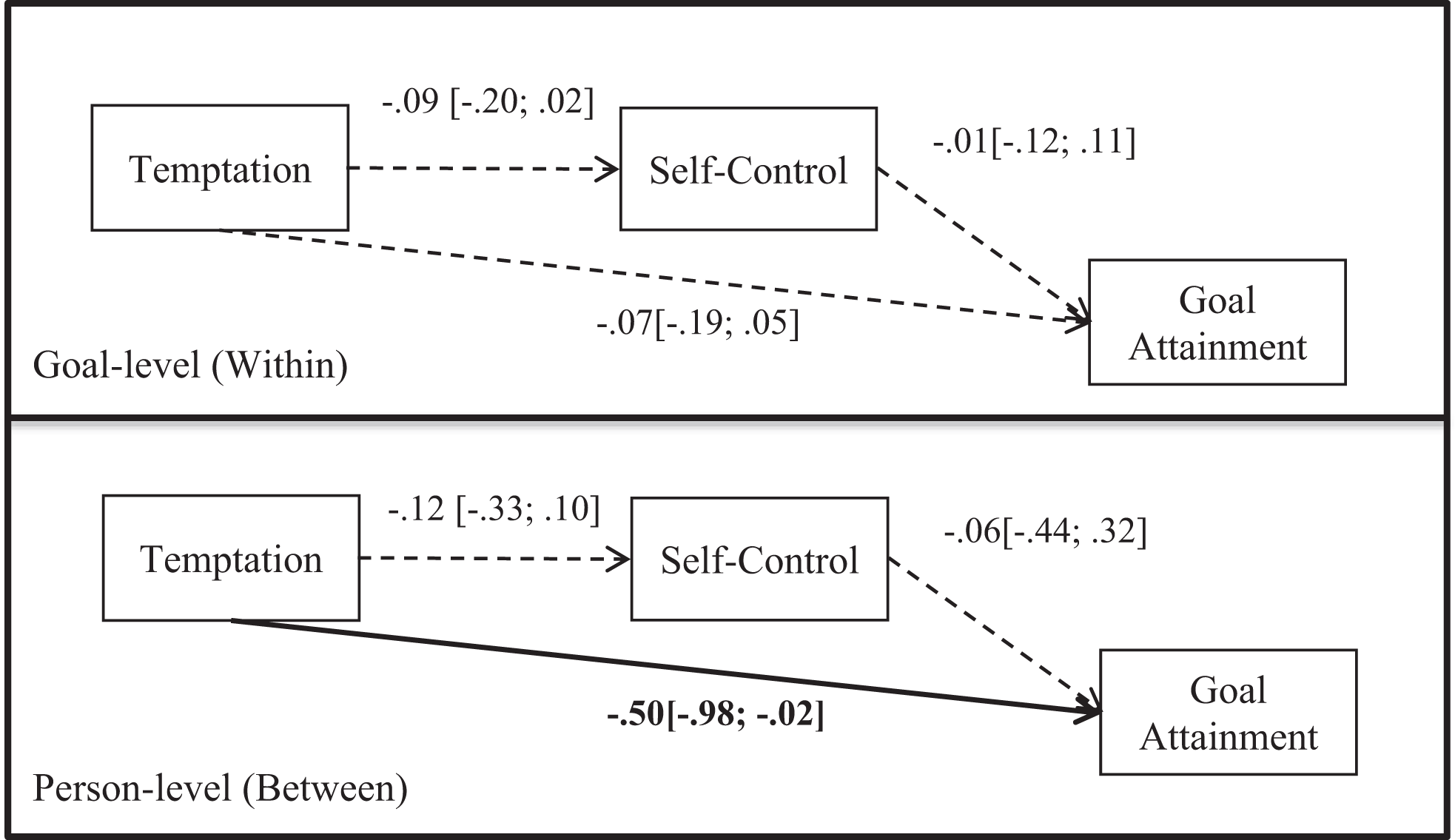
Complete MSEM model of within- and between-person analyses of temptation, self-control, and goal attainment. Standardized coefficients and 95% CIs are reported. Values in boldface are significantly different from 0 at p < .05. MSEM = multilevel structural equation modeling; CIs = confidence intervals.
To further (and more directly) examine whether self-control actually had no effect on goal progress, we used Bayesian analyses that allowed us to corroborate a null effect, something not possible with frequentist statistics (Wagenmakers, 2007). We thus compared the Bayesian Information Criteria (BIC) for the model with self-control as a predictor (illustrated in Figure 2) with models where self-control was fixed at 0 on either the within or the between portion and computed Bayes factors associated with those models (see Table 2). Overwhelmingly, the models without self-control were superior fits to the data. The Bayes factors suggest that the data present strong evidence that the effect of self-control on goal progress is equivalent to 0 at both the within (goal-specific) and between (person-specific) levels. What matters for goal achievement, then, is not how well people control themselves, but the potency of their overall environmental temptations. In other words, and contrary to conventional wisdom, self-control was unimportant in accomplishing one’s goals.
Comparisons Between Models.
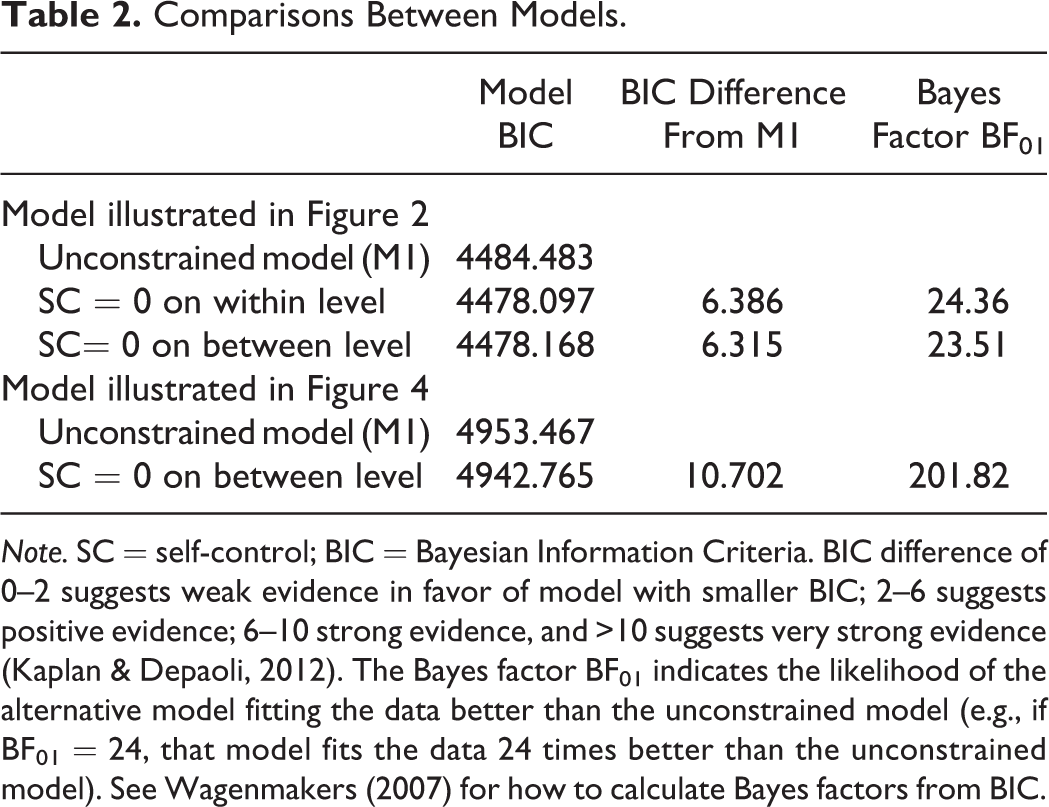
Note. SC = self-control; BIC = Bayesian Information Criteria. BIC difference of 0–2 suggests weak evidence in favor of model with smaller BIC; 2–6 suggests positive evidence; 6–10 strong evidence, and >10 suggests very strong evidence (Kaplan & Depaoli, 2012). The Bayes factor BF01 indicates the likelihood of the alternative model fitting the data better than the unconstrained model (e.g., if BF01 = 24, that model fits the data 24 times better than the unconstrained model). See Wagenmakers (2007) for how to calculate Bayes factors from BIC.
Temptations, Self-Control, and Depletion
Next, we examined our second question using MSEM analyses with the observation-level data to examine whether temptations influence feelings of depletion only indirectly through self-control or directly. Figure 3 illustrates the full model.

Complete MSEM model of momentary temptation, resistance, and depletion. Standardized coefficients and 95% CIs are reported. Values in boldface are significantly different from 0 at p < .05. MSEM = multilevel structural equation modeling; CIs = confidence intervals.
On the within-person (observation) level, stronger in-the-moment temptation was linked to greater use of self-control, which was in turn related to increased momentary feelings of depletion. An indirect within-person effect of temptation on depletion through self-control was also found, ind = .03, 95% confidence intervals (CIs) [0.014, 0.045]. This indicates that people put in more effort in resisting a desire when it represented a stronger temptation compared to other temptations they may have personally encountered, and report increased feelings of depletion or fatigue when they are exerting (or had recently exerted) self-control to resist a desire. Additionally, temptation had a direct within-person effect on depletion, suggesting that although feelings of depletion can come about through the exertion of control, they also occur in the mere presence of strong temptations.
On the between-person level, there were no significant effects of temptations on self-control or of self-control on depletion. This suggests that people who generally experienced more or stronger temptations were not generally more likely to resist their desires and, surprisingly, that people who exerted more overall self-control did not actually report more overall depletion. However, there was a robust between-person effect of temptation on depletion directly, suggesting that people who generally experience stronger temptations are more likely to feel depleted.
Temptation, Depletion, and Goal Pursuit
Next, we tested whether feelings of depletion (assessed nightly, aggregated across all days) mediated the effects of temptation on goal pursuit. We also included self-control in this model, although we did not expect it to play a role since it did not influence goal attainment. The full mediation model (at the between-person level) is illustrated in Figure 4. Results indicated that while experiencing stronger temptations significantly affects feelings of nightly depletion, exerting more self-control does not. Results also showed that there was an indirect effect of temptation on goal attainment, ind = −.15, CIs [−0.29, −0.02], but no significant indirect effect of self-control, ind = −.01, CIs [−0.06, .04]. A test contrasting these two indirect effects showed that the difference among them was significant, b = −.14, CIs [−0.28, −0.01]. As before, Bayesian analyses allow us to corroborate whether self-control plays no role in feelings of depletion or goal attainment. A comparison of the BIC between the model illustrated in Figure 4 and a model where the effects of self-control on both depletion and goal attainment were fixed at 0 suggest that the data present very strong evidence that the effect of self-control on goal progress is equivalent to 0 (see Table for exact values of BIC and associated Bayes factor). This suggests that the reason why temptation is problematic for goal pursuit is that people who experience more temptations experience greater feelings of nightly depletion and fatigue, leading to poorer goal progress. Effortful self-control, in contrast to prevailing views, played no role in predicting goal attainment, directly or indirectly. 6
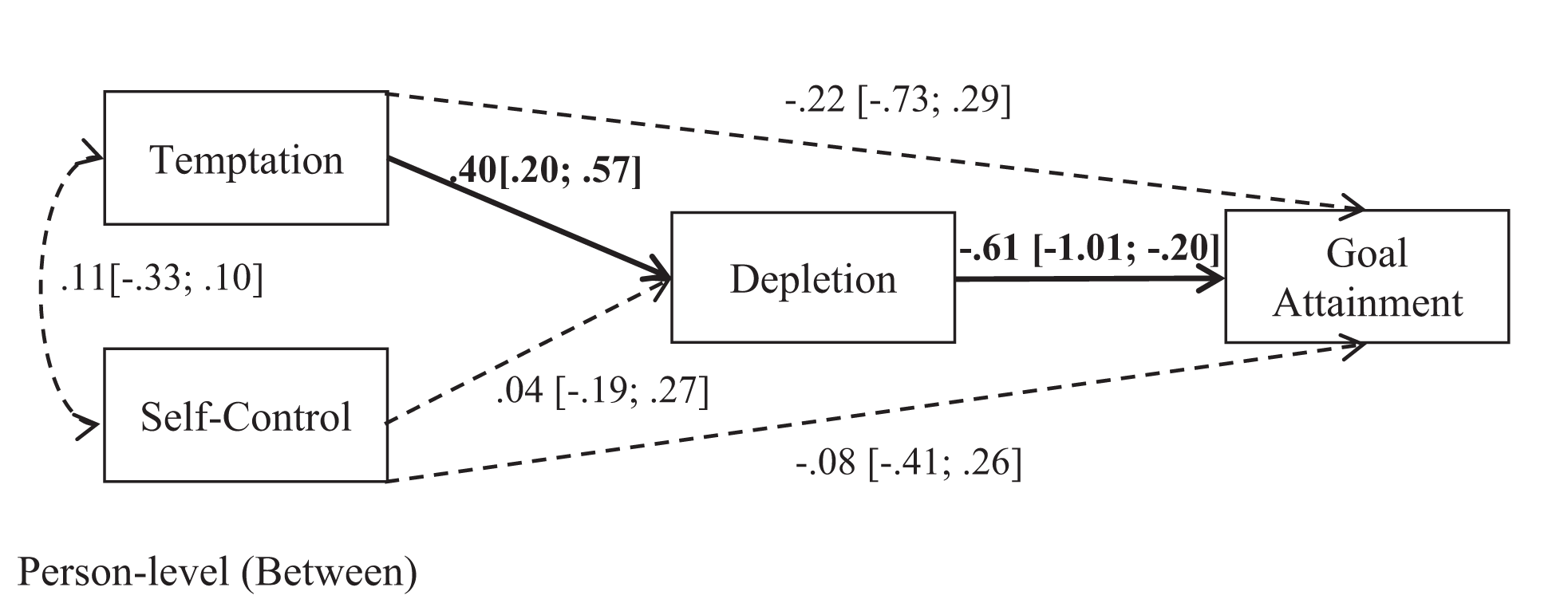
Between-person results from MSEM mediation testing depletion as mediator between temptation and goal attainment. Standardized coefficients and 95% CIs are reported. Values in boldface are significantly different from 0 at p < .05. The direct effect of temptation on goal attainment was no longer significant, but an indirect effect was present (ind = −.15, CIs [−0.29, −0.02]). MSEM = multilevel structural equation modeling; CIs = confidence intervals.
Discussion
Taking research on temptation, effortful self-control, and depletion out of the laboratory and into the realm of everyday life, this study suggests that real-world goal attainment is primarily influenced by experiences of tempting desires, rather than by resisting or controlling these temptations. This study also finds that temptations played a direct role in feelings of the so-called depletion. These feelings of depletion, in turn, predict poorer progress on one’s goals.
Goal Attainment
Looking at the role of temptations and self-control in goal attainment, we found that only temptation influenced goal attainment. This means that people who generally experienced more temptations were less likely to succeed across all their goals. Against popular and scientific wisdom (e.g., Baumeister & Tierney, 2011), effortful self-control did not appear to play a role in goal pursuit, suggesting that the immediate positive consequences of exerting willpower do not translate into long-term goal success. Our Bayesian analyses strongly indicated that models without self-control as a factor consistently outperformed models with self-control. This is particularly powerful, given that self-control was assessed in the moment (or soon after) the temptation was actually experienced, rather than relying on one’s general assessment of self-control to predict positive outcomes. These results also highlight the importance of conducting longitudinal research to determine the long-term consequences of momentary phenomena such as self-control.
Although seemingly counterintuitive, our finding that it is the experience of temptations rather than self-control that matters for goal pursuit fits with previous findings on self-control. For example, in Walter Mischel’s famous marshmallow experiments (Mischel & Ebbensen, 1970), he describes how the children who were successful at self-control distracted themselves and avoided looking at the tempting treat. Being able to avoid temptations, rather than the strength of self-control itself, may be the true predictor of the positive outcomes experienced by those children who did not eat the marshmallow. This is in line with recent research on “effortless self-control” (Fujita, 2011) and habits (e.g., Galla & Duckworth, 2015), which suggest that effective self-regulation may be effortless rather than requiring active self-control (Adriaanse et al., 2014; Gillebaart & de Ridder, 2015; see also Werner, Milyavskaya, Foxen-Craft, & Koestner, 2016).
Surprisingly, neither goal-specific temptations nor goal-specific self-control played a statistically significant role in goal attainment, such that people were not more likely to accomplish those goals where they experienced fewer temptations or where they were particularly good at restraining themselves. Since most of the variance in goal attainment is goal-specific, another mechanism must exist to account for some goals being much more likely to be attained than others. While the properties of the goals themselves (e.g., autonomous vs. controlled, Deci & Ryan, 2000; learning vs. performance, Dweck & Leggett, 1988; promotion vs. prevention, Higgins, 1998) undoubtedly play a large role in goal pursuit, these distinctions do not address how some goals come to be accomplished while others are not. We attempted to address this question in the current study by considering the four goals separately rather than aggregating across them, but did not find any within-person effects of the variables we considered. Future research can continue to investigate this question by identifying other goal-specific mechanisms of goal pursuit and examining how they operate across goals.
Depletion
One key aspect of our research was the focus on the effects of temptations and self-control on feelings of depletion. As expected, people reported increased depletion or fatigue on occasions when they exercised more self-control. Surprisingly, temptation was also experienced as depleting, even when there were no attempts to suppress the temptation. This suggests that simply experiencing desires that conflict with important goals feels depleting, whether or not control is engaged. This may be because the presence of temptations can lead to a cost/benefit analysis of whether to indulge or resist the temptation (Kurzban, Duckworth, Kable, & Myers, 2013). When such an analysis points to relatively more utility for the temptation rather than the superordinate goal (i.e., opportunity costs), fatigue can ensue (Hockey, 2013). Since these results were unexpected, future research is needed to independently confirm them and to better explore these possible mechanisms.
In the present study, depletion was measured via self-report, by asking participants the extent to which they were experiencing mental fatigue either in the moment (at the experience sampling level) or during that day (in the nightly analyses). This represents a departure from previous research on depletion, where depletion is typically assumed (though not directly measured) after some self-control task (e.g., persistence at unsolvable puzzles, emotional control). Assessing depletion through self-report is in line with the process model of depletion (Inzlicht & Schmeichel, 2012), which suggests that depletion is less the product of some diminished capacity and more the product of shifts in motivation and desires away from restraint and toward self-gratification. In our study, these self-reports of depletion predicted goal attainment at the end of the semester, lending further support to the theories that postulate that it is the subjective feelings or perceptions of depletion or fatigue that drive future self-control.
This research is also the first to demonstrate the cumulative negative effects of depletion. While prior research has shown immediate effects of depletion (primarily on further self-control and performance; see Baumeister & Alquist, 2009 for a review), the long-term effects of experiencing greater day-to-day depletion have not been investigated. The present study not only shows that such cumulative depletion is detrimental to goal progress, but that it occurs because of experiences of temptation, and not, as the resource model of depletion would suggest, because of actual, effortful self-control.
Limitations
In the present study, collecting data from multiple observations and on multiple goals for each person enabled us to conduct multilevel analyses, examining our questions of interest at the between- and within-person levels. As can be expected (Preacher et al., 2010), our results at times differed across these two levels. Specifically, the between-person results showed that participants who generally experienced less temptation and reduced depletion were more likely to attain all their goals, compared to other people. As discussed earlier, there were no within-person effects on goal progress, such that neither goal-specific temptation nor self-control significantly affected the attainment of a given goal compared to the person’s other goals. This may have occurred because of our calculations of goal-specific temptation and self-control. Indeed, only 24% of the variance in self-control was goal-specific (compared to 91% of the variance in goal progress). This suggests that our findings linking temptation, depletion, and goal progress may have been influenced by some other individual difference variable. Although we attempted to rule out the most likely ones such as trait self-control and neuroticism (see Notes 5 and 6), future research needs to examine other individual differences that may underlie the experience (or reporting) of temptations, depletion, and goal attainment, as well as examine other alternative mechanisms for why some goals are more likely to be attained than others. Additionally, despite our attempts to effectively operationalize effortful self-control, we acknowledge that other measurements of control might lead to different conclusions regarding the role of control on goal progress. Future work, using a broader set of measures, is needed to verify our conclusions.
Conclusion
In the present study, we investigated the role of temptations and effortful self-control on depletion and goal pursuit. Contrary to the prevalent views of self-control as implicated in long-term positive outcomes, we found that effortful self-control used to inhibit impulses (i.e., resisting desires) did not play a role in goal pursuit in daily life. Our results suggest that the path to better self-regulation lies not in increasing self-control but in removing the temptations available in our environments.
Footnotes
Acknowledgments
The authors would like to acknowledge Richard Koestner and Nora Hope (McGill University) for their help with data collection.
Declaration of Conflicting Interests
The author(s) declared no potential conflicts of interest with respect to the research, authorship, and/or publication of this article.
Funding
The author(s) disclosed receipt of the following financial support for the research, authorship, and/or publication of this article: This research was supported by grants from the Social Science and Humanities Research Council (SSHRC) of Canada to Marina Milyavskaya and Richard Koestner.