




Abstract
One reason White people categorize Black–White Biracial people as Black (called hypodescent) is to maintain the existing racial hierarchy. By creating a strict definition of who can be White, the selectivity, and thus status, of White people increases. Given that racial hierarchies are about the relative status of groups, we test whether perceiving Black groups increases hypodescent by activating fears about shifts in the racial hierarchy (i.e., a majority/minority shift). Indeed, White people rated (Study 1) and stereotyped (Study 4) Black–White Biracial people as more Black in Black groups (but not White groups; Study 2) than when alone. Critically, this pattern was driven by White people relatively high in fear of a majority/minority shift (Study 3a) or those experimentally led to feel this threat (Study 3b). We conclude that Black groups increase hypodescent by activating fears about shifts in the racial hierarchy, posing consequences for racial stereotyping.
President Obama is considered America’s first Black president. This statement is interesting, given that Obama actually has mixed racial heritage. The fact that Obama is often perceived as Black, despite being mixed-race, is consistent with research that indicates that Biracial people are often categorized into a single racial category—specifically, a racial category that represents their socially marginalized identity (Ho, Sidanius, Levin, & Banaji, 2011). This phenomenon—categorizing a mixed-race individual as a minority group member—has been termed hypodescent.
Within the United States, hypodescent has historically been directed toward people with Black ancestry. For example, a precedent of hypodescent—the “one-drop rule”—legally classified anyone with any Black ancestry as “Black” in order to justify having mixed-race people as slaves (Hickman, 1997). Postslavery, one reason why hypodescent in perception of Black–White Biracial people persists is that it allows White people to maintain the existing racial hierarchy (Ho, Sidanius, Cuddy, & Banaji, 2013). In particular, hypodescent reinforces the existing racial hierarchy by accentuating divisions between racial groups and creating a strict definition of who is (and is not) classified as White. This makes membership in the White in-group increasingly selective, thus maintaining its position at the top of the racial hierarchy.
Extending upon this logic, situational factors that accentuate threats to the existing racial hierarchy may increase patterns of hypodescent among White perceivers. Because racial hierarchies involve the relative status of groups of people (Bobo, 1999; Pratto, Sidanius, Stallworth, & Malle, 1994), we predict that when White people perceive Black groups, this may activate fears that Whites will no longer be the racial majority in the future (i.e., a majority/minority shift). Such a loss of majority group status would be a threat to Whites’ position at the top of the racial hierarchy (e.g., Craig & Richeson, 2014). It follows that White people should be motivated to rate Black–White Biracial people as more Black when they are perceived in Black groups (vs. alone) as a method of reinforcing the selectivity, and thus status, of the White in-group.
Background
Diversity is increasing in the United States with Multiracial people being one of the fastest growing demographics (Pew, 2015). Optimistically, we might expect that this surge in racial diversity would increase intergroup contact and thus decrease prejudice (Pettigrew, 1998)—perhaps by blurring the lines between “us” and “them” (Allport, 1954; Gaertner & Dovidio, 2000). However, research indicates that presenting White people with data on the changing racial demographics of the United States increases intergroup prejudice and discrimination (Craig & Richeson, 2014; Willer, Feinberg, & Wetts, 2016). This increase in prejudice is mediated by the perceived threat to the existing racial hierarchy. Thus, the perception of increasing diversity may actually strengthen, rather than minimize, motivations to differentiate between us and them (Brewer, 1991). And, one way for White people to fortify boundaries between racial groups is to rate people with both White and Black racial identities as more representative of their socially marginalized, rather than White, racial identity (i.e., hypodescent).
The emergence of hypodescent is multiply determined. Some evidence suggests that hypodescent is due to basic psychological processes associated with learning and categorization (e.g., Halberstadt, Sherman, & Sherman, 2011). However, motivations also play an important role in race perception (Gaither, Pauker, Slepian, & Sommers, 2016; Ho, Roberts, & Gelman, 2015; Ho et al., 2013; Krosch, Berntsen, Amodio, Jost, & Van Bavel, 2013). For example, White people highest in social dominance orientation (SDO; Pratto et al., 1994), who were led to believe that the existing racial hierarchy was unstable were more likely to rate Black–White Biracial individuals as Black compared to those who did not perceive such a threat (Ho et al., 2013). Relatedly, Whites who felt socially excluded (vs. included) were more likely to rate Black–White Biracial individuals as Black (Gaither et al., 2016). This suggests that, under threat, Whites want to affiliate with a selective in-group. Thus, one driving force behind hypodescent is a desire to maintain clear racial group boundaries and a highly selective (and thus, high status) White in-group. It follows that situations that activate White people’s desire to maintain clear racial boundaries should also increase White people’s tendency to engage in hypodescent. We propose that one such situation is the perception of Black groups.
Recent research indicates that groups are perceived as more representative of racial categories than are individuals (Cooley & Payne, 2017). Cooley and Payne (2017) find that Black and White groups are rated as more representative of “Black people” and “White people” than are the same Black and White people presented individually. Given that racial hierarchies are ultimately about the relative status of entire racial categories (Bobo, 1999), we propose that perception of Black groups may be particularly likely to activate White people’s concerns about the relative power of White and Black people. Because hypodescent can be used to fortify the existing racial hierarchy (Ho et al., 2013), we further expect that White people will demonstrate greater hypodescent when rating the race of Biracial people in Black groups than when they are alone. In contrast, we would not expect perception of White groups to elicit these fears; thus, we would not expect Biracial people to be rated as more Black in White groups.
Critically, if perceptions of the race of Black–White Biracial people shift with the social context, so too may their vulnerability to stereotyping and prejudice. In particular, if Black groups lead White people to rate Black–White Biracial people as more Black, then Black groups may also increase the likelihood that Black–White Biracial people will experience the types of prejudice often directed toward Black people. Such a finding would be important, given a dearth of research on downstream consequences of hypodescent.
To test our hypotheses, we conducted four studies. First, we tested whether White people would rate Black–White Biracial people as more Black when in groups of Black people than when alone (Study 1) but not when in White groups versus alone (Study 2). Next, we tested whether the fear of the shifting racial hierarchy led White people to rate Biracial people as more Black when in Black groups (Studies 3a and 3b). Finally, we demonstrate that Black–White Biracial people are also stereotyped as more Black when in Black groups than when alone (Studies 4a and 4b). All studies and hypotheses were preregistered on Open Science Framework. We disclose all measures, manipulations, and exclusions. For all studies, faces perceived as Black–White Biracial, White, and Black were identified through pretesting (see Online Supplemental Materials).
Study 1
Method
Participants in Study 1 rated the perceived race of Black–White Biracial individuals when among Black groups versus when alone. We hypothesized that White people would rate Black–White Biracial individuals as more Black when in a group of other Black people than when alone.
Participants
Using G*Power Version 3 software (Faul, Erdfelder, Lang, & Buchner, 2007), we determined that we needed a sample of at least 199 for this study to have adequate power (1 – β ≥ .80) to detect a small effect (f = .10). For all studies, we recruited 225 participants on Amazon Mechanical Turk (MTurk) and then stopped data collection. At times, more people responded than we recruited. We analyzed data for all participants who completed each study.
The majority of the 227 respondents in this study were White (84%) with the next largest racial group being Asian people (10%) then Black people (5%). Because we were interested in variables that affect how White people rate the race of Black–White Biracial individuals, we conducted analyses only on White participants for this study as well as all remaining studies. Our final sample was 191 White individuals (115 men, 75 women, and 1 other) who were on average 37 years of age (SD = 13.00).
Procedure
Participants were asked to rate several pictures of people in different situations. Participants were told that a person may or may not look different from one situation to the next. Then, participants were asked to rate the pictured individual on a 100-point scale (0 = definitely White American; 100 = definitely Black American).
Images were presented in a random order. Participants saw each Biracial face once when in a group and once when alone (see Figure 1). On group trials, the Biracial individual was pictured next to two Black men. The position of the Biracial individual (left, middle, or right) was rotated throughout the 10 group photos (each group photo depicted 1 of the 10 Biracial individuals from the pretest and two randomly selected Black individuals). Subjects saw the group photo with a black arrow pointing to one of the pictured individuals in the group and were asked to rate the race of the individual above the arrow. Participants rated all members of the group before moving on to the next photo. Participants rated 10 group photos (which included one Biracial individual), 10 photos of Biracial individuals alone, and 10 photos of Black individuals alone to make our interest in perception of Biracial people less salient.
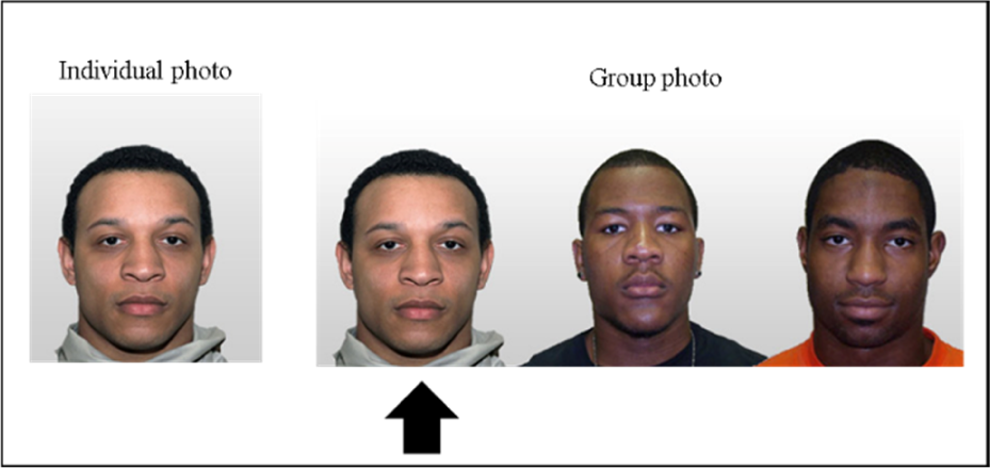
Example of stimuli viewed in the group and individual conditions (Study 1).
After participants rated the photos, they completed feeling thermometers toward several groups (White people, Black people, etc.) and demographic items including age; gender; race/ethnicity; the number of Black, White, and Biracial friends they had; income; education; perceived socioeconomic status (Adler & Ostrove, 1999); political party affiliation; and political ideology. Results were not moderated by any of these demographic measures in any of our studies, so we will not discuss them further.
Results
To test whether Black–White Biracial people were perceived as more Black in Black groups, we ran a repeated measures analysis of variance (ANOVA) with social context (group vs. alone) as the within-subjects factor. As predicted, White people rated Biracial individuals as more Black when presented in a group (M = 54.03, SD = 13.93, 95% CI [52.04, 56.01]) than when presented alone (M = 51.76, SD = 14.31, 95% CI [49.72, 53.81]), F(1, 190) = 32.20, p < .001,
Study 2
Method
Participants in Study 2 rated the perceived race of Black–White Biracial individuals when among White groups versus when alone. Our perspective is that Black groups increase hypodescent by activating White people’s concerns about racial minorities becoming the racial majority. Because we do not expect that perception of White groups would activate these fears, we do not expect that White groups would increase hypodescent in perception of Black–White Biracial people.
Participants
The majority of the 233 respondents in this study were White (84%) followed by Black people (8%) and Asian people (7%). Our final sample was 195 White individuals (73 men, 121 women, and 1 other) who were on average 34 years old (SD = 10.61).
Procedure
The method for Study 2 was the same as Study 1 except group photos consisted of one Biracial person with two White men rather than two Black men (see Figure 2). Participants made ratings of 10 White men and 10 Black–White Biracial men when they were depicted alone on the screen and again when they were within a group. Ratings of each individual (once when alone and once when in a group) were made on 0 (definitely Black American) to 100 (definitely White American) scales with the scale midpoint labeled (mixed-race, Black, and White). Participants also responded to an item that asked the degree to which they fear a majority/minority shift, a measure of SDO7 (Ho, Sidanius, et al., 2015), and an item that asked about their perception that the social status of different racial groups might change in the future. Participants concluded with feeling thermometers to measure explicit prejudice and demographic questions.
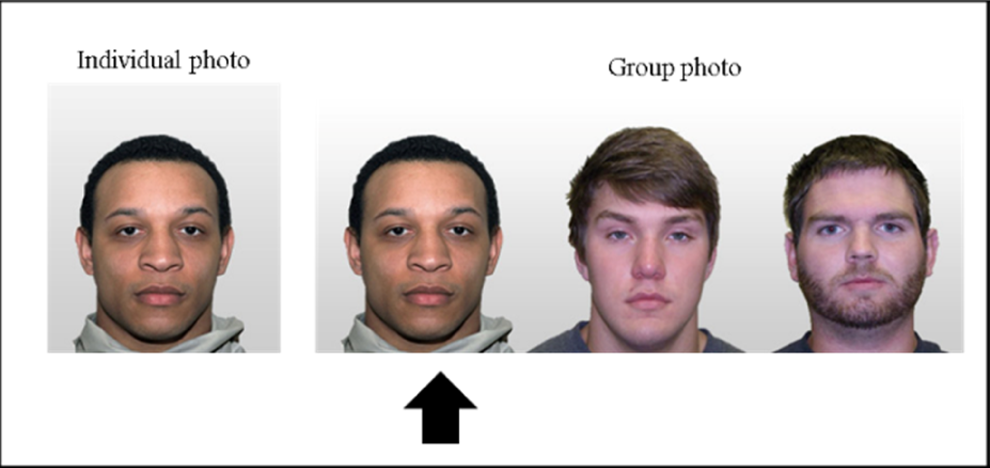
Example of stimuli viewed in the group and individual conditions (Study 2).
Results
To test our hypotheses, we ran a repeated measures ANOVA with social context (group vs. alone) as the within-subjects factor. Results revealed no difference in ratings of Biracial people when in White groups (M = 60.98, SD = 10.51, 95% CI [59.49, 62.46]) as compared to when viewed alone (M = 60.73, SD = 10.43, 95% CI [59.26, 62.20]), F(1, 194) = .65, p = .42,
Studies 3a and 3b
Method
In Study 3a, we measured White people’s racial perception of Black–White Biracial people when alone and when in Black groups. We predicted that White people would rate Black–White Biracial people as more Black when in Black groups—replicating Study 1 findings. Furthermore, we included a measure of fear of a majority/minority shift, so that we could examine whether effects were most pronounced among those highest in this fear. Additionally, because fear of a majority/minority shift has been associated with increased racial prejudice (Craig & Richeson, 2014), we also measured explicit racial prejudice toward Black people. This allowed us to examine whether fear of a majority/minority shift accentuates hypodescent when rating the race of Biracial people in Black groups above and beyond general racial prejudice.
In Study 3b, we experimentally manipulated (rather than measured) threat of a majority/minority shift. If feelings of threat drive the tendency to rate Black–White Biracial people as more Black when in Black groups, then people who are induced to feel this threat (but not those who are not) should replicate our previous findings.
Participants
Study 3a
The majority of the 224 respondents in this study were White (80%) followed by Black people (9%) and Asian people (6%). Our final sample was 179 White individuals (61 men, 115 women, and 3 other) who were on average 34 years old (SD = 10.98).
Study 3b
The majority of the 228 respondents were White (83%) followed by Black people (8%) and Asian people (7%). Our final sample was 190 White individuals (63 men, 126 women, and 1 other) who were on average 34 years of age (SD = 10.64).
Procedure
Study 3a
As in Study 1, participants rated Black–White Biracial people when alone and when in Black groups. However, unlike Study 1, the scale midpoint was also labeled as (mixed-race, Black, and White) and scale anchors were reversed to be 0 (definitely Black American) to 100 (definitely White American). Critically, we also included all measures from Study 2 and added a measure of our proposed moderator: an item that asked participants the degree to which they fear a majority/minority shift on a 0 (strongly disagree) to 100 (strongly agree) scale (i.e., “I am fearful that minority racial groups will become the racial majority”).
Study 3b
The procedure for this study was identical to Study 1 with the addition of a manipulation of threats to White majority status taken from previous research (Willer, Feinberg, & Wetts, 2016). In particular, participants learned that the study had two parts. In the first part, they learned we were interested in quantitative ability. Participants then saw a graph of purported U.S. census data that displayed the projected racial demographics of the United States in upcoming years. Participants in the majority threat condition saw a graph that indicated that all non-White people would exceed the number of White people in upcoming years (see Figure 3). Participants in the majority stable condition saw a graph that indicated that White people were projected to still be the majority in upcoming years (see Figure 4). Participants were quizzed on these graphs (e.g., “In the graph above, which racial/ethnic group will represent the largest percentage of the U.S. population in the year 2060?”). The second portion of the study was the same as Study 3a. Participants completed the study with feeling thermometers, a measure of SDO, and the same demographic information as previous studies.
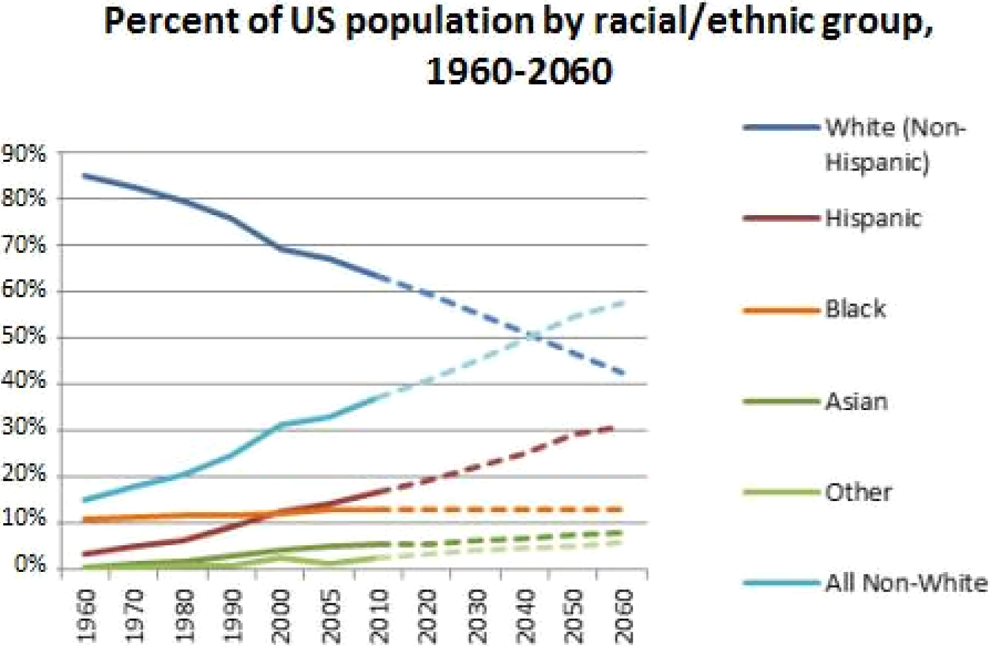
Data presented to participants in the “majority threat” condition.

Data presented to participants in the “majority stable” condition.
Results
Study 3a
In Study 3a, we had two hypotheses. First, we expected to replicate Study 1 such that White people would rate Black–White Biracial people as more Black when in Black groups than when alone. Second, we predicted that this tendency to perceive Biracial people as Blacker in Black groups would be predicted by fear of a majority/minority shift—above and beyond general prejudice toward Black people.
We tested our hypotheses with a mixed-model ANOVA with social context (group vs. alone) as a within-subjects factor and fear of a majority/minority shift (M = 20.29, SD = 28.00) and explicit prejudice toward Black people (M = 71.28, SD = 22.03) as potential moderators of the within-subjects social context variable. We reverse scored race ratings, so that higher values indicate rating the Biracial person as more Black. Additionally, we standardized our measures of fear and prejudice. Replicating Study 1, there was an effect of social context such that people rated Biracial targets as more Black when in Black groups (M = 43.31, SD = 10.17, 95% CI [41.76, 44.85]) than when alone (M = 41.81, SD = 10.30, 95% CI [40.27, 43.35]), F(1, 175) = 13.91, p < .001,
Study 3b
In Study 3b, we predicted that White people would rate Black–White Biracial people as more Black when in Black groups than when alone. Critically, we expected this effect to be driven by those who were randomly assigned to learn that White people would no longer be the racial majority in the near future. We tested this hypothesis by conducting a mixed-model ANOVA with social context (group vs. alone) as the within-subjects factor and majority threat condition as a between-subjects factor. We reverse scored ratings of images, so that higher values indicated rating the target as more Black. Replicating previous studies, there was a significant effect of setting such that White people rated Biracial people as more Black when in Black groups (M = 44.55, SD = 9.94, 95% CI [43.14, 45.99]) than when alone (M = 43.54, SD = 9.69, 95% CI [42.15, 44.93]), F(1, 188) = 8.62, p = .004,

Interaction of majority threat condition and social context on ratings of the race of Black–White Biracial people.
Next, we probed the interaction of social context and threat condition to examine the influence of social context separately for those in the majority threat condition and those in the majority stable condition. Again as predicted, the effect of social context was only significant for White people in the majority threat condition. Replicating previous studies, White people in majority threat condition rated Black–White Biracial people as more Black when in Black groups (M = 45.02, SD = 9.14, 95% CI [43.14, 46.90]) than when alone (M = 43.31, SD = 9.46, 95% CI [41.37, 45.26]), F(1, 92) = 11.62, p = .001,
Studies 4a and 4b
Method
In Studies 4a and 4b, we hypothesized that because Black groups lead people to perceive Biracial individuals as more Black, that Black stereotypes may seem more applicable to Biracial individuals when in a Black group than when alone. We focused on two negative stereotypes of Black Americans—being aggressive (Study 4a) and untrustworthy (Study 4b; Devine & Elliot, 1995).
Participants
Study 4a
The majority of the 220 respondents in this study were White (91%) with the next largest group being Black people (5%) and then Asians (4%). Our final sample was 199 (93 men, 105 women, and 1 other) White people who were on average 36 years old (SD = 11.80).
Study 4b
The majority of the 234 respondents were White (85%) with Black people as the next largest category (8%), then Asian people (5%). Our final sample was 198 (73 men, 124 women, 1 other) White people who were on average 37 years old (SD = 12.00).
Procedure
As in Study 1, participants rated pictures of Biracial people in Black groups and when alone. In Study 4a, participants rated how aggressive the pictured individual seemed on a 100-point sliding scale (0 = not at all aggressive; 100 = extremely aggressive). In Study 4b, participants rated how trustworthy the pictured individual seemed on a 100-point sliding scale (0 = not at all trustworthy; 100 = extremely trustworthy).
Results
To test whether Black–White Biracial individuals were perceived as more aggressive and less trustworthy when in a Black group than when alone, we ran repeated measures ANOVAs with social context (group vs. alone) as the within-subjects factor predicting ratings of aggressiveness (Study 4a) and trustworthiness (Study 4b). Consistent with our hypothesis, Black–White Biracial people were perceived as more aggressive when pictured in a group (M = 32.61, SD = 18.30, 95% CI [28.23, 33.19]) than when alone (M = 30.71, SD = 17.76, 95% CI [30.05, 35.17]), F(1, 198) = 21.37, p < .001,
General Discussion
Across multiple studies, we find evidence that Black, but not White, groups accentuate White people’s tendency to rate Black–White Biracial people as Black. Moreover, the tendency to rate Black–White Biracial people as more Black when in Black groups was linked to a fear of minority/majority shift in both correlational and experimental designs. White participants who self-reported being relatively high (vs. low) in fear of a majority/minority shift were more likely to rate Black–White Biracial people as more Black when in Black groups (vs. alone). Likewise, participants who were led to believe that a majority/minority shift was imminent rated Black–White Biracial people as more Black when in Black groups (vs. alone); while those who thought the White majority was stable did not. In contrast, there were no differences in ratings of the race of Black–White Biracial people when in a White group versus alone. We conclude that Black groups in particular, rather than groups in general, activate threats to the racial hierarchy and result in increased hypodescent.
Critically, contextual shifts in racial categorization were paralleled by shifts in racial stereotyping. When presented in a Black group, Black–White Biracial individuals not only were rated as more Black but were also perceived as more aggressive and untrustworthy—stereotypes associated with Black Americans. This pattern is interesting, given that, in general, Biracial people may be less likely to be stereotyped than Black people, given research on the role of category prototypicality on stereotyping (e.g., Blair, Judd, & Fallman, 2004; Eberhardt, Davies, Purdie-Vaughns, & Johnson, 2006). However, in contexts in which hypodescent drives racial categorization of Black–White Biracial people (e.g., in Black groups), Biracial people may be more vulnerable to racial stereotyping.
Interestingly, our findings are distinct from other research that finds social contrast effects when categorizing the race of Biracial people. In particular, Ito, Willadsen-Jensen, Kaye, and Park (2011) found that Black–White Biracial faces were categorized more often as White in the context of other Black faces and categorized more often as Black in the context of other White faces. However, our study differed in critical ways that likely led to our distinct results. In particular, while we compared perception of the same Biracial people when alone as compared to when in groups of Black or White people, Ito and colleagues (2011) presented faces individually. Context in those studies referred to the broader experimental context in which non-Biracial faces were either White or Black (or both). Because we propose that our effects are driven specifically by the perception of Black groups (and not Black individuals), it makes sense that we find distinct results.
Together, the present findings contribute to an increasing amount of research on mechanisms behind hypodescent (Halberstadt et al., 2011; Ho et al., 2013; Krosch et al., 2013) as well as the role of threat in race perception more generally (Sacco, Wirth, Hugenberg, Chen, & Williams, 2011; Van Bavel, Swencionis, O’Connor, & Cunningham, 2012). Other research has demonstrated that people who are both high in SDO and who are led to believe that a majority/minority shift is going to occur are more likely to engage in hypodescent than those who are not led to believe a majority/minority shift is imminent (Ho et al., 2013). Here we extend upon these findings. In particular, we demonstrate that the perception of groups, and Black groups in particular, accentuates intergroup processes associated with hypodescent—namely, fears that White people will lose their top position in the racial hierarchy. As a result, White people are more likely to rate and stereotype Black–White Biracial individuals as Black when they are situated in Black groups than when they are viewed alone.
Although the present findings (and those of others; Ho et al., 2013) indicate the White people respond to threat by increasing the selectivity of the White race through hypodescent, another way to reinforce racial hierarchies is to increase the numerical majority of one’s own group. Thus, it is possible that the present pattern of findings are restricted to perception of Black–White Biracial people in particular—given historical links to the one-drop rule in America—and may not extend to racial categorization of other mixed-race people (Wolfe, 2001). For example, for Asian-White people, perhaps White people would respond to threat by categorizing them more often as White to increase the White numerical majority. Future research should test the generalizability of responses to threats to the racial hierarchy when rating the race of other mixed-race people.
Finally, we focus on White participants because we expect that our proposed mechanism—fear that White people may no longer be the racial majority in the near future—is specific to White people. Black participants are not only unlikely to engage in hypodescent (Halberstadt et al., 2011), but also unlikely to have feelings of threat triggered by information about a majority/minority shift. However, examining the present research questions with more diverse samples could empirically confirm this reasoning.
Conclusion
Ironically, the perception of increasing diversity in America may strengthen the desire to maintain group-based hierarchies (Craig & Richeson, 2014). One way to maintain the existing group hierarchy (with a high status and selective White group on top) is to strengthen racial group boundaries by preventing anyone with mixed racial heritage from being perceived as White. The present research indicates that the perception of Black groups may be one variable that leads White people to rate Black–White Biracial individuals as more representative of Black Americans by activating threats to the existing racial hierarchy.
Supplemental Material
SPPS708014_suppl_mat - Black Groups Accentuate Hypodescent by Activating Threats to the Racial Hierarchy
SPPS708014_suppl_mat for Black Groups Accentuate Hypodescent by Activating Threats to the Racial Hierarchy by Erin Cooley, Jazmin L. Brown-Iannuzzi, Christia Spears Brown, and Jack Polikoff in Social Psychological and Personality Science
Footnotes
Declaration of Conflicting Interests
The author(s) declared no potential conflicts of interest with respect to the research, authorship, and/or publication of this article.
Funding
The author(s) received no financial support for the research, authorship, and/or publication of this article.
Supplemental Material
The supplemental material is available in the online version of the article.
References
Supplementary Material
Please find the following supplemental material available below.
For Open Access articles published under a Creative Commons License, all supplemental material carries the same license as the article it is associated with.
For non-Open Access articles published, all supplemental material carries a non-exclusive license, and permission requests for re-use of supplemental material or any part of supplemental material shall be sent directly to the copyright owner as specified in the copyright notice associated with the article.
