




Abstract
This study examined whether the extent to which spouses feel they have available and satisfying support outside their marriage buffers spouses from the potential negative physiological effects of conflict inside their marriage. Newlywed couples (N = 214 spouses) reported occurrences of marital conflict in a daily diary and concurrently provided morning and evening saliva samples for the calculation of daily diurnal cortisol slopes. Extending prior work demonstrating links between marital conflict and acute cortisol responses in laboratory settings, results revealed that spouses exhibited flatter (i.e., less healthy) diurnal cortisol slopes on days of greater marital conflict. Although the quantity of spouses’ support network connections was not associated with physiological responses to conflict, the quality of perceived network support attenuated the association between daily marital conflict and diurnal cortisol slopes. Thus, maintaining a satisfying network of social connections outside a marriage may protect spouses’ well-being during periods of marital difficulty.
Conflict is an inevitable part of any marriage (e.g., Kelley & Thibaut, 1978). Despite its ubiquity, however, relationship conflict is not innocuous. Numerous laboratory studies indicate that conflict with a partner dysregulates key body systems that are linked to long-term physical health and disease outcomes (for review, see Wright & Loving, 2011). For example, conflict activates the hypothalamic–pituitary–adrenocortical (HPA) axis of the endocrine system resulting in the release of cortisol, one of the body’s primary stress hormones (Kiecolt-Glaser et al., 1996; Heffner et al., 2006). Over time, elevations in cortisol, including those associated with chronic relationship strain, lead to a host of negative physical outcomes, such as poor cardiovascular and immune function (Robles & Kiecolt-Glaser, 2003), increased likelihood of illness, and early mortality (McEwen, 1998).
One reason why relationship conflict is reliably tied to negative health outcomes is that the experience of conflict often creates a rift between partners that may temporarily undermine partners’ sense of belonging and connectedness to one another (Feeney, 2009; Loving, Le, & Crockett, 2009). During conflict, differences in romantic partners’ goals, desires, or values become salient (Fitzsimons & Anderson, 2012), which can threaten feelings of security within the relationship (Murray, Holmes, & Collins, 2006). Because humans are wired to perceive being socially connected as homeostatic (Coan & Sbarra, 2015; Baumeister & Leary, 1995), any disruptions in perceptions of connectedness are thought to activate a state of distress in which cognitive and physical effort is exerted to compensate and correct for this social deficit.
To ease the sting associated with relationship conflict, partners may draw on other social relationships in order to restore feelings of connectedness. Specifically, couples are embedded within social networks comprised of friends and family members. These close others serve as important sources of relationship support (Bryant & Conger, 1999), providing a shoulder to cry on during times of relationship strain as well as serving as a sounding board to process relationship events (Klein & Milardo, 2000). Critically, in addition to the functional benefits that close others confer on couple members when working through relationship issues, network members provide a general sense of connectedness essential for well-being (Voss, Markiewicz, & Doyle, 1999). Indeed, the capacity to substitute feelings of connectedness in one social relationship with connectedness in another relationship is one way in which individuals are able to automatically maintain social homeostasis or a necessary level of belonging (i.e., the substitution hypothesis; Baumeister & Leary, 1995). Although the original formulation of the substitution hypothesis focused on the formation of new social connections, it has become clear that individuals can seek connection in existing social relationships when experiencing a void in belonging, such as when relationship quality with a current romantic partner suffers (Spielmann, Joel, MacDonald, & Kogan, 2013). Thus, we propose that the extent to which couple members feel connected to and supported by others outside their marriage buffers partners from the potential negative physiological effects of conflict inside their marriage. In other words, relationship conflict should be least harmful to those spouses who feel that they have network members to whom they could turn for support.
The Buffering Role of Social Network Connections
The ability to draw on other sources of social connection during times of relationship conflict should be advantageous for individuals’ physical health. According to the stress-buffering model of social support, perceptions of connectedness to others mitigate the negative consequences of stressful events (Cohen & Wills, 1985); simply put, when individuals feel socially connected, threats are appraised as less threatening (Coan & Sbarra, 2015). For instance, for individuals with greater social resources, physical pain is perceived as less intense (Brown, Sheffield, Leary, & Robinson, 2003) and physical challenges (i.e., the steepness of a hill) are viewed as less daunting (Schnall, Harber, Stefanucci, & Proffitt, 2008).
In the same vein, the support resources provided by one’s social network connections may be particularly important for reducing the threat experienced during relationship conflict. Conflict with a partner is a unique stressor in that the source of stress is, generally, one’s primary support provider. In other words, the person who individuals would naturally turn to during times of difficulty is also the cause of (or associated with) the problem. Given the difficulties of seeking support from a partner during conflict (Cutrona, 1996), sources of support external to one’s marriage should be essential for temporarily buffering individuals from conflict-associated threats to belonging until necessary internal relationship reparations are made. Importantly, it is not the case that a friend can simply replace a romantic partner (Coyne & DeLongis, 1986); rather, it is possible that feelings of connectedness in other relationships can compensate for fluctuations in feelings of connectedness with one’s romantic partner.
Overview of the Current Study
The current study examined biological responses to naturally occurring marital conflict and tested whether the physiological stress of day-to-day conflict is lessened when spouses perceive available and satisfying social network support outside their marriage. Specifically, a daily diary and at-home saliva collection study design was used to assess the link between everyday conflict and diurnal cortisol slopes. The slope of the change in cortisol throughout the day (i.e., cortisol’s diurnal pattern) is a critical marker of HPA axis function, which regulates numerous body processes and responses. The HPA axis is especially sensitive to socially threatening situations (Dickerson & Kemeny, 2004) and perceptions of social support (Sjögren, Leanderson, & Kristenson, 2006), making diurnal cortisol a pertinent biological marker of daily physiological health for the current study. Additionally, diurnal cortisol is a more robust predictor of health outcomes than are absolute levels of cortisol (Adam & Kumari, 2009). Specifically, individuals with normally functioning endocrine systems begin each day with peaking levels of cortisol within the first 30 min of waking and experience a steady decline in cortisol throughout the day. A slower rate of decline in cortisol over the course of the day, or flatter diurnal cortisol slopes, is associated with chronic and acute psychosocial stress (Adam, Hawkley, Kudielka, & Cacioppo, 2006), impaired immune function (Uchino, Cacioppo, & Kiecolt-Glaser, 1996), and early mortality (Sephton, Sapolsky, Kraemer, & Spiegel, 2000).
Analyses addressed two primary questions. First, is daily marital conflict associated with flatter diurnal cortisol slopes? Based on prior work demonstrating a reliable connection between relationship conflict and elevated stress hormone levels in the laboratory (e.g., Malarkey, Kiecolt-Glaser, Pearl, & Glaser, 1994), it was expected that spouses would exhibit flatter diurnal cortisol slopes on days of greater marital conflict compared to days of lower marital conflict. Although naturally occurring marital conflict has been previously linked to the diurnal cortisol slopes of children who observe their parents’ disagreements (Slatcher & Robles, 2012), this is the first study to examine the association between spouses’ daily marital conflict and their own cortisol responses in a nonlaboratory setting.
Second, does perceived social network support moderate the association between daily marital conflict and diurnal cortisol slopes? Perceived network support provides one metric of individuals’ level of connectedness outside of their relationship and has the capacity to protect individuals from a variety of life stressors (Uchino, 2004). This study assessed both the quantity and quality of spouses’ social network connections to better understand how these differing aspects of network support contribute to health outcomes (e.g., Hawkley et al., 2008). Perceptions of greater quantity and quality of network support were expected to attenuate the association between daily marital conflict and diurnal cortisol.
Method
Participants
Newlywed couples (N = 171) were recruited for a longitudinal study of marital development by placing advertisements in community newspapers, premarital counseling offices, local wedding vendors, and online websites (e.g., Facebook and The Knot). All couples met the following eligibility requirements: (a) first marriage for each partner, (b) married less than 6 months, and (c) no children. As a primary goal of the broader study was to examine issues unrelated to the current paper (i.e., stress spillover in marriage), sample size was determined through a power analysis for detecting these other effects, coupled with funding constraints.
On average, husbands were 29.1 (SD = 5.3) years old and had 16.0 (SD = 2.3) years of education. Seventy-seven percent of husbands identified as White, 15.8% as Hispanic/Latino, 2.3% as African American, and 1.8% as Asian American. Wives were, on average, 27.2 (SD = 4.9) years old and had 16.3 (SD = 1.9) years of education. Seventy-five percent of wives identified as White, 15.2% as Hispanic/Latina, 3.5% as African American, and 2.3% as Asian American. The median combined income of couples was approximately US$60,000.
Procedure
Within the first 6 months of their marriages, spouses completed two tasks relevant to the current study. First, spouses were mailed background questionnaires that included measures of the perceived quantity and quality of spouses’ social network support. Couples received $50 for completing these questionnaires. Second, spouses completed a 14-day daily diary, which assessed daily marital conflict. Spouses were given the option of completing the diaries online or on paper and were instructed to complete one diary each night before going to bed. Couples received $30 for completing daily diaries. 1
On each of the first 6 diary days, spouses were also asked to provide two saliva samples for the assessment of diurnal cortisol. Consenting spouses were provided with 12 salivettes (i.e., a piece of sterile dental cotton in a plastic collection tube) and given instructions on how to provide the samples. Spouses provided one sample immediately upon waking and one sample in the evening before going to bed. This sampling schedule was chosen as the change in cortisol values from morning to evening based on two data points is reliably associated with health outcomes (Adam & Kumari, 2009). Mean collection times were 7:53 a.m. (SD = 96 min) and 10:05 p.m. (SD = 95 min). Spouses were instructed not to eat, drink, brush their teeth, or smoke in the hour prior to providing the samples, as these behaviors can affect HPA axis function. Spouses recorded the time and date of each sample, as well as any irregular circumstances that occurred around the time it was provided (e.g., if they did eat). Spouses stored their salivettes in the refrigerator until the end of the 6-day period, at which point they returned the vials in a priority mail box. Couples received an additional $10 for providing saliva samples.
As the purpose of this investigation was to examine links between daily marital conflict and diurnal cortisol slopes, all analyses are based on data collected during the first 6 days of the diary. Overall, 147 couples (86%) agreed to participate in the diary and provide saliva samples. Importantly, spouses who participated in this part of the study did not differ from those who did not participate on any demographic or other variable of interest with one exception: husbands who provided saliva reported lower social network support satisfaction (M = 6.21, SD = 1.11) than did those who did not, M = 6.64, SD = .63; t(169) = 2.67, p = .01, 95% confidence interval (CI) [.11, .76]. Saliva samples from 80 individuals were discarded prior to assay because these individuals reported health conditions or other circumstances known to affect HPA axis functioning (i.e., 5 were pregnant, 9 were on medications that affect the HPA axis, 14 reported anxiety, 15 reported depression, 31 smoked, and 6 reported working nightshifts). Thus, 109 husbands and 105 wives provided eligible saliva samples. 2 Of the possible 2,568 samples, 152 samples (5.9%) were returned with insufficient saliva to determine cortisol levels. If participants indicated that they did eat, drink, or brush their teeth in the hour before providing saliva, their samples were not included in analyses. A total of 216 samples (8.4%) were excluded for this reason. After removing these saliva samples, there were 970 days for which participants provided both morning and evening samples that were eligible for analysis (an average of 4.53 days per person). As data were examined using multilevel modeling techniques, participants who did not provide all 6 days of saliva data could be included in the analyses.
Materials
Perceived social network support
As part of the background questionnaire, spouses indicated the number of people they could turn to, other than their partners, for support in times of need as well as how satisfied they were with that available network support (see Online Supplemental Materials). Perceived quantity of available social network support was assessed with 4 items (e.g., “If you were to have a marital difficulty or personal problem, how many people do you know, other than your spouse, who you would you feel comfortable talking to about your problem?”; 0 = no one to 5 = 5 or more). Perceived quality of available social network support was assessed with 4 follow-up items that each read, “How satisfied are you with this?” (1 = dissatisfied to 7 = satisfied). An average score for each subscale was calculated (quantity: α = .75 for husbands and α = .82 for wives; quality: α = .82 for husbands and α = .86 for wives). Size of the available network and satisfaction with available network were positively correlated (r = .57, p < .001 for husbands and r = .65, p < .001 for wives).
General marital satisfaction
To adjust for general relationship quality, spouses also completed a slightly adapted version of the 16-item Couples Satisfaction Index (Funk & Rogge, 2007) as part of the background questionnaire. Spouses rated items such as “Our marriage is strong” on a 7-point scale (0 = not at all true and 6 = completely true). One item, however, was assessed on a 6-point scale (In general, how often do you think things between you and your partner are going well?). Composite scores could range from 0 to 95, with higher scores indicating greater marital quality (α = .95 for husbands and α = .94 for wives).
Daily marital conflict
As part of the daily diary, spouses completed a checklist indicating whether their partner had enacted any of five marital conflict behaviors toward them that day (e.g., “spouse showed anger or impatience toward you” and “spouse criticized you”). 3 The number of marital conflict behaviors reported was summed for each spouse on each diary day.
Daily nonmarital stress
To ensure that any association between diurnal cortisol slopes and daily marital conflict was not driven by a spurious association with spouses’ stress caused by factors outside their marriages, spouses indicated whether any of nine daily hassles (e.g., “a lot to do at work or school” and “problems with transportation”) had occurred that day as part of the daily diary. The number of nonmarital daily hassles was summed for each spouse on each diary day.
Cortisol-relevant health conditions and behaviors: Exclusionary criteria
Spouses reported whether they were currently diagnosed with depression or anxiety, smoking or regularly using tobacco products, taking any medications, or working night shifts. Consistent with prior work, this information was used to identify eligible saliva samples (Adam & Kumari, 2009).
Cortisol-relevant health conditions and behaviors: Covariates
Spouses provided their age as well as height and weight for body mass index (BMI) calculations to be used as covariates (e.g., Adam & Kumari, 2009). Furthermore, women indicated whether they were currently using hormonal contraception (Kirschbaum, Kudielka, Gaab, Schommer, & Hellhammer, 1999). Finally, spouses recorded saliva collection times due to the strong diurnal rhythms of cortisol (Adam & Kumari, 2009).
Diurnal cortisol
Cortisol concentrations in spouses’ saliva, reported in μg/dl (microgram per deciliter), were determined via Salimetrics, LLC expanded range high sensitivity salivary cortisol enzyme immunoassay kit. All samples were frozen at −20°C until assayed. Each participant’s samples were assayed in duplicate (25 μg per well) in the same batch with high and low control samples provided by Salimetrics, LLC included to ensure reliability. The assays had an average intraassay coefficient of variation of 7.7% and an interassay coefficient of variation of 8.2%. The average of the two duplicate assays was used in all analyses. As is standard practice, obtained cortisol values were subjected to a natural log transformation before statistical analysis to correct for positive skewness. To create a daily index of spouses’ cortisol slopes, the difference between morning and evening cortisol values was calculated. Lower diurnal cortisol slope values indicate flatter (i.e., less healthy) declines in daily cortisol.
Data Analyses
Multilevel modeling analyses were conducted using hierarchical linear modeling (Raudenbush, Bryk, & Congdon, 2013). Interdependence within couples was accounted for using procedures described by Laurenceau and Bolger (2005) for analyzing dyadic diary data. Specifically, husbands’ and wives’ effects were estimated simultaneously for all analyses, and dummy variables were used to nest husband and wife data within each couple. This approach allows for straightforward tests of gender differences in coefficients of interest (a 1 − df χ2 test). As no significant gender differences were found, coefficients were then constrained to be equal for husbands and wives (see Barnett, Marshall, Raudenbush, & Brennan, 1993), and all results are presented pooled across gender. The significance test of such a constrained coefficient is more powerful than tests for gender-specific coefficients.
Results
Descriptive Statistics
Table 1 presents means and standard deviations for all variables. On average, spouses reported that they had approximately four network members to turn to for support and were highly satisfied with the availability of their social network support. Spouses generally reported experiencing marital conflict on 1–2 days of the 6-day daily diary, although 25% of spouses reported no conflict during the diary period. 4
Descriptive Statistics.
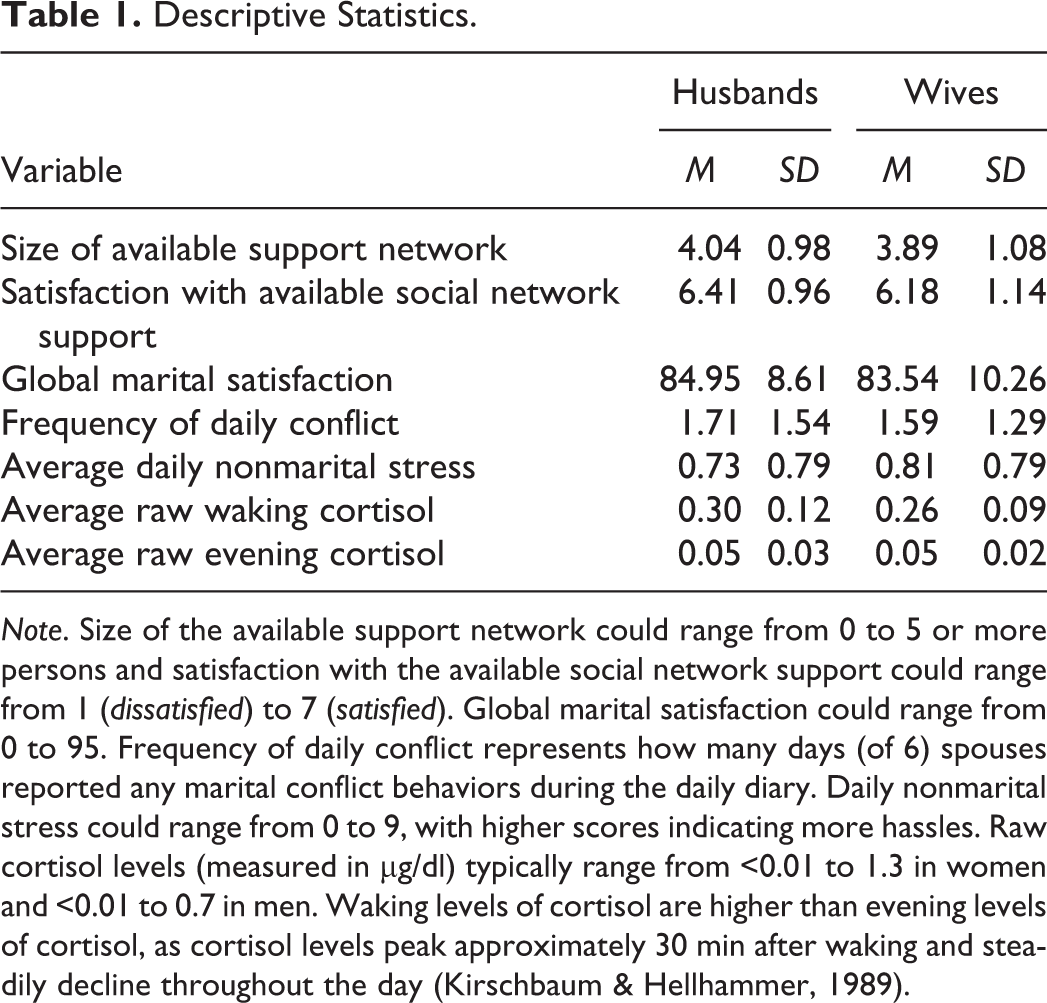
Note. Size of the available support network could range from 0 to 5 or more persons and satisfaction with the available social network support could range from 1 (dissatisfied) to 7 (satisfied). Global marital satisfaction could range from 0 to 95. Frequency of daily conflict represents how many days (of 6) spouses reported any marital conflict behaviors during the daily diary. Daily nonmarital stress could range from 0 to 9, with higher scores indicating more hassles. Raw cortisol levels (measured in μg/dl) typically range from <0.01 to 1.3 in women and <0.01 to 0.7 in men. Waking levels of cortisol are higher than evening levels of cortisol, as cortisol levels peak approximately 30 min after waking and steadily decline throughout the day (Kirschbaum & Hellhammer, 1989).
Is Daily Marital Conflict Linked to Flatter Diurnal Cortisol Slopes?
To examine whether spouses exhibited flatter diurnal cortisol slopes on days of higher versus lower marital conflict, the within-person association between daily marital conflict and daily diurnal cortisol slopes was modeled using the following equations:
Model


In this model, diary day, morning cortisol level, and daily reported marital conflict were centered within persons for each spouse. By adjusting for morning cortisol levels, the model becomes algebraically equivalent to a residualized regression approach, which reduces problems associated with change scores (Allison, 1990). Average reported marital conflict across the 6 diary days was centered between persons. This latter variable was included at the between-subjects level of the analysis (i.e., Level 2) in order to fully disentangle the within-person and between-person effects of marital conflict (Bolger & Laurenceau, 2013; Curran & Bauer, 2011). Adjusting for spouses’ mean levels of marital conflict allows us to examine the effect of daily conflict on a spouse’s diurnal cortisol slope while taking into account the fact that some spouses generally reported greater levels of marital conflict than did others. The between-person equations for each coefficient included a random effect. As seen in Table 2, on days when spouses reported greater marital conflict, they exhibited flatter cortisol slopes compared to days of lower conflict.
Association Between Daily Marital Conflict and Daily Diurnal Cortisol Slopes.

Note. CI = confidence interval; LL = lower limit; UL = upper limit. All effects are reported as unstandardized coefficients. All coefficients presented are pooled across gender. Approximate effect sizes were computed using the formula r = √(t2)/(t2 + df); Snijders and Bosker (1999).
Does Perceived Social Network Support Moderate the Association Between Daily Marital Conflict and Diurnal Cortisol?
Next, we examined whether spouses who perceived greater available and more satisfying social network support would exhibit steeper cortisol slopes on days of greater marital conflict in comparison to spouses who perceived less available and less satisfying social network support. Each type of social network support (i.e., quantity and quality of network support) was centered on the sample mean and added to the between-subjects level of the previous model to predict both the intercept (i.e., β0 and β1) and the covariation between daily marital conflict and daily cortisol slopes (i.e., β6 and β7). The moderating effects of quantity and quality of support were examined in separate analyses.
As seen in Table 3, although the size of spouses’ available social network did not significantly moderate the effect of daily marital conflict on diurnal cortisol slopes, satisfaction with social network support did. Predicted means for spouses with higher (+1 SD) and lower (−1 SD) levels of satisfaction with social network support are plotted across the actual range of daily conflict scores reported by participants (i.e., 0–5 instances per day) in Figure 1. Simple slopes analyses confirmed that spouses who reported lower satisfaction with social network support exhibited flatter cortisol slopes on days of greater marital conflict compared to days of lower marital conflict, b = −.08, SE = .02, t(128) = −3.29, p = .001, effect size r = .28. However, among spouses who were highly satisfied with their social network support, conflict was not associated with daily cortisol slopes, b = −.003, SE = .02, t(128) = −.14, p = .89, effect size r = .01. These results indicate that marital conflict may be less threatening for spouses who feel more satisfied with their external network of close others to turn to in times of need.
Moderating Effects of Quantity of Social Network Connections and Satisfaction With Social Network Support on the Association Between Daily Marital Conflict and Diurnal Cortisol Slopes.

Note. CI = confidence interval; LL = lower limit; UL = upper limit. All effects are reported as unstandardized coefficients. All coefficients presented are pooled across gender, df = 128. Approximate effect sizes were computed using the formula r = √(t2)/(t2 + df); Snijders and Bosker (1999). As daily conflict exhibited positive skew on several diary days, these analyses were rerun after daily conflict was subjected to a natural log transformation. Results revealed the same pattern of effects. Spouses exhibited flatter cortisol slopes on high conflict days, p = .03, effect size r = .20, and support satisfaction buffered this association p = .03, effect size r = .19 (see Online Supplemental Materials for full results).
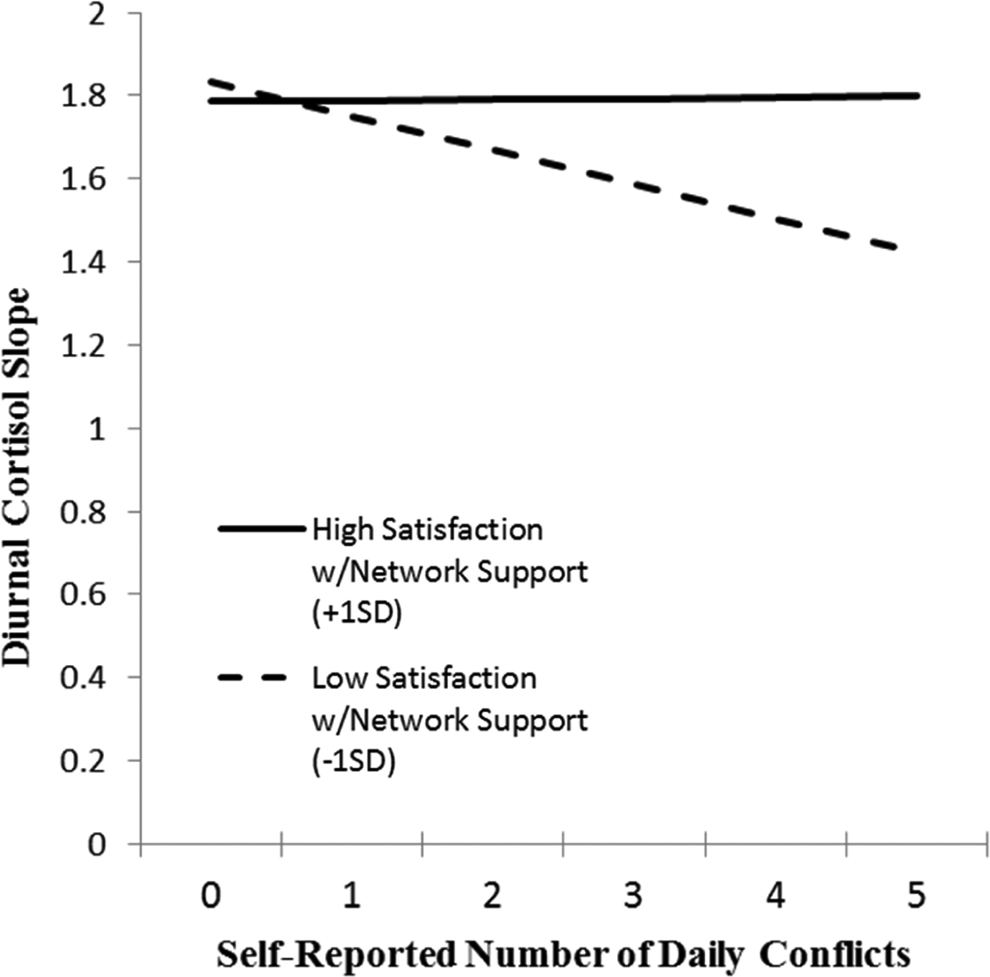
Moderating effects of satisfaction with available social network support on the link between daily marital conflict and spouses’ diurnal cortisol slopes. Flatter diurnal cortisol slopes (smaller values on the y-axis) are associated with poorer health outcomes (e.g., Adam & Kumari, 2009). To produce these predicted means, satisfaction with social network support was centered around the sample mean. Daily marital conflict was left on its original metric (actual range of scores is 0–5 on a given day). As reported in the text, satisfaction with social network support moderated the effect of daily conflict on diurnal cortisol, b = .03, SE = .01, t(128) = 2.44, p = .016, effect size r = .21. Although the effect of daily conflict on diurnal cortisol slopes was significant at low levels of support satisfaction, b = −.08, SE = .02, t(128) = −3.29, p = .001, effect size r = .28, this effect was not significant at high levels of support satisfaction, b = −.003, SE = .02, t(128) = −.14, p = .89, effect size r = .01.
Further analyses were conducted to ensure this effect held when adjusting for several covariates. To account for the strong diurnal rhythms of cortisol, the length of time that elapsed between spouses’ morning and evening cortisol assessments each day was included at the within-subjects level of the model (i.e., Level 1). Spouses’ nonmarital daily stress was also added to the within-subjects level of the model to ensure that changes in spouses’ diurnal cortisol slopes were not simply a function of experiencing more stress than usual outside the marriage. Both of these variables were centered within-person. Finally, to adjust for health factors linked to diurnal cortisol (i.e., BMI, age, and wives’ use of birth control), BMI and age were centered on the mean of the sample and all three variables were added to the between-subjects level of the analysis (i.e., Level 2) to predict the intercept (i.e., β0 and β1). As seen in Table 4, both the effect of daily conflict on diurnal cortisol slopes and the moderating effect of satisfaction with social network support remained significant when adjusting for these additional factors. 5
Moderating Effect of Satisfaction With Social Network Support on the Association Between Daily Marital Conflict and Diurnal Cortisol Slopes Including Additional Covariates.
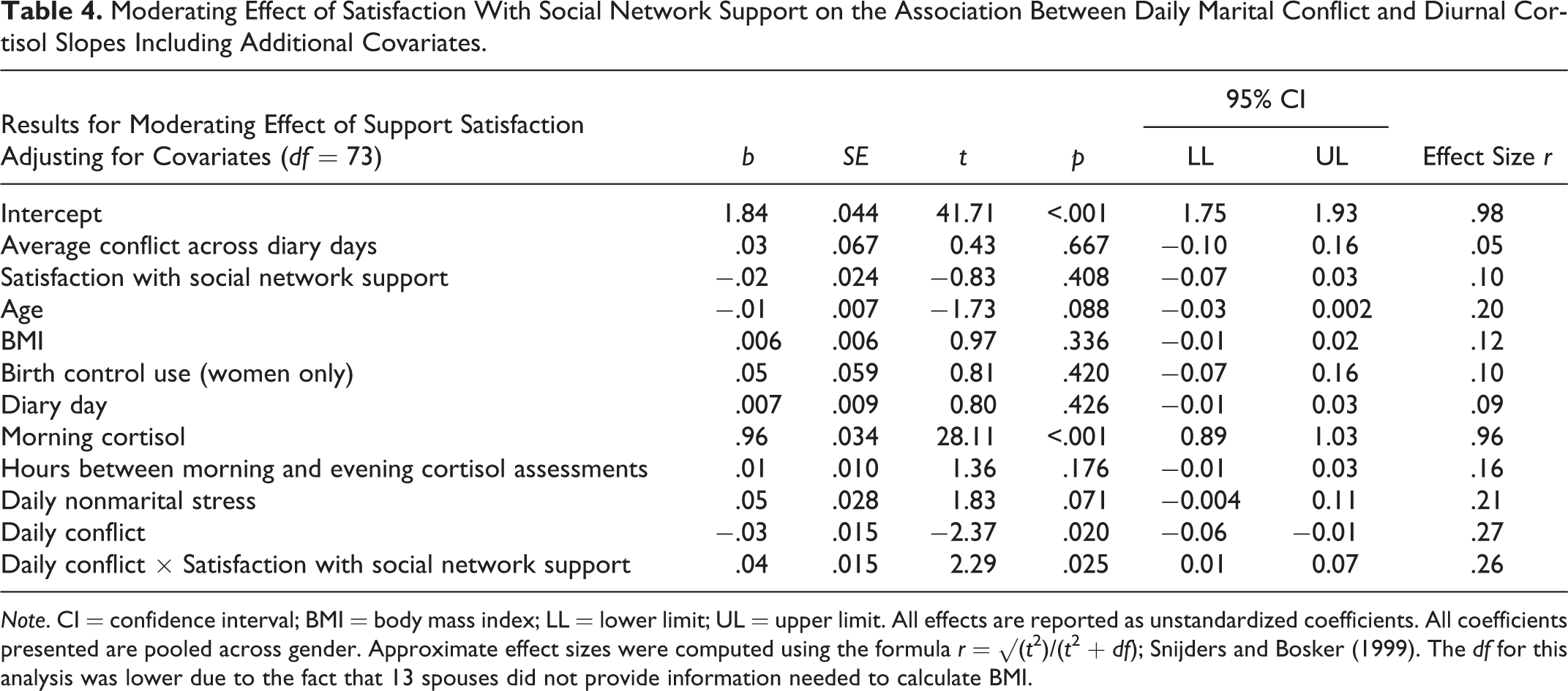
Note. CI = confidence interval; BMI = body mass index; LL = lower limit; UL = upper limit. All effects are reported as unstandardized coefficients. All coefficients presented are pooled across gender. Approximate effect sizes were computed using the formula r = √(t2)/(t2 + df); Snijders and Bosker (1999). The df for this analysis was lower due to the fact that 13 spouses did not provide information needed to calculate BMI.
Additional Analyses
Although there is not a strong theoretical basis for expecting the previous findings to be moderated by marital quality, additional analyses were conducted to examine the possibility that general marital satisfaction might be associated with spouses’ physiological responses to conflict and the extent to which spouses’ satisfaction with their social network support buffers those responses. Specifically, we expanded the model to include the main effect of marital satisfaction, the two-way interaction between marital satisfaction and daily conflict, and the three-way interaction between marital satisfaction, daily conflict, and satisfaction with social network support. Thus, this model fully adjusted for any effects of marital satisfaction.
As seen in Table 5, spouses’ marital satisfaction moderated the previously reported association between daily marital conflict, satisfaction with network support, and diurnal cortisol slopes. For spouses who reported higher levels of marital satisfaction (+1 SD), satisfaction with social network support did not predict the association between daily marital conflict and diurnal cortisol, b = −.003, SE = .021, t(126) = −.12, p = .91, effect size r = .01. For spouses who reported lower levels of marital satisfaction (−1 SD), however, satisfaction with social network support predicted the association between daily marital conflict and diurnal cortisol in the manner illustrated in Figure 1, b = .04, SE = .013, t(126) = 3.31, p < .001, effect size r = .28. Thus, the previously reported pattern of results seemed particularly strong for spouses who were generally less happy in their marriage. However, as there is no strong theoretical rationale for this effect, and power for detecting a three-way interaction was low, these results should be interpreted with caution.
Moderating Effect of General Marital Satisfaction on the Associations Between Social Network Support, Daily Marital Conflict, and Diurnal Cortisol Slopes.

Note. CI= confidence interval; LL = lower limit; UL = upper limit. All effects are reported as unstandardized coefficients. All coefficients presented are pooled across gender, df = 126. Approximate effect sizes were computed using the formula r = √(t2)/(t2 + df); Snijders and Bosker (1999). As reported in the Online Supplemental Materials, the three-way interaction between marital satisfaction, daily conflict, and satisfaction with social network support held when also including all the additional covariates presented in Table 4, b = −.03, SE = .006, t(71) = −4.94, p < .001, effect size r = .51.
Discussion
Although laboratory studies have demonstrated robust links between marital conflict and negative physiological outcomes, empirical evidence for such links in couples’ home environments is limited. The current study addressed this gap by examining whether couples’ naturally occurring, day-to-day marital conflicts are associated with spouses’ diurnal cortisol slopes, which are a powerful predictor of objective health outcomes (Kumari, Shipley, Stafford, & Kivimaki, 2011). On average, spouses exhibited flatter (i.e., less healthy) diurnal cortisol slopes on days of greater conflict; however, this association was moderated by the extent to which spouses felt satisfied with the availability of support outside their marriage. Specifically, spouses who reported being more satisfied with the availability of friends and family, whom they knew they could connect with during times of marital conflict, experienced conflict as less physiologically stressful. These findings, then, suggest a potential mechanism for why perceived support is often linked to positive long-term health outcomes (e.g., Thoits, 2011; Uchino, 2013). Over time, this physiological buffering may manifest in improved health outcomes by slowing the accumulation of the negative consequences typically associated with daily hassles (DeLongis, Coyne, Dakof, Folkman, & Lazarus, 1982).
Notably, the sheer number of network members that spouses reported being able to turn in times of need did not moderate the association between daily marital conflict and diurnal cortisol. Thus, consistent with themes found throughout the broader support network literature (e.g., VanderVoort, 1999), the quality, and not just the quantity, of spouses’ social ties mattered for well-being. As suggested by the substitution hypothesis of belonging (Baumeister & Leary, 1995), when spouses detect disruptions in their feelings of connectedness with one another (i.e., during relationship conflict) their other social resources (i.e., available social network support) may become salient. It seems that feeling connected to just a few close others outside the marriage can compensate for temporary detriments in belonging experienced inside the marriage.
Nevertheless, further work is needed to examine these processes in other samples. For example, although results suggested that maintaining satisfying social connections may be particularly important for spouses in relatively less happy marriages, the current newly married sample reported generally high levels of marital satisfaction on average. In light of work indicating that support from friends and family cannot fully compensate for a poor quality marriage (Coyne & DeLongis, 1986), the benefits of having a satisfying support network may be diminished among couples in truly distressed relationships.
Another study limitation is that all data are correlational. Although we argue that marital conflict should lead to flatter cortisol slopes, it is possible that the direction of causality is reversed. As reported in the Online Supplemental Materials, additional analyses aimed to help clarify this issue indicated that the association between daily conflict and daily cortisol may be bidirectional; although daily conflict was consistently predictive of evening cortisol levels, some evidence suggested that waking cortisol levels also may predict spouses’ reports of marital conflict that day. Thus, further work is needed to investigate more complex associations between daily conflict and diurnal cortisol.
Conclusion
Relationship researchers often assert that “no couple is an island” (Felmlee, 2001, p. 1259) as relationships do not unfold in isolation. However, couples do vary in the extent to which they feel connected to others outside their romantic relationships. Indeed, sociologists have noted that couples in the United States are more socially isolated today than in the past (Amato, 2009). Whereas couples were well integrated in extended kin networks and regularly participated in civic, religious, and recreational groups several decades ago, these opportunities for social connection are limited in today’s individualistic society (Putnam, 2000). Unfortunately, this lower overall level of social integration may contribute to negative health outcomes over time, as couples find themselves less able to depend on social connections outside their relationships to buffer them against the stress of conflict with a romantic partner (see also Finkel, Hui, Carswell, & Larson, 2014).
On a more positive note, though, results indicated that spouses’ satisfaction with network support, and not the number of available support network members, dampened physiological responses to marital conflict. Thus, although modern social networks are smaller than in previous decades (Amato, 2009; Putnam, 2000), partners are still able to derive benefits from having a few, satisfying sources of social support. In essence, spouses who have satisfying social network support know that resources are available to help them “weather the storm” when there is “trouble in paradise.”
Supplemental Material
SPPS731499_suppl_mat - The Importance of a Few Good Friends: Perceived Network Support Moderates the Association Between Daily Marital Conflict and Diurnal Cortisol
SPPS731499_suppl_mat for The Importance of a Few Good Friends: Perceived Network Support Moderates the Association Between Daily Marital Conflict and Diurnal Cortisol by Elizabeth Keneski, Lisa A. Neff, and Timothy J. Loving in Social Psychological and Personality Science
Footnotes
Authors’ Note
Any opinion, findings, and conclusions or recommendations expressed in this material are those of the authors and do not necessarily reflect the views of the National Science Foundation.
Declaration of Conflicting Interests
The author(s) declared no potential conflicts of interest with respect to the research, authorship, and/or publication of this article.
Funding
The author(s) disclosed receipt of the following financial support for the research, authorship, and/or publication of this article: This work was supported by the National Science Foundation under Grant DGE-1110007 awarded to the first author and under Grant BCS-0921896 awarded to the second author.
Notes
Supplemental Material
The supplemental material is available in the online version of the article.
References
Supplementary Material
Please find the following supplemental material available below.
For Open Access articles published under a Creative Commons License, all supplemental material carries the same license as the article it is associated with.
For non-Open Access articles published, all supplemental material carries a non-exclusive license, and permission requests for re-use of supplemental material or any part of supplemental material shall be sent directly to the copyright owner as specified in the copyright notice associated with the article.
