



Abstract
The racial categorization literature, reliant on forced-choice tasks, suggests that mixed-race targets are often categorized using the parent faces that created the racially mixed stimuli (e.g., Black or White) or their combination (e.g., Black–White multiracial). In the current studies, we introduce a free-response task that allows for spontaneous categorizations of higher ecological validity. Our results suggest that, when allowed, observers often classify Black–White faces into alternative categories (i.e., responses that are neither the parent races nor their combination), such as Hispanic and Middle Eastern. Furthermore, we find that the stereotypes of the various categories that are mapped to racially mixed faces are distinct, underscoring the importance of understanding how mixed-race targets are spontaneously categorized. Our findings speak to the challenges associated with racial categorization in an increasingly racially diverse population, including discrepancies between target racial identities and their racial categorizations by observers as well as variable stereotype application to mixed-race targets.
In recent years, increased racial diversity around the world (e.g., U.S. Census Bureau, 2011b; UK Office for National Statistics, 2013) has prompted a growth in research on how faces with mixed-race features are categorized. This research has almost exclusively relied on forced-choice tasks that restrict responses to the parent races (sometimes including a multiracial category), consistent with the identities expressed by mixed-race individuals (Pew Research Center, 2015). Some findings indicate a tendency for minority race categorizations (e.g., Black for a Black–White mixed-race target), a phenomenon termed hypodescent (e.g., Ho, Sidanius, Levin, & Banaji, 2011), whereas other findings indicate a tendency for multiracial categorizations (e.g., Chen & Hamilton, 2012).
However, the racial categorizations of observers may not always align with the identities of mixed-race people (cf. Richeson & Sommers, 2016). In everyday interactions, observers—unlike targets themselves—rarely have access to ancestry or identity information, increasing the likelihood that they might ascribe mixed-race target faces to alternative categories (i.e., neither the parent races nor their combination). For example, children with one Black and one White parent may be erroneously categorized as Middle Eastern. There are several psychological and contextual factors that may contribute to such alternative categorizations: (a) motivation to uphold the racial hierarchy, (b) widespread beliefs in racial essentialism, and (c) greater exposure to alternative racial categories relative to the category multiracial.
Motivation to uphold the existing racial hierarchy, which has been argued to satisfy basic needs for both high- and low-status racial groups (Jost, Banaji, & Nosek, 2004), may lead observers to avoid multiracial categorizations, which blur extant racial boundaries (Ho et al., 2011). Furthermore, in the United States, there is a tendency to essentialize race (i.e., see race as biologically determined; e.g., Jayaratne, Sheldon, Brown, Feldbaum, & Petty, 2006). To the extent that racial categories are seen as distinct and biologically determined, this theory predicts that categorical views of race should be common. Indeed, increased race essentialism among perceivers predicts avoidance of multiracial categories (e.g., Chen & Hamilton, 2012). Overall, these motivations and beliefs may reduce the likelihood that mixed-race individuals will be categorized as multiracial.
If people are motivated to avoid multiracial categorizations, the question becomes, how will mixed-race targets be categorized? Both prototype (e.g., Reed, 1972) and exemplar (e.g., Nosofsky, 1986) models of categorization posit that similarity between a target and a category’s representation is central to categorization. Thus, in the case of Black–White multiracial individuals, perceivers may categorize these targets as Hispanic or Middle Eastern, groups with facial features (e.g., skin tone) that often fall somewhere between those of Whites and Blacks (e.g., Bertoni, Budowlem, Sans, Barton, & Chakraborty, 2003). Given that category learning is dependent on the frequency of exemplar encounters (Kruschke, 2005), “Hispanic” and “Middle Eastern” are likely more salient categories in the United States than “multiracial.” This notion is supported by the racial composition of the United States (17% Hispanic, 3% Middle Eastern, and 1% Black–White multiracial; U.S. Census Bureau, 2011b) as well as representations of race in the media (e.g., Smith, Choueiti, & Pieper, 2017). Thus, the physical similarities between Black–White multiracials and alternative racial groups (e.g., Hispanics) and the greater presence and social salience of these groups likely result in alternative categorizations of mixed-race individuals.
This evidence suggests that, overall, people in the United States will not tend to spontaneously categorize Black–White mixed-race targets as multiracial, instead applying more readily accessible alternative categories, such as Hispanic and Middle Eastern. In fact, some have posited (and found some preliminary evidence for) similar alternative categorization patterns (e.g., Corneille, Huart, Becquart, & Brédart, 2004; Huart, Corneille, & Becquart, 2005; Peery & Bodenhausen, 2008). Yet, the possibility of alternative categorizations has largely been ignored (see Nicolas & Skinner, 2017), and no study has provided a formal account of spontaneous racial categorizations of mixed-race faces.
Whether a mixed-race individual is categorized as multiracial, Black, White, or an alternative category can have profound real-life consequences for that individual. Specifically, racial categorization can activate salient stereotypes associated with a target’s perceived group (Macrae & Bodenhausen, 2000), which can impact judgments of and behaviors toward that target. For example, racial categorization can affect automatic responses, such as a police officer’s determination of whether a suspect is armed (e.g., Correll, Park, Judd, & Wittenbrink, 2002) or whether to use force on a suspect (Payne, 2001). It can also affect more controlled judgments, like a jury deciding whether to convict someone (Eberhardt, Davies, Purdie-Vaughns, & Johnson, 2006). Indeed, discrimination against targets identified as Hispanic or Middle Eastern is a well-documented phenomenon in many everyday situations, including unwarranted police searches of Hispanic-looking targets (e.g., Pilkington, 2012) and excessive scrutiny of Middle Eastern and Hispanic air passengers (e.g., Schmidt & Lichtblau, 2012).
The Current Studies
In the current studies, we introduced a free-response task to test whether U.S. participants would be more likely to place Black–White mixed-race targets into alternative versus multiracial racial categories. To the extent that spontaneous responses are more like real-world responses, where there are no constraints on response options, a free-response task is more ecologically valid than forced-choice tasks. If free-response racial categorizations differ from accepted accounts of predominantly Black and multiracial categorizations of mixed-race targets (based on forced-choice tasks), it would highlight the importance of incorporating open-ended measures and acknowledging task-dependent variation in racial categorization theorizing and replicability.
Consistent with previous research suggesting that perceivers are motivated to uphold the existing racial hierarchy, tend to essentialize race, and are more often exposed to alternative racial categories than the category multiracial—we hypothesized that participants would use alternative racial categorizations (such as “Hispanic” and “Middle Eastern”) more often than multiracial categorizations (Hypothesis 1). Additionally, in Study 1, we compared our free-response task to widely used forced-choice tasks to examine the task dependence of previous reports of high multiracial categorization rates (e.g., Chen & Hamilton, 2012). We hypothesized that multiracial categorizations would be much more common when multiracial was the only available response option other than the parent racial categories (Hypothesis 2). Finally, in Study 2, we measured the stereotypes of the distinct categories (e.g., multiracial, Hispanic) that are applied to Black–White mixed-race targets. We hypothesized that participants would distinctly stereotype these groups (Hypothesis 3), highlighting the potentially critical implications of these categorizations for the lives of mixed-race targets. Data and materials for both studies are available online at https://osf.io/6h2rf/?view_only=ec3d24689fd640fbad41a3a747514e6b.
Study 1
In our first study, we examined whether alternative categorizations would be more common than multiracial categorizations in a free-response task, and how commonplace trichotomous (i.e., Black vs. White vs. multiracial) and polytomous (i.e., Black vs. White vs. both Black and White vs. neither Black nor White) forced-choice tasks may inflate multiracial categorization rates.
Method
Participants
Participants were 211 (after removal of 6 participants for technical issues with the microphone recording) students recruited from a medium-sized college in VA, 1 United States, with a mean age of 20.04 (SD = 2.95), who were mostly female (62%) and mostly White (53%, 18% Asian, 9% Black, and 20% other races/ethnicities). The university’s institutional review board approved all materials and procedures.
Using the effect size (h = .65) from a pilot study, power analyses for a two-sample proportion test indicated that a sample size of 200 provided more than 90% power to test our primary hypotheses.
Materials
Black and White faces of both genders were obtained from several databases and digitally morphed to obtain variation in a Black–White continuum. For Study 1, a total of 80 faces were used, half male, and distributed across five levels of racial phenotypicality (0% Black/100% White, 25% Black/75% White, 50% Black/50% White, 75% Black/25% White, and 100% Black/0% White). See Figure 1 for examples and Supplemental Material for details on creation of stimuli.
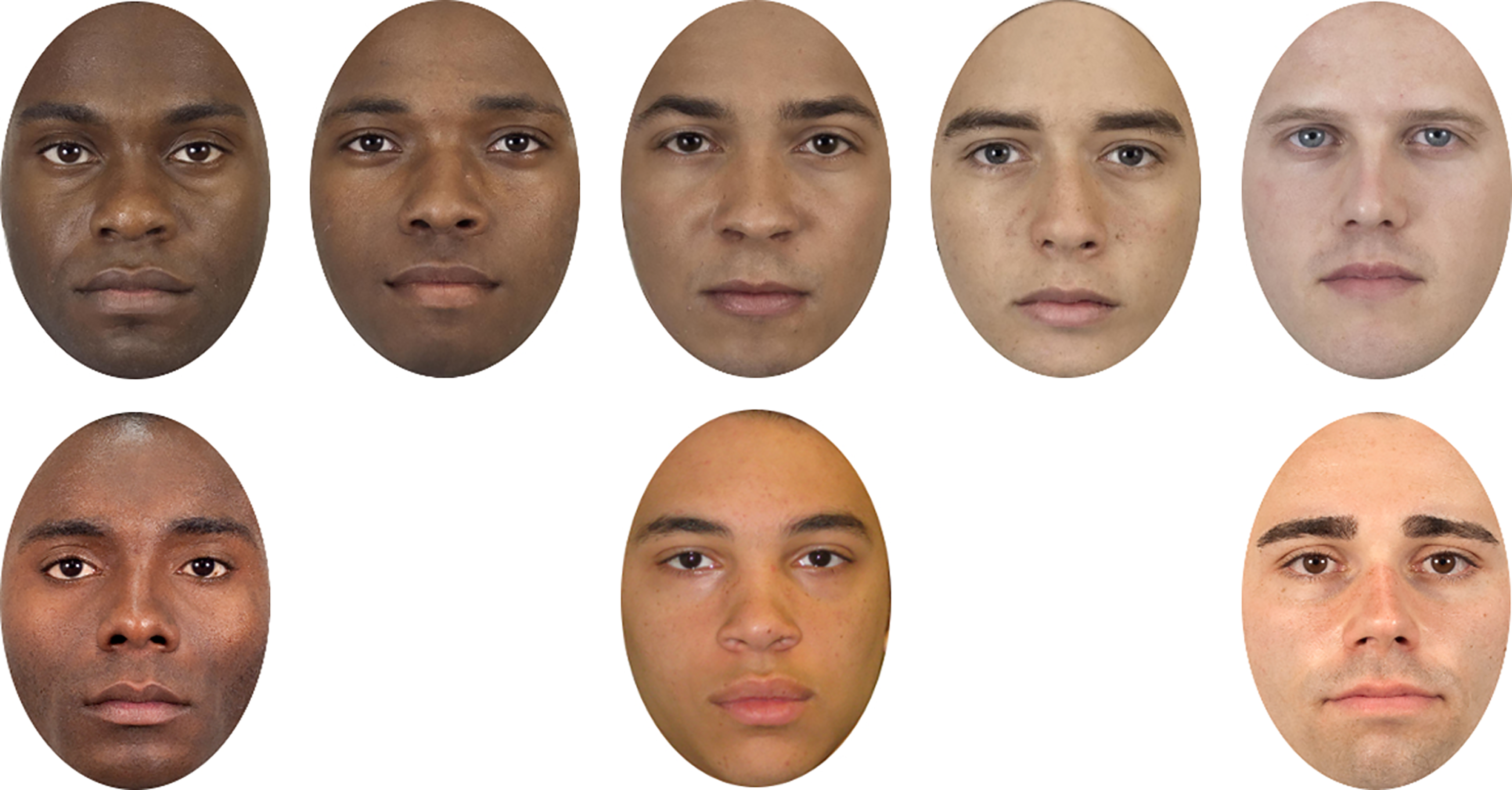
Examples of facial stimuli. Top row are morphed stimuli from Study 1 and Study 2, and bottom row are real face stimuli from Study 2. Faces are in order of phenotypicality from 100% Black to 100% White.
Procedure
Participants came into the lab and were run in groups of up to four. Each participant was randomly assigned to one of the four categorization tasks: dichotomous (Black vs. White), trichotomous (Black vs. White vs. multiracial), polytomous (Black vs. White vs. Both Black and White vs. Neither Black nor White), or free-response. 2 In the main text, we describe and present results for multiracial categorizations in the trichotomous and polytomous tasks as well as for multiracial and alternative categorizations in the free-response tasks. Analyses of Black and White categorizations were exploratory and are presented in the Supplemental Material.
In the trichotomous task (Chen & Hamilton, 2012), participants were asked to make either White, Black, or multiracial categorizations using the “s,” “l,” and space keyboard keys. For the polytomous task (Peery & Bodenhausen, 2008), participants completed two blocks of trials: a block making “White” versus “not White” categorizations and a block making “Black” versus “not Black” categorizations. The White (vs. non-White) and Black (vs. non-Black) blocks were subsequently combined, resulting in four categories: White (White and non-Black), Black (non-White and Black), a proxy for multiracial (White and Black), and a proxy for alternative (non-White and non-Black).
Finally, for the free-response task, participants were run in a private room and asked to speak into a microphone identifying the race of the face. Voice responses were automatically transcribed through Inquisit 3.0 and checked for accuracy by research assistants. For all tasks, participants saw every face twice for a total of 160 randomly presented trials (faces remained on the screen until response; interstimulus interval = 1,500 ms). The polytomous tasks had half as many data points as the other tasks, despite the same number of trials, given that two separate responses are needed to create each data point. See Supplemental Material for reaction time results.
Once participants finished the categorization task, they completed a sorting task in which they sorted 30 racial labels into up to 10 piles based on how racially similar they were. Labels were obtained from a pilot free-response task (N = 29) conducted using similar stimuli. Lastly, participants completed demographic questions.
Analysis Strategy
The sorting task results were analyzed using hierarchical clustering (complete method) to explore the similarity structure between the social groups included (see Supplemental Material). The results of this analysis were used to guide our coding of the responses from the free-response task by cutting the dendrogram in a way that maximizes the distinctiveness of the largest number of clusters. This resulted in Black, White, multiracial, Hispanic, Middle Eastern, and Other being coded separately.
We used R 3.3.3 to conduct a series of mixed models with participants and targets as crossed random factors, as well as their interaction, where appropriate. We specified maximal models where convergence allowed it. All categorical predictors were effect coded, and the phenotypicality predictor (five levels) was treated as continuous and centered at the 50% level. We expected multiracial responses to be most common for the most ambiguous faces (closest to 50%), so we fit a quadratic term for the model predicting multiracial categorizations.
Given the multinomial nature of our main outcome, we dummy coded each categorization decision (yes or no) to indicate if the target was categorized as Black, White, multiracial, or given an alternative category, and used logistic regression. For analyses using free-response task data only, we decomposed the alternative category into Hispanic, Middle Eastern (the most frequent alternative categorizations), or another category (for more idiosyncratic responses). Additionally, for pairwise comparisons in the free-response task, we subset the outcome variable to include only the two categories of interest and recoded it to indicate which of these two categorizations was selected. We focus on reporting easily interpretable predicted probabilities (and observed proportions), but for main hypothesis tests, we also report log-odds as a standardized measure of effect size. Regression coefficients and Z tests are presented for continuous predictors, and χ2 with Tukey’s pairwise comparison Z tests for categorical predictors.
Results
Free-Response Task Results
First, we test Hypothesis 1, that alternative categorizations would be more common than multiracial categorizations for mixed-race faces on the free-response task (see Figure 2). We start by comparing multiracial categorization rates to overall alternative categorizations. Note that models comparing different categorizations use a subset of the data necessary for these kinds of contrasts (e.g., this model includes only observations with multiracial or alternative responses). As predicted, alternative categorizations (>99%) were more common than multiracial categorizations (<1%), χ2(1) = 62.66, p < .001, log-odds = −11.83, 95% CI [−14.74, −8.90], regardless of phenotypicality, Zs < 0.90, ps > .366. Breaking down the distribution of alternative categories, we found that the most common among these were Hispanic categorizations (69%), followed by Middle Eastern categorizations (14%). Similar to analyses of the more general alternative categorizations, Hispanic categorizations were more likely than multiracial categorizations, χ2(1) = 54.10, p < .001, log-odds = 11.48, 95% CI [8.42, 14.54] as were Middle Eastern categorizations, χ2(1) = 32.95, p < .001, log-odds = 14.38, 95% CI [9.34, 19.41].
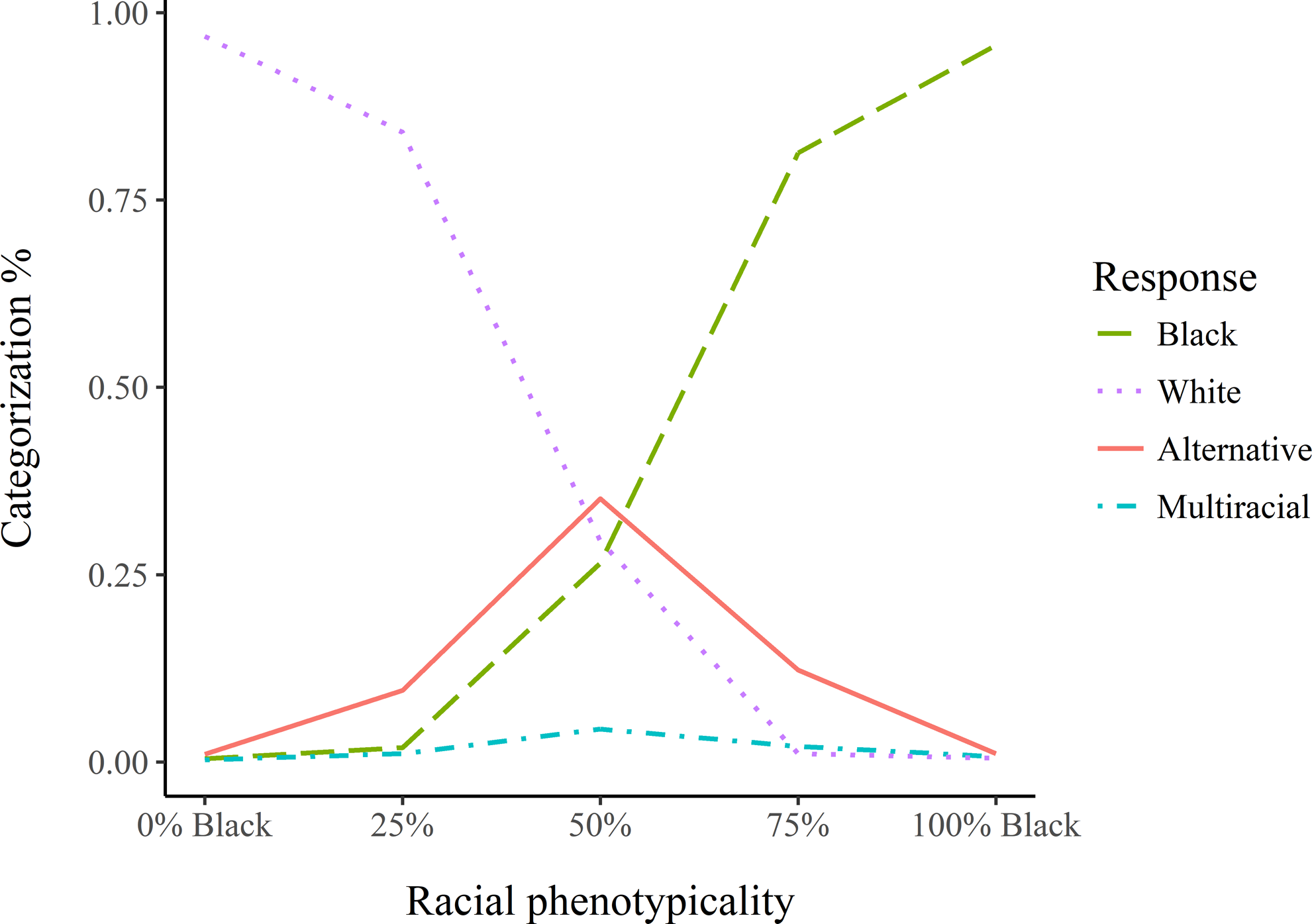
Free-response task categorizations (observed) in Study 1.
Task Effects on Multiracial Categorizations
Next, we tested Hypothesis 2, that multiracial categorizations would be more common in the trichotomous than polytomous and free-response tasks. Thus, task was also included as a predictor in the following models.
We observed a quadratic effect of target phenotypicality, b = −1.16, Z = −9.04, p < .001, such that multiracial categorizations were most common among the most ambiguous faces (50%). In addition, we found an effect of task, χ2(2) = 190.42, p < .001, and an interaction between task and phenotypicality, χ2(4) = 28.65, p < .001 (see Figure 3).
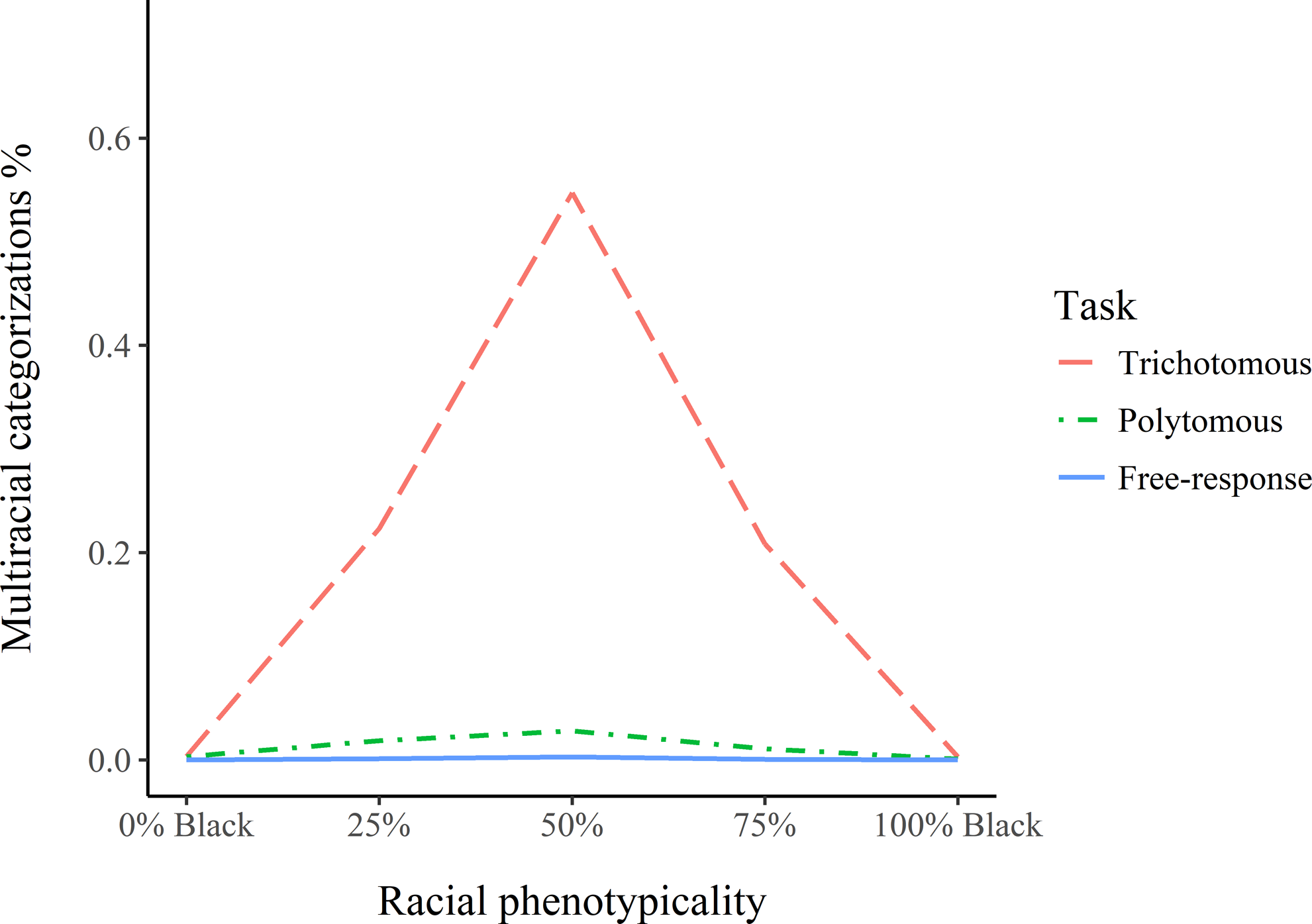
Multiracial categorizations (observed) in Study 1.
To decompose the interaction, we conducted planned contrasts. We focused on the probability of multiracial categorizations for the mixed-race faces (25%, 50%, and 75% faces) and found the predicted pattern of overestimation of multiracial categorizations in the trichotomous task when compared to both the polytomous task, Z = 7.87, p < .001, log-odds = 3.21, 95% CI [2.26, 4.17], and the free-response task, Z = 13.43, p < .001, log-odds = 5.93, 95% CI [4.90,6.97]. The polytomous task also resulted in more multiracial categorizations when compared to the free-response task, Z = 5.82, p < .001, log-odds = 2.72, 95% CI [1.62, 3.82]. See Table 1 for categorization probabilities across all tasks.
Study 1: Probabilities for the Combined 25%, 50%, and 75% Black Faces.
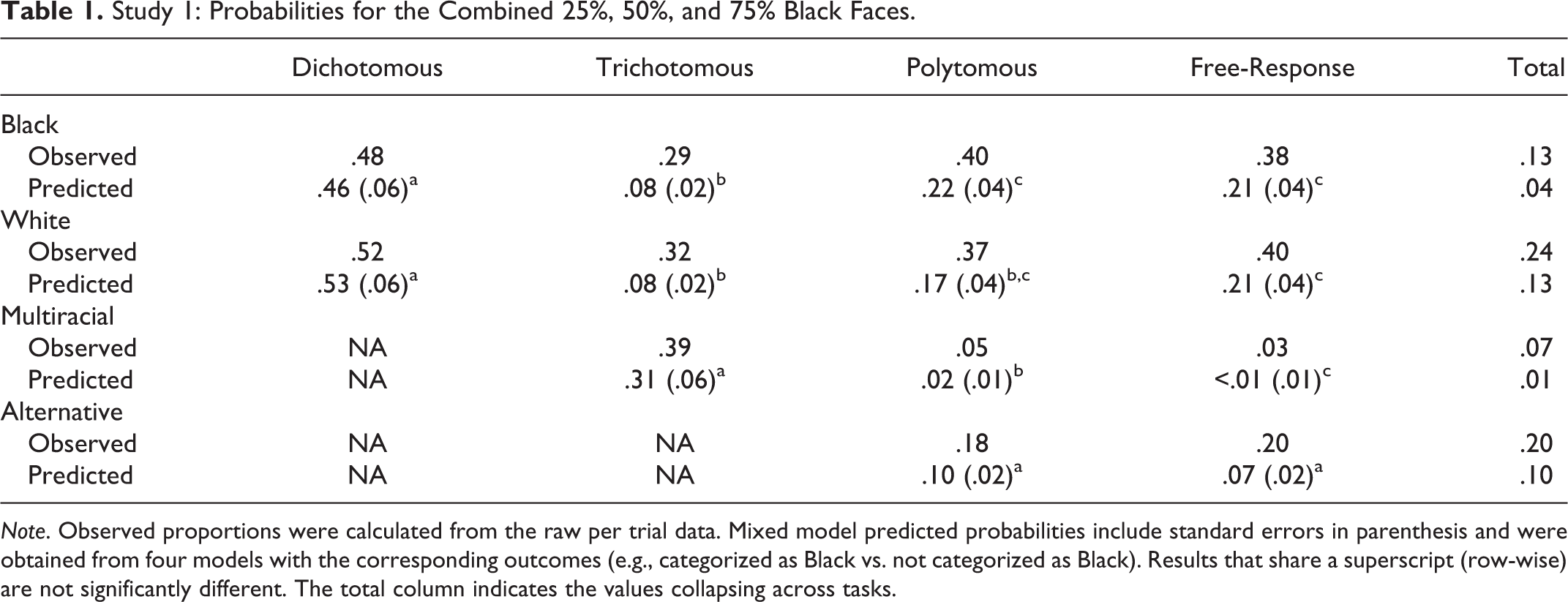
Note. Observed proportions were calculated from the raw per trial data. Mixed model predicted probabilities include standard errors in parenthesis and were obtained from four models with the corresponding outcomes (e.g., categorized as Black vs. not categorized as Black). Results that share a superscript (row-wise) are not significantly different. The total column indicates the values collapsing across tasks.
Discussion
Consistent with Hypothesis 1, we found that Black–White mixed-race faces were categorized with alternative categories more frequently than multiracial. We identified these alternative categories as predominantly “Hispanic” and “Middle Eastern.”
In line with Hypothesis 2, we found that the trichotomous task overestimated multiracial categorizations. The polytomous task also resulted in more multiracial categorizations (compared to the free-response task, but the rate was lower than for the trichotomous task), despite indirectly allowing for an alternative category response. Yet, we cannot know whether task demands or increased saliency of the multiracial category explain the larger proportion of multiracial categorizations in the forced-choice tasks; we address this issue in Study 2. Altogether, these results provide evidence that, at least within the United States, mixed-race faces are often categorized using alternative categories, such as Hispanic and Middle Eastern.
Study 2
In this study, for the first time, the content of stereotypes of the categories most often spontaneously applied to mixed-race targets in the United States (Black, White, multiracial, Hispanic, and Middle Eastern) are compared. We hypothesized that the stereotypes applied to these various groups would significantly differ from one another (Hypothesis 3). We also explored differences in stereotype knowledge (i.e., the degree to which participants can recall stereotypes about a category). Investigation of stereotypes serves several purposes: (a) It validates the sorting task clustering indicating that Hispanic and Middle Eastern are distinct meaningful categories, with uniquely associated schemas, (b) it provides evidence of the downstream implications of different racial categorizations of mixed-race targets, and (c) it provides insight into whether the multiracial category is meaningful to observers (as opposed to a filler, when no other response option fits a target). Although previous research has explored some stereotypes about multiracials in isolation (e.g., Remedios, Chasteen, & Oey, 2012), here we examined how these stereotypes compare to those of other relevant racial categories.
We also aimed to replicate our free-response task findings. To examine the robustness of this effect, we (a) used a more diverse set of stimuli—including real images of mixed-race people and morphed faces and we (b) manipulated the salience of the multiracial category. We predicted that telling participants that some targets were mixed race would increase multiracial categorizations, but that alternative categorizations would still be more frequent. That is, we expected Hypothesis 1 to hold for a wide variety of stimuli and regardless of the salience of multiracial as a category.
Method
Participants
Participants were 119 students recruited from an undergraduate participant pool at a medium-sized college in Virginia, with a mean age of 19.01 (SD = 0.95), and mostly female (67%). Most participants were White (64%), followed by Asian (16%) and Black (9%). The university’s institutional review board approved all materials and procedures. The selected sample size provided over 90% power for our main hypothesis, approximated from a one-sample proportion test for comparing alternative (22%) to multiracial (approximately 0%) categorizations at 50% Black/White (Study 1 probabilities). 3
Materials
Given that most of the variability in categorizations in Study 1 was found for the 50% faces, for Study 2, we decreased phenotypicality levels to three: 100% Black/0% White, 50% Black/50% White, and 0% Black/100% White. We selected a subset of 10 faces from each of these levels in Study 1 as our morphed face stimuli. Additionally, we included 30 real face photographs of Black, White, and Black–White multiracials. Thus, a total of 60 faces were used, 20 from each level of phenotypicality, half of each gender, and half real/half morphed.
Procedure
Participants came into the lab and were run in groups of up to four participants. For this study, we used a typed version of the free-response task using Microsoft Word and the key-logger software Inputlog 7. Participants saw one face at a time and pressed the page down key to move to the next trial. Additionally, they could see what they were typing and make corrections if needed. Participants in both the multiracial salience and control conditions were instructed to type the race(s) of the face, and those in the multiracial salience condition were additionally told that they would see “faces of monoracial and mixed-race individuals.” Participants saw each face once and then proceeded to complete a series of questionnaires.
The questionnaires in Study 2 included two stereotype measures, exploratory measures (see Supplemental Material), and demographics. The stereotype content scale (Fiske, Cuddy, Glick, & Xu, 2002) measured judgments of warmth (items: friendly and sincere) and competence (items: efficient and competent) for Whites, Blacks, Black–White multiracials, Hispanics, and Middle Easterners on 5-point scales. The open-ended stereotype measures asked participants to list three one-word stereotypes culturally associated with each group. Responses were coded by two White researchers (Blind to condition) to group words that broadly referred to the same concept (e.g., “thief” and “steals”).
Analysis Strategy
Mixed models were used for analysis as described in Study 1. All categorical predictors were effect coded, including the racial phenotypicality variable. We used the same coding scheme for participants’ responses as in our previous study.
Results
Free-Response Task Results
Preliminary results confirmed that the Black and White faces were almost exclusively categorized with their concordant category, so we focused only on the mixed-race faces. See Figure 4 for the pattern of results for all data.
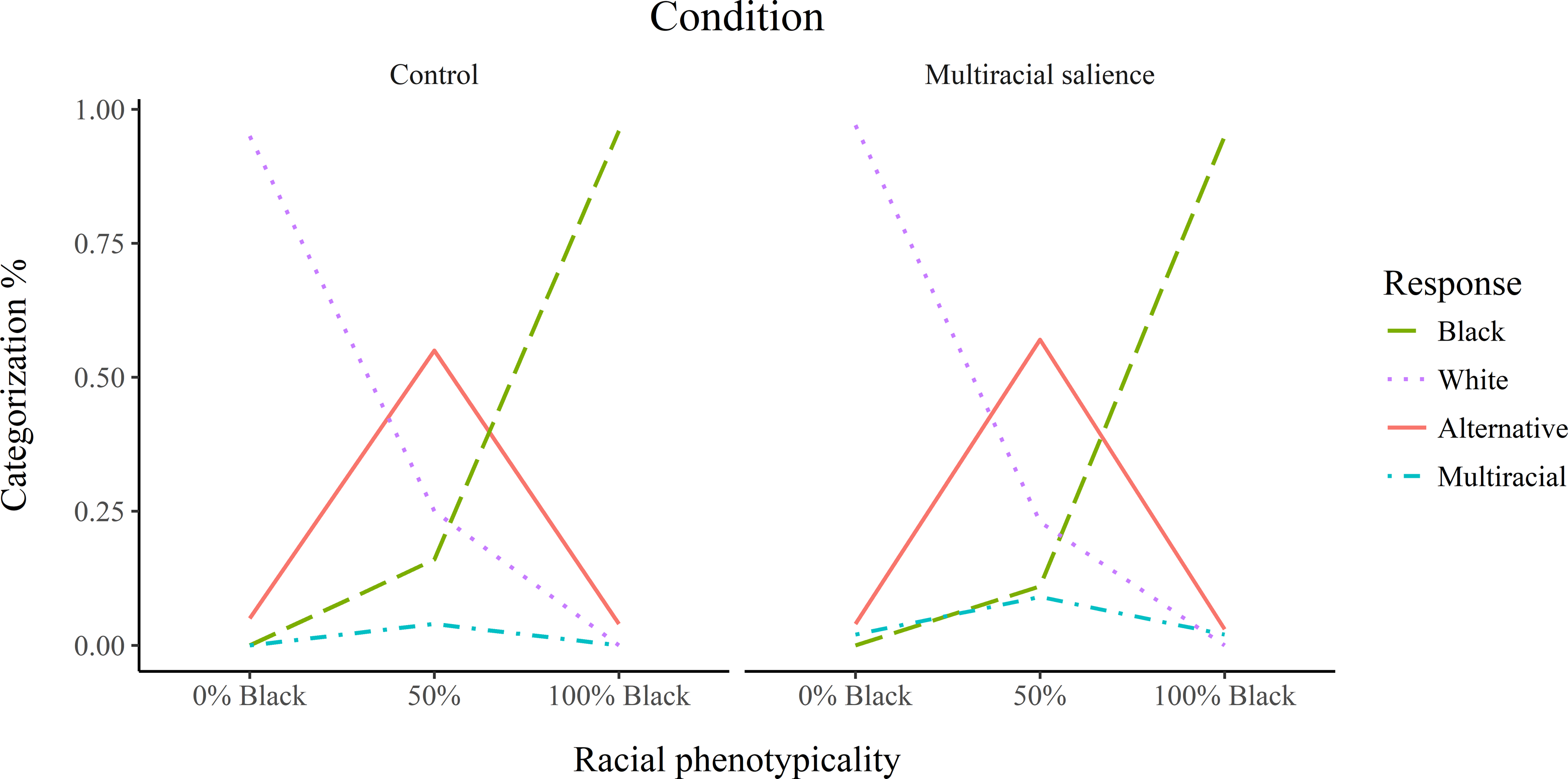
Study 2: categorizations (observed) per multiracial salience condition.
In support of Hypothesis 1, alternative categorizations were significantly more common (98%) than multiracial categorizations (2%), χ2(1) = 71.83, p < .001, log-odds = 4.12, 95% CI [3.17, 5.07]. Hispanic categorizations made up most of the alternative categorizations (59%) followed by Middle Eastern (18%). As with the more general alternative categorizations, Hispanic categorizations were more common than multiracial categorizations, χ2(1) = 41.44, p < .001, log-odds = 3.77, 95% CI [2.62, 4.92], although Middle Eastern categorizations were only marginally more common than multiracial categorizations, χ2(1) = 3.69, p = .055, log-odds = 1.62, 95% CI [−0.03, 3.25].
There was no significant difference between real and morphed faces in rates of alternative versus multiracial categorizations, χ2(1) = 0.06, p = .802. As predicted, our multiracial salience manipulation increased multiracial categorizations (.07%), relative to the control condition (.02%), χ2(1) = 5.50, p = .019, log-odds = −1.29, 95% CI [−2.36, −0.21]. However, multiracial categorizations were extremely rare (<1%) in both conditions.
Stereotype Content and Knowledge
Supporting Hypothesis 3 (see Figure 5), the racial categories we examined significantly differed from one another in terms of their warmth, F(4, 447.15) = 66.65, p < .001, and competence stereotypes, F(4, 447.15) = 86.22, p < .001. See Table 2 for group means.
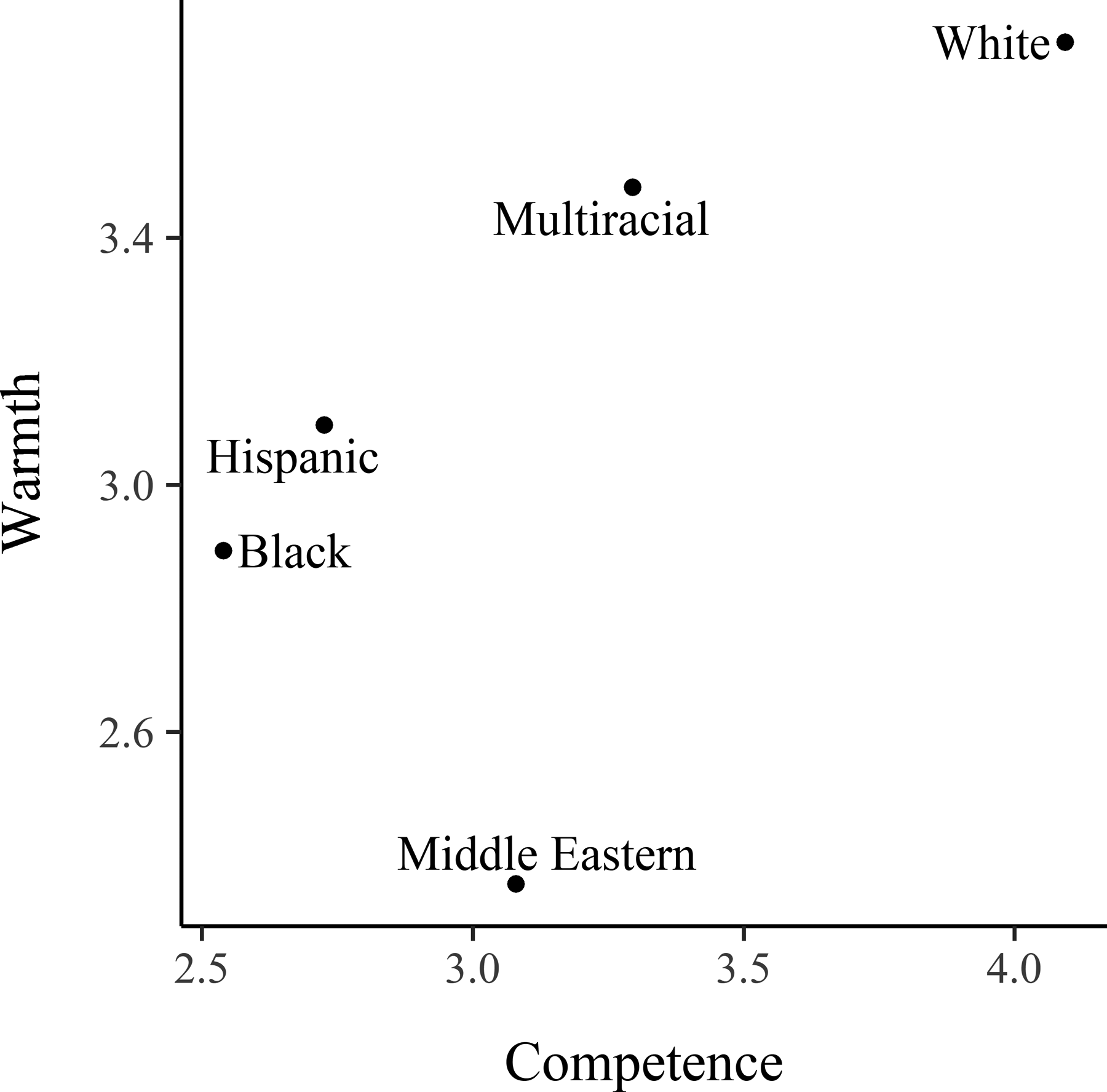
Study 2: stereotype content map.
Study 2: Warmth and Competence Ratings.

Note. Values in the same row with the same superscript are not significantly different from each other (p < .05).
Similarly, open-ended responses demonstrate that each category was attributed unique stereotypes (see Table 3). To explore stereotype knowledge, we examined the number of stereotypes listed for each group finding that although participants provided an average of 2.25 stereotypes about Whites, Blacks, Hispanics, and Arabs, they only provided an average of 1.5 stereotypes for multiracial.
Study 2: Top Three Open-Ended Stereotype Responses Per Category and Percentage of Participants Who Reported That Stereotype.

Discussion
In Study 2, we replicated our finding that mixed-race targets are often spontaneously categorized using alternative categories, supporting Hypothesis 1. We also demonstrated the robustness of this effect across stimuli (real and morphed) and primes (Multiracial vs. control). In doing this, we addressed potential limitations of facial morphing, such as the necessity to use gender-matched faces or to mix features uniformly, which are inconsistent with racial mixing in real faces.
Our results also provided support for our third hypothesis that Black, White, multiracial, and alternative categories differ on stereotype content. This finding suggests that observer responses are meaningful (not different labels for the same category) and illustrates the variety of ways in which mixed-race targets might be stereotyped depending upon categorization. Additionally, the lack of stereotype knowledge associated with the multiracial category is consistent with the notion that this category is not as meaningful to observers as parent and alternative categories. In fact, the most common stereotype was definitional (i.e., being mixed race).
General Discussion
In the current studies, we introduced a free-response task and found that Black–White targets are often placed into alternative categories, in this case Hispanic and Middle Eastern. Our results suggest that mixed-race individuals’ racial identities might differ from how they are categorized by others in the real world (where responses to targets frequently depend entirely on facial information) more often than previously thought (Chen & Hamilton, 2012). In our second study, we provide the first statistical comparisons of the stereotypes of all the categories most often applied to mixed-race targets in the United States. This is important, as there are cases in which entirely distinct groups (e.g., atheists and Muslims in the United States) face largely overlapping warmth and competence stereotypes (Durante, Tablante, & Fiske, 2017). Yet, our results indicated that the warmth and competence stereotypes of the various categories applied to mixed-race targets are largely distinct. Our results also provided evidence of the specific stereotypes applied to each of these groups (e.g., legal status, education, terrorism).
Our findings held with both morphed and real Black–White mixed-race faces and were largely robust to the short-term salience of the multiracial category: Even when participants were explicitly told that some of the targets were mixed race, alternative categorizations remained more common than multiracial categorizations. This suggests that existing restrictive tasks have led to inflated reports of the degree to which people rely on multiracial categorizations for mixed-race targets. Thus, our results also have an important methodological implication: Arriving at ecologically valid conclusions often requires open-ended measures to check design assumptions. Free-response tasks may also be useful in the study of other social dimensions that vary along a visual continuum. Emotion researchers have already started to employ more open-ended tasks, part of a paradigm shift from considering discrete basic emotions to a more constructionist view (see Gendron, Roberson, van der Vyver, & Barrett, 2014). The study of age, trait inferences, or category intersectionality, for example, could also benefit from such open-ended approaches.
Our findings can also stimulate future racial ambiguity theorizing. For example, to what extent are frequent categorizations of mixed-race targets as Hispanic or Middle Eastern underlain by the same mechanisms involved in dominant accounts of racial categorization (e.g., hypodescent)? Given that Hispanics are also lower status than Whites and Black–White multiracials (see Study 2 results; Axt, Ebersole, & Nosek, 2014) and are perhaps a uniquely different threat to the racial hierarchy than Blacks, mediators and moderators previously posited to underlie hypodescent and in-group exclusion of ambiguous targets (e.g., social dominance orientation, right-wing authoritarianism, and conservatism; Ho, Sidanius, Cuddy, & Banaji, 2013; Krosch, Berntsen, Amodio, Jost, & Van Bavel, 2013; Kteily, Cotterill, Sidanius, Sheehy-Skeffington, & Bergh, 2014) may also motivate alternative categorizations.
There are several practical implications of this work. For one, the variability in stereotypes of categories applied to mixed-race targets has implications for how they will be stereotyped and socially evaluated. For example, Black–White mixed-race targets may be categorized as Hispanic, potentially resulting in stereotypes of low warmth and competence, assumptions about immigration status, or even hiring and firing decisions (Cuddy, Glick, & Beninger, 2011). If mixed-race people are categorized as Middle Eastern, they may be stereotyped as threatening, which may put these individuals in danger (e.g., Mange, Chun, Sharvit, & Belanger, 2012; Mange, Sharvit, Margas, & Sénémeaud, 2016). Thus, categorization and subsequent application of stereotypes has the potential to impact the lives of mixed-race people in numerous ways. Moreover, given that race categorization is shaped by context cues, such as physical attire (Freeman, Penner, Saperstein, Scheutz, & Ambady, 2011) and stereotypical cues (Dickter & Kittel, 2012), mixed-race individuals may be stereotyped in line with different groups depending upon the context. For example, Hawaii is one of five U.S. states with a multiracial population that is larger than the Hispanic population (23.6% vs. 8.9% in 2010; U.S. Census Bureau, 2011a, 2012), which might lead to more spontaneous multiracial categorizations than we observed in our studies (Pauker, Carpinella, Lick, Sanchez, & Johnson, in press). 4 A second practical implication of this work is that discrepancies between mixed-race individuals’ own racial identity and racial categorizations by others—which our findings suggest may be more common than previously thought (cf. Chen & Hamilton, 2012)—have the potential to adversely impact mixed-race individuals’ well-being. Previous findings suggest that such identity denials can produce unpleasant emotional reactions, negative interpersonal interactions, and the need to engage in effortful identity assertion (Townsend, Markus, & Bergsieker, 2009; Tran, Miyake, Martinez-Morales, & Csizmadia, 2015).
A limitation of the current research is that we did not assess stereotyping of individual targets. To the extent that categorization is reliably accompanied by the activation of the category stereotypes (see Bodenhausen, Kang, & Peery, 2012), we would expect that responses to mixed-race targets would be influenced by the stereotypes of the category used. However, future studies may be designed to assess whether racial categorization of individual faces mediates stereotyping. Additionally, subsequent research could explore the possibility that Hispanic and Middle Eastern are considered to be subgroups of a superordinate multiracial category—although our hierarchical clustering analysis suggests this was not the case within our sample.
In an increasingly diverse society, racial categorization is bound to become a more complex phenomenon, involving the need to resolve racial ambiguity and to map more fine-grained facial features to a larger variety of racial categories. Studying the discrepancies between target identities and observers’ categorizations will provide us with a richer understanding of the fundamental building block of race relations: the construction of the racial categories and stereotypes that may lay the foundation for racial conflicts and disparities.
Supplemental Material
Supplemental Material, SPPS769591_suppl_mat - Other Than the Sum: Hispanic and Middle Eastern Categorizations of Black–White Mixed-Race Faces
Supplemental Material, SPPS769591_suppl_mat for Other Than the Sum: Hispanic and Middle Eastern Categorizations of Black–White Mixed-Race Faces by Gandalf Nicolas, Allison L. Skinner and Cheryl L. Dickter in Social Psychological and Personality Science
Footnotes
Declaration of Conflicting Interests
The author(s) declared no potential conflicts of interest with respect to the research, authorship, and/or publication of this article.
Funding
The author(s) received no financial support for the research, authorship, and/or publication of this article.
Supplemental Material
The supplemental material is available in the online version of the article.
Notes
References
Supplementary Material
Please find the following supplemental material available below.
For Open Access articles published under a Creative Commons License, all supplemental material carries the same license as the article it is associated with.
For non-Open Access articles published, all supplemental material carries a non-exclusive license, and permission requests for re-use of supplemental material or any part of supplemental material shall be sent directly to the copyright owner as specified in the copyright notice associated with the article.
