



Abstract
Rejection experiences are likely to influence individuals’ subsequent feelings about others and their behavior in social interactions. The present study specifically examined whether stigma-based rejection leads to decreased trust in others, compared to rejections that are not stigma based. Trust was assessed behaviorally with an online task where the interaction partner was preprogrammed. Participants showed less trust after stigma-based rejection than after a nonstigma-based rejection. This research provides the first experimental evidence that stigma-based rejection uniquely influences trust in others.
Social stigma is an attribute that conveys a social identity that is devalued in a particular social context (Goffman, 1963). Individuals with stigmatized identities are often devalued and rejected by others (Link & Phelan, 2001). Social rejection is an inherently unpleasant experience because it contradicts a fundamental human need for acceptance and belonging (Baumeister & Leary, 1995). Existing research linking stigma to social relationships tends to focus on how stigma might lead to social rejection (Crandall & Moriarty, 1995). Comparatively, little research has examined how stigma-based rejection experiences might affect targets’ own social behaviors.
Stigma-based rejection experiences can result in expectations of future rejection in interpersonal interactions and therefore can influence whether or not people enter social interactions or their behavior during social interactions (Richman, Martin, & Guadagno, 2016). Based on prior experiences with being the target of discrimination, individuals with stigmatized identities can become vigilant to whether or not they might be facing prejudice (Major et al., 2002). Crucially, this vigilance is inconsistent with one’s ability to trust others (Watson & Corrigan, 2001).
It would seem relatively self-evident that people might mistrust those who are prejudiced against them. Our focus in this article is on a less self-evident context, as we are interested in particular in the extent to which stigmatization impairs trust in others, even when these others are unrelated to prior stigmatizing events. Research has shown that negative social experiences, such as domestic violence (Mitchell & Hodson, 1983), abuse (Salzinger, Feldman, Hammer, & Rosario, 1993), and bullying (Inderbitzen, Walters, & Bukowski, 1997), are associated with social withdrawal and aggression that go beyond the specific perpetrators, or contexts, of abuse. There is also evidence that experiences with prejudice lead targets to expect prejudiced treatment from others who are unconnected to the original experience (Major et al., 2002), such as when individuals who experience stigmatization from health providers express little trust in health professionals more generally (Verhaeghe & Bracke, 2011).
Going one step further, stigma can lead to negative interaction expectations, even when these are not specifically expected to involve prejudice. Indeed, stigma negatively affects self-views and emotions in ways that, in turn, are known to negatively affect diverse types of social interactions. Specifically, stigma is associated with lowered self-esteem and increased anxiety and depression (Smart & Leary, 2009; Verhaeghe, Bracke, & Bruynooghe, 2008), which are in turn associated with negative expectations about, and avoidance of, social interactions (Inderbitzen et al., 1997; Lutwak & Ferrari, 1997). Exposure to stigma also impairs social relationship functioning (including in romantic relationships) among gay men facing homophobia (Doyle & Molix, 2015, 2016), African Americans facing racism (Doyle & Molix, 2014; Mendoza-Denton, Downey, Purdie, Davis, & Pietrzak, 2002), and women who encounter sexism (Cadaret, Hartung, Subich, & Weigold, 2017; Doyle & Molix, 2014; see also Richeson & Ambady, 2001).
Our specific aim in this article is to build on this knowledge to examine the particular effect of stigma on interpersonal trust. Interpersonal trust constitutes a specific element of interpersonal interactions that relies on a person’s willingness to make oneself vulnerable to others (Mayer, Davis, & Schoorman, 1995) and contributes to overall relationship functioning (Shapiro, 1987). As such, examining the effects of stigma on trust enables us to specify one of the paths through which stigma might negatively affect social relationships.
We hypothesize that trust is likely to be impaired by stigma-based rejection experiences, compared to a (control) rejection experience that is not stigma based. Nonstigma-based rejections can of course also be associated with negative affect, but unless they are repeated experiences, they are likely to be less damaging than experiences with social stigma, which is by definition pervasive as it reflects a dominant social ideology (Barreto & Ellemers, 2015; Schmitt & Branscombe, 2002). Indeed, stigma-based rejection can be particularly painful, compared to nonstigma-based rejection, since stigmatizing treatment is a reminder of a general social devaluation of one’s identity (Mendoza-Denton et al., 2002; Steele, 1997).
In sum, we hypothesize that stigma-based rejections are likely to impair interpersonal trust, compared to nonstigma-based rejections. We examine this hypothesis in two studies that compare trust in others among individuals who possess a stigmatized identity after recalling (Study 1) or experiencing (Study 2) stigma-based rejection compared to rejection that is not stigma based. We assess trust in two ways: through self-reports and by observing behavior indicative of trust. Previous studies have shown that trust is associated with expectations of risk and gain (Mayer et al., 1995). Therefore, in the present studies, we investigated how rejection would modulate the choice to trust an interaction partner in a coin toss game previously developed to measure behavioral manifestations of trust (Lupia & McCubbins, 1998).
Study 1
Method
Participants
Participants were invited to participate in a study about experiences in interpersonal interactions. Participants were screened before signing up for the study, to ensure that they had an identity that is commonly stigmatized in the society where the research was conducted. After providing informed consent, participants indicated which of the following statements best described them (from Newheiser & Barreto, 2014): “I am gay, lesbian, or bisexual”; “I have experienced or am currently experiencing mental health issues (e.g., depression, eating disorder, schizophrenia)”; “I have experienced or am currently experiencing poverty or very low socioeconomic status”; “I am significantly overweight”; “I am a member of a racial, ethnic, or national group that is a minority in the UK”; or “None of these statements describes me.” The study terminated automatically if participants selected the final option. Participants who possessed more than one of these identities were instructed to “select the one that is most central or important in your life.” To check stigmatized identities were randomly distributed across conditions, participants were asked to respond to the following items: (1) I often think of myself as a member of this group, (2) The fact that I am a member of this group is an important part of my identity, (3) Being a member of this group is an important part of how I see myself (identity centrality items adapted from Leach et al., 2008), (4) My membership in this group is clearly visible to others, and (5) This group tends to be devalued (or stigmatized) in the UK (responses from 1 = fully disagree to 7 = fully agree).
Using the effect size obtained in Study 1 of Richman, Martin, and Guadagno (2016), on which we based our manipulation, power analyses, conducted in G*Power Version 3.1, indicated a sample size of 94 was necessary to detect an effect (d = 0.59, power = .80). A total of 178 participants (age = 21.52 ± 4.74 years, range = 17–48) passed the screening, with 23 reporting an lesbian, gay, bisexual, and transgender identity, 67 a history of mental health issues, 9 experience with poverty, 6 being overweight, and 73 having a racial, ethnic, or national minority identity (see Appendix for complete information on sample demographics). Given the total number of participants recruited, our study had .97 power to detect the estimated effect. All participants were fully debriefed and received £5 as compensation for participating in the study.
Procedure
Upon arriving at the lab, participants provided informed consent, after which they completed the screening questions again to render the stigmatized identity salient. Participants were assigned to one of the two conditions in alternating order. Subsequently, participants were asked to provide a brief description of a past rejection experience. In the stigma-based rejection condition, participants described an experience when they felt that they had been rejected because of the group membership they had indicated at the start of the study (i.e., “because you are a sexual minority/are overweight/have low socioeconomic status/are a racial minority/have a history of mental illness”). In the nonstigma-based rejection condition, participants described an experience when they felt they were rejected due to a reason that had nothing to do with who they are but was instead due to rude or unpleasant behavior from the person or people who rejected them. To ensure that participants recalled this situation in sufficient depth, several prompts were used: “Please describe what led up to the situation in which you felt rejected; Who was the person or people who rejected you and what was their relationship to you? How did the rejection itself occur? That is, what did the other person or people say or do that made you feel rejected?” and “Please describe in detail how you felt after you were rejected.”
After, participants completed self-reported trust, using a two-component measure developed by Zhang, Barreto, and Doyle (2018). Five items tapped onto other-focused trust (e.g., “Most people are trustworthy”; a = .84), and 5 items tapped onto self-focused trust (e.g., “Basically, I am a trusting person”; a = .73; responses from 1 = strongly disagree to 5 = strongly agree).
At this stage, participants read that they would be playing an online coin toss game with a partner (similar to that used by Long, Jiang, & Zhou, 2012). Before playing the game, participants were led to believe that they had been randomly assigned to a partner who had been participating in another study in a different room. After, participants were led to believe that the roles of “receiver” or “reporter” had been randomly distributed among the two participants. In fact, all participants played the game as receivers. In each trial of the trust game (see Figure 1), the reporter allegedly observed a video of coins being flipped and provided the receiver (i.e., the participant) with a cue (head or tail) about the result of the toss. Then, on each trial, the participant had to decide whether to trust or distrust the cue reported by the reporter and subsequently received feedback about the “real” result. Participants were made to believe that each person would gain an extra point for his or her success in getting it right (for the receiver) or in deceiving the receiver (for the reporter). That is, it was made clear that the partner had an incentive to deceive the participant, so as to allegedly provide the partner with a reason to try to deceive the participant. Crucially, this implies that the participant expects the partner to lie but also to tell the truth, since otherwise the partner cannot successfully deceive the participant. Each point was associated with extra monetary reward (of up to £8).
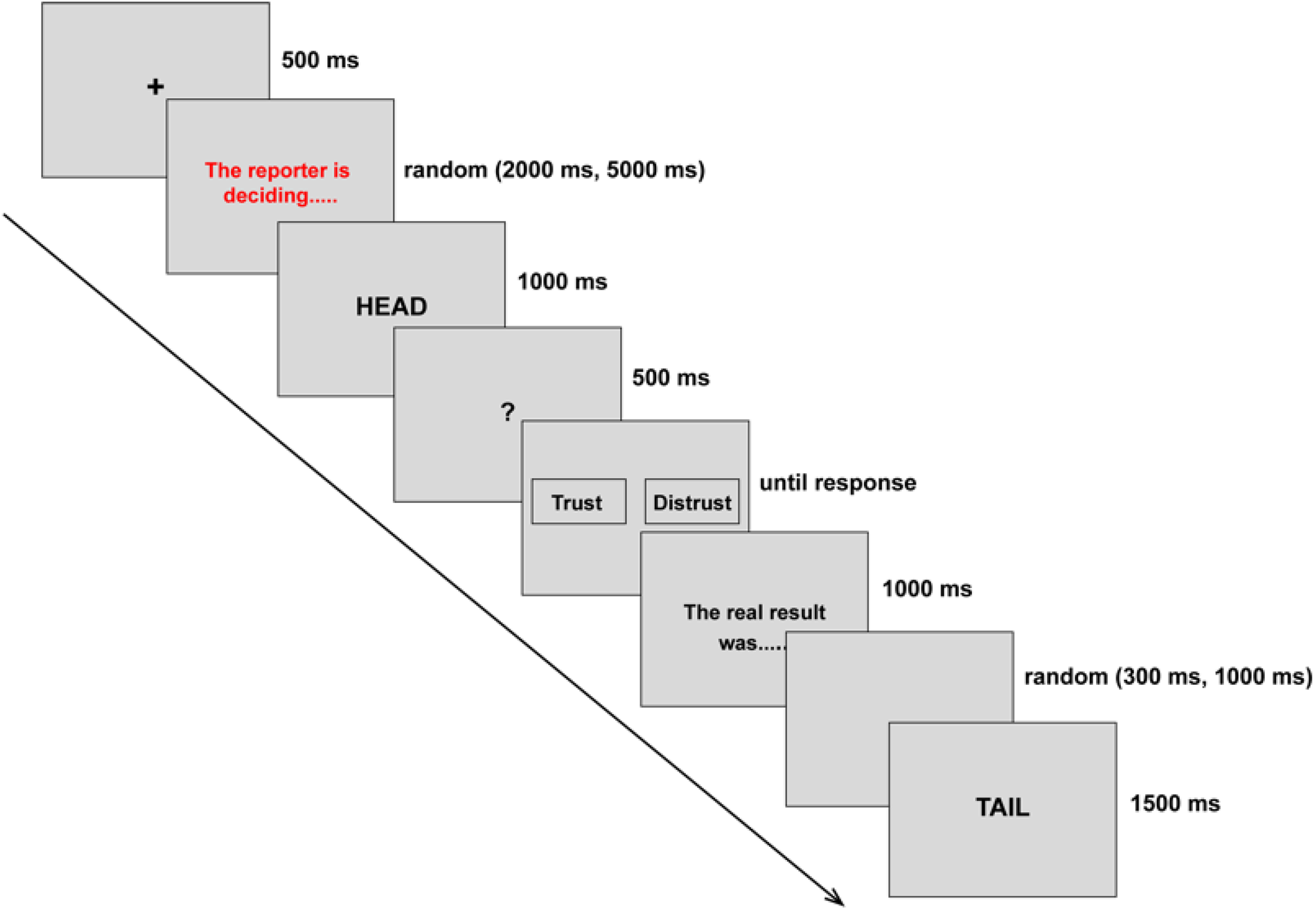
Setup for each trial in Study 1.
The presentation of stimuli and response measurements were controlled using E-Prime 2.0 (Psychological Software Tools, Inc., Pittsburgh, PA). The spatial positions of the “Trust” and “Distrust” cues in each trial, presented on the left and the right side of the screen, were counterbalanced across trials. Each participant played 80 trials in total. In half of the trials, the reporter claimed the coin had fallen with heads up and in the other half that the coin had fallen with tails up. Half of these claims were true and half were untrue, in a perfectly equal distribution. Thus, the percentage of the reporter lying over the result of coin toss was 50%. Note then that this aspect of the task does not mean that participants expect that the reporter will lie exactly 50% of the time. In fact, the reporter could be lying to participants a lot more or less frequently than that, as indeed has been done to manipulate trustworthiness in prior uses of this task (Long et al., 2012). The original study (Long et al., 2012) suggests that participants show slightly more trust than warranted by the actual behavior of the reporter when programmed to be 50% deceitful, indicating that a normative response may be to err on the side of slightly too much trust regardless of actual behavior.
After the game, participants completed two questions used by Long, Jiang, and Zhou (2012): self-reported trust in the partner (“To what extent did you feel trust for the other participant with whom you played the game?”) and involvement in the game (“To what extent did you feel that you were involved in the game?”; responses from 1 = not at all to 7 = very much). A manipulation check was included at this stage: “Please think back about the experience you described at the start of the study. How likely do you think that what happened in the situation you described was due to other people’s attitudes toward the group membership you indicated having before the experiment?” (responses from 1 = extremely unlikely to 7 = extremely likely). Finally, we included a check that the experience recalled was equally negative across conditions: “Still with regard to the experience you described at the start of the study, please indicate how you evaluated it, that is, to what extent did you experience what happened to you as pleasant or unpleasant” (responses from 1 = very unpleasant to 7 = very pleasant)?
Results
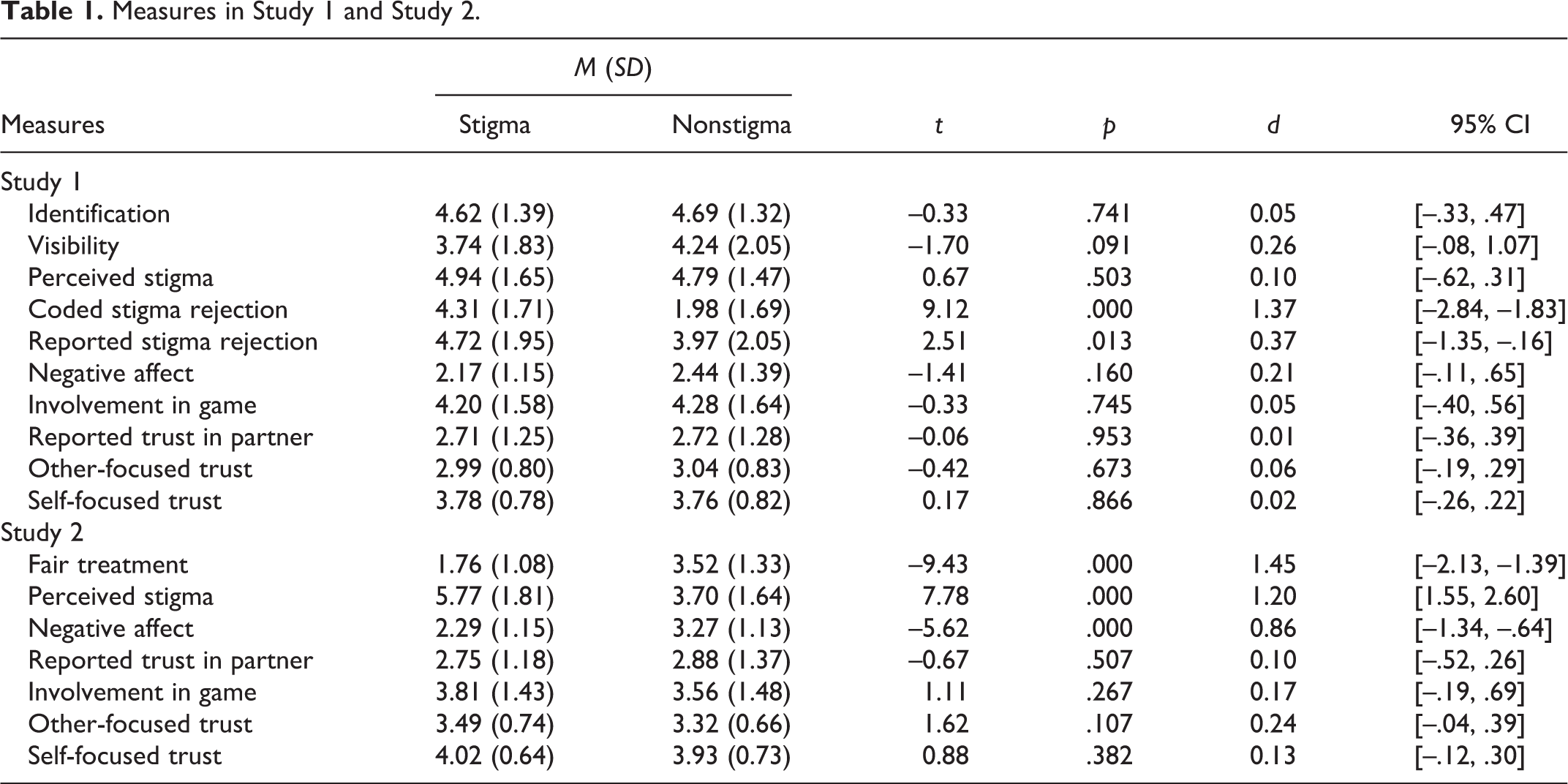
All statistical values are presented in Table 1.
Measures in Study 1 and Study 2.
Checks
Group identity checks
An independent samples t test showed no significant differences in the extent to which participants identified with the stigmatized identities participants indicated in the two conditions, the perceived visibility of this identity to others and the perceived stigma associated with this identity.
Manipulation Checks
Essay coding
Two independent coders blind to the study design and hypotheses coded to what extent participants’ descriptions referred to a rejection based on their identity (responses from 1 = not at all to 7 = very much). Cohen’s κ, percentage of coders’ agreement, and correlation between the two coders’ responses were used to estimate the intercoder reliability (Cho, 2008; Hayes & Hatch, 1999), which showed acceptable reliability (κ = .27, percentage of agreement = 42.13%, and r = .79). An independent samples t test then showed that the descriptions produced by participants in the stigma-based rejection condition were perceived as significantly more about their identity than the descriptions produced by participants in the nonstigma-based rejection condition, suggesting that the manipulation worked as intended.
Self-reported stigma rejection
An independent samples t test revealed that, as intended, participants in the stigma-based rejection condition described a situation in which they felt stigmatized to a greater extent than participants in the nonstigma-based rejection condition.
Additional checks
Independent samples t tests showed that the manipulation did not affect how negative the recalled rejection was or how involved participants felt in the task. In sum, as intended, participants focused on a similarly negative situation, similarly characterized identities, and were similarly involved in the task across conditions, with the manipulating affecting only the extent to which participants recalled a stigma-based rejection.
Effect of stigma on self-reported trust
Independent samples t tests revealed no significant effect of condition on any component of self-reported trust (other-focused, self-focused, or trust in partner).
Effect of stigma on trust behavior
An independent samples t test revealed that the proportion of trust choices in the stigma-based rejection condition (M = .52, SD = .14) was significantly lower than the proportion of trust choices in the nonstigma-based rejection condition (M = .58, SD = .15), t(176) = –2.79, p = .006, d = 0.42, 95% CI [.02, .10] (see Figure 2, left panel). In addition, one-sample t tests against the value of 50% show that levels of trust were slightly but significantly higher than 50% in the nonstigma-based rejection conditions (M = .58, SD = .15), t(88) = 5.23, p < .001, but not significantly different from 50% in the stigma-based rejection conditions (M = .52, SD = .14), t(88) = 1.43, p = .157.
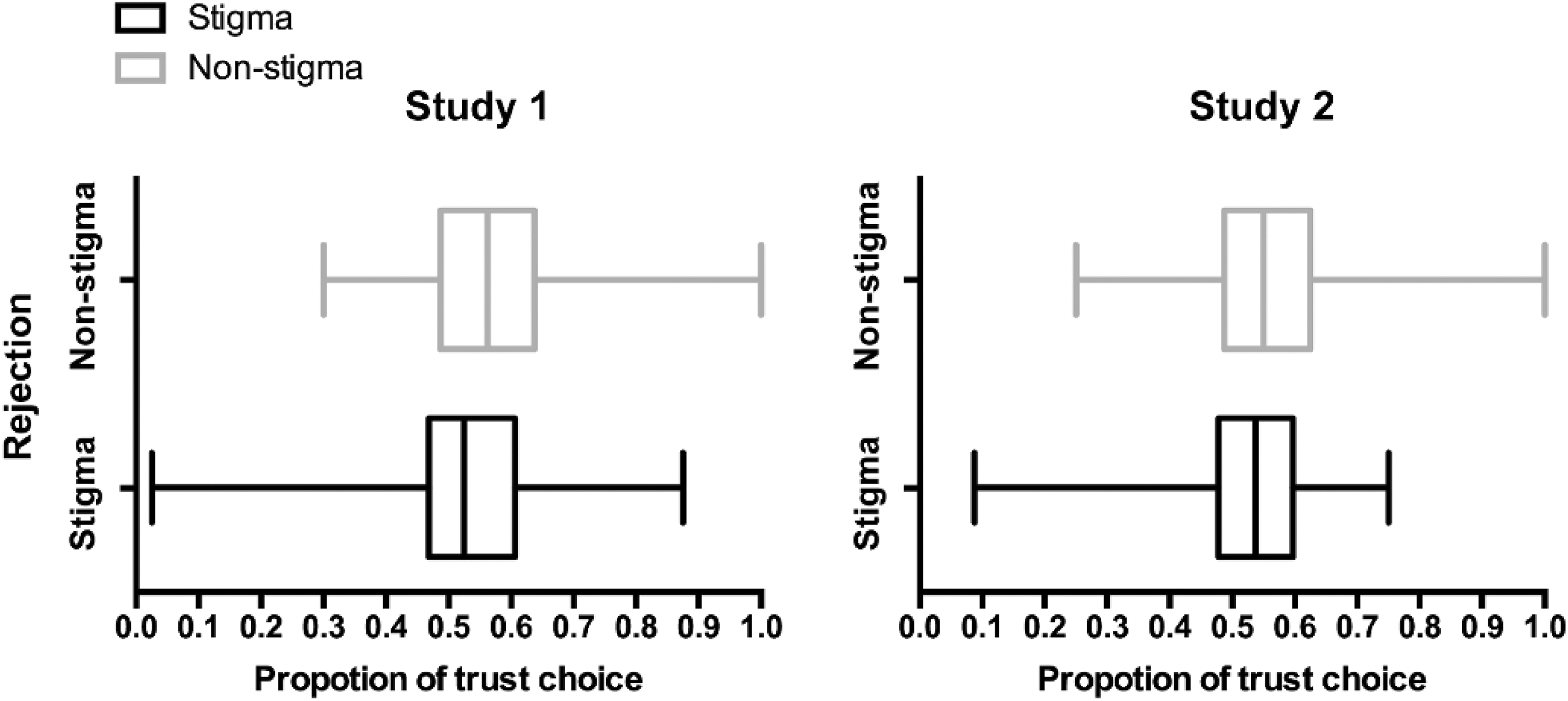
Proportion of trust choice in the two conditions for Study 1 (left) and Study 2 (right).
Discussion
Study 1 provides evidence in support of the hypothesis that stigma-based rejection experiences more negatively affect interpersonal trust behavior than nonstigma-based rejection. We found this with a paradigm that tapped into a range of social stigmas and a variety of past rejection experiences. Interestingly, we only found this on the behavioral measure of trust, but not on any of the self-reported trust measures. That is, self-reported trust did not vary across conditions in the same way as behavioral manifestations of trust. This might suggest that the effect we are examining occurs outside conscious awareness, becoming obscured in self-report measures, but visible when this awareness is not required, as in the behavioral trust task. Alternatively, it might also be that participants wish to resist the effects of stigma and do so in this study by monitoring their self-reported trust. This is however harder to do in the behavioral measure, as it taps into actual vulnerabilities that might be harder to monitor. Study 2 employs a different manipulation of rejection, but the same self-report and behavioral measures, to examine whether or not the restriction of this effect to behavior could be replicated.
Study 2
Study 1 induced rejection by asking participants to recall a past experience. Although this has the advantage of tapping into participants’ own prior experiences, it has some drawbacks too. First, these experiences have passed and are therefore less acutely experienced than current events. Second, these experiences are very varied across participants and between conditions, limiting experimental control. Although we were able to demonstrate that the stigmas and rejection experiences were equal in several ways across the two conditions, the next step is to replicate this design under more controlled conditions. To do so, Study 2 focuses on one stigmatized identity alone and induces rejection in the lab, in a way that is parallel across conditions, except for the manipulated stigma-based reason. Participants were asked to take part in a simulated job interview and were rejected after the interview either because of their gender (stigma-based rejection) or because of inappropriate (but not sexist) behavior on the part of the interviewer. We again hypothesized that stigma-based rejection would decrease interpersonal trust to a greater extent than nonstigma-based rejection. Also, to check whether this affected the results, we changed the order in which we measured self-reported trust and behavioral trust: In Study 2, behavioral trust was measured first.
Method
Participants
Female participants were recruited to take part in an online interview (allegedly to train recruiters). Since our primary aim was to replicate the effect of condition on trust behavior, we calculated the required sample size (182) based on the effect size estimate obtained in Study 1 (d = 0.42; power = .80). Due to an expected long absence of students on campus, the study had to stop when we reached 168 participants (age: 22.60 ± 5.54 years, range: 18–55), who were compensated with £5. The study had .77 power to detect the effect observed in Study 1 (d = 0.42).
Procedure
Upon arriving at the lab, participants provided informed consent. Participants were told the study had two parts: an online job interview and an online game with another participant present in the lab. Participants were given the chance to enter a lottery of £20 in addition to the standard reward depending on their performance in the job interview. After providing basic demographic information, participants were asked to imagine that they applied for a management position in an organization in the information technology sector which employs approximately 500 people across its various departments. After that, participants answered seven interview questions from a bogus interviewer, introduced as Paul White, male, 30 years old, and with 7 years experience in his current post. The last three questions varied across conditions and served to manipulate whether or not the rejection was stigma/gender based, a procedure adapted from Woodzicka and LaFrance (2001). Specifically, in the stigma-based rejection condition, the last three questions reflected gender stereotypes: “I think that men are better at supervising others, so it is important to us that women are good team players—are you a good team player?”; “Do people find you overly emotional?”; and “Do you plan to stop working when you have children?” In the nonstigma-based rejection condition, the last three questions were: “I think it’s good when people have strong beliefs, do you think it’s important for people to believe in God?”; “Do people find you morbid?”; and “Do you have a favorite color?”
Participants were asked one question at the time, through the computer, and had the chance to type their responses. Then, they waited for the interviewer’s decision and, in the meantime, answered two filler questions: “Do you think that you, as a candidate, have done well in the interview?” and “Do you think that Paul, as an interviewer, has done well in the interview” (responses from 1 = not at all to 7 = very much).
In the stigma-based rejection condition, participants were subsequently rejected by the interviewer and told that women are generally not suitable candidates for these kinds of jobs. In the nonstigma-based rejection condition, participants were also rejected by the interviewer who merely explained that they were not suitable for this job. At this point, participants answered two relatively subtle manipulation checks: “To what extent do you think that Paul’s decision appropriately reflects your performance in the interview?” and “To what extent do you think that Paul’s decision is fair?” (responses from 1 = not at all to 7 = very much; r = .818, p < .001, responses averaged across both items for analyses).
After, participants were led to believe that they had been randomly assigned to a partner who had been taking part in a different study in another room to play the same coin toss game used in Study 1 and subsequently completed the same trust scales as in Study 1 (a = .80 for the other-focused scale, a = .70 for the self-focused scale). Finally, participants indicated the extent to which they trusted their game partner and the extent to which they were involved in the task with the same items as in Study 1, answered a more blatant manipulation check “How likely do you think it is that Paul didn’t select you due to his attitude toward women (from 1 = extremely unlikely to 7 = extremely likely)?” and indicated how negative the experience was “To what extent did you experience Paul’s decision as pleasant or unpleasant (from 1 = very unpleasant to 7 = very pleasant)?”
Results
Checks
As intended, participants in the stigma-based rejection condition indicated that the interviewer’s decision reflected their performance to a lesser extent compared to participants in the nonstigma-based rejection condition. Also, participants in the stigma-based rejection condition thought the interviewer’s decision was less fair compared to participants in the nonstigma-based rejection condition.
When asked more directly, at the end of the experiment, the extent to which their rejection was due to gender discrimination, participants in the stigma/gender condition felt stigmatized to a greater extent than participants in the nonstigma-based rejection condition. Participants in the stigma-based rejection condition also felt that Paul’s decision had been more unpleasant than participants in the nonstigma-based rejection condition. All in all, these results suggest that the manipulation worked as intended. The analyses also showed that the manipulation did not affect how involved participants felt in the task.
In sum, as intended, participants felt equally involved in the task across conditions, but the manipulation affected the extent to which they felt they had experience stigma-based rejection. This time, the manipulation also affected how negative the rejection was.
Effect of Stigma on Self-Reported Trust
An independent samples t test revealed that the manipulation did not significantly affect any of the self-reported measures of trust.
Effect of Stigma on Trust Behavior
An independent samples t test showed that the proportion of trust choices in the stigma-based rejection condition (M = .51, SD = .14) was significantly lower than that in the nonstigma-based rejection (M = .57, SD = .13), t(166) = –2.81, p = .006, d = 0.43, 95% CI [–.10, –.02] (see Figure 2, right panel). Again, one-sample t tests revealed that levels of trust are slightly but significantly higher than 50% in the nonstigma-based rejection conditions (M = .57, SD = .13), t(83) = 5.15, p < .001, but not significantly different from 50% for those in the stigma-based rejection conditions (M = .51, SD = .14), t(83) = 1.01, p = .316.
Discussion
Study 2 conceptually replicated the pattern observed in Study 1, with a single stigmatized identity, rejection induced in the lab, and a different order of behavioral and self-reported measures. Study 2 again showed that stigma-based rejection had a more negative effect on interpersonal trust than rejection that was not based on stigma. As in Study 1, this effect only emerged on behavioral trust, but not on self-reported trust. This strengthens the idea that the effect might indeed be limited to less conscious or controllable manifestations of trust rather than on more conscious or controllable reflections on one’s willingness to trust others.
General Discussion
In two studies, we tested the hypothesis that a recalled (Study 1) or actual (Study 2) stigma-based rejection would lead to lower interpersonal trust than nonstigma-based rejection. The results showed no effects of the manipulation on self-reported trust, but statistically significant effects on behavioral trust, with patterns providing support for our hypothesis. That is, across two studies, covering a range of stigmatized identities and rejection experiences, stigma-based rejection led to less behavioral trust than nonstigma-based rejection. In this way, these studies provide new experimental evidence on the negative consequences of stigma-based rejections for social interactions.
In the present studies, we deliberately did not make the identity of the partner clear in order to test how stigma affected trust toward others without narrowing in on effects that might be specific to particular identities—which are of course not always evident in everyday interactions (unless they are visible or performed). It is, however, very likely that the identity of the other might affect trust after stigma-based rejection. For example, stigma-based rejection might impair trust in members of the perpetrator group to a greater extent than in members of the stigmatized group. This is a possibility we are currently examining. However, this is not to say that stigma does not negatively affect relationships with fellow in-group members, as already shown (e.g., Doyle & Molix, 2015, 2016). Indeed, our own work is contributing to understanding the circumstances under which stigma-based experiences draw people away from or, instead, toward other in-group members (e.g., Van Breen, Barreto, Darden, & Dimitriou, submitted).
It is important to reiterate that, in both studies, levels of trust were significantly higher than 50% in the nonstigma-based rejection conditions, but not in the stigma-based rejection conditions. While it is always problematic to interpret absolute values, prior research using this task suggests that people tend to err on the side of trusting more than warranted (i.e., more than 50%), in the absence of any additional manipulation. This would suggest that participants in the stigma-based rejection condition show reduced trust, whereas participants in the nonstigma-based rejection condition do not. However, future research might wish to explore this further by using other types of tasks where absolute levels of “reasonable” trust behavior might be easier to determine.
One limitation of these studies might be that there is no baseline condition. However, it is important to consider what an appropriate baseline condition for these studies might be. Our view was that to understand the specific effects of stigma-based rejections, it is crucial to compare these with the effects of rejections that are not based on stigma. Further comparisons would include too many changes and obscure the mechanisms. However, future research might wish to expand on these findings by including a series of controls, such as conditions where there is neither stigma nor a rejection experience.
These studies focused on unveiling the effect of stigma-based rejections on trust. Future research might focus on the precise mechanisms through which these two forms of rejection might convey different effects on interpersonal trust. Our hypothesis is derived from existing evidence suggesting that stigma-based rejections are likely to have more enduring effects than rejections that are not stigma based. First, stigma-based rejections are identity based and, as such, one carries the potential for rejection within oneself, unless one is able to drive changes in one’s identity, societal views, or societal structures (Link, Struening, Rahav, Phelan, & Nuttbrock, 1997). Second, unlike rejections based on identities that are not widely socially stigmatized, stigma-based rejections suggest pervasive negative treatment (Schmitt & Branscombe, 2002). Future research might also wish to unveil how these effects influence social relationships more broadly. Our interest in trust is precisely linked to its importance for social connections and we expect that stigma-based experiences might be detrimental to targets’ social networks partly because they reduce interpersonal trust. In this way, and by providing the first experimental evidence that stigma-based rejection influences individuals’ trust in others, the present research provides a novel basis from which to improve our understanding of social exclusion.
Supplemental Material
Supplemental_Materials - Stigma-Based Rejection Experiences Affect Trust in Others
Supplemental_Materials for Stigma-Based Rejection Experiences Affect Trust in Others by Ming Zhang, Manuela Barreto and David Doyle in Social Psychological and Personality Science
Footnotes
Appendix
Participant Characteristics in Study 1 and Study 2.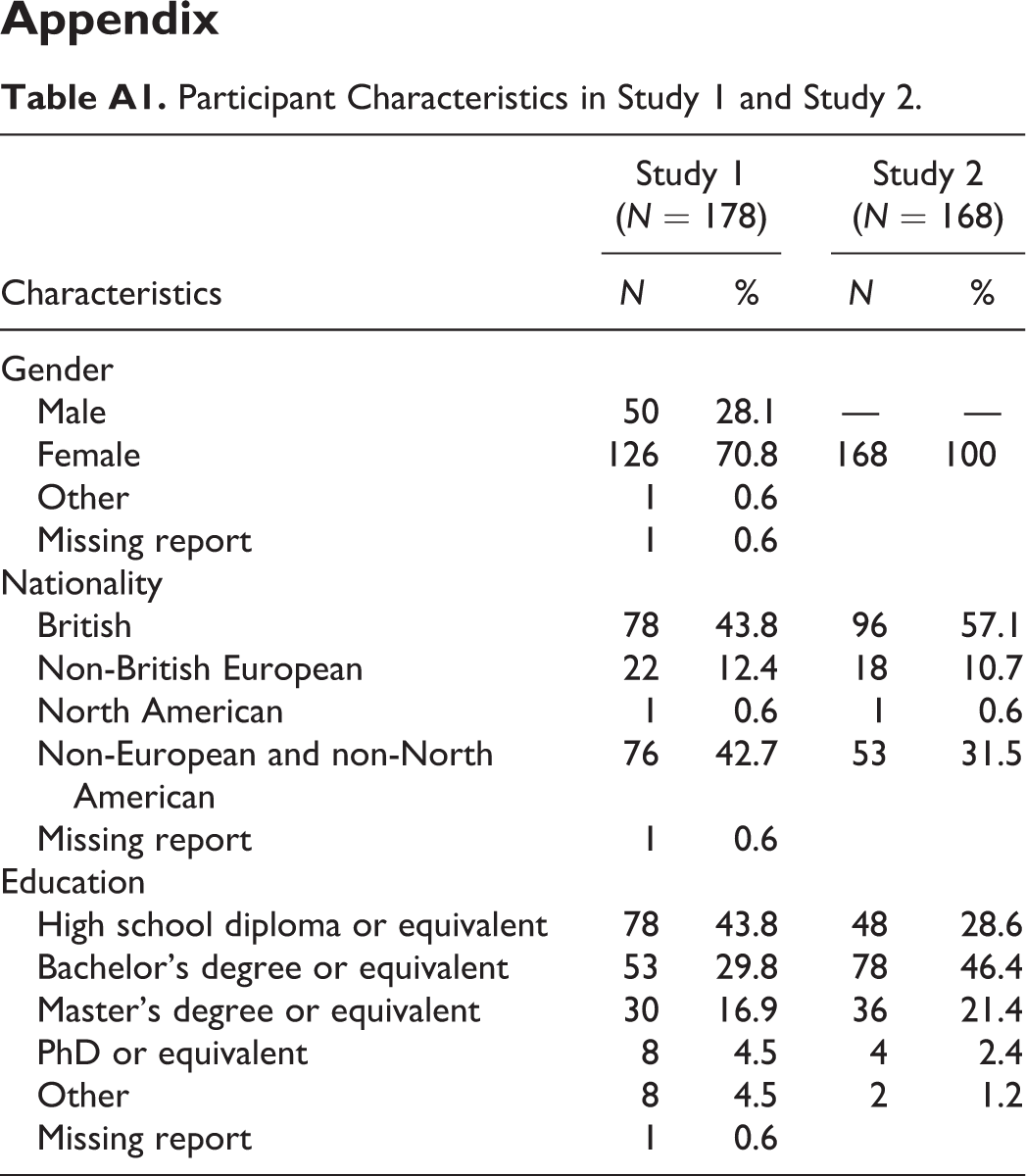
Characteristics
Study 1 (N = 178)
Study 2 (N = 168)
N
%
N
%
Gender
Male
50
28.1
—
—
Female
126
70.8
168
100
Other
1
0.6
Missing report
1
0.6
Nationality
British
78
43.8
96
57.1
Non-British European
22
12.4
18
10.7
North American
1
0.6
1
0.6
Non-European and non-North American
76
42.7
53
31.5
Missing report
1
0.6
Education
High school diploma or equivalent
78
43.8
48
28.6
Bachelor’s degree or equivalent
53
29.8
78
46.4
Master’s degree or equivalent
30
16.9
36
21.4
PhD or equivalent
8
4.5
4
2.4
Other
8
4.5
2
1.2
Missing report
1
0.6
Acknowledgments
We thank the research assistants Dana Kushlyu and Irene Valero for helping with data collection.
Declaration of Conflicting Interests
The author(s) declared no potential conflicts of interest with respect to the research, authorship, and/or publication of this article.
Funding
The author(s) disclosed receipt of the following financial support for the research, authorship, and/or publication of this article: This research was supported by the China Scholarship Council.

Supplemental Material
Supplemental material for this article is available online.
References
Supplementary Material
Please find the following supplemental material available below.
For Open Access articles published under a Creative Commons License, all supplemental material carries the same license as the article it is associated with.
For non-Open Access articles published, all supplemental material carries a non-exclusive license, and permission requests for re-use of supplemental material or any part of supplemental material shall be sent directly to the copyright owner as specified in the copyright notice associated with the article.
