



Abstract
Prior research has examined the impact of unintended birth on parent and child welfare. The present studies examine another potential consequence: namely, how third-party observers react to information about parenthood intention. We examine whether the act of having intended (or not) to become a parent affects people’s impressions of (1) what type of caregiver the (un)intended parent will be, (2) the type of relationship the (un)intended parent will have with the child, and (3) potential outcomes for that family. Studies 1 and 2 demonstrate that people award less custody to accidental mothers and fathers because lack of intention during birth is perceived as decreasing parental quality and closeness between parent and child. Study 3 tests potential moderators of this effect including parenthood status and controllability, highlighting the potential negative consequences of this phenomenon for families in child custody disputes where third-party judgments are especially likely to bear weight.
By some recent estimates, about 37% of infants born in the United States were unintended—that is, their mothers wanted the pregnancy at a later time or did not want the pregnancy at all (Mosher, Jones, & Abma, 2012). Many studies emphasize how unintended childbearing affects the health and well-being of mothers and children (e.g., Kost & Lindberg, 2015; Su, 2017), but far less attention has been paid to how third parties react to a parent’s intent and how such judgments may contribute to the multiple challenges faced by the families who are affected by unintended births.
In this research, we examine whether knowledge regarding parental intent can negatively influence parent–child outcomes in a sphere where a third party’s judgments bear a special weight: child custody evaluations. Specifically, we argue that a negative consequence of unintended childbearing might arise because third-party observers tend to restrict custody arrangements for accidental (vs. intentional) parents, based on the assumption that unintended parents have poorer relationships with their children. In other words, even in situations where the parent in question has arguably demonstrated equal investment in the child’s well-being, the psychological circumstances of a child’s conception—specifically, the mere lack of intentionality when conceiving that child—may tarnish a parent’s reputation, rendering him or her less apparently worthy of being that child’s custodian.
The question of whether parents’ intent to conceive matters has become an increasingly important institutional and legal issue. For instance, several states (including California, Delaware, Illinois, and New Mexico) apply an intent-based standard of parentage to recognize the rights of people who initiated the creation of a child when that child is conceived by a surrogate or via assistive reproductive technology (ART). In the case of surrogacy and ART, the legal standard adopted by these states means that the intent to conceive a child is crucial and can triumph even when the person claiming intent is not genetically related to the child (for a review, see Byrn & Holzer, 2015). And when custody of children conceived using ART is disputed, recent research found that approximately 20% of court judgments used the “intent test,” and 74% of ART disputes were found in favor of the parent who initiated the child’s conception (Byrn & Giddings, 2013).
It remains possible that the parenting intuitions that underlie the legal intent test contribute to biases in judgment when extended to the majority of custody disputes (which do not involve ART). Indeed, we might expect parental intent to make no difference in general custody disputes, since organizations like the American Psychological Association (APA, 2010) offer evidence-based guidelines which recommend considering factors including the age and psychological and developmental needs of the child, the parent–child history, parenting work schedules, and access to a support network (Herman, 1997; Wallace & Koerner, 2003). Making custody judgments guided by these factors is meant to facilitate “competent and impartial opinions with direct relevance to the psychological best interests of the child” (APA, 2010, p. 863). But while such objective guidelines may be the goal, to our knowledge, there has been no investigation of whether evaluators’ or other third parties’ intuitions might be influenced by whether a party in a custody dispute intended to be a parent in the first place.
This research thus has two goals: First, it explores people’s intuitions about parenthood. To date, little research has examined how unintended parents are viewed compared to intended caregivers, and improving our understanding of people’s biases in this area promises to inform interpersonal judgment in the fields of psychology, human development, social work, and the law. Second, and more importantly, we extend research on the consequences of unintended births by examining the psychological processes that color third-party judgments. Clearly, the phenomenon of unintended birth has multilevel, complicated causes and consequences (e.g., institutional inequalities, gender roles, cultural expectations about family planning), but our research purposefully controls for such factors to demonstrate that third-party perceptions of involved families may supply another negative effect.
In other words, we argue that, all things being equal, third-party observers penalize people who have children by accident, to the point where merely knowing that a parent did not originally intend to have a child has the potential to sway crucial outcomes. In so doing, we hope to uncover a causal, individual-level process contributing to the challenges faced by families with unintended children. Since unintended births occur at a greater rate in the United States as compared to other industrialized countries and disproportionately affect ethnic and socioeconomic minority populations (e.g., Finer & Zolna, 2016; Sweeney & Raley, 2014), it is of social and practical value to understand the complicated impact that unintended childbearing has upon parents and families involved (Sonfield, Kost, Benson Gold, & Finer, 2011).
The Present Research
Three studies examine whether having intended (or not) to have a child affects third-party observers’ impressions of what type of caregiver the (un)intended parent will be, the relationship the parent will have with that child, and potential legal outcomes. In Studies 1–3, we predicted that people would award less custody to a parent based upon the simple fact that the parent had not originally intend to conceive that child—even in situations like custody battles, where both parents claim to have a history of taking care of the child and desire primary custody. When both parents are presumably equally invested in the child’s well-being and prior parental investment is equal or ambiguous, minimal reason exists to assume that lack of parental intent during conception would lead to poorer parental quality.
Given that prior research documents an association between unintended births and less positive mother–child relationships (Barber et al., 1999; Baydar, 1995; Logan, Holcombe, Manlove, & Ryan, 2007), we also hypothesize that perceivers’ poorer impressions of parent–child relationships will explain the relationship between parental intentions and third-party custody recommendations for both mothers (Study 1) and fathers (Study 2).
Study 3 examines whether people can be held to account for this phenomenon. We predict that while making perceivers aware of this bias may do little to attenuate the effect of intention on custody recommendation, personal parenting experience may prove a successful mitigating factor. Taken together, this research aims to suggest that, independent of socioeconomic circumstances, (lack of) intention during conception has potential downstream effects on family outcomes via third-party judgments.
Study 1
Method
We posted an advertisement on Amazon MechanicalTurk seeking workers to participate in a three condition (intended birth, unintended birth, and control) between-participants experiment. We a priori sought to recruit ∼150 per condition and ended up with 433 responses in our data set. 1
All participants read a scenario about a divorcing couple (John and Lisa) who were both seeking custody of their only child in family court. In the intended birth condition, John claimed that he was the primary caretaker even though he and Lisa “both wanted to start a family.” Lisa disagreed about John’s caretaking but agreed that she had always been “planning to have a baby” and she would “do everything [she could] for her child.” In the unintended parent scenario, John identified himself as the primary caretaker and “the only one who wanted to start a family.” Lisa disputed John's caretaking history but admitted that even though she “hadn’t been planning to have a baby, it was that time in life” and reaffirmed her parental commitment. The control scenario did not mention whether Lisa or John originally intended to have a child at all.
Participants were then asked to recommend a resolution (0 = sole custody of the child to John, 100 = sole custody of the child to Lisa). Next, we included measures of parent–child closeness and perceived parental fitness, since these variables are likely to affect people’s intuitions about custody arrangements. As our measure of perceived parent–child closeness, we used an adapted Inclusion of Self in Other Scale where participants were asked to indicate which of six gradually overlapping circle pairs best represented the relationship between Lisa and her child (Inclusion of Self in Other scale; Aron, Aron, & Smollan, 1992). Versions of this scale have been used by prior research to measure interpersonal closeness (e.g., Ketay, Welker, Beck, Thorson, & Slatcher, 2018). To measure perceived parental fitness, participants rated their agreement with the statements, “My intuition is that Lisa may be a neglectful parent” (reverse coded) and “My intuition is that Lisa will be a good parent to her child” (1 = strongly disagree, 8 = strongly agree). Participants’ responses were averaged into a composite perceived parental quality measure, r = .55, p < .001.
Next, participants responded to the question, “Did Lisa originally want to be a parent?” (1 = yes, 2 = no, 3 = unsure). Approximately 95% of participants in the intended condition and 71% of participants in the unintended condition answered the comprehension question correctly, verifying the scenario successfully manipulated perceived parental intent. Finally, participants rated their familiarity with custody disputes and provided basic demographic information before being thanked, debriefed, and compensated for their time.
Results
An analysis of variance (ANOVA) revealed the predicted effect of condition on custody recommendation, F(2, 430) = 6.216, p = .002, η2 = .028 (Figure 1). Post hoc Tukey tests confirmed the prespecified pattern of effects, where participants awarded the least custody to Lisa when she hadn’t intended to be a mother (M = 48.048, SD = 12.596) compared to when she had explicit parental intentions (M = 53.558, SD = 13.452), p = .002, and compared to when no information was offered about her childbearing intentions (M = 52.201, SD = 15.695), p = .032. 2
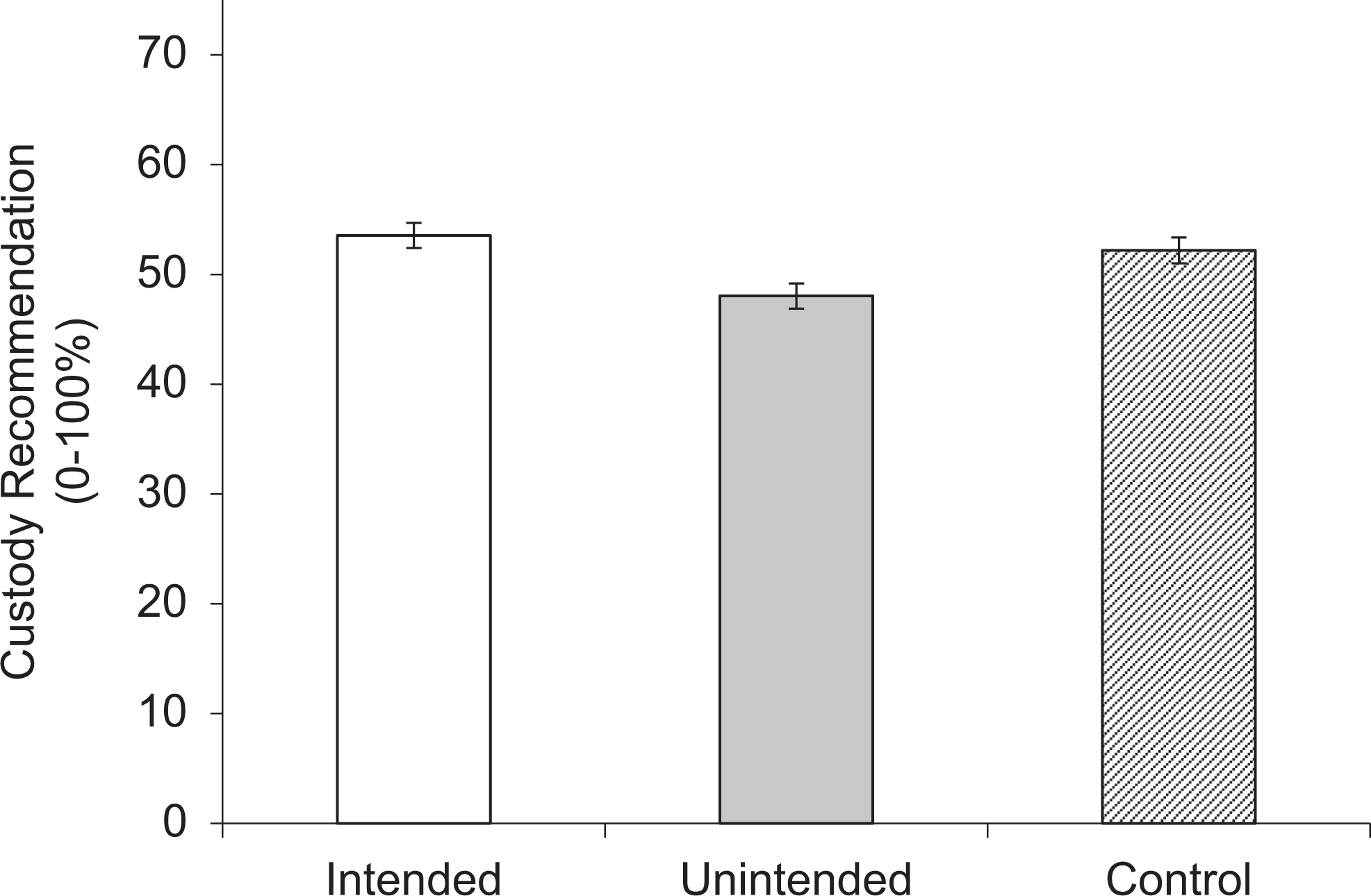
Mean custody recommendations by condition (Study 1). Error bars represent standard errors.
Similar differences emerged with the perceived closeness measure. Since Levene’s test indicated unequal group variances (F = 5.506, p = .004), we report overall differences using the more conservative Welch’s statistic, F(2, 275.362) = 9.451, p < .001, η2 = .041. Games-Howell post hoc tests confirmed that participants’ impressions of parent–child relationship quality appeared to mirror real-life associations. Participants perceived more distance between a mother and an unplanned child (M = 3.930, SD = 1.248) than a planned child (M = 4.518, SD = 1.187), p < .001, and also when compared to the control condition (M = 4.456, SD = 1.414), p = .003. With respect to our parental fitness index, participants rated Lisa to be a marginally worse mother when she became one by accident (M = 5.490, SD = 1.428) compared to when she became one intentionally (M = 5.888, SD = 1.433), Tukey-adjusted p = .050, but not when compared to the control condition (M = 5.784, SD = 1.495), Tukey-adjusted p = .201, overall test, F(2, 430) = 2.966, p = .053, η2 = .014.
We then conducted a parallel mediational analysis in PROCESS (Hayes, 2018; Model 4 with condition entered as a multicategorical variable) to test whether the mere knowledge that a parent lacked intention during conception decreases custody affordances through perceived closeness and parental quality ratings. When participants read about Lisa’s unintended (vs. intended) parenthood, they perceived her to be less close to her child; the decreased closeness then diminished the amount of custody they awarded to her (indirect effect = −1.025, SE = 0.483, 95% confidence interval [CI] = [−2.092, −0.226]). Similarly, when Lisa had not originally intended to be a mother (compared to when she had intended so), participants attributed lower parenting abilities to her, which were in turn related to decreased custody recommendations (indirect effect = −1.403, SE = 0.651, 95% CI [−2.742, −0.195]; Figure 2).
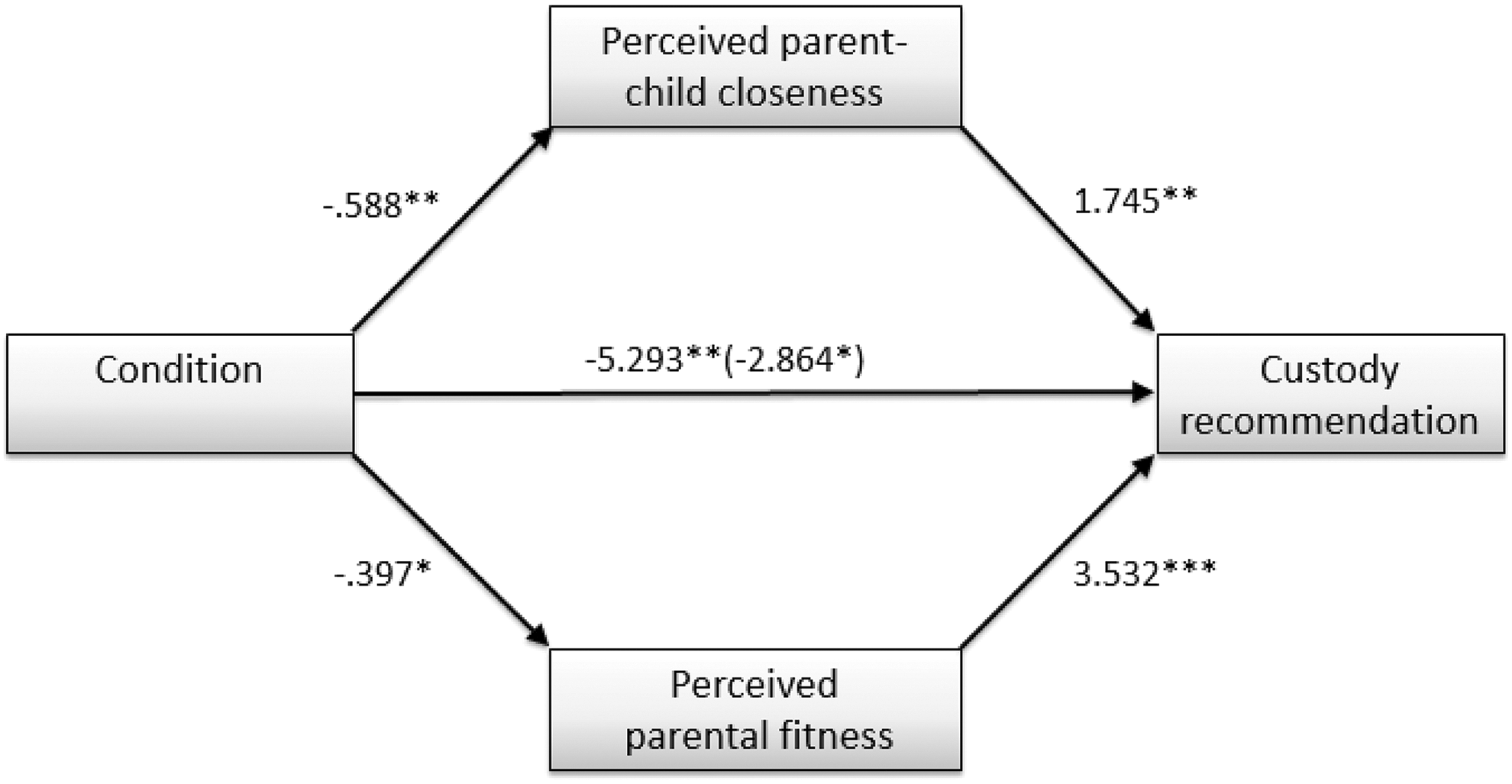
Study 1 parallel mediation model with a multicategorical predictor. Numbers next to lines are unstandardized coefficients of that path. *p < .05. **p < .01. ***p < .001.
Importantly, we found no such evidence of parallel mediation when comparing the control condition to the intended condition (indirect effectperceived closeness = −.108, SE = 0.291, 95% CI [−0.696, 0.502] and indirect effectparental fitness = −.390, SE = 0.635, 95% CI [−1.669, 0.853]).
Study 2
Study 1 provided preliminary evidence that third-party perceivers are affected by knowledge regarding parental intention. Specifically, a target who became a parent unintentionally was perceived as being less close to and fit to parent that child, which influenced the custody amount perceivers deemed appropriate for that caregiver.
To date, the majority of research on unintended birth focuses on mothers and children rather than fathers (cf. Lindberg, Kost, & Maddow-Zimet, 2016). However, Study 1’s data suggest that the relationship between parent’s childbearing intentions and perceivers’ custody evaluations are explained by perceived closeness and parental quality—factors that are also relevant for fathers. Consequently, we expected to replicate Study 1’s effects with an (un)intending father figure.
Method
Given that society tends to have stronger caregiving expectations for mothers rather than fathers, we anticipated that detecting an effect slightly smaller than Study 1’s with power = .95 required ∼150 participants per cell (Faul, Erdfelder, Lang, & Buchner, 2007) for a 3 (condition: intended, unintended, control) between-participants study. We overrecruited to account for potential data exclusions, bringing our data set to 535 participants.
As with Study 1, participants were asked to form impressions of people in a custody scenario; however, here the father’s childbearing intentions varied. In the intended condition, participants read that both John and Lisa had wanted to start a family and were committed to the child. Participants in the unintended condition read that even though John had not originally intended to start a family, he was committed now. The control condition’s scenario included no mention of John’s original parental intent.
Participants were next asked to recommend a custody arrangement and rate their impressions of parent–child closeness and parenting abilities, r = .607, p < .001. They then verified whether John originally wanted to be a parent (94% of participants in the intended condition and 77% of participants in the unintended condition correctly responding) before providing basic demographic information.
Results
Unequal variances were observed for custody recommendation scores (F = 8.187, p < .001). Analyses using Welch’s ANOVA revealed similar patterns to those observed in Study 1, with an overall effect of condition on custody recommendation for a male parental figure, F(2, 343.122) = 4.159, p = .016, η2 = .014. Games-Howell comparisons confirmed that participants awarded the least custody to John when he became a father unintentionally (M = 45.287, SD = 11.112) as opposed to when he had wanted to be one from the beginning (M = 48.256, SD = 8.699), p = .016, and also marginally so when compared to the control condition (M = 48.049, SD = 13.588), p = .091.
As with Study 1, similar differences emerged when examining the data for perceived closeness between parent and child, F(2, 518) = 4.613, p = .010, η2 = .018. Tukey post hoc tests confirmed that a child was perceived as the most distant from an unintentional parental figure (M = 3.836, SD = 1.376) compared to an intentional one (M = 4.179, SD = 1.209), p = .040, and also when compared to the control condition (M = 4.232, SD = 1.313), p = .014. Similarly, an effect of condition on parental fitness emerged, F(2, 532) = 4.085, p = .017, η2 = .015. Despite being in court to fight for custody, an accidental father was perceived as a worse parent (M = 5.787, SD = 1.280) compared to an intentional one (M = 6.133, SD = 1.177), p = .027. In contrast to Study 1, an accidental father was judged a worse caregiver compared to when no intention-related information was offered (M = 6.103, SD = 1.306), p = .047.
Using the same analytical strategy as Study 1, we conducted a parallel mediation model predicting custody affordances through perceived parental closeness and quality (Hayes, 2018). Participants perceived John to be a poorer caregiver and less close to a child that he hadn’t planned for (vs. when he had) and this predicted the decreased custody they felt he deserved, indirect effectcloseness = −.590, SE = 0.273, 95% CI [−1.185, −0.112], and indirect effectparental quality = −.844, SE = 0.383, 95% CI [−1.664, −0.177] (Figure 3).
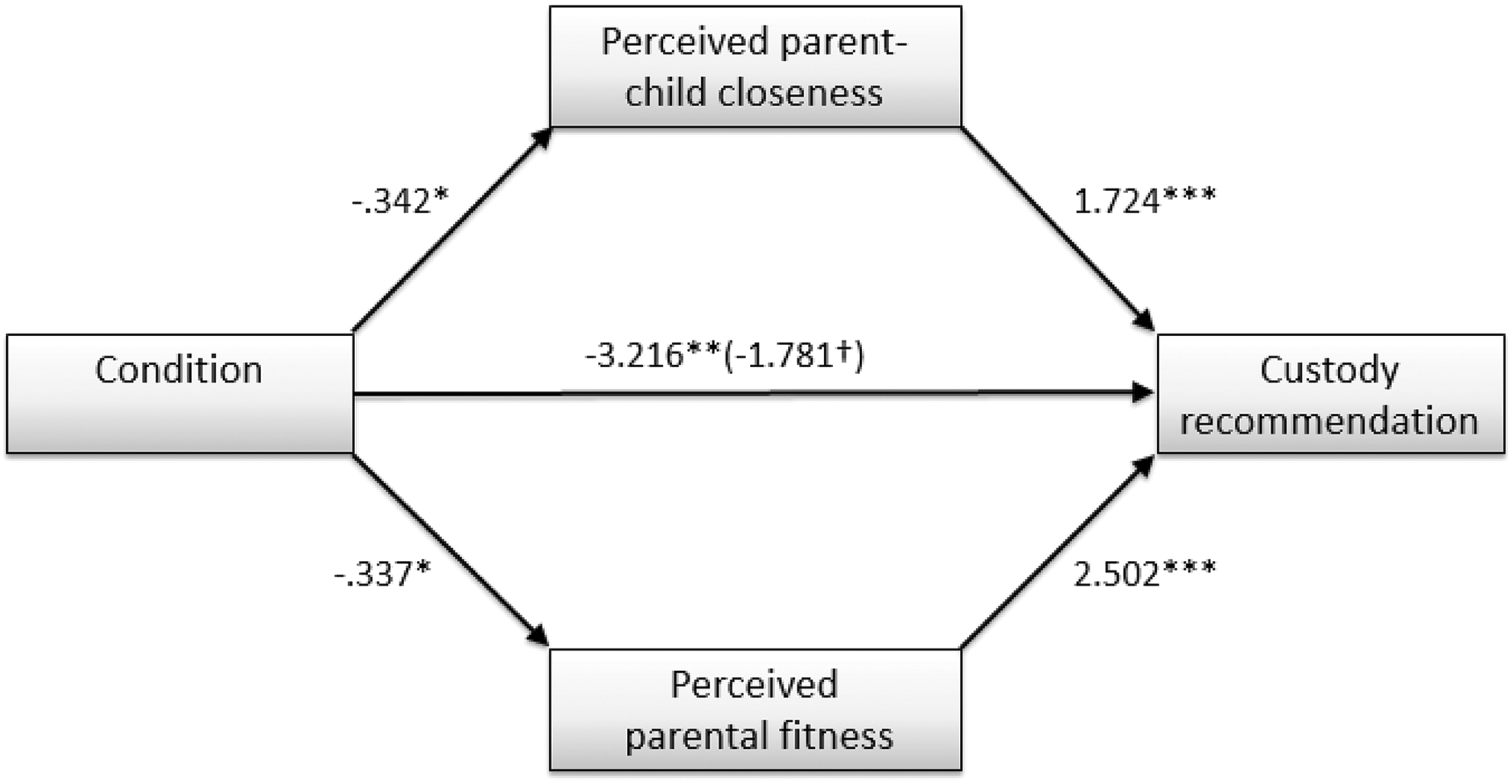
Study 2 parallel mediation model with a multicategorical predictor. Numbers next to lines are unstandardized coefficients of that path. † p < .10. *p < .05. **p < .01. ***p < .001.
No significantly different paths emerged when comparing the control condition to the intended condition (indirect effectperceived closeness = .091, SE = 0.234, 95% CI [−0.389, 0.555] and indirect effectparental fitness = −.145, SE = 0.344, 95% CI [−0.878, 0.484]).
Study 3
Given that third-party evaluations (i.e., counselor recommendations) are influential in resolving child custody disputes (Kunin et al., 1992), and evaluators are encouraged to be impartial, “remain[ing] as free as possible of unwarranted bias or partiality” (APA, 2010, p. 864), it may be important to understand how to intervene against biases relating to parental intent. Study 3 thus examines whether instructing perceivers to disregard information about original parental intent can reduce its influence on third-party judgment. Given the lack of reference to original parental intent in the child custody dispute literature, we reasoned that people may not be aware that they hold such biases to begin with. Thus, we predicted that explicit instruction to avoid such sources of bias would not be sufficient to abate its influence on child custody evaluations.
As an additional hypothesis, we also test whether individual experience with parenting attenuates people’s propensity to react to information about others’ original intentions. Specifically, we predicted that participants with parenting experience might be more sympathetic toward accidental parents (perhaps having been one themselves, since approximately 24% of births occurring for married couples are unintended; Finer & Zolna, 2016) and thus judge them less harshly compared to their childless counterparts.
Finally, one might argue that perceivers judge those who do not desire to have children as atypical and that the deviance itself (rather than the topic of it) renders one less worthy of custody. To address this alternate explanation, Study 3 highlights that the child was unintended because the birth was mistimed (rather than unwanted), which is more common in the United States and arguably represents a situation where the child’s outcome is less yolked to a parent’s desire to conceive.
Method
Power analyses revealed that ∼160 participants per cell were needed to achieve .95 power to reject the null hypothesis with a small-to-medium effect (Faul et al., 2007) for a 2 (condition: intended parent, unintended parent) × 2 (Instruction: present, absent) between-participants study. We again recruited above this number to ensure reliable data, ending up with 776 usable responses.
Half of all participants were randomly assigned to the instruction present (vs. instruction absent) condition. These participants were instructed prior to reading the custody scenario to avoid being biased “about who originally wanted to conceive the baby” since psychological research suggests that people tend to award less custody to a parent if he or she became one by accident. Meanwhile, the other half of participants assigned to the instruction absent condition proceeded to the custody scenario without extra instruction.
Study 3’s scenario emphasized that Lisa had a mistimed birth (as opposed to an unwanted birth). In the unintended parent condition, John explicitly argued that Lisa had not wanted to conceive a baby at the specific time that they did. In the intended parenthood condition, John recognized that Lisa had wanted to conceive the child when they did.
Participants completed the same dependent measures as in Studies 1–2, with 94% and 74% of participants correctly answering the comprehension question in the intended and unintended conditions, respectively. Finally, participants rated a list of factors which they believed affected their custody recommendations and indicated whether they were parents (0 = no, 1 = yes) before being thanked and debriefed. Three participants did not respond, 389 confirmed they were parents, and 384 reported not having children.
Results
Instruction
To test whether making perceivers aware that information about original parental intent can reduce its influence on third-party judgment, we conducted an ANOVA with condition and instruction as fixed factors and custody recommendation as the dependent variable. Asking participants to avoid being influenced by parental birth intention did not appear to interact with condition to affect custody recommendations, F(1, 772) = 1.082, p = .299, offering preliminary support that instructing people to disregard information about parental intent may not be sufficient to mitigate its influence over third-party judgments.
Since there was no observed interaction, we collapsed across instruction condition and examined whether condition alone affected custody recommendation. Analyses revealed that participants continued to recommend less custody to an unintended parent (M = 51.517, SD = 13.511) compared to an intentional one (M = 54.969, SD = 12.638), F(1, 774) = 13.514, p < .001, η2 = .017, echoing patterns from Studies 1–2. Similarly, an accidental parent was deemed marginally less close to her child (M = 4.597, SD = 1.301) compared to an intentional caregiver (M = 4.771, SD = 1.159), Welch’s F(1, 750.715) = 3.814, p = .051, η2 = .005, equal variances not assumed. In contrast to prior studies, however, participants did not perceive Lisa to be a poorer caregiver when the child was mistimed (M = 4.452, SD = 0.677) compared to when the child had been planned (M = 4.512, SD = 0.629), F(1, 774) = 1.601, p = .206, η2 = .002.
Parenthood Status
An ANOVA revealed the predicted, albeit marginal, interaction of parenthood status and condition, F(1, 769) = 2.872, p = .091, η2 = .004, which was qualified by effects of condition, F(1, 769) = 13.654, p < .001, η2 = .017, and parenthood status, F(1, 768) = 5.653, p = .018, η2 = .007. Childless participants allocated smaller custody amounts for an unintended parent (M = 49.532, SD = 12.947) versus an intentional one (M = 54.536, SD = 13.073), p < .001, while participants who were parents did not appear to make the same distinction (M unintended = 53.313; SD unintended = 13.721; M intended = 55.170, SD intended = 11.808), p = .156. Indeed, when compared to childless participants, parents made similar custody recommendations for an intentional target, p = .629, but were more sympathetic when the target became a parent by accident, p = .004.
Unexpectedly, no significant evidence emerged to support parenthood status and condition variables jointly affecting participants’ responses on the perceived closeness measure, F(1, 758) = 1.729, p = .189, nor on the parental quality measure, F(1, 769) = 0.180, p = .672. These findings were not predicted and are discussed along with other unexpected patterns in the Discussion section.
Additional Analyses: Natural Experiment Within Experiments
The design of Studies 1–2 offered the opportunity to examine, post hoc, the robustness of our phenomenon in question. In Studies 1 and 2, participants answered a comprehension check (“Did Lisa/John originally want to be a parent?” 1 = yes, 2 = no, 3 = unsure) to verify that participants in both intended and unintended parent conditions had correctly interpreted the scenario. For those in the control condition, however, no correct answer technically existed since the passage offered no information regarding Lisa’s/John’s original parenting intentions (although one could argue that the most accurate answer would be “unsure,” the wording of the question made it unclear whether unsure referred to participants’ own uncertainty or the target’s uncertainty). Nevertheless, all participants assigned to the control condition answered this question (n Study1 = 139, n Study2 = 184).
We decided to examine control participants’ responses as part of a natural experiment into whether assumed parental intentional affects custody recommendations, even in the explicit absence of intention-related information. First, given that the majority of U.S. births are planned (Mosher et al., 2012), we assumed it possible that participants given no explicit information would assume that both parties had intended to have the child. This is especially likely given that both parents were arguing for custody and thus at least currently expressing parental commitment, and typically, family planning decisions are made jointly with a partner. Indeed, the Study 1 data support this notion: Despite the fact that control participants were given no information about whether Lisa wanted the baby, most assumed that she did (n = 77), while 8 assumed she didn’t and 54 marked unsure. Similarly, most control participants in Study 2 assumed that John wanted the baby (n = 105), while 8 assumed he didn’t and 66 marked unsure.
We combined control participants from these two studies into a single data set to test for the presence of an association between participants’ assumptions regarding parental intentions and custody recommendations. To create our quasi-experimental variable of assumed intent, we coded control participants who assumed Lisa/John had intended to have a child with a value of 0. Participants who assumed Lisa/John was an unintended parent, and participants who were unsure of parenthood intention were coded as 1. (Note that we compared participants who assumed Lisa/John had intended to have a child to the other two groups combined for two reasons: [1] intended birth served as the comparison “default” condition in our main analyses and [2] this division would preserve two roughly equivalently sized groups.)
Analyzing the combined data set with PROCESS (Hayes, 2018; Model 4) revealed data consistent with prior analyses. Compared to control participants who assumed Lisa/John wanted to have a child (n = 182), those who assumed he or she didn’t and those who were unsure (n = 136) tended to recommend less custody, b = −3.721, SE = 1.575, t = −2.363, p = .019. Importantly, we found evidence for parallel mediation again, whereby this relationship was explained by perceived closeness (indirect effect = −1.333, SE = 0.627, 95% CI [−2.761, −0.300]) and parental quality (indirect effect = −1.800, SE = 0.691, 95% CI [−3.277, −0.588]).
It is important to note that while these internal analyses were exploratory and not prespecified, they represent another way to test a priori predictions in an unexpected way (similar to split sample approaches; Mellor, Vazire, & Lindsay, 2018). Consequently, we view these analyses as additional support for the robustness of our findings that people award less custody to accidental, rather than intentional, parents.
Discussion: Unintended Births In Situ Versus In Vivo
Across three studies, we predicted and found that knowledge regarding original parental intention colors the evaluations of third-party observers even when the parent is clearly invested in the child’s well-being. Specifically, people award less custody to both mothers and fathers who unintentionally became parents (compared to those who intentionally had children). Studies 1–2 reveal that this relationship is mediated by people’s assumptions regarding parent–child relationships and caregiver ability, while Study 3 suggests that neither direct experience with parenthood nor explicit instruction eliminates this effect.
We urge caution when interpreting some of our findings. Study 3’s results might be construed as evidence of the bias’s strength because it persisted regardless of explicit instruction, but we advise against such interpretation. Participants in the instruction condition were told not only that parental intent typically affects custody judgments, but also how it does so. This introduces the possibility of demand. 3 It remains possible that simply instructing participants to avoid using parental intention (without telling them about the potential influence of that stimulus) could have decreased their biases. Additionally, given that parenthood emerged as a marginal moderator for custody evaluations but not for parental fitness nor perceived closeness, it is clear that additional studies are needed to verify the extent to which participants can correct their own biases and whether individuals with different parenting experiences would be better suited at doing so.
Moreover, parental intention exerted inconsistent and sometimes marginal effects on parental fitness and perceived closeness. For example, Study 3 participants did not perceive an unintended mother as less competent than an intentional one, and perceived closeness ratings differed marginally; both of these patterns were unexpected. We surmise that participants may have been more lenient toward a mother who mistimed childbirth (as explicitly mentioned in Study 3), compared to parents who may never want children (Studies 1–2). Relatedly, participants perceived no differences in parenting capabilities between an unintended mother and when no information about her original intent was offered (Study 1) but deemed an accidental father as less capable compared to the control condition (Study 2). Such inconsistencies indicate that further research is needed to understand whether, and in what circumstance, additional factors affect third-party attributions about custody evaluation and our proposed mediators.
We also highlight that the current research does not speak to whether causal relationships between parental intent and subsequent outcomes exists. Instead, we suggest that for third-party observers, a potential causal relationship exists between their knowledge of the parent’s childbearing intentions and their legal recommendations for the families involved. These studies contribute to the public health literature by documenting an additional challenge that may be faced by parents and families affected by unintended births.
Indeed, it is important to acknowledge the complication of studying unintended births in situ. First, our studies were further constrained by the Western population sampled (Henrich, Hein, & Norenzayan, 2010). Examining whether this phenomenon occurs in other populations may indicate whether observers’ intuitions regarding parenthood stem from larger Judeo-Christian mores surrounding sex for procreation versus for pleasure.
Second, a mountain of public health, sociological, and psychological research has documented multiple factors that likely give rise to and exacerbate the phenomenon of and the consequences associated with unintended births in the United States and other countries (e.g., Logan et al., 2007). In our experiments, we purposefully held such factors constant to isolate and demonstrate that the mere knowledge regarding the childbearing intentions of one parent can potentially sway family outcomes. Consequently, the current research cannot speak to how complicated institutional factors might play into this phenomenon. Given that unintended births disproportionately affect various minority populations (e.g., women of Black and/or Latino ethnicity and lower educational attainment; Mosher et al., 2012; Sonfield et al., 2011; Su, 2017; Su & Addo, 2018; Sweeney & Raley, 2014), future research is needed to understand how greater socioethnic pressures coupled with individual circumstances interact with biases to create challenges that are disproportionately faced by different populations.
Third, our research is primarily concerned with determining whether parental intent can influence custody evaluations rather than determining how frequently it occurs outside of experimental settings. It is important to note that limiting the information with which participants could base their custody evaluations likely exaggerated the impact of parental intent cues as compared to more naturalistic settings where far more information is available. Consequently, an important future direction includes establishing how often the issue of parental intent arises in situ, particularly in custody disputes that do not involve ART. Another future step may be to examine whether those with expertise are more capable of controlling their biases, especially given the importance of third-party objectivity for child custody evaluations (APA, 2010).
To conclude, the present research offers the first attempt to establish biases borne from information about original parental intent, as well as the first to causally link third-party judgments regarding unintended childbearing (without any other knowledge of the relationship) to potential negative consequences for families. We also present findings which enhance knowledge regarding an understudied bias affecting parent–child relationships. As such, important limitations exist and further investigation is warranted. Nevertheless, our studies present initial support for the notion that the mere fact of having been intended or not—regardless of care afterward—has the potential to affect people’s perceptions of that child’s relationships after he or she is born.
Supplemental Material
Supplemental Material, SPPS_Huang_Unfit_by_accident_Supplemental_R2_SUBMITTED-1 - Unfit by Accident: Third-Party Perception of Parental Fitness Based on Childbearing Intention
Supplemental Material, SPPS_Huang_Unfit_by_accident_Supplemental_R2_SUBMITTED-1 for Unfit by Accident: Third-Party Perception of Parental Fitness Based on Childbearing Intention by Julie Y. Huang in Social Psychological and Personality Science
Footnotes
Acknowledgment
The author would like to thank Lindsey A. Beck and Oriana R. Aragon for their helpful comments on an earlier manuscript version.
Declaration of Conflicting Interests
The author(s) declared no potential conflicts of interest with respect to the research, authorship, and/or publication of this article.
Funding
The author(s) received no financial support for the research, authorship, and/or publication of this article.
Supplemental Material
The supplemental material is available in the online version of the article.
Notes
References
Supplementary Material
Please find the following supplemental material available below.
For Open Access articles published under a Creative Commons License, all supplemental material carries the same license as the article it is associated with.
For non-Open Access articles published, all supplemental material carries a non-exclusive license, and permission requests for re-use of supplemental material or any part of supplemental material shall be sent directly to the copyright owner as specified in the copyright notice associated with the article.
