



Abstract
A foodie call occurs when a person, despite a lack of romantic attraction to a suitor, chooses to go on a date to receive a free meal. The present study examines predictors of a deceptive form of the foodie call in the context of male–female dates: when a woman purposefully misrepresents her romantic interest in a man to dine at his expense. In two studies, we surveyed women regarding their foodie call behavior, dark triad personality traits, traditional gender role beliefs, and online dating history. We found 23–33% of women surveyed had engaged in a foodie call. In Study 1, dark triad and traditional gender role beliefs significantly predicted previous foodie call behavior and its perceived acceptability. Study 2 employed fuller measures and suggested again that dark triad traits predicted foodie calls and their perceived acceptability.
Dining out can be expensive. Some people are unable to afford, or may be unwilling to pay, the cost of dining out at a restaurant. This financial strain may be especially pronounced for women who remain underrepresented and underpaid in the workforce (International Labour Organization, 2014; World Economic Forum, 2015). Some women have found a solution: the foodie call (Urban Dictionary, 2009). A foodie call occurs when a person, despite a lack of romantic attraction to a suitor, chooses to go on a date to get a free meal. Foodie calls have been profiled by Maxim Magazine (Yenisey, 2017) and the New York Post (Gollayan, 2017). They were said to occur among women toward men, for whom both traditional gender roles and dating norms apply, and suggest men cover the cost of a first date (Delucia, 1987; Jaramillo-Sierra & Allen, 2013).
While foodie calls may be acceptable to some suitors, may be explicitly communicated by some, may occur across same- and opposite-sex relationships, and may be perpetrated by either men or women, in the present study, we chose to focus on one specific type of foodie calls: deceptive foodie calls in heterosexual exchanges where a woman misrepresents her romantic interest to a man so that he will pay for her food. For simplicity, we will henceforth refer to these generally as “foodie calls,” but caution this is a simplification of female-to-male deceptive foodie calls.
Despite media attention, it is unclear how often foodie calls occur or what type of women are most likely to engage in them. Still, they are likely of interest to personality and social psychologists as they represent a provocative, real-world behavior at the intersection of antisocial personality traits, social role theory, and traditional dating scripts.
Who Are These Women?
Not all women date men for food. Instead, it may be a certain type of woman who misrepresents her romantic interest for the purpose of gaining free food. Specifically, we suspected that foodie calls may be most prevalent among women who score high in Machiavellianism, psychopathy, and narcissism—a constellation of subclinical, antisocial personality traits referred to as the “dark triad” (Paulhus & Williams, 2002). Further, we suspected women who espouse more traditional gender role beliefs may expect men to pay for a date and thus be more likely to misrepresent their romantic interest for a free meal.
First, women who score high in Machiavellianism may be most likely to engage in foodie calls. People high in Machiavellianism tend to manipulate and deceive others, including romantic partners, for self-interest (Miller, Lynam, Hyatt, & Campbell, 2017). Within a sample of predominately heterosexual men and women, those who scored higher in Machiavellianism were more likely to send unsolicited explicit images of themselves to coerce a desired partner into sex (March & Wagstaff, 2017). Further, heterosexual women who scored higher in Machiavellianism were more likely to fake orgasms during sex (Brewer, Abell, & Lyons, 2016). Consistent with a tendency to use others, we suspect women high in Machiavellianism will be more likely to engage in foodie calls.
Second, women who score high in subclinical psychopathy may also be likely to engage in foodie calls. People who score higher in psychopathy tend to lack remorse, empathy, and thus are unlikely to consider the perspective of their dates. They may fail to consider the intense negative emotions of being “led on” (Baumeister, Wotman, & Stillwell, 1993). We suspected that women who score higher in psychopathy may lack the remorse and empathy that likely inhibits others from engaging in foodie calls.
Third, women who score high in narcissism may be likely to engage in foodie calls. Narcissists have overly positive self-views and tend to be self-focused, entitled, disinterested in warm relationships, and socially adept (Campbell & Foster, 2007). Further, narcissists often believe they are exceptionally attractive partners (Zeigler-Hill & Trombly, 2018). Women high in narcissism may thus be drawn to foodie calls. They may believe that agreeing to date someone justifies the cost of him paying for the meal.
Dark triad and foodie calls may also be viewed through the lens of evolutionary theory, particularly life history theory as applied to psychology (Kaplan & Gangestad, 2005). People high in the dark triad tend to live “fast” lifestyles (Jonason, Koenig, & Tost, 2010; Jonason, Webster, Schmitt, Li, & Crysel, 2012), focusing on immediate rewards and gratification over longer term goals. They tend to adopt “game-playing” and “pragmatic” love styles—allowing them to see dating partners as a practical means to a hedonic end (Jonason & Kavanagh, 2010).
Finally, women who espouse traditional gender roles may also be likely to engage in foodie calls. According to social role theory (Eagly, 1987; Eagly & Wood, 1991), throughout their lifetimes, people are socialized to think and behave in gender stereotypical ways. Men and women internalize gender stereotypes (Bem, 1981) and often expect others to engage in stereotype-congruent behavior (Eccles, Jacobs, & Harold, 1990). Within dating contexts, the extent to which heterosexual men (women) identify with their gender role predicts their later, masculine (feminine) dating behavior (Delucia, 1987). Therefore, we expect that women who espouse more traditional gender role beliefs, and thus assume their date will engage in stereotype-congruent behavior of paying for their meal, are more likely to engage in foodie calls.
Current Research
To offer an initial assessment on the frequency, acceptability, and individual difference predictors of foodie calls, we asked women whether they had engaged in a foodie call and how socially acceptable it was to date a man (to whom she was not attracted) with the intent he pays for the meal. We hypothesized that dark triad and traditional gender role belief scores would positively predict previous foodie call behavior and the extent to which they perceived foodie calls as acceptable. In Study 1, we predicted foodie call behavior using a short form of the dark triad. In Study 2, we predicted foodie call behavior using fuller assessments of Machiavellianism, psychopathy, and narcissism. Study 2 did not examine gender role beliefs.
Given the correlational nature of our studies, readers should avoid inferring causality. Third variables (e.g., relationship history, nonmonogamy) may potentially explain the link between dark triad and foodie calls.
Study 1
Method
Participants
We recruited 820 women (Mage = 34.64 years, SD = 10.93) using Amazon’s Mechanical Turk and paid them US$0.26 as remuneration. 1 Their current relationship status was mostly single (40%), followed by married (33%), and currently in a committed relationship (but not married; 27%). Of those responding to the ethnicity question (96%), women identified as White (75%), Black or African American (11%), Asian (7%), Hispanic (5%), and Other (2%). Furthermore, of those responding to an employment question (96%), women identified mostly as employed/self-employed (78%), followed by homemakers (8%), students (6%), looking for work (4%), and retired/unable to work/not looking for work (4%). Approximately, 59% of women had tried online dating. Most women identified as heterosexual (85%) rather than homosexual (4%) or bisexual (11%). We chose to include only the 698 self-identified heterosexual women in all subsequent analyses because we were interested in foodie calls that involved women deceiving men for a free meal. 2
Materials
Descriptive statistics, reliabilities, and correlations between measures appear in Table 1.
Study 1: Descriptive Statistics and Correlation Matrix for Previous Foodie Call, Social Acceptability, Dark Triad Traits, and Traditional Gender Roles.

Note. N = 678. Previous foodie call is a dichotomous variable (no = 0, yes = 1), so the correlation is a Pearson point biserial.
*p < .05. **p < .001.
Foodie call frequency
Because no other study has assessed foodie call behavior, we created items to measure the frequency of foodie calls. First, using a yes or no response scale, women were asked, “Have you ever agreed to date someone (who you were not interested in a relationship with) because he might pay for your meal?” If women responded affirmatively, they were then asked how often they had engaged in the behavior, using both a 6-point Likert-type scale, ranging from 1 (never) to 6 (very frequently), and an open-ended recollection of how many times.
Foodie call acceptability
We assessed the acceptability of foodie calls using the item “How acceptable do you think it is to date someone (you were not interested in a relationship with) because he might pay for your meal?” (1, extremely unacceptable to 6, extremely acceptable; midpoint 4—neutral).
Dark triad
We assessed women’s dark triad traits using the dirty dozen (Jonason & Webster, 2010), a brief measure of subclinical Machiavellianism, psychopathy, and narcissism. In randomized order, women rated the degree to which they agreed or disagreed with 12 statements, using a 1 (disagree strongly) to 7 (agree strongly) scale.
Gender role beliefs
We used the Gender Role Beliefs Scale (Brown & Gladstone, 2012) to measure women’s endorsement of traditional gender roles. Women rated the degree to which they agreed or disagreed with 10 statements using a 7-point Likert-type scale ranging from 1 (disagree strongly) to 7 (agree strongly).
Procedure
Women from Amazon’s Mechanical Turk were presented with a “Dating Attitudes Survey.” Within the survey, participants were first presented with the foodie call items, the dirty dozen measure of the dark triad, and the Gender Role Beliefs Scale, in random order, followed by demographic items.
Results and Discussion
Analyses
All univariate descriptive and inferential analyses were conducted using SPSS Version 24. Structural equation modeling, including confirmatory factor analysis, was conducted using the lavaan package (0.6-3) in R Studio (1.1.463) and R (3.4.3). All data and syntax appear online at https://osf.io/5u8ex/?view_only=c4698034887d4be1bd2e314909a6515f.
How Frequent Are Foodie Calls?
Of those choosing to respond to the question (97%), 23% of women (n = 156) indicated they had engaged in a foodie call, whereas 77% (n = 522) had not. Of the women who had engaged in a foodie call, most indicated that they did so occasionally (27%), very rarely (26%), or rarely (21%), though about a quarter of women indicated that they engaged in foodie calls frequently (15%) or very frequently (10%). On average, women who engaged in foodie calls had done so 4.62 times (SD = 6.71). Frequency of foodie calls was positively skewed (Md = 3.00) and ranged from 1 to 55 times.
Most women found foodie calls slightly to moderately unacceptable (M = 2.68, SD = 1.79; Figure 1). The average acceptability rating was significantly below the neutral midpoint of the scale, t(673) = −19.13, p < .001, d = −0.74. Women who had engaged in a previous foodie call perceived foodie calls as significantly more acceptable (M = 4.37, SD = 1.59) than women who had never engaged in a previous foodie call (M = 2.17, SD = 1.52), t(672) = −15.64, p < .001, d = 1.41. Foodie call rates were quite similar among those in a relationship (24%) and those who were single (22%), χ2(1, 678) = 0.45, p = .51, Φ = .03. 3
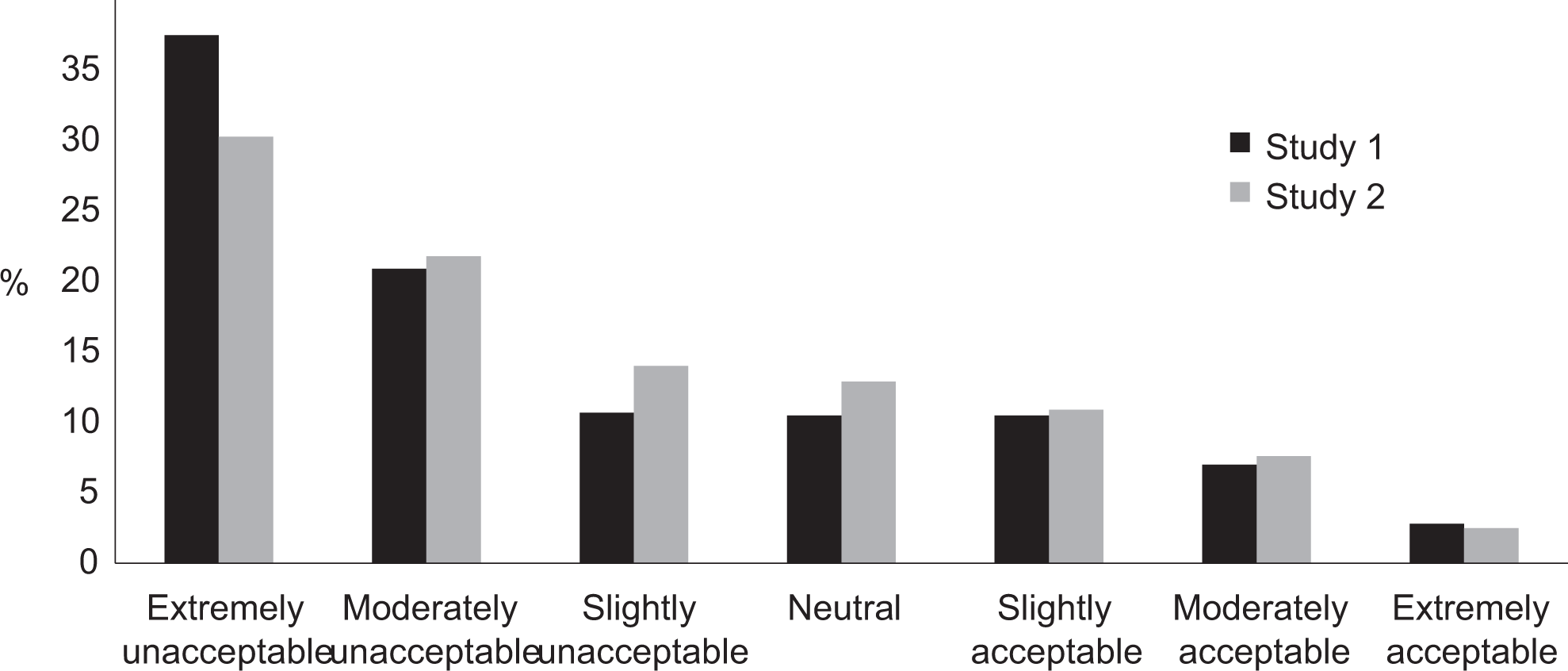
Distribution of acceptability ratings of foodie call behavior for both studies.
Does the Dark Triad Predict Foodie Calls?
Table 1 presents the correlations between previous foodie calls (no = 0, yes = 1), foodie call acceptability, and aggregate measures of dark triad traits and gender role beliefs as well as descriptive statistics for each. All correlations were significant at the p < .001 level, suggesting that both foodie call behavior and acceptability related significantly to Machiavellianism, psychopathy, narcissism, and gender role beliefs.
Next, we examined the incremental prediction of the dark triad traits and gender role beliefs in predicting foodie call behavior and acceptability. Given the high correlations between the dark triad traits, and consistent with the recommendations of Westfall and Yarkoni (2016), we decided to use structural equation modeling to evaluate the incremental prediction of the dark triad traits and gender roles.
Because the dark triad involves three independent traits, but is also considered a constellation of traits, we chose to use a bifactor model of the dark triad items. In a confirmatory factor analysis, this bifactor model (root mean square error approximation [RMSEA] = .07, 90% CI [.06, .08], p = .001) fit the dark triad data better than either a correlated traits or a second-order factor model (RMSEA = .116, 90% CI [.107, .124], p < .001; see Reise, Moore, & Haviland, 2010). A visual representation of our final structural equation model appears in Figure 2. In this model, we offer a general factor of the dark triad as well as three orthogonal traits, one for each trait. The general dark triad factor thus represents the shared constellation of variance across the dark triad and the traits themselves represent the variance unique to those traits.

Study 1: structural equation models predicting foodie call behavior (Model 1) and acceptability (Model 2) from dark triad and gender role traits. For ease of visualization, we have made the regression paths dark (black) and the factor-loading/covariance/error paths light (gray).
Table 2 presents the estimates for the primary paths (those in black in Figure 2) in our first model predicting previous foodie call behavior (yes or no) from the bifactor dark triad model and gender role beliefs, RMSEA = .08, 90% CI [.08, .09]. Full results output including additional model fit statistics, factor loadings, variances, and covariances appear on the OSF project page: https://osf.io/5u8ex/?view_only=c4698034887d4be1bd2e314909a6515f. An examination of the results suggests that the general dark triad factor was the largest predictor of previous foodie call behaviors such that those higher in the dark triad were more likely to have previously engaged in foodie call behaviors. After controlling for this general dark triad trait, only Machiavellianism, but not psychopathy or narcissism, significantly predicted additional variance in previous foodie call behavior. Traditional gender roles were also significantly related to previous foodie call behavior such that those higher in traditional gender roles were more likely to have engaged in previous foodie calls.
Study 1: Structural Equation Model Examining Whether the Dark Triad and Gender Roles Predict Previous Foodie Call Behavior.

Next, we assessed whether perceived acceptability of foodie call behavior was related to the dark triad and gender role beliefs. Table 3 presents the estimates for the primary paths (those in black in Figure 2) in our second model predicting perceptions of acceptability of foodie calls from the bifactor dark triad model and gender role beliefs, RMSEA = .08, 90% CI [.08, .09]. Full results output including additional model fit statistics, factor loadings, variances, and covariances appear on the OSF project page: https://osf.io/5u8ex/?view_only=c4698034887d4be1bd2e314909a6515f. Results suggest that the general dark triad factor was the largest and only significant predictor of perceived acceptability. Higher scores on the dark triad related to greater perceived acceptability.
Study 1: Structural Equation Model Examining Whether the Dark Triad and Gender Roles Predict Perceptions of the Acceptability of Foodie Call Behavior.

In sum, the dark triad and traditional gender role beliefs positively predict previous foodie call behavior and the extent to which women find foodie calls socially acceptable on a bivariate level. When entered into a model simultaneously, the general constellation of the dark triad traits was the only significant predictor of both prior foodie call behavior and perceived foodie call acceptability.
While Study 1 suggests a general factor representing the dark triad is the most robust predictor of foodie call beliefs and behaviors, our conclusion is limited by the fact that we used a 12-item, short form of the dark triad, developed as a singular measure which possibly created an overemphasis on the higher order factor. To examine whether the dark triad is robustly related to, and predictive of, foodie call behavior and attitudes, we replicated Study 1 using full versions of Machiavellianism, psychopathy, and narcissism. Study 2 did not examine gender role beliefs.
Study 2
Method
Participants
We recruited 428 women (Mage = 33.79, SD = 10.72) using Amazon’s Mechanical Turk and paid them US$0.26 as remuneration. Their current relationship status was mostly single (41%), followed by currently in a committed relationship (but not married; 33%), and married (27%). Women identified as Caucasian (76%), African American (10%), Asian (5%), Hispanic (6%), and Other (3%). Furthermore, women identified mostly as employed/self-employed (78%), followed by homemakers (7%), students (7%), looking for work (3%), and retired/unable to work/not looking for work (5%). Approximately, 69% of women had tried online dating. Most women identified as heterosexual (83%) rather than homosexual (2%) or bisexual (15%). Like Study 1, we included only the 357 self-identified heterosexual women in later analyses.
Materials
Descriptive statistics, reliabilities, and correlations between measures appear in Table 4.
Study 2: Descriptive Statistics and Correlation Matrix for Previous Foodie Call, Social Acceptability, and Dark Triad Traits Including Facets From the Original Measures for Exploratory Purposes Only.

Note. N = 357. Previous foodie call is a dichotomous variable (no = 0, yes = 1), so the correlation is a Pearson point biserial.
*p = .004. **p < .001.
Foodie call items
We included the same foodie call items used in Study 1.
Machiavellianism
We used the 20-item Mach IV Scale (Christie & Geis, 1970) to assess Machiavellianism. Women rated the degree to which they agreed or disagreed with statements using a 5-point Likert-type scale ranging from 1 (strongly disagree) to 7 (strongly agree).
Psychopathy
We used the 27-item Levenson Self-Report Psychopathy Scale (Levenson, Kiehl, & Fitzpatrick, 1995) to assess women’s level of subclinical psychopathy. Women rated the degree to which they agreed or disagreed statements using a 5-point Likert-type scale ranging from 1 (disagree strongly) to 7 (agree strongly).
Narcissism
We used the 40-item Narcissistic Personality Inventory (Raskin & Hall, 1981) to assess narcissism. Women were presented with pairs of statements and selected the statement they most agreed with.
Procedure
Women were randomly presented with the foodie call items, the Mach IV Scale, the Levenson Self-Report Psychopathy Scale, and the Narcissistic Personality Inventory, in randomized order, followed by demographic items.
Results and Discussion
How Prevalent Are Foodie Calls?
Thirty-three percent (n = 118) of women had engaged in a foodie call; 67% (n = 239) had not. Of women who had engaged in a foodie call, most did so occasionally (33%), rarely (24%), or very rarely (21%), although about a fifth of women indicated that they engaged in foodie calls frequently (16%) or very frequently (5%). On average, women who engaged in foodie calls had done so 5.62 times (SD = 21.69). Frequency of foodie calls was positively skewed (Md = 3.00) and ranged from 1 to 233 times (no reports between 20 [n = 2] and 233 [n = 1] times).
Most women found foodie calls as slightly to moderately unacceptable (M = 2.85, SD = 1.75). The average acceptability rating was significantly below the neutral midpoint of the scale, t(356) = −12.40, p < .001, d = −0.66. Women who had engaged in a previous foodie call perceived foodie calls as significantly more acceptable (M = 4.19, SD = 1.70) than women who had never engaged in a previous foodie call (M = 2.19, SD = 1.35), t(192.87) 4 = −11.21, p < .001, d = 1.30. Foodie call rates were quite similar among those in a relationship (32%) and those who were single (35%), χ2(1, 357) = 0.50, p = .48, Φ = .04. 5
Does the Dark Triad Predict Foodie Calls?
Table 4 presents the correlations between previous foodie calls (no = 0, yes = 1), foodie call acceptability, and aggregate measures of dark triad traits as well as descriptive statistics for each. For transparency, we include in this table the results for the facets of psychopathy and Machiavellianism scales. All correlations were significant at the p < .001 level suggesting that both greater foodie call behavior and greater ratings of acceptability related to higher scores on Machiavellianism, psychopathy, and narcissism.
Next, we examined the incremental prediction of the dark triad traits. In confirmatory factor analysis, this bifactor model (RMSEA = .047, 90% CI [.045, .049], p = .99) fit the dark triad data better than either a correlated traits model or a second-order factor model (RMSEA = .057, 90% CI [.055, .058], p < .001). A visual representation of our final structural equation model appears in Figure 3.

Study 2: structural equation models predicting foodie call behavior (Model 1) and acceptability (Model 2) from a bifactor model of the dark triad traits. For ease of visualization, we have made the regression paths dark (black) and the factor-loading/covariance paths light (gray). Because of the sheer number of variables, we were unable to label them or show arrows indicating error variances.
Table 5 presents the estimates for the primary paths (those in black in Figure 3) in our first model predicting previous foodie call behavior (yes or no), RMSEA = .046, 90% CI [.045, .048]. Full results output including additional model fit statistics, factor loadings, variances, and covariances appear on the OSF project page: https://osf.io/5u8ex/?view_only=c4698034887d4be1bd2e314909a6515f. As in Study 1, the general dark triad factor was the largest predictor of previous foodie call behaviors such that those higher in the dark triad were more likely to have previously engaged in foodie call behaviors. After controlling for this general dark triad trait, narcissism, but not psychopathy nor Machiavellianism, significantly predicted additional variance in previous foodie call behavior.
Study 2: Structural Equation Model Examining Whether the Dark Triad and Gender Roles Predict Previous Foodie Call Behavior.

Next, we assessed whether perceived acceptability of foodie call behavior was related to the dark triad and gender role beliefs. Table 6 presents the estimates for the primary paths (those in black in Figure 3) in our second model predicting perceptions of acceptability of foodie calls from the bifactor dark triad model and gender role beliefs, RMSEA = .046, 90% CI [.045, .048]. Full results output including additional model fit statistics, factor loadings, variances, and covariances appear on the OSF project page: https://osf.io/5u8ex/?view_only=c4698034887d4be1bd2e314909a6515f. As in Study 1, the general dark triad factor was the largest predictor of perceptions of foodie call acceptability. After controlling for general dark triad, only psychopathy, but not Machiavellianism or narcissism, significantly predicted additional variance in perceptions of foodie call acceptability.
Study 2: Structural Equation Model Examining Whether the Dark Triad and Gender Roles Predict Perceptions of the Acceptability of Foodie Call Behavior.

Discussion
In an online sample of heterosexual women, we examined frequency, acceptability, and individual difference predictors of foodie calls. Despite women generally rating foodie calls as unacceptable, approximately 23% of women had engaged in a foodie call in Study 1, whereas 33% reported engaging in a foodie call in Study 2. Women who had engaged in a foodie call consistently perceived the behavior as more socially acceptable than did those who had not engaged in a foodie call.
We also determined the characteristics of women who engaged in foodie calls and whether those characteristics predicted perceived acceptability of behavior. We predicted that foodie calls may be most prevalent among women who scored high in the dark triad as well as those who espoused more traditional gender roles. In Study 1, each of our hypotheses was confirmed. At a bivariate level, each of the dark triad traits as well as traditional gender role beliefs were positively related to previous foodie call behavior and the degree to which women found foodie calls socially acceptable. In Study 2, we replicated the findings for the dark triad using full measures of Machiavellianism, psychopathy, and narcissism. Again, each positively related to foodie call behavior and its perceived acceptability.
We also examined the incremental prediction of each trait in Studies 1 and 2 using structural equation modeling. The general dark triad factor, rather than any specific trait, was the only predictor to emerge in all models. This suggests the general constellation of the “dark” traits, rather than any one trait, represents a robust predictor of previous foodie call behaviors and higher ratings of foodie call acceptability.
One reason we observed correlations between all dark triad traits on the bivariate level but only found the general dark triad factor to be a consistent predictor when examining the incremental prediction of each factor is the large overlap between the dark traits. Pattern of correlations in both studies showed all three traits were related to previous foodie calls and their perceived social acceptability, but they were also highly related to another. This is why a bifactor model (modeling general dark triad plus individual traits) fit the data best. Still, future research may more clearly distinguish dark traits in predicting foodie calls.
Strengths, Limitations, and Future Directions
Studies 1 and 2 both included large samples of heterosexual women recruited online. Nevertheless, the sample is not generalizable to the population. Future research should consider using a representative sample to gauge actual prevalence of foodie calls.
The current research is the first to link foodie calls—an understudied phenomenon—to theory in personality and social psychology. Both social role theory and dark triad suggest that women with dark personality traits and traditional gender role beliefs may exploit traditional dating scripts for men. The findings support these theoretical relationships in a real-world dating situation. Future studies may apply additional theoretical frameworks. Whereas we focused on heterosexual women’s experiences, studying other gender and sexual orientation subgroups may advance evolutionary or feminism theories.
One limitation was reliance on self-reported foodie calls. People may have misreported their history to avoid seeming manipulative or misremembered bad dates as foodie calls to view their taste in men positively. Unfortunately, because prior research has not examined this phenomenon, we were unable to use validated measures of foodie call behavior. Nevertheless, we urge future research developing and validating measures of foodie call behavior.
Finally, we chose to focus on a particular type of foodie calls: deceptive female-to-male foodie calls. We chose this focus in part because of its consistency with traditional dating scripts and because this type of foodie call has received media attention (e.g., Maxim Magazine, New York Post). Nevertheless, it is certainty possible that foodie calls occur in same-sex relationships and by men toward women in some opposite-sex relationships.
Footnotes
Declaration of Conflicting Interests
The author(s) declared no potential conflicts of interest with respect to the research, authorship, and/or publication of this article.
Funding
The author(s) received no financial support for the research, authorship, and/or publication of this article.