




Abstract

Brandt, M. J., Crawford, J. T., & Van Tongeren, D. (2019). Worldview conflict in daily life. Social Psychological and Personality Science, 10, 35-43. (Original DOI: 10.1177/1948550617733517)
We discovered a minor error in our computation of the baseline measures of the individual items making up the Well-Being and Mental Stress scales. When corrected, the precise estimates of the coefficients change, although the qualitative summary of the coefficients (i.e., size, significance) do not. There is one exception: In Model 1, the original estimate of disagreement on the individual happiness item was significantly different from zero (b = −.06, 95% CI [−.09, −.03]); however, upon correction, it was no longer significant, although substantively the same size (b = −.05, 95% CI [−.11, .004]). The originally reported coefficients are in Original Table 3. The corrected coefficients are in Corrected Table 3. Mark Brandt was responsible for the analyses and takes responsibility for the error.
We discussed some of the corrected coefficients in the text. Specifically, on page 39–40, we originally wrote: It appears that the negative relationship between event disagreement and well-being is driven by the happiness item; event disagreement was associated with less happiness in Models 2 and 3 (the models with covariates; Model 3: b = −.14), whereas there was no clear associations between event disagreement and the remaining items measuring well-being (Life Satisfaction Model 3: b = −.04, Meaning Model 3: b = −.004). It appears that the negative relationship between event disagreement and well-being is driven by the happiness item; event disagreement was associated with less happiness in Models 2 and 3 (the models with covariates; Model 3: b = −.14), whereas there was no clear associations between event disagreement and the remaining items measuring well-being (Life Satisfaction Model 3: b = −.04, Meaning Model 3:
Original Unstandardized Coefficients and 95% Confidence Intervals (CIs) from Models Assessing the Link Between Event Disagreement (Models 1–3) and Event Disagreement × Ideology (Models 4 and 5), and the Individual Items Making Up the Well-Being and Mental Stress Outcome Variables.
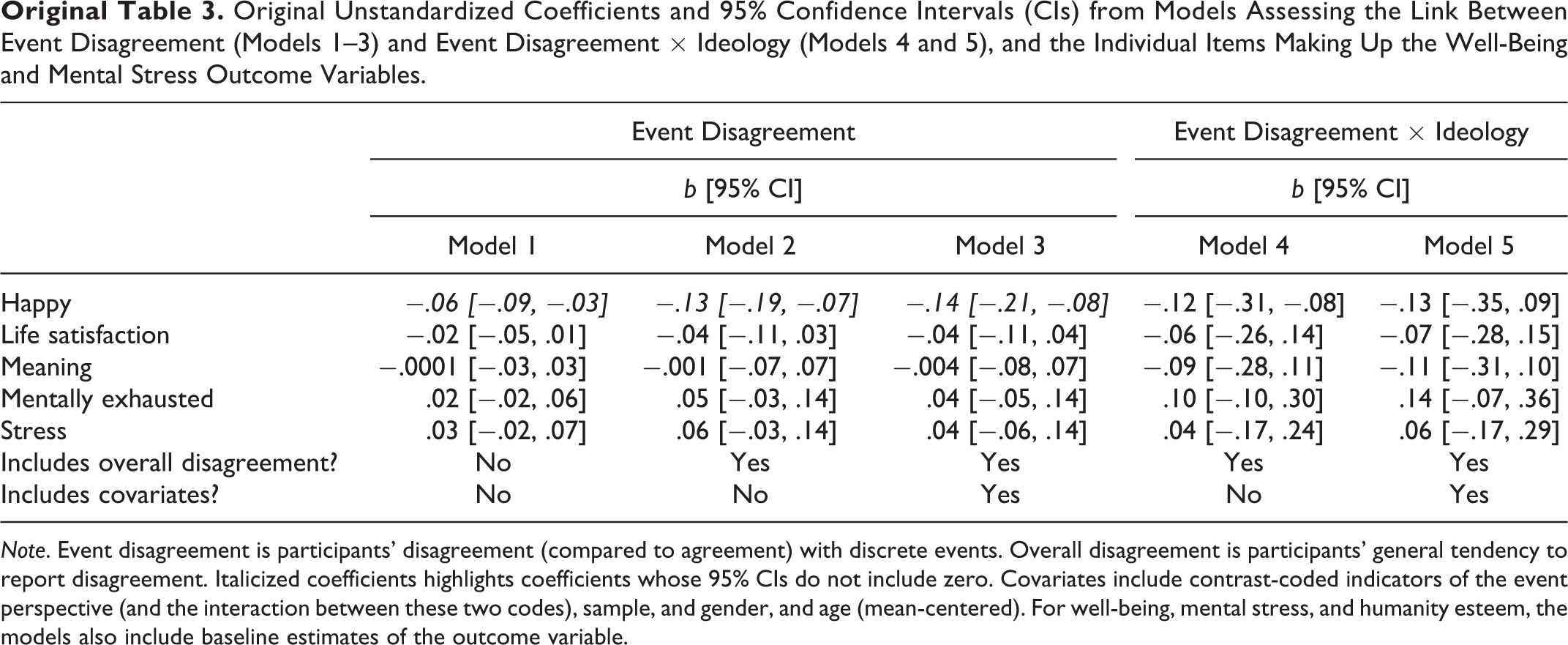
Note. Event disagreement is participants’ disagreement (compared to agreement) with discrete events. Overall disagreement is participants’ general tendency to report disagreement. Italicized coefficients highlights coefficients whose 95% CIs do not include zero. Covariates include contrast-coded indicators of the event perspective (and the interaction between these two codes), sample, and gender, and age (mean-centered). For well-being, mental stress, and humanity esteem, the models also include baseline estimates of the outcome variable.
Corrected Unstandardized Coefficients and 95% Confidence Intervals (CIs) From Models Assessing the Link Between Event Disagreement (Models 1–3) and Event Disagreement × Ideology (Models 4 and 5), and the Individual Items Making Up the Well-Being and Mental Stress Outcome Variables.

Note. Event disagreement is participants’ disagreement (compared to agreement) with discrete events. Overall disagreement is participants’ general tendency to report disagreement. Italicized coefficients highlights coefficients whose 95% CIs do not include zero. Covariates include contrast-coded indicators of the event perspective (and the interaction between these two codes), sample, and gender, and age (mean-centered). For well-being, mental stress, and humanity esteem, the models also include baseline estimates of the outcome variable.