




Abstract
While language style is considered to be automatic and relatively stable, its plasticity has not yet been studied in translations that require the translator to “step into the shoes of another person.” In the present study, we propose a psychological model of language adaptation in translations. Focusing on an established interindividual difference marker of language style, that is, gender, we examined whether translators assimilate to the original gendered style or implicitly project their own gendered language style. In a preregistered study, we investigated gender differences in language use in TED Talks (N = 1,647) and their translations (N = 544) in same- versus opposite-gender speaker/translator dyads. The results showed that translators assimilated to gendered language styles even when in mismatch to their own gender. This challenges predominating views on language style as fixed and fosters a more dynamic view of language style as also being shaped by social context.
In an era where we regularly engage with people and ideas that span different cultures and backgrounds, the ability to understand one another—beyond spoken language—is a concern of growing importance. In multilingual contexts, translators are charged with not only capturing and transferring the intended meaning of a message but also representing the psychological essence of the original speaker. The task of the “interpreter,” then, carries particular significance. While the literature on cognitive factors involved in multilingual translation is well-established (e.g., Schwieter & Ferreira, 2017), the degree to which translation also involves the capturing of rich social psychological dynamics remains largely unexplored.
The Social Psychology of Language Use
The ability to capture key components of people’s thoughts and feelings from their language has a rich tradition in psychology (Boyd et al., 2019). Broadly speaking, the psychological analysis of language differentiates between what a person says (language content) and how a person says it (language style; Chung & Pennebaker, 2007). Intuitively, the content of people’s language often provides clues as to what they are thinking (Pennebaker et al., 2003). Conversely, function words—small parts of language that are inherently “content-free”—are revealing of a person’s thinking style. The rates and patterns at which people use pronouns, articles, or conjunctions, that is, the language style signature, have been found to be reliable indicators of social psychological phenomena such as attachment style, interpersonal motives, and depression (Tausczik & Pennebaker, 2010). Additionally, one of the best established findings regarding language style differences is gender (e.g., Mulac et al., 2001; Newman et al., 2008; Schwartz et al., 2013).
Language style is seen as difficult to consciously monitor and alter due to the automaticity with which function words are generated; this applies to not only the sender of the message but also the recipient, meaning that the ability to monitor one’s own and other speakers’ function word use is limited (Chung & Pennebaker, 2007).
Psychological Adaption in Translations: Language Assimilation and Projection
Despite the stability of psychological language traits reported in the literature (Boyd, 2018; Boyd & Pennebaker, 2015), social situations require multiple forms of psychological adaptation. Individuals mirror the gestures, behaviors, and language of their conversation partners (Doyle & Frank, 2016; Giles et al., 1987; Thomson et al., 2001), phenomena that occur automatically and have also been referred to as verbal mimicry or language style matching of function words (Ireland et al., 2011).
When two people interact, they tend to adapt and produce similar language patterns, a process that has primarily been studied in the context of real-time and asynchronous social interactions. Translations, on the other hand, are a whole different story, as there is no direct social interaction. In fact, the question of whether translators manage to capture the psychological essence of a message, that is, its language style signature, has not yet been subject of psychological research. While the primary goal of any translation is to transmit the content of a message, translators may implicitly leave traces of their own psychological style.
In the broader multilingual literature, providers of interpretation services indicated that they usually adapt to different language styles (Hlavac, 2012). Translators may convey subtle qualities of the message, such as the speaker’s intent and emotional tone, as well as their gender (Hayeri, 2014). In fact, context-dependent variability in translation styles has been observed, supporting the idea of varying degrees of language adaptation in translations (see Angermeyer, 2009).
The Psychology of Translation: A Dual-Task Model of Translation
In Figure 1, we present our psychological model of translation that distinguishes between the translation of what is being said, that is, language content (primary task), and the translation of more implicit language features, that is, how the content is put in words (language style; secondary task). Beyond content translation, do translators also manage to capture and assimilate (a) to the original psychological style? Or, does their core focus on content inadvertently lead them to project (b) their own psychological signature onto the translation? Language adaptation may depend on the translator’s ability to monitor the speaker’s and the own language output.

The two tasks of translation.
If translators do not fully manage to step into the shoes of the speaker, they project their own psychological style, producing dissimilarity between original and translated language style. Even very simple requests may be expressed in many different ways, stylistically. Whereas the original speaker may have said “Pass the salt, please,” a translator might change it to “Would it be possible for you to pass me the salt?” projecting the own, more polite signature onto the message. Ideally, however, a translator assimilates to the original message by transferring its exact succinct style onto the translation and thus providing a translation that is accurate in both content and style. Assimilation and projection are not mutually exclusive and might occur simultaneously to a certain degree, for example, for particular function words.
In the present study, we focused on gender as a well-established interindividual difference marker in language style to study psychological adaptation in translations and investigated the language categories introduced in the literature (Newman et al., 2008; see “Measures”). Despite the heterogeneity in the specific findings on how male and female speakers differ in their language use, patterns of function word use have been identified as best discriminators between the genders (Argamon et al., 2003; Cheng et al., 2011; Schwartz et al., 2013). For example, women often use more pronouns and fewer articles (Argamon et al., 2003; Newman et al., 2008; Schwartz et al., 2013). In the salt example above, many women might thus favor the latter way of expressing the request.
Assimilation versus projection in translations are best observable when translators and speakers do not have the same gender. Does a female translator assimilate to a male speaker’s language style? Or does she implicitly project her own, more feminine language style signature?
We studied TED Talks to examine our research questions. TED Talks form a relatively homogeneous speech corpus, and the transcripts of original and translated talks are available online. In an initial step, we examined gender differences in TED speakers’ language to empirically identify our function word categories of interest. In our main question, we focused on TED Talk translations to examine whether translators assimilate to or project gendered language style in opposite-gender speaker/translator dyads.
To sum up, we investigated the following, preregistered (osf.io/jvp6r) research questions:
Method
We collected 2,731 transcripts of English TED Talks from the official TED website (https://www.ted.com) in March, 2018, along with the translated German transcript, where available. Since we used the text analysis program Linguistic Inquiry and Word Count (LIWC; Pennebaker et al., 2015) that contains a recently updated German dictionary (Meier et al., 2018), focusing on the German translations allowed us to analyze language use in a way that is comparable across the two languages.
TED conferences, at which academics, entrepreneurs, artists, and a variety of other individuals give short talks about their area of expertise, have enjoyed global popularity with the videos of these talks subsequently being hosted and freely available on the TED website.
TED provides a transcript of the talk in its original language. A community of volunteers translates the talks from the original language into a variety of other languages. TED requires its translators to be fluently bilingual in both languages of translation, to be knowledgeable of the topics covered in the talks, and to learn about their best translation practices (https://www.ted.com/participate/translate). Among these guidelines are recommendations to try to match and emulate the speaker’s original tone. Translated transcripts are reviewed by an experienced volunteer and approved by a TED language coordinator before they are published on the website.
TED speakers and translators are credited with a personal TED profile page. We used information from these public profiles to code the genders of speakers and translators. For speakers, the gender they identified with was coded based on the videos as well as their names, profile pictures, and descriptions (personal pronouns) on their profile. Conforming to current practices on gender identity measures (American Psychological Association, 2015), transgender speakers were coded in terms of their identified gender (n = 5 in “full sample,” n = 1 in “translated subsample”).
For translators, we used the available information on their public profiles, such as their first name, picture, and links to personal web pages to infer their gender. If these sources provided inconclusive information about their gender, the corresponding transcripts were not included in our sample.
In general terms, we followed a preregistered sampling procedure and a detailed overview of the steps that resulted in our final sample is provided in Figure 2.
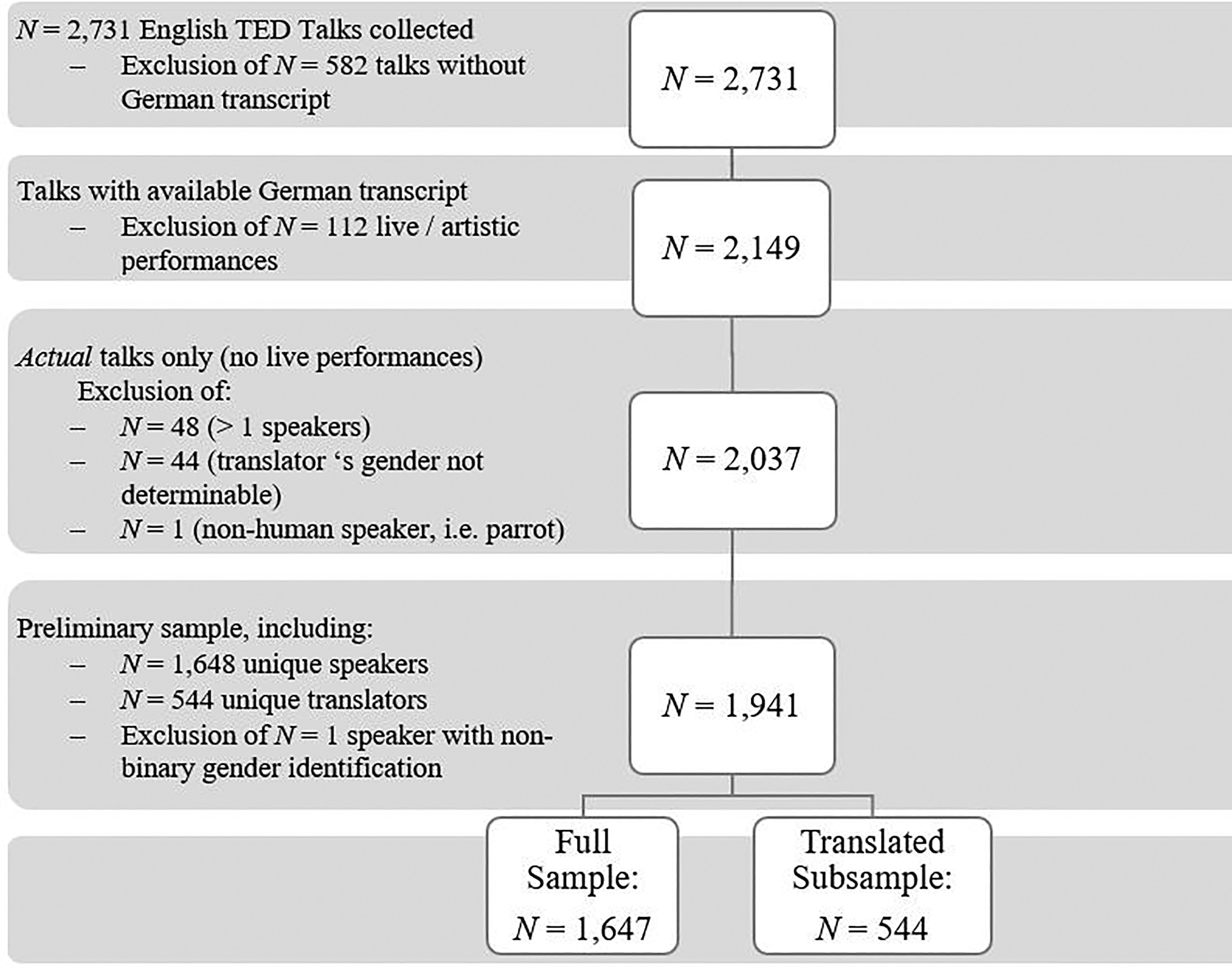
Sampling procedure.
First, only talks with an available translated German transcript were included (n = 2,149, 78.7%). Second, we excluded transcripts of videos which were live performances (n =112) rather than talks in order to keep the context of language homogeneous. Third, we excluded talks for which translator’s gender was not clearly determinable (e.g., aliases, unisex names, and no profile picture available, n = 44) that included more than one speaker (n = 48) or had a nonhuman speaker (i.e., parrot, n = 1). Forth, for reliable language use analysis, talks with fewer than 100 words (n = 3) were excluded. These exclusions resulted in a tentative pool of n = 1,941 talks.
One challenge for our analyses was the nesting of speakers and translators: In our preliminary sample of n = 1,941 talks, there were 1,648 unique speakers (539 female, 1,108 male, 1 nonbinary) and 599 unique translators (333 female, 266 male). In all, 212 speakers gave more than one talk, and 263 translators translated more than one talk.
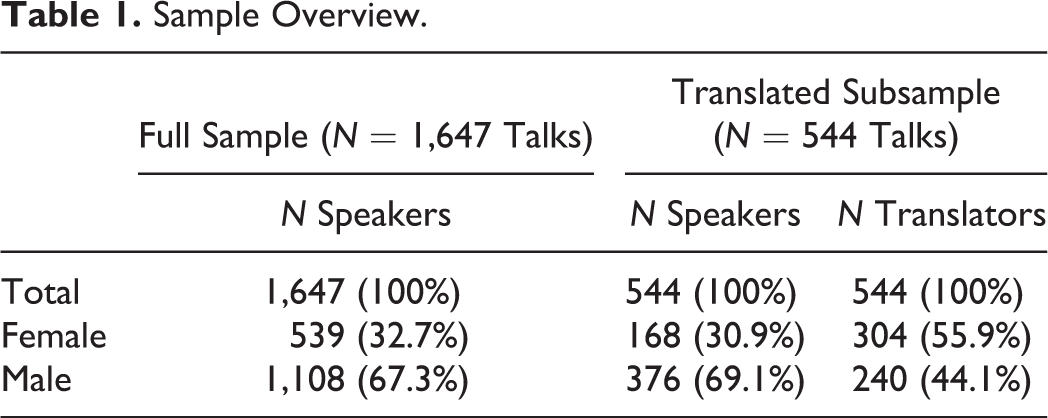
For our analyses, we used two samples, each of which was either restricted to the total number of unique speakers (full sample) or the total number of unique speakers and unique translators (translated subsample). This represents a conservative approach to avoid nonindependence in the data and systematic overrepresentation of translators with a high number of translations in the analysis. We here describe these two final samples in detail (see Table 1 for a sample overview). Sensitivity analyses revealed that our sample sizes were appropriate for detection of the assumed effects (see Supplemental Material B for more information on our power considerations).
Sample Overview.
Full Sample
For speakers who gave more than one talk, we selected one single talk from each speaker (the one with the largest word count). The aim here was to reduce nonindependence of this subsample of data while using the most reliable observation in terms of language data. We further excluded one talk from a speaker who identified themselves as outside of the gender binary.
The full sample thus consisted of 1,647 talks each given by a different speaker. The sample therefore shows a nonnested structure and was used for the analyses in which the original TED Talks rather than the translations were in focus (RQ1, speakers), that is, to establish the function word marker of gender differences.
Translated Subsample
For the talk translations, we undertook an analogous procedure to reduce nonindependence of data: As there were 544 unique translators in the preliminary sample, 310 translated one talk each, while 234 translators translated at least 2 and up to 88 talks. For this remaining nesting of translators in talks, stemming from translators who provided more than one translation, we tested whether there was consequential nonindependence in this subset (Kenny et al., 2006). For several of our dependent variables, this was the case (see Supplemental Material A). Since the majority of translators translated one talk only, a multilevel framework was not feasible here due to lack of within-person variability. We therefore opted for a conservative approach that allows the inclusion of all translators and restricted this sample to the number of unique translators (N = 544, see Table 1). We used the translated subsample to examine our main research question, where the translations were of interest (RQ2, and RQ1, translators).
Measures
Gender and dyad type
Based upon the gender coding of speakers and translators, we created a dyadic variable representing the genders of both speakers and translators. We coded “dyad type” as 0 = same gender (female speaker/translator, male speaker/translator) or 1 = opposite gender (female speaker, male translator/male speaker, female translator). In the translated subsample, there were two different types of same-gender speaker/translator dyads as well as two types of opposite-gender dyads: n = 113 female/female, n = 185 male/male, n = 191 male/female, and n = 55 female/male.
Language use
We analyzed the transcripts with the LIWC2015 in English (Pennebaker et al., 2015) and in German (DE-LIWC2015, “LIWC auf Deutsch”; Meier et al., 2018). LIWC measures the rates at which psychologically meaningful words occur in a given text, expressing the scores in terms of percentages. For example, the text “I am feeling depressed” would be scored as 25% first-person singular pronouns (“I”) and 25% negative emotions (“depressed”). The recently developed DE-LIWC2015 contains the same categories as the English dictionary, and the comparability of the two dictionaries has been empirically established (Meier et al., 2018).
First, we generally tested gender differences in speakers’ language use, which can be seen as a replication of previous findings, in the context of TED Talks. As outlined in the preregistration, we focused on LIWC content and function word categories for which gender differences have previously been found (Newman et al., 2008; Pennebaker, 2011; see Table 2). Furthermore, we included new categories that were added to LIWC in its 2015 version, and we expected to differ between genders based on conceptual considerations (Lakoff, 1975; Leaper & Ayres, 2007; Newman et al., 2008). A comprehensive overview of all LIWC variables treated as candidate word categories for gender differences is listed in Table 2 (see Supplemental Material C for more information). For our main question, RQ2, psychological adaptation to language style was our core interest; we therefore focused on all function word categories for which gender differences were found in RQ1.
Preregistered Candidate LIWC Categories for Gender Differences as Hypothesized.

Note. LIWC = Linguistic Inquiry and Word Count.
a LIWC categories were selected based on previous evidence about gender differences in language use (Newman et al., 2008). We only included categories with an effect size |d| ≥ .15 in the Newman et al. (2008) sample. bThese LIWC categories are new (or substantially revised) to the 2015 version of the LIWC dictionaries and were considered as candidates of gender differences. cAll cognitive process word categories were included in our analysis based on findings summarized by Pennebaker (2011).
Analyses of Preregistered Hypotheses
We provide here an overview of the statistical analyses. All hypotheses were preregistered (available at osf.io/jvp6r) 1 ; data, syntaxes, and supplementary analyses are available at osf.io/dtf83.
Question 1: Do male and female TED speakers, as well as male and female translators, differ in their language use?
As an initial step, we examined gender differences in word use. We investigated this separately for speakers and for translators relying on multivariate analyses of variance (MANOVAs). This can be seen as a descriptive way of examining whether speakers and translators differed in their word use while accounting for speaker/translator interdependencies (Kenny et al., 2006). Additionally, this approach was used to empirically establish the gendered function word use pattern for our primary question. We used the full sample for TED speakers and the translated subsample for translators. We then recomputed the analysis for speakers in the translated subsample to cross-validate the effects in the smaller sample.
Independent variables included the genders of speakers (MANOVA 1) and the genders of translators (MANOVA 2); dependent variables (LIWC scores) are depicted in Table 2. We controlled for length of speech samples by including total word count of the talks as covariates. As initially not all assumptions of MANOVA were met (see Supplemental Material B), we log-transformed the dependent variables, which satisfactorily improved homogeneity of variance–covariance matrices. For the interpretation of subsequent univariate test results, and in particular for the establishment of the “gendered language signature,” we relied on a conservative level of significance (0.1%). Moreover, whenever possible, we report confidence intervals around estimated effect sizes. For the univariate
Question 2: Are there greater differences between speakers’ and translators’ language styles in opposite-gender versus same-gender dyads?
To address our primary research question whether translators assimilate to speakers’ gendered function word use even when in mismatch with their own gender, we conducted a MANOVA using a dyad-level variable (difference score between speaker and translator) for each dyad as dependent variables. We chose a difference score of z-transformed LIWC scores in order to acknowledge the dyadic pairing of speaker and translator as well as to partial out potential language-specific baseline differences, following a procedure that has been applied in analyses of gender differences in personality traits across cultures (Costa et al., 2001). Differences of z-transformed LIWC scores (“translator minus speaker”) represent deviations in gender-relevant LIWC categories between the original talk and the translation. The difference scores can be interpreted as effect sizes corresponding to Cohen’s d. Tests of the model requirements are reported in Supplemental Material B, which led us to abstain from log-transformation of the difference scores.
We included main effects of “gender” and “dyad type” to test whether differences in language use between speaker and translator were different in opposite-gender (dyad type = 1) versus same-gender dyads (dyad type = 0). The full model included a Dyad Type × Gender Translator interaction and thus the following possible groupings: female speaker–translator, male speaker–translator, male speaker–female translator, and female speaker–male translator. Again, we included total word count of the talks as a covariate.
Results
Language profiles for all gender-sensitive word categories in original talks and translations are illustrated in Figure 3. Figure 3 suggests that the general language profile of translations strongly resembled the gender differences found in the original talks and that translators’ own gender differences were diminished. Assimilation then, rather than implicit projection of gendered language use, appears to be the norm for both language content and style during translation; subsequent analyses explicitly tested whether this was the case.

Language use profiles in gender-sensitive word categories in (A) TED Talks and (B, C) their translations. Speaker’s gender showed a similar language use pattern in (A) the original and (B) translated talks, whereas no clear pattern was evident for (C) translator’s gender. Depicted are all categories for which TED speakers showed significant gender differences (p < .001 in Research Question 1); all values are means of z-standardized Linguistic Inquiry and Word Count scores.
Question 1: Do Male and Female TED Speakers as well as Translators Differ in Their Language Use?
Regarding the identification of a gender-language signature, there was a statistically significant main effect of speaker’s gender in language use, F(34, 1611) = 9.65, p < .001; Pillai’s Trace = .169,
Descriptives and results of the univariate tests of LIWC categories as a function of speaker’s gender are reported in Table 3. Out of 34 dependent candidate variables, 21 LIWC categories showed significant gender differences (p’s < .05); 12 were significant at p < .001. The intercorrelations between all language variables are reported in Supplemental Material H.
Gender Differences in Language Use in TED Talks for Speakers (Full Sample, N = 1,647).
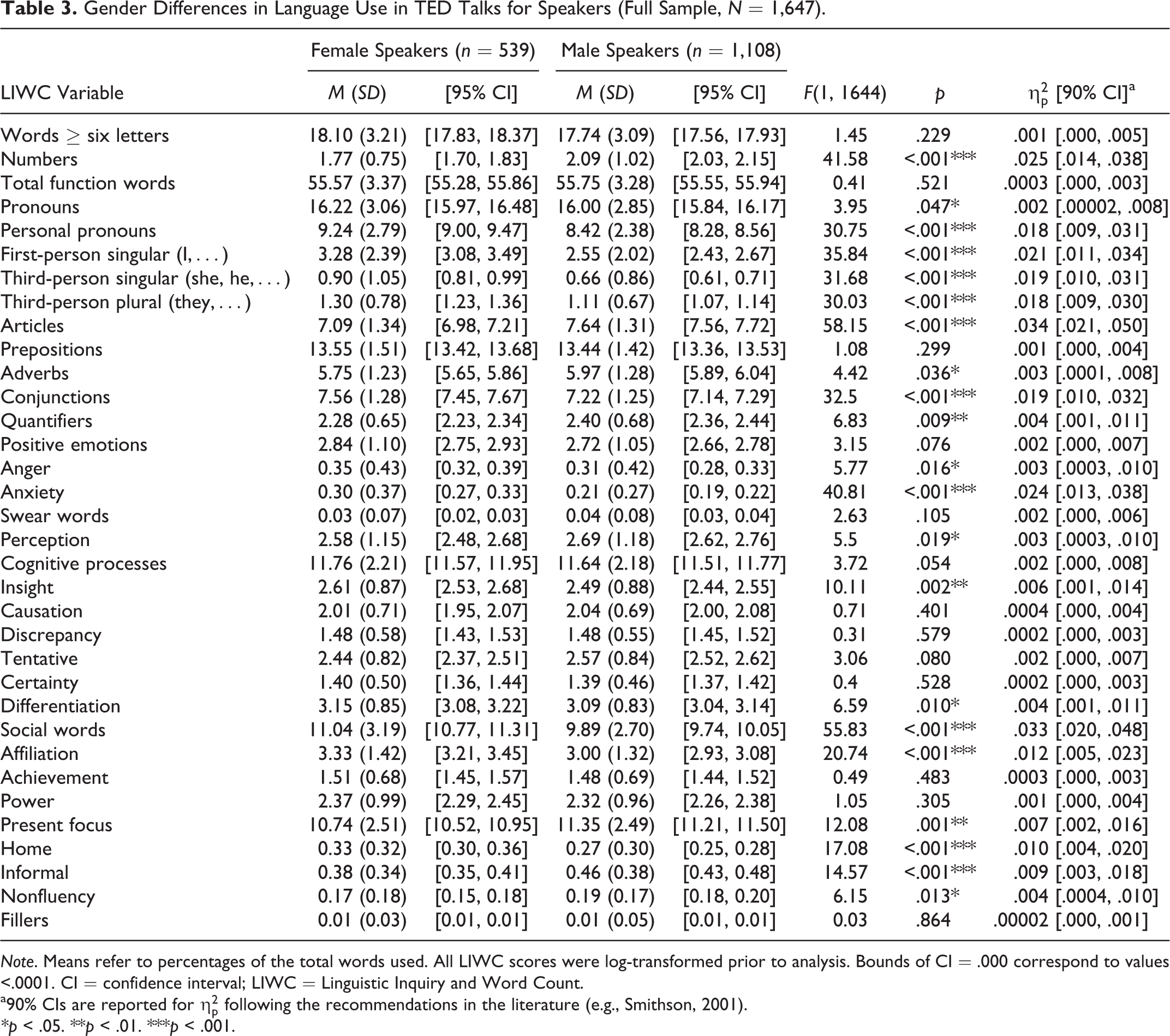
Note. Means refer to percentages of the total words used. All LIWC scores were log-transformed prior to analysis. Bounds of CI = .000 correspond to values <.0001. CI = confidence interval; LIWC = Linguistic Inquiry and Word Count.
a90% CIs are reported for
*p < .05. **p < .01. ***p < .001.
A parallel MANOVA was performed to replicate gender differences of speaker’s language in the translated subsample (N = 544 talks). Again, there was a statistically significant effect of speakers’ gender on language use, F(34, 508) = 3.58, p < .001; Pillai’s Trace = .193,
For the translations, there was a statistically significant main effect of “translator’s gender,” F(34, 508) = 1.72, p = .008; Pillai’s Trace = .103,
Gender Differences in Language Use in TED Talks for Translators (Translated Subsample, N = 544).

Note. Means refer to percentages of the total words used. All LIWC scores were log-transformed prior to analysis. Bounds of CI = .000 correspond to values <.0001. CI = confidence interval; LIWC = Linguistic Inquiry and Word Count.
a90% CIs are reported for
*p < .05.
Supplementing the preregistered analyses, we recomputed the models for the translations including speaker’s gender as an independent variable to examine how language use in TED translations differs as a function of the speakers’ genders. These analyses were treated as preliminary tests of whether speakers’ versus translators’ gender explains more variance in gendered word use in translations as the visualization in Figure 3 already hinted. Word count of the transcript was a covariate and showed a significant effect, F(34, 507) = 5.60, p < .001; Pillai’s Trace = .273,
There was a statistically significant difference in translated language use based on the translator’s gender, F(34, 507) = 1.55, p = .026; Pillai’s Trace = .094,
In this new model, only one LIWC category showed statistically significant differences based on the translator’s gender (“nonfluencies,” p = .025). For speaker’s gender, however, 14 LIWC categories showed significant differences (p < .05), 5 of which were significant at p < .001 (for more details, see Supplemental Material E, and Figure 3 for an illustration).
Summing up, gender differences in language use for the translators were present but weaker than those for the original speakers; and language use in the translations was better explained by the speaker’s rather than the translator’s gender, when we included both main effects in the model. Moreover, these first analyses enabled us to establish a function word-based marker of gender, forming the basis of RQ2.
Question 2: Are There Greater Differences Between Speakers’ and Translators’ Language Styles in Opposite-Gender Versus Same-Gender Dyads?
Means and confidence intervals for translator–speaker difference scores are reported in Table 5. Neither the multivariate effect of dyad type (p = .643) nor translator’s gender (p = .305) significantly explained the language use difference scores; therefore, the hypothesis that translators implicitly project their own gendered function word use and that opposite-gender speaker/translator dyads show greater differences was not supported. However, there was a statistically significant Dyad Type × Translator’s Gender interaction effect on the LIWC difference scores, F(7, 533) = 2.39, p = .021; Pillai’s Trace = .030,
Summary Information for Research Question 2: Differences of z-Transformed LIWC Scores “Translator Minus Speaker.”
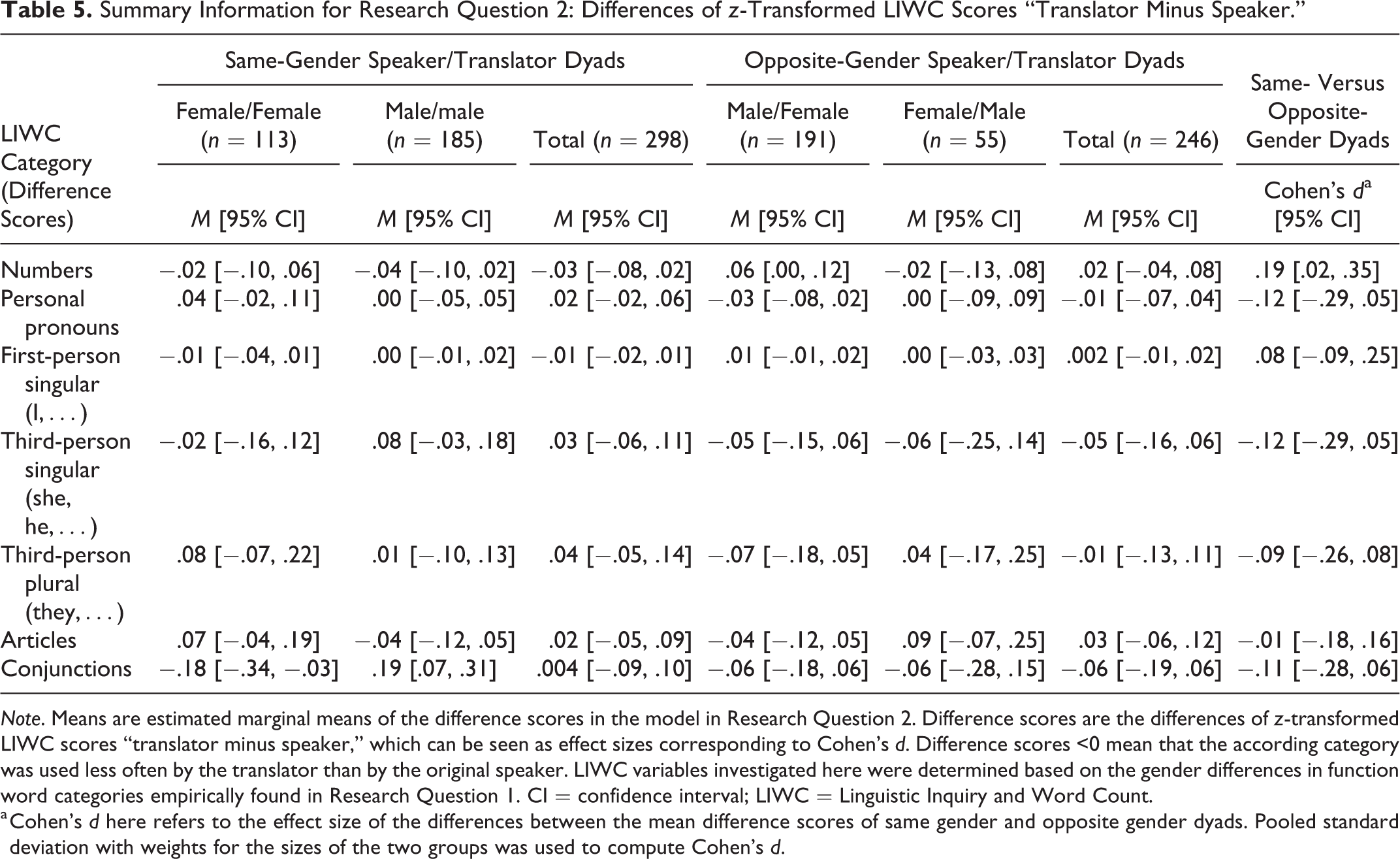
Note. Means are estimated marginal means of the difference scores in the model in Research Question 2. Difference scores are the differences of z-transformed LIWC scores “translator minus speaker,” which can be seen as effect sizes corresponding to Cohen’s d. Difference scores <0 mean that the according category was used less often by the translator than by the original speaker. LIWC variables investigated here were determined based on the gender differences in function word categories empirically found in Research Question 1. CI = confidence interval; LIWC = Linguistic Inquiry and Word Count.
a Cohen’s d here refers to the effect size of the differences between the mean difference scores of same gender and opposite gender dyads. Pooled standard deviation with weights for the sizes of the two groups was used to compute Cohen’s d.
In line with the main analyses, use of conjunctions in translations was more reduced (relatively to the original transcript) in male/female dyads, compared to male/male dyads, and in same-gender dyads, when the translator was female rather than male. Together with the Dyad Type × Gender interaction effect, this hints toward gender-specific tendencies of translators to level out extreme cases of conjunction and article use.
Discussion
Building upon a conceptual model to distinguish between language content versus style, the current study used gendered language style as an example to investigate psychological adaptation during translation. The results did not support our assumption that translators implicitly project their own gendered, stylistic features onto translations. In other words, the gender differences observed in TED speakers’ language style were in fact not lost in translation. Essentially, the profile of gender-sensitive word categories in translations largely matched the genders of the original speakers, suggesting that assimilation of gendered language styles happens during translation. Put another way, beyond the mere translation of what was said, translators managed to capture the more subtle characteristics of how something was said: the message’s psychological essence.
As the first study to investigate translations from a psychological perspective, the results suggest that translators may overcome the temptation to implicitly project their own automatic function word use pattern and assimilate to patterns that are in contrast to their own. This speaks for a more dynamic view on gendered language style as construed within the social situation (Thomson et al., 2001). In a similar way as gender differences in emotional expression depend on socialization (Brody, 2000; Brody & Hall, 2008), individuals might adapt their language style contrary to their own gendered inclinations.
Although our results generally point to assimilation of gendered language signatures during translation, subtle signs of projection were also observed, and we note that conjunctions and articles might form an exceptional case. Not only were they among the best discriminating word categories between male and female speakers, male and female translators seemed to level out their low or high use, particularly in same-gender dyads. Since articles and conjunctions are part of an analytical thinking dimension in language (Pennebaker et al., 2014), examining the special role that dynamic versus analytical language styles might play during translation would be an intriguing question for future research.
Findings from the present study add to the well-established literature on gendered language styles in several significant ways. First of all, the gender differences identified for TED speakers are in line with previous work suggesting that function words—especially personal pronouns, articles, conjunctions, and numbers—are robust discriminators between men and women and that language typically used by females is characterized by higher emotional expressiveness, personal and social relatedness, whereas males’ language style is more instrumental or concept-oriented (Argamon et al., 2003; Newman et al., 2008). Although all these differences were rather small effects (
Previously, it has been suggested that gender differences in language style are most pronounced in contexts with few constraints, that is, spontaneous, spoken language (Newman et al., 2008). People’s inclination to use language in ways conforming to their social group may be driven by situational cues, for example, the salience of gender. Despite TED’s homogeneous and comparable format across talks, the underrepresentation of female speakers might possibly activate gender schemes and trigger speakers’ use of gender-conform language styles in this context. Translations on the other hand may represent a situation in which own gender is not as salient, thus possibly facilitating assimilation to gendered signatures that contrast with the own gender.
The results of the present study should be understood in the context of its limitations. First, female TED speakers (32.7%) and male TED translators (44.1%) were underrepresented in our sample, which led to an underrepresentation of female speaker–male translator dyads (n = 55, 10.1%).
Secondly, TED translations represent well-prepared, written translations and translators were encouraged to try to match the talks’ original tone. We cannot exclude the possibility that this triggered translators’ conscious efforts to monitor stylistic aspects and that less accommodation (and, conversely, more projection) happens during more spontaneous, time-constrained forms of translations. This opens the door for further experimental research, for example, comparing simultaneous translations with off-line translations that vary in task instruction, time, and cognitive demand.
Further research is required to shed light on possible cultural implications when studying translations. While in the current study, the cultural context of English versus German language would not suggest differences in the expression of gender roles, it might possibly activate different self-schemes of personality (Ramírez-Esparza et al., 2006; Rodríguez-Arauz et al., 2017). Future research should examine whether individuals assimilate to psychological styles that are in contrast with their own personality and whether certain languages facilitate assimilation to, for example, “extraverted” language styles. Another intriguing avenue will be to explore whether language-specific, emotional display rules (Ekman et al., 1969) may affect translations; for instance, whether translation to more “emotional” languages, for example, Italian, would lead to more projection in emotional tone. More generally speaking, our findings should be replicated in other contexts beyond TED Talks before being generalized prematurely.
Conclusion
The present study provided first evidence that psychological adaptation occurs during translation. Understanding the social psychological dynamics involved in translations is an issue of immense importance in multilingual contexts, but one that has remained largely unexplored. Results of the present study yield promising insights into how translators manage to step into the shoes of another person and capture subtler features of the intended meaning, opening the door for more research to be conducted in this area.
Supplemental Material
Supplemental Material, (Not)_Lost_in_Translation_Supplemental_Materials_A_Through_H - (Not) Lost in Translation: Psychological Adaptation Occurs During Speech Translation
Supplemental Material, (Not)_Lost_in_Translation_Supplemental_Materials_A_Through_H for (Not) Lost in Translation: Psychological Adaptation Occurs During Speech Translation by Tabea Meier, Ryan L. Boyd, Matthias R. Mehl, Anne Milek, James W. Pennebaker, Mike Martin, Markus Wolf and Andrea B. Horn in Social Psychological and Personality Science
Footnotes
Authors’ Note
During her work on this project, Tabea Meier was a pre-doctoral fellow of LIFE (International Max Planck Research School on the Life Course; participating institutions: MPI for Human Development, Humboldt-Universität zu Berlin, Freie Universität Berlin, University of Michigan, University of Virginia, University of Zurich). Tabea Meier and Andrea B. Horn are affiliated with and Mike Martin is the director of the URPP “Dynamics of Healthy Aging” at the University of Zurich, Switzerland.
Acknowledgments
The authors would like to acknowledge Vanessa Infanger for her support in data preparation.
Declaration of Conflicting Interests
The author(s) declared the following potential conflicts of interest with respect to the research, authorship, and/or publication of this article: James W. Pennebaker is the owner of the text analysis program LIWC, which is a commercial product from  . All profits that he receives are donated to the University of Texas at Austin. All other authors declared that they had no conflicts of interest with respect to the research reported in this article.
Funding
The author(s) disclosed receipt of the following financial support for the research, authorship, and/or publication of this article: National Institutes of Health (5R01GM112697-02), Federal Bureau of Investigation (15F06718R0006603), Schweizerischer Nationalfonds zur Förderung der Wissenschaftlichen Forschung (SNF PMPDP1_164470), John Templeton Foundation (#48503, #61156), National Science Foundation (IIS-1344257), and Jacobs Foundation.
Supplemental Material
The supplemental material is available in the online version of the article.
Note
References
Supplementary Material
Please find the following supplemental material available below.
For Open Access articles published under a Creative Commons License, all supplemental material carries the same license as the article it is associated with.
For non-Open Access articles published, all supplemental material carries a non-exclusive license, and permission requests for re-use of supplemental material or any part of supplemental material shall be sent directly to the copyright owner as specified in the copyright notice associated with the article.
