




Abstract
Lin-Healy and Small found that laypeople believed that selfless prosocial actors were less likely than their selfish counterparts to benefit from their acts—that is, “nice guys finish last” (Study 1). The purpose of the current research was to replicate and extend their results. Our first three studies asked laypeople to estimate selfless or selfish prosocial actors’ future benefits. Inconsistent with the original results, we found that both Eastern and Western laypeople believed that selfless actors were more likely to benefit than selfish actors (Studies 1 and 2), and the belief in a just world moderated this effect (Study 3). Study 4 asked participants to choose an agent among three prosocial actors with different motivations to gamble for a monetary reward. The results showed that laypeople were more likely to choose a selfless agent to make the bet. The findings indicate that laypeople believe that authentic altruistic actors obtain future benefits.
Lay theories on prosocial actors’ motivations have attracted substantial attention (Carlson & Zaki, 2018). Recently, Lin-Healy and Small (2013) found that prosocial actors’ motivations or benefits influence audiences’ evaluations of them. Specifically, they found that audiences believed that prosocial actors with selfless motives were less likely than their counterparts with selfish motives to win a raffle—that is, “nice guys finish last” (study 1)—whereas prosocial actors who benefited from their acts were perceived to be less altruistic than those who did not—and “guys who finish last are nice” (study 2). Lin-Healy and Small (2013) interpreted the results with reference to the altruism prototype, which suggests that unrequited sacrifices are associated with prosocial behavior and are incompatible with benefits to the prosocial actor. Their paper was published in a prestigious journal, received much attention, and has been cited many times.
The “guys who finish last are nice” results from study 2 in Lin-Healy and Small (2013) were verified by subsequent studies. Specifically, laypeople were skeptical about prosocial actors’ motivations if the actors obtained material or reputation benefits from prosocial behavior regardless of whether the prosocial actor was at the individual level (Barasch et al., 2014; Berman et al., 2015; Lin-Healy & Small, 2013) or at the company level (Lin-Healy & Small, 2013; Newman & Cain, 2014; Yoon et al., 2006).
However, the “nice guys finish last” results of Lin-Healy and Small’s (2013) study 1 are inconsistent with established theories of belief in a just world (BJW; Lerner & Miller, 1978) and the prevailing belief in karma (White & Norenzayan, 2019). Specifically, the BJW theory proposes that people usually believe that they live in a world where people get what they deserve (Lerner & Miller, 1978). People who believe in karma also expect that good acts will cause good things to happen, whereas bad acts will cause bad things to happen (White & Norenzayan, 2019). For example, people are willing to engage in prosocial behaviors while awaiting uncertain but important future outcomes because they believe that it may increase their luck (Converse et al., 2012). Thus, previous findings suggest that individuals in both Eastern and Western contexts believe that doing good deeds will bring future benefits. Given the inconsistencies in previous studies, the current study aimed to replicate and extend study 1 in Lin-Healy and Small (2013).
Independently replicating study 1 from Lin-Healy and Small (2013) is worthwhile for several reasons. First, the importance of replication studies in building a cumulative science has been noted, particularly in social psychology (Pashler & Wagenmakers, 2012; Spellman, 2012, 2013). Second, audiences’ moral speculations on prosocial behavior can determine what kind of good deeds is praised or criticized, which may provide insights into public policies and organizational behavior (Carlson & Zaki, 2018). Finally, the way that laypeople evaluate a prosocial act may impact their own altruistic tendencies (Carlson & Zaki, 2018). Caution is needed when drawing conclusions in this area, and further investigation is needed.
Therefore, the current Study 1 first replicated study 1a from Lin-Healy and Small (2013). Study 2 was a preregistered study and replicated study 1b of Lin-Healy and Small (2013). Study 3 further explored the possible moderator of the BJW in the relationship between prosocial motivation and future benefits. Studies 1–3 used a self-report approach, whereas Study 4 examined the issue indirectly using a gambling game.
Study 1: Replicating the ‘Nice Guys Finish Last’ Results in the Individual Level
In this study, we replicated Lin-Healy and Small’s (2013) study 1a. In Study 1a, we employed a between-subjects design and a Chinese undergraduate student sample. In Study 1b, to ensure that the results could be generalized to the population as a whole, a within-subject design and a more diverse sample were employed. Moreover, to explore whether culture acted as a confounding variable, we conducted Study 1c among Westerners using a between-subjects design.
Study 1a
Method
We performed an independent samples t test and used G*Power (Version 3.1; Faul et al., 2009) for a power analysis based on a medium effect size of 0.5, which was determined by the effect size of the probability of winning a raffle in study 1a from Lin-Healy and Small (2013). To achieve 95% power, a minimum sample size of 210 was needed (α = .05). To accommodate any potential exclusions, we recruited 276 Chinese undergraduate students (males/females, 61/215; mean age = 21.66 ± 1.94). The participants were randomly assigned to the selfless condition (n = 137) or the selfish condition (n = 139).
The procedure closely adhered to that described in Lin-Healy and Small (2013). First, the participants read the prosocial scenario. In the scenario, a charity raffle to help impoverished local children was being held during a sports game in a stadium. Only those who donated a certain amount of money were qualified to enter the raffle. The prize was an opportunity to have dinner with two players of the winner’s choice.
Then, we manipulated the donor’s motivation as in Lin-Healy and Small (2013). In the selfless condition, participants read, “Thinking about all the children that need help and feeling that he or she should do something, Jamie donates an amount of money and has the chance to participate in this raffle.” In the selfish condition, participants read, “Thinking about how great it would be to meet the players, Jamie donates an amount of money and has the chance to participate in this raffle.”
Finally, the participants completed the measures. Specifically, the participants rated the donor’s chances of winning the raffle on a 1 (almost no chance) to 7 (pretty good chance) scale and the donor’s probability of winning the raffle (0–100%). In addition, the participants evaluated the donor’s motivation on a 1 (extremely selfless) to 7 (extremely selfish) scale as a manipulation check.
Results
Manipulation Check
Compared with that of the selfish donors (M = 3.86, SD = 1.14), the motivation of the selfless donors (M = 2.78, SD = 1.10) was believed to be less selfish, t(274) = −7.96, p < .001, d = 0.96, 95% confidence interval (CI) [−1.34, −0.81], indicating that the manipulation was effective (Supplementary Fig. 1).
The Possibility of Winning the Raffle
The selfless donors (M = 3.29, SD = 1.35) were perceived to be more likely to win the raffle than the selfish donors (M = 2.73, SD = 1.18), t(274) = 3.72, p < .001, d = 0.44, 95% CI [0.27, 0.87]. Additionally, the selfless donors (M = 35%, SD = 23) were perceived to have a higher probability of winning the raffle than the selfish donors (M = 23%, SD = 21), t(274) = 4.59, p < .001, d = 0.55, 95% CI [6.87%, 17.20%] (Supplementary Fig. 1).
Study 1b
Method
This experiment employed a within-subject design. We conducted a paired samples t test and ran a power analysis in G*Power (Version 3.1; Faul et al., 2009) based on a medium effect size of 0.5. To achieve 95% power, a minimum sample size of 54 (α = .05) was needed. To accommodate any potential exclusions, 71 Chinese participants (males/females, 32/39; mean age = 32.31 ± 10.89) from local communities were recruited using the convenience sampling method. The procedure was identical to that in Study 1a. The order of the conditions was counterbalanced across participants.
Results
Manipulation Check
The selfless donors (M = 2.41, SD = 1.55) were considered to have less selfish motivation than the selfish donors (M = 4.70, SD = 1.54), t(70) = −8.47, p < .001, d = 1.49, 95% CI [−2.83, −1.76], indicating that the manipulation was effective (Supplementary Fig. 2).
The Possibility of Winning the Raffle
The selfless donors (M = 4.35, SD = 1.48) were believed to have a greater chance of winning the raffle than the selfish donors (M = 3.24, SD = 1.31), t(70) = 5.74, p < .001, d = 0.80, 95% CI [0.73, 1.50]. The selfless donors (M = 49%, SD = 22) were also believed to have a higher probability of winning than the selfish donors (M = 31%, SD = 18), t(70) = 7.30, p < .001, d = 0.88, 95% CI [12.61%, 22.09%] (Supplementary Fig. 2).
Study 1c
Method
The design was identical to that in Study 1a, so a minimum sample size of 210 was needed. To accommodate any potential exclusions, 225 Caucasian American participants (males/females, 133/92; mean age = 36.70 ± 11.36) completed the survey via Turkprime on Qualtrics (August 2018). Participants were randomly assigned to the selfless group (n = 116) or the selfish group (n = 109). The procedure was identical to that in Study 1a.
Results
Manipulation Check
Compared with that of the selfish donors (M = 2.82, SD = 1.39), the motivation of the selfless donors (M = 4.29, SD = 1.58) was believed to be less selfish, t(223) = −7.46, p < .001, d = 0.99, 95% CI [−1.86, −1.08], indicating that the manipulation was effective (Supplementary Fig. 3).
The Possibility of Winning the Raffle
The selfless donors (M = 3.24, SD = 1.53) were perceived as having a greater chance of winning the raffle than the selfish donors (M = 2.73, SD = 1.53), t(223) = 2.49, p = .014, d = 0.33, 95% CI [0.11, 0.91]. In addition, the selfless donors (M = 28%, SD = 27) were perceived as having a higher probability of winning the raffle than the selfish donors (M = 20%, SD = 25), t(223) = 2.27, p = .024, d = 0.30, 95% CI [1.05%, 14.72%] (Supplementary Fig. 3).
Discussion
The results of Studies 1a–1c showed that the selfless donors were considered to be more likely to win the raffle than the selfish donors, indicating that the participants, instead of expecting them to experience losses, thought that good people always have good luck. The results are consistent with the BJW theory and karma beliefs but inconsistent with study 1a in Lin-Healy and Small (2013). Notably, Study 1c employed an American sample and found the same results, which may indicate that culture does not act as a confounding factor.
Study 2: Replicating the ‘Nice Guys Finish Last’ in the Corporate Level
Study 1 found that laypeople believed that selfless donors were more likely to win a raffle than selfish donors. However, the results are based on individual philanthropy. To explore whether the same results could be obtained with respect to corporate social responsibility, we preregistered a replication of Lin-Healy and Small’s (2013) study 1b.
Method
Study 2 was a preregistered replication (available at https://aspredicted.org/ct92y.pdf) of Lin-Healy and Small’s (2013) study 1b and adhered closely to their methods. We conducted an independent samples t test and ran a power analysis in G*power (Faul et al., 2009) based on the effect size of 0.70 in the original study. To achieve 95% power, a minimum sample size of 108 was needed. To accommodate any potential exclusions, 115 participants (males/females, 43/72; mean age = 21.30 ± 4.04) were recruited. The participants were randomly assigned to the selfless condition (n = 60) or the selfish condition (n = 55).
First, the participants read the prosocial scenario: A company that makes snow-removal products has decided to undertake environmentally friendly reforms. The participants were randomly assigned to either the selfless condition or the selfish condition. In the selfless condition, participants were told that the company has undertaken these reforms out of a sense of social responsibility and moral conviction. In the selfish condition, participants were told that the company has undertaken the reforms because it hopes to generate goodwill, which will benefit the company in the long run. Then, all the participants were told that because of the high cost of environmental reform, the company will profit only if the region in which it is located experiences particularly heavy snowfall this coming winter.
Finally, the participants completed the measures. Specifically, the participants rated the chances (on a 7-point scale) and the probability (0–100%) that the area would experience unusually high snowfall during the coming winter. As a manipulation check, participants also rated the company’s motivation with the two statements from Lin-Healy and Small’s (2013) study, one of which was “Winter Solutions changed its manufacturing process because it was the morally right thing to do.”
Results
Manipulation Check
The selfless company (M = 5.12, SD = 1.38) was considered to be more morally upright (M = 4.29, SD = 1.60), t(113) = 2.98, p = .004, d = 0.27, 95% CI [0.28, 1.38], and to care less about profit (M = 3.90, SD = 1.10), t(113) = −6.36, p < .001, d = 0.51, 95% CI [−1.87, −0.98], than the selfish company (M = 5.33, SD = 1.31), which confirmed the success of the manipulation (Supplementary Fig. 4).
The Possibility of Winning the Raffle
The selfless company (M = 4.62, SD = 1.15) was considered to have a greater chance of experiencing unusually high snowfall than the selfish company (M = 3.91, SD = 1.58), t(113) = 2.76, p = .007, d = 0.25, 95% CI [0.20, 1.22]. The selfless company (M = 52%, SD = 19) was also thought to have a higher probability of experiencing unusually high snowfall than the selfish company (M = 42%, SD = 22), t(113) = 2.57, p = .012, d = 0.24, 95% CI [2.23%, 17.34%] (Supplementary Fig. 4).
Discussion
In the context of corporate responsibility, we still found consistent results: Laypeople judged a selflessly motivated company to be more likely to experience a profitable year than a selfishly motivated company. The results were inconsistent with the results from Lin-Healy and Small’s (2013) study 1b. In Study 3, we further explored the potential mechanism underlying this effect.
Study 3: Moderating Role of BJW
BJW refers to people’s belief that the world they live in is just: People get what they deserve, and what they get is what they deserve (Lerner & Miller, 1978). We introduced BJW as a potential variable moderating the relationship between the prosocial motivation of actors and the perceived chances of good luck.
Method
This was an online experiment. For the moderation analysis, we performed a linear multiple regression, fixed model, R 2 increase power analysis in G*Power (Version 3.1; Faul et al., 2009) based on a Cohen’s f 2 value of 0.0714 and three predictors (Perugini et al., 2018). The results showed that a minimum sample size of 220 (α = .05) was needed. To accommodate any potential exclusions, 272 Chinese participants (males/females, 113/159; mean age = 31.18 ± 11.12) were recruited and randomly assigned to the selfless (n = 132) or the selfish (n = 140) group.
The procedures were identical to those of Study 1a except that participants were required to complete The General Belief in a Just World Scale (Dalbert et al., 1987; Cronbach’s α = .82).
Results
Manipulation Check
The motivation of the selfless donors (M = 2.92, SD = 1.47) was believed to be less selfish than that of the selfish donor (M = 4.20, SD = 1.37), t(270) = −7.44, p < .001, d = 0.90, 95% CI [−1.62, −0.94], indicating that the manipulation was effective (Supplementary Fig. 5).
The Possibility of Winning the Raffle
The selfless donors (M = 4.11, SD = 1.95) were considered to have a greater chance of winning the raffle than the selfish donors (M = 2.95, SD = 1.61), t(270) = 5.34, p < .001, d = 0.65, 95% CI [0.73, 1.58]. Additionally, the selfless donors (M = 42%, SD = 29) were perceived to have a higher probability of winning the raffle than the selfish donors (M = 29%, SD = 25), t(270) = 3.92, p < .001, d = 0.48, 95% CI [6.40%, 19.28%] (Supplementary Fig. 5).
The Moderation Analysis
Using the PROCESS macro (Hayes, 2013) and resampling 5,000 times for bootstrap estimates, we found that the BJW moderated the relationship between perceived prosocial motivation and the probability of winning (ΔR 2 = 0.03, p = .005, 95% CI [−2.27, −0.41]). Specifically, in the selfless condition, the probability of the donor winning was rated significantly higher among those with a high BJW than among those with a low BJW. However, in the selfish condition, there were no significant differences in the judgments of the probability of the donor winning (Figure 1).
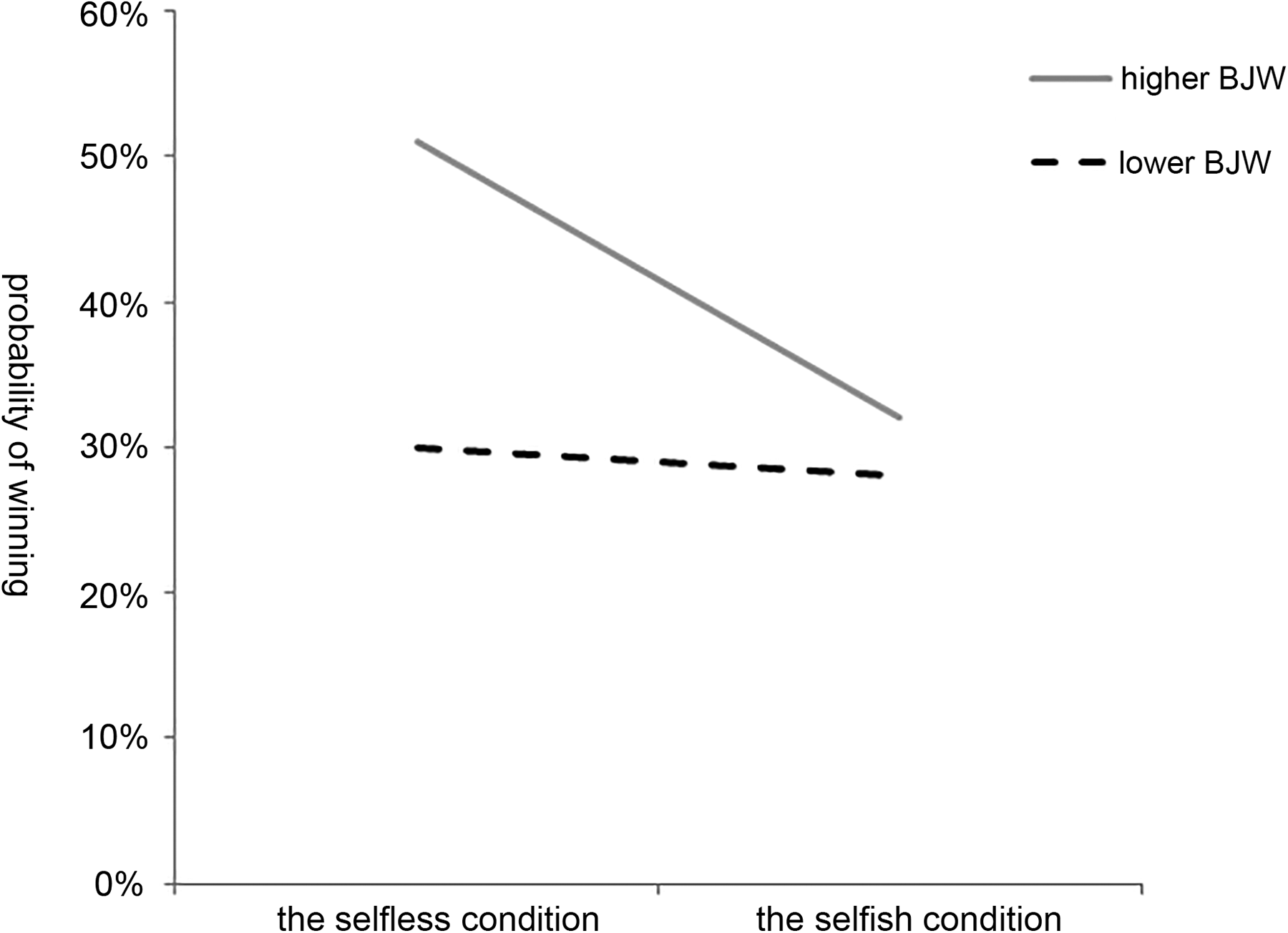
The moderating role of the belief in a just world between perceived motivation and donors’ winning probability.
Discussion
Consistent with previous studies, the results from Study 3 showed that the selfless donors were considered to be more likely to win the raffle than the selfish donors. Furthermore, the results showed that BJW moderated the relationship between prosocial motivation and the chance of winning the raffle, consistent with the BJW theory. According to this theory, people believe that “you get what you deserve” (Lerner & Simmons, 1966). In a prosocial setting, people with a high BJW believed that the prosocial actor did a good thing and that the actor was therefore guaranteed to have good luck in the following raffle.
Study 4: Indirect Measurement Using the Gambling Game
In Studies 1–3, we consistently found that the selfless donors were considered more likely to have good luck than the selfish donors. However, this result was based on data obtained via a self-report method, which is vulnerable to the social desirability effect. In Study 4, we examined this issue in an indirect way using a gambling game. In the game, participants were instructed to choose an agent among three people with different prosocial motivations to gamble for a monetary reward. We hypothesized that laypeople would more frequently choose the selfless agent than the other agents to gamble because of a belief that such agents may have enough good luck to win money.
Method
We conducted a repeated measures analysis of variance (ANOVA) power analysis in G*Power (Version 3.1; Faul et al., 2009) based on a medium effect size (f = 0.25). To achieve 95% power, a minimum sample size of 36 was needed. To accommodate any potential exclusions, 43 undergraduate students (males/females, 16/27; mean age = 18.63 ± 1.29) were recruited.
The procedure involved reading the scenario, playing the gambling games, and completing the post hoc survey. First, participants read the same scenario as in Study 1, which depicted three people with different motivations to donate. Specifically, one person (A) thought that the children needed help and felt that he or she should do something, so he or she donated an amount of money (the selfless condition); one person (B) wanted to meet the players, so he or she donated an amount of money (the selfish condition); and one person (C) hoped to enjoy delicious food after the game when he or she donated an amount of money (the control condition).
The participants then played gambling games (Figure 2). First, the participants were shown four golden eggs and a hammer. Then, the names of the three donors with different motivations were shown, and participants chose one person as their agent. The selected agent would then break one of the four golden eggs, after which a feedback cue—“+” or “none”—was shown, indicating that the participant won (+1 RMB) or received nothing (+0 RMB) in this trial. The game had 18 trials. We predetermined the hit rates for each agent: 55% (selfish), 50% (control), and 45% (selfless). The participants did not know the actual hit rate during this first round of trials. The sequence of the donors was counterbalanced across the participants. The participants were compensated with the money that they earned from this game.
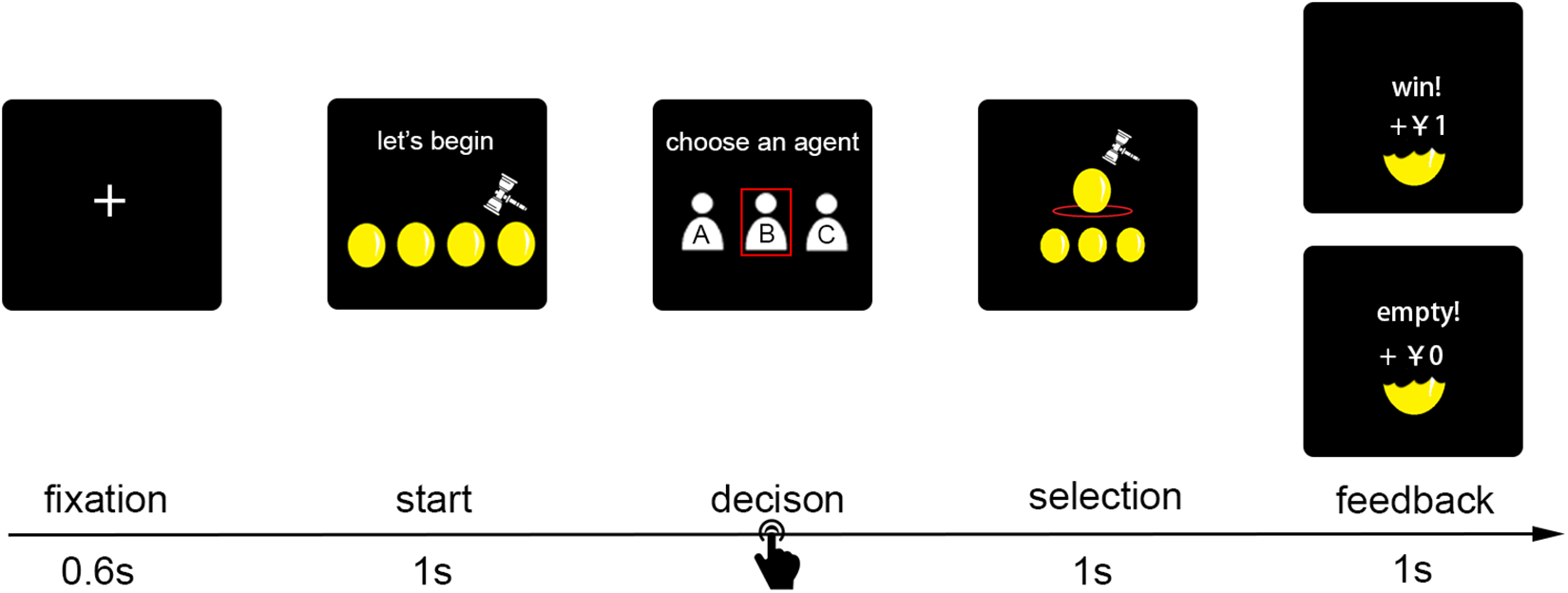
The gambling games.
After the game, participants completed the post hoc survey. First, the participants reported their evaluation of the donor’s motivation, the likeability of each agent, and their motivation to win money on a 7-point scale. Second, they also evaluated the probability of winning for each agent (0–100%). Third, participants reported their main reasons for choosing the agent that they selected. Answers included “I think this agent is more likely to smash a golden egg with a prize,” “I like this agent,” and “other reasons.” Finally, the participants were told that the actual hit rate of each agent was 55% (selfish), 50% (control), and 45% (selfless), and they could then play the gambling games a second time.
Results
Manipulation Check
A one-way repeated measures ANOVA on the motivation check yielded a main effect for condition, F(2, 84) = 41.03, p < .001,
Choice Frequency Before Knowing the Actual Hit Rate
A one-way repeated measures ANOVA on choice frequency yielded a main effect for condition, F(1.64, 68.70) = 14.53, p < .001,

Choice frequency in each condition before and after knowing the actual hit rate.
Choice Frequency After Learning the Actual Hit Rate
A one-way repeated measures ANOVA on choice frequency yielded a main effect for condition, F(1.69, 71.10) = 19.86, p < .001,
We also analyzed other data from the post hoc survey (i.e. the degree of likeability, the estimation of the probability of winning, the desire to win, and the reasons for agent selection). Due to the limited space, we showed the results in the Supplemental Material (Please see the additional results of Study 4 in Supplemental Material).
Discussion
The results from Study 4 showed that the selfless donors were more frequently chosen as agents than the selfish and control donors before participants learned the actual hit rate. When people make decisions related to their own interests, they subconsciously choose the most valuable option with the highest feasibility (Jing et al., 2012; Polman, 2012). The results provide indirect evidence indicating that laypeople might have the implicit belief that people with authentic altruistic motivation are more likely to have good luck.
The likeability of the selfless donor may also play a role in the observed results. However, the participants were primarily motivated by the desire to win the prize and not by a desire to express their preferences. This speculation was verified by asking the participants why they chose the agent they did (see Supplemental Material). Furthermore, when the participants did not know the actual hit rate of the agents, they chose the selfless agent; after they learned it, they chose the selfish agent. This strategy changes also indicated that people prefer an agent with a higher probability of winning to one that is more likable. Moreover, the participants subjectively perceived that the selfless agent was more likely to win than the other agents. Thus, we can exclude the potential alternative explanation that people choose their favorite donor as their agent.
General Discussion
The current research aimed to replicate and extend Lin-Healy and Small’s (2013) study. The results showed that laypeople in both Western and Eastern cultures perceived selfless people as being more likely to win the raffle than selfish people (Study 1). Moreover, laypeople believed that the selfless corporation would be more likely to experience a profitable year than the selfish one (Study 2). Furthermore, compared with people with low BJW, people with high BJW believed that the selfless actors were more likely to win (Study 3). Finally, this belief was also indirectly reflected in the gambling game, in which laypeople were more likely to choose the selfless actors as agents to win money (Study 4).
Our results were inconsistent with Lin-Healy and Small’s (2013) findings, which showed that laypeople considered that prosocial actors with selfless motives were less likely to benefit than those with selfish motives. One reason for the divergent results may be the differences in the participants’ social and cultural backgrounds between the two studies. We carefully examined the means of the probability of winning in the two studies. Although they were stable across the current studies, they were notably lower in the original study than in the replication study (average Ms = 14% for the original study 1a vs. average Ms = 36% for the replication Study 1). First, it is possible that, in general, people were more likely to believe that the possibility of winning the raffle was higher when the replication study was conducted than when the original study was conducted. Second, most of the participants in our study had an Eastern background. Although karma beliefs prevail in the East and West, karma beliefs are stronger in Eastern contexts (White et al., 2019), which may result in high probability estimations. Another reason for the contrasting results may due to the materials and procedures we used. The materials or procedures we used here were not completely identical to those used in the original study, though we made a concerted effort to follow the original methods as closely as possible and the original paper provided sufficient details. Future studies with more stringent methods are needed.
Although the current results were not wholly consistent with those of the original study, they were consistent with BJW theories (Lerner & Miller, 1978) and karma beliefs (White & Norenzayan, 2019). These theories predict that laypeople believe that good things will happen to good people. The participants with high BJW believed that the actor’s selfless behavior ensured good future outcomes. The results may encourage greater prosociality in practice. We also extend these theories by providing evidence that the participants with high BJW did not think that bad things would happen to the selfish actor. Perhaps in a prosocial setting, people believe that their prosocial actions, regardless of whether they are selfishly or selflessly motivated, should not be punished. However, further studies are needed to examine this finding.
Furthermore, our results were not inconsistent with the altruism prototype, which proposes that people believe that authentic altruistic behavior should be associated with self-sacrifice (Lin-Healy & Small, 2013). The raffle event and the donation event were separate and independent in this prosocial scenario we used. In other words, the donors did not obtain material benefits from the donation behavior itself.
Several limitations and future directions should be mentioned. First, the prosocial situation in our study was assumed to be a prosocial scenario, which may undermine the ecological validity of the current study. Second, although preregistration is important for a replication study (Brandt et al., 2014), we only preregistered some of the studies (Study 2). We also did not have access to the materials used in the original study. Future studies based on preregistration and close replication are needed. Third, across all the studies, motivation was the only information provided, which may have caused the participants to become aware of its relevance. It would be worthwhile to eliminate demand characteristics in future studies. Finally, future studies are needed to examine the relationship between laypeople’s prosocial perceptions and their own prosocial tendencies.
In summary, we investigated how laypeople’s speculations about prosocial actors’ motivations influence their estimations of the actors’ future benefits in four studies employing different designs and measures and diverse cross-cultural samples. Consistent results were found with respect to observers’ perceptions: people with authentic prosocial motivation were more associated with future benefits, and the BJW played a moderating role.
Supplemental Material
Supplemental Material, Sumplemental_material - Nice Guys Finish Last? The Effect of Lay Theories on Prosocial Actors’ Motivation and Future Benefits
Supplemental Material, Sumplemental_material for Nice Guys Finish Last? The Effect of Lay Theories on Prosocial Actors’ Motivation and Future Benefits by Yue Zhang, Xuhai Chen, Zaijia Liu, Yuzhuo Zhang, Tong Jiang, Xuqun You and Yangmei Luo in Social Psychological and Personality Science
Footnotes
Acknowledgments
The authors would like to thank the editor and three anonymous reviewers for valuable comments and suggestions on our article.
Declaration of Conflicting Interests
The author(s) declared no potential conflicts of interest with respect to the research, authorship, and/or publication of this article.
Funding
The author(s) disclosed receipt of the following financial support for the research, authorship, and/or publication of this article: This work was supported by the National Natural Science Foundation of China (number 31600913), the China Postdoctoral Science Foundation (grant numbers 2016M590918 and 2017T100724), the Shaanxi Province Postdoctoral Science Foundation (grant number 2016BSHTDZZ10), and the Fundamental Research Funds for the Central Universities (grant number 18SZYB03).

Supplemental Material
The supplemental material is available in the online version of the article.
References
Supplementary Material
Please find the following supplemental material available below.
For Open Access articles published under a Creative Commons License, all supplemental material carries the same license as the article it is associated with.
For non-Open Access articles published, all supplemental material carries a non-exclusive license, and permission requests for re-use of supplemental material or any part of supplemental material shall be sent directly to the copyright owner as specified in the copyright notice associated with the article.
