




Abstract
Psychology research focuses primarily on male competition. This research, however, investigates women’s competition for love and the ideal partner in the mating market and reveals one psychological consequence for women, that is, beautification. This is demonstrated with ecologically valid, real-world archive and online search query data, a quasi-experiment, and a series of controlled experiments with random assignments. Intrasexual competition, indexed by the operational sex ratio (OSR) and income inequality (GINI), predicts women’s beautification reflected by Google search queries for cosmetic surgery terms (Study 1) and the density of certificated plastic surgeons (Study 2). Female college students from faculties with female-biased OSRs exhibit greater appearance focus than women from male-biased faculties (Study 3). A causal relationship, between women’s intrasexual competition and beautification (and even self-objectification), is subsequently demonstrated in experiments (Studies 4–6). Additionally, self-objectification due to intrasexual competition leads to women’s preference for appearance-oriented products (Study 6). Implications are discussed.
Although competitions are ubiquitous, existing literature focuses primarily on male competition and suggests that women are not as competitive as men (Clutton-Brock, 2007; Niederle & Vesterlund, 2007). A few scholars have noted that this conclusion neglects an essential form of female competition, namely competition for love and an ideal partner in the mating market (e.g., Baumeister et al., 2017). Durante et al. (2012) found that a scarcity of men, implying heightened female competition, can make certain women, if able, choose to opt out of the mating market and focus on their careers. However, what happens to the majority of women remains unknown—those who want, or are forced, to enter the mating market and engage in intrasexual competition.
Meanwhile, beautification refers to investing in one’s physical appearance (Blake et al., 2020), and under certain circumstances could lead to self-objectification, that is, seeing oneself as an object to be evaluated and judged merely based on physical appearance (Fredrickson & Roberts, 1997). Physical attractiveness, however, is highly valued especially in romantic relationships (e.g., Buss, 1989; Meltzer et al., 2014) and thus could become the focus of attention when women face competition in the mating market. Therefore, the present study aimed to combine these two fields: intrasexual competition, dominated by evolutionary psychologists and biologists, and beautification and self-objectification, examined primarily by social and personality psychologists, feminists, philosophers, and recently evolutionary psychologists. 1 Specifically, we aimed to reveal one psychological consequence of intrasexual competition for women, that is, beautification and even self-objectification.
Women’s Intrasexual Competition
Interspecies competition is observed throughout the animal kingdom, often with life-and-death consequences. Intraspecies competition is no less fierce. Given limited resources, competition for survival and breeding is inevitable. The intensity of competition for mates, as indexed by the operational sex ratio (OSR), affects various behaviors including aggression, courtship, and mate guarding (e.g., Weir et al., 2011). Mammals rely on combat, weapons, and dominance to gain access to mating resources, but the nonaggressive use of physical appearance and ornaments, including visual, vocal, and olfactory manifestations, has also proven to be an extremely useful means of attracting potential mates (Clutton-Brock & Huchard, 2013).
Similar patterns are observed in human society. An abundance of men and a scarcity of women increases competition among men, whereas an abundance of women and a scarcity of men (especially those with access to resources) increases women’s intrasexual competition. Similar to animals, intrasexual competition influences the behavior of men and women. In the face of competition, men resort to aggression (Barber, 2003) and devote more resources and energy to their mates, such as spending more money during courtship (Griskevicius et al., 2012). In parallel, women’s selectivity declines when intrasexual competition is high (Kenrick et al., 2003). They tend to be acceptive of out-of-wedlock births and less paternal investment (Guttentag & Secord, 1983). Those who desire a mate must invest effort in attracting a potential partner by competing in terms of sex appeal (Baumeister et al., 2017).
Women’s Beautification
Beautification refers to the investment in one’s physical attractiveness (Blake et al., 2020). The dominant perspective holds that beautification is highly related to self-(sexual) objectification, which entails individuals, and often women, internalizing the perceptions that others have of them and focusing on their appearance above their other characteristics (e.g., Fredrickson & Roberts, 1997; Moradi & Huang, 2008). A sizable body of literature revealed the detrimental consequences of self-objectification in women, from seeking cosmetic surgery, inertness, and the denial of autonomy to impaired cognitive performance, negative self-evaluation, eating disorders, a threatened moral self, and reduced interpersonal intimacy (e.g., Calogero et al., 2013; Chen et al., 2013; Heflick, & Goldenberg, 2009; Quinn et al., 2006; Zurbriggen et al., 2011). Recent studies, however, have started to show the positive side of beautification. For instance, a temporary, although not a long term, boost in self-esteem was observed among women who felt attractive and self-objectified (Breines et al., 2008). Beautification can bring women assertiveness (Blake et al., 2020) and self-efficacy (Nistor & Stanciu, 2017). Physical valuation can be beneficial, especially in the context of a romantic relationship (Meltzer, 2020).
Throughout history, women have been competing with one another for high-quality men, which is a crucial domain of women’s intrasexual competition (Campbell, 2004). Considering that numerous empirical studies have established that sex appeal and physical attractiveness are highly valued qualities in women in the mating market (e.g., Buss, 1994; Hill & Durante, 2011; Li et al., 2002), intrasexual competition between women can promote beautification and even sexual self-objectification. Put differently, physical attractiveness and sexuality can be an effective way for a woman to gain an advantage over her competitors and increase her chances of finding love and the ideal partner. As a result, engaging in intrasexual competition may result in beautification in women.
Previous studies have provided preliminary support for this view. For example, women compete with one another on the basis of physical appearance (Cashdan, 1998), perceive those high in attractiveness and sexuality as threatening (Fink et al., 2014), and act aggressively toward them (Vaillancourt & Sharma, 2011). Women looking for sexual partner(s) are prone to wearing revealing clothes (Grammer et al., 2004). Recent studies have found that economic decline and income inequality, potentially signaling a skew in resource holding among men and increased intrasexual competition among women for male resource holders, predict increased spending on cosmetics and sexualization on social media (Blake et al., 2018; Blake & Brooks, 2019; Hill et al., 2012). Thus, intrasexual competition, where sexuality serves as an effective tool, can raise women’s awareness of the instrumental use of their physical appearance and sexuality. In other words, intrasexual competition may spur women to engage in beautification and even sexually objectify themselves.
The Present Research
The aim of the present work is to test that intrasexual competition predicts beautification and even self-objectification in women, using real-world archive and online search query data with high ecological validity, a quasi-experiment, and a series of controlled experiments with random assignment. Additionally, this study aims to demonstrate that self-objectification, as a result of intrasexual competition, can contribute to shaping women’s consumption intention.
Therefore, the first two studies used ecological data from 50 U.S. states, to test whether intrasexual competition, as indexed by the OSR and income inequality (GINI), would predict an outcome of women’s beautification, that is, an interest in plastic surgery, as reflected by the search queries for cosmetic surgery terms on Google (Study 1) and the density of certificated plastic surgeons (Study 2). The quasi-experiment further tested whether female students from faculties with female-biased OSRs would focus on one’s physical appearance to a greater extent than female students from faculties with male-biased OSRs (Study 3). Studies 4–6 used single, female college students to examine the causal relationship between engaging in intrasexual competition and investment in physical appearance, (sometimes) even more than other inner attributes (i.e., self-objectification). Finally, Study 6 tested a downstream consequence, whereby the self-objectification caused by engaging in intrasexual competition drives women to prefer appearance-oriented products.
Sample Size Determination
We aimed for 300 participants per condition for the quasi-experiment and 100 participants per condition for the experiments. Sensitivity power analyses revealed that minimum effect sizes of f = .11 (Study 3, N = 681), f = .21 (Study 4, N = 177), f = .20 (Study 5, N = 205), and f = .20 (Study 6, N = 195) could be detected under standard criteria, respectively. Data will be made available online once the manuscript is accepted for publication.
Study 1
Study 1 used online search query data to examine the relationship between intrasexual competition and women’s beautification. To capture women’s intrasexual competition, two previously validated state-level socioecological proxies were used: (1) the OSR that reflects the local ratio of unmarried men to unmarried women (e.g., Durante et al., 2012) and (2) income inequality (i.e., GINI) that reflects a skew in resource holding among men and increased competition among women for high-quality men (e.g., Blake et al., 2018). Importantly, these two proxies tap into the same underlying latent construct, that is, female intrasexual competition, and are highly correlated (i.e., /r/ = .7).
In parallel, several empirical studies have demonstrated the relationship between beautification/self-objectification and seeking cosmetic surgery (e.g., Calogero et al., 2013; Vaughan-Turnbull & Lewis, 2015). Additionally, cosmetic surgery in the United States is predominantly performed on women (see 1 in Supplementary Materials). Therefore, a state-level proxy was employed to reflect women’s beautification/sexual objectification; that is, search queries for cosmetic surgery terms based on Google Trends (GT). We predicted that states with high intrasexual competition between women (i.e., a high OSR and GINI) would show more online search queries related to cosmetic surgery.
Method
Women’s Intrasexual Competition (see 2 in Supplementary Materials)
OSR
Drawing on prior work (e.g., Durante et al., 2012; Weir et al., 2011), OSR is calculated as the ratio of local men of reproductive age to women aged 15–54. OSR for each of the 50 states and Washington, DC, was obtained using the 2012 U.S. Census Bureau 5-year estimates from the American Community Survey (ACS). Higher numbers correspond to lower levels of female-biased OSRs and thus lower levels of women’s intrasexual competition.
Income inequality
State-level GINI coefficients are used as a measure of income inequality and were obtained from the 2012 U.S. Census Bureau’s 5-year estimates based on the ACS. Higher numbers correspond to higher levels of women’s intrasexual competition for high-quality men (Blake et al., 2018).
Women’s Beautification/Self-Objectification
Cosmetic surgery-related Google search volume
GT reports the volume of searches entered into Google by calculating the relevant number of searches for a particular term relative to the total number of Google searches. This reflects public interest in certain behavior and is significantly associated with actual behavior (Tijerina, Morrison, Nolan, Vail, Lee, Nazerali, 2019; Tijerina, Morrison, Nolan, Vail, Nazerali, Lee, 2019; Tijerina, Morrison, Vail, et al., 2019). Following Walcott et al. (2011), the keywords used in GT included the most relevant terms frequently searched for concerning cosmetic surgery: liposuction + facelift + lip injections + rhinoplasty. Considering the causal time lag of the influence of the independents on the dependents, the time range for the GT query was set from January 1, 2012, to June 1, 2019. The geographical distribution of the index is illustrated in Figure 1, where darker areas represent more searches on cosmetic surgery-related terms and thus higher levels of women’s beautification/self-objectification.
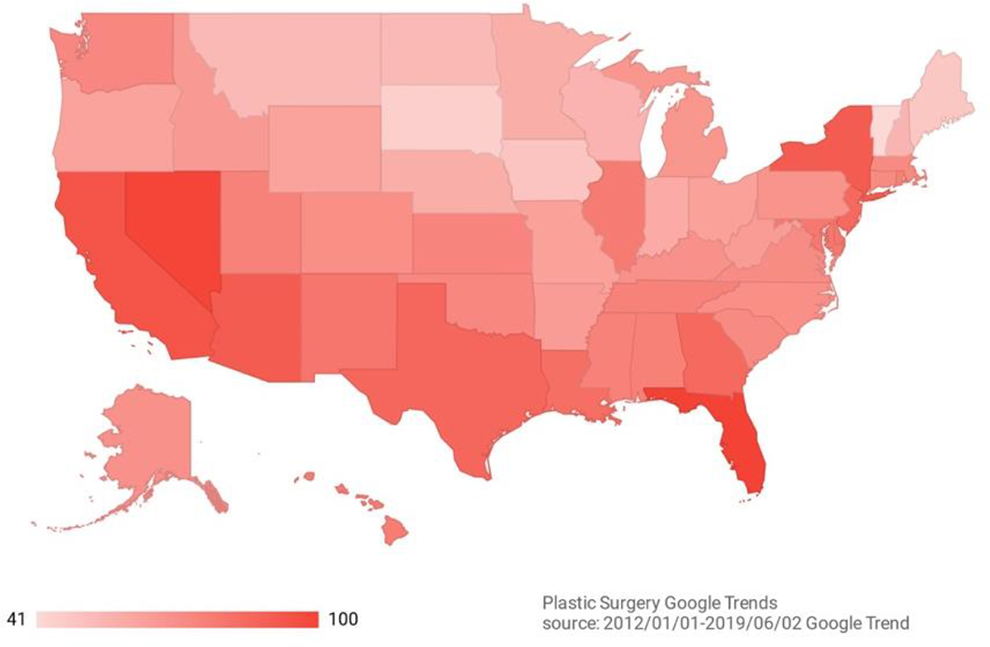
Geographical distribution of searches related to cosmetic surgery. Note. Plastic Surgery Google Trends.
Confounding variables
Drawing on the work of Blake et al. (2018), Hale et al. (2010), Peslak (2004), and Spooner et al. (2003), controlled variables that could influence women’s internet usage were used. These include urbanization, female median age, female educational level (percentage of women with a bachelor’s degree or higher), female employment rate (the percentage of employed women between the ages of 20 and 64), and female median income (the average earnings of women aged 16 and older). Additionally, female edu/empl/inc was created by principal component analysis, which accounts for 69.63% of the variance in the three socioeconomic status (SES) variables: female educational level, female employment rate, and female median income (KMO = 0.595, χ2(3) = 63.53, p < .001; see 3 in Supplementary Materials).
Results
Multiple regression models were used. Step 1: Confounding variables, including state-level female median age, female edu/empl/inc, and urbanization, were entered as independents (Model 1, Table 1). Step 2: The predictor state-level OSR was introduced into the model. As hypothesized, states with lower OSRs, corresponding to heightened women’s intrasexual competition, had larger Google search volumes in terms of cosmetic surgery (Model 2, Table 1). In parallel, entering state-level income inequality (GINI) in Step 2 yielded consistent results. States with higher GINI also showed larger search volumes (Model 3, Table 1). Additionally, by entering a composite of OSR and GINI using principal component analysis (see 4 in Supplementary Materials) in Step 2 (accounting for 84.6% of the variance), the states with heightened women’s intrasexual competition also demonstrated larger search volumes (Model 4, Table 1). Importantly, these results hold true after considering the issue of spatial nonindependence (aka. Galton’s problem, see 5 in Supplementary Materials). Overall, Study 1 consistently shows that, at the state level, women’s intrasexual competition can predict Google search volumes for terms related to cosmetic surgery, as an index of women’s beautification/self-objectification.
Regression Models of Study 1.
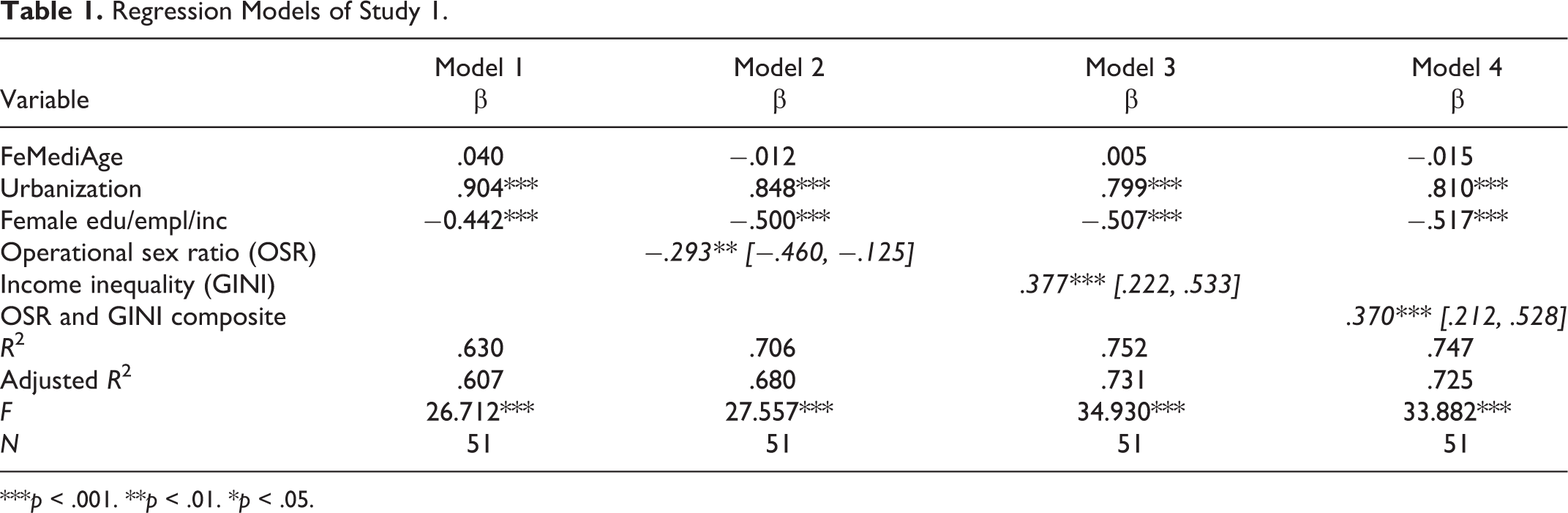
***p < .001. **p < .01. *p < .05.
Study 2
Study 2 aimed to test whether we could conceptually reproduce the findings of Study 1, using another proxy for an outcome of women’s beautification/self-objectification: the density of plastic surgeons.
Method
Women’s Intrasexual Competition
OSR
This is identical to that of Study 1.
Income inequality
This is identical to that of Study 1.
Women’s Self-Objectification
Density of certified plastic surgeons
The density of certified plastic surgeons was calculated by the number of certified plastic surgeons per 100,000 people, in each U.S. state, and was obtained from the American Board of Plastic Surgery (ABPS; Gardner & Safran, 2014). Considering the causal time lag on the influence of the independents on the dependents, ABPS data, from 2013–2014, were used. The geographical distribution of the index is illustrated in Figure 2, where darker areas represent a higher density of certified plastic surgeons, in other words, higher levels of women’s beautification/self-objectification.

Geographical density of certified plastic surgeons. Note. Plastic surgeons density (per 100,100 population).
Confounding variables
These are identical to those in Study 1.
Results
As in Study 1, multiple regression models were used. Step 1: Confounding variables, including state-level female median age, female edu/empl/inc, and urbanization, were entered as independents (Model 5, Table 2). Step 2: The predictor, the state-level OSR, was introduced in the model. As hypothesized, states with lower OSRs had higher densities of plastic surgeons (Model 6, Table 2). In parallel, entering state-level income inequality (GINI) in Step 2 yielded consistent results. States with higher GINI also had higher densities of plastic surgeons (Model 7, Table 2). Additionally, by entering a composite of OSR and GINI (accounting for 84.6% of the variance) in Step 2, the states with heightened women’s intrasexual competition demonstrated higher densities of plastic surgeons (Model 8, Table 2). Importantly, these results held true after considering the issue of spatial nonindependence (aka. Galton’s problem, see 5 in Supplementary Materials). Overall, Study 2 shows that, at the state level, the level of women’s intrasexual competition predicts the density of plastic surgeons. This conceptually replicates the result of Study 1.
Regressions Models of Study 2.

***p < .001. **p < .01. *p < .05.
However, it is important to note that online search queries related to cosmetic surgery and the density of plastic surgeons are only correlates or proxies of women’s beautification/self-objectification and are thus subjected to various limitations. For instance, we cannot rule out the possibility that women may also seek plastic surgery due to health-related needs and that a few men also search for plastic surgery terms or seek plastic surgery. Therefore, Studies 3–6 were conducted to (1) operationalize women’s beautification and self-objectification more precisely and (2) to demonstrate a causal relationship.
Study 3
The quasi-experiment in Study 3 aimed to further test whether intrasexual competition results in women’s beautification. We sampled first-year female college students from colleges with large OSR variations, female students over male students (high-competition), and male students over female students (low-competition). We predicted that female participants from female-biased OSRs would show greater beautification than those in male-biased OSRs.
Method
Participants
A total of 681 female undergraduate students (Mage = 18.67, SD = 0.90), from a Chinese university, volunteered to participate in this study and did not receive any monetary payment. Participants were deliberately selected from colleges with large OSR variations and were classified into two conditions: 366 participants were from colleges with high female-biased OSRs (high-competition) and 315 participants were from colleges with large male-biased OSRs (low-competition; see 6 in Supplementary Materials). To minimize the influence of extraneous variables, only first-year college students were targeted, and the study was conducted 2 months after college entry. Informed consent was obtained from all participants, prior to the experiments, for Studies 3–6.
Procedure and Measures
The study was conducted in Chinese using Wenjuanxing, a Chinese survey software, comparable to Qualtrics. Participants first provided general demographic information including gender, age, and SES (i.e., parents’ educational level, family income, and perceived social rank). They were then asked to report their affiliated college. Next, the participants’ beautification was assessed using 4 items from the Body Surveillance subscale of the Objectified Body Consciousness Scale (McKinley & Hyde, 1996) that measures the extent to which people habitually monitor their outward appearance (see 7 in Supplementary Materials). An overall beautification score was calculated by averaging the item scores, with higher scores corresponding to higher levels of appearance focus (α = .64).
Results
As predicted, female participants from colleges with female-biased OSRs (high-competition condition; M = 4.61, SD = 0.83) focused on their appearance more compared to female participants from colleges with male-biased OSRs (low-competition condition; M = 4.42, SD = 0.90), F(1, 679) = 7.78, p = .005,
Study 4
Study 4 aimed to further test a causal relationship. Single, female college students were invited to a speed dating event. The intrasexual competition was manipulated by varying the OSR, namely, a limited number of men (high competition) and an abundance of men (low competition) participating in the event. It was predicted that female participants in the high-competition condition would invest more in their physical appearance than participants in the low-competition condition.
Method
Participants
In total, 177 legally single, heterosexual, female college students (Mage = 21.6, SD = 2.80) from a Chinese university were included in the final analysis (see 9 in Supplementary Materials). Participants were randomly assigned to one of the two conditions (high-competition or low-competition), resulting in approximately 90 people in each condition.
Procedure and Measures
An experimenter, blind to the hypothesis, approached female college students to invite them to a speed dating event on campus. Interested participants were sent a link to the study, which was described as a short survey to gather and reveal necessary information about the event.
The study was conducted in Chinese, using Wenjuanxing, a survey software comparable to Qualtrics. Participants first provided general demographic information and answered filler questions concerning their hobbies and qualities valued in a partner. Subsequently, participants were informed of the number of men and women that registered for the speed dating event. In the high-competition condition, they were told that 62 women and 19 men had registered for the event. Participants in the low-competition condition were told that 19 women and 62 men had registered for the event. A pilot study has validated this manipulation (see 10 in Supplementary Materials).
To measure the extent to which people invest in their appearance (rather than inner qualities), participants were given a total of 100 points to assign to attributes that they themselves wish to possess, with higher points indicating greater importance placed on an attribute (for a similar procedure see Li et al., 2002). The attributes comprised qualities that are highly valued in romantic relationships, with two qualities focusing on outward appearance (i.e., an attractive face and a sexy body shape) and five qualities reflecting inner qualities (i.e., warmth, intelligence, interesting personality, sense of humor, and sociability; e.g., Botwin et al., 1997; Luo & Klohnen, 2005). Points that could be assigned to each attribute ranged from 0–100 with an increment of 5. It was made clear that the total score assigned to these seven attributes should add up to 100. To control for physical attractiveness, participants’ level of attractiveness was assessed (α = .79, see 11 in Supplementary Materials).
Results
Participants in the high-competition condition (M = 39.3, SD = 14.2) allocated significantly more points to outward appearance, compared with those in the low-competition condition (M = 32.5, SD = 12.6), F(1, 175) = 11.4, p = .001,
Study 5
In Study 4, women’s intrasexual competition was manipulated by varying the OSR in the speed dating. However, it is possible that not all women in the high-competition condition would fully engage in the competition. In Studies 5 and 6, a more direct manipulation method was used; a highly desirable target was presented and then the number of competitors was manipulated. We predicted the replication of the results of Study 4.
Method
Participants
In total, 205 single, heterosexual, female college students (Mage = 21.5, SD = 2.56) from a Chinese university were included in the final analysis (see 12 in Supplementary Materials). Participants were randomly assigned to one of the two conditions (high-competition or low-competition), resulting in approximately 100 participants in each condition.
Procedure and Measures
The study was conducted online, in Chinese, using Wenjuanxing. After reading the instructions and providing some general demographic information, participants were asked to carefully read the following scenario. Specifically, they were asked to imagine that they had been single for a while and had finally found someone who was ideal. They were highly attracted to this person and desired him very much. In the high-competition condition, participants were further informed that there were another three girls who also liked the target and who wanted to ask him on a date. Contrastingly, participants in the low-competition condition were further told that they did not need to compete with any other girls. A pilot study has validated the manipulation (see 13 in Supplementary Materials).
Next, the participants completed the Body Surveillance subscale of the Objectified Body Consciousness Scale (McKinley & Hyde, 1996), which was further modified to measure a state of focusing on one’s appearance (α = .80, see 14 in Supplementary Materials). As a control measure, participants reported how much they wanted to be with this person (1 = definitely not, 7 = definitely yes). To control for physical attractiveness, the participants’ level of attractiveness was assessed in the same way as in Study 4 (α = .76).
Results
Replicating the findings of Study 4, participants in the high-competition condition (M = 5.32, SD = 1.08) scored higher on state body surveillance than those in the low-competition condition (M = 4.91, SD = 0.95), F(1, 203) = 8.50, p = .004,
Study 6
Study 6 aimed to test whether we could replicate the findings of the prior studies and to further test a downstream consequence of beautification/self-objectification, namely, the consumption of appearance-oriented products.
Method
Participants
A total of 195 single, heterosexual, female college students (Mage = 22.1, SD = 2.76) were included in the final analysis (see 15 in Supplementary Materials). Participants were randomly assigned to one of the two conditions (high-competition or low-competition), resulting in approximately 100 participants in each condition.
Procedure and Measures
The study was conducted online, in Chinese, using Wenjuanxing. Participants were randomly assigned to the high-competition or low-competition conditions, using the same scenario as employed in Study 5.
To measure self-objectification, the state Self-Objectification Scale was used (Noll & Fredrickson, 1998), which measures the extent to which people value their physical appearance, in comparison to physical competence, at a particular moment. Specifically, participants were asked to rank 10 bodily attributes in their order of importance to their current physical self-concept (1 = most important, 10 = not important at all). Five of the attributes were appearance-related (e.g., body measurements), whereas the other five attributes were competence-related (e.g., energy levels). The self-objectification score was calculated by subtracting the sum of the ranks given to competence items from the sum of ranks given to the appearance items; possible scores ranged from −25 to 25. The score was further reversely coded, so that a higher score corresponded to a greater degree of self-objectification.
Subsequently, to measure the downstream consequence of self-objectification, participants were assigned a consumer task. Specifically, they were offered a budget that could be spent on 10 different items, including 5 appearance-related items (i.e., clothes, accessories, body enhancements, cosmetics and makeup, and cosmetic surgery), and 5 nonappearance-related items (i.e., books, traveling, skill-building courses, hobbies, and further education). Participants indicated the percentage of their budgets, ranging from 0 to 100, in increments of 5%, which they would like to spend on each of these items. It was made clear that the total percentage assigned to these 10 items should add up to 100%. As with Study 5, the desire to be with the ideal partner, and participants’ physical attractiveness (α = .81) were used as control measures.
Results
Confirming the prior findings, participants in the high-competition condition (M = −1.38, SD = 14.6) showed a higher level of self-objectification than the participants in the low-competition condition (M = −7.00, SD = 13.1), F(1, 193) = 7.93, p = .005,
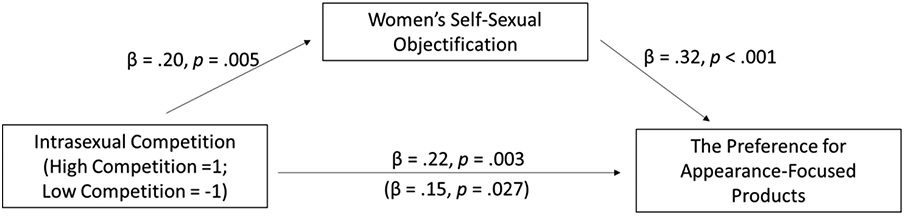
Mediation model for condition on appearance-oriented consumption via self-objectification, with β and p values after controlling for the mediator shown in parentheses.
General Discussion
Previous research has predominantly focused on male competition. This study, however, examined an important form of female competition, namely, competition for love and the ideal partner in the mating market. We tested a psychological consequence of intrasexual competition for women, namely, beautification, the investment in one’s physical appearance.
The effect is demonstrated by real-world archive and online search query data with high ecological validity, a quasi-experiment, and a series of controlled experiments with random assignment. Specifically, intrasexual competition, as indexed by the OSR and income inequality (GINI), predicts an outcome of women’s investment in physical appearance, that is, an interest in plastic surgery, as reflected by Google search queries for cosmetic surgery terms (Study 1) and the density of certificated plastic surgeons (Study 2), in the United States. Female students from faculties with female-biased OSRs demonstrated greater levels of appearance focus than the students from faculties with male-biased OSRs (Study 3). Using single, female college students in China, we further demonstrated a causal relationship, whereby intrasexual competition leads to women’s investment in physical appearance (Studies 4–6), rather than inner attributes (i.e., self-objectification, Studies 4 and 6). Furthermore, such an appearance focus due to engaging in intrasexual competition leads to a stronger preference among women for appearance-oriented products (Study 6).
Our findings add to the growing literature concerning evolution and social cognition (e.g., Blake et al., 2018; Durante et al., 2012; Griskevicius et al., 2012), as well as beautification and objectification (e.g., Fredrickson & Roberts, 1997; Moradi & Huang, 2008), by highlighting that women’s beautification and self-objectification are sensitive to socioecological conditions. In this case, women’s beautification and even self-objectification are shaped by the OSR and, more precisely, the level of intrasexual competition. The effect has been witnessed across two different countries, namely, the United States and China, which differ in ethnicities, cultures, and social ideologies. These findings also connect certain psychology literature with nonhuman animal work by providing a unified perspective, whereby physical appearance is used as a means in intraspecies, intrasexual competition. Future studies could investigate whether such beautification induced by intrasexual competition could subsequently give rise to agency and assertiveness (e.g., Blake et al., 2020) or some detrimental consequences, such as anxiety and body shame, as documented in the self-objectification literature (e.g., Calogero et al., 2005), or both simultaneously.
Previous studies have shown that unfavorably biased OSRs, and the subsequent intrasexual competition, lead both genders to behaviors intended to impress their potential romantic partners. However, there are gender differences. Men desire immediate financial gains, where some women, if able, choose to opt out of the mating market and pursue high-paying careers (Durante et al., 2012; Griskevicius et al., 2012). Our results complement previous findings by showing that women who choose, or are forced, to engage in intrasexual competition will resort to beautification and even sexually objectify themselves sometimes. Despite significant advances in female education and economic independence across the globe, human evolutionary biology remains the same (Durante et al., 2012). Current research suggests that intrasexual competition is still likely to exacerbate women’s self-perception and subsequent behavior. Future research could examine whether this effect is unique to women by testing whether intrasexual competition could also increase beautification among men.
Supplemental Material
supplementary_materials_SPPS_revision_round_2 - Women’s Intrasexual Competition Results in Beautification
supplementary_materials_SPPS_revision_round_2 for Women’s Intrasexual Competition Results in Beautification by Xijing Wang, Hao Chen, Zhansheng Chen and Ying Yang in Social Psychological and Personality Science
Footnotes
Authors' Note
Dr. Xijing Wang and Dr. Hao Chen are co-first authors
Acknowledgments
The authors thank Bin Hong for his assistance with the development of the models and Dr. Yue Zhang for his helpful comments.
Declaration of Conflicting Interests
The author(s) declared no potential conflicts of interest with respect to the research, authorship, and/or publication of this article.
Funding
The author(s) disclosed receipt of the following financial support for the research, authorship, and/or publication of this article: This research was partially supported by the Key Program of the National Natural Science Foundation of China Grants 71731004 and 71532005.

Supplemental Material
The supplemental material is available in the online version of the article.
Note
References
Supplementary Material
Please find the following supplemental material available below.
For Open Access articles published under a Creative Commons License, all supplemental material carries the same license as the article it is associated with.
For non-Open Access articles published, all supplemental material carries a non-exclusive license, and permission requests for re-use of supplemental material or any part of supplemental material shall be sent directly to the copyright owner as specified in the copyright notice associated with the article.
