



Abstract
I examined the relationship between personal values and moral foundations by conducting a mini meta-analysis of the values–foundations links in five large-scale cross-cultural samples (overall N = 32,492). I further tested whether the two theories predicted unique variance in moral variables. I found support for values and foundations as unique constructs with consistent and theoretically meaningful relationships. Broadly, self-transcendence versus self-enhancement values dimensions were associated with individualizing foundations, whereas conservation versus openness-to-change values dimensions were associated with binding foundations. Links between values and foundations categories followed the expected theoretical values theory circumplex structure sinusoidal pattern. Dimensions of the two theories predicted unique variance in morality attitudes, behavior, and individual differences. All materials, data sets, and code are available on https://osf.io/6qs5g/.
How are long-term motivations related to moral judgments? Researchers studying personal values and moral psychology have made significant advances in recent years toward an overall framework of universal categories that help explain individual differences in personal values and moral judgments. The Schwartz (1992) personal values theory and the moral foundations theory (Graham et al., 2011) emerged as the two most widely used theories in their respective domains. The two theories are commonly used in predicting political orientations and moral judgments and behavior and are both strongly embedded in the social–cultural context, but the two streams of literature remain largely disconnected. Moreover, it has long been theorized that personal values hold conceptual links with morality intuitions (Kohlberg & Hersh, 1977), yet little research has been done to test or map such links. Scholars have only recently begun to theorize on possible links between the two theories (e.g., Sverdlik et al., 2012), and thus far there are only limited theoretical work and empirical evidence on these links.
The aim of the present investigation is to connect between the two streams of literature by testing a model of the relationships between values and foundations and examining whether both theories predict unique variance in moral variables. The empirical test is conducted on five large-scale samples collected by different methods, using a variety of scales, and from diverse contexts.
Personal Values
Personal values are long-term motivational goals reflecting desirable guiding principles of what people consider important in their lives (Rokeach, 1973). The most widely used theory of personal values by Schwartz (1992) groups personal values into 10 value categories of universal meaning which follow a consistent structure of relationships. The theory proposed two bipolar dimensions on a multidimensional circular model (see Figure 1): self-enhancement (power and achievement) versus self-transcendence (benevolence and universalism) and openness-to-change (self-direction and stimulation) versus conservation (tradition, security, and conformity). 1 This theoretical conceptualization of values considers values as part of a complete values system rather than as separate disconnected singular values (Boer & Fischer, 2013; Parks-Leduc et al., 2015; Schwartz, 1992, 1994, 1996). The theorized values categories and the mapping of their interdependencies on the circumplex structure have received universal empirical support across more than 70 countries around the world (Davidov et al., 2008; Schwartz et al., 2012; Schwartz & Sagiv, 1995).
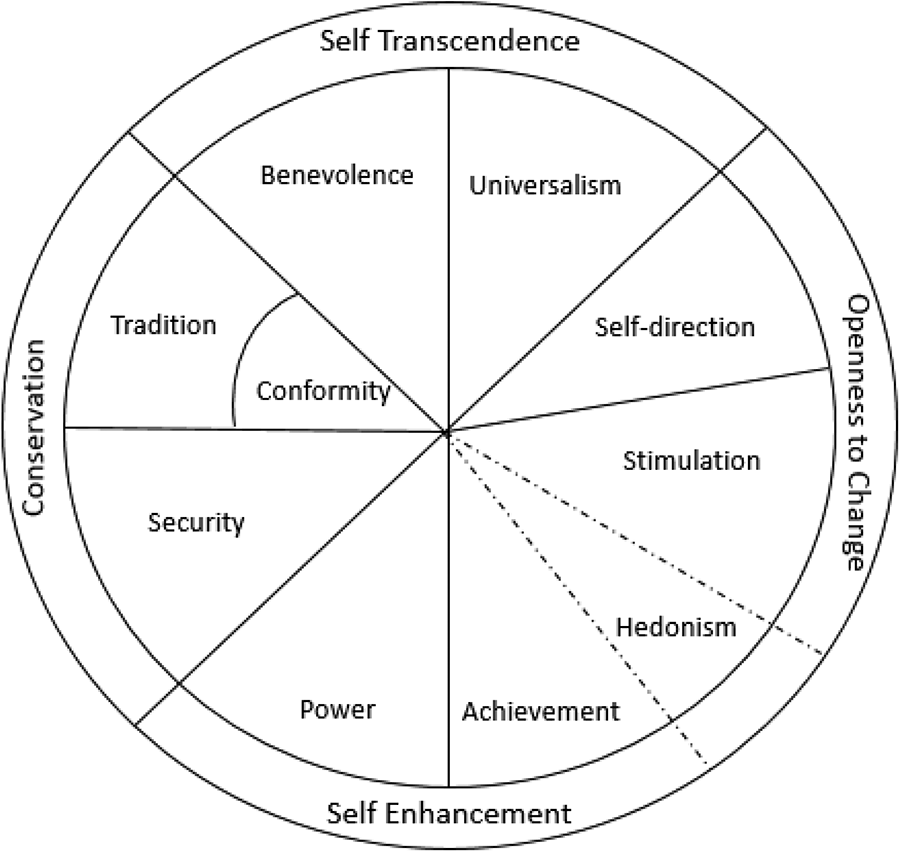
The theoretical structure of personal values.
Moral Foundations
Moral psychology research has long sought to identify moral categories that would help explain fundamental differences in people’s moral judgments (Graham et al., 2009; Haidt & Graham, 2007). The moral foundations theory (Graham et al., 2009, 2011) initially identified five domains of moral judgments, summarized in Table 1. These were used to explain differences in moral evaluations of people from different cultures and political orientations (Haidt, 2008). Harm–care moral foundation is about the prevention of harm and the promotion of care toward others, fairness–reciprocity moral foundation centers on ensuring the fair treatment of others, in-group–loyalty moral foundation focuses on obligations to the close social group and the promotion of the group’s interests, authority–respect moral foundation emphasizes following authority and tradition, and purity–sanctity moral foundation is about chastity and decency. People vary in the extent to which they apply moral foundations in their judgments of morality.
Predictions for the Relationship Between Personal Values and Morality.
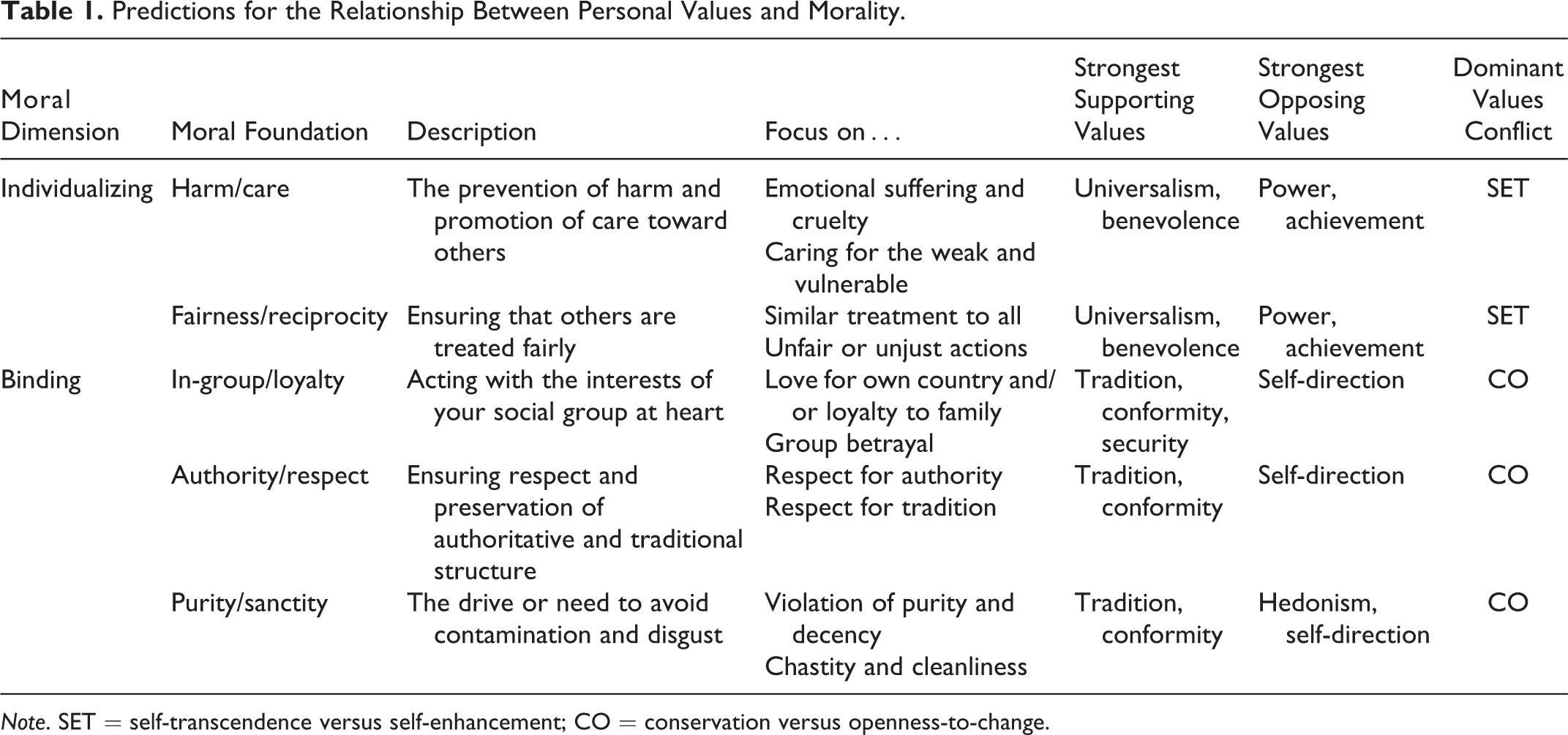
Note. SET = self-transcendence versus self-enhancement; CO = conservation versus openness-to-change.
The five foundations are typically mapped onto two high-order dimensions, with harm–care and fairness–reciprocity termed the “individualizing” foundations, often endorsed by political liberals (in U.S. terms), and in-group–loyalty, authority–respect, and purity–sanctity termed the “binding” foundations, often endorsed by political conservatives (Graham et al., 2009, 2011, 2012; Iyer et al., 2012).
Relationship Between Personal Values and Moral Foundations
There has so far been very little theoretical and empirical research on the links between values and foundations. I reviewed this literature and briefly summarized the main insights from each of the identified articles to suggest an integrated model. Graham et al. (2009) introduced the moral foundations theory and aimed to validate structure and scale. In their empirical investigation, they tested the foundations against specific values as an external criterion tapping a similar domain. They reported that benevolence and social justice values showed the strongest relationship with the foundations of harm–care and fairness–reciprocity (r = .29–.52). Values of loyalty, national security, family security, social order, authority, respect for tradition, honoring parents, and obedience showed the strongest relationship with in-group–loyalty, authority, and purity (r = .37–.62).
Sverdlik et al. (2012) conducted a theoretical review of cross-cultural differences in morality using the values theory and proposed that the moral foundations map onto only half of the values circumplex on the self-transcendence and conservation values dimensions. They argued that the individualizing foundations would be positively associated with self-transcendence values, and authority–respect moral foundation would be positively related to conservation values and negatively related to openness-to-change values. They built on Schwartz (2007) that summarized related findings suggesting that people tend to think about self-transcendence and conservation values as more morally laden than self-enhancement and openness-to-change values.
Boer and Fischer (2013) conducted a meta-analysis on the relationship between social attitudes and values and used the moral foundations theory typology to theorize on those links. They found that empathy attitudes (related to harm–care) were associated with self-transcendence values, environmental attitudes (related to fairness–reciprocity) with self-transcendence and openness-to-change, and conservatism (related to authority–respect) with conservation and self-enhancement values.
Feldman et al. (2015) examined the relationship between personal values and unethical behavior, the clear violation of social ethical norms, rules, and/or laws. Their findings suggested that self-enhancement values would be associated with generally lower importance for all moral foundations, self-transcendence would mainly be associated with harm–care and fairness–reciprocity moral concerns, conservation would be associated with authority–respect, and openness to change would be associated with high moral relativism seeing morality as more flexible based on the context.
Overall Model of Values–Foundations Links
Based on the above theories and suggestive findings, I summarized the expected model of relationships between personal values and moral foundations. In the model, I focused on the two bipolar high-order values dimensions—self-enhancement versus self-transcendence values and openness-to-change versus conservation values. The suggested framework is presented in Figure 2 and detailed in Table 1 (three right columns).

Personal values high-order dimensions and moral foundations mapping.
I expected that the tension between self-enhancement and self-transcendence values would be most strongly associated with the moral foundations of harm–care and fairness–reciprocity. On the other bipolar values dimensions, I expected that the tension between openness-to-change and conservation values would be most strongly associated with the moral foundations of in-group–loyalty, authority–respect, and purity–sanctity.
Method
Disclosures and Materials
I tested the values–foundation links on five large samples in a correlational mini meta-analysis. The Supplementary material includes disclosures, all scales and materials used, and these together with the data and code were made available on the Open Science Framework (https://osf.io/6qs5g/).
Participants and Procedure
myPersonality and myType
Participants answered questionnaires online using the myPersonality (Kosinski et al., 2013; Youyou et al., 2015) and myType (Wilson et al., 2012) Facebook applications, platforms intended for data collection in which Facebook users receive feedback on various psychological questionnaires they choose to answer. A total of 3,342 participants on myPersonality (M age = 25.22, SD age = 10.64; 1,871 females, 1,357 males, 114 unreported, 57% Americans, 8.1% British) and 3,184 participants on myType (M age = 24.47, SD age = 8.36; 1,815 females, 8 unreported) have chosen to use these platforms to answer the personal values and Moral Foundations Questionnaires (MFQ).
Survey of World Views (SWV)
A total of 8,883 participants took part in the data collection for the SWV in 2012. Details about data collection and the sample are provided in Saucier et al. (2015). Of the sample, 7,097 participants from 33 countries answered both the values and the foundations measures (M age = 22.26, SD age = 5.55; 3,548 females, 930 unreported).
Measuring Morality (MM)
MM project is a nationally representative survey of American adults regarding morality. A total of 1,519 participants participated in MM (M age = 50.19, SD age = 16.72; 767 female). The survey included the personal values questionnaire and shortened versions of morality scales.
Yourmorals
Yourmorals.org is an online platform surveying morality related attitudes. A total of 25,719 participants answered a series of online questionnaires on yourmorals.org. Of the entire sample, 17,350 of the participants choose to answer both the personal values and the moral foundations (6,987 females, 2 unreported).
Measures
All measures and materials are reported in full in the Supplementary material.
Personal values
Personal values in myPersonality and yourmorals.org were measured using the Schwartz Value Survey (SVS; Schwartz, 1992, 1994) that includes 57 values items, each value described with a couple of related abstract key words. The participants were asked to rate how important values are as guiding principles in their lives using a standard 9-point rating scale numbered from −1 to 7 (−1 = opposed to my values, 0 = not important, 3 = important, 6 = very important, and 7 = of supreme importance).
In myType, personal values were measured using the 40-item Portrait Values Questionnaire (PVQ-40; Schwartz et al., 2001) that consists of short verbal statements implicitly pointing to different values by highlighting what those individuals value as important in their lives. As an example, the item “It is important to me to be rich. I want to have a lot of money and expensive things” is indicative of a person valuing power. For each of those descriptions, participants were asked to indicate “How much like you is this person?” on a 6-point scale (1 = not like me at all, 6 = very much like me).
The personal values measure in the SWV was the short SVS (Lindeman & Verkasalo, 2005), which asks participants to directly rank the values categories using a single item (e.g., such as “Power, that is, social power, authority, wealth”) on a scale of −1 to 7 (−1 = opposed to my values, 0 = not important, 3 = important, 6 = very important, and 7 = of supreme importance).
Participants in MM completed a short 21-item version of the PVQ-40 (Schwartz et al., 2001) and devised for the European Social Survey (PVQ-21; see Schwartz, 2003). I followed the standard recommended procedure for analyzing values scales. In all measures, scores for value categories and high-order value dimensions were mean-centered (Parks-Leduc et al., 2015; Schwartz, 2009).
Moral foundations
Participants in yourmorals.org, myPersonality, and myType completed the 32-item MFQ (Graham et al., 2009) that includes two subscales asking about the relevance of moral concerns (0 = not at all relevant, 5 = extremely relevant) and agreement with statements about moral intuitions (0 = strongly disagree, 5 = strongly agree). The SWV measured foundations using the 22-item shortened version of the MFQ (Graham et al., 2011). Participants in yourmorals.org could also answer the Moral Foundations Sacredness Scale (MSS; Graham & Haidt, 2012) that asks about the required monetary compensation for undertaking immoral actions (1 = for free, 2 = $10, 3 = $100, 4 = $1,000, 5 = $10,000, 6 = $100,000, 7 = a million dollars, and 8 = never for any amount of money) used as a proxy for importance given to moral concerns. For example, “Curse your parents, to their face (You can apologize and explain 1 year later)” is an item measuring authority/respect foundations and “Kick a dog in the head, hard” is an item measuring the harm/care foundations. Participants in MM completed a short 18-item version of the MSS (Graham & Haidt, 2012).
Morality variables
MM data set included moral measures I used to test the incremental predictive validity of personal values versus the moral foundations. Specifically, I examined one classic moral decision vignette measuring moral attitudes—Heinz and the Drug, a game theory behavioral moral dilemma—the dictator game, and one Morality Trait Scale—moral identity (Aquino & Reed, 2002). Previous literature has theorized, discussed, and tested associations between these morality variables and both values (e.g., morality trait: Frimer & Walker, 2009; moral dilemma: Lönnqvist et al., 2013, 2014; moral attitudes and attitudes: Boer & Fischer, 2013; Feldman et al., 2015) and foundations (e.g., morality trait: Smith et al., 2014; moral dilemma: Schier et al., 2016; moral attitudes: Djeriouat & Trémolière, 2014). Materials are provided in the Supplementary material.
Results
I conducted a mini meta-analysis on the five samples regarding the relationship between the 10 personal values and the 5 moral foundations, with analyses of the values high-order dimensions and the categories circumplex sinusoidal patterns. Reporting focuses on the meta-analytic summary, yet descriptives and findings for each of the individual samples can be found in the Supplementary material. I then examined whether personal values and the moral foundations high-order dimensions accounted for unique variance in the prediction of morality variables.
Values and Foundations as Unique Constructs
I first begin with an exploratory and confirmatory factor analysis to examine whether the high-order dimensions can be regarded as unique latent constructs. The Yourmorals data set was used for the factor analyses as it had the largest sample population from a single culture (17,000+ Americans) and employed the most comprehensive and well-validated measures of personal values (SVS-57) and the moral foundations (MFQ-32).
I first conducted an exploratory factor analysis (EFA) to examine which high-level dimensions would emerge from these factors. The values theory (Schwartz, 1992) was first theorized and tested using multidimensional scaling (MDS) in order to establish the interrelationships among values and tension between the two high-order dimensions. I note that this introduces some challenges in conducting exploratory and confirmatory factor analysis (explained in detail in Schwartz & Boehnke, 2004), especially together with other constructs that treat dimensions as orthogonal.
I ran an EFA on the personal values categories, with very simple structure and parallel analysis, and two factors emerged that matched well with the values theory two high-level dimensions. I continued to rerun the same analyses with moral foundations included. Three factors emerged, with the previous factor loadings unchanged and all the moral foundations falling on the third factor. MDS analyses revealed that the individualizing moral foundations were positioned close to self-transcendence values and furthest from self-enhancement values, whereas the binding moral foundations were positioned close to the conservation values and furthest from the openness-to-change values. Eigenvalues scree, factor loadings, and MDS plots are provided in the Supplementary material.
The analysis supported the distinction between the personal values and the moral foundations dimensions. I then proceeded to conduct a confirmatory factor analysis comparing different possible models, again focusing on how personal values and moral foundations categories map onto the higher level constructs. This was modeled after the method by Schwartz and Boehnke (2004).
I compared several models: (1) one-factor model; (2) two factors—values and moral foundations; (3) two factors—binding with openness-to-change/conservation and individualizing with self-enhancement/self-transcendence; (4) three factors—binding with openness-to-change/conservation, individualizing, and self-enhancement/self-transcendence; (5) three factors—individualizing with self-enhancement/self-transcendence, binding, and openness-to-change/conservation; and (6) four separate factors—individualizing, self-enhancement/self-transcendence, binding, and openness-to-change/conservation.
The four-factor model emerged as the superior model and had the best fit with the data. Detailed model plots and fit comparisons are provided below. I concluded support for the personal values and the moral foundations high-order dimensions as unique constructs.
Mini Meta-Analytic Effects
I conducted a mini meta-analysis (Goh et al., 2016) of the included samples and determined the meta-analytic effects and confidence intervals for the correlations between personal values and the moral foundations. The meta-analytic estimates using Schulze (2004) DerSimonian–Laird method are provided in Table 2 and plotted in Figure 3. There was an overall high consistency between the samples. Of the 50 possible correlations (10 values × 5 foundations), 31 correlations were in the same direction across all samples. Additional analyses of mini meta-analytic effects with reliability corrections are provided in the Supplementary material, and the results were very similar, though with much larger effects for the corrected estimates.
Personal Values and Moral Foundations Mini Meta-Analytic Effects.
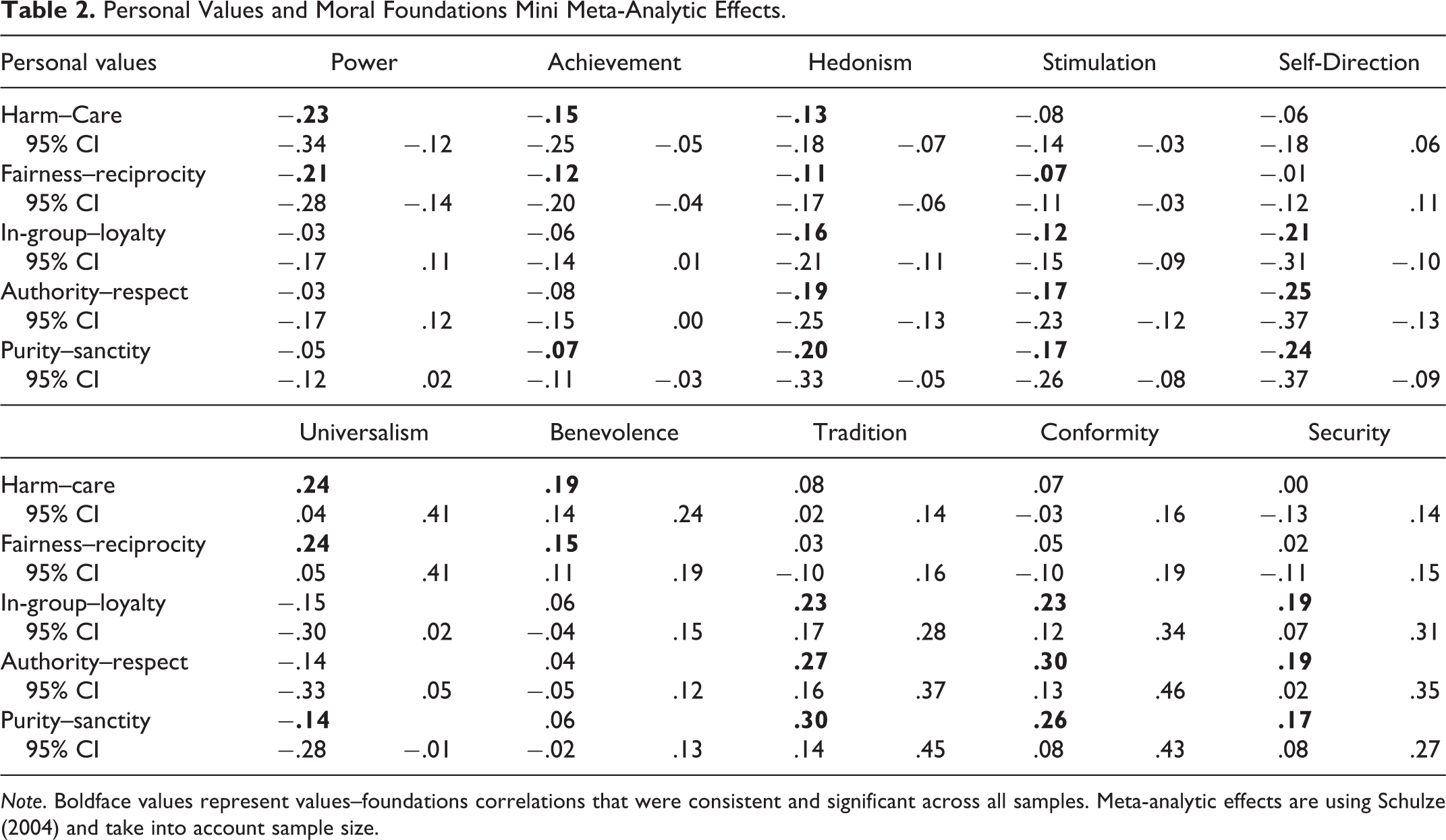
Note. Boldface values represent values–foundations correlations that were consistent and significant across all samples. Meta-analytic effects are using Schulze (2004) and take into account sample size.
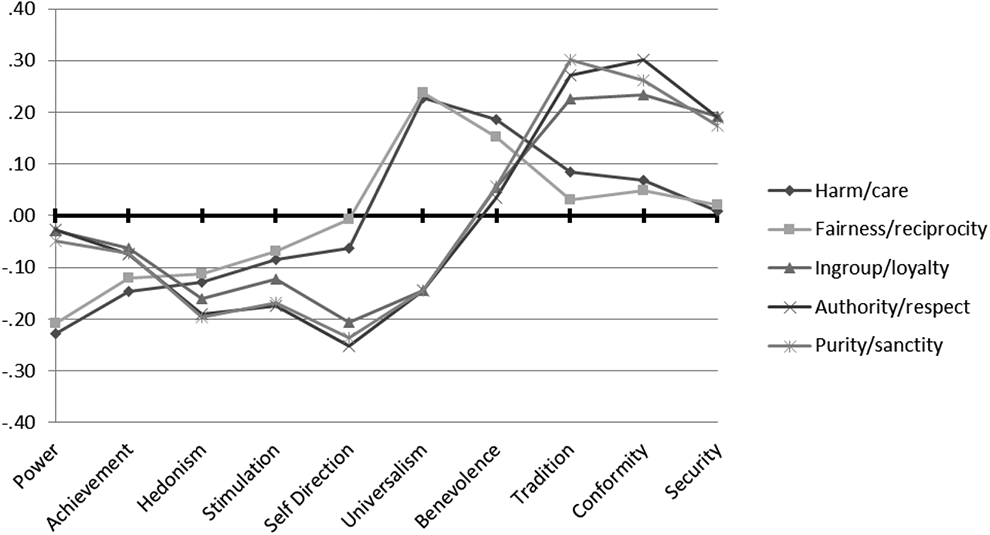
Personal values and moral foundations mini meta-analytic effects plot.
Openness-to-change values dimension includes stimulation, self-direction, and hedonism. Hedonism values were negatively correlated with all foundations (
On the opposite values dimension of conservation are tradition values, conformity values, and security values. All of the conservation values were positively correlated with the binding foundations of in-group–loyalty (
Meaning, that the tension between openness-to-change and conservation values was mainly reflected in concerns regarding in-group–loyalty, authority–respect, and purity–sanctity. The binding moral foundations were associated with lower openness-to-change values and higher conservation values.
For the self-transcendence values dimension, universalism values and benevolence values were positively correlated with harm–care (
Fit With Theoretical Model
Figure 3 plots the meta-analytic effects of values and foundations on a graph with values listed on the horizontal axis in order following the values theory circumplex structure. The plot clearly shows the sinusoidal pattern of correlations predicted by the values theory for all five moral foundations.
The summary of consistent values–foundations links above provides descriptive results in line with the theorized model in Figure 2. I therefore proceeded to empirically test how well the results fit the suggested model. Specifically, I examined which of the two high-order values dimensions, self-enhancement versus self-transcendence or openness-to-change versus conservation, were more central and showed a stronger contrast in predicting foundations. I did so by testing the strength of the sinusoidal patterns using the shape consistency method devised by Boer and Fischer (2013). Shape consistency is defined as the extent to which an observed value correlations pattern maps onto a sinusoidal shape emphasizing either the self-enhancement versus self-transcendence dimensions (SET-shape) or the conservation versus openness-to-change dimensions (CO-shape; effect sizes: 0.4—weak consistency, 0.6—moderate consistency, 0.8—strong consistency). So, for example, a strong CO-shape consistency means that there is a high contrast between the correlations of conservation and openness-to-change values. A weak SET-shape consistency means that the contrast between the correlations of self-enhancement versus self-transcendence was rather weak. Figure 4 details the shape consistency equation and calculations table. When contrasting the two shape consistencies, a dominant SET-shape means that the contrast between self-enhancement and self-transcendence is stronger than that of conservation versus openness to change, whereas a dominant OC-shape indicates the opposite.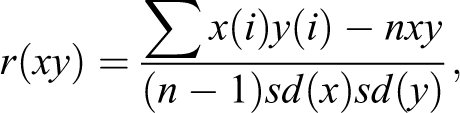
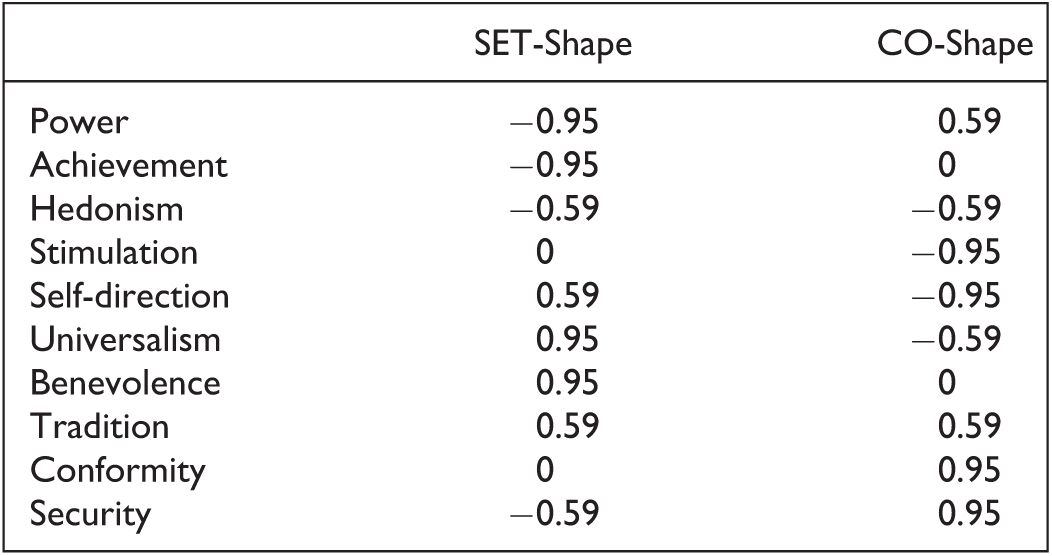
The shape consistency equation (Boer & Fischer, 2013) and the shape consistency vectors table; x represents the actual correlations vector, y represents the expected sinusoidal pattern vector (SD(y) = .75), and n is the number of effects (= 10 values).
The results of the shape consistency analyses are detailed in Tables 3 (meta-analytic summary) and 4 (with detailed effects for each sample). Harm–care and fairness–reciprocity foundations showed a strong dominant SET-shape consistency (.83 and .84, respectively). An opposite pattern emerged for in-group–loyalty, authority–respect, and purity–sanctity foundations, showing a strong dominant CO-shape consistency (.89, .90, and .87, respectively).
Values Theory Sinusoidal Shape Consistency Effects for Morality.
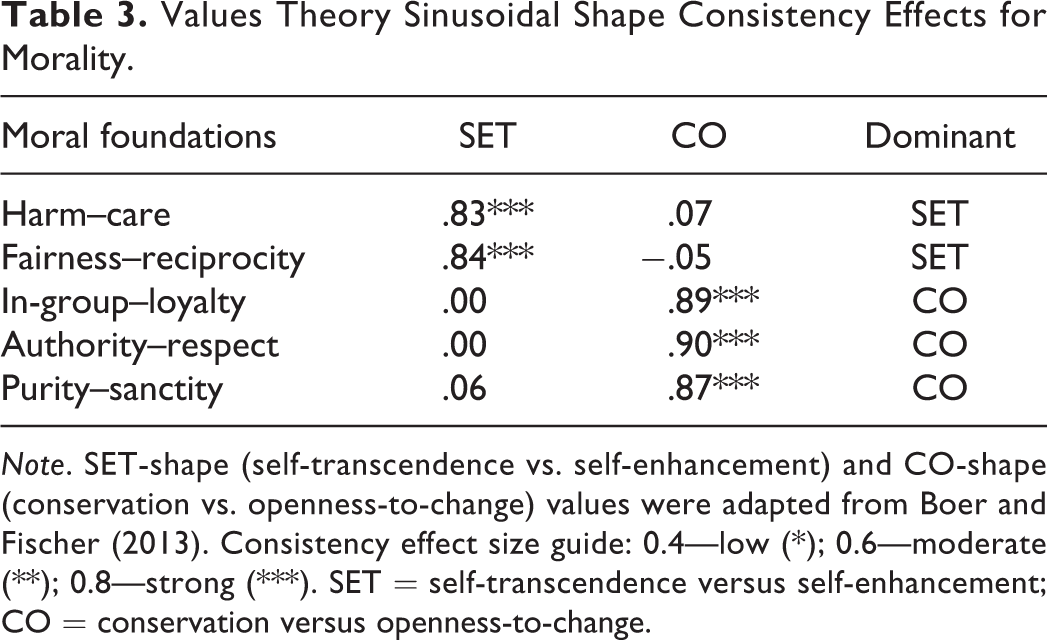
Note. SET-shape (self-transcendence vs. self-enhancement) and CO-shape (conservation vs. openness-to-change) values were adapted from Boer and Fischer (2013). Consistency effect size guide: 0.4—low (*); 0.6—moderate (**); 0.8—strong (***). SET = self-transcendence versus self-enhancement; CO = conservation versus openness-to-change.
Incremental Predictive Validity
I followed the method by Graham et al. (2011) and used a two-step regression approach to test whether personal values and the moral foundations explained unique variance in predicting moral variables—moral trait, moral attitudes, and moral behavior. The test was conducted on the MM data set. I tested the four high-order latent constructs—individualizing, binding, self-enhancement/self-transcendence, and openness-to-change/conservation, to determine whether the factors explained unique variance in the morality dependent measures. I focused on the contrasts between individualizing and self-enhancement/self-transcendence and binding versus openness-to-change/conservation.
The results are provided in Table 5. The detailed correlations of the associations between all foundations, values, and morality dependent measures are provided in the Supplementary material. Across the three dependent variables, self-enhancement/self-transcendence values explained unique variance beyond the individualizing foundations and vice versa, and openness-to-change/conservation explained unique variance beyond the binding foundations and vice versa.
Summary of Samples and Main Findings on Values–Foundations Links.
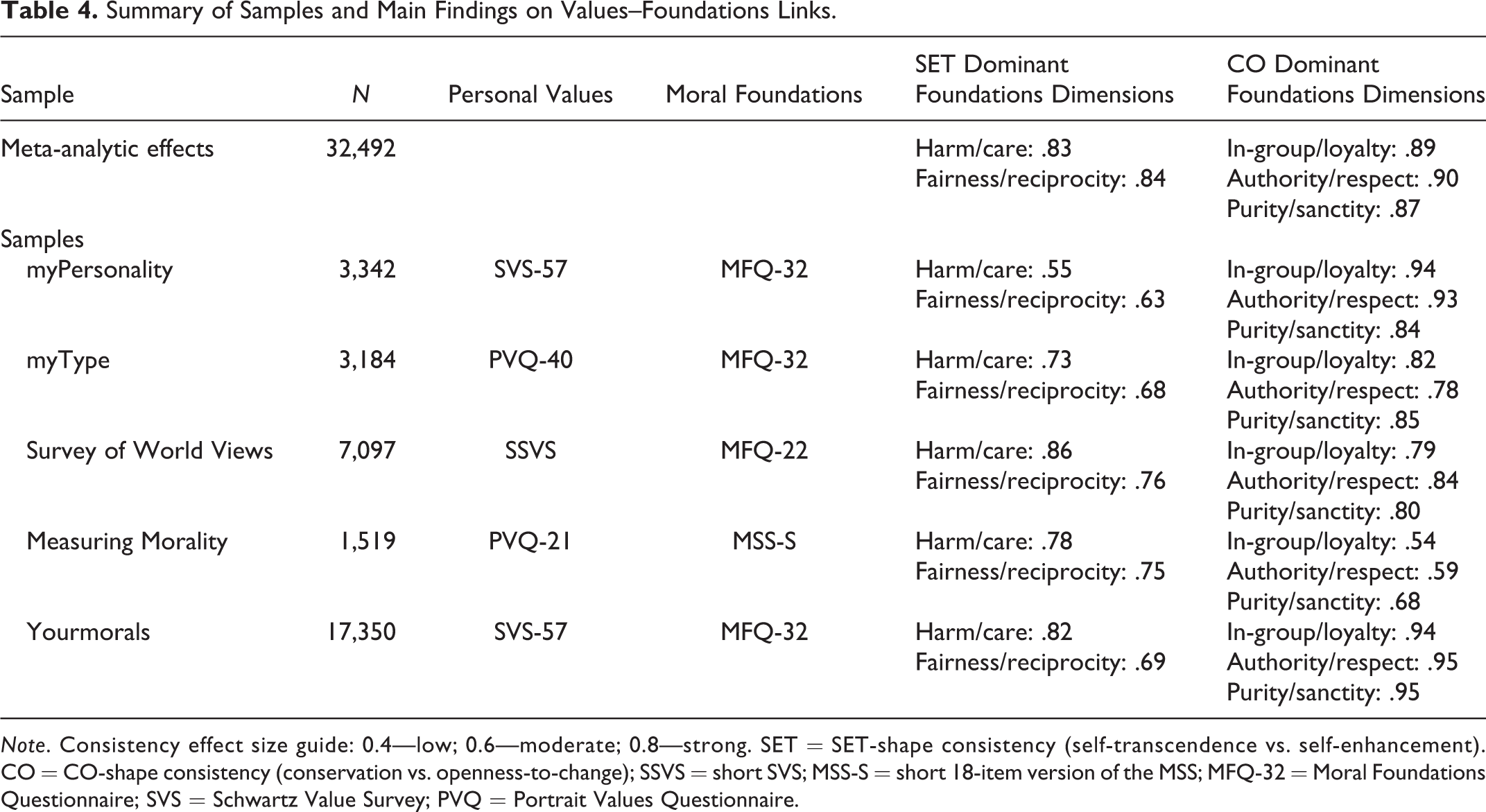
Note. Consistency effect size guide: 0.4—low; 0.6—moderate; 0.8—strong. SET = SET-shape consistency (self-transcendence vs. self-enhancement). CO = CO-shape consistency (conservation vs. openness-to-change); SSVS = short SVS; MSS-S = short 18-item version of the MSS; MFQ-32 = Moral Foundations Questionnaire; SVS = Schwartz Value Survey; PVQ = Portrait Values Questionnaire.
Personal Values and Moral Foundations Incremental Prediction.
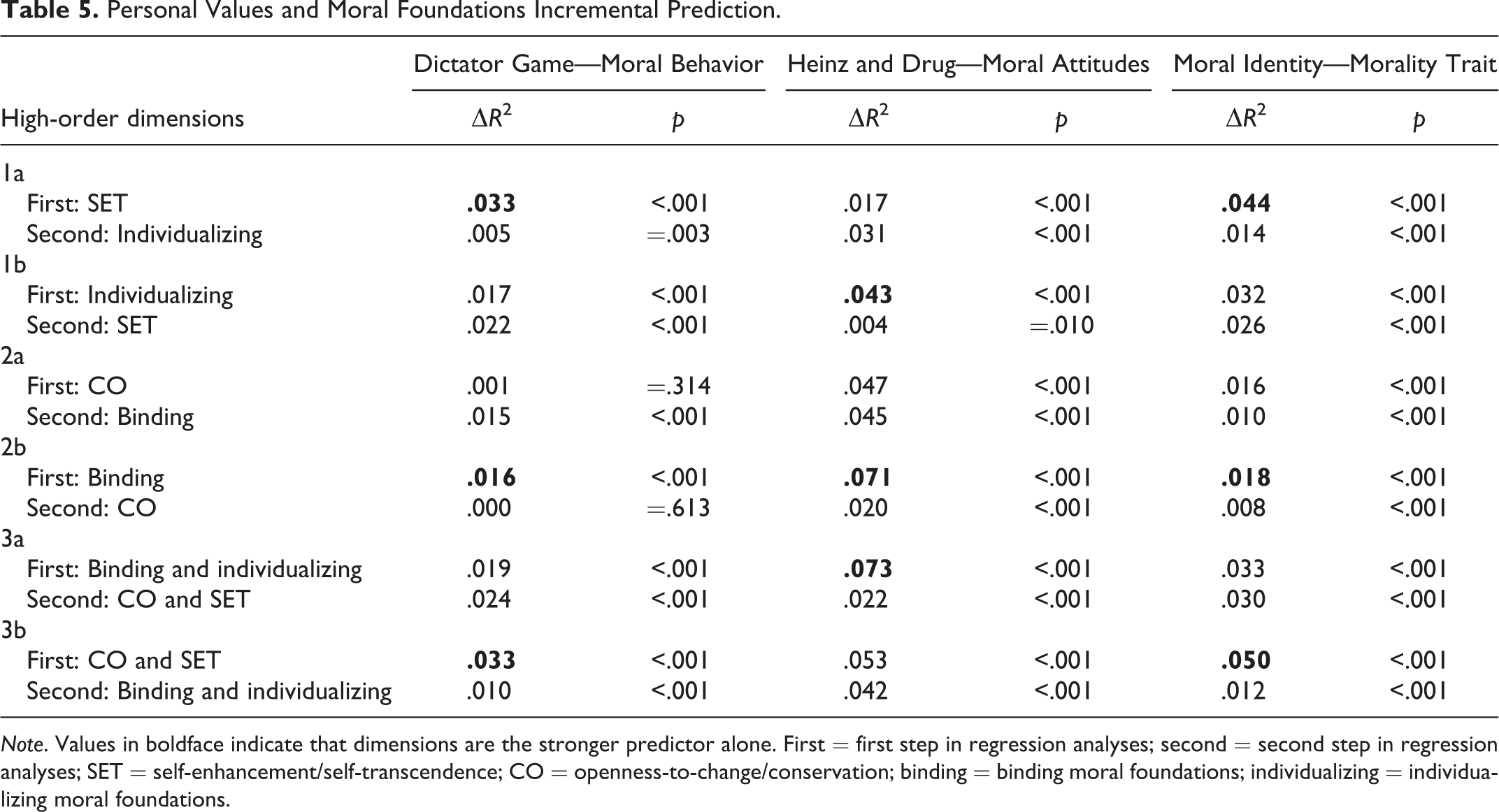
Note. Values in boldface indicate that dimensions are the stronger predictor alone. First = first step in regression analyses; second = second step in regression analyses; SET = self-enhancement/self-transcendence; CO = openness-to-change/conservation; binding = binding moral foundations; individualizing = individualizing moral foundations.
Discussion
A summary of the findings is provided in Table 4. I theorized and found consistent and theoretically meaningful relations between the values circumplex and moral foundations. The findings supported the expected model (summarized in Figure 2 and Table 1) and were consistent across samples. The values tension between self-transcendence and self-enhancement (summarized using SET-shape consistencies) was related to the individualizing foundations, meaning that higher self-transcendence values and lower self-enhancement values were associated with higher concern for harm–care and fairness–reciprocity. The values tension between conservation and openness-to-change (summarized using CO-shape consistencies) was related to the binding foundations, meaning that higher conservation values and lower openness-to-change values were associated with higher concern for in-group–loyalty, authority–respect, and purity–sanctity. The shape consistencies’ effect sizes that serve as fit measures for the suggested framework indicate a very strong fit (shape consistency of .83–.90).
The strongest most consistent correlations were between conservation values (tradition, conformity, and security) and the binding foundations (in-group–loyalty, authority–respect, and purity–sanctity). This is to be expected, as conservation ideals aim to align values and morality between people in society. Conservative societies tend to be higher in agreement regarding both their values and morality, with higher monitoring and sanctioning of culturally deviant behaviors, resulting in stronger conservative values–foundations links. Conformity values, for example, have been shown to decrease the impact of other values over emotions and behaviors (Lönnqvist, Walkowitz, Wichardt, Lindeman, & Verkasalo, 2009), which may therefore lead to higher consistency in observing the prevalent cultural values and moral standards. In addition, incremental predictive validity analysis of the four high-order dimensions showed that values and foundations dimensions explained unique variance in the prediction of moral attitudes, behavior, and individual differences.
Theoretical and Empirical Implications and Future Directions
Integration and extending to behavior and real-life situations
Values and foundations have so far been mostly studied in isolation, yet the findings suggest that the literature would greatly benefit from using the theories together in studies aiming to predict human social psyche and behavior, such as in morality variables. The consistent links between the two theories and their usefulness in predicting unique variance in outcomes may lead to a more comprehensive and better integrated understanding of psychosocial phenomenon.
The empirical investigation conducted is a first attempt to theorize and test the unified values–foundations perspective using large-scale data sets in which participants report their values and morality using various measures. The next step would be to extend these findings and test the framework in actual behaviors, both in controlled lab settings and in the field (Baumeister, Vohs, & Funder, 2007; Graham, 2015). For example, the myPersonality data set offers opportunities for investigating people’s personal values and the moral domain looking at their real-life interactions on Facebook, and similar investigations can be done with other social media like Twitter (e.g., Dehghani et al., 2016). I call scholars to extend this initial investigation by looking at how values predict real-life moral judgment and behavior, how morality predicts manifestations of values in real behavior, and how personal values and moral foundations jointly predict people’s everyday life behaviors.
Values and foundations theories
The values and foundations theories used are currently the most widely used and cross-culturally validated theories in their domains, yet there are other theories with ongoing debates. The moral foundations theory, for example, is still debated in the moral psychology literature, especially regarding purity and the centrality of harm in moral judgments (Graham, 2015; Gray & Keeney, 2015; Schein & Gray, 2015). There are also recent developments in the values literature, such as the refined theory of values (Schwartz et al., 2012), and suggested improvements in the moral foundations theory to include more than five dimensions, such as liberty–oppression (Haidt, 2012; Iyer et al., 2012). The framework I tested here can be adjusted and elaborated to meet these advancements, and future research can build on these to extend, fine-tune, and further test these ideas.
Values and foundations: Meaning, structure, and causality
The examination of the links between values and morality presents a challenge. The two differ not only in content but also in structure and meaning. Values theory emphasizes a universal circular structure of values with an inherent tension between values on opposite sides on the values circumplex, whereas foundations theory describes orthogonal dimensions that may or may not conflict (e.g., liberals tend to report stronger tension between the individualizing and the binding foundations, compared to conservatives). These differences also have empirical implications, as values are commonly mean-centered to make clear the values tension, whereas foundations are not. There are further differences in meaning reflected in construal level, as values are abstract and mainly measured by rating importance, whereas foundations are more concrete and mainly measured by making evaluations. This investigation offered a first simplified integration of the two different theories, inviting future research to go deeper and explore these differences and how they may affect associations.
Do values precede foundations or do foundations precede values? Perhaps they are both formed at the same time? The question of which precedes the other remains open. In this investigation, I generally referred to the relationship between the two as the “values–foundations link,” setting aside the question of causality. Yet the question is interesting and important and the findings only represent a snapshot of the relationships at a very specific point in time for when the data were collected and in a specific culture or context.
Political ideology with values–foundations links
Both values and foundations have often been studied in the context of political ideologies, examining associations with right-wing authoritarianism and social dominance orientation (Whitley, 1999). Broadly, those higher in liberal values tend to endorse values of self-transcendence and openness-to-change, whereas those more conservative tend to endorse values of conservation and self-enhancement (Caprara et al., 2006; Jost et al., 2016; Piurko et al., 2011; Schwartz et al., 2010). The literature on foundations showed that in the United States, conservatives differ from liberals in their endorsement of moral foundations, with liberals emphasizing individualizing over binding foundations, whereas conservatives base moral judgment on all foundations (Graham et al., 2009; Haidt et al., 2009; Kugler et al., 2014). Put together, the findings in the two literatures about the links to political ideology are in support of the theoretical model I outlined and the empirical findings. Future research can extend to further theorize and examine links between values, foundations, and political ideology in a single study (e.g., Sylwester & Purver, 2015).
Conclusion
I found support for personal values and moral foundations as explaining unique variance in predicting moral variables with consistent theoretically meaningful relations. I found links between the individualizing foundations and values tension of self-enhancement versus self-transience and between the binding foundations and the values tensions of openness-to-change versus conservation. I discussed implications and laid out promising future directions for research on the two theories.
Supplemental Material
SPPS-RNR-2-values-foundations-supplementary-materials-v3 - Personal Values and Moral Foundations: Examining Relations and Joint Prediction of Moral Variables
SPPS-RNR-2-values-foundations-supplementary-materials-v3 for Personal Values and Moral Foundations: Examining Relations and Joint Prediction of Moral Variables by Gilad Feldman in Social Psychological and Personality Science
Footnotes
Acknowledgments
I thank the many scholars that helped make this project possible. I would like to especially thank the scholars who have provided us with access and guidance regarding the large-scale data sets used in the empirical studies: David Stillwell and Michal Kosinski from myPersonality, Ravi Iyer and Jesse Graham from  , Sam Gosling and Carson Sandy from myType, Gerard Saucier from Survey of World Views, and the Kenan Institute for Ethics at Duke University for the Measuring Morality open archive. Additional thanks to Sing Hang Cheung for his help with methods.
Declaration of Conflicting Interests
The author(s) declared no potential conflicts of interest with respect to the research, authorship, and/or publication of this article.
Funding
The author(s) received no financial support for the research, authorship, and/or publication of this article.
Supplemental Material
The supplemental material is available in the online version of the article.
Note
References
Supplementary Material
Please find the following supplemental material available below.
For Open Access articles published under a Creative Commons License, all supplemental material carries the same license as the article it is associated with.
For non-Open Access articles published, all supplemental material carries a non-exclusive license, and permission requests for re-use of supplemental material or any part of supplemental material shall be sent directly to the copyright owner as specified in the copyright notice associated with the article.
