




Abstract
Recent work suggests that implicit partner evaluations have long-term implications for relationship success. However, little evidence shows whether and under which conditions implicit partner evaluations affect relationship maintenance processes in daily life, especially those exhibited in situations that may be highly decisive for the fate of the relationship, such as when partners hurt each other. Drawing upon dual-process theories, we predicted that, when executive control is limited—either as a trait or a state—people’s implicit partner evaluations influence forgiveness toward their partner. Results revealed that when temporarily impairing people’s executive control with an experimental manipulation (Study 1), or for people with lower trait executive control (Study 2), more positive implicit partner evaluations were associated with more forgiveness, both in laboratory settings and in an 8-day diary. These findings highlight the importance of implicit partner evaluations under specific, yet common, conditions for promoting reparatory responses that are key to relationship success.
Keywords
Forgiveness is a keystone process to maintaining relational harmony with important others, especially romantic partners (McCullough et al., 2000), and to promoting psychological well-being (Karremans et al., 2003). For decades, research has studied forgiveness as being the result of effortful and deliberate cognitive processing (Burnette et al., 2014). However, real-life situations in which partners possess sufficient executive control to engage in deliberate processes appear scarce (Hofmann et al., 2012; Miyake & Friedman, 2012), and therefore, oftentimes, forgiveness may occur in an effortless and impulsive fashion (Karremans & Aarts, 2007). Yet nothing is known about the factors that promote forgiveness when executive control is low.
Drawing upon theories of implicit social cognition, we propose that implicit partner evaluations—the automatic affective reactions to one’s partner—may advance our understanding of forgiving behavior. Growing evidence indeed shows that implicit partner evaluations predict long-term relationship success (McNulty et al., 2013), notably because they likely influence behavior when people do not have the ability to engage in more deliberate reasoning (Hicks & McNulty, 2019). Thus, we posit that, under low executive control, implicit partner evaluations predict forgiveness toward the partner.
Implicit Partner Evaluations
Flourishing relationships are important for people’s mental and physical well-being (Proulx et al., 2007; Robles et al., 2014). However, research repeatedly shows that maintaining mutually satisfying relationships is particularly difficult because romantic satisfaction inevitably decreases as time goes by (Amato & James, 2010; Lavner & Bradbury, 2010; McNulty et al., 2013). Given the substantial practical implications for our societies, it appears theoretically and practically relevant to identify which factors may help romantic partners to maintain thriving relationships.
In this regard, recent work has found that implicit partner evaluations are unique determinants of long-term relationship satisfaction (McNulty et al., 2013, 2017), break-up likelihood (LeBel & Campbell, 2009; Lee et al., 2010), and even mental health (McNulty et al., 2019). These spontaneous affective reactions toward one’s partner seem to reflect a stable summary of people’s past romantic experiences with their partner (Hicks et al., 2016; Murray et al., 2010). Interestingly, implicit partner evaluations appear weakly associated—if at all—with more explicit self-reported evaluations (Hicks et al., 2020; Scinta & Gable, 2007). Indeed, when asked explicitly, people often engage in motivated reasoning to see their relationship partner in an overly positive light (Murray, 1999). As a result, not only does this deliberate processing disconnect people’s explicit evaluations from their spontaneous affective reactions, but it also restricts the long-term predictive validity of explicit measures. Crucially, implicit partner evaluations, as assessed by implicit measures, appear much less affected by such motivational biases and, thus, predict relationship quality over time, even when explicit evaluations do not (McNulty et al., 2013).
Dual Processes and Executive Control
Nevertheless, little is known regarding the proximal factors that may explain why implicit partner evaluations have long-term implications. The MODE model (Motivation and Opportunity as DEterminants of the attitude-behavior relationship; Fazio & Olson, 2014) posits that implicit partner evaluations are automatically activated upon thinking or encountering the partner to guide behavior toward that partner in an automatic manner, unless people are motivated and cognitively able to engage in more controlled responses. Although people are strongly motivated to regulate their (negative) responses in their relationships (McNulty & Olson, 2015), at times, they may be unable to do so, allowing implicit partner evaluations to predict behavior (Faure et al., 2018).
One important reason why this occurs is because people have limited executive control. Executive control, as assessed by performance-based measures (e.g., cognitive tasks), is defined as the cognitive ability to regulate one’s behavior (Duckworth & Kern, 2011; Toplak et al., 2013). Crucially, individuals differ significantly in trait executive control (Miyake & Friedman, 2012), and consequently, people with lower cognitive ability are more likely to behave in an impulsive and automatic way. Consistent with this idea, previous research found that for people with lower working memory capacity, more positive implicit partner evaluations predicted more resilience when expecting critiques from the partner (Murray et al., 2012).
Furthermore, executive control is also prone to be temporarily impaired by a large range of situational factors (Hofmann et al., 2012). For instance, over the course of their relationship, romantic partners regularly have to cope with external stress, which inevitably undermines their executive control (Buck & Neff, 2012). Under such circumstances, even individuals high in executive control at a trait level may be temporarily unable to engage in effortful considerations and, thus, to override their automatic affective associations. In line with this reasoning, there is evidence that when people are under high cognitive load, more positive implicit partner evaluations are associated with more confidence in the partner’s closeness and more automatic inclination to approach the partner in the face of relationship threats (Murray et al., 2011).
Forgiveness
These findings provide encouraging evidence that, when executive control is low, implicit partner evaluations may affect perceptions of and approach-avoidance tendencies toward the partner. Yet these studies do not document whether implicit partner evaluations may also affect more overt responses that are critical for the fate of the relationship. One such response is how people react when their partner hurt them. Indeed, partners inevitably offend each other’s feelings over the course of their relationships—such as when they do or say something offensive to each other, when they forget or refuse to do something important for the other, or when they engage in a heated argument with each other. In those situations, avoidance and revenge responses are generally associated with destructive relational dynamics (McCullough et al., 2000), whereas forgiving responses are associated with increased intimacy and relatedness (Karremans & Van Lange, 2008), more constructive interactions (Fincham et al., 2004), and higher relationship quality (Paleari et al., 2005).
Relationship research defines forgiveness as being the result of a process of transformation of motivation (Rusbult & Van Lange, 1996). For this process to occur, people must be motivated (Finkel et al., 2002; McCullough, 2008) and cognitively able (Burnette et al., 2014; Pronk et al., 2010) to transform their negative affect into more constructive relationship responses. That is, when executive control is high, deliberate processing allows people to base their forgiveness responses on the integration of various kinds of information, such as their relationship value (van der Wal et al., 2014), the exploitation risks (Burnette et al., 2012), the severity of the transgression (Stanton & Finkel, 2012), the domain of transgression, and so forth (Rusbult et al., 1991). However, although it is clear that forgiveness sometimes depends on effortful processing, other work suggests that forgiveness may also occur effortlessly in close relationships (Pronk & Righetti, 2015). In fact, research shows that people seem automatically inclined to forgive close others as compared to nonclose others (Karremans & Aarts, 2007) and that the willingness to forgive romantic offenses can arise when executive control is low (Karremans & Aarts, 2007; Stanton & Finkel, 2012). To date, however, the factors driving such effortless forgiveness inclinations remain unknown. Thus, further work is sorely needed to examine what contributes to forgiveness in everyday life when people do not engage in effortful and deliberate reasoning.
Research Overview
The current research aims to fill in these gaps by investigating whether and under which conditions implicit partner evaluations may promote forgiveness in close relationships. Consistent with dual-process theories (Fazio & Olson, 2014), when people do not have the opportunity to engage in effortful deliberations, their spontaneous affective reactions are likely to guide their behaviors and decisions, all without effort. Thus, we propose that, when executive control is low, implicit partner evaluations will predict forgiveness. Conversely, we do not expect this relationship to emerge when executive control is high—conditions under which forgiveness likely depends on more effortful processing and deeper considerations of other goals and contextual aspects.
Specifically, in two studies, we test when and for whom more positive implicit partner evaluations promote greater forgiveness toward the partner. In Study 1, we use an experimental manipulation to investigate whether people under cognitively taxing conditions (i.e., low state executive control) are more likely to rely on their implicit partner evaluations to determine their willingness to forgive their close other. In Study 2, we use a daily diary procedure to examine whether people with lower performance-based trait executive control are more likely to rely on their implicit partner evaluations when forgiving their romantic partner in daily life. Given their automatic nature, we expect that these effects are not explained by explicit evaluations of the relationship partner or by other constructs that have been identified as important determinants of forgiving dispositions (i.e., self-reported self-control, trait aggressiveness, agreeableness, and commitment). Therefore, in both studies, results are reported with and without these covariates. Material, code, and data (with restricted access for our dyadic sample) for this project are available at https://osf.io/whcfx/.
Study 1
Study 1 examines whether the link between implicit partner evaluations and forgiveness is moderated by state executive control (i.e., how much cognitive ability people have at a particular moment). We predicted that more positive implicit partner evaluations would be associated with more willingness to forgive a close other when people’s executive control is temporarily impaired but not when it is kept intact. Furthermore, we expected that this association would neither be driven by explicit evaluations toward the close other nor by the type of relationship with that close other. Similarly, because some individuals are more (un)forgiving than others, we measured and controlled for two indicators of (un)forgiving dispositions, namely, self-reported trait self-control (Burnette et al., 2014) and trait aggressiveness (Ross et al., 2007).
Method
Participants
In this study, we recruited as many participants as financial and time constraints allowed. In total, 131 Dutch individuals (88 females) participated in exchange for course credit or financial compensation. Participants’ age ranged from 18 to 60 years (M = 22.0, SD = 5.0), and about half of the sample (n = 61) were committed to an exclusive romantic partner. All other participants who took part in the study were asked to think carefully about a significant close other 1 (e.g., best friend) instead of a romantic partner. A one-tailed sensitive power analysis for R 2 increase performed with G*Power Version 3.1 (Faul et al., 2009) revealed that the current sample would provide adequate power (α = .05, 1 − β > .80) to detect a small-to-medium effect size (f 2 > .047) for one tested predictor in a linear multiple regression with three predictors.
Measures and Procedure
Upon arrival to the labs, participants were welcomed and invited to sign an informed consent form. To measure their implicit partner evaluations, we used a Single Category Implicit Association Test (SC-IAT; Karpinski & Steinman, 2006). This computer-based behavioral test has proven to be a valid and reliable tool for assessing trait implicit partner evaluations (Faure et al., 2018). In this task, participants were instructed to indicate as quickly and correctly as possible to which category (i.e., positive, negative, partner) the target words sequentially presented on the screen belonged to. Target words were 21 positive, 21 negative, and 3 partner-related words (participants provided their partner’s first name, last name, and nickname—or alternatively, their initials—before the task). Following Karpinski and Steinman’s (2006) procedure, participants performed two blocks of 96 trials each (both including 24 practice trials). One block in which the category partner was paired with positive on the same side of the screen (compatible block), and another block in which the categories partner and negative were paired together (incompatible block). Thus, faster responses in the compatible block than in the incompatible reflected more positive implicit partner evaluations scores (see Supplemental Material for details about the scoring procedure). Next, as previously noted, we assessed other constructs to rule out alternative explanations to our findings. That is, participants completed a 5-item explicit partner evaluations scale, the 11-item Self-Control Scale (Tangney et al., 2004) and the 12-item Brief Aggression Questionnaire (Webster et al., 2014).
Thereafter, to manipulate executive control, participants were randomly assigned to a self-control manipulation in which they were asked to watch a short videotape (Schmeichel et al., 2003; see Supplemental Material). During the video, a series of common one-syllable words were sequentially displayed in the bottom right corner of the screen for 30s each. Half of the participants were asked to focus exclusively on the interviewee and not to read nor to look at any words that may appear on the screen (experimental condition, n = 65), while the other half were not given any instructions nor made aware of the irrelevant words (control condition, n = 66). Crucially, asking participants to consciously manage their attention has been found to lower executive control (Hagger et al., 2010). Supporting our experimental manipulation, participants in the experimental condition were more likely to report watching the entire video from beginning to end than those in the control condition, χ2(1, N = 131) = 8.28, p = .004, ϕ = 0.25.
After that, all participants read a transgression scenario in which their close other (e.g., partner or best friend) broke an important promise by not coming to the participant’s graduation party and instead attended a concert (see Supplemental Material). Participants indicated that they successfully pictured themselves in the scenario (M = 4.89, SD = 1.55), t(130) = 6.55, 95% CI = [4.62, 5.15], p < .001, d = 0.57 (one-sample t test against 4, the scale mid-point). Finally, we used the 18-item Transgression-Related Interpersonal Motivation (TRIM-18) scale to measure participants’ willingness to forgive their close other following that transgression (McCullough et al., 2006). Theoretical and empirical evidence suggests that this scale adequately operationalizes a unidimensional construct that encompasses the three underlying motivations of forgiveness (i.e., avoidance, revenge, and benevolence; see Burnette et al., 2012; Forster et al., 2019) and provides a reliable and valid assessment of state forgiveness in hypothetical scenarios involving close others (Pronk et al., 2010).
Results
All reliabilities, descriptive statistics, and zero-order correlations are reported in Table 1. In Study 1, we estimated three multiple linear regression models using standardized variables. First, to test our main hypothesis, we used implicit partner evaluations scores, a dummy-coded condition variable, and their interaction term to predict forgiveness scores. In line with our prediction, results revealed a significant interaction 2 between implicit partner evaluations and condition (Model 1 in Table 2). As expected, simple slope analyses indicated that implicit partner evaluations significantly predicted forgiving responses when participants’ executive control was low, β = .24, SE = 0.12, 95% CI = [0.01, 0.48], p = .045, R 2 = .031, but not high, β = −.11, SE = 0.13, 95% CI = [−0.36, 0.14], p = .398, R 2 = .005.
Means, Standard Deviations, and Correlations for Major Study 1 Variables.
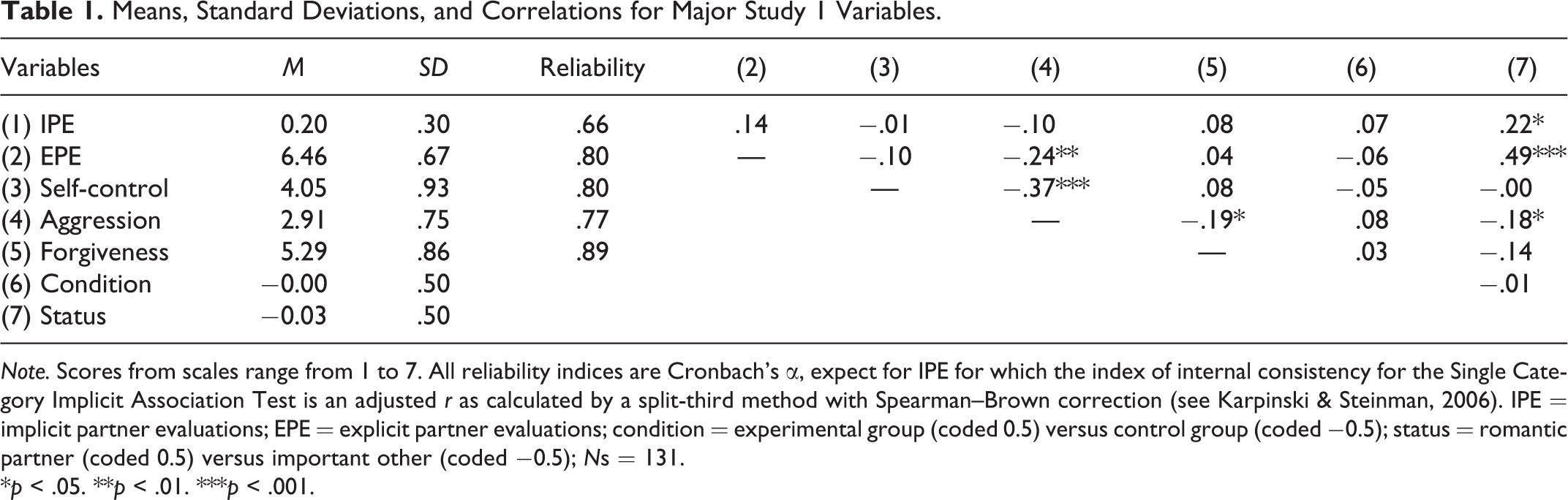
Note. Scores from scales range from 1 to 7. All reliability indices are Cronbach’s α, expect for IPE for which the index of internal consistency for the Single Category Implicit Association Test is an adjusted r as calculated by a split-third method with Spearman–Brown correction (see Karpinski & Steinman, 2006). IPE = implicit partner evaluations; EPE = explicit partner evaluations; condition = experimental group (coded 0.5) versus control group (coded −0.5); status = romantic partner (coded 0.5) versus important other (coded −0.5); Ns = 131.
*p < .05. **p < .01. ***p < .001.
Results of Multiple Linear Regressions Models Predicting Forgiveness (TRIM-18).
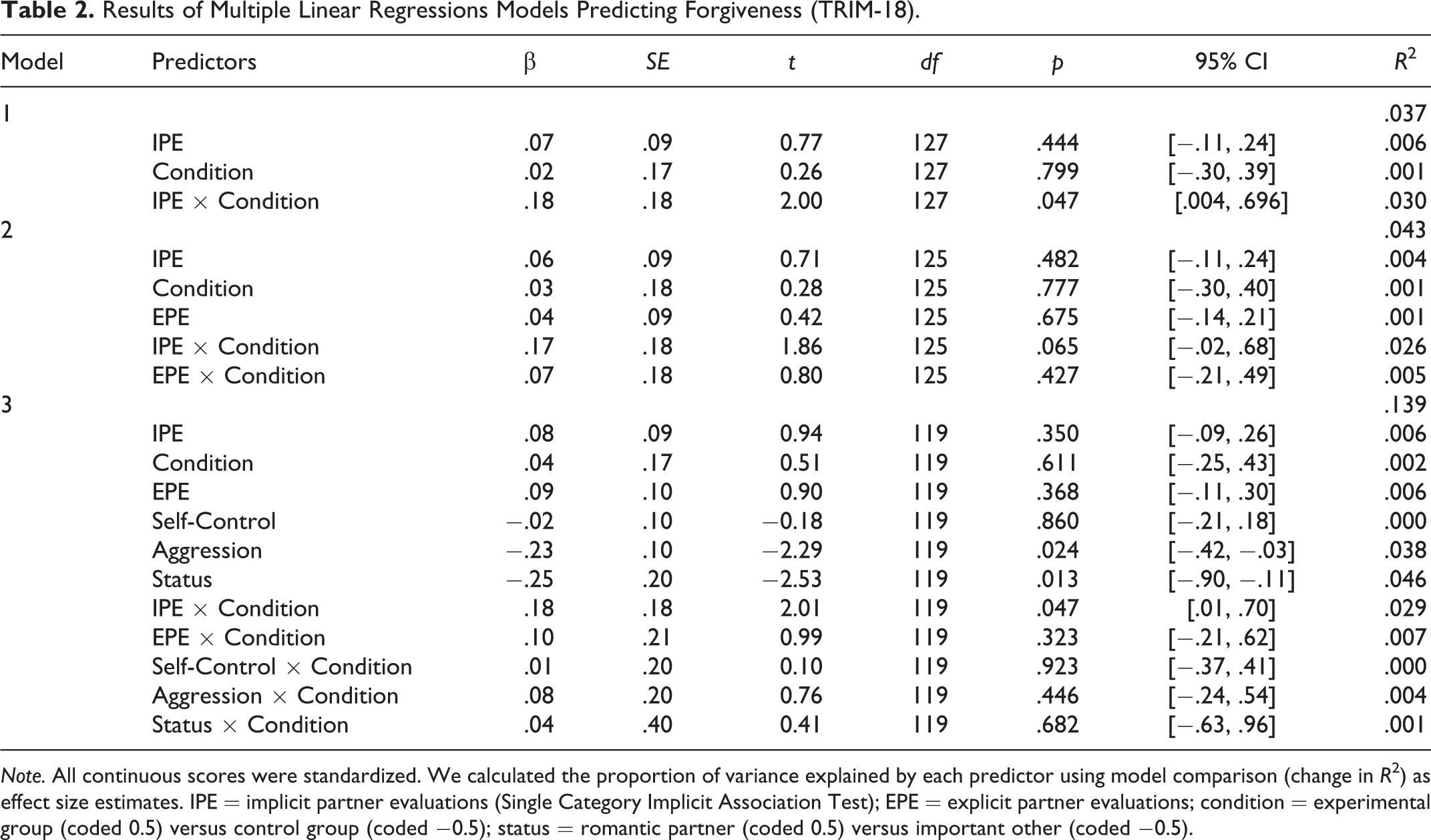
Note. All continuous scores were standardized. We calculated the proportion of variance explained by each predictor using model comparison (change in R 2) as effect size estimates. IPE = implicit partner evaluations (Single Category Implicit Association Test); EPE = explicit partner evaluations; condition = experimental group (coded 0.5) versus control group (coded −0.5); status = romantic partner (coded 0.5) versus important other (coded −0.5).
Second, we tested whether our interaction effect held when controlling for explicit partner evaluations and their interaction by condition (Model 2 in Table 2). Results from this model were similar, though marginally significant: Implicit partner evaluations tended to be more positively associated with forgiveness in the experimental condition, β = .23, SE = 0.12, 95% CI = [−0.01, 0.47], p = .063, R 2 = .027, compared to the control condition, β = −.10, SE = 0.13, 95% CI = [−0.36, 0.15], p = .430, R 2 = .005. Finally, to further examine the robustness of this effect, we controlled for all our covariates 3 and for their interaction by condition to avoid statistical biases in the estimation of coefficients (Yzerbyt et al., 2004). As shown in Table 2 (Model 3), the interaction effect was significant: Participants with more positive implicit partner evaluations were significantly more likely to forgive their close other’s transgression in the experimental condition, β = .26, SE = 0.12, 95% CI = [0.02, 0.50], p = .034, R 2 = .033, but not in the control condition, β = −.09, SE = 0.13, 95% CI = [−0.35, 0.16], p = .464, R 2 = .006.
Discussion
The findings of Study 1 provide preliminary support for the idea that, when executive control is low, implicit partner evaluations determine forgiveness. More specifically, when impairing participants’ executive control with an experimental manipulation, more positive implicit partner evaluations were associated with more willingness to forgive a close other and, overall, neither explicit partner evaluations nor other confounds seemed to explain this effect. In contrast, there was no significant association between implicit partner evaluations and willingness to forgive for participants who did not experience such impairment. These findings suggest that implicit partner evaluations may have important consequences for relational processes because romantic partners regularly experience situations in which situational stressors tax their executive control (Buck & Neff, 2012). Nevertheless, Study 1 has some limitations. It relied on a relatively modest sample size, and it examined the willingness to forgive in an experimental setting rather than actual forgiveness in a natural environment. Thus, in an additional study, we used a daily diary method with a sample size twice as large to corroborate the conclusions drawn from this experiment.
Study 2
The goal of Study 2 was to replicate and extend the results observed in Study 1. That is, we used a daily diary design involving a large dyadic sample of romantic couples to gain ecological validity and show for whom implicit partner evaluations are likely to affect real-life forgiveness. Therefore, Study 2 assessed, rather than manipulated, people’s trait executive control using a well-established cognitive task 4 (Stroop, 1935). We expected that implicit partner evaluations would be positively associated with daily-life forgiveness for individuals with low, but not high, trait executive control and that this association would remain significant when controlling for personal and relational confounding variables.
Participants
Study 2 used an existing data set of 130 couples (including one same-sex dyad; see Supplemental Material for sample characteristics and previous publications using this data set). Following current research standards (Finkel et al., 2015), sample size was determined a priori and combined with a diary design to provide adequate statistical power. Participants (N = 260) were recruited in the Netherlands through various methods in exchange for financial compensation. We excluded two couples and one participant who did not comply with the instructions at intake. The final sample (N = 255) included 63.9% students, 33.7% working adults, and 2.4% of people both working and studying at the same time, whose age varied from 18 to 43 years (M = 23.31, SD = 3.64). On average, relationship duration ranged from 4 months to 17 years (M = 33.91 months, SD = 29.01). Moreover, 34% of the couples were living together, few of whom were married (2.4%).
Measures and Procedure
At intake, couples came to the lab and provided informed consent. Implicit partner evaluations were assessed using the same SC-IAT as in Study 1 (Karpinski & Steinman, 2006). Ten SC-IAT scores were excluded due to failure to comply with the instructions (see Faure et al., 2018). Next, to assess participants’ level of executive control, we used a Stroop task (Stroop, 1935). This task measures participants’ response inhibition by requiring them to indicate in which font color the color words are presented on the screen, regardless of whether this font color is congruent or incongruent with the color words. As a result, more difficulty experienced in inhibiting the tendency to respond to the valence of the word reflects lower executive control (see Supplemental Material for details).
Following the reasoning noted earlier, we measured self-reported relationship satisfaction (4-item scale; Rusbult et al., 1998) to ensure that our effects hold over and beyond people’s explicit evaluations. Moreover, to control for determinants of forgiving dispositions, we used the same measure of self-control as in Study 1 (Tangney et al., 2004). Likewise because past research has demonstrated that commitment and agreeableness are important determinants of forgiving inclinations (Finkel et al., 2002; Hilbig et al., 2016), participants completed the 7-item Commitment Scale (Rusbult et al., 1998) and the 10-item HEXACO agreeableness facet (Ashton & Lee, 2009).
Finally, participants took part in an information session about the 8-day diary procedure that would follow. On days in which participants encountered a conflicting situation in which their partner made them feel upset, angry, or hurt (k = 962 observations across 232 participants), they were asked to report how quickly they forgave their partner that day (1 item). We focused on this specific aspect because forgiveness should occur in a rather fast and spontaneous manner under low level of executive control. Moreover, forgiveness is conceptualized as a motivational process that arises specifically from the readiness to forgive (Fincham et al., 2002). That is, being more prone to forgive is assumed to facilitate the process of forgiveness and, thus, to result into quicker and, ultimately, more forgiving responses.
Results
Table 3 provides the main reliabilities, descriptive statistics, and zero-order correlations. Given the nested nature of our data, we used cross-classified two-level multilevel modeling (i.e., participants were nested within dyads and crossed with measurement occasions) with random intercepts and fixed slopes (Kenny et al., 2006). Following Kenny and colleagues’ (2006) recommendations, we treated our dyads as indistinguishable because we did not have any theoretical reason to expect different patterns of results for men and women and because gender did not reliably moderate our effects.
Means, Standard Deviations, and Correlations for Major Study 2 Variables.
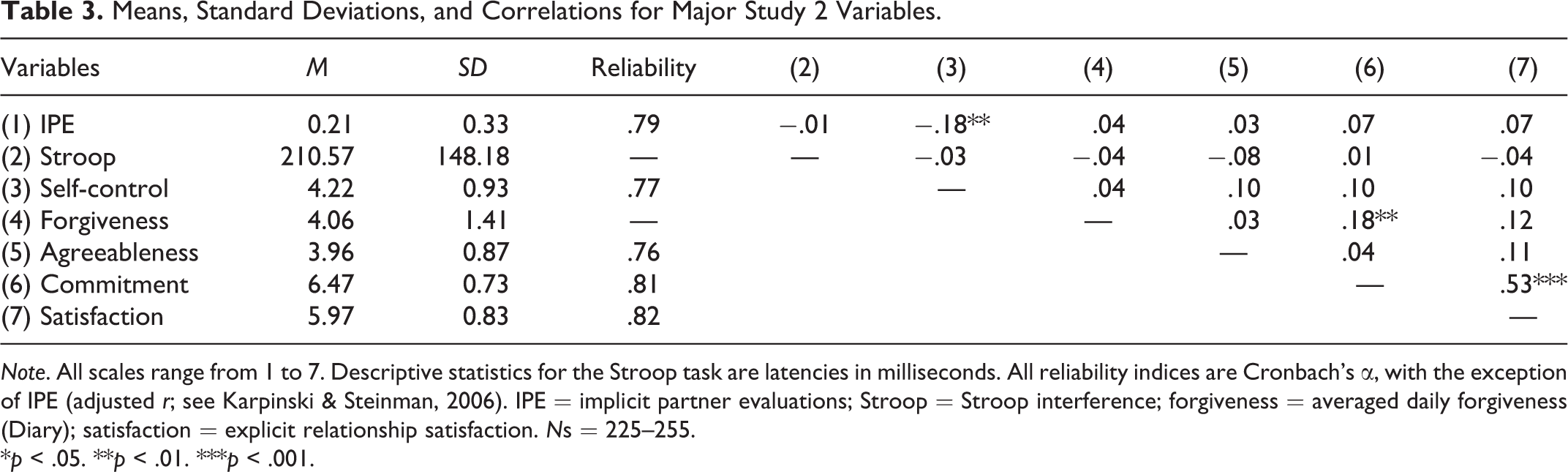
Note. All scales range from 1 to 7. Descriptive statistics for the Stroop task are latencies in milliseconds. All reliability indices are Cronbach’s α, with the exception of IPE (adjusted r; see Karpinski & Steinman, 2006). IPE = implicit partner evaluations; Stroop = Stroop interference; forgiveness = averaged daily forgiveness (Diary); satisfaction = explicit relationship satisfaction. Ns = 225–255.
*p < .05. **p < .01. ***p < .001.
To investigate our question, we used the same three sets of analyses as in Study 1. First, consistent with our prediction, results revealed that the effect of implicit partner evaluations on daily self-reported forgiveness was significantly moderated by performance on the Stroop task (Model 1 in Table 4). Simple slopes analyses (at ±1 SD from the mean) indicated that more positive implicit partner evaluations were significantly associated with more forgiving behaviors over the following week for individuals with lower executive control (i.e., higher Stroop interference), β = 0.18, SE = 0.07, 95% CI = [0.04, 0.31], p = .009, but not for those with higher executive control (i.e., lower Stroop task interference), β = −.09, SE = 0.06, 95% CI = [−0.22, 0.04], p = .157.
Results of Multilevel Models Predicting Daily Forgiveness.
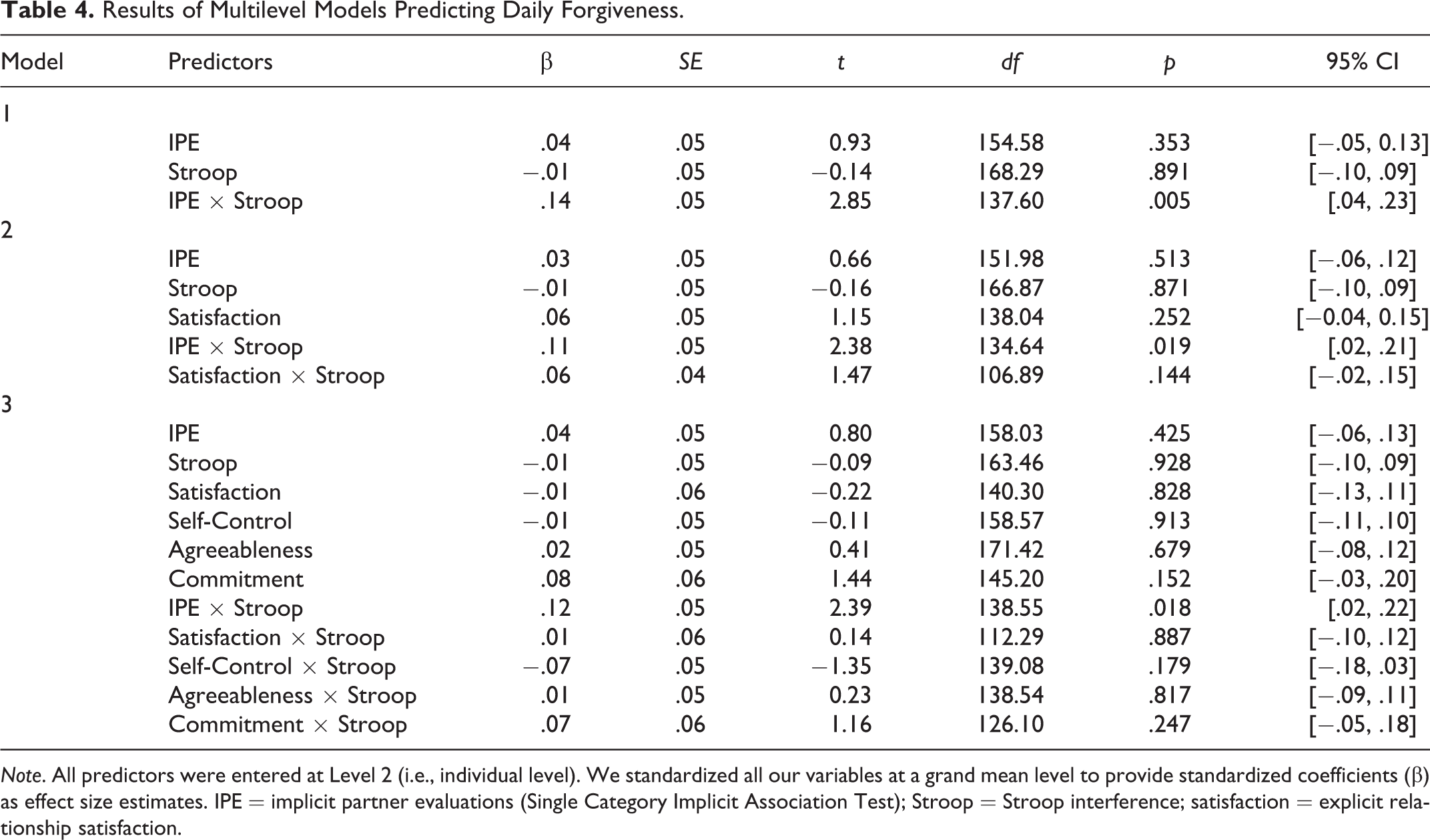
Note. All predictors were entered at Level 2 (i.e., individual level). We standardized all our variables at a grand mean level to provide standardized coefficients (β) as effect size estimates. IPE = implicit partner evaluations (Single Category Implicit Association Test); Stroop = Stroop interference; satisfaction = explicit relationship satisfaction.
Next, in an effort to rule out alternative explanations, we tested whether our effect would remain significant when controlling for explicit relationship satisfaction (Model 2) and for all covariates (Model 3). As shown in Table 4, results were significant and highly similar in both models; controlling for all these covariates, there was a significant positive association between implicit partner evaluations and forgiveness for people with lower executive control, β = .16, SE = 0.07, 95% CI = [0.02, 0.30], p = .028, but not for higher executive control people, β = −.08, SE = 0.07, 95% CI = [−0.22, 0.05], p = .234.
Discussion
Study 2 replicates and extends previous findings in showing that not only situational characteristics but also individual differences in trait executive control can illuminate when implicit partner evaluations affect actual forgiveness in real-life settings. More specifically, we found that, for people with lower performance-based executive control, more positive implicit partner evaluations were linked to greater forgiveness toward their romantic partners over the following week, even after controlling for several confounds.
General Discussion
This research investigated under which conditions implicit partner evaluations affect forgiveness in close relationships. Across two studies, we found evidence that more positive implicit partner evaluations promoted more forgiveness when executive control is low, either because of situational characteristics (Study 1) or because of individual traits (Study 2). Importantly, these effects appeared to be unique and largely automatic: They occurred when people had reduced opportunities to engage in effortful cognitive processing (Payne, 2012) and emerged over and above people’s explicit evaluations as well as various personal and relational determinants of forgiving predispositions.
The current findings have important implications for relationship research. In fact, they corroborate other work showing that the long-term implications of implicit partner evaluations may be due to the fact that they promote constructive relational processes in the first place (Hicks & McNulty, 2019). Importantly, our results further extend previous research in showing that such influences can affect key maintenance processes at critical times. Because it occurs in highly decisive situations, such as when partners hurt each other, forgiveness is indeed essential to relationship maintenance (McCullough et al., 2000) and personal well-being (Karremans et al., 2003). To date, however, forgiveness remained as a cactus in the relationship realm: a thorny issue. Although forgiveness has long been conceptualized as requiring executive control (Burnette et al., 2014), not everyone is high in trait executive control (Miyake & Friedman, 2012), nor do people always have high executive control across all situations (Hofmann et al., 2012). And yet, forgiveness nevertheless seems to occur in relationship contexts that do not allow people to rely on executive control (Karremans & Aarts, 2007; Stanton & Finkel, 2012) and, until now, research remained mute regarding the source of these impulsive responses. Our work contributes to this gap in showing that, under such conditions, people’s forgiving responses are guided by automatic and effortless processes, such as by the spontaneous affective associations that they have toward their partner.
One finding that may seem surprising is that we did not find explicit evaluations to predict forgiveness when executive control is high (see Tables 2 and 4). A possible explanation for this null result may be that, when people engage in deliberative processes, they consider other information than their explicit evaluations to forgive their partner, such as the severity, the domain, the intentionality, or the history of transgressions (Rusbult et al., 1991). Another possibility is that the role of explicit evaluations in determining forgiveness may increase as time goes by (Karremans & Aarts, 2007) and may not be detectable right after, or on the day of, the offense like in our studies. Indeed, given that the link between relationship value and forgiveness seems to be partially mediated by positive cognitive interpretations (Finkel et al., 2002), it might take time for people to form such positive cognitive interpretations, and thus, they may become effective only after some time has elapsed since the incident. Also, it is important to note that explicit evaluations are highly susceptible to motivational biases (e.g., positive illusions; Murray, 1999), which has been found to undermine the predictive power of these evaluations (Faure et al., 2018; McNulty et al., 2013).
Undoubtedly, we do not argue that forgiveness is the only factor that results in relationship success, nor that one should always forgive their partner; indeed, these forgiving behaviors may backfire, such as when constructive behaviors are not reciprocated by the partner (Luchies et al., 2010). In this regard, we believe that automatic processes may nevertheless promote forgiveness when it is particularly adaptive to do so. In fact, it has been hypothesized that implicit partner evaluations have an important functional value, summarizing both one’s positive and negative past experiences with a romantic partner such that one can perceive, behave, and make appropriate decisions toward that partner (Hicks & McNulty, 2019). Drawing upon this perspective, when executive control is low, implicit partner evaluations may be especially functional and only promote forgiveness toward relationship partners that have been satisfying and reassuring, but not harmful or destructive.
Lastly, it is important to discuss potential boundary conditions and limitations of our work. Notably, our findings stem from young samples of Dutch participants, which might restrict their generalizability to other samples. Also, our interaction effects involved either one or two continuous predictors, and such effects are inevitably more difficult to detect than fully categorical interactions (e.g., 2 × 2) due to their distributional properties (McClelland & Judd, 1993). Moreover, Study 2 examined how quickly participants forgave their partner, which may be only one component of the forgiving process. Furthermore, this research did not assess the perceived severity of the incidents and, in Study 2, we did not measure the actual reasons for the conflict. Thus, it remains unclear whether implicit partner evaluations promote forgiveness similarly across different domains as well as for both mild and severe transgressions.
Despite these limitations, our work entails several strengths. Following current scientific standards (Finkel et al., 2015; Funder et al., 2014), we used a laboratory experiment to investigate the link between implicit partner evaluations and forgiveness in a controlled environment, we replicated our findings in an ecologically valid daily diary study involving a large sample of romantic couples and controlled for several confounds to increase power, precision, and confidence in the robustness of our effects. Furthermore, while past work has depicted how forgiveness occurs when people have opportunities to engage in cognitive effort, the current investigation instead focuses on a more realistic and prevalent situation: what predicts forgiveness when individuals can hardly engage in such controlled reasoning. Under such circumstances, our findings suggest that their implicit partner evaluations help them foster crucial sentiments to navigate through the storm of inevitable (but forgivable) offenses and, ultimately, to maintain thriving relationships.
Supplemental Material
Revision2_IPEandForgiveness_SupplementalMaterial - When and for Whom Implicit Partner Evaluations Predict Forgiveness
Revision2_IPEandForgiveness_SupplementalMaterial for When and for Whom Implicit Partner Evaluations Predict Forgiveness by Ruddy Faure, Francesca Righetti, Grace Larson, Maria Fernanda Cuellar, Antonis Koutsoumpis, Maria Zwicker and Wilhelm Hofmann in Social Psychological and Personality Science
Footnotes
Authors’ Note
Although the data of Study 2 are part of a larger project, they represent unique work that has not appeared in any other publication (we provide an exhaustive overview of previous publications using this data set in the Supplemental Material for transparency purposes). Material, code, and data (with restricted access for Study 2 given the sensitive nature of dyadic data) for this project are provided at  .
.
Declaration of Conflicting Interests
The author(s) declared no potential conflicts of interest with respect to the research, authorship, and/or publication of this article.
Funding
The author(s) disclosed receipt of the following financial support for the research, authorship, and/or publication of this article: This research was supported by a Veni grant from the Netherlands Organization for Scientific Research (NWO) allocated to F. Righetti (No. 451-12-024) and by a joint Open Research Area (ORA) grant to F. Righetti and W. Hofmann (NWO Grant No. 464-15-093 and German Research Foundation Grant HO 4175/6-1, respectively).
Supplemental Material
The supplemental material is available in the online version of the article.
Notes
References
Supplementary Material
Please find the following supplemental material available below.
For Open Access articles published under a Creative Commons License, all supplemental material carries the same license as the article it is associated with.
For non-Open Access articles published, all supplemental material carries a non-exclusive license, and permission requests for re-use of supplemental material or any part of supplemental material shall be sent directly to the copyright owner as specified in the copyright notice associated with the article.
