




Abstract
Previous longitudinal research indicates that although religion may affect how personality traits are expressed, religion does not affect people's underlying personalities. However, such research has drawn from small North American samples and relatively short time intervals that do not include data from individuals prior to conversion. Here, we use a representative national sample of New Zealand adults over 9 years (2009–2017, N = 31,604) and piecewise latent growth models to assess longitudinal change in Big Five personality and Honesty-Humility before and after conversion to/deconversion from Christianity (N = 540 converts, N = 886 deconverts). We observed no personality changes before conversion or after deconversion. However, we observed increases in Honesty-Humility, Conscientiousness, and Neuroticism following conversion. We also observed increases in Honesty-Humility and decreases in Agreeableness preceding deconversion. These findings indicate that religious conversion initiates specific changes in character, the most pronounced of which relate to increases in modesty and greed-avoidance.
The bandwidth of human religious diversity is impressive. However, from Aztec human sacrifice to tantric fertility rituals, a clear human universal abides: All religions seek to cultivate changes in a person’s fundamental character. As Paloutzian et al. (1999) put it, “religious changes are intended to be foundational” (p. 1048). Intuitively, it would seem that a change in one’s beliefs about meaning and morality should also impact on a person’s basic character. By contrast, a review by Paloutzian and colleagues (1999) found little evidence that religious change impacts on personality (see also Paloutzian et al., 2013). Recent longitudinal research agrees with this conclusion; religious affiliation, in general, appears to have little impact on personality traits (see Saroglou, 2010, for a review).
However, previous studies have been methodologically challenged in two ways. First, personality traits tend to change very slowly (Roberts & Wood, 2006). To infer the impact of religious change on personality requires large longitudinal samples assessed over long periods of time. Second, to assess the impact of religious change, measures of personality both before and after conversion and deconversion are needed. Here, we aim to replicate previous research but extend upon it methodologically by leveraging nine waves of national-scale longitudinal panel data to identify whether conversion to and deconversion from Christianity impacts upon personality. What kind of person does religion make us? This important and age-old question deserves a strong test before final conclusions are drawn.
Background to the Present Study
Personality describes ways of thinking, feeling, and acting that, while differing between individuals, remain stable within individuals as they age (McCrae & Costa, 1997). Most trait models of personality organize this diversity of human behavior into five or six broad clusters. The current research uses the Big Five model, which organizes personality into the traits of Extroversion, Agreeableness, Conscientiousness, Neuroticism, and Openness to experience (see Table 1 for a summary; Goldberg, 1990; McCrae & Costa, 1997). We also measure facets of Honesty-Humility, a trait from the Big Six model of personality (Ashton & Lee, 2007). Different levels of personality traits predict real differences in behavior, goals, values, and resilience (Ashton & Lee, 2007; Ejova et al., in press; Roberts & Robins, 2000; Sibley et al., 2011). As such, measuring the change in these traits is an ideal way to assess whether religion contributes to foundational changes in a person’s character.
Interpretation of Each Mini-International Personality Item Pool Factor, Including Example Traits, and Likely Adaptive Benefits and Costs Resulting From High Levels of Each Personality Dimension.
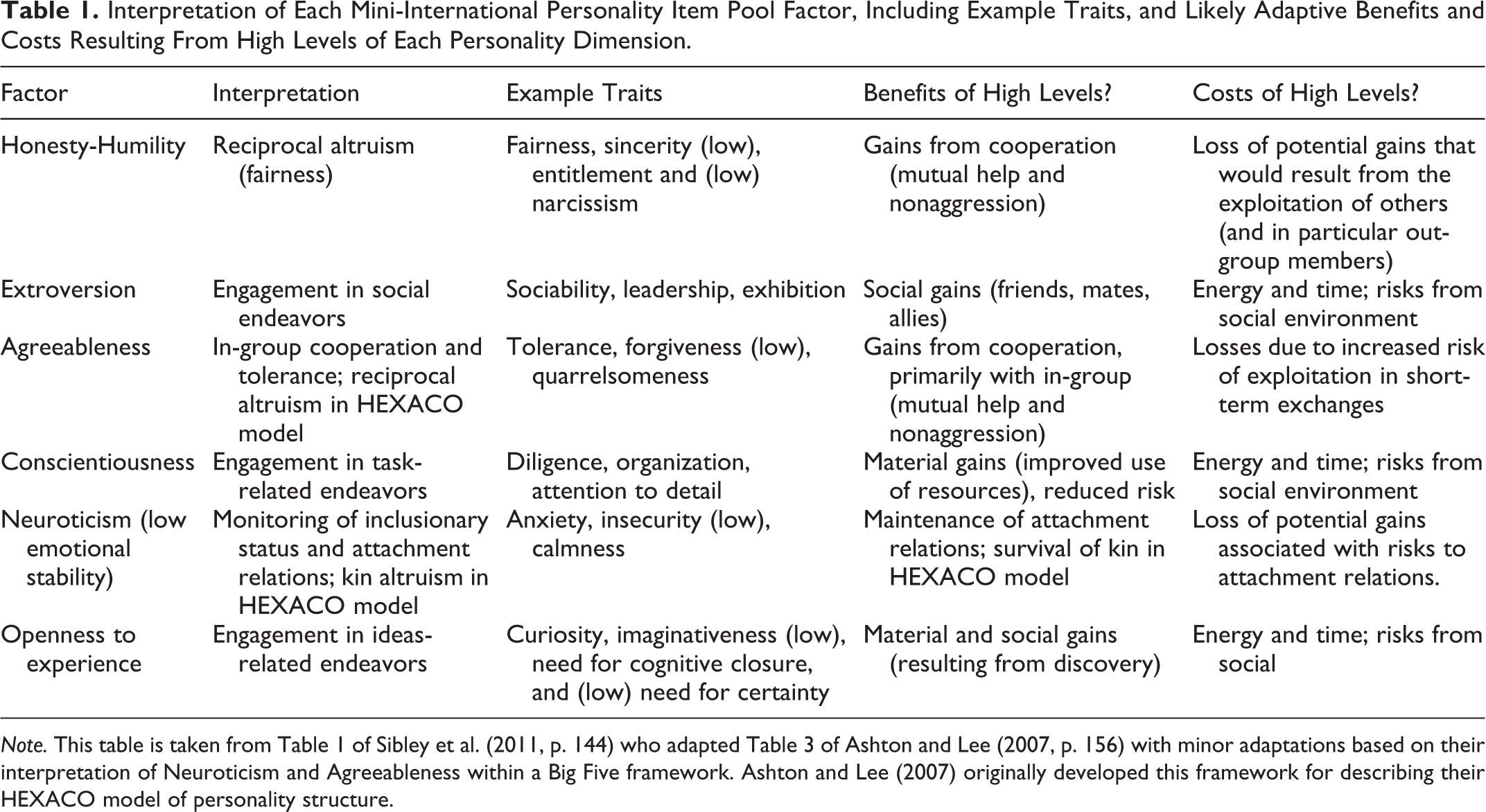
Note. This table is taken from Table 1 of Sibley et al. (2011, p. 144) who adapted Table 3 of Ashton and Lee (2007, p. 156) with minor adaptations based on their interpretation of Neuroticism and Agreeableness within a Big Five framework. Ashton and Lee (2007) originally developed this framework for describing their HEXACO model of personality structure.
Previous correlational research has identified associations between Big Five personality traits and religiosity (typically measured as the importance of religion to one’s life). In a large cross-sectional meta-analysis, religiosity was found to be most consistently associated with higher Agreeableness and Conscientiousness (Saroglou, 2010). Associations between Extroversion, Neuroticism, and Openness were weaker and less consistent and depended more upon the cultural context (Saroglou, 2010). Large-scale research examining the Big Six model has also identified a consistent positive association with Honesty-Humility across cultures (Aghababaei et al., 2016; Ashton & Lee, 2019; Lee et al., 2005). However, correlational studies cannot tell us which personality traits motivate people to convert to religion in adulthood and which are a result of being religious. Retrospective self-reports of Big Five personality among people who have converted to Christianity somewhat support the correlational findings, with converts viewing themselves as higher in Extroversion, Agreeableness, and Conscientiousness and lower in Neuroticism following their conversion (Halama & Lačná, 2011). However, converts’ recollections may be influenced by the need to view their new life as a positive one (Halama & Lačná, 2011; Paloutzian et al., 1999).
Where longitudinal research has been conducted, the results largely suggest that religion does not impact upon personality. An early review of the longitudinal literature concluded that while religious change may bring about new goals and a different lifestyle, it does not produce a change in a person’s more fundamental personality traits (McAdams, 1994; Paloutzian et al., 1999). Indeed, Paloutzian and colleagues (1999) theorize that abrupt and profound changes following conversion are a stereotype, one that does not reflect most conversion experiences. More recently, longitudinal studies have found that higher intrinsic religiosity and higher religious centrality predicted increases in Agreeableness over time among both North American and Australian adolescents (Huuskes et al., 2013; Wink et al., 2007). Yet in contrast to correlational findings, religiosity was not associated with any other Big Five personality changes over time (Huuskes et al., 2013; Wink et al., 2007). Studies that tracked conversion and deconversion similarly observed no change in any of the Big Five personality traits following religious change among Chinese Christians (Hui et al., 2017, 2018).
However, personality change at the trait level is subtle and slow. Detecting personality changes brought about by religion would likely require larger samples assessed over long time frames (Roberts & Wood, 2006), with Hui and colleagues (2018) noting that personality change is unlikely to be detected in their 3-year time span following conversion and deconversion. While some research has used longer time frames, they examined degree of religiosity rather than religious change (Huuskes et al., 2013; Wink et al., 2007). No longitudinal studies have assessed the association between religiosity and Honesty-Humility. Some longitudinal research tests whether personality predicts religiosity but not vice versa (Heaven & Ciarrochi, 2007; McCullough et al., 2003; McCullough et al., 2005). All previous longitudinal research has used samples (∼200–600 participants) that may not be large enough to detect subtle personality change. The current research aims to address these issues by investigating longitudinal personality change preceding and following conversion and deconversion in a large sample of adults over nine waves of data.
How should religious change impact upon a person? Personality theories suggest that personality change is the slow result of day-to-day behaviors, experiences, and social expectations of others (Roberts & Wood, 2006). For example, people tend to become more conscientious after they begin their first job and less conscientious when they retire (Specht et al., 2011). Religious theories similarly suggest that religiosity is created and maintained through socialization and ongoing conversations with family, partners, friends, and community that influence religious beliefs and behaviors (Sherkat, 2003; Spilka et al., 2003). Someone who is religious is thus typically regularly encouraged to think and behave in line with its tenets. A central tenet of most major religions, Christianity included, is to cultivate a virtue of humility. Namely, people learn to put the good of others, the collective, and the sacred (God, nature, humanity, or whatever is considered at the heart of spirituality) above their own interests (see Baumeister et al., 2010). Thus, religious instruction and socialization should encourage the development of “religious habits” such as humility, kindness, and putting others before yourself.
These values largely describe the trait of high Honesty-Humility, which in the current study encompasses humility, modesty, and greed-avoidance. Agreeableness describes similar facets such as tolerance and sympathy that should likewise be encouraged by Christianity. Conscientiousness could also be increased by Christianity as people search for order, are encouraged to practice self-control, and follow rituals such as prayer and regular church attendance (McCullough & Willoughby, 2009; Saroglou, 2017). 1 Neuroticism, as an indicator of sensitivity to the needs of others and concern about whether one belongs within a group (Denissen & Penke, 2008; Sibley et al., 2011), may also be relevant to religious change. In short, as religious socialization creates and maintains religious belief, it should similarly impact upon personality. We expect to see increases over time in Honesty-Humility, Agreeableness, Conscientiousness, and Neuroticism among people who have converted to Christianity. Correspondingly, we expect to see decreases in those traits among those who have deconverted from Christianity. The loss of religious socialization (or sometimes, actively irreligious socialization; Dahl et al., 2019; Thiessen & Wilkins-Laflamme, 2017) should result in the loss of “religious habits.”
Personality changes preceding and following religious change should be localized—we would expect there to be change in relevant personality traits and no change in irrelevant personality traits. Openness tends to be related to specific types of religious belief (i.e., fundamentalism or spirituality) but is not typically associated with religiosity as a whole (Saroglou, 2010), while Extroversion is typically unrelated to religiosity in Western contexts (Ashton & Lee, 2019; Saroglou, 2010). Thus, no changes in these traits are expected following religious change. In addition to changes after conversion and deconversion, we will assess changes prior to conversion and deconversion. However, both personality theory and theories of religious socialization suggest that personality changes come about after life changes as a result of new habitual behaviors, social roles, and the expectations of others (Roberts & Wood, 2006; Sherkat, 2003). Thus, while goals and values may shift in the lead-up to religious change, we do not expect to see changes in fundamental personality traits.
To summarize, research has yet to demonstrate much evidence that religious change can cause lasting changes in personality (Ashton & Lee, 2014; Paloutzian et al., 1999; Saroglou, 2010). However, prior tests of the idea have been weak. A stronger test would require larger samples tracked over longer periods of time. In the present study, we replicate and extend upon previous research using piecewise growth models and a large national panel study of New Zealand adults (N = 31,604) to assess changes in Big Five personality and facets of Honesty-Humility as people convert to or deconvert from Christianity. In a basic growth curve model, the model estimates the rate of change over time for each participant—how much does someone’s personality change as they age. In piecewise growth models, a separate growth curve is modeled before and after an event—in this case, for personality change leading up to conversion and for personality change following conversion (and likewise for deconversion). These models are often used where change is predicated on some event occurring (e.g., changes in life satisfaction after divorce or becoming a parent; Agache et al., 2014; van Scheppingen & Leopold, 2019). We hypothesize that Honesty-Humility, Agreeableness, Conscientiousness, and Neuroticism will increase following conversion and likewise decrease following deconversion. Furthermore, we investigate changes in personality prior to conversion and prior to deconversion; however, no changes are expected.
Method
Sampling and Procedure
The New Zealand Attitudes and Values Study (NZAVS) is a longitudinal panel study of New Zealand adults that began in 2009. Online and postal questionnaires are sent to all active participants annually. Participants are sampled from the New Zealand electoral roll that is publicly available for scientific research and represents all citizens over 18 years of age who were eligible to vote regardless of whether they chose to vote. Various booster samples have been collected in the following waves of the study to increase sample size and diversity. As of the latest wave of data collected in 2017, 31,604 unique participants have taken part in the study. Informed consent was obtained from all participants for each wave of the study (see Sibley, 2019, for full details regarding sampling and procedure).
Participants
We identified participants who changed from being nonreligious to affiliating with a Christian denomination, or vice versa (from Christian to nonreligious), during the first 9 years of the annual longitudinal NZAVS spanning 2009–2017. We allowed for missing waves of data (not all participants completed all waves, due to some participants joining the study through booster sampling at latter waves, or intermittent responding over the years). However, to be included in the analysis, a participant must have completed 2 consecutive years of the study, and change must have been observed between those two waves. This was necessary so that we always observed the wave immediately preceding conversion/deconversion and the wave immediately following it. We only included participants who were observed to convert only once or those observed to deconvert only once, as our modeling approach was not appropriate for repeated dynamic (on/off/on/off) types of change. Thus, our analysis focused solely on people who converted (or deconverted) and then stayed consistently in that new state for the remainder of the study waves in which they participated.
Demographic information for participants is presented in Table 2. The demographic data are taken from the wave immediately following conversion or deconversion for each participant (see Supplementary Table 1 for information on the age participants were when they converted or deconverted). Participants took part in approximately four waves of the NZAVS on average. Deprivation was measured using the New Zealand Deprivation Index (Salmond et al., 2007) that uses census information to assign a decile rank index from 1 (least deprived) to 10 (most deprived) to each meshblock unit. Education was coded into an ordinal variable (0 = no qualification to 10 = doctorate).
Demographic Information Using Data From the Wave Immediately Following Conversion or Deconversion.
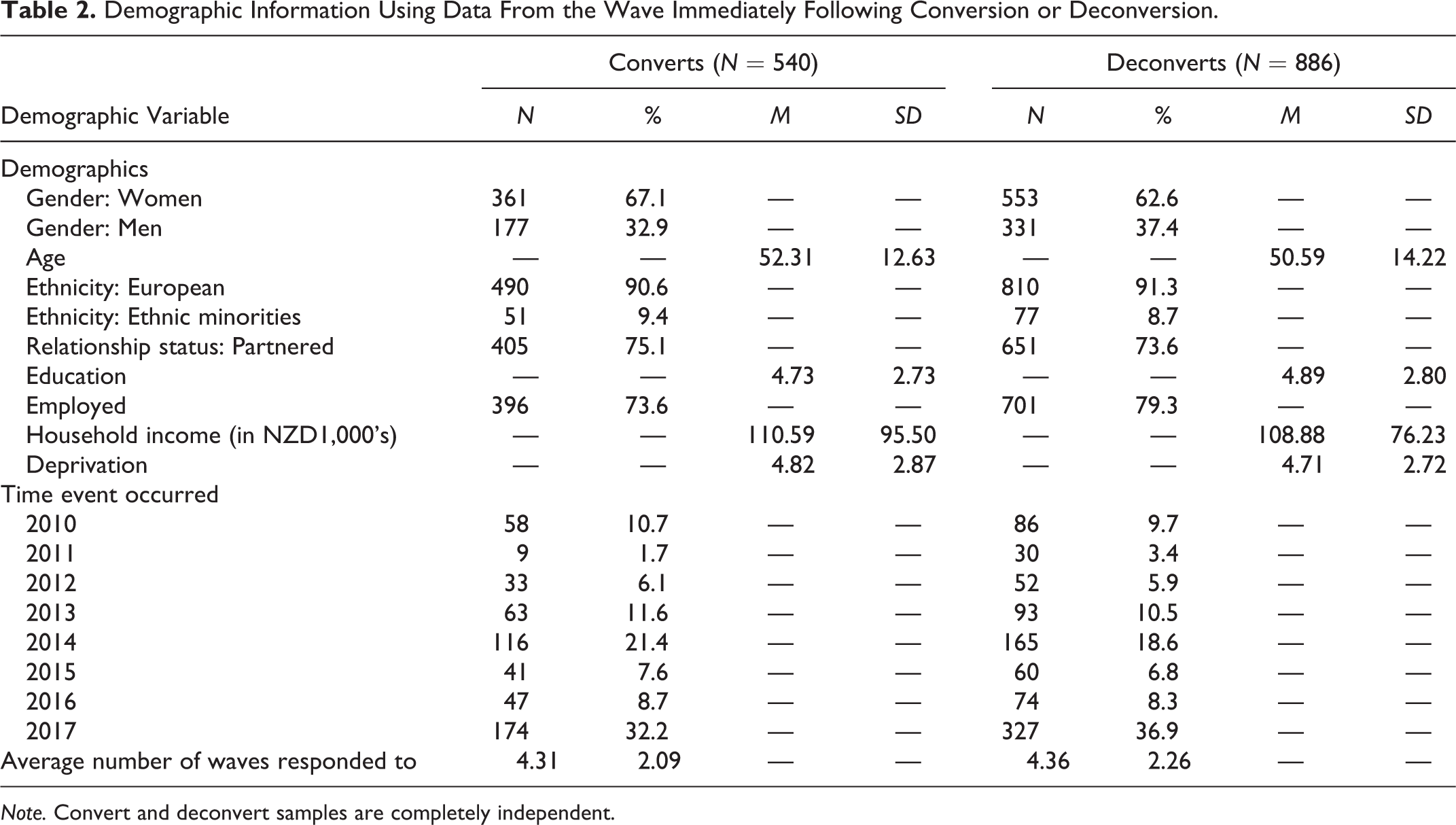
Note. Convert and deconvert samples are completely independent.
Model Estimation
We constructed a series of event-aligned piecewise growth models. We used Bayesian estimation with a noninformative prior distribution using Mplus Version 8.3 defaults (Asparouhov & Muthén, 2010; L. K. Muthén & Muthén, 1998). Each model assessed the growth function for a given personality trait in the years leading up to the point of conversion or deconversion and the growth function for that same personality trait in the years following the point of conversion or deconversion. Our piecewise models were event-aligned because the point in time during which the event of interest occurred (i.e., conversion or deconversion) was modeled as the break point between the two slopes in the piecewise model for each individual, regardless of the chronological point in time at which it occurred. For example, the break point for a participant who converted from nonreligious to Christianity in 2012 would be between the 2011 and 2012 waves, with one slope representing the growth function for a given personality trait leading up to 2011 (before they converted) and the second slope representing the growth function for that same personality trait in the years following conversion (see Supplementary Figure 1 for missing data rates across the 6 years preevent and 5 years postevent). We controlled for the year in which religious change occurred and the age of the participant at the time of religious change in all models.
Questionnaire Measures
All measures were included within the larger NZAVS questionnaire (see Sibley, 2018, for a full list of measures).
Religion
Religiosity was measured by a single item (yes/no), “Do you identify with a religion and/or spiritual group?” If participants indicated they were religious, they were asked an open-ended question: “If so, what religion or spiritual group?” We restricted our analyses to those participants who stated that they were Christian, as sample sizes in other religious groups were small.
Personality
Big Five personality was assessed using the Mini-International Personality Item Pool (IPIP6; Sibley et al., 2011), a short-form adaptation of the Mini-IPIP (Donnellan et al., 2006). Extroversion was assessed by 4 items: “[I] am the life of the party,” “[I] don’t talk a lot” (reverse-scored), “[I] keep in the background” (reverse-scored), and “[I] talk to a lot of different people at parties” (αconverts = .72, αdeconverts = .73). Agreeableness was assessed by 4 items: “[I] sympathize with others’ feelings,” “[I] am not interested in other people’s problems” (reverse-scored), “[I] feel other’s emotions,” and “[I] am not really interested in others” (reverse-scored; αconverts = .66, αdeconverts = .66). Conscientiousness was assessed by 4 items: “[I] get chores done right away,” “[I] like order,” “[I] make a mess of things” (reverse-scored), and “[I] often forget to put things back in their proper place” (reverse-scored; αconverts = .62, αdeconverts = .66). Neuroticism was assessed by 4 items: “[I] have frequent mood swings,” “[I] am relaxed most of the time” (reverse-scored), “[I] get upset easily,” and “[I] seldom feel blue” (reverse-scored; αconverts = .66, αdeconverts = .67). Openness to experience was assessed by 4 items: “[I] have a vivid imagination,” “[I] have difficulty understanding abstract ideas” (reverse-scored), “[I] do not have a good imagination” (reverse-scored), and “[I] am not interested in abstract ideas” (reverse-scored; αconverts = .68, αdeconverts = .67). All traits were measured using the mean of 4 items rated on a scale from 1 (very inaccurate) to 7 (very accurate).
Honesty-Humility was also measured using 4 items; 2 items adapted from the HEXACO Honesty-Humility Scale (Ashton & Lee, 2009): “[I] would like to be seen driving around in a very expensive car” and “[I] would get a lot of pleasure from owning expensive luxury goods,” and 2 items adapted from the Psychological Entitlement Scale (Campbell et al., 2004): “[I] feel entitled to more of everything” and “[I] deserve more things in life” (all items reverse-coded; αconverts = .78, αdeconverts = .78). These 4 items have been shown to have high reliability and construct validity in the New Zealand context; they are markers for a distinct “sixth” factor in models including the Big Five (Sibley et al., 2011), have excellent test–retest stability (Milojev et al., 2013), and have good test information function in analyses using item response theory (Sibley, 2012).
Results
Results for the event-aligned piecewise growth models are presented in Table 3 for participants who converted to Christianity and in Table 4 for participants who deconverted from Christianity. Slopes are also presented in Figure 1. Results showed no significant changes to personality prior to conversion; however, there were significant increases over time in Honesty-Humility (b = .078), Conscientiousness (b = .031), and Neuroticism (b = .035) following conversion. For participants who deconverted, Honesty-Humility increased (b = .039) over time prior to deconversion, and Agreeableness decreased (b = −.034) over time prior to deconversion. There were no significant changes in personality following deconversion.
Piecewise Latent Growth Models for Participants Who Converted to Christianity.
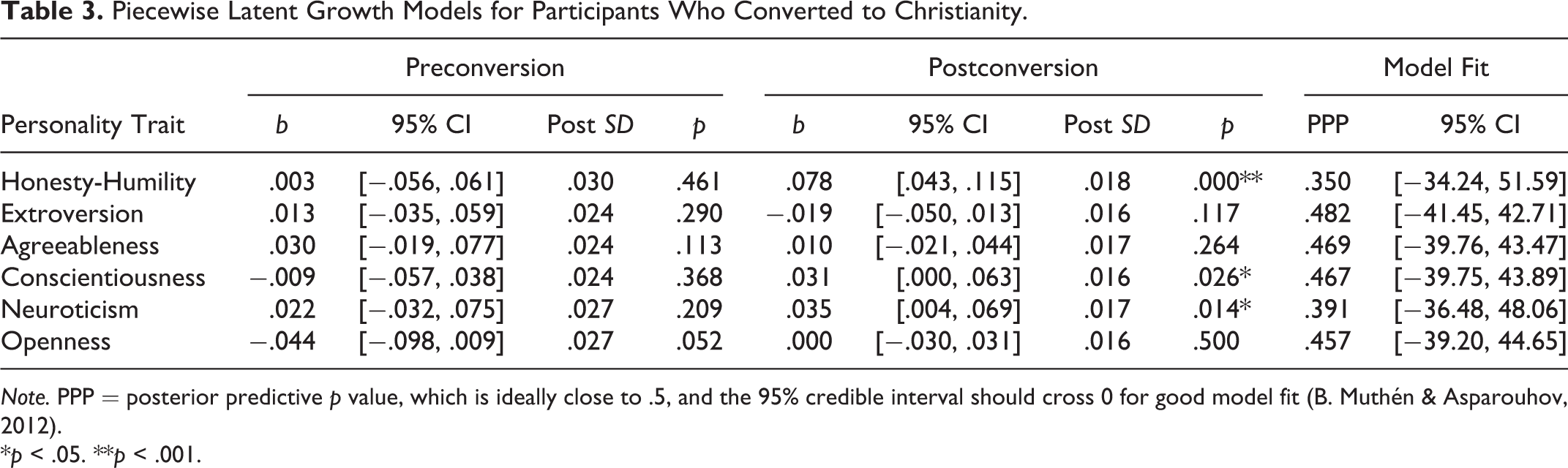
Note. PPP = posterior predictive p value, which is ideally close to .5, and the 95% credible interval should cross 0 for good model fit (B. Muthén & Asparouhov, 2012).
*p < .05. **p < .001.
Piecewise Latent Growth Models for Participants Who Deconverted From Christianity.

Note. PPP = posterior predictive p value, which is ideally close to .5, and the 95% credible interval should cross 0 for good model fit (B. Muthén & Asparouhov, 2012).
*p < .05. **p < .001.
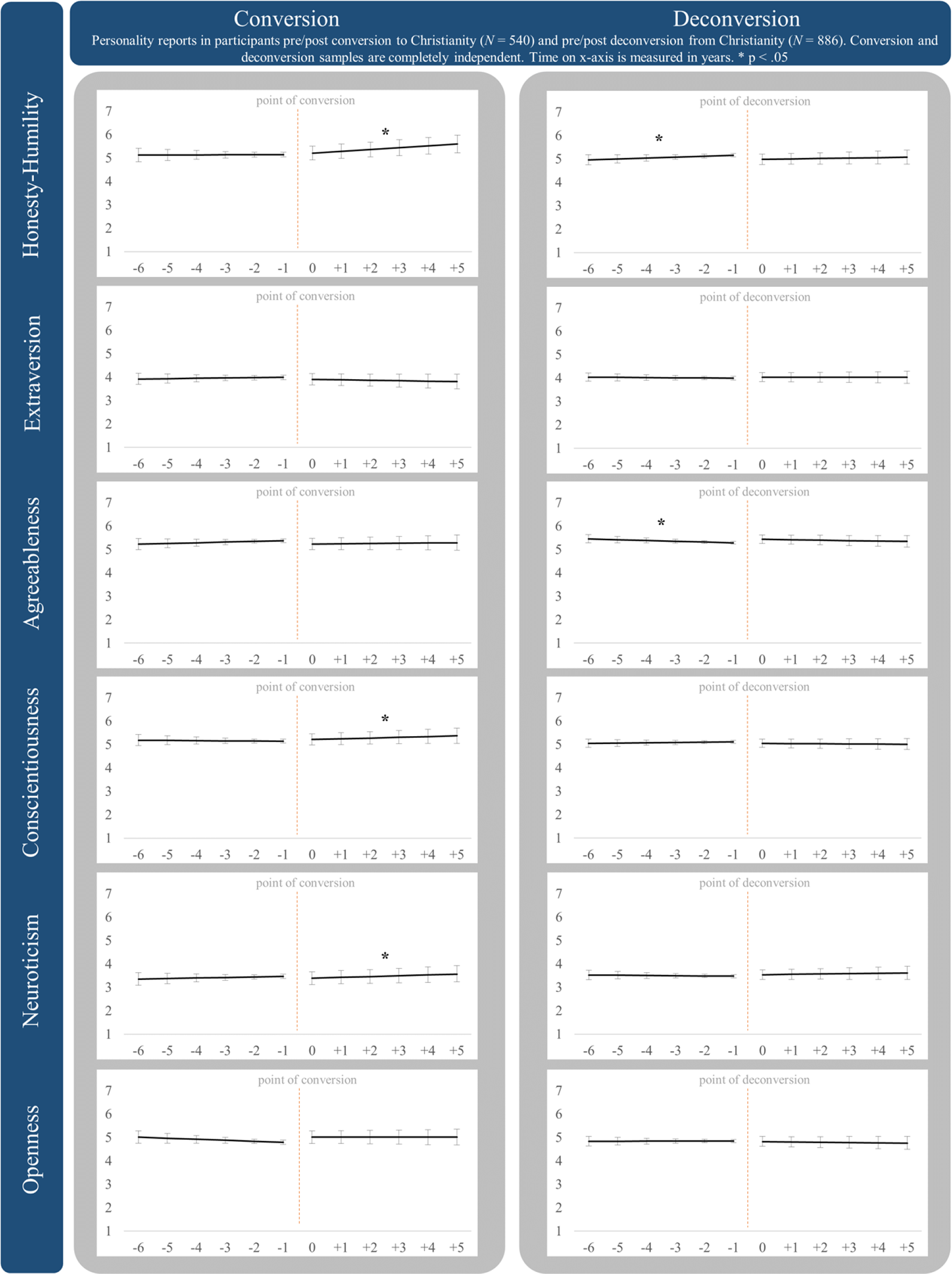
Piecewise latent growth models estimating change in personality traits preconversion and postconversion and deconversion. Error bars represent 95% credible intervals.
Discussion
Religious institutions and their followers are invested in the idea that religion changes a person’s character, typically for the better. Drawing on 9 years of data from a large and diverse national panel sample of New Zealand adults, we investigated longitudinal change in personality traits preceding and following conversion to and deconversion from Christianity. In contrast to previous small-scale research (see Paloutzian et al., 1999), we observed personality changes both before and after change in religious affiliation. The greatest observed personality change occurred in Honesty-Humility, with increases observed following conversion and preceding deconversion. Increases in Conscientiousness and Neuroticism were also observed following conversion. Finally, Agreeableness was observed to decrease prior to deconversion. These findings add fresh data to a body of research that has long searched for the impact that religiosity has on character (Hui et al., 2017, 2018; Huuskes et al., 2013; Paloutzian et al., 1999; Wink et al., 2007). Overall, personality changes were only observed after conversion or prior to deconversion. That is, personality only changed while people identified as Christian, suggesting that religious socialization plays a role. However, this contradicts our hypothesis that the loss of religious socialization would mean corresponding decreases in personality traits. Personality changes associated with conversion were not “undone” by deconversion, supporting the idea that religion contributes to enduring and foundational changes in personality.
Increases in Honesty-Humility following conversion were the largest observed change in personality overall. This finding suggests that Christianity is indeed effective at promoting traits relevant to its central tenets among recent converts, such as humility, modesty, and greed-avoidance. Different levels of personality traits can translate into behavioral differences, with this measure of Honesty-Humility associated with greater rates of charitable giving (Sibley et al., 2011). No decreases in Honesty-Humility were observed following deconversion suggesting that religious experiences created a lasting change in personality.
Honesty-Humility was also observed to increase prior to deconversion. This was an unexpected finding; we predicted that personality changes would follow life changes, not precede them. This finding has several potential explanations. Deconverts may be gathering their moral strength around them and increasing their commitment to their principles in order to better navigate the moral and social implications of leaving their religion. Deconverts may also come to view participation in an organized hierarchical religion such as Christianity as inconsistent with their principles of humility and modesty. Altemeyer and Hunsberger’s (1997) interviews with deconverts indicated that they were often concerned with moral hypocrisy and dishonesty within their religion (see also Wright et al., 2011). These results suggest that while Christianity may effectively cultivate humility for some (and more specifically, as we measure here, greed-avoidance), exiting Christianity appears to be similarly effective in cultivating humility for others. However, this finding is exploratory and should be taken tentatively until investigated further.
We found that conversion preceded increases in Conscientiousness, suggesting Christians developed greater diligence. Prior research and theory have discussed how Conscientiousness maintains religiosity, in that, people with high Conscientiousness choose to be religious and remain committed over time (Heaven & Ciarrochi, 2007; Saroglou, 2010; Wink et al., 2007). Here, we demonstrate that religiosity may also impact upon Conscientiousness. This fits with theory suggesting that religion aids in setting and achieving goals, provides more structure to one’s life through regular rituals such as prayer, and encourages greater self-control and better health behaviors such as limiting substance use (McCullough & Willoughby, 2009; Saroglou, 2017). Our results provide strong support to the idea that religious habits like these may reflect change in more fundamental personality traits.
We also found that conversion preceded increases in Neuroticism, as hypothesized. Neuroticism may reflect greater anxiety and monitoring of group status—a logical development after joining a new and important social group (Sibley et al., 2011). In contrast to the other personality trait changes we observed following conversion, Neuroticism is not typically viewed as a positive or pro-social trait and is linked longitudinally to poorer mental health (Ejova et al., in press). Interestingly, retrospective self-reports indicated that people believed they were lower in Neuroticism following conversion (Halama & Lačná, 2011), suggesting that converts are biased toward perceiving their religious change in a positive light.
Finally, contrary to our hypothesis, we observed no increases in Agreeableness following conversion. This finding conflicts with previous research, where Agreeableness is one of the traits most strongly associated with religiosity cross-sectionally (Saroglou, 2010) and longitudinally (Huuskes et al., 2013; Wink et al., 2007). Furthermore, we found that Agreeableness decreased prior to deconversion. Both of these findings are at odds with the simultaneous increases in Honesty-Humility postconversion and predeconversion. One interpretation of these findings is that while Christian converts can strive to be modest and humble (as indexed by our narrow-bandwidth measure of Honesty-Humility), that does not necessarily translate into being more empathetic on an interpersonal level (Agreeableness). Similarly, decreasing Agreeableness prior to deconversion suggests that one can endorse the tenets of a religion (Honesty-Humility) while not cooperating with the religious organization (Agreeableness), as we describe above. The inconsistencies between the current research and previous research could also indicate that strength of religious belief (Huuskes et al., 2013; Wink et al., 2007) and simply identifying as religious may produce quite different impacts on personality; perhaps only those who are strongly identified as Christian would see increases in their Agreeableness. However, as an unexpected finding that contradicts previous research, these findings should be interpreted cautiously.
Overall, the changes in personality we observed were small, slow, and steady and occurred over several years. Given the nature of the model, all rates of change are best interpreted in absolute terms (i.e., on a scale from 1 to 7). The largest observed change was in Honesty-Humility postconversion, which showed an increase of approximately 0.4 units, or 6.6% of the total scale, across 5 years. Change in the other personality traits clustered around ∼3% of the total scale. These findings fit with personality theory, which theorizes that personality is stable and does not change quickly (Roberts & Wood, 2006). Put simply, we would doubt our results if we observed substantial and rapid change among those who convert and deconvert. Instead, our results are consistent with the expected sorts of adjustments that might arise from embracing belief systems that emphasize humility, order, and social inclusion. Our findings fit with both Paloutzian et al.’s (1999) claim that sudden, profound changes associated with religious change are a stereotype and classical religious doctrines that emphasize the role of sustained religious practice in the cultivation of character.
Limitations
It is important to note that personality changes in consistent ways as people age (known as normative change), with Honesty-Humility and Conscientiousness increasing over time for the average person regardless of religious change (Milojev & Sibley, 2017; Roberts et al., 2006). As the growth curves for converts and deconverts are aligned to a specific event, they cannot be meaningfully compared to growth curves for those who remained religious or nonreligious. However, the fact that religious converts and deconverts change in clearly predictable ways (increasing in Honesty-Humility after but not before conversion), with some changes in the opposite direction of normative change (Neuroticism typically decreases as people age; Milojev & Sibley, 2017), indicates that these changes are not normative but may reflect the effect of conversion itself.
We also caution that there may be limitations to self-report measures of personality. Longitudinal research helps to reduce recall bias by providing an assessment of personality before religious change occurs; however, participants could still fill out a measure of personality following religious change in a biased way. For example, change in personality could reflect changes in values—a convert wants to be someone who does not value wealth—but not necessarily behavior. While the Mini-IPIP6 has been validated using behavioral measures (Sibley et al., 2011), postreligious change is a context where self-serving bias could be particularly strong. The next step would be to explicitly link change in personality traits following religious change with shifts in behavioral measures (e.g., charitable giving).
Although we measure conversion and deconversion as a binary change in this research, we note that it is typically not an abrupt process. Changes in religious belief and practice can occur for long periods before and after a change in religious identity (Paloutzian et al., 2013; Streib et al., 2009). Indeed, in the current study, personality changed for years before deconversion was reported and for years after conversion was reported. Future longitudinal research using more fine-grained religious measures may untangle the specific religious behaviors and social interactions that lead to personality change. Future research may also identify different pathways of personality change for different kinds of conversion and deconversion. For example, some deconverts report continuing religious or spiritual beliefs following exit from an organized religion, while others do not (Paloutzian et al., 2013). Similarly, different kinds of religious socialization may predict different changes in personality traits; some deconverts could simply return to baseline personality levels through lack of religious socialization, while others could develop higher Openness, for example, through irreligious socialization.
Whether these effects are limited to New Zealand, or to Christianity, remains unclear. Indeed, many of our findings contradict previous research, both longitudinal findings (Hui et al., 2017, 2018; Huuskes et al., 2013; Wink et al., 2007) and cross-sectional findings using large samples across multiple countries (Ashton & Lee, 2019; Saroglou, 2010). For example, the particular facets of Honesty-Humility (greed-avoidance and modesty) measured here had the weakest associations with religiosity in previous cross-cultural research (Ashton & Lee, 2019). This suggests that contextual factors may be particularly important, whether the cultural context or the type of religiosity measured. We hope our findings here keep the debate about whether religion impacts on fundamental personality traits open and that longitudinal research (using diverse samples and more in-depth personality measures than the short-form scales used here) continues to be conducted on this issue.
Conclusion
The impact religion has on one’s character is a given among those who convert but has mixed support in the scientific literature. The conclusion drawn from previous small-scale longitudinal research is that fundamental personality traits are not impacted by religious change (e.g., Paloutzian et al., 1999). Our study leveraged national scale longitudinal data to evaluate personality before and after religious conversion to and deconversion from Christianity over periods of up to 9 years, in order to detect small and subtle personality changes. Results indicated that religious change appears to change a person’s character; specifically, religious conversion predicts increases in aspects of Honesty-Humility primarily related to modesty and greed-avoidance, Conscientiousness, and Neuroticism. Prior to deconversion, Honesty-Humility increases and Agreeableness decreases. These results suggest that Christian religious conversion appears to evoke a subtle but lasting change in these fundamental qualities of human character, and we hope that more longitudinal research will investigate this important question in the future.
Supplemental Material
Supplementary_Figure_1_-_Missing_Data - Religion and the Development of Character: Personality Changes Before and After Religious Conversion and Deconversion
Supplementary_Figure_1_-_Missing_Data for Religion and the Development of Character: Personality Changes Before and After Religious Conversion and Deconversion by Samantha Stronge, Joseph Bulbulia, Don E. Davis and Chris G. Sibley in Social Psychological and Personality Science
Supplemental Material
Supplementary_Table_1_-_Age_and_Religious_Change - Religion and the Development of Character: Personality Changes Before and After Religious Conversion and Deconversion
Supplementary_Table_1_-_Age_and_Religious_Change for Religion and the Development of Character: Personality Changes Before and After Religious Conversion and Deconversion by Samantha Stronge, Joseph Bulbulia, Don E. Davis and Chris G. Sibley in Social Psychological and Personality Science
Footnotes
Author’s Note
The funders had no role in design of this research project, data collection and study design, formulation of hypotheses, data analysis, or decision to publish. Ethics approval for the New Zealand Attitudes and Values Study was attained from the University of Auckland Human Participants Ethics Committee (014889) and all relevant ethical regulations were complied with. Mplus syntax for the models reported here are posted publicly on the New Zealand Attitudes and Values Study (NZAVS) website. Participants have consented to share their de-identified data with competent professionals on a case-by-case basis, so data are available upon reasonable request from any member of the NZAVS research group (www.psych.auckland.ac.nz/uoa/NZAVS).
Declaration of Conflicting Interests
The author(s) declared no potential conflicts of interest with respect to the research, authorship, and/or publication of this article.
Funding
The author(s) disclosed receipt of the following financial support for the research, authorship, and/or publication of this article: This research was supported by a grant from the Templeton Religion Trust (Grant TRT0196).

Supplemental Material
The supplemental material is available in the online version of the article.
Note
References
Supplementary Material
Please find the following supplemental material available below.
For Open Access articles published under a Creative Commons License, all supplemental material carries the same license as the article it is associated with.
For non-Open Access articles published, all supplemental material carries a non-exclusive license, and permission requests for re-use of supplemental material or any part of supplemental material shall be sent directly to the copyright owner as specified in the copyright notice associated with the article.
