



Abstract
The present study examined the relation between personality and changes in physical activity and sedentary behaviors during the acute phase of the 2019 coronavirus disease (COVID-19) pandemic. Personality was assessed prior to the coronavirus crisis in the Understanding America Study (UAS, N = 6,702) and the Psychological, Behavioral, and Social Response (PBSR) to the coronavirus pandemic (N = 3,992) study. Physical activity was assessed 4 times from March 2020 to May 2020 in the UAS, and sedentary behavior was assessed 3 times from January 2020 to April 2020 in the PBSR. Higher neuroticism was associated with less increase in physical activity, whereas higher conscientiousness and agreeableness were related to a steeper increase in physical activity over time in the UAS. In the PBSR, higher neuroticism and lower extraversion, agreeableness, and conscientiousness were related to higher average sedentary behavior. This study provides new evidence that personality predicts behavioral responses to the COVID-19 crisis.
The 2019 coronavirus disease (COVID-19) caused by the severe acute respiratory syndrome coronavirus 2 has rapidly spread around the world. In addition to its mortality risk (Banerjee et al., 2020), the COVID-19 outbreak has had substantial public health, societal, and economic consequences. Precautionary behaviors, including social distancing and stay-at-home orders, have been used by governments around the world to slow the spread of the virus. Although critical for public health, these restrictive measures disrupt daily life, especially behaviors related to physical activity. Most fitness centers and gyms, for example, were closed during the stay-at-home orders issued across most states. Such closures may pose a challenge to maintaining physical activity. The stay-at-home orders may likewise have reduced the amount of walking individuals do on an ordinary day (e.g., shopping, walking from the parking lot to work, taking kids to school, and after school activities). Such limitations may have thus also increased the amount of time spent sedentary. The extent to which individuals remain physically active and limit their sedentary time during the COVID-19 pandemic is of crucial public health interest. Indeed, maintaining or increasing physical activity over time has benefits for longevity (Mok et al., 2019), whereas prolonged sedentary behavior over time increases the risk of all-cause mortality (Diaz et al., 2017).
Research from Europe on physical activity during the pandemic revealed a nuanced picture of how it has changed: The COVID-19 lockdown was related to a decrease in vigorous physical activity and an increase in sedentary behavior but also to more time spent walking and engaging in moderate physical activity (Cheval et al., 2020). Psychological factors may shape how patterns of physical activity/sedentary behaviors have changed during the COVID-19 pandemic. The present study examines the relation between personality traits, which are enduring patterns of thoughts, feelings, and behaviors, and change in physical activity and sedentary behavior during the acute phase of the pandemic.
Health-related behaviors are crucial pathways in existing models on personality and health (Friedman & Kern, 2014; Turiano et al., 2015). According to these models, personality contributes to more engagement in health behaviors that impact health. Supporting this theoretical framework, there is a consistent association between personality and physical activity (Allen, Magee, et al., 2017; Rhodes & Smith, 2006; Sutin et al., 2016; Wilson & Dishman, 2015). Cross-sectional studies report that higher extraversion (e.g., the propensity to experience positive emotions and to be sociable), conscientiousness (e.g., the tendency to self-discipline and responsibility), and openness (e.g., the tendency to be curious and unconventional) are related to greater engagement in physical activity, whereas higher neuroticism (e.g., a tendency to experience distress and negative emotions) is associated with less physical activity (Rhodes & Smith, 2006; Sutin et al., 2016; Wilson & Dishman, 2015). Longitudinal research suggests that higher conscientiousness and openness are related to increases in physical activity over time, whereas higher agreeableness (e.g., the tendency to be altruistic and trusting) is associated with decreases in physical activity (Allen, Magee, et al., 2017). Furthermore, higher neuroticism and lower conscientiousness have been related to more sedentary behavior (Allen, Walter, & McDermott, 2017; Sutin et al., 2016).
Taken together, these findings suggest that personality may be related to individuals’ engagement in physical activity and sedentary behaviors during the coronavirus crisis. The association between personality and health behaviors, such as physical activity and sedentary behavior, has only been tested in nonpandemic contexts. These associations may or may not generalize to the COVID-19 crisis. Personality traits have, however, been found to predict psychological and behavioral responses to COVID-19 in theoretically consistent ways (Aschwanden et al., in press; Blagov, 2020; Bogg & Milad, 2020). For example, higher neuroticism has been associated with taking fewer precautions to avoid catching the virus, whereas higher conscientiousness, extraversion, and openness to experience and agreeableness are associated with more precautions (Aschwanden et al., in press; Blagov, 2020; Bogg & Milad, 2020). These behavioral implications of personality in response to COVID-19 may extend to changes in more general health-related behaviors, including physical activity.
The present study examines the change in both physical activity and sedentary behavior during the COVID-19 pandemic and whether personality is associated with these changes. It was hypothesized that higher neuroticism would be related to lower average level and greater decrease in physical activity and a higher average level of and greater increase in sedentary behavior. Higher extraversion, conscientiousness, and openness were expected to be related to higher average level and greater increase in physical activity. Higher conscientiousness was also expected to relate to both lower average level and a steeper decrease in sedentary behavior.
Method
Participants
Two samples were included in the present study. Changes in physical activity and their association with personality were examined in the Understanding America Study (UAS). The UAS started in 2014 as a nationally representative internet panel of approximately 6,000 adult respondents that is administered by the Center for Economic and Social Research at the University of Southern California. UAS participants who did not have a device and internet access were provided with both to be able to participate. Personality traits were assessed in 2018. Starting on March 10, 2020, the UAS started the Understanding Coronavirus in America tracking surveys of attitudes and behaviors around the COVID-19 pandemic. This new survey is fielded every 2 weeks. At the time of the analyses, four waves of data collection were available, including physical activity, from March 10 to May 26, 2020. A total of 6,702 participants provided complete demographic information and personality data in 2018 and provided physical activity data in March 2020. A total of 6,136 participants had at least one physical activity assessment at follow-up. Individuals with follow-up data were significantly more educated (d = 0.23) and more likely to be non-Hispanic and White than those without data. No other differences were observed. UAS data are publicly available at https://uasdata.usc.edu/index.php
The association between personality and sedentary behavior was examined in the Psychological, Behavioral, and Social Response (PBSR) to the coronavirus pandemic study. The PBSR study is registered at https://osf.io/q8cpd (for more information on PBSR, see also Sutin et al., 2020). The PBSR study included participants 18 years or older and living in the United States, recruited by Dynata (dynata.com), who completed an online Qualtrics survey. Participants were stratified by age, gender, and race. A first wave of data collection was conducted between January 31 and February 10, 2020, when COVID-19 was not yet known to be spreading in the United States. The second wave occurred between March 18 and March 29, 2020, during the President’s 15 Days to Slow the Spread guidelines. The third wave was conducted between April 23 and April 29, as the 30 Days to Slow the Spread guidelines were about to end. Personality was assessed at Wave 1, and sedentary behaviors were assessed at all three waves. A total of 3,992 participants provided complete demographic, personality, and sedentary behavior data at Wave 1. A total of 2,230 participants provided at least one sedentary behavior assessment at follow-up. Attrition analysis indicated that participants with data at follow-up were significantly older (d = 1.00); more educated (d = 0.43); more likely to be men, White, non-Hispanic, and less neurotic (d = 0.45); more agreeable (d = 0.30); more conscientious (d = 0.52); and more sedentary (d = 0.08) than those without data at follow-up.
Measures
Personality
Participants in UAS completed the 44-item version of the Big Five Inventory (BFI; John et al., 2008). Participants in the PBSR completed the BFI-2, a 60-item updated version of the BFI (Soto & John, 2017). Participants were asked to rate items that finished the sentence: “I see myself as someone who…” that measured neuroticism (e.g., can be moody), extraversion (e.g., is full of energy), openness (e.g., is curious about many things), agreeableness (e.g., has a forgiving nature), and conscientiousness (e.g., makes plan and follows through with them). Answers were given on a scale from 1 (strongly disagree) to 5 (strongly agree). Cronbach’s αs ranged from .77 to .83 in the UAS and from .81 to .88 in the PBSR.
Physical activity and sedentary behavior
In the UAS, participants were asked the same question at each of the four waves: “Out of the past 7 days, what is your best estimate of the number of days that you did each of the following activities?” The activities were drinking alcohol, consumed cannabis products, consumed other recreational drugs, meditated, and got extra exercise. Participants reported the number of days they did each activity from 0 to 7 days. Physical activity was measured as the number of days individuals got extra exercise, with higher score indicating more frequent physical activity. In the PBSR, participants were asked at baseline how much time they usually spent sitting on a typical day. At follow-up, they were asked: “Over the last 7 days, how much time did you spend sitting on average per day?” Time spent sitting was reported in hours.
Covariates
In each sample, covariates included self-reported age in years, sex (0 = female, 1 = male), education, race (other = 0, White = 1), and ethnicity (0 = non-Hispanic, 1 = Hispanic). Education was rated on a scale from 1 = less than first grade to 16 = doctorate degree in the UAS and from 1 = less than high school to 7 = PhD or equivalent in the PBSR.
Data Analysis
Multilevel modeling (MLM) was used to examine the relation between personality and change in both physical activity and sedentary behavior. A maximum likelihood estimation method was run in JAMOVI (version 1.1.9). Each personality trait was standardized to the sample mean and tested separately, controlling for the demographic covariates. Personality traits and demographic covariates were fixed effects and entered as predictors of the intercept. Personality traits and the interaction of each trait with time were further entered as predictors of the slope. A significance level of p < .05 was set for all analyses.
Results
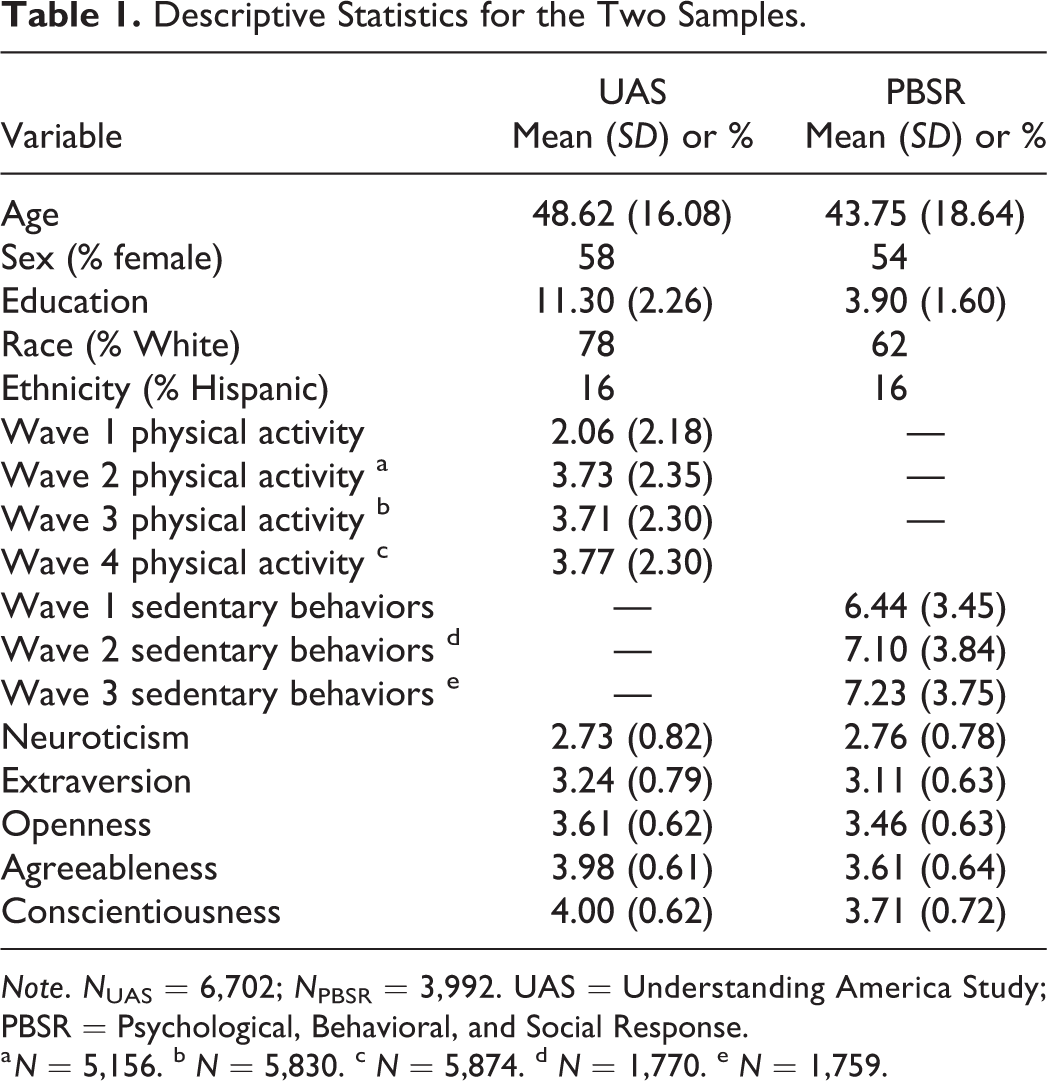
Descriptive statistics for the two samples are in Table 1. All data satisfied the criteria for parametric analysis (e.g., skewness below 2).
Descriptive Statistics for the Two Samples.
Note. N UAS = 6,702; N PBSR = 3,992. UAS = Understanding America Study; PBSR = Psychological, Behavioral, and Social Response.
a N = 5,156. b N = 5,830. c N = 5,874. d N = 1,770. e N = 1,759.
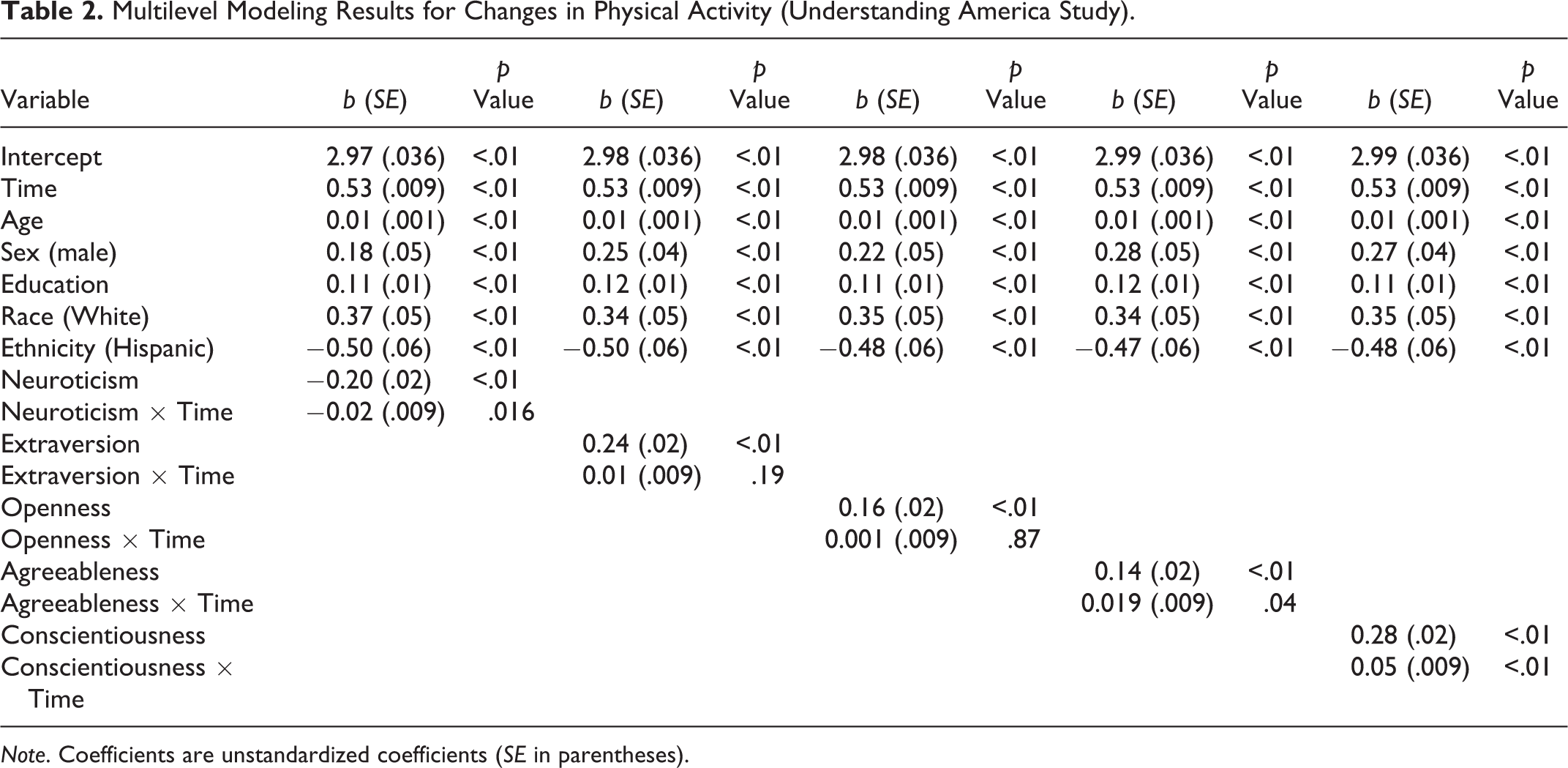
In the UAS, the average number of days of physical activity in the last week increased from about 2 days a week in early March to almost 4 days a week by the end of May (Table 1). The MLM analysis confirmed that this increase in physical activity during the pandemic was significant (Table 2). A quadratic term was added in an additional analysis, which revealed that physical activity followed a nonlinear trajectory and tended to plateau over time (b = −0.39, SE = .01, p < .001). Personality was associated with both the intercept and slope of physical activity. Consistent with the literature on personality and physical activity, higher neuroticism was related to a lower mean level of physical activity, whereas higher extraversion, openness, agreeableness, and conscientiousness were associated with a higher mean level of physical activity level (i.e., the association with the intercept). Consistent with the hypothesis, neuroticism was associated negatively with the slope of physical activity, whereas conscientiousness had a positive association with the slope; agreeableness was also positively associated with the slope (not hypothesized). These results suggested that higher neuroticism attenuated the increase in physical activity, whereas higher conscientiousness and agreeableness were related to a greater increase in physical activity over time (Table 2). Neither extraversion nor openness was related to the slope of physical activity.
Multilevel Modeling Results for Changes in Physical Activity (Understanding America Study).
Note. Coefficients are unstandardized coefficients (SE in parentheses).
In the PBSR, the number of hours spent being sedentary increased from about 6.5 hr/day before the pandemic to about 7.25 hr/day during the pandemic (Table 1). The MLM analysis confirmed that this increase in sedentary behavior was significant (Table 3). Further analysis revealed that sedentary behaviors followed a nonlinear trajectory, illustrated by an increase and a plateau (b = −0.19, SE = .08, p < .05). Consistent with the literature on personality and sedentary behavior, higher neuroticism was related to a higher mean level of sedentary behavior, whereas higher extraversion, agreeableness, and conscientiousness were related to a lower mean level of sedentary behavior. Openness was unrelated to the intercept of sedentary behavior. In contrast to the hypothesis, there was no association between any of the five traits and the slope of sedentary behavior (Table 3).
Multilevel Modeling Results for Changes in Sedentary Behaviors (Psychological, Behavioral, and Social Response Study).

Note. Coefficients are unstandardized coefficients (SE in parentheses).
Discussion
The present study examined the change in physical activity and sedentary behavior during the acute phase of the COVID-19 pandemic and tested whether personality traits were related to change in these behaviors. Both physical activity and sedentary behavior increased overall. Lower neuroticism and higher conscientiousness and agreeableness were associated with a greater increase in physical activity over time. Higher neuroticism and lower extraversion, agreeableness, and conscientiousness were also associated with average levels of sedentary behavior but not to change over time. These results extend recent findings on both changes in patterns of physical activity and sedentary behavior found in Europe to the United States, and the association between personality and precautionary behaviors (Aschwanden et al., in press; Blagov, 2020; Bogg & Milad, 2020) by showing that personality traits are also related to the adoption of health-related behaviors during the pandemic.
This study builds on preliminary evidence from Europe on changes in patterns of physical activity and sedentary behavior during the lockdown caused by the pandemic. Specifically, Cheval and colleagues (2020) found that engagement in vigorous physical activity declined and sedentary behavior increased during the pandemic, whereas moderate physical activity increased. Although UAS did not differentiate between moderate and vigorous physical activity, we found an increase in the average number of days that individuals exercised during the pandemic. The number of hours spent sedentary likewise increased. This pattern supports anecdotal evidence reported in the news that although gyms and other fitness centers were closed across the country during the lockdown, there has been an increase in the time spent outside, particularly walking around one’s neighborhood compared to before the pandemic (San Francisco Chronicle, 2020).
The relation between personality and physical activity in the present study was consistent with the larger literature in this area: Individuals higher in neuroticism tend to engage in less physical activity and more sedentary behavior, whereas individuals higher in conscientiousness, extraversion, and openness tend to be more active (Allen, Magee, et al., 2017; Allen, Walter, & McDermott, 2017; Rhodes & Smith, 2006; Sutin et al., 2016; Wilson & Dishman, 2015). In addition, the results support the link between conscientiousness and less sedentary behaviors (Allen, Walter, & McDermott, 2017). The present study adds that these basic associations replicate during the pandemic and that personality is associated with changes in physical activity across the pandemic. Again, consistent with the broader literature on personality and health, we found that lower neuroticism and higher conscientiousness were associated with a greater increase in physical activity.
There may be a number of reasons why neuroticism and conscientiousness were associated with changes in physical activity. Individuals higher in neuroticism, for example, express more concerns about the virus, including concerns about contracting COVID-19 (Aschwanden et al., in press; Bogg & Milad, 2020), and have experienced more negative affect during the crisis (Kroencke et al., 2020). These concerns and negative affect may lead individuals higher in neuroticism to avoid physical activity and outside environments that may have culminated in declines in physical activity. Individuals higher in conscientiousness, in contrast, have engaged in more preventative behavior to avoid catching the virus (Aschwanden et al., in press; Blagov, 2020; Bogg & Milad, 2020) and may be particularly likely to follow the physical activity guidelines during the COVID-19 crisis because of their propensity to comply with social norms (Jackson et al., 2010). Further, as the crisis constrained daily life, their self-discipline and organization may facilitate the ability and dedication to maintain an active lifestyle.
Some of the findings were surprising. For example, we did not expect agreeableness to be associated with either the baseline level of physical activity or increases in physical activity over time. This result is, in fact, in contrast to cross-sectional studies that find no association between agreeableness and physical activity and longitudinal studies that find agreeableness to be associated with decreases in physical activity over time (Allen et al., 2017). It is, however, consistent with recent findings that indicate that agreeableness predicts engagement in more precautions to reduce the risk of virus (Aschwanden et al., in press; Blagov, 2020; Bogg & Milad, 2020). Individuals high in agreeableness also want to get along well with others and close others that may compel them to engage in physical activity together, such as going for a walk. Individuals high in agreeableness may thus be both more likely to adhere to recommendations for physical activity and to maintain relationships with others.
It was likewise surprising that neither extraversion nor openness was related to change in physical activity. Both of these traits have been linked previously with greater engagement in physical activity (Sutin et al., 2016; Wilson & Dischman, 2015), and, in the present study, both traits were associated with higher average physical activity. Individuals high in extraversion tend to be active and vigorous (Armon & Shirom, 2011) and may derive a lot of enjoyment from physical activity (Courneya & Hellsten, 1998). These characteristics were true prior to the pandemic, and individuals high in extraversion may already have found their optimal level of activity. Further, individuals higher in openness engage in a variety of activities (Stephan et al., 2014), which may include physical activity during the pandemic but may also include greater engagement in other areas of interest (e.g., reading books, listening to podcasts, cooking new recipes).
The present study provides new evidence that personality predicts behavioral responses to the COVID-19 crisis. In addition to precautionary behaviors that both reduce the risk of contracting the virus and spreading it to other people (Aschwanden et al., in press; Blagov, 2020; Bogg & Milad, 2020), personality traits are associated with engagement in crucial health-related behaviors during the acute phase of the coronavirus crisis. This study has theoretical implications for existing models on personality and health (Friedman & Kern, 2014; Turiano et al., 2015). These models postulate that personality traits predispose individuals to engage in behaviors that contribute to their health over time. This study extends these models by showing that the association between personality and physical activity and sedentary behavior observed in nonpandemic times (e.g., Allen et al., 2017; Sutin et al., 2016) generalizes to the COVID-19 crisis.
The present study had several strengths that included a longitudinal design with repeated measures of physical activity and sedentary behaviors during the acute phase of the coronavirus crisis and an assessment of personality before the acute phase of the crisis in two large samples of adults. Both studies had adequate power to test the associations. Some limitations should also be considered. First, there were selection effects into the longitudinal assessments for both samples that may limit the generalizability of the findings. For example, in the PBSR, individuals with follow-up sedentary behaviors data had more adaptive personality profiles, characterized by lower neuroticism and higher conscientiousness, that lead to less sedentary behaviors. Second, the UAS did not have an assessment of physical activity using the same item prior to the pandemic. Therefore, this study examined the change in physical activity during the pandemic, and it was not possible to test whether the pandemic had an impact on usual patterns of physical activity. Third, this study relied on self-reported physical activity and sedentary behavior. More research using objective measures like accelerometer is needed. Finally, the data were collected in the acute phase of the pandemic in the United States. The patterns observed may or may not generalize to other countries or if the pandemic lingers.
In sum, this study provides further evidence for the role of personality for the prediction of behavioral responses to COVID-19 crisis. Higher neuroticism was related less physical activity and more sedentary behavior, whereas higher conscientiousness, agreeableness, and to a lesser extent higher extraversion and openness were related to more favorable patterns of physical activity during the acute phase of the coronavirus pandemic.
Footnotes
Declaration of Conflicting Interests
The author(s) declared no potential conflicts of interest with respect to the research, authorship, and/or publication of this article.
Funding
The author(s) received no financial support for the research, authorship, and/or publication of this article.
