



Abstract
Negative stereotypes about only children (OC) have caused widespread concern. However, relatively little is known about the accuracy of these stereotypes, especially regarding altruistic behaviors. In Study 1 (N = 337), participants rated the altruism of OC and non-only children (NOC) on three measurements on the basis of the participants’ perceptions. Results revealed that participants rated OC as less altruistic, and the stereotype primarily came from NOC raters. Results of Study 2 (N = 391) did not reveal any difference between OC and NOC in altruism. In Study 3 (N = 99), a social discounting task was applied to further investigate whether OC and NOC displayed different degrees of altruistic behavior toward various social distances. No differences were found among individuals at close or distant social distances. Ultimately, this research indicates that the negative stereotype regarding the altruistic behavior of OC is an incorrect prejudice.
Since the implementation of the one-child policy in 1979, China has become one among the countries with the largest numbers of only children (OC). In 2010, the total number of OC in China reached 145 million (Wang, 2013). Despite growing trends toward single-child families and numerous studies that revealed compelling evidence of OC’s strengths, negative stereotypes about OC persist (Blake, 1981; Mancillas, 2006, for a review). Specifically, OC are thought to be more narcissistic, depressive, and impulsive than non-only children (NOC; Dufner et al., 2020; Mõttus et al., 2008); they have been described as “little emperors” (Cameron et al., 2013). These stereotypes have ignited widespread concern among some people; however, relatively little is known about the accuracy of these stereotypes. Accurate information is critical if parents, educators, and governments are to make unbiased decisions. Therefore, this research aimed to examine a negative stereotype about OC and the accuracy of that stereotype.
Negative stereotypes about OC mainly revolve around the parents’ mode of upbringing and the lack of siblings. Generally, in OC families, these two factors have detrimental effects on the development of social behaviors (Veenhoven & Verkuyten, 1989). The belief is that the parents’ mode of upbringing in single-child families might offer inflated parental attention and protection, which could result in self-centered behaviors (Fan et al., 1994). Moreover, being deprived of siblings might mean that OC are not provided opportunities to learn social behaviors (Kitzmann et al., 2002; Van Lange et al., 1997).
Prior studies have investigated potential differences in personality traits (Stronge et al., 2019) and personal characteristics such as independence (Fan et al., 1994), confidence (Fan, 2016), life satisfaction (Shao et al., 2013), and narcissism (Cai et al., 2012; Dufner et al., 2020; Foster et al., 2020) between OC and NOC. However, few studies have examined the actual behavioral differences between OC and NOC. Cameron et al. (2013) have applied several economics experiments to investigate the effects of China’s one-child policy on society. They revealed that OC are less trusting and less trustworthy than NOC. Regarding their altruistic behavior toward strangers, no difference was found. Given that the behavioral differences between OC and NOC were absent from altruistic behavior, one might doubt that this pattern might be modulated by other variables. Social distance is one of the potential variables that can affect altruistic behaviors, given that individuals are more willing to share with others they perceived to be socially closer (Harrison et al., 2011; Jones & Rachlin, 2006).
The mode of parenting in an OC family is likely to result in a more positive or closer parent–child relationship, which might lead OC to be more altruistic (as opposed to selfish) toward close others (e.g., parents), compared with NOC. For example, accumulated evidence has demonstrated that OC have closer and more positive relationships with their parents (Falbo & Polit, 1986; Polit & Falbo, 1987); OC also receive more emotional warmth from their parents (Someya et al., 1999) compared with NOC. Recent research using Chinese samples has also confirmed this pattern (Liu & Jiang, 2021).
Existing studies have failed to provide direct supporting evidence to confirm the accuracy of the stereotype regarding the altruistic behaviors of OC. Mõttus et al. (2008) have investigated the accuracy of OC stereotypes by using the Revised NEO Personality Inventory (NEO-PI-R). They found that participants perceived an incorrect stereotype about the altruism of OC, one which did not reflect the actual personality of OC. However, their results should be interpreted cautiously. First, the study used a small sample; only 24 OC were included in the study, which may have resulted in low statistical power. Second, the study employed a self-reported scale to investigate altruism, which measured selflessness and concern for others (Costa et al., 1991) rather than actual altruistic behaviors, that is, “costly acts that confer economic benefits on other individuals” (Fehr & Fischbacher, 2003). Third, their research was organized in Europe. One should be cautious about generalizing the study’s results to China. The implementation of the one-child policy may compel us to look forward to a different outcome. Fourth, the study did not control for potential covariates that might bias the conclusions. For example, age (Gong et al., 2019; Pornpattananangkul et al., 2017), gender (Engel, 2011), socioeconomic status (SES; Benenson et al., 2007), area of upbringing (Ma et al., 2015), and educational level (Ogawa & Ida, 2015) can all affect altruistic behavior. Given these limitations, concluding whether the stereotype regarding the altruistic behavior of OC has truly been disproven is difficult. The current research applied a self-rated scale and behavioral experiments to investigate the potential differences in altruistic behavior between OC and NOC to further explore the accuracy of the stereotype.
Current Research
The purpose of this study was to test the accuracy of the negative stereotype about the altruistic behaviors of OC. In Study 1, the prevalence of the stereotype by which OC are considered to be less altruistic than NOC was measured. In Study 2, the behavioral differences were measured. In Study 3, two groups’ altruistic behaviors toward individuals were further tested at different social distances. All the covariates mentioned above that may affect altruistic behaviors were controlled in Studies 2 and 3. Educational level was not controlled for in Study 3 because all participants were university students.
Study 1
In Study 1, the goal was to measure the prevalence of a negative stereotype about OC, by which OC are considered to be more selfish than NOC. According to the study of Dufner et al. (2020), the stereotype became more salient when the raters are NOC. Hence, with the raters’ OC status in mind, we investigated whether the stereotype is more salient when the raters come from the NOC group.
Method
Participants
Based on the estimation of G*power Version 3.1 (Faul et al., 2007), a sample of 327 participants was enough to detect a small effect size (d = 0.2) with a two-tailed t test (α level at .05, 1 – β at .95, paired group). For this study, 409 participants nationwide completed the research online via Questionnaire Star (https://www.wjx.cn). All participants were recruited through an Internet bulletin board system. All participants were compensated with 5 Yuan (about US$0.77). Ultimately, 72 participants were dropped because they failed the attention check question. Hence, the final sample comprised 337 participants (117 males; 112 OC; mean age 28.20 ± 10.26). Among the NOC, 46.2% had one sibling, 26.7% had two siblings, 10.7% had three siblings, and 16.4% had four or more siblings. All the data and syntaxes of our studies can be seen at https://osf.io/shu4n/?view_only=3ebc8a6634b342169c92dfed94b3e608.
Procedure and Measures
Prior to entering the study, participants were informed that this study was being launched to test the general public’s views about OC and NOC. The participants were required to finish the following measurements:
Philosophies of Human Nature Scale (PHNS)
To test people’s general view of the altruism of OC, six revised items from the Altruism subscale of the Chinese version of PHNS (Wang et al., 1999) were presented to the participants. Participants indicated to what extent each statement could be used to describe a typical OC and a typical NOC on a 6-point Likert-type scale (1 = strongly disagree; 6 = strongly agree). Higher scores indicated that the rater thought the group to be more altruistic. Reliabilities for estimations of OC and NOC were α = .64, and α = .60, respectively.
Dictator game (DG)
To test people’s perspectives of the behaviors of OC and NOC, a variation of the DG was applied. Participants were asked to judge how much of an endowment of RMB 200 (about US$30.7) another player would be willing to share with them when a typical OC or NOC, respectively, played the role of the dictator. The money in this task was hypothetical; participants did not receive any money from playing the DG. To ensure understanding of the task, an additional attention check task was applied before the DG: Suppose the receiver has RMB 200. After giving you RMB 120, how much money do the other and you have, respectively? The correct answers were 80 and 120. If an answer was incorrect, then the data of this participant were dropped.
Social value orientation (SVO)
The final measure of altruism in this study was an item from the SVO task (Van Lange et al., 1997), which was used to test the preference for the distribution of benefits for oneself and others. The original SVO contains nine items: Each item has three options that involve deciding for oneself and another person (i.e., 480 points for oneself and 480 points for the other). Option A represents prosocial orientation, Option B represents individualistic orientation, and Option C represents competitive orientation. One item was extracted from the original SVO to ask participants to judge how a typical OC and NOC would choose from these three options.
Results
First, we analyzed whether participants viewed OC and NOC differently on the PHNS, DG, and SVO, respectively. Participants gave a higher rating to NOC in the PHNS, t(336) = 5.64, p < .001, d = .31, 95% CI = [0.20, 0.42], and in the DG, t(336) = 2.53, p = .012, d = .14, 95% CI = [0.031, 0.25] (Figure 1, top panel). For the SVO, a binary dummy variable was created: 0 = prosocial choice (Option A), 1 = non-prosocial choice (Options B and C). A McNemar χ2 test was applied to test the paired data (Adedokun & Burgess, 2011). Ultimately, 184 participants (54.6%) believed that a typical OC is prosocially oriented; meanwhile, 236 participants (70.0%) believed that a typical NOC is prosocially oriented, McNemar χ2 (1, N = 337) = 20.98, p < .001. Thus, in all three altruistic indicators, OC were thought to be less altruistic than NOC.

Estimations of altruism for only children (OC) and non-only children (NOC) as measured by the dictator game (DG) and Philosophies of Human Nature Scale (PHNS) by all raters (top panel: A and B) and by OC and NOC raters (bottom panel: C and D). Note. Error bars represent 95% confidence intervals.
Next, the data were analyzed according to the raters’ OC status. The NOC raters considered the OC to be less altruistic in the PHNS, t(224) = 6.80, p < .01, d = .46, 95% CI = [0.32, 0.60], and in the DG, t(224) = 3.27, p = .001, d = .22, 95% CI = [0.09, 0.35]. For the SVO, the same tendency was observed: 161 participants (71.6%) thought that a typical NOC is prosocially oriented, whereas 105 participants (46.7%) thought a typical OC is prosocially oriented, McNemar χ2 (1, N = 225) = 35.17, p < .001. However, when we focused on the OC raters, no differences were found: for the PHNS, t(111) = 0.24, p = .81, d = .02, 95% CI = [−0.16, 0.21]; for the DG, t(111) = 1.34, p = .182, d = −.13, 95% CI = [−0.31, 0.06]. For the SVO, 79 participants (70.5%) thought a typical OC is prosocially oriented, whereas 75 participants (67%) thought a typical NOC is prosocially oriented, McNemar χ2 (1, N = 112) = .237, p = .626. Accordingly, NOC raters tended to assess OC as being less prosocial than NOC; conversely, OC raters saw OC and NOC as equally altruistic.
Finally, we separately adopted two 2 (between factor: raters are OC or NOC) × 2 (within factor: rating targets are OC or NOC) analysis of variance for the PHNS and DG. The interaction effect was significant for the PHNS, F(1, 335) = 14.22, p < .001,
Study 2
This study aimed to investigate the potential differences in altruistic behavior between OC and NOC. Study 2 used the measures identical to those used in Study 1, and the only difference was that these measurements were employed to test the altruism of OC and NOC. All participants completed this study on the same platform as Study 1, and they all received 5 Yuan (about US$0.77) as compensation.
Method
Sample and Measures
For Study 2,509 participants completed our questionnaires; 118 participants were dropped because they failed the attention check question. The final sample, therefore, comprised 391 participants (221 males; 169 OC; mean age 23.63 ± 5.57). Based on the estimation of G*Power, this sample size was sufficient to obtain an effect size of magnitude of d = .31 with a power of 91.8% (one-tailed t test, independent groups, α = .05). We collected the SES, education level, gender, age, and the upbringing area as covariates. Reliabilities of the PHNS for OC were α = .77 and for NOC children were α = .75.
Results
First, several one-tailed t tests were used to investigate whether OC are less altruistic than NOC. The results revealed that, for all three of our indicators, there were no differences between OC and NOC: for the PHNS, t(389) = −0.23, p = .41, d = −.02, 95% CI = [−0.22, 0.18]; for the DG, t(389) = −0.85, p = .20, d = −.09, 95% CI = [−0.29, 0.11] (see Figure 2). For the SVO, χ2 (1, N = 391) = .14, p = .71, which means that OC status did not influence participants’ prosocial orientation. All three indicators failed to reach significance, indicating that OC were not found to be less altruistic than NOC.
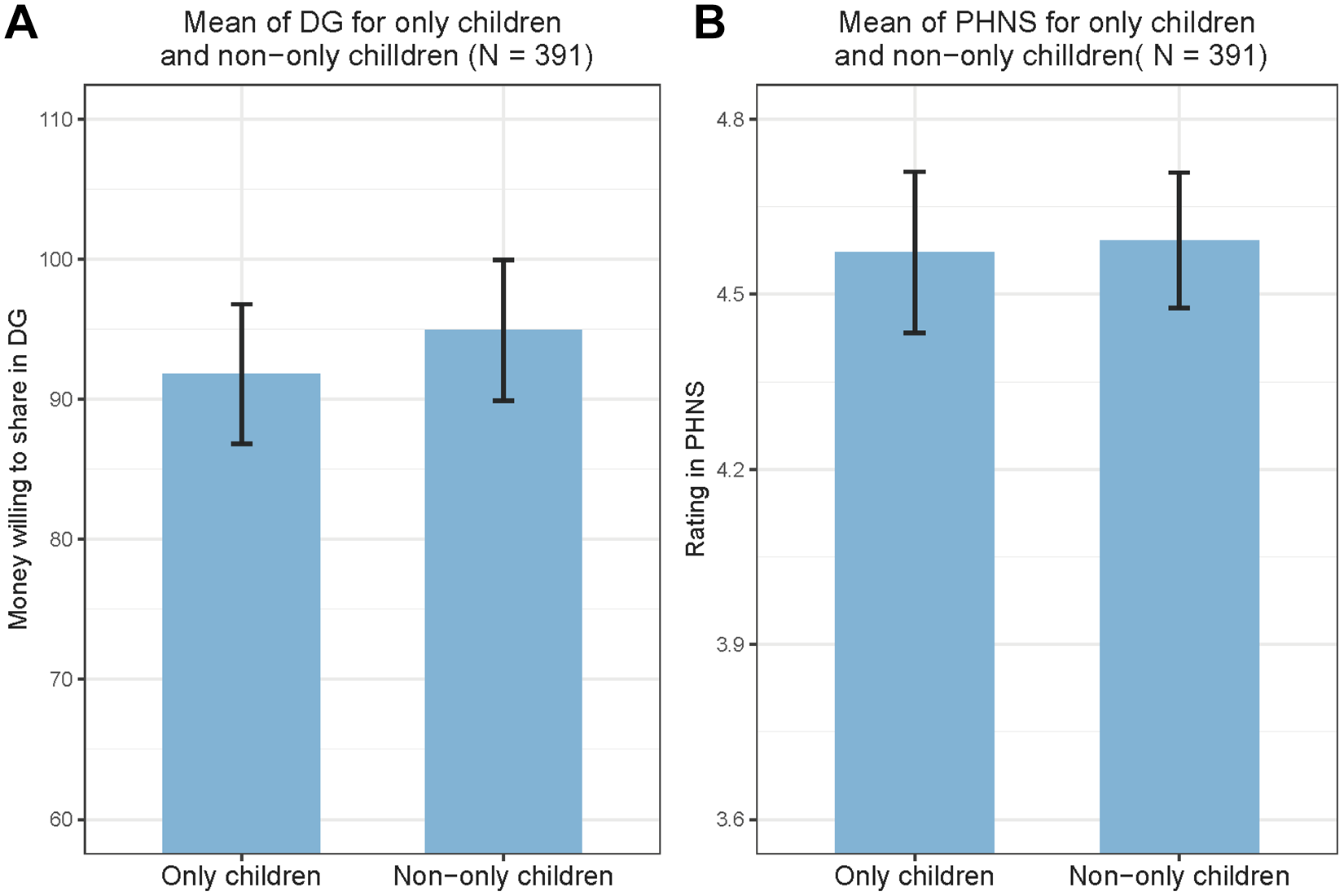
Raw means of altruism of only children and non-only children as measured by the dictator game (DG; the higher the money sharing is, the higher the degree of altruism is) and Philosophies of Human Nature Scale (PHNS; the higher the scoring is, the higher the degree of altruism is). Note. Error bars represent 95% confidence intervals.
Second, we tested whether OC are less altruistic than NOC after controlling for all the covariates. For the PHNS, OC were not found to be less altruistic than NOC, F(1, 384) = .015, p = .90,
Finally, several Bayesian inferential t tests were applied in JASP (Version 0.14.1; JASP Team, 2020) to test the ratio of the strength of the null hypothesis (H0) to that of the alternative hypothesis (H1). The null hypothesis claimed that OC are not less altruistic than NOC; conversely, the alternative hypothesis claimed that OC are less altruistic than NOC. The prior was set as .31 for PHNS and .14 for DG. For the PHNS, the Bayes factor (BF) BF+0 was 0.286, which means the probability of our data supporting H1 was less than 3.5 times that of the data supporting H0. For the DG, the BF+0 was 0.823, which means that the evidence is insensitive. However, as Supplemental Figure S4 shows, the most prior set shows strong evidence for the H0. A BF ranging from 0.33 to 3 is considered to be inconclusive (Dienes, 2014). Therefore, this study convincingly indicates that OC are not less altruistic than NOC.
Study 3
This study employed the social discounting task to investigate the altruistic behaviors of OC and NOC toward people of various social distances (Jones & Rachlin, 2006; Rachlin & Jones, 2008). The validity of social discounting in identifying altruistic behaviors has been proven, indicating that social discounting is related to individuals’ actual altruistic behaviors (Bradstreet et al., 2012; Vekaria et al., 2017), such as kidney donation (Vekaria et al., 2017) and smoking cessation in the interest of their baby during pregnancy (Bradstreet et al., 2012), and to self-reported pro-social behaviors (Böckler et al., 2018).
Method
Experimental Design
The experimental procedure followed those of previous studies (Ma et al., 2015; Strombach et al., 2014; Wu et al., 2019), all of which applied social discounting to Chinese participants. The task was presented in PsychoPy3 (Peirce et al., 2019). In the social discounting task, participants were instructed to seriously consider their social environment and to identify seven target individuals ranging from social distance 1 (closest) to social distance 100 (farthest). Target individuals were defined as being at the following social distances: 1, 2, 5, 10, 20, 50, and 100. As per Wu et al.’s (2019) study, participants were required to list the names of people at social distances of 1, 2, 5, 10, 20, and those people’s relationship with the participant. This was not done for social distances 50 and 100 (only acquaintances or strangers). All social distances were displayed on a ratio scale and transformed into a scale containing 101 icons. The leftmost icon symbolized the participant themselves. The yellow icon symbolized a target person at a certain social distance, which was indicated by a number (1, 2, 5, 10, 20, 50, and 100) above the icons across the blocks (see Figure 3).

In the social discounting task, participants were asked to choose between a selfish and a generous option. Note. The selfish option was adjusted across trials, from RMB 290 to RMB 130, in nine increments of RMB 20. The generous option was kept constant across trials; the participant and a specific person received RMB 130; the social distance of the other person varied across blocks. A total of 63 (7 social distance × 9 choices) trials were presented to participants.
For every trial, participants had to decide whether they would be willing to keep an amount of money for themselves (selfish option) or share it with another person (generous option).
Participation fees comprised 12 Yuan and an additional compensation, depending on their choice. Specifically, 5% of a randomly chosen trial actual amount(s) was paid out. If the generous option was chosen, the participant and the Nth individual would receive the money via “Alipay” or “WeChat pay,” both of which are popular mobile wallet applications in China. The social distances 50 and 100 were substituted for a random person in the building or at the school.
Participants
Participants were all recruited from a Chinese university; 118 participants completed the study. All participants provided written informed consent. A total of 19 participants were dropped because of their choice inconsistency. The final sample comprised 99 participants (30 men), including 43 OC with an average age of 20.28 years (SD = 2.42) and 56 NOC with an average age of 19.34 years (SD = 2.16). The G*Power showed that the sample size allows us to detect an effect size of magnitude of d = .51 with a power of 80% (one-tailed t test, independent groups, α = .05). All respondents received monetary compensation for participating.
Data Analysis
Based on the previous studies, generosity declines across social distance following a hyperbolic function (Jones & Rachlin, 2006; Rachlin & Jones, 2008) as follows:

where N is the social distance, parameter v is the amount forgone at a given social distance, V represents the generosity to close social distances (Wu et al., 2019), which equals the amount forgone when N = 0. Parameter V determines the height of the function curve. Parameter s manifests the discounting rate, that is, the degree to which the amount forgone v decreases as a function of social distance. Parameter s determines the steepness of the discounting curve.
On the basis of previous studies, logistic regression was applied to calculate the indifference point for each social distance, at which the statistical probabilities of choosing the selfish option and the generous option were equal to 50%. If a participants’ choice shifted from the generous option to the selfish option and back to the generous option, and vice versa, then their data cannot be analyzed because this pattern failed to identify an indifference point at that social distance (Vekaria et al., 2017). If participants exclusively chose the selfish or generous option at a specific social distance, their indifference point was determined to be RMB 120 or RMB 300, respectively. In this experiment, 130 (the amount participants would benefit from choosing the generous option) was subtracted from the indifference point to serve as the amount willing to be forgone v. This was used to investigate how generosity declines as the social distance increases. More succinctly, if a participant was indifferent between the options of keeping RMB 230 for themselves or benefiting both themselves and another person RMB 130, this participant was willing to forgo RMB 100 (230–130) in the interest of another person’s RMB 130. A greater amount of money forgone indicated a higher level of altruistic behavior.
Two t tests were used to investigate the differences of two free parameters, V and s, across groups. In addition, an analysis of covariance (ANCOVA) was applied to test the differences of the amounts forgone between groups at various social distances while controlling for covariates (gender, age, area of upbringing, and SES).
Finally, a model-free approach was applied to thoroughly analyze the discounting data due to the nonparametrically distributed discounting rate. Specifically, the area under the curve (AUC) was individually calculated for every participant. The AUC was calculated by normalizing the amount participants were willing to forgo v as a percentage of maximum v, normalizing N as a percentage of maximum N, connecting the amount of money participants were willing to forgo using a straight line, and summing the trapezoids thus formed (Myerson et al., 2001; Vekaria et al., 2017). The AUC varied from 0 (no discounting) to 1 (extreme discounting). A one-tailed t test was used to compare the group difference.
Results
Generosity Declines With Social Distance
Equation ( 1) was fitted to each group separately (Figure 4, left panel). The discounting rate of OC was s = .086 (V = 184.97, R 2 = .982, Akaike information criterion [AIC] = 54.7), whereas the discounting rate of NOC was s = .090 (V = 169.17, R 2 = .994, AIC = 44.6), indicating a good fit for both groups.
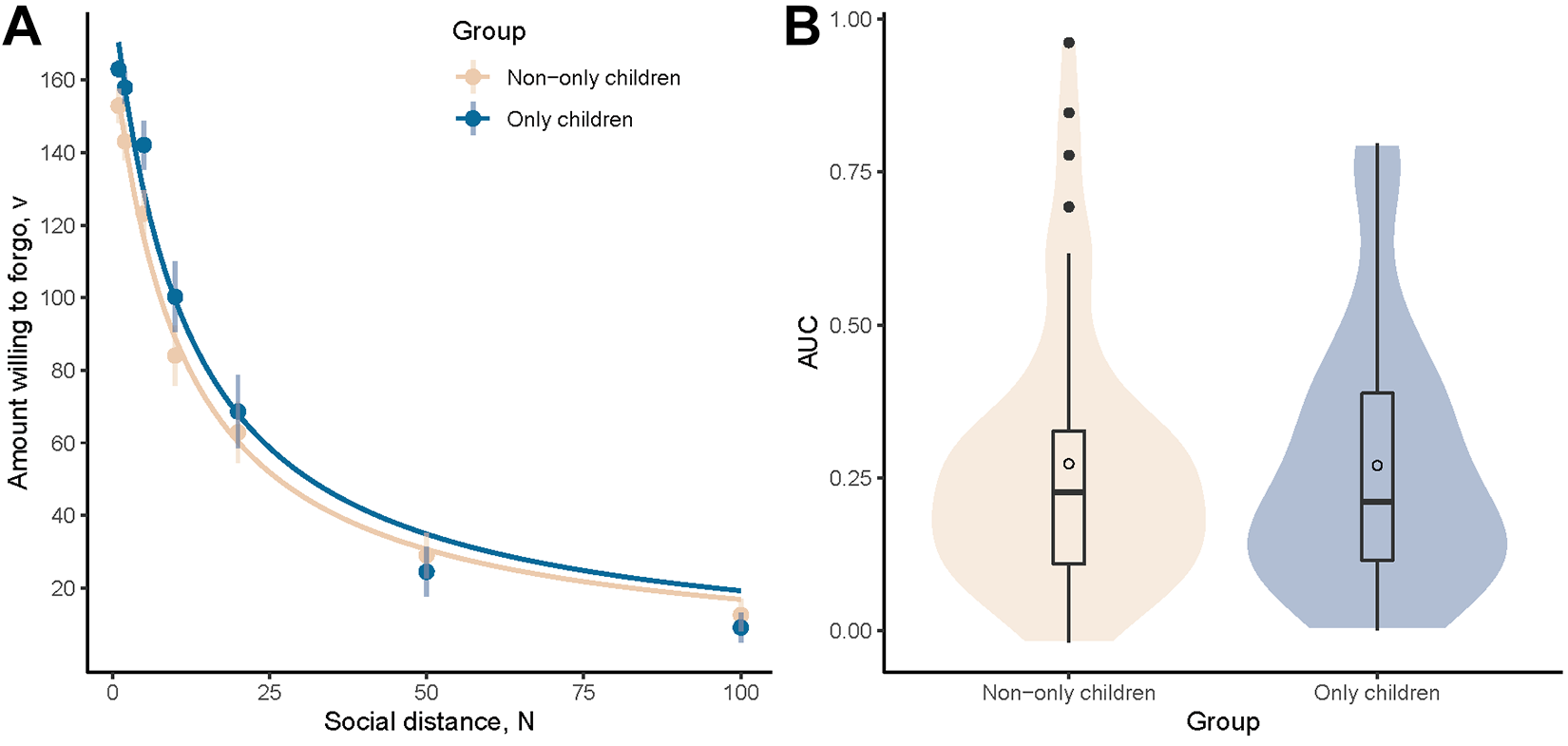
Social discounting and area under the curve (AUC) for only children (OC) and non-only children (NOC) groups. Note. In A, the mean amount of money participants were willing to forgo for each social distance was used to fit a standard hyperbolic function. The lines describe the OC and NOC discounting functions separately; both revealed that generosity declined in line with increasing social distance. Error bars represent the standard errors of the mean. In B, the AUC is a model-free index of generosity, presented in the box-whisker contours. The band represents the median AUC, and the hollow point represents the mean AUC. The boxes represent the third (top) and first (bottom) quartiles, and the shaped areas describe the relative percentage (frequency) of individuals with corresponding AUC values.
Discounting Results
First, two free parameters, V and s, were compared between groups. The results of one-tailed t tests revealed that neither s, OC: M = 0.21, SD = 0.29; NOC: M = 0.26, SD = 0.38; t(97) = 0.69, p = .75, d = .14, 95% CI = [−0.26, 0.54], nor V, OC: M = 211.67, SD = 48.10; NOC: M = 205.49, SD = 78.89; t(97) = −0.45, p = .67, d = −.09, 95% CI = [−0.49, 0.31], reached significance between OC and NOC.
Next, a 2(between factor: OC status) × 7(within factor: social distance) ANCOVA was applied, with the average amount forgone v as the dependent variable, while controlling for all covariates. The interaction effect between OC status and social distance was insignificant, F(6, 558) = .72, p = .63. No significant difference was found between OC and NOC in the average amount forgone, either at close social distances (1, 2, 5, and 10) or distant social distances (20, 50, and 100).
Finally, the AUC results again revealed that no difference existed between the two groups (Figure 4, right panel), t(97) = 0.07, p = .47, d = .01, 95% CI = [−0.38, 0.41]; OC: mean AUC = 0.27, SD = 0.21; NOC: mean AUC = 0.27, SD = 0.21.
General Discussion
Three studies were applied to evaluate the presence and accuracy of a stereotype that holds that OC are less altruistic than NOC. The overall results illustrated that this stereotype is prevalent and primarily comes from NOC. However, observed altruistic behaviors showed no difference between OC and NOC for various social distances. Thus, the stereotype about OC is groundless.
The results of Study 1 are consistent with previous studies that revealed that people hold negative stereotypes about OC (Dufner et al., 2020; Mancillas, 2006; Mõttus et al., 2008). This research complements these existing studies by finding that the stereotype extends beyond the personality traits to encompass the behaviors of OC as well. Altruistic behaviors are socially favorable, reflecting a good reputation (Hardy et al., 2006). Thus, the in-group would be expected to pursue superiority over the out-group in the evaluation of behaviors through social comparisons (Tajfel & Tuner, 1986). That is, NOC see OC as a separate social group; out-group stereotypes are present when in-group identity is salient (Wilder & Shapiro, 1991). This is confirmed by the data in this research. In Study 1, the OC targets were rated similarly by OC and NOC raters on PHNS. However, NOC targets were rated significantly higher by NOC raters than by OC raters; NOC’s rating to NOC was also significantly higher than their rating to OC. A combination of these results indicated that NOC were overvaluing their group (i.e., NOC) in the social comparisons.
Another plausible explanation is that NOC overemphasized the influence of family factors on the development of the altruistic behaviors of OC. Many factors impact the development of an individual (Bronfenbrenner, 1979, 2005; Bronfenbrenner & Morris, 2007). However, NOC may evaluate OC from an unvarying perspective that focuses solely on specific environmental factors or characteristics such as parenting or the absence of siblings.
The results of Study 2 are in agreement with previous studies (Cameron et al., 2013; Polit & Falbo, 1987), which indicated that OC are not less altruistic than NOC. Combining the results of Studies 1 and 2, we concluded that the prevalent stereotype about the altruistic behavior of OC might be erroneous. The results of this study strengthen the conclusions of previous literature by indicating that OC status neither affects the development of personality traits (Mõttus et al., 2008; Polit & Falbo, 1987) nor influences altruistic behavior. Cameron et al. (2013) found that OC and NOC differ in several behaviors but not in altruistic behaviors. The participants of Cameron et al. (2013) were born just before or after the implementation of the one-child policy. As such, the policy’s effect on the participants of our studies might fundamentally differ from the effect on the participants of Cameron et al.’s (2013) study. Nonetheless, our results corroborate with Cameron et al.’s (2003) study, thereby providing strong evidence that OC status might have minimal or no effect on altruistic behaviors. However, the results of this study cannot be generalized to other social behaviors.
The results of Study 3 expand previous studies by indicating that being an OC might have minimal or no impact on altruistic behaviors toward various social distances. This finding did not support the hypothesis that OC would be more altruistic than NOC toward close others. Material provision for parents is one of the behaviors that represent filial piety (Zhan & Montgomery, 2003); the more one shares, the more filial one is. Filial piety is an indispensable component of Confucianism, which describes how children should take care of their parents (Yeh & Bedford, 2003). The prevalent emphasis on filial piety in Chinese culture, as phrased by the traditional proverb, “Among all the good deeds, filial piety comes first” (Li et al., 2016), might lead children (regardless of OC or NOC) to show a strong sense of filial piety to parents or grandparents. For example, Deutsch (2006) found that OC are as likely to plan to help their parents as NOC. However, the results of this study might be contaminated by the ceiling effect. Specifically, filial piety might lead everyone to give the same amount of money to their parents or close others when the cost is low, but this might not remain true when the cost is high.
The results of this study have some important implications. First, OC are becoming more prevalent across many countries, following the overall decreasing fertility rate worldwide (United Nations, 2019). The existence of negative stereotypes may make the stereotype more tenable in the views of others and even as a self-characterization (Steele, 1997; Steele & Aronson, 1995). Therefore, overcoming these stereotypes is of immediate interest. Second, to the best of our knowledge, this is the first study to investigate the altruistic behavior of OC at various social distances, which strengthens the understanding of OC’s behaviors and provides more convincing evidence to overthrow the false stereotype(s).
Some limitations should be noted. First, raters’ SES and other psychosocial factors in Study 1 might affect raters’ judgments about OC or NOC. However, we underexploited these in the research. Future research should pay more attention to the role of these factors in the formation of stereotypes. Second, the samples in Studies 2 and 3 were relatively small. In addition, the participants might lack representativeness, especially in Study 3, where the participants were all university students. Future studies could recruit more representative samples and contain a larger sample size. Ultimately, this research was conducted in China, where the one-child policy has had a broad and profound impact. Therefore, our results cannot be generalized to other contexts entirely.
This research reveals that the negative stereotype about the altruistic behaviors of OC is flawed. The observed altruistic behaviors of OC and NOC are indistinguishable, concerning close others and distant others. However, people falsely believe that OC are less altruistic than NOC.
Supplemental Material
Supplemental Material, sj-docx-1-spp-10.1177_19485506211038190 - They Are Not Little Emperors: Only Children Are Just as Altruistic as Non-Only Children
Supplemental Material, sj-docx-1-spp-10.1177_19485506211038190 for They Are Not Little Emperors: Only Children Are Just as Altruistic as Non-Only Children by Xuegang Zheng, Qianru Su, Changyu Jing and Yang-Yang Zhang in Social Psychological and Personality Science
Footnotes
Acknowledgments
The authors would like to thank the editor and two anonymous reviewers for their constructive suggestions. We also thank people who contribute their time and energy for this work.

Declaration of Conflicting Interests
The authors declared no potential conflicts of interest to the research, authorship, and/or publication of this article.
Funding
The author(s) disclosed receipt of the following financial support for the research, authorship, and/or publication of this article: This work is supported by the National Natural Science Foundation of China (71701117) and the Youth Innovation Team of Shaanxi Universities (2020084).
Supplemental Material
The supplemental material is available in the online version of the article.
References
Supplementary Material
Please find the following supplemental material available below.
For Open Access articles published under a Creative Commons License, all supplemental material carries the same license as the article it is associated with.
For non-Open Access articles published, all supplemental material carries a non-exclusive license, and permission requests for re-use of supplemental material or any part of supplemental material shall be sent directly to the copyright owner as specified in the copyright notice associated with the article.
