



Abstract
COVID-19 has been characterized by unprecedented levels of public gratitude to some, but not all, essential workers. In this research, we integrate insights from the stigmatized occupations and gratitude literature to build theory on the positive and negative relationships between such displays of public gratitude and essential workers’ recovery activities. We argue that felt public gratitude positively relates to adaptive recovery activities (e.g., exercise) and negatively relates to maladaptive recovery activities (e.g., overdrinking). We further explain how felt public gratitude impacts (mal)adaptive recovery activities through (a) felt invisibility and (b) negative/positive affect. We find support for our predictions in a two-wave survey of 186 corrections officers (Study 1) and an experiment with 379 essential workers across a variety of industries (Study 2).
We’re doing 3 times the amount of work and feel more unappreciated than before this virus [. . .] Sometimes I question why I’m still an Officer [. . .] (Corrections officer; May 16, 2020) For the first time, [. . .] from the patients, from families, from management, from random people on the street [. . .] (they) stopped to say thank you [. . .] it just re-energizes you. (Nurse [Triomphe, May 20, 2020])
Although remote work became “the new normal” for many workers during the coronavirus (COVID-19) pandemic (Gurchiek, 2021), essential workers (i.e., “those who conduct a range of operations and services that are typically essential to continue critical infrastructure operations” [U.S. Department of Homeland Security, 2020]) risked their health each day, which elevated their visibility and importance in the eyes of the general public. Indeed, many essential personnel who were previously unappreciated and marginalized by the public (e.g., grocery store clerks) prior to the pandemic (Ashforth & Kreiner, 1999) were suddenly viewed as critical to the functioning of society and received outpourings of gratitude. However, such displays of gratitude were not felt equally by all essential workers. While some felt seen and valued by the public, others felt even more forgotten and unappreciated, leading them to question whether they are really “essential,” or instead “sacrificial” (Gidia, 2020).
To understand how and why these expressions matter, we examine the effects of felt public gratitude (i.e., the worker’s experience that the general public has “expressed a feeling of thankfulness” [Lee et al., 2019, p. 199] for their efforts) on essential workers’ recovery activities outside of work. We propose that felt public gratitude is negatively associated with felt invisibility, which (a) positively relates to negative affect and maladaptive recovery activities (e.g., overdrinking) and (b) negatively relates to positive affect and adaptive recovery activities (e.g., exercise) (see Figure 1). Results of a multi-wave survey study of corrections officers (henceforth called “COs”) in the United States (Study 1) and a field experiment with an expanded set of essential workers in English-speaking countries (e.g., Canada, UK, USA; Study 2) support our predictions.
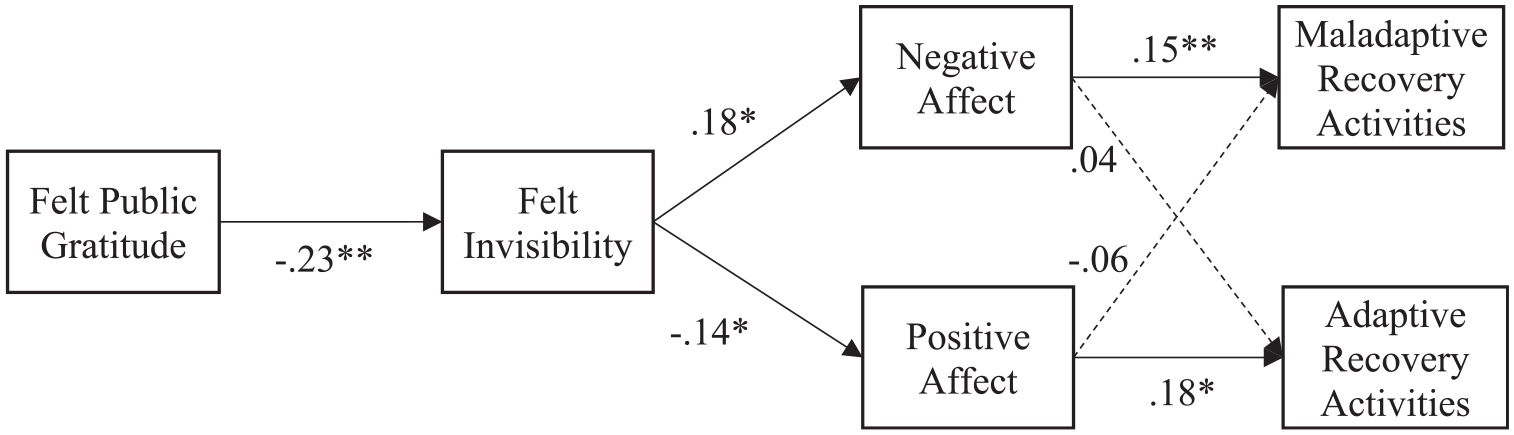
Study 1: Summary of Path Analyses.
This research makes several contributions. First, because recovery activities at home affect job performance (Fritz & Sonnentag, 2005) and well-being (Sonnentag et al., 2017), examining how they relate to felt public gratitude makes this research critical to sustaining our essential personnel. The elevated job stress essential workers endure—from increased workload, understaffing, and hazardous working conditions, among others—underscores the importance of identifying the psychological mechanisms that explain why public gratitude (or lack thereof) may mitigate (or exacerbate) the negative impact of the COVID-19 pandemic on these workers. Second, although we know that gratitude from direct beneficiaries affects the recipient’s engagement in prosocial behaviors and even family life (Grant & Gino, 2010; Lee et al., 2019; Tang et al., 2021) and expressing gratitude positively relates to the expresser’s well-being (Emmons & Shelton, 2002), we know less about how receiving gratitude—and particularly gratitude from the general public who may or may not be directly impacted by the gratitude recipient’s efforts—relates to the recipient’s own well-being (e.g., recovery activities). Third, extant literature has largely focused on how gratitude relates to positive outcomes (e.g., helping, work engagement) (Grant & Gino, 2010; Lee et al., 2019), but we examine how both negative (i.e., felt invisibility, negative affect, maladaptive recovery activities) and positive outcomes (i.e., positive affect, adaptive recovery activities) relate to felt gratitude. In doing so, we seek to paint a more complete picture of the theoretical and practical implications of felt gratitude.
Essential Workers During the COVID-19 Pandemic
A salient feature of many essential workers is that they are often unappreciated and marginalized by the general public. Much of the work performed by essential workers (e.g., COs, meat processing plant workers) is considered “physically, socially, or morally beneath the dignity of the profession” (Hughes, 1958, p. 122). Workers in these occupations routinely experience devaluing interactions with the public (e.g., Dutton et al., 2016; Henslin, 1974; Rabelo & Mahalingam, 2019), which often involve non-actions that “deny both a person’s existence and sense of worth” (Dutton et al., 2016, p. 18). Research on the work experience of custodians (Dutton et al., 2016; Rabelo & Mahalingam, 2019) and taxicab drivers (Henslin, 1974) uniformly indicates that it is the general public’s act of disregard or obliviousness of the workers’ presence, rather than more overt displays of disrespect, that constitutes the most common form of devaluing acts (Dutton et al., 2016). These devaluing acts—which workers interpret as indicating that they are not worthy of recognition and appreciation—create feelings of invisibility, undermining people’s fundamental desire to belong (Baumeister & Leary, 1995) and feel valued (Cunningham et al., 2020; Mead, 1934).
Felt invisibility, or the feeling that one is “not seen or are treated as though they cannot be seen” (Rabelo & Mahalingam, 2019, p. 104), is a distressing experience with affective and behavioral consequences (Baldwin, 1911). Essential workers are particularly subject to felt invisibility because of society’s derogatory perceptions of their work. While it is true that such occupations often have strong and highly identified occupational subcultures (Ashforth & Kreiner, 1999) that provide affirmation to the workers (Tajfel & Turner, 1979), this does not negate the impact of the general public (i.e., “outsiders”). In fact, essential workers should be especially affected when outsiders provide a positive view of their work because such sentiments are unexpected (Ashforth & Kreiner, 1999). For the general public, showing gratitude is a simple way to express positive feelings about essential workers.
Yet, while displays of gratitude are intended to signal to workers that their efforts are seen and that they matter (Emmons & McCullough, 2004; Sawyer et al., 2021), they can also bring about unintended consequences, especially among those who are (inadvertently) excluded from expressions of public gratitude. Indeed, during the COVID-19 pandemic, only a select group of essential workers have been given media and public attention, while many were not (see opening quotes). Due to the salient disparity in the allocation of attention and gratitude across essential workers—with some capturing most of the attention and the remaining others receiving none or very little of it—we propose that the relationship between felt gratitude and felt invisibility will be particularly prominent during the COVID-19 pandemic. The workers who are recognized and appreciated during the pandemic are likely to feel particularly more visible, whereas those who are excluded from appreciation are likely to feel more invisible due to the uneven distribution of public gratitude (Ashforth & Kreiner, 1999).
Felt Invisibility, Affect, and Recovery Activities
Workers who perceive that their work is invisible (Hatton, 2017) feel the indignity associated with being “non-personed,” contributing to the experience of diminished social worth. Reflecting the distress it creates, we propose that felt invisibility will positively relate to negative affect, which taxes self-regulation (Rosen et al., 2016; Tice et al., 2004) and thereby affects the activities workers choose to counteract the strain caused by job stressors (Sonnentag et al., 2017). Negative affect at work has undesirable spillover effects at home, such as unhealthy eating (Liu et al., 2017) and greater alcohol consumption (Sayre et al., 2020). When workers experience emotional distress, they focus on alleviating this negative state as quickly as possible, even if it comes at the expense of future-oriented goals (Tice et al., 2004). Thus, workers will engage in activities that are mood-altering in the short term, but likely lead to long-term harm (see Milkman et al., 2008). Therefore, we propose that felt public gratitude will have a negative indirect relationship with maladaptive recovery activities through felt invisibility and negative affect.
In contrast, when workers feel appreciated and thus visible in the eyes of the general public, they are more likely to experience positive affect at work (Saavedra & Kwun, 2000), which can spill over to their experiences at home (Sonnentag & Grant, 2012). Positive emotions “broaden people’s thought and action repertoires” (Fredrickson, 2001), generate physical and psychological resources that counteract the effect of depletion (Shmueli & Prochaska, 2012), and enhance engagement in productive behaviors (Bono et al., 2013). Replenished resources lead to adaptive and healthy—yet more effortful—behaviors, such as exercise (Fransson et al., 2012). Thus, we propose that felt public gratitude will have a positive indirect relationship with adaptive recovery activities through felt invisibility and positive affect.
Overview of Studies
We tested our predictions in a two-wave survey with corrections officers (Study 1) and in a pre-registered study where we experimentally manipulated messages of gratitude with a sample of essential workers across various industries (Study 2). We report all measures that were collected to test our predictions, as well as conditions, data exclusions, and sample size determination. Data, materials, and exploratory analyses are available online. 1
Study 1
Method
Participants and Study Design
We recruited COs working in the Northeastern states of the United States—the hardest hit states at the beginning of the pandemic—to participate in a two-wave survey during May 11–June 13, 2020. 2 COs are classified as essential workers who work in a highly stressful setting (DeCelles & Anteby, 2020) that is largely out of public view, 3 thus providing a highly relevant sample to test our proposed effects. Work inside prisons (described as “vectors for disease”) likely increased stress during the pandemic. In our sample, 23% of COs reported having contracted COVID-19 and 23.5% reported possible infection. 4 Participants were recruited via (a) an app for State COs working in one of the Northeastern states 5 (82.3%), (b) an email to county COs working in the same state as State COs (7.5%), and (c) a Facebook ad targeting COs in Connecticut, New Jersey, New York, and Pennsylvania (10.2%). 6
We measured felt public gratitude at Time 1. Approximately 2 weeks later (Time 2), we collected mediators (felt invisibility; positive and negative affect), and dependent variables ([mal]adaptive recovery activities). An a priori power analysis based on a two-tail point biserial correlation with a moderate effect size of |ρ| = .30 and power of .95 (Faul et al., 2009) suggested a necessary sample size of 134 participants. We sought to recruit at least 140 participants. Given the timing of the onset of COVID-19 in the United States, participants must have (a) been working as a CO as of February 1, 2020, and (b) responded to both surveys. Participants were excluded for missing data through list-wise deletion. Our final sample consisted of 186 COs (MAge = 40.24, SDAge = 8.14; male: 82.8%; Race: White [72.0%], African American/Black [10.8%], Asian/Pacific Islander [1.1%], Hispanic/Latino [14.5%], Other [1.6%]; MTenure = 12.41 years).
Measures
Felt Public Gratitude (Time 1)
We adapted three items from Lee et al.’s (2019) felt gratitude scale to capture felt gratitude since the beginning of the COVID-19 pandemic. The items were: “The general public has (1) expressed gratitude, (2) shown appreciation, (3) expressed positive emotions toward me” (1 = not at all; 5 = very much) (α = .94).
Felt Invisibility (Time 2)
We developed three items from Rabelo and Mahalingam’s (2019) definition of felt invisibility: “I feel I am (1) invisible to, (2) unseen by, and (3) forgotten by those outside of corrections” (1 = strongly disagree; 5 = strongly agree) (α = .91).
Negative and Positive Affect (Time 2)
Using eight items from Van Katwyk et al. (2000), respondents indicated the extent to which they currently felt positive affect (PA) (“enthusiastic,” excited,”“energetic, “ecstatic”; α = .88) and negative affect (NA) (“anxious,”“tense,”“distressed,”“agitated”; α = .90) (1 = not at all; 5 = a great deal). Because we were interested in people’s behavioral responses, we focused on high arousal emotions as these are more likely to elicit behavior than low arousal emotions (Baas et al., 2008). Results did not differ when using either (a) low arousal emotions (Deactivated PA: content, at ease, relaxed, calm; Deactivated NA: depressed, discouraged, gloomy, disappointed) or (b) a combination of high and low arousal emotions (see Supplemental Online Materials).
Maladaptive and Adaptive Recovery Activities (Time 2)
We collected six items adapted from Weiss et al.’s (2018) risky behavior questionnaire to assess maladaptive recovery activities. Each item represents a distinct disinhibited behavior, and the ratings on all items were averaged together. Referencing the past 2 months, participants indicated how frequently they, “[1] drank too much alcohol, [2] used tobacco products, [3] ate so much food that my stomach hurt, [4] shouted, yelled, or screamed at others, [5] spent time venting frustrations to others, and [6] misused prescription drugs” (1 = never; 5 = daily). 7 Subsequently, participants reported their engagement in six adaptive activities in the past 2 months (e.g., Fransson et al., 2012; Ryff & Singer, 1998; 1 = never; 5 = daily). The items were “I [1] exercised, [2] went for a walk or spent time outside, [3] sought out support from a friend or loved one, [4] spent time meditating, [5] expressed gratitude, [6] read, watched, listened to something to lift my spirits.”
Control Variables
We controlled for (a) the frequency with which they watched or read the news (1 = never, 5 = everyday) because it provides a primary medium through which people perceive expressions of public gratitude; (b) perceived occupational stigma (Pinel & Paulin, 2005; 1 = strongly disagree, 5 = strongly agree) for its effects on felt invisibility (Rabelo & Mahalingam, 2019); (c) perceived job essentiality (1 = definitely essential, 5 = not at all essential; reverse-coded so that higher values indicate greater essentiality) because it may affect their reaction to low public gratitude; and (d) gender (1 = male, 2 = female). Results remain substantively the same with or without controls. 8
Analyses
We used Mplus 8 to test our model (Muthén & Muthén, 2017). To examine indirect effects, we computed bias-corrected confidence intervals (Preacher & Hayes, 2008), mean-centered independent variables (Cohen et al., 2003), and modeled cross-paths.
Results and Discussion
Table 1 provides descriptive statistics and correlations among variables. Overall, participants felt low levels of public gratitude, with mean felt gratitude (M = 1.92, SD = .92) falling significantly below the midpoint of 3, t(185) = 16.11, p < .001, d = 1.18. On one of the gratitude items (“the general public has expressed gratitude toward me”), 40.9% of COs reported receiving no gratitude at all. Confirmatory factor analyses (CFAs) show that although the six-factor model (i.e., predictor, three mediators, two outcomes) demonstrates fit indices that are slightly lower than would be ideal, χ2(284) = 605.36, p < .001, comparative fit index (CFI) = .88, standardized root mean square residual (SRMR) = .08, root mean square error of approximation (RMSEA) = .07, it is superior to all alternative models in which any of the two factors are combined.
Study 1: Means, Standard Deviations, and Correlations.
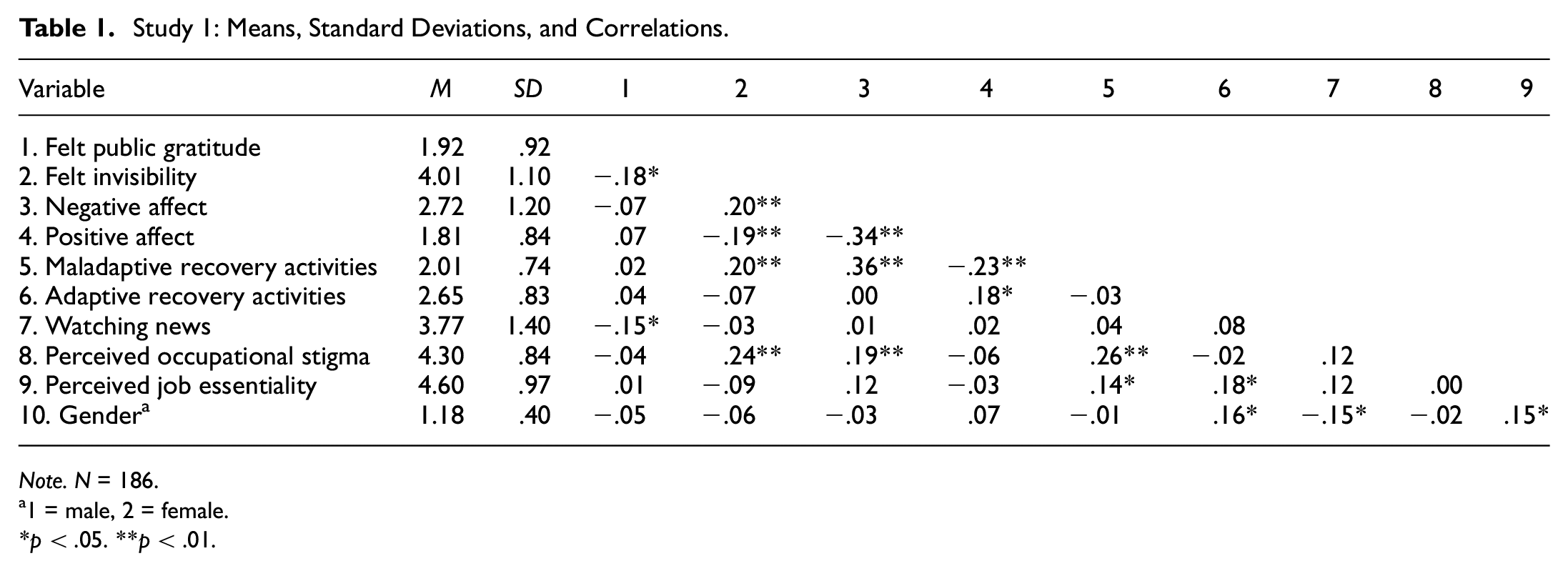
Note. N = 186.
1 = male, 2 = female.
p < .05. **p < .01.
Path analysis (see Figure 1) shows that felt public gratitude negatively relates to felt invisibility (B = −.23, SE = .09, p = .008, 95% CI [−.39, −.06]). Furthermore, (a) felt invisibility positively relates to negative affect (B = .18, SE = .08, p = .030, 95% CI [.02, .33]), (b) negative affect positively relates to maladaptive recovery activities (B = .15, SE = .04, p < .001, 95% CI [.07, .22]), and (c) the serial indirect effect of felt public gratitude on maladaptive recovery activities is negative (Bindirect = −.01, SE = .00, 95% CI [−.02, −.00]). In contrast, (a) felt invisibility negatively relates to positive affect (B = −.14, SE = .06, p = .018, 95% CI [−.25, −.02]), (b) positive affect positively relates to adaptive recovery activities (B = .18, SE = .08, p = .016, 95% CI [.03, .33]), and (c) the serial indirect effect of felt public gratitude on adaptive recovery behaviors is positive (Bindirect = .01, SE = .01, 95% CI [.00, .02]).
In a sample of COs, the results of Study 1 support our prediction that felt public gratitude is negatively associated with felt invisibility, which then (a) positively relates to negative affect and maladaptive recovery activities and (b) negatively relates to positive affect and adaptive recovery activities. While Study 1 provides initial evidence of our predicted effects, we sought to replicate our effects with an expanded set of essential workers for greater generalizability of our findings. Furthermore, Study 2 employs an experimental research design to more closely mimic the lived experiences of essential workers during the COVID-19 pandemic, where some workers experience public gratitude given explicitly to their own occupation while others experience public gratitude being directed to other occupations but not toward their own.
Study 2
In a pre-registered study using a broader sample of essential workers, we experimentally manipulated messages of public gratitude.
Method
Participants and Study Design
A total of 476 essential workers were recruited via Prolific. An a priori power analysis using the standardized effect size from Study 1 of |ρ| = .16–.28 and Monte Carlo simulations that allow a power analysis of serial indirect effects up to two mediators (Schoemann et al., 2017) suggested a minimum sample of 442 participants to achieve power of .95. Given that the serial indirect effects of interest consist of three variables, we sought to recruit as many essential workers as possible within a 5-day window to ensure adequate power after data exclusions. After excluding missing data, we obtained 379 usable responses (MAge = 31.91, SDAge = 8.86; male: 27.2%; Race: White [82.3%], African American/Black [3.2%], Asian/Pacific Islander [8.4%], Hispanic/Latino [2.4%], Other [3.7%]; MTenure = 7.30 years). We recruited participants employed across four occupational categories: Health care and Social Assistance (61.2%); Primary/Secondary (K-12) Education (17.4%); Food Processing, Hotel, and Food Services (11.1%); and Transportation and Warehousing (10.3%).
Participants were randomly assigned to one of three conditions in a between-participants design. Given the observed disparity in gratitude expressions across essential occupations during the pandemic, we included a “high gratitude” condition, where participants received gratitude messages from the general public made directly toward the participant’s occupation, and a “low gratitude” condition, where participants received messages of public gratitude directed toward an occupation other than their own. We also included a control condition, where participants received food pictures.
Procedure
Participants first completed Survey 1, which included demographics, job-related questions, and the participant’s Prolific ID which allowed us to randomly assign participants to conditions and match their responses to Survey 2. Participants then received a total of three messages sent at different time points (i.e., the first message was sent 1 week after Survey 1; the second message was sent 3 days after the first message; the third message was included in Survey 2, which was administered approximately 1 week after the second message). The first, second, and third messages were created to look like an actual (a) tweet, (b) Instagram post, and (c) Facebook post, respectively (see Supplemental Online Materials).
Depending on condition assigned, the content included in the messages varied. Specifically, in the high gratitude condition, the social media post included messages of gratitude directed toward workers in the participant’s occupation (as indicated by the participant in Survey 1). In the low gratitude condition, the post included messages of gratitude directed toward corrections officers, as none of our participants were COs. In the control condition, participants saw posts about food (e.g., poke bowl). Several comments (e.g., “They are so deserving of our gratitude. Thank you!”; “Looks so good!”) were added to the posts, which were perceived to be realistic by the participants (M = 3.68, SD = .89; versus scale midpoint [3]: t = 15.01, p < .001, d = .77).
Measures and Analyses
Time 1 measured control variables (i.e., occupational stigma, perceived essentiality, age, gender). 9 At Time 2, we used the same items as Study 1 to measure felt public gratitude (α = .96), felt invisibility (α = .95), negative (α = .87) and positive affect (α = .89), and intentions to engage in (mal)adaptive activities. We used Mplus 8 and bias-corrected confidence intervals to test our indirect effect hypotheses.
Results and Discussion
Table 2 provides descriptive statistics and correlations among variables. The average level of felt public gratitude was still low, despite the occupational diversity of our sample (M = 2.67, SD = 1.16). CFA results support the validity of the hypothesized six-factor model, χ2(284) = 562.67, p < .001, CFI = .94, SRMR = .06, RMSEA = .05. 10
Study 2: Means, Standard Deviations, and Correlations.

Note. N = 379.
1 = male, 2 = female.
p < .05. **p < .01.
Planned contrasts showed that felt public gratitude significantly differed between the high, M = 2.83, SD = 1.25, and low, M = 2.49, SD = 1.06, t(376) =2.26, p = .025, d = .28, conditions. We observed no difference between the high gratitude and control conditions, M = 2.69, SD = 1.12, t(376) =.92, p = .361, d = .11, nor between the low gratitude and control conditions, t(376) =1.36, p = .176, d = .18.
Path analyses tested the hypothesized model whereby experimental condition (i.e., high vs. low gratitude) was modeled as the predictor; felt public gratitude, felt invisibility, and negative (positive) affect were modeled as mediators; and intentions to engage in (mal)adaptive recovery activities were modeled as dependent variables. Following recent recommendations (e.g., O’Keefe, 2003; Quinn et al., 2021; Schabram & Heng, 2021), we included felt public gratitude as a mediating variable to reflect the state induced by the manipulation materials. In the primary analyses, the high gratitude condition was compared against the low gratitude condition. 11 As shown in Figure 2, results show that (a) experimental condition (high gratitude = 1; low gratitude = 0) significantly impacts felt gratitude (B = .33, SE = .14, p = .024, 95% CI [.04, .61]), (b) felt public gratitude negatively relates to felt invisibility (B = −.42, SE = .05, p < .001, 95% CI [−.52, -.−33]), which (c) positively relates to NA (B = .24, SE = .05, p < .001, 95% CI [.15, .33]) and negatively relates to PA (B = −.18, SE = .04, p < .001, 95% CI [−.26, −.11]). NA significantly predicts maladaptive recovery activities intentions, (B = .09, SE = .03, p < .001, 95% CI [.04, .14]) and PA significantly predicts adaptive recovery activities intentions (B = .23, SE = .04, p < .001, 95% CI [.14, .31]). The indirect effect of public gratitude (i.e., experimental contrast) on maladaptive activities via felt public gratitude, felt invisibility, and NA is significantly negative (Bindirect = −.00, SE = .00, 95% CI [−.01, −.00]) and the indirect effect of public gratitude on adaptive activities via felt public gratitude, felt invisibility, and PA is significantly positive (Bindirect = .01, SE = .00, 95% CI [.00, .02]).

Study 2: Summary of Path Analyses.
Study 2 replicated the serial mediation using a sample of diverse essential workers and a manipulation of public gratitude. Felt gratitude did not differ between the control and high gratitude conditions, or between the control and low gratitude conditions. However, significant differences in felt public gratitude (and its downstream effects) emerged when comparing workers who received public gratitude directed toward their own occupation (high gratitude condition) against those who observed public gratitude directed to workers in occupations other than their own (low gratitude condition), suggesting important differences between receiving gratitude versus seeing others receive gratitude.
General Discussion
This research identifies felt public gratitude as a critical factor that shapes the experiences and recovery activities of essential workers. Despite their essentiality, many workers receive little appreciation for their efforts. In a sample of COs (Study 1) and other essential workers (Study 2), felt public gratitude had a negative relationship with maladaptive recovery activities through felt invisibility and negative affect, and a positive relationship with adaptive recovery activities through felt invisibility and positive affect. In Study 2, we manipulate messages of public gratitude and replicate the indirect effects of Study 1.
Much of the work in the gratitude literature has focused on how gratitude expressed by direct beneficiaries impacts its recipients (Algoe et al., 2016; Lee et al., 2019). Our work demonstrates that gratitude from the general public—who could be either indirect beneficiaries or strangers with whom the worker may never have had any direct interaction—can powerfully impact the recovery activities of workers through reducing felt invisibility. Furthermore, gratitude research has mostly focused on the positive psychological and behavioral effects of gratitude, such as prosocial behavior (Grant & Gino, 2010); however, much less is known about the negative psychological experiences and downstream maladaptive behaviors that relate to a lack of felt gratitude. Our work extends prior research by examining how gratitude (or lack thereof) from the general public relates to (mal)adaptive recovery activities. We further highlight that the salience of gratitude to other essential workers may particularly affect those who feel excluded from recognition and appreciation.
There is notable practical value in understanding how and why public gratitude relates to recovery activities of front-line workers, especially those who are more inclined to feel invisible to the public. A CO in our sample expressed this sentiment: “This job is thankless [. . .] we believe that [people] feel that our lives are not as valuable as other first responders [. . .]” (emphasis added). Despite the outpourings of gratitude to some essential workers, many other essential workers report feeling “overlooked, deprioritized, and even expendable” (Kinder, 2020). Indeed, a home health aide notes: “Sometimes [. . .] I see how they clap when the doctors and nurses come out [. . .] but what about the people out here trying to prevent these people from going into the hospital?” (Kinder, 2020). We acknowledge that we do not find a significant total effect between felt public gratitude and (mal)adaptive recovery behaviors, but the relationship of felt public gratitude is uncovered when considering its relationship through felt invisibility and affect. This highlights the importance of understanding feelings of unappreciation and invisibility (Hennekam et al., 2020), which may induce maladaptive activities with grave long-term consequences (e.g., alcohol addiction [Sayre et al., 2020], antisocial behaviors [Dai et al., 2015]) and stifle adaptive ones that recharge one’s energy and resources.
Although our research has practical implications in the COVID-19 context, it also has relevance beyond the current pandemic to other health crises which are projected to become increasingly common (Hilsenrath, 2020). Furthermore, society relies on the work of essential workers during both disaster situations (e.g., fire crews during fire season) as well as more routine events (e.g., poll workers during election season), and we expect that public displays of gratitude will have similar effects on them given the importance of feeling seen.
Conclusion
Do expressions of public gratitude matter to those who receive them? Our work suggests they do. A CO in our sample noted, “I’m exhausted, and beginning to become numb toward others. I’ve seen friends and coworkers [. . .] (commit) suicide, become addicts because of stress. . .” When workers feel more appreciated by the public, they are more likely to turn away from harmful behaviors and toward healthy recovery activities. Offering our gratitude to essential workers, especially now, seems like the least we can do.
Footnotes
Handling Editor: Lisa Libby
Declaration of Conflicting Interests
This research was funded through the personal research funds of the authors.
Funding
The author(s) received no financial support for the research, authorship, and/or publication of this article.

Supplemental Material
See foonote 1.