



Abstract
Previous research suggests that loss of social status adversely impacts subjective well-being. Here, we show that important factors modulating this relationship are age differences in beliefs in opportunities and upward mobility. Across two preregistered longitudinal analyses (N1 = 5,487 and N2 = 1,092; 18–89 years), we found that individuals who hold a stronger belief that they have more opportunities in the future to improve their social status are less likely to suffer from status loss. Further analyses revealed that this interaction effect can be explained by age differences in these beliefs. Specifically, younger individuals were more likely to hold opportunity and upward mobility beliefs and, thus, were better able to maintain their relative level of life satisfaction when experiencing status loss. Overall, these findings contribute to our understanding of how individuals may mitigate the detrimental consequences of status loss to their subjective well-being across the adult life span.
Keywords
Social hierarchy is a pervasive feature of social life shaping development and well-being through the life span (Boyce et al., 2010; Havighurst, 1971; Tan et al., 2020). Yet, social hierarchies are not fixed and individuals’ position and status within a given hierarchy may change across time (Pettit et al., 2010; Sapolsky, 2004). Thus, individuals may move up or down in the social hierarchy across time and as a consequence, their reputation may change (Bendersky & Pai, 2018; Robertson & Weiss, 2017). According to Newman (1988), throughout their life, many individuals “find themselves sliding down the socioeconomic ladder—they fall from grace” (p. 20).
In fact, individuals at different life stages not only move up but also down in various formal and informal social hierarchies. For example, teens may realize not being popular anymore after the summer break, presidents are voted out of office, CEOs may lose their prestigious positions when stakeholders are unhappy, retirees may feel less respected for not participating in the workforce anymore, and famous actors may feel that they do not receive the attention they used to. Here, we define status loss as the subjective experience that one’s position or rank within a group or society has been declining. Specifically, status loss is denoted by perceived loss of prestige, respect, and regard in the eyes of others (Marr & Thau, 2014; Neeley, 2013). In line with previous research, we focus on the “evaluation and perceived experience of loss, rather than an objective measure of positional change” (Neely, 2013, p. 478; Pettit & Marr, 2020). We sought to examine the link between status loss and subjective well-being from a life span perspective with a focus on the moderating role of opportunity and mobility beliefs.
Research consistently suggests that individuals lower in the hierarchy experience less favorable conditions and outcomes (well-being, health, access to resources, and reproductive success) than those higher up in the hierarchy (Fiske, 2010; Redhead et al., 2019; Sapolsky, 2004). For example, a recent meta-analysis demonstrated that lower subjective social status was consistently linked to lower levels of subjective well-being (r = .22; N = 2,352,095; see Tan et al., 2020). While previous research has mostly focused on the negative consequences of low social status in relatively stable hierarchies (Adler et al., 2000), the individual experiences of status loss have received less attention so far. Increasing evidence suggests that falling down the social ladder, that is, losing social status, seems to be more harmful for people’s well-being than having low status to begin with. For example, research showed that losing status can lead to elevated levels of stress, diminished performance, exaggerated cardiovascular reactivity, negative emotions, impaired well-being, and a higher risk for depression (Anderson et al., 2012; Gilbert, 2000; Marr & Thau, 2014; Mendelson et al., 2008; Neeley, 2013; Scheepers et al., 2009; Weiss & Kunzmann, 2020). However, so far, this research has largely omitted potential boundary conditions, assuming that status loss uniformly leads to lowered well-being. Yet, given that individuals of different ages often have a different perception of future opportunities and upward mobility, they may react differently to losing status. We thus propose that an integrative perspective on both lifespan development and status-related beliefs systems may be useful in understanding inter-individual and age-related differences in the experience of status loss.
One important factor that might influence how individuals’ experience changes in social status (gain or loss) is whether they belief they will move up or down in the status hierarchy in the future. A body of research suggests that beliefs concerning the nature of status differences and the stability of social hierarchies represent a decisive factor in determining how changes in one’s social status are experienced (Knight & Mehta, 2017; Sapolsky, 2004; Scheepers et al., 2009; Tajfel & Turner, 1979). If individuals perceive hierarchies as malleable and the future full of opportunities to move up the social ladder, they may feel that they can escape having a lower social status and can avoid the detrimental consequences of status loss. For example, one study showed that the effect of unemployment on subjective well-being depends on individuals’ perceived future employability (Green, 2011). In addition, studies suggest when individuals learn that moving up in the social hierarchy is limited, they experience negative emotions and a reduction in subjective well-being (Layte & Whelan, 2014; Sagioglou, 2019). Thus, our main proposition is that a focus on opportunities and beliefs in upward mobility should buffer the detrimental effect of perceived status loss on changes in life satisfaction.
The Role of Age-Differences in Opportunity and Upward Mobility Beliefs
Life-span developmental approaches (Baltes, 1987; Freund, 2006; Havighurst, 1971; Heckhausen et al., 2010) emphasize age differences in motivation across the life span. According to that, motivation appears to shift from a predominant focus on achieving gains in younger adults toward an increased importance of maintenance in midlife and loss avoidance in later adulthood (Ebner et al., 2006; Freund, 2006; Freund & Keil, 2021; Weiss et al., 2016, 2022). For example, Freund (2006) showed in a set of experiments that younger adults persisted longer in a task that reflected an opportunity to enhance performance (i.e., growth orientation), whereas, older adults persisted longer when the same task was framed as a means to counteract losses. In line with this, research consistently demonstrates that younger—relative to older adults—tend to overestimate their future outcomes (e.g., Busseri, 2013; Lachman et al., 2008; Lang, et al., 2013). In addition, Zacher and colleagues (Zacher and Frese, 2009; Zacher et al. 2010) have shown that younger adults exhibit a stronger focus on opportunities, including new goals, options, and that this focus decreases with older age. Thus, in contrast to older adults, younger adults seem to more strongly believe that they can “achieve new goals and exploit upcoming opportunities in the future” (Gielnik et al., 2012; p. 130). What’s more, research suggests that the adaptive value of focusing on opportunities becomes reduced with advancing age, because opportunities for attaining desired goals may increasingly become limited (Wrosch et al., 2000).
Against this backdrop, we explored the idea that due to younger adults’ primary orientation toward growth and focus on opportunities, they should be more likely to believe that their social status is relatively malleable and will increase in the future. By contrast, due to middle-aged and older individuals stronger focus on maintenance and loss prevention, they should be less likely to endorse beliefs in upward mobility and opportunity. Building up on these findings, we furthermore sought to explore whether the effect of status loss on life satisfaction is contingent on age differences in opportunity and upward mobility beliefs. According to that, younger adults should hold stronger beliefs in opportunity and upward mobility than middle-aged and older adults, which help them to mitigate the detrimental influence of status loss on their subjective well-being.
The Current Research
Across two longitudinal studies, we investigated whether beliefs in future opportunity (Study 1) and in upward mobility (Study 2) buffer the detrimental effect of perceived status loss on changes in life satisfaction across time. We predicted that experienced loss of social status should be less detrimental to subjective well-being when individuals believe that they have the opportunities to change and improve their status position in the future as compared with those who believe that they have little opportunities and their status position is fixed. Thus, the expectation that one may regain social status in the future (i.e., strong opportunity and upward mobility beliefs) should dampen the effect of status loss on life satisfaction.
To test these hypotheses, we performed preregistered analyses in two longitudinal studies of age-heterogeneous samples (Study 1: N = 5,487 participants between 32 and 89 years; Study 2: N = 1,092 participants between 18 and 84 years). To furthermore gauge the role of age in these relationships, we performed exploratory analyses testing the conditional indirect effects of chronological age through opportunity and upward mobility beliefs for the experience of status loss on life satisfaction.
Study 1
Future expectations are an important determinant of subjective well-being (Diener, 2013; Diener & Oishi, 2005). It has been argued that depending on one’s future outlook, people show different patterns of behavior in relation to the achievement of goals which ultimately contribute to their subjective well-being (Carver & Scheier, 2002). For example, when individuals are confronted with setbacks and constraints, more optimistic future expectations facilitate psychological adjustment (Wrosch et al., 2017). In addition, life span perspectives suggest that younger adults typically hold stronger beliefs in future opportunities as compared with middle-aged and older adults (Weiss et al., 2022). We therefore explored the potential indirect effect of age on beliefs in future opportunity on the impact of status loss on longitudinal changes in life satisfaction.
Method
We preregistered our main hypotheses, design, and planned analyses on the Open Science Framework before any analyses were performed (OSF; https://doi.org/10.17605/OSF.IO/4J7GY). In addition, we tested the exploratory (not-preregistered) hypotheses examining the potential indirect effect of age on beliefs in future opportunity on the impact of status loss on longitudinal changes in life satisfaction. Analyses scripts to reproduce analyses are available on the OSF (https://osf.io/r4wg2). The data for Study 1 are publicly accessible at https://www.elsa-project.ac.uk.
Participants
The study is based on data of Wave 2 (2004–2005) and Wave 3 (2006–2007) of the English Longitudinal Study of Aging (ELSA). ELSA is a nationally representative, large-scale longitudinal panel study of adults in England that started in 2002 (Wave 1) and makes repeat assessments every 2 years. Ethical approval for all ELSA waves was granted from National Health Service (NHS) Research Ethics Committees under the National Research and Ethics Service (NRES). A detailed description of ELSA’s can be found elsewhere (Steptoe et al., 2013).
In Waves 2 and 3, N = 8,082 and N = 9,771 individuals participated in the ELSA, respectively. In this study, we focus on data from 5,921 participants with complete data on future beliefs, life satisfaction in both waves, and status change. Our main analyses were performed on a sample of N = 5,487 participants between 32 and 89 years (M = 64.77, SD = 9.36; 56.6% women), who either experienced no status change or status loss during follow-up. The majority of the sample identified as White (98.9%). Note that the sample size was predetermined by the ELSA. Power analysis for the multiple regression analysis revealed, assuming α = .025, power = .90, that the total variance explained in the outcome of this model is 60%, and that the terms for adding terms for status loss will explain 1% more variance in the outcome variable compared with the null model, that the required sample size would be N = 594 (the same analysis assuming status loss will explain 5% more variance when added to the model would be N = 122).
Measures
Perceived Status Loss
To assess whether participants experienced changes in their social status retrospectively they were asked in Wave 3 “Has your position on the social ladder changed in last two years” and they could answer this question by indicating that (a) “Yes, I have moved down,” (b) “No, my position has not changed” and (c) “Yes, I have moved up.” For our main analyses, we used a dichotomous status loss scale (0 = “No, my position has not changed” and 1 = “Yes, I have moved down”).
Belief in Future Opportunity
Future expectations were measured in Wave 3 using three items (e.g., “How often do you feel free to plan for the future?”“How often do you feel that life is full of opportunities?,” and “How often do you feel the future looks good to you?”). Answers were given on a 4-point Likert-type scale ranging from 1 (often) to 4 (never). The scale was recoded and averaged, so that higher values represent more positive expectations of future opportunities (Cronbach’s α = .76). Values were centered to the mean before analyses.
Subjective Well-being
Subjective well-being was measured in Wave 2 (T0) and Wave 3 (T1) using the Satisfaction with Life Scale (Diener et al., 1985), which consists of five items about overall life satisfaction (e.g., “In most ways my life is close to ideal,”“I am satisfied with my life”). Answers were given on a 7-point Likert-type scale ranging from 1 (“strongly agree”) to 7 (“strongly disagree”), and all items were coded, so that, higher values represent higher levels of life satisfaction and averaged for each participant (Cronbach’s α = .90 and .90, respectively). Life satisfaction at Wave 2 was centered to its mean before analyses.
Covariates
Gender (0 = female, 1 = male) and socioeconomic status (SES) consisting of a mean composite of z-standardized level of education (1= “no formal qualifications,” 5 = “college or university degree”) and occupational role/prestige (1 = “never worked,” 6 = “higher managerial and professional occupations”) were included as covariates.
Results Study 1
Means, standard deviations, and bivariate correlations of all variables included in Study 1 are depicted in Table 1. For example, chronological age was significantly negative associated with opportunity beliefs and status loss was significantly negative associated with life satisfaction in both waves. Of the 5,921 participants, n = 396 (6.7%) participants had experienced status loss, n = 5,091 (86.0%) status maintenance, and n = 434 (7.3%) status gain over the course of two years.
Means, Standard Deviations, and Bivariate Correlations of Variables in Study 1

Note. N = 5,487; age in years, range, 32 to 89 years; gender: (0 = “female,” 1 = “male”), SES = socioeconomic status; LS = life satisfaction.
p < .05. **p < .01. ***p < .001.
Preregistered Analyses: The Buffering Role of Future Opportunity Beliefs
We performed our preregistered analysis using a moderated regression analysis to test whether social status loss and belief in future opportunity predicted life satisfaction at Wave 3 (adjusting for life satisfaction at Wave 2), and whether the effect of social status loss depends on belief in future opportunity. As we were only interested in status loss, this analysis included N = 5,487 participants who experienced either no status change or status loss. 1 Our analysis showed that compared with no change in status, status loss was associated with lower life satisfaction at Wave 3 (B = −.32; 95% confidence interval [CI]: [−.42, −.22]; p < .001; SE = −.07), whereas, higher belief in future opportunity was associated with higher life satisfaction at Wave 3 (B = .59; 95% CI: [.55, .63]; p < .001; SE = .32). Importantly, we found a significant interaction effect of status loss and belief in future opportunity (B = .21; 95% CI: [.10, .33]; p < .001; SE = .04; see Table 2). Simple slope analyses (see Figure 1) showed that optimistic beliefs in future opportunities buffered the detrimental effect of status loss on life satisfaction (status loss: B = .63; 95% CI: [.494, .767]; p < .001; SE = .07; no change: B = .38; 95% CI: [.346, .413]; p < .001; SE = .02). The detrimental effect of status loss on life satisfaction was stronger for individuals with less optimistic beliefs in future opportunities (−1 SD: B = −.59; 95% CI: [−.693, −.484]; p < .001; SE = .05) as compared with those who held a more optimistic view of future opportunities (+1 SD: B = −.22; 95%; CI: [−.396, −.051]; p = .01; SE = .09). These effects remained robust and significant after the inclusion of covariates (age, gender, and SES).
Results of Regression Analyses for Study 1

Note. N = 5,487; age in years, range, 32 to 89 years; gender: (0 = “female,” 1 = “male”). SES = socioeconomic status; CI = confidence interval.

Interaction Effect of Belief in Future Opportunity and Status Loss on Life Satisfaction Across Time (Study 1; With Confidence Bands)
In addition, we tested the potential moderating role of age for the effect of status loss on life satisfaction but did not find any significant effects for age (or the curvilinear effect of age).
Exploratory Analyses: The Role of Age Differences in Opportunity Beliefs
Further exploratory analyses revealed a negative correlation between age and beliefs in future opportunity (r = −.16, 95% CI: [−.18, −.13]; p < .001), suggesting that older adults tended to hold lower beliefs in their future opportunities than younger adults.
Next, to test the potential indirect effect of age, we estimated the effects of age on the relationship between status loss and life satisfaction through future opportunity beliefs (i.e., moderated-mediation effect, see Hayes, 2015). Results demonstrate that age differences in opportunity beliefs indirectly affect the effect of status loss on life satisfaction across time. When status loss was perceived, the conditional indirect effect of age via opportunity beliefs was larger (status loss: B = −.008, SE = .001; 95% CI: [−.011, −.002]), as compared with the condition when no status change was perceived (no status change: B = −.005, SE = .001; 95% CI: [−.006, −.004]). The index of moderated mediation (difference between conditional indirect effects) was significant (B = −.003; 95% CI: [−.005, −.002]) suggesting that younger adults were better able to mitigate the detrimental consequences of status loss to their life satisfaction as they were more likely to endorse future opportunity beliefs.
Discussion Study 1
This 2-year longitudinal study demonstrated that perceived status loss was linked to a decrease in life satisfaction across time and that this effect was moderated by beliefs in future opportunity. Specifically, the association between status loss and decreases in life satisfaction was diminished when individuals expected many (vs. little) opportunities in the future. The identified indirect effect of age suggests that younger adults were more likely than middle-aged and older adults to endorse beliefs in future opportunity, which buffered the effect of status loss on life satisfaction across time. These findings point to the protective role of holding strong beliefs in future opportunity when experiencing status loss across the life span.
Limitations of this study concern beliefs in future opportunity may represent a proxy of general beliefs about one’s future rather than one’s position in the social hierarchy or upward mobility beliefs. In addition, status loss was solely assessed by asking whether participants’ subjective social status position has changed over the past 2 years. The somewhat restricted age range of the sample (32–89 years) and the fact that most participants (> 70%) were between 50 and 70 years of age may limit the examination of age-differential effects across the life span. We addressed these limitations in a second longitudinal study.
Study 2
Another factor that may explain differences in the impact of social status on well-being refers to beliefs in upward mobility. Upward mobility beliefs capture the degree to which a person believes that their social status is malleable rather than fixed and that it will be possible to move up in the social hierarchy beliefs (Day & Fiske, 2017; Sagioglou et al., 2019; Shane & Heckhausen, 2017; Weiss et al., 2022). Similar to Study 1, we predicted that beliefs in upward mobility moderate the effect of status loss on changes in life satisfaction across time (3-month interval). Accordingly, the effect of loss of social status on changes in life satisfaction should be significantly stronger among individuals who weakly endorse upward mobility beliefs as compared with those who strongly endorse upward mobility beliefs.
Study 2 included a sample of adults between 18 and 84 years with a broader age distribution (more than 40% of participants were aged 49 and younger). On the basis of this sample, we wanted to further explore the possibility that the effect is driven by age differences in upward mobility beliefs such that younger adults hold stronger upward mobility beliefs than middle-aged and older adults and, thus, should report higher levels of life satisfaction in the face of status loss.
Method
We preregistered our hypotheses, design, and planned analyses on the Open Science Framework before any analyses were performed (OSF; https://doi.org/10.17605/OSF.IO/5AY7S). In addition, we tested the exploratory (not-preregistered) hypotheses examining the potential indirect effect of age on upward mobility beliefs on the impact of status loss on longitudinal changes in life satisfaction. Analyses scripts are also available on the OSF project website (OSF; https://osf.io/r4wg2). Requests for the data for Study 2 can be sent to the corresponding author. The data are not publicly available due to privacy and ethical restrictions.
Sample
The study design consisted of a two-wave longitudinal study (Wave 1: January 2021 and Wave 2: April 2021) including adults between 18 and 84 years. The first author a commissioned professional panel provider to recruit participants from a nationally representative online panel in Germany. Participants received a monetary compensation for their participation in the study.
The longitudinal sample consisted of N = 1,092 participants (age range: 18–84 years; M = 52.73, SD = 16.44; 48.3% women). We anticipated that the available data for both waves (N > 1,000) would meet the minimum required power to detect the predicted main and interaction effects of perceived status loss and upward mobility beliefs on life satisfaction (assuming a small to medium effect size). In line with Study 1, we estimated that to explain 1% more variance when in the outcome variable adding status loss to the multiple regression the required sample size is N = 594.
Measures
Perceived Status Loss
To assess perceived loss of social status retrospectively (Wave 2), we used two items (“I feel like other people don’t respect me enough anymore” and “I have felt degraded by others lately”). The scale is anchored using a 7-point Likert-type scale ranging from 0 (do not agree) to 6 (absolutely agree). The two items were highly correlated (r = .77, p < .001), which indicates that they measure a common construct. An average was calculated across both items and the variable was centered to their mean before the analyses.
Upward Mobility Beliefs
To assess participant’s beliefs about their upward social mobility at Wave 2, we used a six-item scale (e.g., “I have many opportunities to move up in society,”“If I try hard enough, I can improve my social status in society”; Weiss et al., 2022). The scale ranged from 0 (do not agree) to 6 (absolutely agree) and Cronbach’s α of the scale was .87. The scale was averaged, so that, higher values indicated higher mobility beliefs. The scale was centered to their mean before the analyses.
Subjective Well-Being
As in Study 1, subjective well-being was measured in Wave 1 (T0) and Wave 2 (T1) using the five-item Satisfaction with Life Scale (Diener et al., 1985). Answers were given on a 7-point Likert-type scale ranging from 0 (do not agree) to 6 (absolutely agree) and Cronbach’s α of the scale for both waves was .90. An average was calculated, and the life satisfaction at T1 was centered to its mean before the analyses.
Covariates
We included gender (0 = female, 1 = male) and SES consisting of a mean composite of z-standardized level of education (1= no formal qualifications–8 = doctoral degree) and monthly income (1= less than 500 Euro–9 = more than 5,500 Euro) as covariates. In addition, we assessed perceived control with a brief six-item scale (Lachman, & Weaver, 1998; “What happens to me in the future mostly depends on me.,”“What happens in my life is often beyond my control.” [reverse coded]; 0 = do not agree to 6 = absolutely agree; Cronbach’s α = .76).
Results Study 2
Preregistered Analyses: The Buffering Role of Mobility Beliefs
Means, standard deviations, and bivariate correlations of all variables included in Study 2 are depicted in Table 3. For example, chronological age was significantly negative associated with upward mobility beliefs and status loss significantly negative associated with life satisfaction in both waves. Perceived control was positively correlated with upward mobility beliefs and negatively with perceived status loss.
Means, Standard Deviations, and Bivariate Correlations of Variables in Study 2

Note. N = 1,092; age in years, range, 18 to 84 years; gender: (0 = “female,” 1 = “male”), SES = socioeconomic status; LS = life satisfaction.
p < .05. **p < .01. ***p < .001.
We performed our preregistered analysis using a multiple regression analysis to test whether perceived social status loss and mobility beliefs predicted life satisfaction 3 months later (by adjusting for life satisfaction at T0), and whether the effect of social status loss depends on belief in upward mobility (see Table 4). Results revealed that higher status loss was associated with lower subsequent life satisfaction (B = −.04; 95% CI: [−.07, −.01]; p = .017; SE = −.04) and higher upward mobility beliefs were associated with higher subsequent life satisfaction (B = .12; 95% CI: [.08, .16]; p < .001; SE = .12). As predicted, this effect was qualified by an interaction effect of status loss and upward mobility beliefs (B = .05; 95% CI: [.02, .07]; p < .001; SE = .07), such that, upward mobility beliefs buffered the effect of social status on subsequent life satisfaction. Simple slope analyses (Figure 2) showed that upward mobility beliefs buffered the detrimental effect of status loss on changes in life satisfaction across time (status loss [+1 SD]: B = .20; 95% CI: [.141, .262]; p < .001; SE = .03 vs. no status loss [–1 SD], B = .06; 95% CI = .021, .105; p < .001; SE = .02). In addition, status loss had a significant effect on life satisfaction for individuals with weaker (–1 SD: B = −.10; 95% CI: [−.142, −.054]; p < .001; SE = .02) but not for those with stronger upward mobility beliefs (+1 SD: B = .02; 95% CI: [−.021, .064]; ns; SE = .02). Finally, effects remained robust and significant when including covariates (age, gender, SES, and perceived control).
Results of Regression Analyses for Study 2
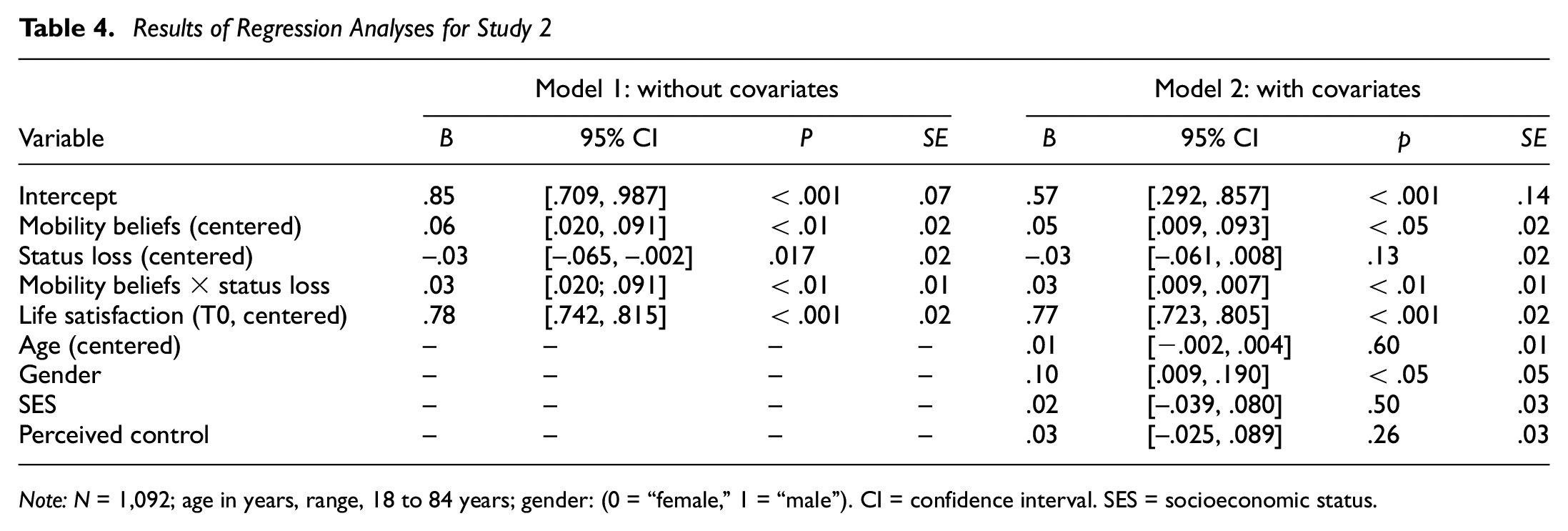
Note: N = 1,092; age in years, range, 18 to 84 years; gender: (0 = “female,” 1 = “male”). CI = confidence interval. SES = socioeconomic status.

Interaction Effect of Upward Mobility Beliefs and Status Loss on Life Satisfaction Across Time (Study 2; With Confidence Bands)
In addition, we tested the potential moderating role of age for the effect of status loss on life satisfaction. Analyses show an interaction effect of perceived status loss and chronological age (B = −.003; 95% CI: [−.005, −.001]; p < .001; SE = .001). Specifically, the effect of status loss is only significant on middle-aged and older adults’ life satisfaction and increases with age. Thus, experienced status loss has a significant effect on the life satisfaction of middle-aged and older adults but not for younger adults. Johnson-Neyman procedure suggests that the regions of significance for the effect of status loss on life satisfaction lie between 48 and 84 years of age. We speculate that younger adults might be less vulnerable to status loss because of their stronger beliefs that they have plenty opportunities in the future to move up the status ladder (i.e., upward mobility beliefs).
Exploratory Analyses: The Role of Age Differences in Mobility Beliefs
In line with this idea, further exploratory analyses revealed a moderate correlation between age and beliefs in upward mobility (r = −.42, 95% CI: [−.37, −.46]; p < .001), suggesting that older adults tended to hold lower upward mobility beliefs than younger adults. Finally, we tested the potential indirect effect of chronological age on the interplay of upward mobility beliefs and status loss on life satisfaction. Results demonstrate that age differences in upward mobility beliefs indirectly affect the effect of status loss on life satisfaction across time. Specifically, for individuals higher in perceived status loss (+1 SD) the conditional indirect effect of age via upward mobility beliefs was larger (B = −.007, SEB = .001; 95% CI: [−.009, −.005]), as compared to those lower in perceived status loss (–1 SD; B = −.003, SEB = .001; 95% CI: [−.005, −.001]). The index of moderated mediation (difference between conditional indirect effects) was significant (B = −.002; 95% CI: [−.003, −.001]). According to that, age differences in upward mobility beliefs buffer the effect of status loss on life satisfaction across time. Again, all effects remained robust and significant when including covariates (age, gender, and SES).
Discussion Study 2
Results from this 3-month longitudinal study including a large sample of adults between 18 and 84 years demonstrated that the effect of status loss on life satisfaction was moderated by upward mobility beliefs. We found that individuals who hold a stronger belief that they have more opportunities in the future to improve their social status are less likely to suffer from status loss. As compared with Study 1 which covered a 2-year interval, results from Study 2 suggests that status loss has also a more short-term effect on changes in life satisfaction across 3 months and that this detrimental effect is buffered by individuals’ belief that they will move up in the hierarchy in the future.
In addition, exploratory analyses revealed a conditional indirect effect of age on changes in life satisfaction via upward mobility beliefs when experiencing status loss. This suggests that younger adults might be better able to cope with status loss—at least in short term—because they hold stronger upward mobility beliefs than middle-aged and older adults.
General Discussion
Plunging down the social ladder throughout one’s life is more common than one would think. However, previous research suggests that this is not without risk and that the experience of social status loss may adversely impact subjective well-being. Our results from two longitudinal studies suggest that for individuals who endorsed a belief in opportunities and perceived status differences as malleable, status loss had a weaker impact on changes in their life satisfaction, as compared with those who saw only limited opportunities and perceived their social status position as more immutable. In addition, our results further show that this effect was contingent on age differences in opportunity and upward mobility beliefs. Consistent with the life span perspective (Baltes, 1987; Freund, 2006; Havighurst, 1971), younger adults held stronger opportunity and upward mobility beliefs than middle-aged and older adults and, thus, reported higher levels of life satisfaction in the face of status loss.
Although previous research has well documented that a loss of social status has detrimental consequences for individuals’ well-being (e.g., Sapolsky, 2004), less was known about the boundary conditions, which might be informed by age differences in motivation. Specifically, we found that the effect of status loss on subjective well-being is influenced by age differences in opportunity and upward mobility beliefs across the adult life span. The results suggest that an optimistic outlook of future opportunities and strong upward mobility may reflect young adults’ growth orientation and serve the motivational function to explore novel environments, exploit opportunities, and accumulate experiences to maximize future outcomes (Baltes, 1987; Freund, 2006; Heckhausen et al., 2010; Zacher et al., 2010).
While for younger adults, higher mobility and opportunity beliefs might be buffering the negative effects of status loss, older adults may exhibit a generally higher accommodative flexibility in coping with status loss (Brandtsẗdter & Rothermund, 2002). In later adulthood, people expect a normative decline in social status and changes in social status appear to be less relevant and consequential for their subjective well-being (Robertson & Weiss, 2017; Weiss & Kunzmann, 2020). Specifically, older adults might engage in downgrading and eventually disengaging from status goals as a source of their well-being and may focus on alternative goals related to emotional closeness and intimacy (Brandtsẗdter et al., 2010).
The insights of the current research contribute to our understanding of the potentially adverse consequences of status loss in several meaningful ways. First, findings are consistent with social rank theory (Gilbert, 2000) suggesting that the detrimental consequences of a loss of status might be preventable when people feel that they can leave and escape the situation and move to another situation where a higher status attainment is possible (Buunk et al., 2007). However, status loss becomes most detrimental to well-being when individuals feel that they are trapped in a situation of chronically low social status. Second, there might be detrimental long-term effects when people continuously experience status loss but maintain beliefs in upward mobility. Given the relatively short time frame of the study, our results cannot be generalized to long-term dynamics. Third, our results point to age-differential effects of opportunity and upward mobility beliefs, which seem to lose their adaptive value in old age when (status) goals become less attainable, and older adults need to disengage and shift to alternative, meaningful goals (Weiss & Kunzmann, 2020; Wrosch & Scheier, 2020).
Limitations point to the self-reported nature of social status loss. Individuals might be reluctant to admit that they have lost status and research suggests that people often engage in positive illusions in the face of loss. For example, illusions of control, unrealistic optimism, and inflated self-assessment may exaggerate one’s ability to counteract loss of social status (e.g., Taylor & Armor, 1996). Thus, perception of status loss might be distorted by self-protective strategies that aim at maintaining a positive self-image despite loss of prestige. Moreover, in the current set of studies we focused on individuals’ perceptions and experience of status loss rather than on objective measures of changes in rank. For example, objective instances of status loss may differ across the life span (unemployment in midlife, retirement in later adulthood) rendering status loss more normative and thus less reversible and consequential in later adulthood. Thus, future research needs to examine how people different ages respond to instances of status loss that are (non)normative for a certain life phase.
In addition, on the basis of our relatively short longitudinal studies (Study 1: 2-year interval and Study 2: 3-month interval), we were not able to examine long-term effect nor disentangle age from cohort effects. For example, ideologies about opportunity structures and ways to move up in the social hierarchy may differ as they are shaped by cultural differences and historical changes. Both studies were different with regard to age range and the assessment of status loss. Specifically, Study 1’s sample covered ages ranging from to 32 to 89 years (> 70% between 50 and 70 years) and used a dichotomous item to assess status loss; Study 2 included a sample between 18 and 84 years (> 40%, 49 years and younger) and measured status loss using a 7-point scale. However, despite these differences findings of both studies complement each other by providing a coherent insight in the consequences and boundary conditions of perceived status loss. In addition, although the two studies are based on two large, national representative samples that were diverse in terms of age and SES, the generalization of the current findings is limited by including data of two European countries (England and Germany) only. In addition, the diversity in terms of other demographics, such as race/ethnicity, was limited. Thus, it is important to investigate whether the current findings generalize to populations of other countries and cultures as well as other racial/ethnic groups. Moreover, the non-experimental nature and non-randomized assignment to status loss of our designs precludes any inferences about causality. Finally, the buffering role of opportunity and upward mobility beliefs in the face of status loss might be limited to short-term and may do not extend to long-term changes when, for example, individuals realize that their opportunity and upward mobility beliefs might be inflated and do not match reality (e.g., upward mobility is not possible for everyone and declined across past decades). In this situation, high opportunity and upward mobility beliefs may backfire by rendering the individual accountable for status loss and impairing their subjective well-being (Major et al., 2007; Wilkinson & Pickett, 2009).
Conclusion
Across two preregistered longitudinal analyses, we showed that age differences in beliefs in future opportunities and upward social mobility moderate the effect of status loss on life satisfaction across the adult life span. The results also revealed that the effect of status loss on life satisfaction was further contingent on age differences in opportunity and upward mobility beliefs. Thus, compared with middle-aged and older adults, younger adults seem to be better able to mitigate the detrimental consequences of status loss to their life satisfaction as they are more likely to endorse future opportunity and upward mobility beliefs. These insights help us better understand the different consequences of loss of social status for younger, middle-aged and older adults and highlight the unique role of opportunity and upward mobility beliefs across the adult life span.
Supplemental Material
sj-docx-1-spp-10.1177_19485506231162405 – Supplemental material for Loss of Social Status and Subjective Well-Being Across the Adult Life Span: Feeling Stuck or Moving Up?
Supplemental material, sj-docx-1-spp-10.1177_19485506231162405 for Loss of Social Status and Subjective Well-Being Across the Adult Life Span: Feeling Stuck or Moving Up? by David Weiss and Maria Blöchl in Social Psychological and Personality Science
Footnotes
Handling Editor: Job Veronika
Declaration of Conflicting Interests
The author(s) declared no potential conflicts of interest with respect to the research, authorship, and/or publication of this article.
Funding
The author(s) disclosed receipt of the following financial support for the research, authorship, and/or publication of this article: This research was supported by a Heisenberg Fellowship from the German Research Foundation awarded to David Weiss (396974499).

Supplemental Material
Supplemental material for this article is available online.
Notes
Author Biographies
References
Supplementary Material
Please find the following supplemental material available below.
For Open Access articles published under a Creative Commons License, all supplemental material carries the same license as the article it is associated with.
For non-Open Access articles published, all supplemental material carries a non-exclusive license, and permission requests for re-use of supplemental material or any part of supplemental material shall be sent directly to the copyright owner as specified in the copyright notice associated with the article.
