



Abstract
Across four preregistered experiments on American adults (total N = 968), and five supplemental experiments (total N = 869), we examined four accounts that might explain people’s aversion to “dirty money” (i.e., money earned in immoral ways): (a) they think it is morally tainted, (b) they care about illicit ownership, (c) they do not wish to profit from moral transgressions, and (d) accepting dirty money might imply an endorsement of the immoral means by which the money was acquired. Participants were unwilling to accept or touch dirty money, but they were relatively willing to take dirty money when it is lost and found. Together these findings suggest that people’s aversion to dirty money stems from concerns about both moral taint and endorsing the way in which dirty money was acquired.
As far back as biblical times (Titus 1:11), there has been talk of dirty money––that is, money earned in immoral ways. Over the past decade, psychological science has become increasingly interested in dirty money (see Tasimi & Gross, 2020), with research in social psychology (e.g., Stellar & Willer, 2014), neuroscience (e.g., Crockett et al., 2017), developmental psychology (e.g., Tasimi & Gelman, 2021), and cognitive psychology (e.g., Siegel et al., 2022) converging on a picture of people devaluing and being reluctant to accept dirty money.
Not only has dirty money inspired research throughout psychological science, but its ability to permeate fictional enterprises (e.g., Breaking Bad, The Sopranos) and news headlines (e.g., coverage of institutions like the Met rejecting gifts from the Sackler Family, who amassed a multi-billion-dollar fortune through sales of opioids, which over 100 Americans overdose and die from every day; see Harris, 2019) testify to its significance in the everyday world. Thus, understanding why people are averse to dirty money is a timely and pragmatically important issue.
As it stands, this burgeoning literature has yielded different explanations regarding people’s aversion to dirty money, with no unified attempt to consider the various accounts that have been offered. One idea is that people consider dirty money to be tainted (henceforth, a moral taint account; see Tasimi & Gelman, 2017). Just as a sweater worn by Hitler is thought to carry his “essence” (e.g., Rozin et al., 1986), people may likewise consider dirty money to carry traces of its history. Supporting this impression, a series of experiments (Tasimi & Gelman, 2017) asked participants to imagine different people offering them money earned in different ways. Whether the amount was big or small or likely to get them into trouble or not, participants consistently preferred non-stolen over stolen money––even when non-stolen money was offered by someone who stole an equivalent, but different, sum of money (e.g., a professor stole $100 but offered you $100 they earned from their 9-month salary).
Other accounts might also contribute to people’s aversion to dirty money—either alongside a moral taint account or instead of it. Indeed, one of these accounts—an ownership account—inspired our adversarial collaboration (see Cowan et al., 2020; Kahneman, 2003; Mellers et al., 2001). For example, the above findings (from Tasimi & Gelman, 2017) could be interpreted through the lens of ownership. To elaborate, when someone offers money they earned, the money they are offering is theirs. By contrast, when someone offers stolen money, that money is not theirs. Even young children judge items acquired by theft do not become owned (e.g., Blake & Harris, 2009; Shaw et al., 2012; for a review, see Pesowski et al., 2022), and people readily assign ownership to money (e.g., DeScioli et al., 2017; Uhlmann & Zhu, 2013). Thus, while a moral taint account (originally favored by Tasimi) predicts that people should be unwilling to accept dirty money of all forms, an ownership account (originally favored by Friedman) predicts that people should be more willing to accept dirty money as long as it is not stolen.
Another account—a profit account—posits that people reject dirty money because they do not wish to profit from moral transgressions. After all, individuals who profit from misdeeds are often referred to by the pejorative “profiteer” (see Goodin, 2013). Consistent with a profit account, people dislike individuals who profit from the suffering of others (Inbar et al., 2012; Lelieveld et al., 2018), and people will even sacrifice more money to reduce a stranger’s pain than their own pain (Crockett et al., 2014). Moreover, the greater the guilt that one reports when acquiring dirty money, the less likely they are to spend it (Kardos & Castano, 2012).
The final account we considered––an endorsement account—holds that people reject dirty money because accepting it would serve as an endorsement of the immoral means by which the money was acquired (e.g., Jones, 2014; also see Elliott, 2004). For example, accepting donations from a corporation that engages in fracking may be seen as endorsing the practice or at least tolerating it. An endorsement can also be viewed as a public act, in which case people may be reluctant to accept dirty money because they do not want others to think they approve of how the money was acquired (for related proposals on moral signaling, see Hok et al., 2020; Jordan et al., 2016, 2017; Lee et al., 2018).
In summary, people’s aversion to dirty money is open to multiple explanations, but we do not yet know which explanation, or explanations, underlies it. What is more, these accounts are not mutually exclusive. Indeed, one possibility is that two or more of the mechanisms could independently influence people’s judgments. For example, people may be reluctant to accept dirty money because they see it as an endorsement of immoral activities, but they may be especially reluctant to accept stolen money because they also care about ownership. Another possibility is that two or more of the mechanisms could work together. For example, perhaps people do not wish to profit from moral transgressions because doing so might be seen as a form of endorsement.
Across four preregistered experiments, we sought to assess these four accounts. We also report five additional experiments in the Supplemental Materials. Experiment S1 is a norming study used to select items for the main experiments. The other supplemental experiments were preregistered: Experiments S2 and S3 show that key findings from Experiment 1 are robust across different experimental designs. Experiment S4 finds that people’s aversion to dirty money extends to gift cards purchased with dirty money. Finally, Experiment S5 tests the premises of the four theoretical accounts.
General Method
Preregistrations, data, materials, and analytic code for all experiments are available at https://osf.io/gvd67/. In each experiment, we preregistered the design and analysis plan. From Experiment 2 onward, we also preregistered predictions of the different accounts (see Figure 1 for an overview of each account’s predictions).
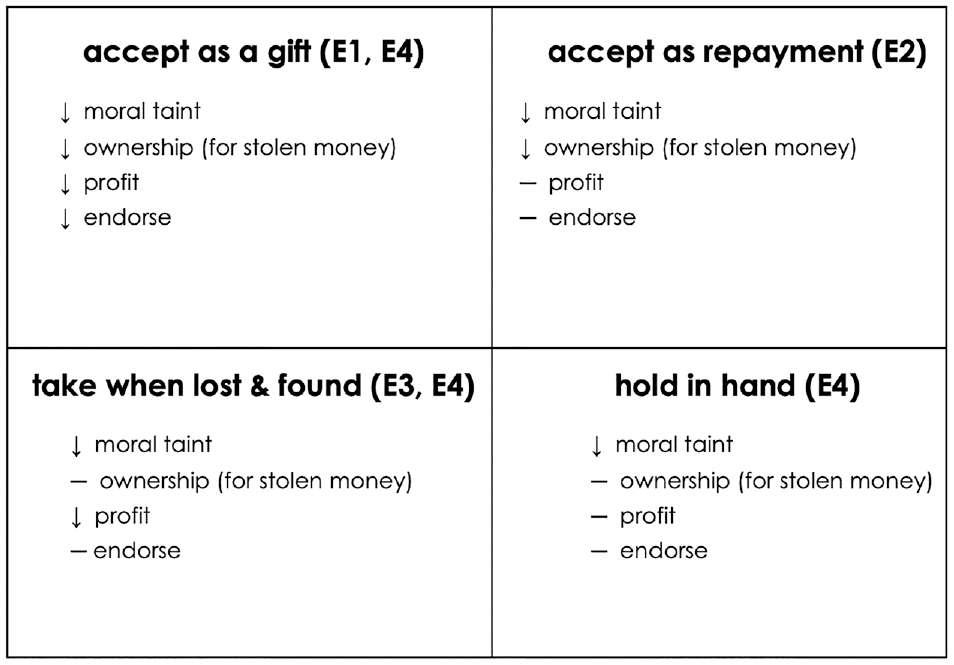
An Overview of Each Account’s Predictions Across Our Experiments
Participants were recruited using CloudResearch. In Experiments 1 to 3, we recruited slightly more than 100 participants because we hoped to have approximately 100 participants (based on Tasimi & Gelman, 2017) after exclusions, as these experiments were fully within-subject; in Experiment 4, we recruited slightly more than 100 participants per condition, as this experiment was fully between-subjects. Experiments 1 to 3 included three comprehension checks; we preregistered that we would exclude participants who failed these checks. However, the exclusion rates were high (e.g., 31% of participants in Experiment 1), and our analyses came out the same regardless of whether we included or excluded these participants (see Supplemental Materials). Thus, we report findings from all participants here. Note that Experiment 4 included one check, and there too, we report findings from all participants since excluding those who failed the question did not impact our analyses.
Experiment 1: Gift Money
Here we examined people’s willingness to accept different kinds of dirty money—either money that was stolen in different ways or money that was acquired by other unsavory means (e.g., selling drugs). The ownership account predicts that people should only be averse to dirty money that is stolen. By contrast, the moral taint, profit, and endorsement accounts predict that people should be averse to dirty money, stolen or not.
Method
Participants
We tested 106 participants (Mage = 39, 34% females and 63% males). A power analysis suggested we had 91% power to detect a significant two-way interaction (the highest-order effect tested) with an effect size of d = .15; see Supplemental Materials for further details about all power analyses.
Materials and Procedure
This experiment was fully within-subject. Participants saw 18 test scenarios in random order. In each scenario, a person obtains money in two different ways: by working in a café or a restaurant and through some other pursuit. Participants were told the person wanted to give them a $100 bill earned through one of these means and were asked to indicate how much they would want the $100 bill on a seven-point scale. Figure 2 shows a sample trial and the scale.
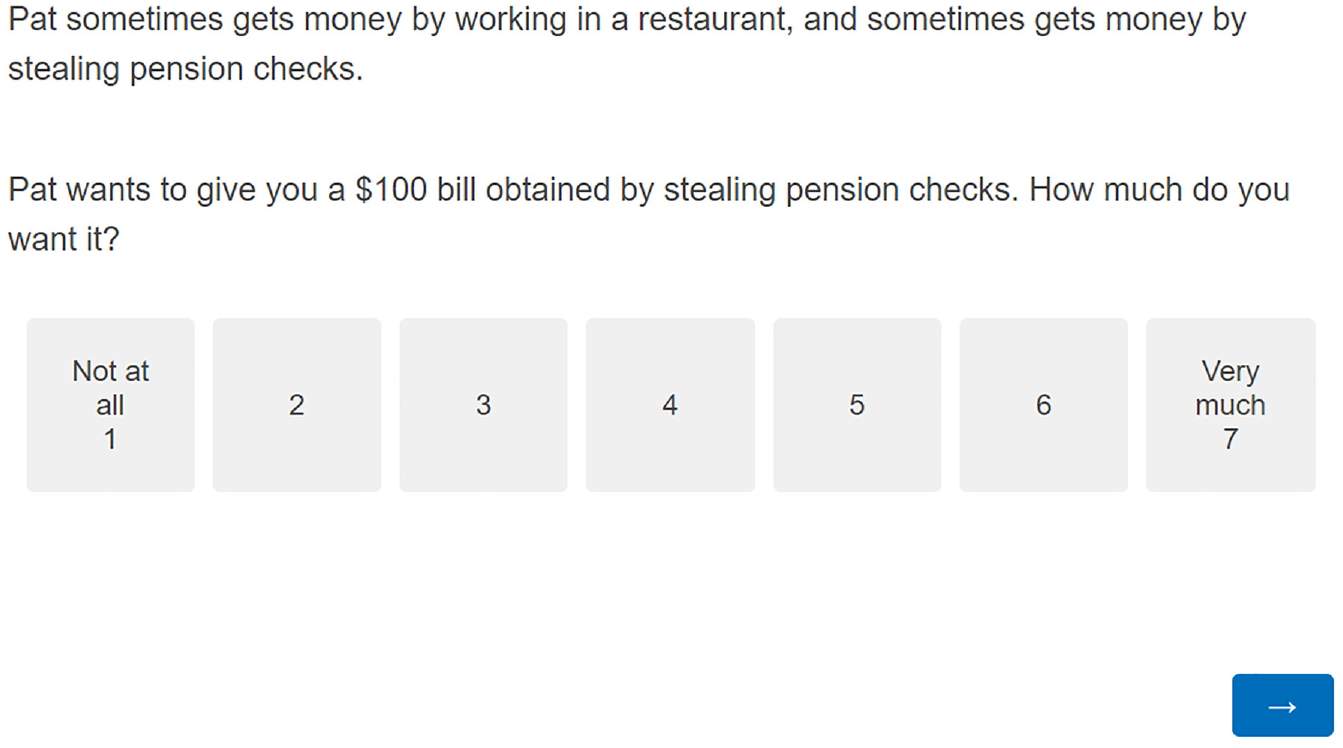
Sample Trial From Experiment 1
The experiment crossed two factors. One factor, giver-type, concerned the way the person in each scenario obtained money when not working in a restaurant or a café: (a) by stealing money or obtaining it in ways suggesting the giver does not own the money (stealing pension checks, robbing a convenience store, pickpocketing; henceforth, thief), (b) by other morally questionable means suggesting the owner does own the money (selling counterfeit goods, selling drugs, selling fake IDs; henceforth, criminal), or (c) through a morally acceptable job (working as a mail carrier, teacher, or garbage collector; henceforth, morally acceptable). 1 The other factor, money type, concerned whether the proffered $100 bill was obtained by working at a restaurant or a café, or through the giver’s other means of obtaining money.
The giver in each scenario had a different gender-ambiguous name, and the order in which the two means of obtaining money were first mentioned was randomized across trials for each participant. We also included two extra trials about a tarot card reader and a clown. These were included for the attention checks at the end of each experiment; see Supplemental Materials for more information.
Results and Discussion
In Experiments 1 to 3, we analyzed data using 3 (giver-type: thief, criminal, morally acceptable) × 2 (money-type: earned from restaurant or café, obtained in another way) generalized estimating equations models for linear data (independent correlation matrices).
Here the model revealed a main effect of money, F(1) = 141.01, p < .001, a main effect of giver, F(2) = 128.10, p < .001, and an interaction between these factors, F(2) = 69.71, p < .001; see Figure 3. This interaction resulted because money was preferred if it was earned from a restaurant or a café for thieves (Mdifference = 2.59, p < .001, 95% confidence interval [CI95%]: [2.16, 3.00]) and criminals (Mdifference = 2.20, p < .001, CI95% [1.80, 2.61]), whereas this difference was not significant for morally acceptable givers (Mdifference = 0.03, p = .579, CI95% [−0.06, 0.11]).
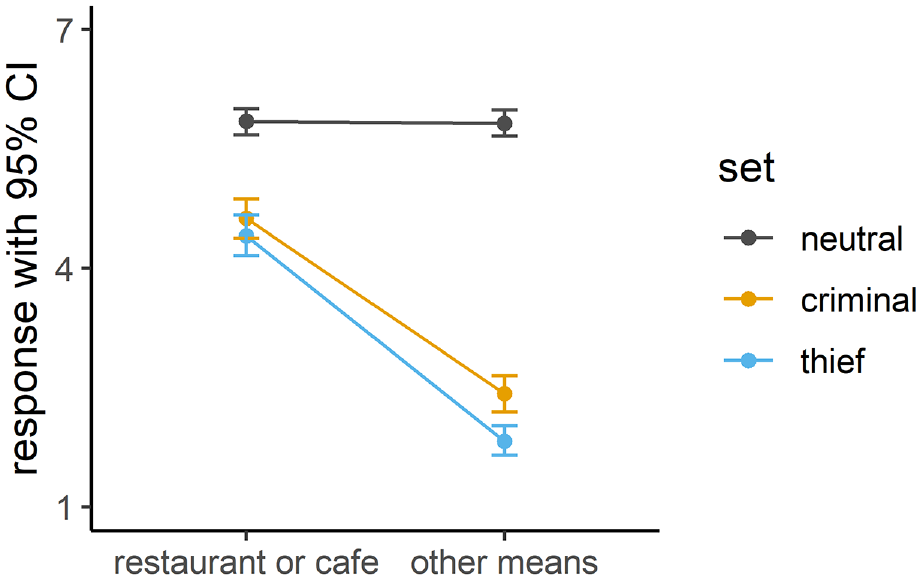
Mean Ratings From Experiment 1. Please refer to the online version for colored lines
Interaction contrasts also revealed that the effect of money type differed between each pair of givers: thieves > morally acceptable, Mdifference = 2.56, p < .001, CI95% [2.13, 2.99]; criminals > morally acceptable, Mdifference = 2.18, p < .001, CI95% [1.77, 2.59]; thieves > criminals, Mdifference = 0.38, p = .002, CI95% [0.14, 0.62]. The greater effect for thieves than criminals suggests an effect of ownership. But as Figure 3 shows, the influence of ownership was negligible—for thieves and criminals alike, participants wanted gift money when it was earned in a restaurant or café, but not when it was obtained illicitly.
In sum, participants disliked dirty money—stolen or otherwise. Although we found a small effect of ownership, it was a minor contributor to people’s aversion to dirty money. By contrast, these findings are consistent with a moral taint account, as it predicted that people would avoid money so long as it was acquired in unsavory ways. However, these findings might also be explained by the profit and endorsement accounts because a person who accepts dirty money profits and also could be seen as endorsing the means by which the money was acquired.
Experiment 2: Owed Money
Here we provided participants with a rationale for accepting dirty money—it was offered as a repayment for a debt. A moral taint account predicts the money should be undesirable (it is still tainted); the alternative accounts might not. After all, accepting owed money might not be viewed as a source of profit (the recipient breaks even). Indeed, in an additional study that we report in the Supplementary Materials (Experiment S5), we find that when asked if a repayment for a debt serves as a form of profit, participants disagreed. 2 Moreover, because the debt provides independent grounds for taking the money, accepting it might not be viewed as a sign of endorsement. Experiment S5 also found that accepting owed money was viewed as less of an endorsement than accepting gift money (as in Experiment 1).
Method
Participants
We tested 116 participants (Mage = 38, 48% females and 59% males). A power analysis suggested we had 93% power to detect a significant 2-way interaction (the highest-order effect tested) with an effect size of d = .15.
Materials and Procedure
The procedure was the same as in Experiment 1, with one exception. Here, participants were asked to imagine that the giver in each scenario owed them $100 and wanted to pay them back with money obtained through one of the two means they obtain money (e.g., “Imagine Blake owes you $100. To pay you back, Blake wants to give you a $100 bill obtained by stealing pension checks.”).
Results and Discussion
The model revealed a main effect of money, F(1) = 224.48, p < .001, a main effect of giver, F(2) = 137.48, p < .001, and an interaction between these factors, F(2) = 111.90, p < .001; see Figure 4. As in Experiment 1, the interaction resulted because money was preferred when it was earned from a restaurant or café for thieves (Mdifference = 3.45, p < .001, CI95% [3.01, 3.90]) and criminals (Mdifference = 2.79, p < .001, CI95% [2.36, 3.21]), while this difference was not significant for morally acceptable givers (Mdifference = 0.03, p = .327, CI95% [−0.03, 0.09]).
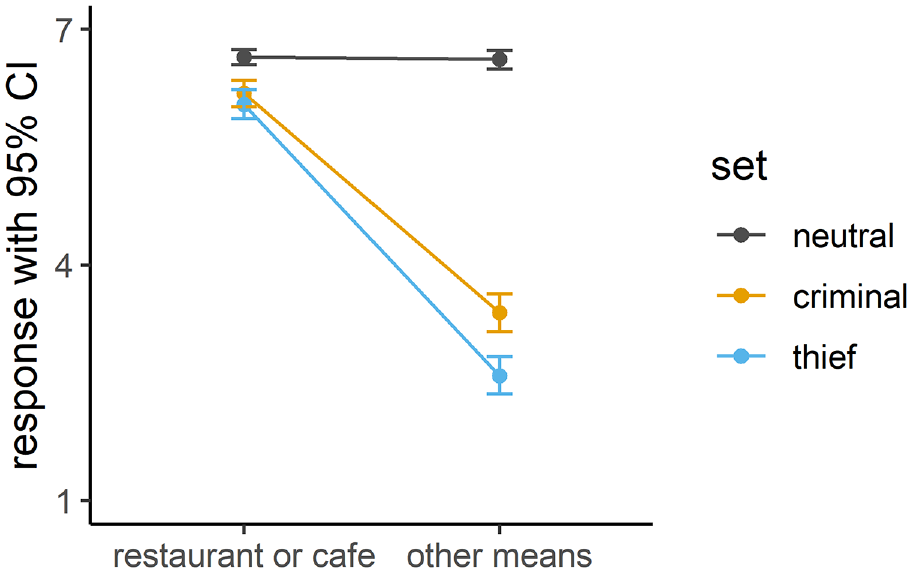
Mean Ratings From Experiment 2. Please refer to the online version for colored lines
Interaction contrasts found that the effect of money type differed between each pair of givers: thieves > morally acceptable, Mdifference = 3.42, p < .001, CI95% [2.97, 3.87]; criminals > morally acceptable, Mdifference = 2.76, p < .001, CI95% [2.33, 3.19]; thieves > criminals, Mdifference = 0.66, p = .002, CI95% [0.40, 0.93]. As in Experiment 1, the greater effect for thieves compared with criminals suggests an effect of ownership, but again, the effect was small. Whereas participants wanted owed money earned in a restaurant or café, they did not want it when it was obtained illicitly—stolen or otherwise.
In addition to replicating Experiment 1, these findings are consistent with the moral taint account, as participants were again averse to accepting dirty money. By contrast, these findings may not fit with the profit and endorsement accounts. On the profit account, people might be willing to accept the money offered as repayment for a debt because this does not strictly profit the recipient—instead, the recipient breaks even (as corroborated by Experiment S5). Likewise, on an endorsement account, accepting owed money might not suggest one tolerates the means by which it was acquired, since the debt provides an independent reason for accepting it. 3 However, we felt the profit and endorsement accounts warrant further attention.
Experiment 3: Found Money
We next asked participants to imagine finding dirty money. Here, the moral taint and profit accounts predict that people should not want it. Even when lost, dirty money retains its tarnished essence (e.g., Uhlmann & Zhu, 2013), and keeping the lost money counts as profit. By contrast, the endorsement account predicts people should be willing to take dirty money. After all, when the money is lost, the original owner does not voluntarily offer it (and presumably would want it back), so taking the money is hardly a way to endorse their actions. And indeed, in Experiment S5, participants disagreed that taking found dirty money could be interpreted as an endorsement of the immoral means by which the money was acquired.
Method
Participants
We tested 116 participants (Mage = 39; 52% females, 48% males). A power analysis suggested we had 93% power to detect a significant two-way interaction (the highest-order effect tested) with an effect size of d = .15.
Materials and Procedure
The procedure was the same as in the previous experiments, however, here, participants were asked to imagine that each giver dropped a $100 bill obtained by one of the two means they obtain money from on the sidewalk (e.g., “Imagine Blake dropped a $100 bill on the sidewalk without realizing it. Blake obtained the money by stealing pension checks. You find the $100 bill, and you can take it.”).
Results and Discussion
Participants’ ratings were notably different in Experiment 3 than in the previous experiments. The model revealed a main effect of a main effect of giver, F(2) = 15.07, p < .001, which resulted because participants gave similar ratings for money from thieves and criminals, Mdifference = 0.01, p = .998, CI95% [−0.30, 0.29], but preferred money from both of these kinds of givers over money from morally acceptable givers: thieves>morally acceptable, Mdifference = 0.88, p < .001, CI95% [0.58, 1.19]; criminals>morally acceptable, Mdifference = 0.89, p < .001, CI95% [0.59, 1.19]. There was no main effect of money, F(1) = 1.23, p = .263, and although there was a significant interaction between money and giver, F(1) = 4.57, p = .011, Figure 5 shows it was generally inconsequential. Consistent with this, we found no simple effects of money when separately examining ratings for each kind of giver: thieves, Mdifference = 0.00, p = .986, CI95% [−0.31, 0.31]; criminals, Mdifference = 0.27, p = .052, CI95% [0.00, 0.54]; morally acceptable, Mdifference = .05, p = .167, CI95% [ −0.02, 0.11].
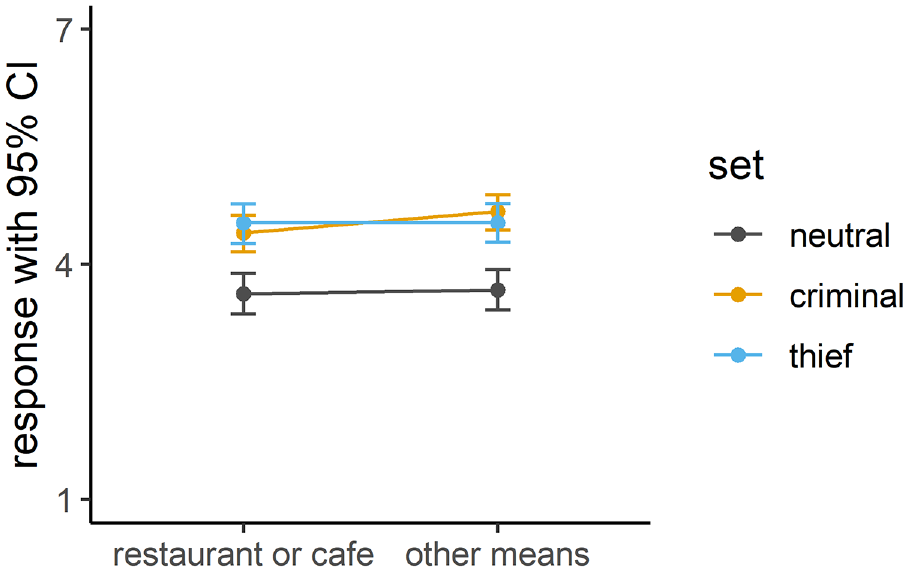
Mean Ratings From Experiment 3. Please refer to the online version for colored lines
Overall, participants were relatively willing to take dirty money. This finding was predicted by the endorsement account––it is difficult to view taking lost money as an endorsement of the means by which it was acquired. 4 By contrast, these findings were not predicted by the moral taint and profit accounts; when dirty money is found on the ground, taking it means accepting its taint and also serves to profit the finder.
Experiment 4: Gift Money, Found Money, Touched Money
We conducted a final experiment to further investigate the moral taint and endorsement accounts and to address potential issues with the previous experiments. While the previous experiments used within-subjects designs to separately examine different means of acquiring money, this experiment uses a between-subjects design to directly compare gift money and found money. More importantly, this experiment added a condition where participants consider holding money in their hand. Prior work has shown that people are resistant to holding morally tainted objects like a dictionary that belonged to Hitler (e.g., Fedotova & Rozin, 2018; for a review see Huang et al., 2017). We wanted to know if participants would be less willing to hold money if it was earned nefariously than honestly and whether this difference is equivalent to the gap expected when participants consider accepting gift money.
Method
Participants
We tested 630 participants (Mage = 41; 45% females, 53% males). A power analysis suggested we had 83% power to detect a significant 2-way interaction (the highest order effect we tested) with an effect size of d = .15.
Materials and Procedure
Participants saw a single scenario about Jesse, who obtains money by selling drugs and by working in a restaurant. The scenario specified that Jesse had a $100 bill and that participants knew how it had been obtained—either by selling drugs or by working at a restaurant (manipulated between-subjects). Participants then indicated how willing they would be to take one of 3 actions relating to the bill (also manipulated between-subjects): (a) taking the bill if Jesse offered it as a gift, (b) holding it in their hand for a few minutes, or (c) taking it if Jesse dropped it on the ground without realizing it. Participants responded on the seven-point scale used in the other experiments.
Results and Discussion
A 2 × 3 between-subjects analysis of variance revealed a main effect of money type, F(1, 624) = 16.89, p < .001, ηp 2 = .03, a main effect of action, F(2, 624) = 42.70, p < .001, ηp 2 = .12, and a significant interaction between these factors, F(2, 624) = 24.52, p < .001, ηp 2 = .07; see Figure 6. The interaction resulted because participants gave higher ratings for restaurant money than drug money when indicating their willingness to accept money as a gift (Mdifference = 1.31, p < .001, CI95% [0.74, 1.89]) or to hold it (Mdifference = 1.72, p < .001, CI95% [1.15, 2.30]), while they gave higher ratings for drug money when indicating their willingness to take money that had been lost (Mdifference = −0.96, p = .001, CI95% [−1.53, −0.39]). An interaction contrast revealed that the effect of money type did not significantly differ on the basis of whether participants considered accepting it as a gift or holding it, p = .319.
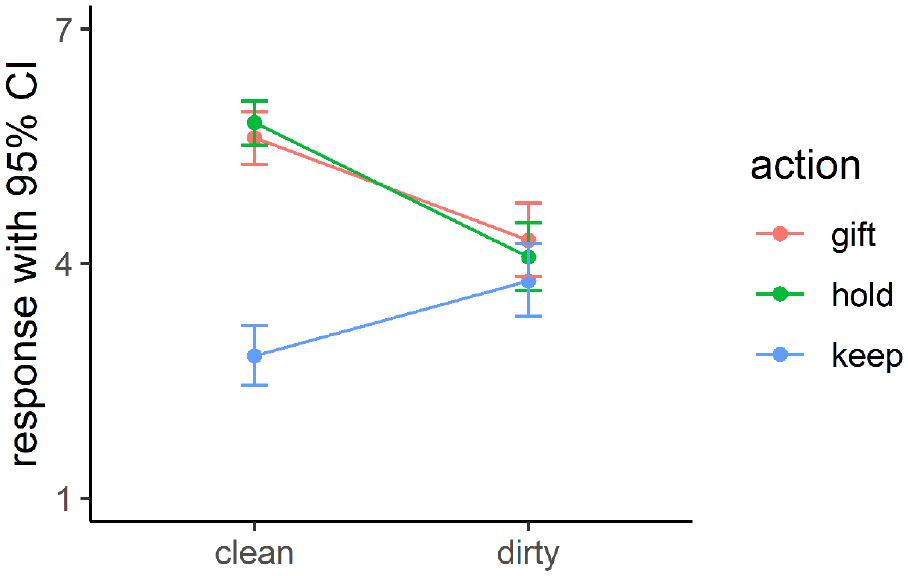
Mean Ratings From Experiment 4. Please refer to the online version for colored lines
Also, with clean money (i.e., earned in a restaurant), ratings did not significantly differ between accepting a gift or holding (Mdifference =−.20, p = .777, CI95% [−0.88, 0.49]), with both ratings higher than those for taking the money when it had been found (gift > found, Mdifferences = 2.79, p < .001, CI95% [2.11, 3.47]; hold > found, Mdifferences = 2.99, p < .001, CI95% [2.30, 3.67]). With dirty money, ratings for all three actions did not significantly differ from one another (ps > .184.)
As we consider below, these findings suggest that the moral taint and endorsement accounts both contribute to people’s aversion toward dirty money. Reluctance to accept gifts of dirty money is explained by both accounts; reluctance to hold dirty money is explained by the moral taint account but not the endorsement account; and relative willingness to take found dirty money fits with the endorsement account but not the moral taint account.
General Discussion
We investigated why people are averse to dirty money. Participants disliked money offered by thieves and other criminals, and this aversion was particularly strong when the giver had acquired these proceeds through immoral means than through honest means. We also found that participants were unwilling to hold dirty money in their hand. However, participants were relatively willing to acquire dirty money when they had found lost money and could choose to take it. Altogether, these findings lend support to both the taint and the endorsement accounts while casting doubt on the ownership and profit accounts. We consider each account below.
Ownership
This account predicts that people’s aversion to dirty money is specific to situations where the money was stolen—the situation often explored in research showing that people are reluctant to accept dirty money (see Tasimi & Gelman, 2017, 2021) Although we saw some sensitivity to ownership when examining judgments about owed money in Experiments 1 and 2, these effects were very small. Overall, people did not want to accept offers of dirty money regardless of whether it was stolen or obtained in other unsavory ways.
Ownership could matter in other ways. The very question of whether people are willing to accept dirty money is itself about the kinds of things they are willing to acquire and own, suggesting that concerns about ownership could play into people’s aversion to dirty money in other ways. But even here our findings did not appear to hinge on ownership. For example, in Experiment 4 (which focused on money earned from selling drugs), concerns about dirty money were no less pronounced with ownership taken out of the picture; participants were just as reluctant about holding dirty money as they were about accepting it as a gift.
Profit
This account predicts that people’s reluctance to dirty money stems from an aversion to profiting from moral transgressions. We found little support for this account. First, participants were reluctant to accept dirty money when it was owed in Experiment 2, even though repayment of debts is not viewed as a form of profiting (a claim substantiated by Experiment S5). Second, participants were relatively willing to accept dirty money that had been found, although keeping found money surely counts as a kind of profit (as also confirmed by Experiment S5). And finally, participants were just as averse to briefly holding dirty money as accepting it as a gift, even though holding dirty money does not provide any profit. Note that these findings also do not support a broader account wherein participants are not just averse to profiting from dirty money, but also averse to benefiting from it; this “benefit account” does not fit well with people’s relative willingness to take dirty money that was found or their aversion to briefly holding it.
Moral Taint
This account links people’s aversion to dirty money with psychological essentialism and concerns about contagion (e.g., Gelman, 2003, 2013; Newman et al., 2011; Rozin & Royzman, 2001). On this view, people are reluctant to accept dirty money because they see it as retaining traces of its nefarious history. This account can explain many of our findings and was most directly supported by participants’ unwillingness to hold dirty money in their hands in Experiment 4. Indeed, a reluctance to hold or touch objects like Hitler’s dictionary or a sweater belonging to one’s enemy has been viewed as evidence that people see objects as bearing unwanted traces of their histories (e.g., Fedotova & Rozin, 2018; Huang et al., 2017; Rozin et al., 1986; Rozin & Nemeroff, 1990). Nonetheless, the moral taint account cannot readily explain why participants were relatively willing to keep dirty money when it was found. This finding suggests that multiple factors feed into people’s aversion to accepting dirty money, among them, an endorsement account as we consider next.
Endorsement
This account suggests that people’s aversion to dirty money reflects beliefs that accepting dirty money is tantamount to endorsing (or morally tolerating) the illicit means by which it was acquired. This account predicted that while people would be reluctant to accept offers of dirty money, they would be relatively willing to take dirty money when it was found, as taking found dirty money does not signal an endorsement of how it was acquired any more than penalties and fines signal endorsement of the deeds they punish. Nonetheless, some of our findings were not predicted by this account. For example, participants were reluctant to accept offers of dirty money when they had independent grounds for accepting it because it was offered as a repayment for a debt. Our preregistration of Experiment 2 noted that dirty money offered as repayment may be less likely to be viewed as an endorsement of the way it was acquired, and Experiment S5 also provided some support for this claim.
Further Issues
Additional factors could influence people’s aversion to dirty money and the contexts where they are relatively willing to accept it. For example, our treatment of the endorsement account focused on the idea that people reject dirty money because they do not want to endorse the means by which the money was acquired. But this account may have other sides. Indeed, people might want to punish the immoral giver or communicate to them (and/or others) that they disapprove of how the money was acquired, a possibility that blends rejecting dirty money with communicative and expressive functions of punishment (e.g., Dunlea & Heiphetz, 2021; Feinberg, 1965; Funk et al., 2014; Sarin et al., 2021). If this is the case, we would expect people’s reasoning about dirty money to differ between public and private contexts, as has been the case for other immoral stimuli (e.g., wearing Nazi clothing; see Kupfer & Giner-Sorolla, 2021; also see Fedotova & Rozin, 2018).
Future work might also explore how concerns about taint and endorsement interact with one another in people’s reasoning about dirty money. Existing work on dirty money—and related forms of money—has found that people would prefer to spend money acquired under negative circumstances on virtuous causes, like donations to charities (e.g., Levav & McGraw, 2009; Siegel et al., 2022; Tasimi & Gelman, 2017; Zelizer, 1994). Such findings likely connect with both moral taint and endorsement accounts. For example, people might see giving dirty money to virtuous causes as cleansing its taint (Imas et al., 2021; Zelizer, 1994), and they might also see this form of spending as reducing the sense that one endorses how it was acquired.
More than anything, we hope our work highlights the importance of engaging with the multiple causal accounts that may be operating when people reason about dirty money. Although our investigation attempted to bring these various accounts together, future research could ask the same individuals to (a) provide ratings of how much they believe different actions (e.g., accepting drug money as a gift) correspond to different accounts (as we do in Experiment S4) and to (b) respond to the various scenarios reported here. With this approach, we can also illuminate whether these accounts may come together differently for different people, and thus shed light on potential individual differences.
Conclusion
To conclude, we would be remiss if we did not highlight the merits of our adversarial collaboration. While neither of us anticipated the outcome reported here—that people’s aversion to dirty money is shaped by both a moral taint account and an endorsement account—we were able to land on this insight because our collaboration opened each of us to the opposing view, which, in turn, prompted us to consider other views as well.
Supplemental Material
sj-docx-1-spp-10.1177_19485506231167231 – Supplemental material for An Adversarial Collaboration on Dirty Money
Supplemental material, sj-docx-1-spp-10.1177_19485506231167231 for An Adversarial Collaboration on Dirty Money by Arber Tasimi and Ori Friedman in Social Psychological and Personality Science
Footnotes
Acknowledgements
The authors thank Susan Gelman, Sam Johnson, and Nina Strohminger for their feedback on a previous version of this manuscript. Thanks to Brandon Goulding as well for suggesting Experiment 3.
Handling Editor: Mallett, Robyn
Declaration of Conflicting Interests
The author(s) declared no potential conflicts of interest with respect to the research, authorship, and/or publication of this article.
Funding
The author(s) received no financial support for the research, authorship, and/or publication of this article.

Data Availability statement
Supplemental Material
The supplemental material is available in the online version of the article.
Notes
Author Biographies
References
Supplementary Material
Please find the following supplemental material available below.
For Open Access articles published under a Creative Commons License, all supplemental material carries the same license as the article it is associated with.
For non-Open Access articles published, all supplemental material carries a non-exclusive license, and permission requests for re-use of supplemental material or any part of supplemental material shall be sent directly to the copyright owner as specified in the copyright notice associated with the article.
