




Abstract
Western conservatives are more focused on the past than are liberals: They experience stronger cultural pessimism and nostalgically yearn back for past society. We test the hypothesis that this ideological difference reflects long-term national-historical developments, by comparing ideological differences in the United States and Türkiye. Using archival data, Study 1 confirms that whereas U.S. society over the last century moved in a liberal direction, Turkish society recently shifted toward greater conservatism. Consistent with predictions, Studies 2 and 3 show that the relationship between political ideology and cultural pessimism is reversed in Türkiye, compared with the United States. Partially consistent with predictions, in both studies, the link between ideology and a nostalgic yearning for the past is attenuated (and essentially blocked) in Türkiye, although not reversed, compared with the United States. Together, these findings suggest that ideological differences in pessimism and nostalgia reflect, at least partially, objective differences in national-historical development.
In his 2022 fourth of July speech, President Joe Biden (2022) stated, “Make no mistake, our best days still lie ahead.” Expressing his belief that America should deal with its current issues by moving in new directions, the Democrat pointed toward the future as a source of hope and inspiration. In contrast, in his inaugural speech, former President Donald Trump (2017) pointed in the opposite temporal direction and proposed to Make America Great Again by returning it to the past. This points to a fundamental distinction between conservatives’ and liberals’ dominant temporal focus: To find inspiration for their political ideas, liberals focus predominantly on the future, while conservatives instead focus on the past. In the current work, we test whether this difference in temporal focus is limited to Western liberals and conservatives—and whether the link may also be different in other cultures.
Sociohistorical Moderators
In the West, this difference in temporal focus can be traced back to the philosophical roots of the two political movements, with liberalism being born out of a desire for change and conservatism out of the urge to resist that change and stick with the past (Ball & Bellamy, 2003; Lammers & Proulx, 2013; McClelland, 2005; Muller, 1997). Western conservatives experience a sense of cultural pessimism and feel that society is heading in the wrong direction (Bennett, 2001; Jost et al., 2003; Steenvoorden & Harteveld, 2018; Tomkins, 1963, 1965) As a result, conservatives and others on the right side of the political spectrum are more prone to feelings of nostalgia than are liberals and others on the (Lammers & Baldwin, 2018; Smeekes et al., 2018, 2023; Smeekes & Verkuyten, 2015). In fact, these feelings of nostalgia run so deep that merely changing how a policy proposal is framed in relation to time can shift conservatives’ and liberals’ opinions about it. For example, framing pro-environmental policies or gun-control laws as a return to a greener or less violent past, rather than a greener or less violent future, increases American conservatives’ support for these policies (Baldwin & Lammers, 2016; Lammers & Baldwin, 2018; but see Kim et al., 2021; Stanley et al., 2021).
But in other cultural settings, this relationship may be different. Individual variation in ideological beliefs is not only due to intrapsychic processes but is also, in part, shaped by a collective representation of the historical trajectory of society (Durkheim, 1924). Over the course of their lives, children learn the structure and meaning of ideologies and other higher-order concepts through their interactions with parents and others (Erikson, 1950; Vygotsky, 1962, 1978; see also Peterson & Lane, 2001; Peterson et al., 1997). Because these interactions occur in specific sociohistorical contexts, cultural differences can emerge in the ideological beliefs and associations that people learn. In particular, because different countries follow different sociohistorical trajectories, the associations that people may form with the past may also differ strongly between societies. As a result, political factions that share similar ideological positions with their ideological peers in other countries may develop radically different perspectives on the past and future. We propose that a particularly interesting comparison in this light is between the West and the Republic of Türkiye (formerly Turkey).
The West: Greater Liberalism
In much of the Western world, including the United States, societies have moved in the last century in a liberal direction. Despite exceptions such as economic deregulation and harsher criminal punishment, American and other Western societies have moved in a liberal direction toward greater secularism, equal rights, and tolerance (Smith, 1990). People have become more tolerant toward women, minorities, and LGBTQ+ (Charlesworth & Banaji, 2021). Individual freedom to make one’s own life decisions has greatly expanded (Cherlin, 2004; Hicks & Lee, 2006; Loftus, 2001; Santos et al., 2017). And although sexism continues to affect society, it has retreated from the blatant restricting of women’s rights to more subtle and covert forms (Benokraitis & Feagin, 1986; Swim et al., 1995). Given these trends toward greater liberalism and away from traditional, conservative norms, we expect that U.S. conservatives experience a sense of pessimism about the direction their country is heading and therefore feel nostalgic for the past.
Türkiye: Greater Conservatism
The Republic of Türkiye was founded in 1923 after a revolution that brought the end of the traditional Ottoman Empire. Its first leader, President Kemal Atatürk, initiated a rigorous program of modernization. Inspired by Western liberalism and secularism, he, for example, introduced compulsory primary education and equal rights for women (Landau, 1984). Although this Kemalist modernization has been the dominant force guiding Turkish politics for much of the 20th century, the last decades have seen a rise in conservatism that has challenged this transformational process (Benhabib, 2013). In particular, the Turkish conservatives currently in political power and centered on the Justice and Development Party (AKP) have embraced a more traditional, Ottoman-inspired religious society that does not share the earlier enthusiasm about Kemalist modernization (Özbudun, 2006; Yavuz, 2020). Instead, Turkish conservatives have broken with the secularist tradition of the past and have moved their country instead to a more religious “New Turkey” (Elçi, 2022; Kaya, 2015). As a result, we expect that Turkish conservatives do not share the cultural pessimism of Western conservatives. Instead, we expect that in Türkiye, liberals are more likely to feel pessimistic about the direction of their society and therefore more likely to experience a nostalgic desire for the Turkish society of the recent past.
Summary and Overview of Studies
Earlier work conducted in the West links political conservatism (and those on the right side of the political spectrum in general) to pessimism, nostalgia, and an appeal to ideas that are framed as a return to the past (Baldwin & Lammers, 2016; Lammers & Baldwin, 2018, 2020; Smeekes et al., 2018, 2023; Smeekes & Verkuyten, 2015; Tomkins, 1963, 1965). Here we test the prediction that this relationship differs between the West and Türkiye, given differences in historical trajectories. Study 1 analyzes archival data to confirm our prediction about these different sociohistorical trajectories between Türkiye and the United States. Study 2 tests whether ideological differences in cultural pessimism and nostalgia differ between the two countries. We predict that a conservative (vs. liberal) political identity positively predicts cultural pessimism and nostalgia in the United States, but negatively in Türkiye. Study 3 tests the consequences this has for the replicability of temporal framing effects. We predict that in the United States, conservatives prefer political ideas that are framed as a return to the past (over those framed as moving away from the past), compared with liberals (replicating Lammers & Baldwin, 2018), but we also predict that this temporal framing effect is reversed or at least attenuated in Türkiye.
All studies were preregistered. We report how we determined sample size, all data exclusions, all manipulations, and all measures. These studies were the only studies conducted as part of this research line and therefore there is no file-drawer effect. 1 For readability, we summarize deviations from the preregistrations below per study but report them in more detail in the Online Supplemental Material (SOM). All data, materials, and analysis scripts are publicly available via this link: https://osf.io/teb8a/
Study 1: Historical Differences Between Türkiye and the United States
Method
To test our prediction that the United States has continued its course toward a more liberal society with greater liberties for minorities, while Turkish society has in recent decades changed course toward the opposite direction, we gathered publicly available data taken from the Varieties of Democracy Institute at https://www.v-dem.net (Coppedge et al., 2022). In particular, we test differences in the Liberal Component Index (LCI) across the current and last centuries. This index captures the degree to which a society protects individual and minority rights against any tyranny by the state and majority groups, through the effective influence of checks and balances on the executive. We preregistered this analysis here: https://aspredicted.org/dc5gd.pdf
Results
A polynomial linear regression predicting linear and quadratic effects of year (1900–2021, standardized) on the LCI in the United States showed only a significant linear effect, blinear = 0.077, SE = 0.015, β = .796, t(118) = 5.29, p < .0001, 95% confidence interval (CIb) [0.048, 0.106], but no significant quadratic effect, bquadratic = 0.006, SE = 0.008, β = .107, t(118) = 0.71, p = .480, 95% CIb [−0.011, 0.023]. In contrast, a polynomial linear regression of the effect of year on the LCI in Türkiye showed not only a significant linear effect, blinear = 0.670, SE = 0.077, β = 1.952, t(118) = 8.73, p < .0001, 95% CIb [0.518, 0.822], but also a significant negative quadratic effect, bquadratic = −0.266, SE = 0.045, β = −1.133, t(118) = −5.96, p < .0001, 95% CIb [−0.354; −0.177]. As can be seen in Figure 1, the data support the idea that whereas the United States continued its course toward greater liberalism, Türkiye recently reversed its historical course.
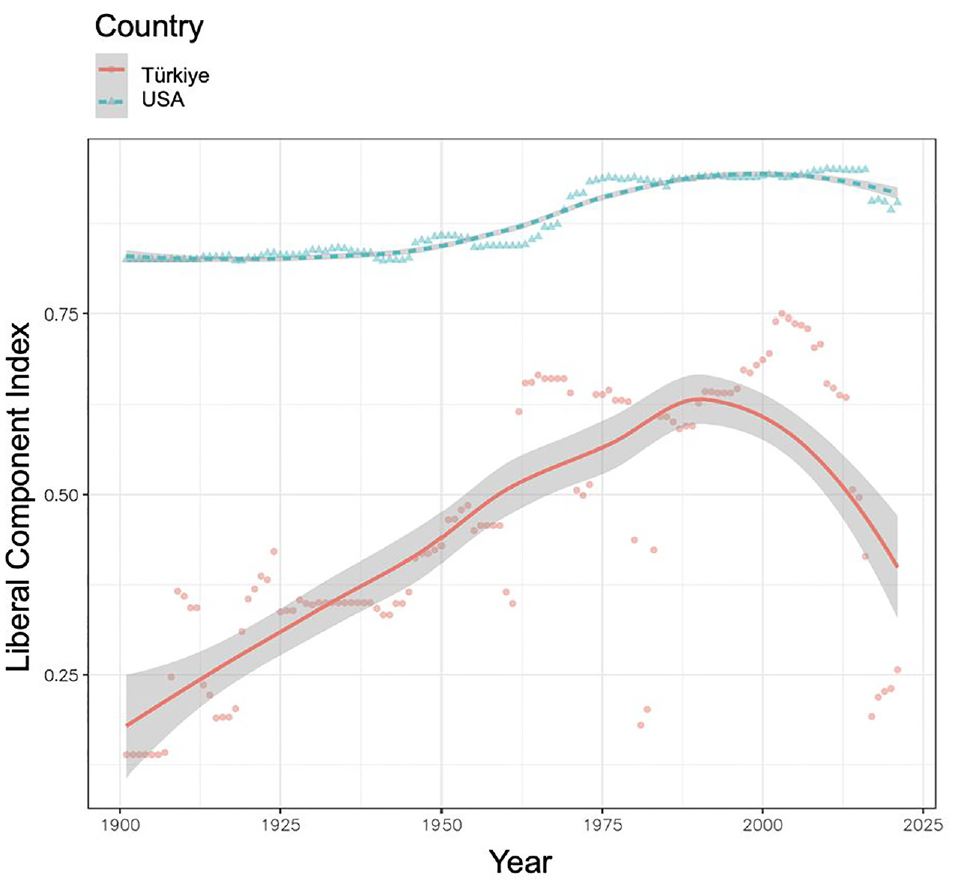
Study 1: Liberal Component Index in Türkiye (Red, Solid Line/ Dots) and the United States (Blue, Dashed Line/ Triangles) Over Time. Lines Indicate Non-Parametric Regression Coefficients (and Their 95% Confidence Intervals) Within Each Country. Data Are Vertically Jittered to Avoid Overplotting
Study 2: Ideological Differences in Pessimism and Nostalgia
Building on Study 1’s findings that the United States and Türkiye have moved in opposite directions, we test in Study 2 the idea that in contrast to the United States, Turkish liberals would experience greater cultural pessimism and nostalgia than conservatives.
Method
Participants and Design
We recruited 300 American and 300 Turkish participants in return for a compensation of US$1 or TL17. Sample size was set a priori based on Schönbrodt and Perugini’s (2013) recommendation that N = 300 provides about 80% power to detect most correlations. American participants were recruited via CloudResearch Prime Panels (https://www.cloudresearch.com/products/prime-panels/) and using the various data quality tools offered by that service (Litman et al., 2017). Turkish participants were recruited via NG Research (https://ngteknoloji.com/en/), a professional online data collection agency from Istanbul. The study was administered in the local language in December 2021. Following preregistered exclusion criteria, https://aspredicted.org/pq456.pdf, we analyzed 579 valid cases (299 Americans and 280 Turkish; 257 women, 321 men, one other; mean age = 41.4 years). In addition to country (United States vs. Türkiye), we measured political ideology (continuous) as a second independent variable.
Measures
Political Ideology
Participants indicated their political ideology on a single 7-point Likert-type item (M = 3.72; SD = 1.96) between very liberal (1) and very conservative (7), consistent with similar research into political differences in temporal focus (Baldwin & Lammers, 2016; Lammers & Baldwin, 2018, 2020).
Cultural Pessimism
Participants completed Holbrooke’s (1993) eight-item measure (α = .763; M = 4.97; SD = 1.33; αUSA = .784, αTürkiye = .656). Originally conceived as a measure of nostalgia (see the preregistration), later findings reinterpreted it as a measure of cultural pessimism (Hallegatte & Marticotte, 2014). We follow this and therefore treat it as a measure of cultural pessimism. Example items are, Things used to be better in the good old days, History involves a steady improvement in human welfare (recoded), and We are experiencing a decline in the quality of life (all between 1 = strongly disagree and 9 = strongly agree).
Nostalgia Proneness
We measured Baldwin and colleagues’ (2015) 16-item measure of nostalgia (α = .916; M = 3.62; SD = 0.82; αUSA = .899, αTürkiye = .928) but consistent with Baldwin et al. (2015), we preregistered our particular interest in the four-item collective nostalgia subscale which measures the self-reported frequency of feelings of nostalgia for past society, its morals and values, its people, and its social system (α = .932; M = 3.30; SD = 1.25; αUSA = .932, αTürkiye = .925). In the SOM, we also include analyses for the 16-item scale, which are similar.
Other Measures
We also included the 16-item Social Dominance Orientation scale (SDO-16; Pratto et al., 1994) and the 10-item Resistance to Change-Beliefs Scale (RC-BS; White et al., 2020). These are discussed in the SOM.
Results
Cultural Pessimism
A linear regression testing the effect of participants’ political ideology (centered), country (dummy-coded, 0 = Türkiye, 1 = United States), and their interaction on pessimism showed the predicted interaction effect, b = 0.401, SE = 0.050, β = .408, t(574) = 7.96, p < .0001, 95% CIb [0.302, 0.500]. In the United States, conservatives were more pessimistic than liberals, b = 0.221, SE = 0.037, β = .325, t(296) = 5.91, p < .0001, 95% CIb [0.147, 0.295], while in Türkiye, the opposite was the case, b = −0.180, SE = 0.034, β = −.305, t(278) = −5.34, p < .0001, 95% CIb [−0.246; −0.113]. See Figure 2.
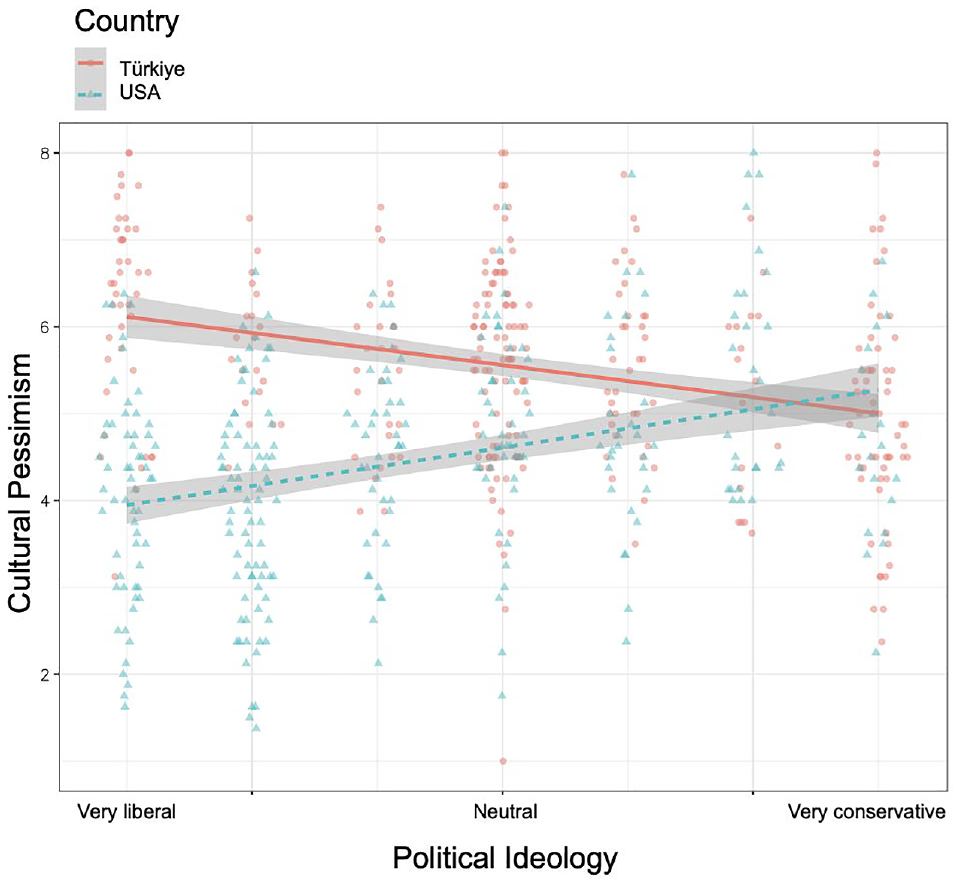
Study 2: In the United States (Blue, Dashed Line/ Triangles), Conservatives (Right) Are More Pessimistic About Their Country Than U.S. Liberals (Left), but in Türkiye (Red, Solid Line/ Dots), the Opposite Is the Case. Data-Points Are Jittered to Avoid Overplotting. Lines Indicate Regression Coefficients (and Their 95% Confidence Intervals) Within Each Country
Collective Nostalgia
A linear regression testing the effect of participants’ political ideology (centered), country (dummy-coded, 0 = Türkiye, 1 = United States), and their interaction on the four-item Collective Nostalgia subscale, the predicted Country × Ideology interaction was significant, b = 0.267, SE = 0.050, β = .289, t(574) = 5.30, p < .0001, 95% CIb [0.168, 0.366]. Replicating earlier work (Lammers & Baldwin, 2018), American conservatives reported experiencing more intense feelings of collective nostalgia than did liberals, b = 0.270, SE = 0.034, β = .420, t(296) = 7.95, p < .0001, 95% CIb [0.203, 0.337], but this relation was not there among Turkish participants, b = 0.003, SE = 0.037, β = .005, t(278) = 0.080, p = .937. See Figure 3.

Study 2: In the United States (Blue, Dashed Line/ Triangles), Conservatives (Right, Solid Line/ Dots) Are More Nostalgic Than U.S. Liberals (Left), but in Türkiye (Red, Solid Line/ Dots), This Effect Is Not Found. Data-Points Are Jittered to Avoid Overplotting. Lines Indicate Regression Coefficients (and Their 95% Confidence Intervals) Within Each Country
Moderated Mediation
We explored whether the effect on collective nostalgia was mediated by cultural pessimism, using Model 8 of the PROCESS Macro (Hayes, 2017; 5,000 bootstrap samples), using ideology as independent variable, country as moderator, pessimism as mediator, and collective nostalgia as dependent variable. This analysis was not preregistered. This showed significant evidence of moderated mediation, b = 0.064, SE = 0.021, 95% CIb [0.026, 0.107]. In the United States, a conservative (vs. liberal) ideology produced a positive indirect effect on collective nostalgia via pessimism, b = 0.035, SE = 0.012, 95% CIb [0.014, 0.613], but in Türkiye, a conservative (vs. liberal) ideology produced a negative indirect effect on collective nostalgia via pessimism, b = −.285, SE = 0.010, 95% CIb [−0.051; −0.010]. See Figure 4.
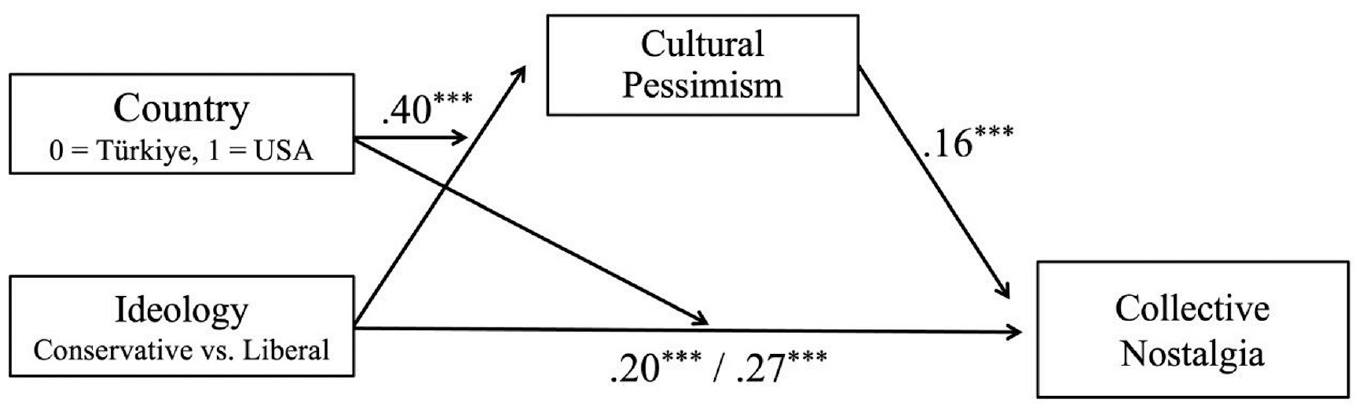
Study 2: Results of a Moderated Mediation Regression Analysis (PROCESS, Model 8). Conservatives Experience Stronger Feelings of Collective Nostalgia Than Liberals, but Only in the United States and Not in Türkiye, Because U.S. Conservatives Are More Pessimistic Than Liberals in the United States, but Less Pessimistic in Türkiye. Numbers Indicate b-Values and Their Significance
Study 3: Ideological Differences in Pessimism and Temporal Framing
Study 2 showed that in Türkiye, ideological differences in pessimism are reversed, and ideological differences in nostalgia are essentially blocked, compared with the United States. Drawing on these results, Study 3 now tests whether this country-difference similarly moderates the relation between conservatism and a preference for past-focused temporal frames. Earlier research found that Western conservatives prefer political ideas that are framed as a move back to the past, rather than a move toward a new future, even if the content remains the same (Lammers & Baldwin, 2018). ӧere, we test whether this framing effect is similarly attenuated in Türkiye, compared with the United States.
Method
Participants and Design
We recruited 421 American and 421 Turkish participants in return for a compensation of US$1 or TL17, and again via CloudResearch (United States) and NG Research (Turkey). We set our a priori sample size to 800 and oversampled to meet that target even after any unplanned deletion to have 80% power to detect a small interaction (f = .1). The study was administered in the local language in July 2022. Following our preregistration, https://aspredicted.org/zt48w.pdf, we deleted responses of participants who recommended doing so because of their inattentiveness, leaving 795 valid cases (359 women, 436 men, 0 other; M age = 37.9 years), of which 419 were Americans and 376 Turkish. In addition to country (United States vs. Türkiye), we measured political ideology (continuous) as a second independent variable and measured participants’ response to two stimuli that differed in their temporal frame (past-focused vs. future-focused; within participants, counterbalanced).
Procedure and Measures
Political Ideology
Participants indicated their political ideology on two 7-point Likert-type items between very liberal (1) and very conservative (7) and between very left-wing (1) and very right-wing (7). These items correlated well, rcombined = .783, rUSA = .855, rTürkiye = .653, ps < .0001.
Temporal Frame Manipulation
Next, participants were presented with two fictional statements by two politicians who offered an abstract description of the ideas for the country. The statements of the two politicians were framed using two different temporal foci (within participants; counterbalanced order). We kept the content of the policy, deliberately vague, to avoid that this would affect the results. Specifically, in the past- (vs. future-) focused frame condition, the statement reads as follows: My political ideas are inspired by my desire to maintain (move away from) the past. We should respect and follow our country’s tradition (find new options for our country). My goal is to build a bridge to the past (future) with established (by establishing new) norms and values. Let’s move our country back (forward) to the old days (a new future)!
Measures
Participants indicated their attitudes toward each politician’s statement, using two sets of four 7-point Likert-type items measuring whether participants agreed and liked them, whether participants expected that they would perform well in office, and whether participants would be inclined to vote for them. For simplicity, we calculated a single difference score by subtracting these two indices, where positive values indicate a relatively more positive attitude toward the past- than toward the future-focused politician, and negative values the opposite (α = .884; M = −1.12, SD = 2.55; αUSA = .920, αTürkiye = .800). Participants also again completed Holbrooke’s (1993) eight-item measure (α = .795; M = 4.69, SD = 1.38; αUSA = .802, αTürkiye = .694), which we again used as a measure of cultural pessimism (as in Study 2). Finally, we asked participants to indicate what year in the past they were thinking of, between 1765 and 2022. These are discussed in the SOM.
Results
Cultural Pessimism
We first tested the replicability of Study 1’s finding, by conducting the same regression analysis of the effect of political ideology (centered), country (dummy-coded, 0= Türkiye, 1= United States), and their interaction on cultural pessimism. We replicated the predicted interaction effect, b = 0.508, SE = 0.049, β = .504, t(783) = 10.28, p < .0001, 95% CIb [0.411, 0.604], in addition to the same main effect of country observed in Study 1, b = −1.128, SE = 0.086, β = −.408, t(783) = −13.10, p < .0001, 95% CIb [−1.297; −0.959]. Separate regressions within each country showed that a conservative (compared with liberal) political ideology was associated with stronger pessimism in the United States, b = 0.296, SE = 0.030, β = .430, t(417) = 9.73, p < .0001, 95% CIb [0.236, 0.355], but had the opposite effect in Türkiye, b = −0.212, SE = 0.039, β = −.272, t(366) = −5.41, p < .0001, 95% CIb [−0.289; −0.135]. These results replicate those of Study 2. See Figure 5.
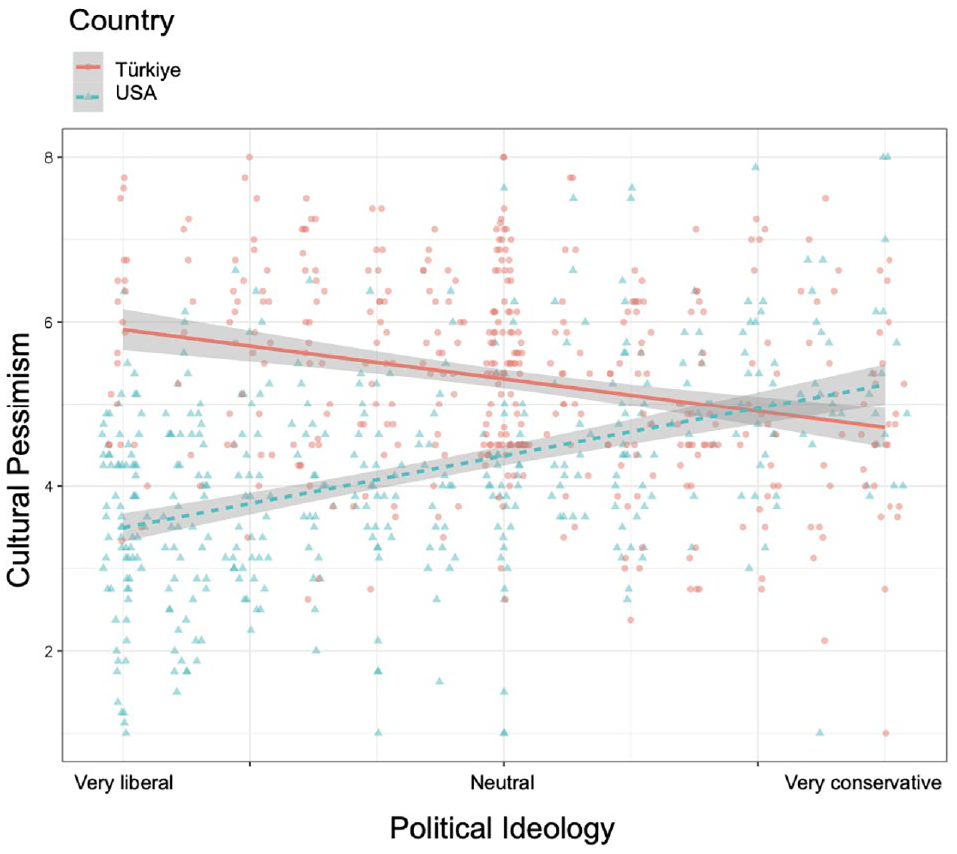
Study 3: In the United States (Blue, Dashed Line/ Triangles), Conservatives (Right) Are More Pessimistic About Their Country, but in Türkiye (Red, Solid Line / Dots) the Opposite Is the Case. Data-Points Are Jittered to Avoid Overplotting. Lines Indicate Regression Coefficients (and Their 95% Confidence Intervals) Within Country
Temporal Framing
We then tested the effect of political ideology (centered), country (dummy-coded, 0= Türkiye, 1= United States), and their interaction on the difference between attitudes toward the past- and future-focused politicians. This showed the predicted interaction effect, b = 0.847, SE = 0.083, β = .454, t(790) = 10.19, p < .0001, 95% CIb [0.684, 1.010], in addition to main effects of political ideology, b = 0.264, SE = 0.065, β = .185, t(790) = 4.07, p < .0001, 95% CIb [0.137, 0.391], and country, b = −0.447, SE = 0.145, β = −.088, t(790) = −3.08, p = .002, 95% CIb [−0.733; −0.162]. Separate regressions within each country showed that a conservative (compared with liberal) political ideology was strongly associated with a preference for the past-focused over the future-focused politician in the United States, b = 1.111, SE = 0.051, β = .732, t(417) = 21.93, p < .0001, 95% CIb [1.011, 1.210], but less so in Türkiye, b = 0.264, SE = 0.067, β = .201, t(373) = 3.95, p < .0001, 95% CIb [0.133, 0.395]. See Figure 6.
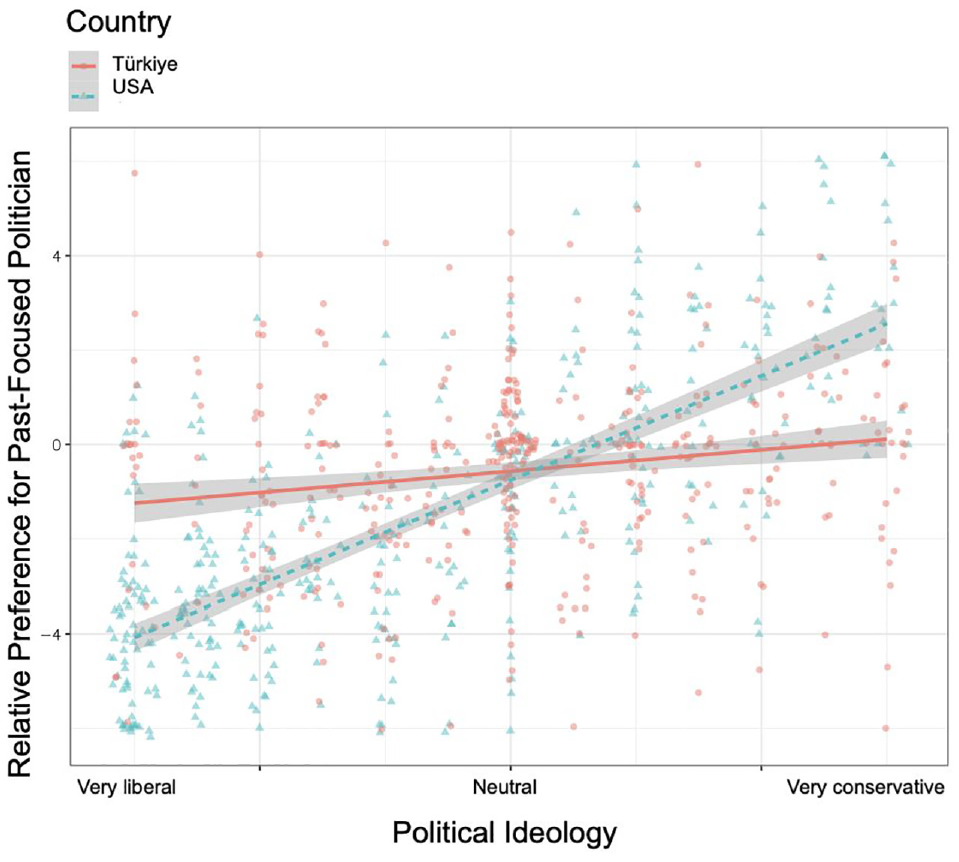
Study 3: In the United States (Blue, Dashed Line/ Triangles), Conservatives Strongly Prefer Politicians Who Advocate Policies That Are Framed With a Temporal Focus on the Past Over Those Who Use a Future-Focused Frame (Difference Score; Positive Values Indicate a Relative Preference for the Past-Focused Frame), While Liberals Show an Opposite Preference (Negative Values), But This Framing Effect Is Attenuated in Türkiye (Red, Solid Line/ Dots) Compared With the United States. Data-Points Are Jittered to Avoid Overplotting. Lines Indicate Regression Coefficients (and Their 95% Confidence Intervals) Within Country
Moderated Mediation
We also tested whether the latter Ideology × Country interaction effect on relative preference for the past- over the future-focused political candidate is mediated by the formerly observed Ideology × Country interaction effect on cultural pessimism. We used Model 8 (5,000 bootstrap samples) of the PROCESS Macro (Hayes, 2017), with ideology as independent, country as moderator, cultural pessimism as mediator, and past- versus future-focused attitude difference-score as the dependent variable. This showed significant evidence for a moderated mediation effect, b = 0.246, SE = 0.046, 95% CIb [0.161, 0.339]. In the United States, a conservative (vs. liberal) ideology produced a positive indirect effect on support for the past- over the future-focused politician, through increased pessimism, b = 0.143, SE = 0.026, 95% CIb [0.096, 0.196]. In contrast, in Türkiye, a conservative (vs. liberal) ideology produced a negative indirect effect on support for the past- over the future-focused politician, through decreased pessimism, b = −.103, SE = 0.027, 95% CIb [−0.158, −0.054]. See Figure 7.
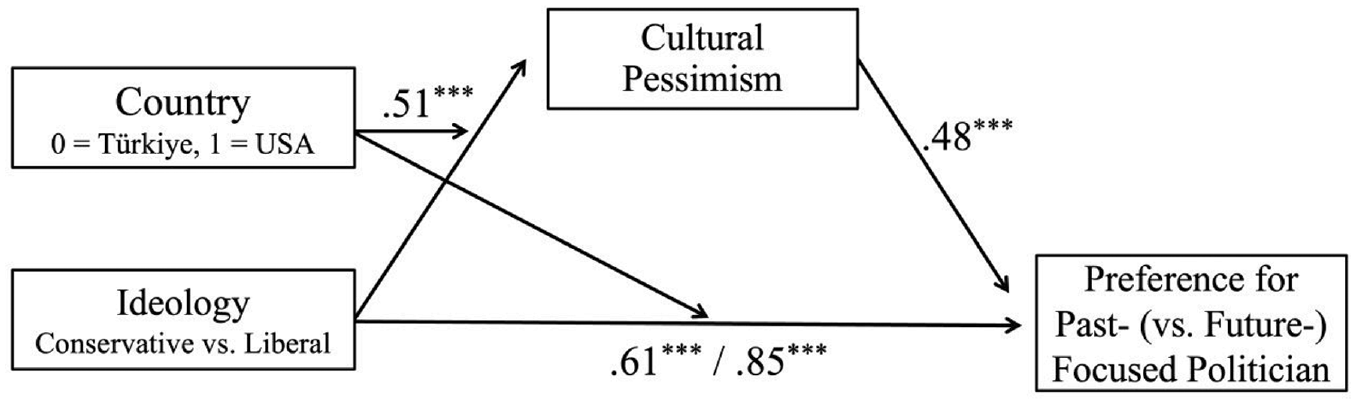
Study 3: Results of a Moderated Mediation Regression Analysis (PROCESS, Model 8). Conservatives Prefer Politicians Who Frame Their Policies as a Return to the Past Over Those Who Frame It as a Move to a New Future (Difference Score), but More so in the United States Than in Türkiye, Because Conservatives are More Pessimistic Than Liberals in the United States, but Liberals Are More Nostalgic Than Conservatives in Türkiye. Numbers Indicate b-Values and Their Significance
General Discussion
A classic idea is that Western conservatives (and others on the right side of the political spectrum) are more pessimistic about the direction of society than are liberals (and others on the left) and therefore experience stronger feelings of nostalgia for the past (Bennett, 2001; Jost et al., 2003; Smeekes et al., 2018, 2023; Smeekes & Verkuyten, 2015; Steenvoorden & Harteveld, 2018; Tomkins, 1963, 1965). In fact, these feelings of nostalgia among those at the right side of the political spectrum are so strong that merely framing (liberal) political ideas as a return to the past increases support among conservatives (Baldwin & Lammers, 2016; Lammers & Baldwin, 2018, 2020). The current research shows that this relation between ideology and a temporal focus on the past is moderated by the cultural context. We predicted this cultural moderation because although the United States and many other Western societies have over the last century moved in a liberal direction, Türkiye has in recent decades moved toward a more conservative and less-secular society. Therefore, while Western conservatives feel pessimistic in an ever-increasingly liberal environment, in Türkiye, this feeling predominates on the liberal side of the political spectrum. Study 1 demonstrated this difference in direction between the two countries using a preregistered analysis of historical data. Testing our key hypotheses, preregistered Studies 2 and 3 showed that American conservatives are more prone to pessimism than liberals, while Turkish conservatives show less pessimism than Turkish liberals. As a result, the link between conservatism and nostalgia (Study 2) and temporal framing effects (Study 3) is essentially blocked—although not reversed—in Türkiye, compared with the United States.
Theoretical Implications
Lammers and Baldwin (2018) propose that conservatives are more nostalgic and like the past better than liberals because they have stronger epistemic needs for certainty and predictability than liberals (Jost et al., 2003; see also Jost & Amodio, 2012; Webster & Kruglanski, 1994) making the past inherently attractive for them as it is by definition more certain and predictable than the future. Yet our results qualify this explanation and suggest that ideological differences in nostalgia between liberals and conservatives do not necessarily reflect epistemic needs, but instead may be driven by an evaluation of the historical direction of the country (Festinger, 1954; Kahneman & Miller, 1986). In other words, both American conservatives and Turkish liberals are nostalgic because they both dislike the direction their country is heading—even though these two directions are opposite.
On the contrary, an alternative interpretation of these findings is consistent with the epistemic needs explanation: Tradition and religion can serve as a source of epistemic certainty because they prescribe how to act and behave (Brandt & Reyna, 2010; Federico et al., 2014). Because America moves in a liberal direction, past American society fits with these epistemic needs because society was more traditional and religious in the past. In contrast, because Turkish society moves away from secularism and toward more religion and tradition, today’s “New Turkey” fits better with Turkish conservatives’ epistemic needs.
Theoretically, this idea connects back to Jost and colleagues’ (2003) notion that the motivated social cognition underlying political ideology results from the operation of non-directional motives. That is, political beliefs and attitudes do not flow directly from underlying needs and motives but instead are an interaction between those needs and the construal of social reality (Griffin & Ross, 1991; Lewin, 1943; Ross & Nisbett, 1991). Therefore, because social reality can be construed in opposite ways, the same processes can lead people to move in different or even opposite directions (Kay et al., 2004; Liberman et al., 2004).
Ideas for Future Research
In our theorizing, we explain these findings with the general notion that Western conservatives dislike but Turkish conservatives like the direction their society is heading. This explanation is consistent with the more specific idea that Western conservatives experience a sense of unease with modern permissive society and thus nostalgically yearn back to a past with more traditional values and norms that better fit with their identity (Baldwin et al., 2015; Sedikides et al., 2015, 2016; Wohl et al., 2020a, 2020b). After all, Turkish liberals may similarly feel nostalgic about the secular Turkish society of the 1990s. Our explanation is also consistent with the idea that Western conservatives feel that they do not fit in modern society and therefore think nostalgically back to the past as a time of greater social cohesion (Wildschut et al., 2010; Zhou et al., 2008). After all, due to the long-term trends in Türkiye, Turkish liberals may similarly feel nostalgia for a time in which they fitted better in society, during the 1990s. Future research may want to better disentangle these explanations.
Here we focused on general feelings of nostalgia that follow long-term historical movements of society, as identified in Study 1. Future research may want to test whether the link between ideology and pessimism is also reversed (compared with the West) in other countries that—like Türkiye—move toward a conservative direction or experience democratic backsliding, such as Hungary or Egypt. It would also be interesting to explore whether the same Turkish-American cross-cultural difference in the relation between ideology and temporal focus extends to other downstream effects on cognition and behavior. At the individual level, nostalgia creates a sense of meaning and belongingness, thus increasing psychological comfort and happiness (Sedikides et al., 2008; Wildschut et al., 2006, 2010; Zhou et al., 2008). At the collective level, nostalgia is associated not only with greater solidarity with the ingroup but also with increased hostility toward the outgroup (Cheung et al., 2017; Smeekes & Verkuyten, 2015; Wildschut et al., 2014). Future research may want to test whether U.S.-Turkish cross-cultural differences exist in the relationship between political ideology and these variables. Finally, it would be interesting to test how societal developments affect how liberals and conservatives reference time. A content analysis of 600 conservative and liberal websites and 145 State of the Union addresses showed that U.S. conservatives reference the past more than the future, while U.S. liberals do the opposite (Robinson et al., 2015). Presumably, a similar analysis would find a reversed difference in Turkish political communication of recent decades but a similar difference in older texts.
Limitations
All our studies were correlational; therefore, the usual concerns apply, particularly concerning our mediation models (Fiedler et al., 2018, 2011). Also, we explain these findings with the notion that American and Turkish societies have followed different historical trajectories. But of course, there may be other differences between the two countries responsible for the moderation we observed.
One critic might argue that the United States currently has a liberal (Mr. Biden) and Türkiye, a conservative (Mr. Erdoğan) president in power. Therefore, the currently observed differences in nostalgia may simply reflect a short-term longing for the previous administration (cf. Fetterman et al., 2021). In this case, we believe this explanation is implausible because earlier work has observed the same focus on the past among U.S. conservatives when the country was under the presidency of Mr. Trump (Baldwin & Lammers, 2016). Another difference is that Türkiye differs from the United States because it is a younger democracy and features a continental multi-party system. But again, earlier work has observed the same focus on the past among German conservatives (Lammers & Baldwin, 2018), and Germany is, like Türkiye, a younger democracy with a multi-party system. Nonetheless, we agree that more cross-cultural work is needed to solidify our claim.
Conclusion
Our findings show the relevance of cross-cultural comparisons for political psychology. It has been frequently noted that political-psychological research beyond Western democracies is still rare—let alone replications of political-psychological findings across different cultures (Esser & Pfetsch, 2004; Eveland et al., 2015; Wedeen, 2002). Our findings show that such a cross-cultural analysis not only can identify the main effects of cultural differences (Turkish participants were, on average, more nostalgic than Americans) but can also offer insight in underlying processes because they show that the same emotion can play opposite roles in forming political-psychological cognition, being associated with conservatism in one country, but with liberalism in another.
Supplemental Material
sj-docx-1-spp-10.1177_19485506231173735 – Supplemental material for Political-Ideological Differences in Cultural Pessimism and Nostalgia Reflect People’s Evaluation of Their Nation’s Historical Developments
Supplemental material, sj-docx-1-spp-10.1177_19485506231173735 for Political-Ideological Differences in Cultural Pessimism and Nostalgia Reflect People’s Evaluation of Their Nation’s Historical Developments by Joris Lammers and Pınar Uğurlar in Social Psychological and Personality Science
Footnotes
Handling Editor: Danny Osborne
Author Contributions
Both authors designed, conducted, and analyzed the studies. J.L. drafted the manuscript and P.U. provided critical revisions.
Declaration of Conflicting Interests
The author(s) declared no potential conflicts of interest with respect to the research, authorship, and/or publication of this article.
Funding
The author(s) disclosed receipt of the following financial support for the research, authorship, and/or publication of this article: This research was supported by a grant under Germany’s Excellence Strategy, Grant Number EXC 2126/1–390838866.

Supplemental Material
Supplemental material for this article is available online.
Notes
Author Biographies
References
Supplementary Material
Please find the following supplemental material available below.
For Open Access articles published under a Creative Commons License, all supplemental material carries the same license as the article it is associated with.
For non-Open Access articles published, all supplemental material carries a non-exclusive license, and permission requests for re-use of supplemental material or any part of supplemental material shall be sent directly to the copyright owner as specified in the copyright notice associated with the article.
