




Abstract
Human history and recent empirical studies have documented many cases of human unity or estrangement during global crises. This reflects that a common threat may not always promote intergroup cooperation. An intriguing question arises: What determines the effect of a common threat on intergroup cooperation? In response, we proposed and tested the moderating role of perceived resource scarcity in the effect of a common threat on intergroup cooperation. We found that when perceived resource scarcity was low, common threats posed by pandemics (Studies 1 and 2) and earthquakes (Study 3) promoted intergroup cooperation in controlling outbreaks, building public medical systems, and reducing public resource depletion. However, the effect attenuated when perceived resource scarcity was high. The findings broaden our understanding of common threats and provide avenues to enhance intergroup cooperation in the face of interminable global crises.
Human society has always been fraught with global crises, such as pandemics, earthquakes, climate change, terrorism, and nuclear pollution. The crises inevitably trap humanity in common threats (Kahn et al., 2022). Common threat refers to a phenomenon or event that may have harmful outcomes for two or more groups simultaneously (Feshbach & Singer, 1957; Flade et al., 2019). Coping with these common threats requires intergroup cooperation (Buchan et al., 2009; Römpke et al., 2019), such as collaborative problem-solving, investing more in public facilities, and reducing public resource depletion (Koopmans & Rebers, 2009; Molenmaker et al., 2014; Van Vugt et al., 2007). Intergroup cooperation can also subtly manifest in providing help to outgroups, reducing outgroup prejudice, and increasing intergroup trust (Balliet et al., 2014; Fuesting et al., 2019; Kung et al., 2018).
Paradoxically, a common threat does not always evoke intergroup cooperation. For instance, the recent COVID-19 threat predicted less intergroup prejudice and more intergroup helping intentions (Toprakkiran & Gordils, 2021; Zheng et al., 2021) on one hand but, on the other, intensified perceived interracial competition and mistrust (Gordils et al., 2021) and predicted more responsibility for the pandemic attributed to an outgroup (Wang et al., 2021). Likewise, the global challenge posed by artificial intelligence (AI) has been found to mitigate prejudice against other human groups (Jackson et al., 2020) but increase intergroup competition for jobs and anti-immigrant sentiment (Gamez-Djokic & Waytz, 2020). Similar cases have occurred when humans faced common threats such as earthquakes (Andrighetto et al., 2016; Vezzali et al., 2015) and hurricanes (Feshbach & Singer, 1957; Vardy & Atkinson, 2019). These instances raise an intriguing question: What determines the propensity to engage in intergroup cooperation in facing a common threat?
We argue that humans cope with common threats based on two basic considerations. One is cross-group shared destiny. That is, distinct social groups are targeted by a common threat without discrimination, leading to the feeling that “we will all suffer” (Drury, 2018) and then promoting intergroup cooperation (Cortland et al., 2017; Dovidio et al., 2004). The other is that the common threat poses challenges to group interests, including physical harm, emotional distress, or financial hardship (Butz & Yogeeswaran, 2011; Frankenberg et al., 2012). The salience of potential harm to group interests hampers intergroup cooperation in facing a common threat (Gamez-Djokic & Waytz, 2020; Uenal et al., 2021). Inspired by Scarcity Theory, which suggests that scarcity draws more attention to scarcity-related events while ignoring others (Mani et al., 2013; Mullainathan & Shafir, 2014), we propose that perceived resource scarcity drives people to pay different attention to these two aspects of common threats and thus has different effects on intergroup cooperation. Thus, the present research aimed to clarify the opposing directional findings regarding the effect of a common threat on intergroup cooperation by examining the moderating role of perceived resource scarcity.
The Moderating Role of Perceived Resource Scarcity
Perceived resource scarcity is defined as a subjective sense of having less than needed (Mullainathan & Shafir, 2013). Unlike hardship, perceived resource scarcity may stem not only from objectively lacking resources but also from people subjectively feeling that they have too little (DeSousa & Rego, 2022). For example, financially well-off people also feel that their resources are scarce when compared with richer people (Mullainathan & Shafir, 2013; Yang & Zhang, 2022). This suggests that even if the resources people have are objectively sufficient, some scarcity-related cues may initiate perceived resource scarcity (Roux et al., 2015). As exhibited during COVID-19, when exposed to false statements about medical resource shortages, people perceive high resource scarcity, despite the objective availability of adequate resources. Perceived resource scarcity concentrates people’s attention on areas where scarcity is prominent, which reduces “cognitive bandwidth” and leads to neglect of other events (Mani et al., 2013; Mullainathan & Shafir, 2014; Shah et al., 2012).
We propose that perceived resource scarcity moderates the association between a common threat and intergroup cooperation. On one hand, when perceived resource scarcity is high, a common threat might negatively predict intergroup cooperation. Based on the Scarcity Theory (Mani et al., 2013; Mullainathan & Shafir, 2014), perceived resource scarcity makes people under a common threat more concerned with challenges to group interests associated with scarcity than cross-group shared fate. In this case, outgroups in a high common threat would be seen as adversaries competing for limited resources (Esses et al., 1998; Gamez-Djokic & Waytz, 2020). Realistic conflicts of interest exist among threatened groups such that “your success in grabbing resources means my failure,” with consequent damage to intergroup relations, which is consistent with the Realist Group Conflict Theory (Jackson, 1993; Sherif & Sherif, 1969). Thus, it is reasonable to assume that when perceived resource scarcity is high, a common threat might not promote intergroup cooperation and even decrease it.
On the other hand, when perceived resource scarcity is low, a common threat might positively predict intergroup cooperation. Humans struggling for survival could unite by sharing resources in response to crises over the long evolutionary history (Brewer, 2004; Higgins, 2008). Some studies have suggested that if resources are abundant, discrimination is unlikely to emerge in the distribution of resources (Hewstone et al., 2002; Krosch et al., 2017). That is, low perceived resource scarcity would provide the basic condition that allows people to focus more on the cross-group common fate of a common threat. Indeed, common threats create large-scale communism in which groups, regardless of race, culture, or social class, are equally affected (Fritz, 1965/1996; Vezzali et al., 2016). Based on the Common Ingroup Identity Model (Gaertner & Dovidio, 2000, 2012), such a shared fate lends prominence to a common identity involving ingroups and outgroups, thereby promoting intergroup cooperation. Thus, it is reasonable to assume that when perceived resource scarcity is low, a common threat might promote intergroup cooperation.
Overview
Based on the foregoing theoretical arguments and empirical evidence, we hypothesized that perceived resource scarcity moderates the effect of a common threat on intergroup cooperation. Specifically, a common threat negatively predicts intergroup cooperation when perceived resource scarcity is high, while the effect attenuates or even reverses to positive when perceived resource scarcity is low. We conducted three studies to test the hypothesis. Study 1 was conducted to obtain correlational evidence of the moderating model in a realistic COVID-19 threat context. In Study 2, to establish causality, we manipulated the common threat and perceived resource scarcity based on a fictitious pandemic context. Study 3 replicated and generalized Study 2 to the common threat posed by earthquakes, and measured general intergroup cooperation by an adapted common resource dilemma game.
All data and analysis codes have been made publicly available via the Open Science Framework (https://osf.io/mp52j). We preregistered Study 3 on OSF (https://osf.io/s2q3m). In the Online Supplementary Material, we provide stimulus materials and supplemental analyses.
Study 1
In Study 1, we used a correlational study based on a real threat context to test our hypothesis. In August 2022, nearly 200,000 travelers from all over China were stranded in Hainan Province due to the sudden recurrence of the COVID-19 pandemic. To alleviate the pressure of combating the pandemic and effectively control it, cooperation between Hainan and return destinations was required to arrange a closed-loop return for stranded travelers. Such a scenario provides a natural context for testing the moderating role of perceived resource scarcity in the relationship between the COVID-19 common threat and cooperation to control the pandemic.
Method
Participants
Relying on a small-to-medium effect size of interest (Cohen, 1988) of R2 = .030 and α = .05, a total sample size of 357 would provide 80% power to detect a moderating role of perceived resource scarcity in the relationship between common threat and intergroup cooperation. We recruited 364 participants 1 (131 men and 233 women; Mage = 29.23 years, SDage = 7.81 years, range = 17–56 years) via Credamo (https://www.credamo.com/), paying each participant 2 CNY (US$ 0.3).
Procedure and Materials
Common Threat
We assessed the COVID-19 common threat using an adapted five-item common threat scale (Adam-Troian & Bagci, 2021; Meleady & Hodson, 2022; for example, “COVID-19 constitutes a threat across the country”; 1 = strongly disagree, 7 = strongly agree). Higher scores represent a greater common threat (α = .74).
Perceived Resource Scarcity
Participants completed the perceived resource scarcity scale on COVID-19 (Pitesa & Thau, 2018) including five items (e.g., “Essential resources are scarce”; 1 = strongly disagree, 7 = strongly agree). Higher scores represent higher perceived resource scarcity (α = .90).
Intergroup Cooperation
Participants read a passage describing that many tourists were stranded in Hainan Province due to COVID-19. We then asked participants, as representatives of the government resolution, to decide the extent to which they agree that their city would cooperate with Hainan Province to accept stranded travelers (“Whether to agree to accept the groups of stranded passengers,”“Whether to agree to provide adequate cooperative arrangements for receiving stranded passengers”; 1 = strongly disagree, 7 = strongly agree). Scores were averaged (rSpearman-Brow = .47), with higher scores representing greater intergroup cooperation with Hainan Province.
Results and Discussion
Descriptive Statistics and Correlations
The descriptive statistics and correlations for the study variables are shown in Table 1.
Descriptive Statistics and Correlations of Variables in Study 1
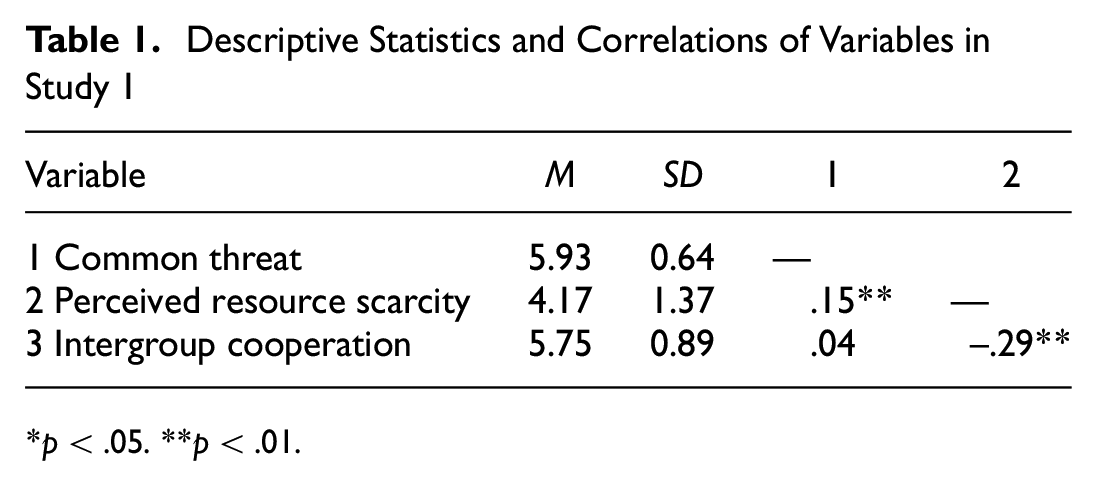
p < .05. **p < .01.
Perceived Resource Scarcity as a Moderator
To test the hypothesis, we conducted a multiple linear regression analysis on intergroup cooperation. Specifically, we entered common threat (centered) and perceived resource scarcity (centered) as the first step and entered the two-way interaction as the second step. The main effect of common threat was nonsignificant, B = 0.12, 95% CI [−0.02, 0.26], SE = 0.07, β = .09, t(361) = 1.69, p = .092. Participants with higher perceived resource scarcity reported less intergroup cooperation, B = −0.20, 95% CI [−0.26, −0.13], SE = 0.03, β = −.31, t(361) = −6.05, p < .001.
Most importantly, the interaction effect was significant, B = −0.12, 95% CI [−0.22, −0.02], SE = 0.05, β = −.13, t(360) = −2.39, p = .018. See Figure 1. Simple slope analyses showed that when perceived resource scarcity was low (−1SD from the mean), the COVID-19 common threat was positively associated with intergroup cooperation, simple slope = 0.16, 95% CI [0.04, 0.27], SE = 0.06, t(360) = 2.68, p = .008. However, when perceived resource scarcity was high (+1SD from the mean), the effect was nonsignificant, simple slope = −0.08, 95% CI [−0.25, 0.09], SE = 0.09, t(360) = −0.92, p = .360.
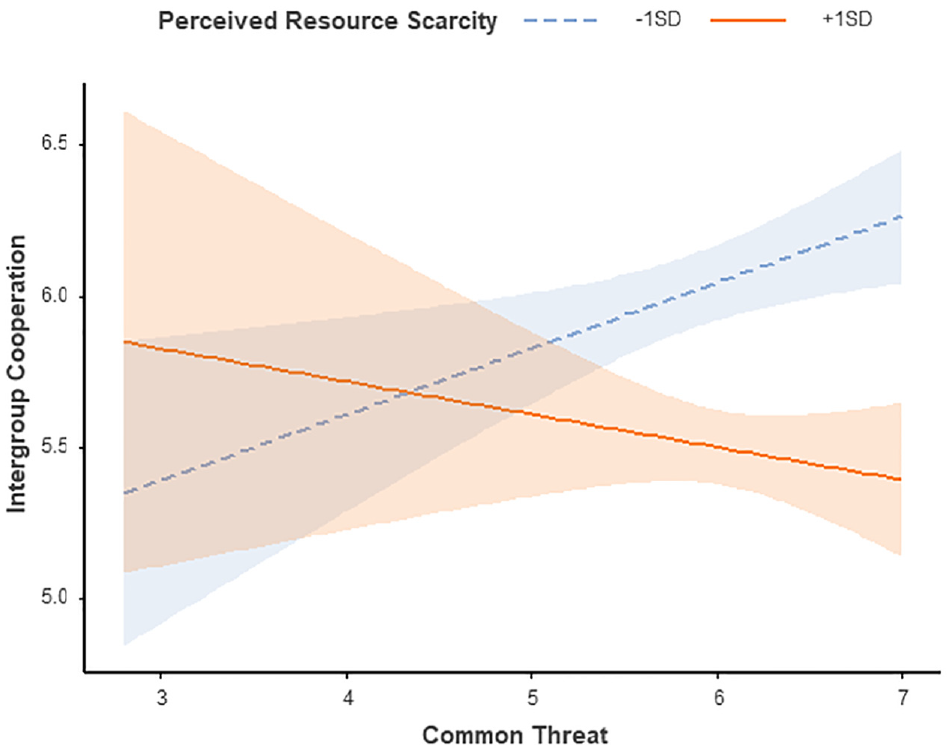
Perceived Resource Scarcity Moderated the Relationship Between the Common Threat and Intergroup Cooperation in Study 1
To provide a more complete understanding of the interaction, we further used the Johnson–Neyman technique (Johnson & Neyman, 1936; Spiller et al., 2013) to examine simple effects of the common threat on intergroup cooperation at all possible values of perceived resource scarcity. The results revealed that the common threat positively predicted intergroup cooperation with perceived resource scarcity scores at or below 3.46 (B = 0.14, 95% CI [0.00, 0.28], SE = 0.07).
Study 1 used a correlational design to provide preliminary evidence of the moderating role of perceived resource scarcity. Specifically, the common threat positively predicted intergroup cooperation when perceived resource scarcity was low. Nevertheless, when perceived resource scarcity was high, the promoting effect disappeared.
Study 2
The purpose of Study 2 was twofold. First, we manipulated the common threat and perceived resource scarcity in a fictitious pandemic threat scenario to establish causality. Second, to extend Study 1, we used an adapted public goods game to measure intergroup cooperation in building public medical systems.
Method
Participants
We employed a 2 × 2 between-subjects design. Relying on the moderation effect from Study 1 (Rp2= .015), a priori power analysis indicated that a sample size of 518 would provide 80% power (α = .05) to detect a moderation of perceived resource scarcity. We recruited 548 participants (217 men and 331 women; Mage = 29.27 years, SDage = 7.70 years, range = 18–64 years) via Credamo and randomly and evenly assigned them to one of the four conditions, compensating each with 2 CNY (US$ 0.3).
Procedure and Materials
Common Threat Manipulation
Participants read a bogus article for manipulating a pandemic common threat (adapted from Teasdale et al., 2012). They were instructed to imagine that they were in 2026, and there was a new globally spreading epidemic virus named ZIAVID-26. In the high [low] common threat condition, participants were informed that ZIAVID-26 poses a serious [minor] threat to human health and life safety. ZIAVID-26 has a mortality rate of 27.4% [1.04%], much higher [lower] than SARS and COVID-19. The World Health Organization has assessed the global public health risk of ZIAVID-26 as extremely high [low]. Participants then completed an adapted five-item scale similar to Study 1 (e.g., “ZIAVID-26 constitutes a threat to countries worldwide”; 1 = not at all, 7 = very much; α = .98) as a manipulation check.
Perceived Resource Scarcity Manipulation
We manipulated perceived resource scarcity similarly to Pereira et al. (2022). Specifically, in the high [low] scarcity condition, participants read the following: In 2026, according to Our World in Data, each country has an average of approximately 600 VJ2[8000 VJ] of pandemic medical resources. The global average pandemic medical resources in all countries can meet the needs of 19.60% [112.80%] of citizens, which makes them very scarce [not scarce]. As a manipulation check, participants completed five items (e.g., “Essential medical resources for pandemics are scarce”; 1 = strongly disagree, 7 = strongly agree; α = .97), similar to Study 1.
Intergroup Cooperation
Next, we measured intergroup cooperation in public medical system construction by an adapted public goods game (Bowen, 1943). Participants were informed that based on the research needs, a country with a similar population base, level of economic development, and medical resource reserve as China was selected. The two countries were kept anonymous for the remaining study, with China referred to as C and the other country referred to as G.
There is a public medical system-building program in which countries C and G would draw medical resources from their countries to build. According to the established criteria, the maximum amount of resources that both countries can invest in construction is 100 VJ. The VJ resource represents the level of pandemic resistance effectiveness. The pandemic resistance effect produced by the medical system would increase by 1.5 times, with each country receiving an average proportional increase in the resilience effect. If Country C contributed a VJ medical resources and Country G contributed b VJ medical resources, then Country C would obtain (100−a) + {(a+b) × 1.5}/2 pandemic resistance effectiveness and Country G would obtain (100−b) + {(a+b) × 1.5}/2. The participants, as citizen representatives of Country C, were asked to choose the number of medical resources (0∼100 VJ) for Country C to input. The input of medical resources was the index of intergroup cooperation, with more inputs representing more intergroup cooperation.
Results
Manipulation Checks
Participants in the high common threat condition (M = 6.42, SD = 0.51) perceived a higher common threat posed by ZIAVID-26 than those in the low common threat condition (M = 2.50, SD = 1.14), t(377) = 52.12, p < .001, d = 4.44, 95% CI [4.00, 4.88]. The common threat manipulation was successful.
Perceived resource scarcity was submitted to a 2 (common threat: high, low) × 2 (resource scarcity: high, low) between-subject ANOVA. The results revealed a significant effect of resource scarcity, F(1, 544) = 3116.22, p < .001, η2 = .851, 90% CI [.835, .864]. Participants in the high scarcity condition (M = 6.07, SD = 0.68) perceived resources as scarcer than those in the low scarcity condition (M = 2.12, SD = 0.99). Although participants in the high common threat condition (M = 4.29, SD = 2.11) perceived resources as scarcer than those in the low common threat condition (M = 3.90, SD = 2.18), F(1, 544) = 30.66, p < .001, η2 = .053, 90% CI [.027, .087], the absence of a two-way interaction, F(1, 544) = 3.69, p = .055, η2 = .007, 90% CI [.000, .023], suggests that the manipulation of perceived resource scarcity was successful regardless of whether the common threat was manipulated as high or low (see detailed results in the Online Supplementary Material).
Moderating Effect of Perceived Resource Scarcity
We conducted the same 2 × 2 between-subject ANOVA on intergroup cooperation. The main effect of common threat was nonsignificant, F(1, 544) = 0.66, p = .419, η2 = .001. Participants in the high scarcity condition showed less intergroup cooperation than those in the low scarcity condition, F(1, 544) = 9.82, p = .002, η2 = .018, 90% CI [.004, .040].
The interaction effect was significant, F(1, 544) = 15.62, p < .001, η2 = .028, 90% CI [.010, .054]. Simple effects analyses (Figure 2) revealed that when perceived resource scarcity was low, people showed significantly more intergroup cooperation in the high common threat condition (M = 53.15, SD = 15.84) than in the low common threat condition (M = 46.10, SD = 18.86), F(1, 544) = 11.33, p = .001, η2 = .020, 90% CI [.005, .044]. In contrast, when perceived resource scarcity was high, people showed less intergroup cooperation in the high common threat condition (M = 42.66, SD = 17.19) than in the low common threat condition (M = 47.31, SD = 17.25), F(1, 544) = 4.94, p = .027, η2 = .009, 90% CI [.001, .027].
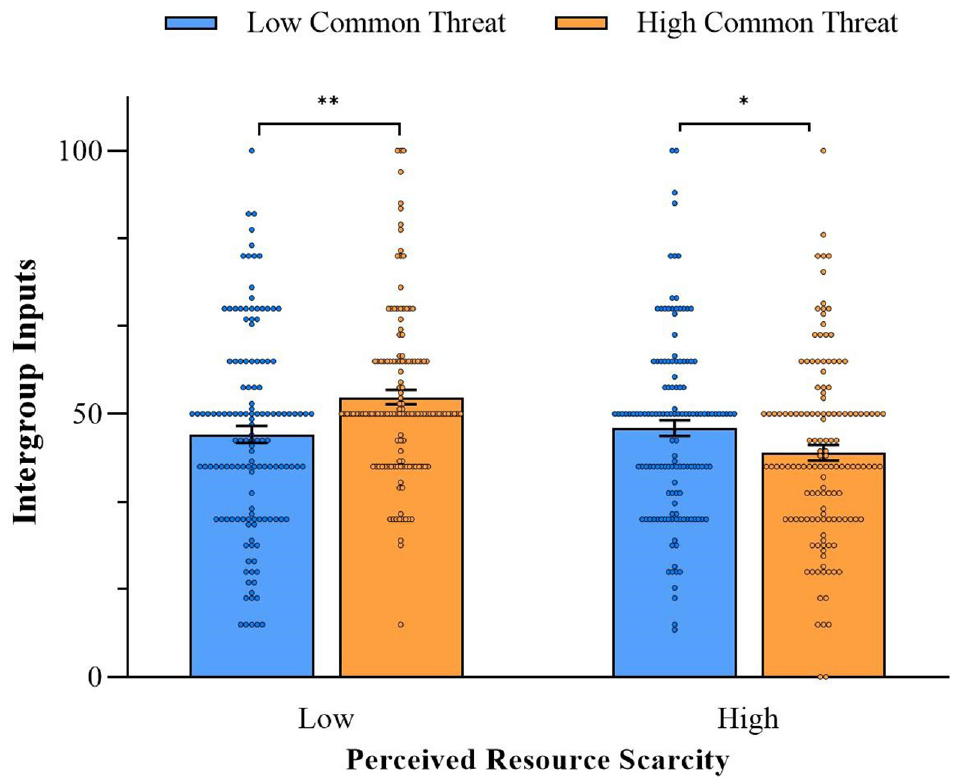
Intergroup Inputs as a Function of the Common Threat and Perceived Resource Scarcity in Study 2
Study 2 provided further evidence for the moderating role of perceived resource scarcity. Specifically, the common threat promoted intergroup cooperation when perceived resource scarcity was low, whereas the effect was reversed when perceived resource scarcity was high. Studies 1 and 2 focused on the common threat of COVID-19 (Study 1) and a virtual pandemic (Study 2). The generalizability of the findings to other common threats was uncertain. Thus, Study 3 examined the common threat of earthquakes. Earthquakes pose threats mostly to local people and have immediate and long-term social and psychological impacts (Drury et al., 2016).
Study 3
Study 3 aimed to examine the generalizability of our findings. We manipulated the common threat of earthquakes and measured intergroup cooperation in reducing public resource depletion through a common resource dilemma game.
Method
Participants
Study 3 employed a similar design to that of Study 2. Relying on the effect size (η2= .028) obtained in Study 2, a sample size of 275 would provide 80% power (α = .05) to detect the moderating role of perceived resource scarcity. Aiming for high statistical power, we conservatively recruited 360 participants (149 men and 211women; Mage = 29.19 years, SDage = 8.20 years, range = 18–64 years) via Credamo, paying each participant 2 CNY (US$ 0.3). Participants were randomly and evenly assigned to one of four conditions.
Procedure and Materials
Common Threat Manipulation
We presented participants with a map called Greke Islands that showed four countries—A, B, C, and D—of similar areas and populations. Participants were asked to imagine that they were residents of Country C and lived there with their families. Participants completed six items (Brown et al., 1986) regarding their identification with Country C (e.g., “I consider myself as belonging to Country C,” 1 = strongly disagree, 7 = strongly agree; α = .90). Participants strongly identified with Country C (M = 5.76, SD = 0.91).
Then, participants were randomly divided into two conditions. In the high [low] common threat condition, participants were informed that earthquakes have occurred frequently [occasionally] in the Greke Islands. It is predicted that major [no major] earthquakes will continue to occur in every country of the Greke Islands, and there is a serious [minor] threat to the living environment and the safety of the inhabitants. Participants completed manipulation check questions (e.g., “Earthquakes would have harmful effects in the Greke Islands”; α = .96) similar to Study 2.
Perceived Resource Scarcity Manipulation
We manipulated resource scarcity as in Study 2. Specifically, in the high [low] resource scarcity condition, participants were presented with the following: countries in the Greke Islands have very limited [an adequate] supplies of earthquake-related resources, and 21% [111%] of their citizens’ needs can be met on average. There are very scarce [no scarce] resources to cope with earthquakes in the countries of the Greke Islands. As a manipulation check, participants completed four items (Roux et al., 2015; for example, “Our resources to cope with earthquakes are scarce,” 1 = strongly disagree, 7 = strongly agree; α = .87).
Intergroup Cooperation
Next, we measured intergroup cooperation with an adapted common resource dilemma game (Budescu et al., 1990). Participants were informed that countries in the Greke Islands circulate G coins. Three years ago, the four countries in the islands each invested 100 yn (1 yn = 100,000,000) G coins and formed a 400 yn fund project (Figure 3). At the end of the project, each country can take a certain amount of funds (0∼100 yn) from the project directly to their own country. Each country does not know how much is taken out by other countries. After each country takes an amount, the total amount of funds left in the project is doubled and then divided equally among the four countries. The participant, as a citizen representative, was asked to choose the amount of funds to be taken out by Country C (0∼100 yn) after considering the international situation, and the number of funds that may eventually be obtained. The number of funds taken was the index of intergroup cooperation, with more funds taken representing less intergroup cooperation.
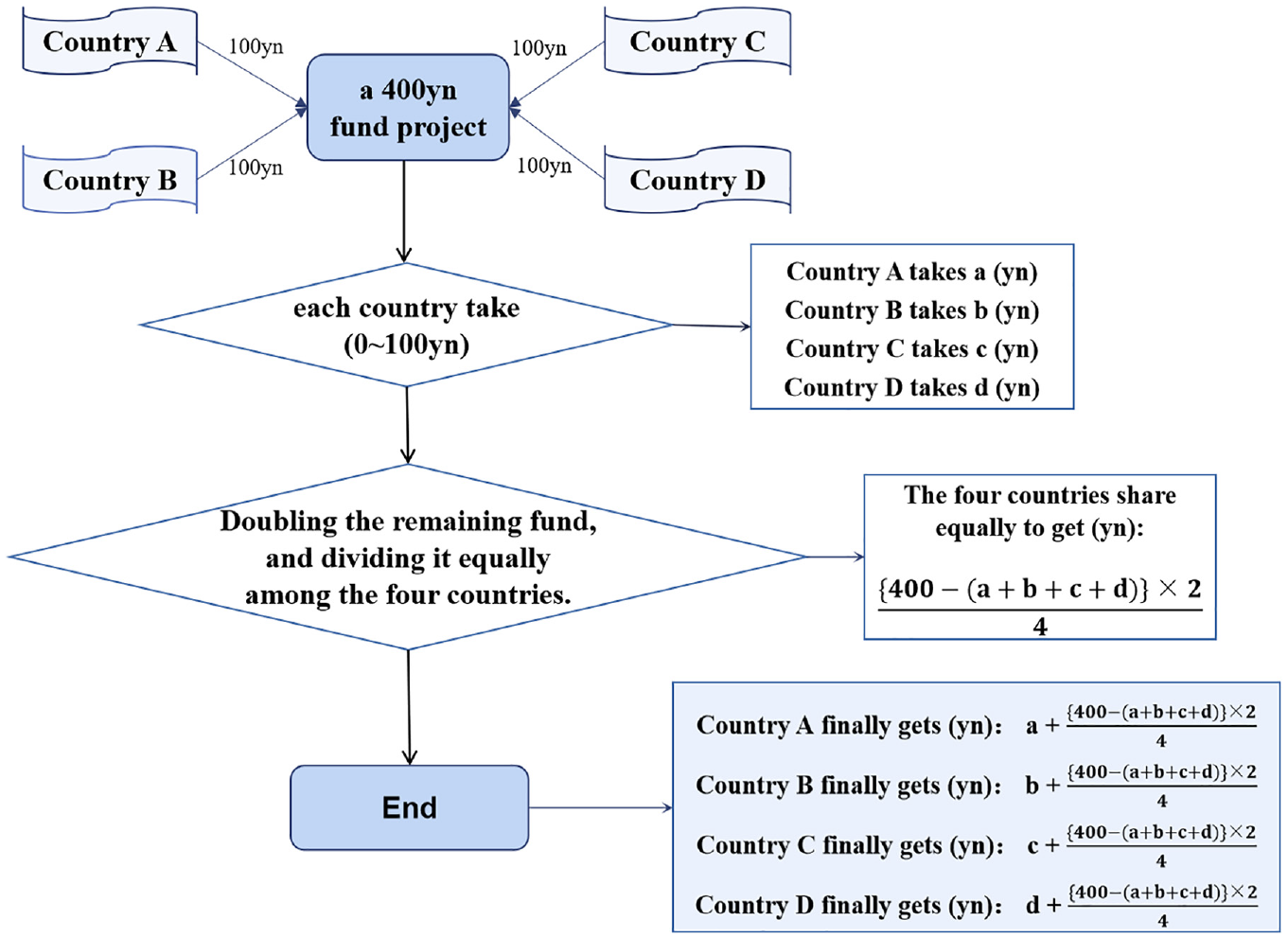
The Illustration Showing the Steps of the Common Resource Dilemma Game in Study 3
Results
Manipulation Checks
Participants in the high common threat condition (M = 6.27, SD = 0.49) perceived a higher common threat from earthquakes than those in the low common threat condition (M = 3.96, SD = 1.62), t(211) = 18.32, p < .001, d = 1.93, 95% CI [1.58, 2.28]. The common threat manipulation was successful.
Perceived resource scarcity was submitted to a 2 (common threat: high, low) × 2 (resource scarcity: high, low) between-subject ANOVA. Participants in the high scarcity condition (M = 6.28, SD = 0.52) perceived resources as scarcer than those in the low scarcity condition (M = 3.08, SD = 0.90), F(1, 356) = 1718.43, p < .001, η2 = .828, 90% CI [.805, .847]. Neither the main effect of common threat, F(1, 356) = 1.78, p = .183, η2 = .005, 90% CI [.000, .024], nor the interaction, F(1, 356) = 1.42, p = .235, η2 = .004, 90% CI [.000, .022], was significant. Thus, the manipulation of perceived resource scarcity was successful.
Moderating Effect of Perceived Resource Scarcity
We conducted a similar 2 × 2 between-subject ANOVA on the number of funds taken. The main effect of common threat was nonsignificant, F(1, 356) = 0.09, p = .769, η2 = .000. The amount taken was significantly greater in the high scarcity condition than in the low scarcity condition, F(1, 356) = 7.31, p = .007, η2 = .020, 90% CI [.003, .050].
As expected, the interaction effect was significant, F(1, 356) = 12.16, p = .001, η2 = .033, 90% CI [.009, .069]. Simple effects analyses (Figure 4) revealed that when perceived resource scarcity was low, the amount of funds taken was significantly less in the high common threat condition (M = 43.62, SD = 19.15) than in the low common threat condition (M = 50.76, SD = 18.03), F(1, 356) = 7.15, p = .008, η2 = .020, 90% CI [.003, .050]. In contrast, when perceived resource scarcity was high, the amount taken was significantly greater in the high common threat condition (M = 55.30, SD = 16.53) than in the low common threat condition (M = 49.28, SD = 17.78), F(1, 356) = 5.09, p = .025, η2 = .014, 90% CI [.001, .041].
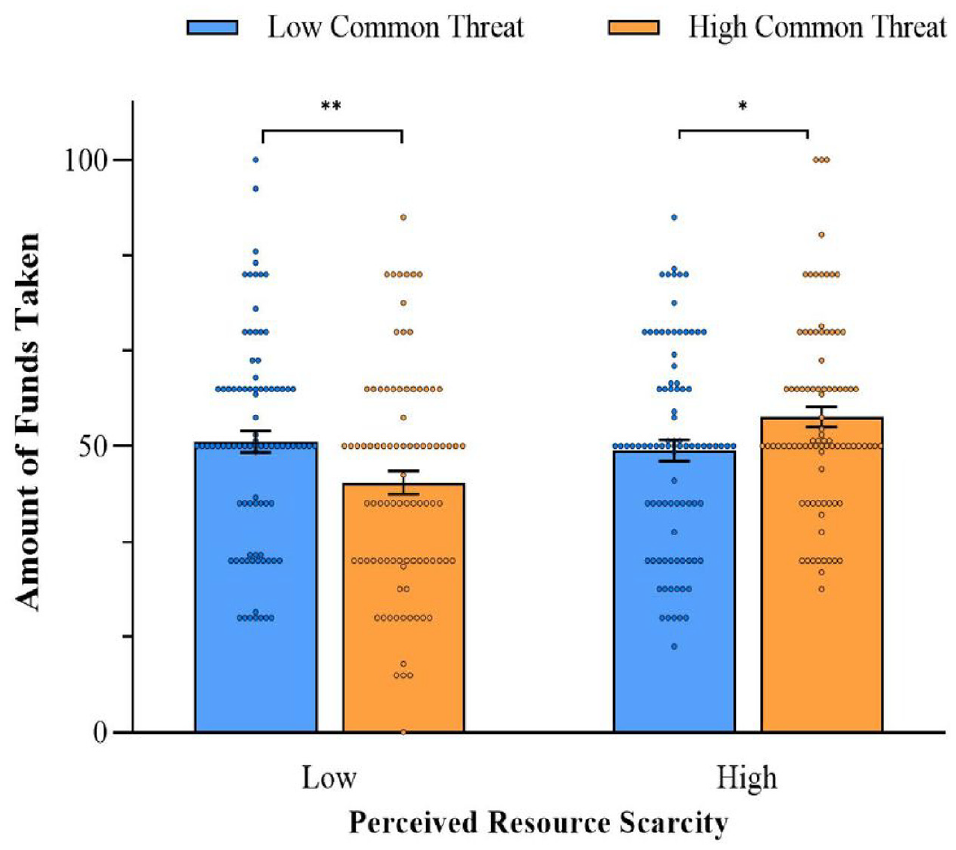
Amount of Funds Taken as a Function of the Common Threat and Perceived Resource Scarcity in Study 3
Study 3 provided further evidence in support of our hypothesis. Specifically, the positive effect of the common threat on intergroup cooperation reversed when perceived resource scarcity was high rather than low. Study 3 demonstrated that perceived resource scarcity moderated intergroup unions under a common threat, which was not limited to pandemic threat contexts but also applied to other threat contexts.
General Discussion
Three studies conducted with common threats of COVID-19, fictitious pandemics, and earthquakes supported our hypothesis that the level of perceived resource scarcity determines the differential impact of a common threat on intergroup cooperation. Specifically, when perceived resource scarcity was low, high common threat promoted intergroup cooperation in controlling the pandemic (Study 1), building public medical systems (Study 2), and reducing public resource depletion (Study 3). However, when perceived resource scarcity was high, the common threat did not promote intergroup cooperation and even hampered it.
The present research not only makes sense of the previous seemingly inconsistent results but also advances our understanding of common threats. Some studies have suggested that a common threat may promote intergroup cooperation (e.g., Chen et al., 2022; Cortland et al., 2017; Craig & Richeson, 2012; Fuochi et al., 2021; Vezzali et al., 2016), while others found that a common threat can spark negative intergroup interactions (e.g., Butz & Yogeeswaran, 2011; Schleussner et al., 2016; Uenal et al., 2021; Zhang et al., 2007). We argued that the former may highlight the cross-group shared fate of the common threat and thus promotes intergroup cooperation. However, the latter may emphasize the challenges to group interests posed by a common threat, which drives different groups to conflict for limited resources. Thus, we examined how a common threat affects intergroup cooperation under different levels of perceived resource scarcity. The moderating role of perceived resource scarcity indirectly complements previous arguments that a common threat has two intrinsic features of being “common” (cross-group shared fate) and “threat” (challenges to group interests), which can have positive and negative impacts on intergroup cooperation, respectively. Particularly, which feature is more prominent depends on the level of perceived resource scarcity.
The moderating model found in this research has important implications for understanding the complex dynamics of intergroup interactions during crises. In reality, groups may unite during crises, but they do not always do so. In addition, frequent political rhetoric calls for intergroup coalitions by emphasizing a high common threat; however, in some cases, the results are less than ideal. As the present research found, perceived resource scarcity is a critical barrier to unions under crisis. This supports the Instrumental Model of Group Conflict (Esses et al., 1998) proposing that the combination of resource scarcity and potentially competitive group salience leads to intergroup competition rather than intergroup cooperation. Our research further suggests that with a severe scarcity of perceived resources, a high common threat serves as an explicit factor that accentuates potentially competitive groups.
The present findings have practical implications for promoting intergroup cooperation and preventing intergroup conflict during global crises. First, when facing a common threat, it is necessary to mobilize resources expeditiously and publish timely announcements reminding the public of the adequacy of corresponding resources, thus avoiding vicious competition or even intergroup conflicts. Second, the equitable distribution of resources should be continuously promoted to alleviate scarcity pressures (Esses et al., 1998) and thus create a favorable premise for intergroup cooperation against a common threat. Third, scarcity should be accounted for when choosing to mobilize solidarity by emphasizing a high common threat. Specifically, emphasizing a high common threat is more applicable to situations with low resource scarcity. When resource scarcity is high or faced with crises related to nonrenewable resources (e.g., water shortage), it may be more appropriate to call for resource protection than to overemphasize the high common threat (e.g., by manipulating the messaging frames).
Our research also inspires future research directions. First, we assume that a critical mechanism underlying the results might be concerns about self-interests. Specifically, when perceived resources are scarce, people’s self-interests or basic needs are more likely not being met (Zhao & Tomm, 2018). The dissatisfaction with needs makes people more self-centered, and to maximize their survival chances, people tend to prioritize self-interests over others’ interests (Balliet & Joireman, 2010; Zheng et al., 2021). Accordingly, high common threat may cause competition rather than intergroup cooperation when resource scarcity is salient. Future research should test this possibility and identify other potential mechanisms. Second, we manipulated common threats as threat to life and health, which can be categorized as realistic threats (Jackson, 1993). Global crises are manifested mainly in realistic threats to humanity, for example, pandemics and earthquakes. Nevertheless, there are other kinds of threats, such as symbolic threats, that challenge people’s morality, values, and cultural attitudes (Maoulida et al., 2021; Sears & Henry, 2003). Future research should examine our findings by focusing on symbolic common threats. Finally, we focused on the impact of common threats on intergroup cooperation between provinces or countries. Participants who identify with their residence or country also have other social identities, such as gender, race/ethnicity, and socioeconomic status (Cortland et al., 2017). Future research should test the generalizability of our findings across groups with multiple social identities.
Supplemental Material
sj-doc-1-spp-10.1177_19485506231195501 – Supplemental material for Unity or Estrangement Under Crises? Perceived Resource Scarcity Moderates the Effect of a Common Threat on Intergroup Cooperation
Supplemental material, sj-doc-1-spp-10.1177_19485506231195501 for Unity or Estrangement Under Crises? Perceived Resource Scarcity Moderates the Effect of a Common Threat on Intergroup Cooperation by Xiaoyan Miao, Li Liu, Jianning Dang, Cong Wei, Lingling Huang and Zhen Liu in Social Psychological and Personality Science
Footnotes
Handling Editor: Gaertner Lowell.
Declaration of Conflicting Interests
The author(s) declared no potential conflicts of interest with respect to the research, authorship, and/or publication of this article.
Funding
The author(s) disclosed receipt of the following financial support for the research, authorship, and/or publication of this article: This work was supported by the Major Project of the National Social Science Foundation of China (18ZDA332). The funder had no role in study design, data collection, decision to publish, or preparation of the manuscript.

Supplemental Material
Supplemental material for this article is available online.
Notes
Author Biographies
References
Supplementary Material
Please find the following supplemental material available below.
For Open Access articles published under a Creative Commons License, all supplemental material carries the same license as the article it is associated with.
For non-Open Access articles published, all supplemental material carries a non-exclusive license, and permission requests for re-use of supplemental material or any part of supplemental material shall be sent directly to the copyright owner as specified in the copyright notice associated with the article.
