



Abstract
Using three large-scale longitudinal datasets collected from a cohort of university students over the span of 3 years (total N = 2,896 participants; ecological momentary assessments = 129,414), we found that engagement in meaningful social interactions with peers was associated with lower momentary loneliness and greater affective well-being. We also examined the role of four contextual factors (interaction partners, communication channels, places, and co-occurring activities) in explaining the relationships between meaningful social interactions and momentary well-being. Across samples, we found (a) participants reported experiencing greater loneliness and lower affective well-being after engaging in meaningful social interaction via computer-mediated channels (and via direct messaging in particular), compared to face-to-face, and (b) participants reported experiencing lower affective well-being after engaging in meaningful social interactions while dining and studying or working, compared to while resting. Taken together, our findings provide insight into the relationships between meaningful social interactions, momentary well-being, and contextual factors.
Introduction
A rich social life with a strong support network and interactions with both strong and weak ties is associated with a variety of benefits to people’s well-being (e.g., Cohen & Wills, 1985; Sandstrom & Dunn, 2014; Siedlecki et al., 2014; Webster et al., 2021). Research conducted in daily life settings suggests that the effects of socializing on well-being tend to differ based on quality-related aspects of social interaction (e.g., Mehl et al., 2010; Milek et al., 2018; Sun et al., 2020). For example, social interactions characterized by objective measures of conversational and relational quality (e.g., substantive conversations, interactions with people one knows and likes) have been associated with greater feelings of social connection, happiness, and life satisfaction (Milek et al., 2018; Sun et al., 2020). However, social interactions can vary in terms of how they are experienced by those involved—some interactions may be considered meaningful to the people involved even if they are not characterized as such by objective quality characteristics. A recent study of participants across the United States, India, and Japan found that meaningful social interactions were those deemed to have an emotional or informational impact that enhanced people’s lives and their relationships (Litt et al., 2020) Therefore, accounting for subjective perceptions of meaning attributed to social interactions may provide new insights about their beneficial effects for well-being.
Social interactions naturally occur in different social and digital contexts, such as with different interaction partners and via multiple communication channels that may influence their relationship to well-being outcomes. Recent research focused on the moderating effects of interaction partner (Kroencke et al., 2022) and found that interactions with people considered to be close ties (e.g., family members) were associated with higher well-being in the moment, compared to interactions with weak ties (e.g., classmates). Similar findings have been documented in other studies on strong and weak tie interactions in daily life settings (e.g., Quoidbach et al., 2019; Sandstrom & Dunn, 2014). Among university students, for example, students who had more interactions with their classmates reported higher levels of happiness and greater feelings of belonging, compared to students with fewer interactions (Sandstrom & Dunn, 2014). Across communication channels, face-to-face and mixed interactions (e.g., a combination of face-to-face and computer-mediated interactions) have been found to confer greater benefits to positive affect in the moment, compared to not engaging in social interaction or solely having computer-mediated interactions (Kroencke et al., 2022). Whether the well-being benefits of engaging with certain interaction partners and communication channels over others hold when a social interaction is deemed to be subjectively meaningful remains unclear. However, cross-sectional research suggests that meaningful social interactions are more likely to occur with strong community ties (e.g., friends, family, neighbors), and are just as likely to occur in person as they are via computer-mediated channels (Litt et al., 2020).
Social interactions also naturally occur in spatial and behavioral contexts. For example, social interactions occur in moments when people are spending time in different places (e.g., home, public places) and while people are simultaneously engaged in other co-occurring activities (e.g., resting, working). Why might such contexts influence the relationship between meaningful social interactions and well-being? Past studies have shown that the places people spend time in (e.g., Müller et al., 2020; Sandstrom et al., 2017) and the activities they engage in (e.g., Brajša-Žganec et al., 2011; Han & Patterson, 2007) are independently associated with various well-being outcomes. For example, spending time at home is associated with experiencing less positive affect, and engaging in leisure activities is associated with experiencing greater subjective well-being (Brajša-Žganec et al., 2011; Sandstrom et al., 2017). Given these findings, it seems likely that the places people are in and the co-occurring activities they are engaged in during a social interaction may modulate the relationship between meaningful social interactions and subsequent momentary well-being outcomes.
In this paper, we used three large-scale intensive longitudinal datasets collected over 3 years (2019, 2020, and 2021) from the undergraduate student population of a university to investigate the following research questions:
Research Question 1 (RQ1): Does engaging in (a) meaningful social interactions, with certain (b) interaction partners and via certain (c) communication channels lead to improvements in subsequent stress, loneliness, and affective well-being?
Research Question 2 (RQ2): Is the relationship between meaningful social interactions and momentary well-being moderated by the (a) places and (b) co-occurring activities surrounding the interaction?
We build upon past work on social interactions and well-being in two ways. First, we examine the effect of engaging in meaningful social interactions on a broad range of momentary outcomes across well-being domains, namely stress, loneliness, and affective well-being. Most studies about the effects of social interactions have focused on either social well-being outcomes (e.g., loneliness; Sun et al., 2020) or psychological well-being (e.g., life satisfaction; Milek et al., 2018) independently, whereas few studies have focused on multiple well-being outcomes simultaneously. Second, we provide a comprehensive examination of meaningful social interactions in context by focusing on interaction partners, communication channels, places, and co-occurring activities to determine whether these contextual factors are consequential for strengthening or weakening subsequent changes in well-being.
Open Practices Statement
The data from Studies 1 to 3 were collected prior to data analysis as part of a broader research project that involves a multiyear longitudinal panel study focused on examining the social factors underlying the mental health of young adults in college. The data (https://osf.io/7dxb6/) and code (https://osf.io/7dxb6/?view_only=aeb434a8c28748b6af637520238df99a) needed to reproduce our analyses are accessible on our Open Science Framework (OSF) page. The research materials for the broader research project are not publicly accessible at this time, but the Method section describes the relevant procedure and measures.
We initially conducted exploratory analyses to answer our research questions with data from Study 1, which was conducted in 2019. Based on the findings from Study 1, we preregistered our analytic plan and hypotheses for testing in Study 2, which was conducted in 2020. The pre-registration document is available here: https://osf.io/7dxb6/?view_only=aeb434a8c28748b6af637520238df99a. Given Study 2 data was collected during the first year of the COVID pandemic, we subsequently conducted the same set of analyses using a third sample of data from Study 3, which was conducted in 2021. Our analytic strategy and deviations from our pre-registration are described in more detail in the Method section.
Method
Participants and Procedure
Participants were undergraduate students at a university on the West Coast of the United States recruited via emails sent to the entire undergraduate student body, inviting students to participate in a longitudinal project about social relationships and well-being in exchange for monetary compensation. Students who consented to participate in the study were asked to complete various survey-based assessments two or three times during the academic year (during the Fall, Winter, and Spring quarters) and were permitted to participate more than once during their undergraduate career. Thus, some participants only participated once, while others participated multiple times over the years.
For the purposes of the study presented here, we focused our research on subsets of the data that were collected during the Fall quarter in three consecutive years: Study 1 (S1; N = 876) was conducted in 2019 before the COVID-19 pandemic, Study 2 (S2; N = 1,421) was conducted in 2020 during the first year of the pandemic when the campus was on lockdown and students were living off-campus, and Study 3 (S3; N = 2,135) was conducted in 2021 during the second year of the pandemic when the campus had re-opened and students were living on-campus once again. Our samples were generally diverse and representative of the student population at our institution (see Table 1).
Descriptive Information About the Three Samples
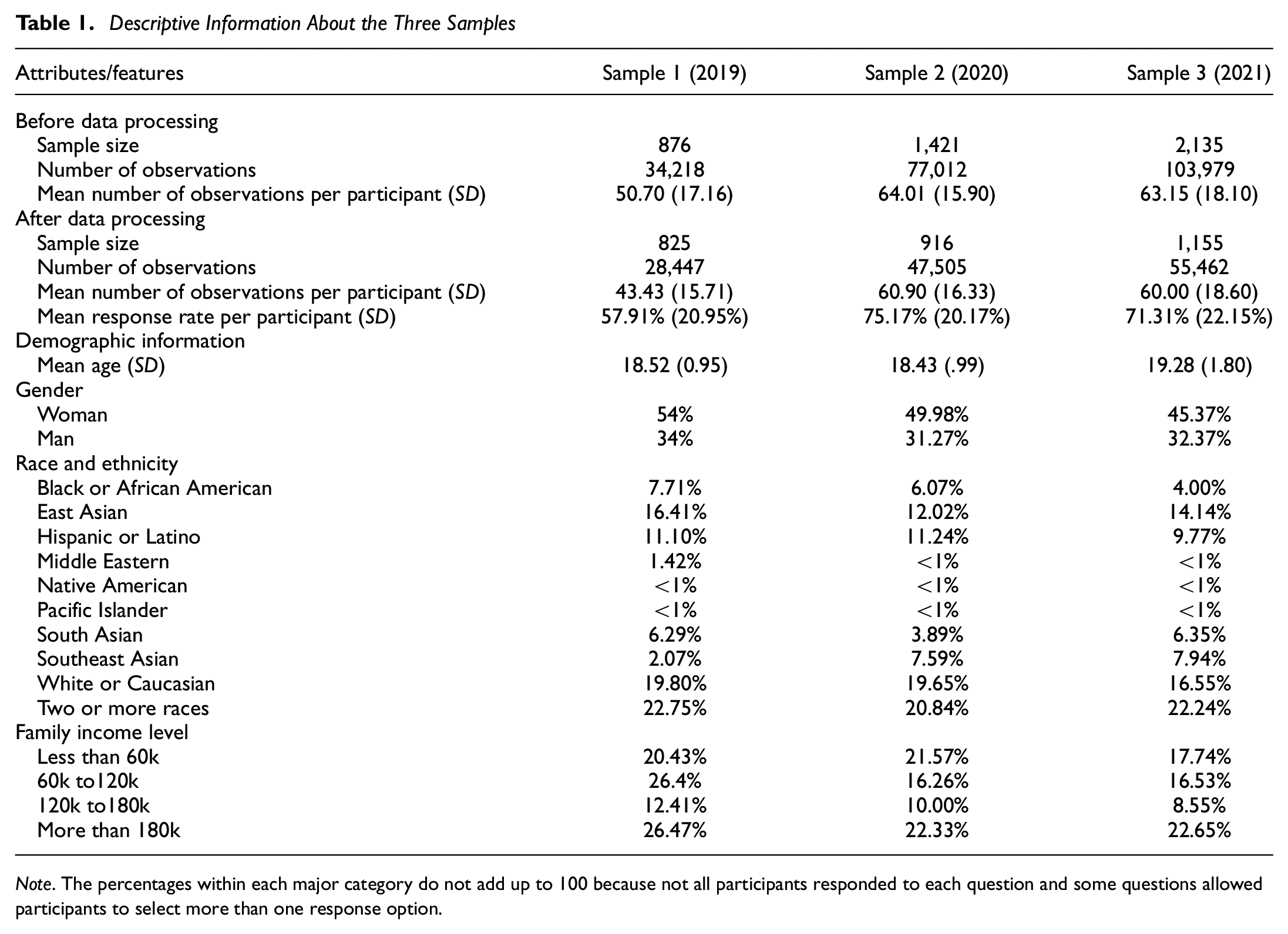
Note. The percentages within each major category do not add up to 100 because not all participants responded to each question and some questions allowed participants to select more than one response option.
The data collected during the Fall quarters included one-time self-report surveys collected through Qualtrics and repeated ecological momentary assessments (EMAs) collected through a mobile app, called WellPing, which is a customized version of the Beiwe research platform (Onnela et al., 2021). Participants downloaded WellPing directly to their Android or iOS smartphones and received survey notifications (i.e., “pings”) to complete EMAs that asked them to report on their meaningful social interactions, momentary well-being, and context. The EMA component of the study lasted three weeks, and participants received four pings per day at randomly selected times within designated 4-hr block time windows between 9:00 AM and 11:00 PM. Participants had 2 hr to complete the EMA associated with each ping, and in total participants could complete up to 84 EMAs during the study. They were compensated $ 0.75 per EMA completed and a bonus of $7 per week if they completed more than 85% (of the 28 possible pings) per week. Across the years, participation rates were high with the total number of EMAs collected ranging from 34k to 103k and the average number of EMAs per participant ranging from 50 to 63 (see Table 1). In this research, we focus on the EMA data, so we do not report further on the one-time surveys.
Data Processing
We employed several exclusion and filtering steps on the EMA datasets as part of our data processing prior to analysis. First, we excluded all individual EMA observations with extremely high or low response times (i.e., all that fell outside of the 95% confidence interval around the mean response time of 148 s in S1, 126 s in S2, and 101 s in S3). Second, we excluded those participants in each study who completed less than five EMA observations.
To keep the samples across the studies independent, we filtered out repeat participants who completed the study multiple times. So, we only included the unique participants for each year to ensure that there were no participants overlapping across the three samples. As shown in Table 1, the exclusion criteria and filtering steps resulted in decreasing our raw sample sizes (approximately 5.8% in S1, 35.5% in S2, and 45.9% in S3) and the number of observations analyzed across all samples (approximately 16.8% in S1, 38.3% in S2, and 46.6% in S3).
Measures
Momentary Well-Being
For the momentary well-being questions, participants provided ratings on stress, anxiety, loneliness, happiness, sadness, anger, and fear using a scale bar from 0 to 100 (“Please use the slider bars to indicate how you feel right now.”). Affective well-being was calculated based on an average of four items: Happy, Sad (reverse-coded), Angry (reverse-coded), and Anxious (reverse-coded). Negative items were reverse-coded so that higher values on the affective well-being measure would correspond to “better” affective well-being. Loneliness and stress were assessed using the single items.
Meaningful Social Interactions
Participants were asked to indicate which student peers they had meaningful social interactions with (“Please nominate the university undergraduate[s] you had the most meaningful interactions with within the past hour.”). Participants could indicate up to three peers by name, with whom they had meaningful social interactions. We created a binary measure to indicate whether participants had or had not engaged in a meaningful social interaction during the past hour. We treated this variable as indicating engagement in meaningful social interactions (vs. not) to examine its relationship to subsequent well-being states.
Interaction Partner
Participants indicated were asked about the people they had meaningful social interactions with (“How would you best describe your relationship to **UNDERGRADUATE PEER**?”). We created two categories from the seven response options: Strong Ties (any interactions with a “Significant Other,”“Dormmate/Roommate,” or “Friend”) and Weak Ties (any interactions with a “Teammate,”“Classmate,”“Co-worker,” or “House staff”). In addition, an eighth category (i.e., “Strangers”) was included in Study 1 but was not included in Study 2 or Study 3, so it was dropped.
Communication Channel
Participants were also asked about the communication channels they had used for meaningful social interaction (“How did the interaction with **UNDERGRADUATE PEER** take place?”). We created two categories from the five response options: Face-to-face interactions (any “In-Person” interactions) and computer-mediated communication (CMC; any interactions via “Phone Call,”“Video Call,”“Direct Messaging,” or “Social Media”).
Places
Participants were also asked about the places they were spending time in (“During the past hour, what was your primary location?”). We created four categories from the nine response options: Home, Social and Public Places (any observations in a “Cafe/Restaurant/Bar,”“Other’s Home/Dormitory,”“Fraternity/ Sorority House,”“Gym,” or “Store/Mall”), Study and Work Places (any observations in a “Library,”“Classroom/Lecture Hall,” or “at Work”), and Outdoors.
Activities
Participants were also asked about the activities they were engaged in (“During the past hour, what was your primary activity?”). We created five categories from the nine response options: Resting, Studying, and Working (any observations of “Attending Classes/Meetings,”“Studying,” or “Working”), Dining, Exercising, Consuming Media (any observations of “Digital entertainment,”“Social Media,” or “Browsing the internet”). In S1 and S3 (but not S2), the response options also included a “Socializing” category as a primary activity that we excluded from the analyses for consistency across the samples and because we were interested in understanding the moderating role of co-occurring activities surrounding meaningful social interactions as a contextual factor.
Analytic Strategy
The research presented here is generally exploratory in nature, but we followed a preregistered analytic plan. We initially explored our research questions in S1 and then sought to replicate the findings as confirmatory hypotheses to be tested in S2. Notably, only the findings for RQ1 replicated in our confirmatory analyses using the S2 dataset, which were those corresponding to the main effects of engaging in meaningful social interactions on momentary well-being, as compared to not engaging in meaningful social interactions. The hypotheses for RQ2 about the moderating effect of contexts failed to replicate in S2, which we suspected was due, in part, to the timing of the data collection occurring in 2020 during the COVID-19 pandemic when students were off-campus due to lockdown restrictions. 1 So, we conducted the same analyses as outlined in our pre-registration using data from S3 (conducted in 2021) and found that several of our initial hypotheses for RQ1 and RQ2 (derived from S1) had replicated in S3 when participants had returned to campus (see Table S1 of the Supplemental Materials).
Given the inclusion of a third exploratory sample, we report on findings from a mega-analysis, pooling all the datasets across the three studies and including the years of data collection as control variables for parsimony and to increase statistical power (Scheibehenne et al., 2016; see also Curran & Hussong, 2009). We focus our interpretation on the results from the mega-analysis of Studies 1 to 3. Table 2 presents the findings from the mega-analysis and indicates which findings replicated across samples. Due to the highly powered design (at the between and within-person level) and the number of analyses conducted, many findings were significant in the mega-analysis and within individual samples (the findings from each sample analyzed separately can be found in Table S1 of the Supplemental Materials). To ensure that pooled findings did not reflect the idiosyncrasies of any one sample, we focused our interpretation in the main text of the manuscript on those findings that were deemed to be most reliable due to their replication in at least two of the three samples (i.e., S1 and replicated in either S2 or S3). Interested readers are directed to the tables for other findings that may be of interest.
Results From Multilevel Models for Research Questions 1 and 2
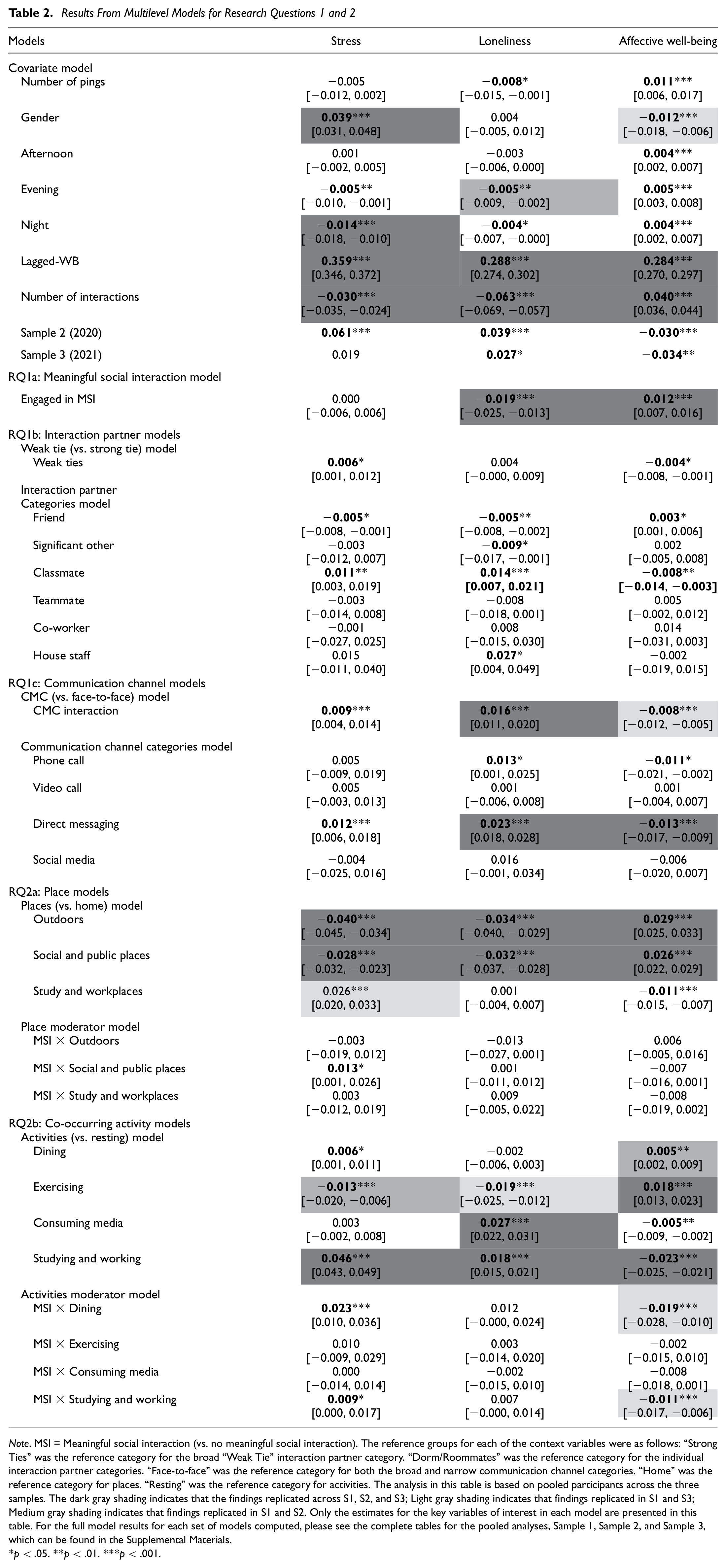
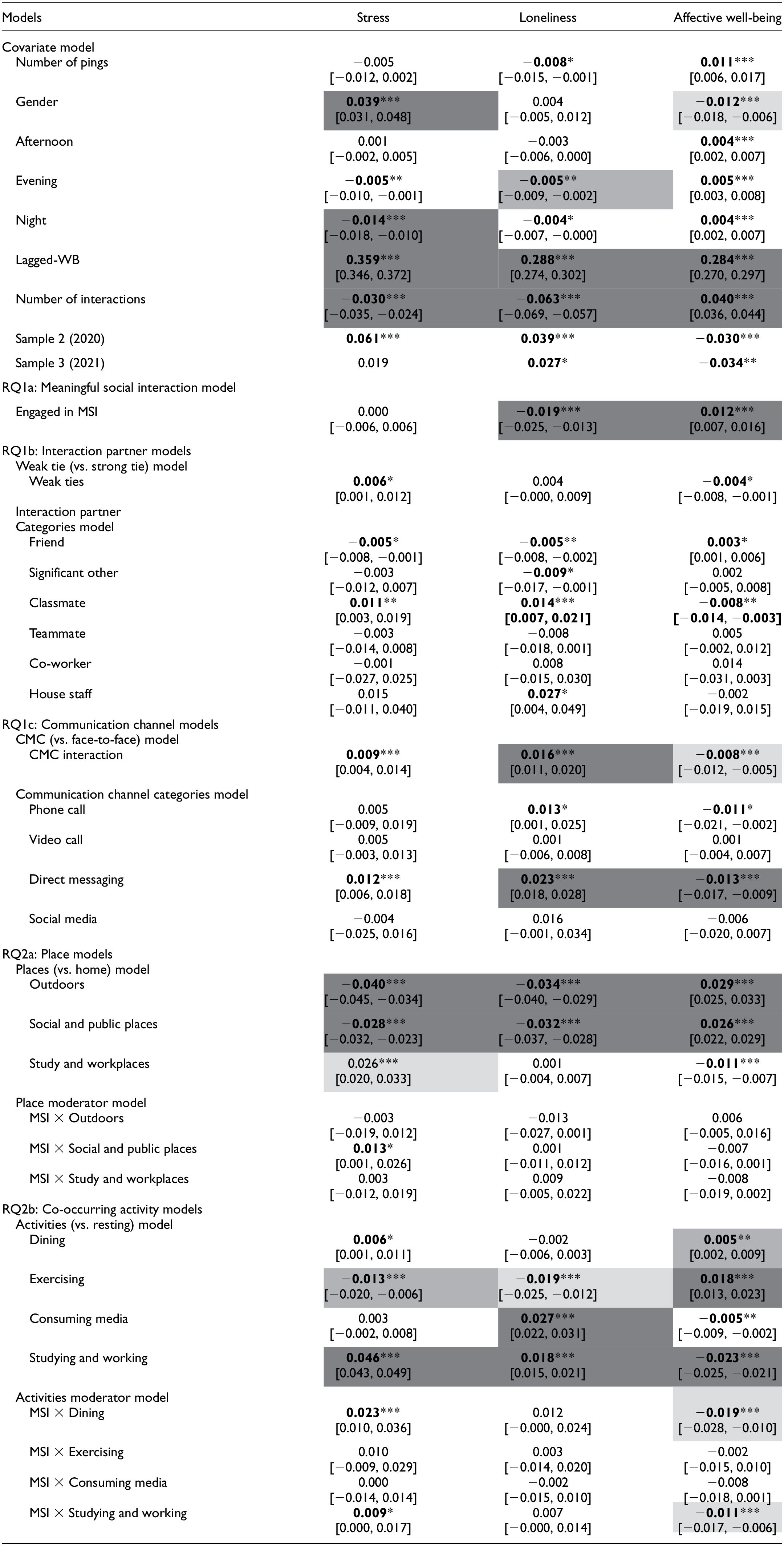
Note. MSI = Meaningful social interaction (vs. no meaningful social interaction). The reference groups for each of the context variables were as follows: “Strong Ties” was the reference category for the broad “Weak Tie” interaction partner category. “Dorm/Roommates” was the reference category for the individual interaction partner categories. “Face-to-face” was the reference category for both the broad and narrow communication channel categories. “Home” was the reference category for places. “Resting” was the reference category for activities. The analysis in this table is based on pooled participants across the three samples. The dark gray shading indicates that the findings replicated across S1, S2, and S3; Light gray shading indicates that findings replicated in S1 and S3; Medium gray shading indicates that findings replicated in S1 and S2. Only the estimates for the key variables of interest in each model are presented in this table. For the full model results for each set of models computed, please see the complete tables for the pooled analyses, Sample 1, Sample 2, and Sample 3, which can be found in the Supplemental Materials.
p < .05. **p < .01. ***p < .001.
Due to the nested structure of our data, we used frequentist multilevel models to answer our research questions, using the lme4 package (Bates et al., 2015) in R version 4.4.1. We fit models with momentary data (Level 1) nested within individuals (Level 2). We included a random intercept for each participant in line with recommendations based on the intraclass correlation coefficient (ICC) values, which showed a considerable degree of between-person variability in our dependent variables (stress ICC = .49, loneliness ICC = .57, affective well-being ICC = .53; see Tables S2–S4 in the Supplemental Materials for models with control variables included). We followed recommendations for multilevel models with regard to centering and standardizing variables (Curran & Bauer, 2011; Yaremych et al., 2021). Specifically, repeated-measures continuous and categorical variables that were used as independent and control variables in the models were person-mean centered (at Level 1; Enders & Tofighi, 2007), whereas between-person variables were sample-mean centered and standardized (at Level 2; Cowan, 2019). Following the recommendation for multilevel modeling, we did not center or standardize dependent variables. Finally, following the recommendation from lme4, we normalized all independent variables prior to analysis to facilitate model convergence (Bates et al., 2015).
We included a number of control variables in our models, including gender at Level 2, and time of day (morning [9:00 AM–12:00 PM], afternoon [12:00 PM–6:00 PM], evening [6:00 PM–9:00 PM], and night [9:00 PM–1:00 AM]) at Level 1 to account for the fact that both gender and times of the day have been associated with differences in well-being outcomes (e.g., Cox et al., 2018; Matud et al., 2019). We also included the number of observations per person at Level 2 (to account for differences in the total number of EMAs completed by each participant) and a lagged well-being score that was the standardized average of each participant’s well-being the previous day at Level 1 (to control for preceding well-being states). Finally, we also included the number of meaningful social interactions participants had for each observation at Level 1 (participants could report on zero to three meaningful social interactions during each measurement occasion) to account for the fact that the meaningful social interactions were modeled as separate observations dovetailing on the same well-being DVs (Dependent Variables) (assessed one time per measurement occasion) in the multilevel models.
Furthermore, we observed that the relationships between lagged well-being and momentary well-being varied significantly across people, as did the relationships between meaningful social interactions and momentary well-being (see Figures S1–S3 of the Supplemental Materials). Based on these observations, we included a random slope for lagged well-being and a random slope for meaningful social interactions to assess this within-person variability (see Tables S2–S4 of the Supplemental Materials).
Formally, the model equation for RQ1 about the main effect of engaging in meaningful interactions on subsequent well-being outcomes can be specified as follows:

where
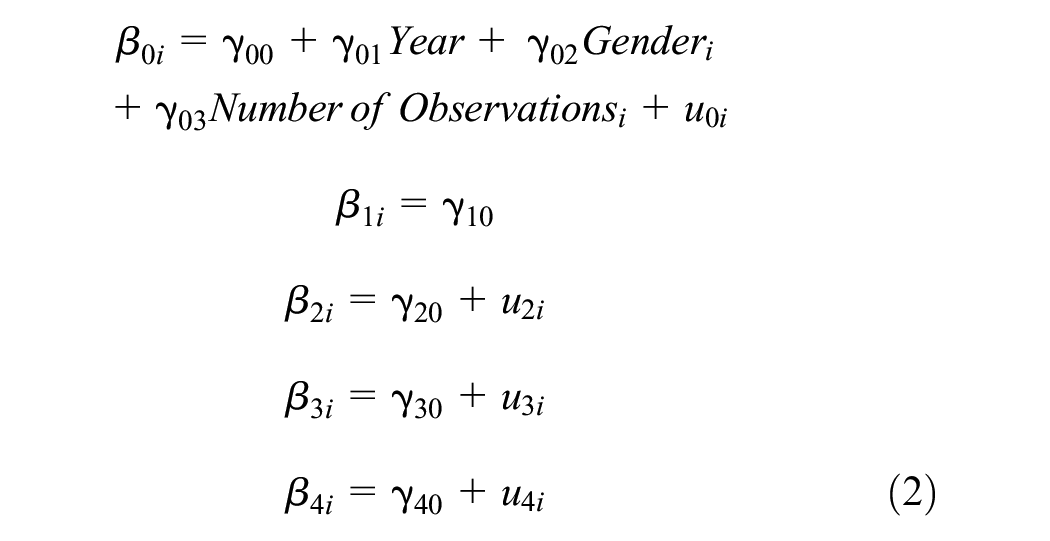
The analyses examining the main effects of interaction partners and communication channels used the same model specifications for Levels 1 and 2, but included terms to capture these variables at Level 1, respectively
The analyses examining the moderating effects of places and activities as contextual factors (RQ2) used the same model specifications for Levels 1 and 2, but instead included the main effect
Deviations From Pre-registration
We note three deviations from the pre-registration that were made pertaining to how we analyzed the data and how we interpreted the results.
First, we modified how we categorized weak tie interaction partners to include interactions with “House Staff” (instead of having a separate “University Staff/Stranger” category) given that the question asked participants about student peers who were staffing the dormitories and houses where they reside.
Second, we included (a) the number of meaningful social interactions participants had reported during the past hour (which ranged from 0 to 3) as an additional control variable in our models, and (b) conducted additional exploratory analyses for each individual response option within the broader interaction partner and communication channel categories (see Table 2).
Third, we preregistered four research questions but for the purposes of brevity, we only focused on three of the research questions. The question we did not report on focused on psychological dispositions that may moderate the relationship between meaningful social interactions and well-being outcomes.
Results
Meaningful Social Interactions and Momentary Well-Being
Across all three samples, our findings showed that engaging in meaningful social interactions with peers was associated with lower momentary loneliness (pooled: B = −0.019, p < .001) and greater momentary affective well-being (pooled: B = 0.012, p < .001; see RQ1a Model, Table 2), as compared to not engaging in a meaningful social interaction. Moreover, the quantity of meaningful social interactions was also beneficial for momentary well-being outcomes such that having a greater number of such interactions was associated with a decrease in stress (pooled: B = −0.03, p < .001) and loneliness (pooled: B = −0.063, p < .001), and increase in affective well-being (pooled: B = 0.040, p < .001; see Covariate Model, Table 2).
With Different Interaction Partners
There were several findings suggesting that engaging in meaningful social interactions with strong and weak tie interaction partners was associated with momentary stress, loneliness, and affective well-being (see RQ1b Models, Table 2); however, the findings did not replicate across samples so we do not interpret them further here.
Across Different Communication Channels
Engaging in meaningful social interactions via computer-mediated channels was associated with greater loneliness (pooled: b = 0.016, p < .001) and lower affective well-being (pooled: b = −0.008, p < .001), as compared to face-to-face interactions (see RQ1c Models, Table 2). The findings for loneliness replicated across all three samples, while the findings for affective well-being replicated in S1 and S3. Additional analyses of the individual communication channel categories indicated that these relationships were largely driven by direct messaging being associated with greater loneliness (pooled: b = 0.023, p < .001), and lower affective well-being (pooled: b = −0.013, p < .001), compared to having meaningful interactions face-to-face. A pattern of findings replicated across all three samples for loneliness and affective well-being. We also observed findings suggesting that phone calls were associated with loneliness and affective well-being, however, the findings did not appear to be reliable as they did not replicate across samples.
In Different Places
Across the three samples, we found the main effects of places on momentary well-being such that being outdoors and in social/public places was associated with increased well-being, compared to being at home (see RQ2a Models, Table 2). Notably, we only observed one moderating effect of social and public places on meaningful social interactions and momentary stress in the pooled analysis (Table 2; Figure S8), however, this finding did not replicate across samples.
Co-occurring Activities
Across the three samples, we found the main effects of exercising being associated with increased well-being, while consuming media and studying or working activities were associated with decreased well-being, compared to resting (see RQ2b Models, Table 2). The few moderating effects of activities on meaningful social interactions and momentary well-being were observed for affective well-being. Specifically, participants reported weaker increases in their affective well-being after engaging in meaningful social interactions while they were studying or working (pooled: b = −0.011, p < .001), and while dining (pooled: b = −0.019, p < .001), compared to when they were resting (Figure 1). The findings for affective well-being were replicated in S1 and S3. We also observed findings for studying or working and dining on stress, but these did not replicate across samples (Table 2; Table S1 and Figures S9).
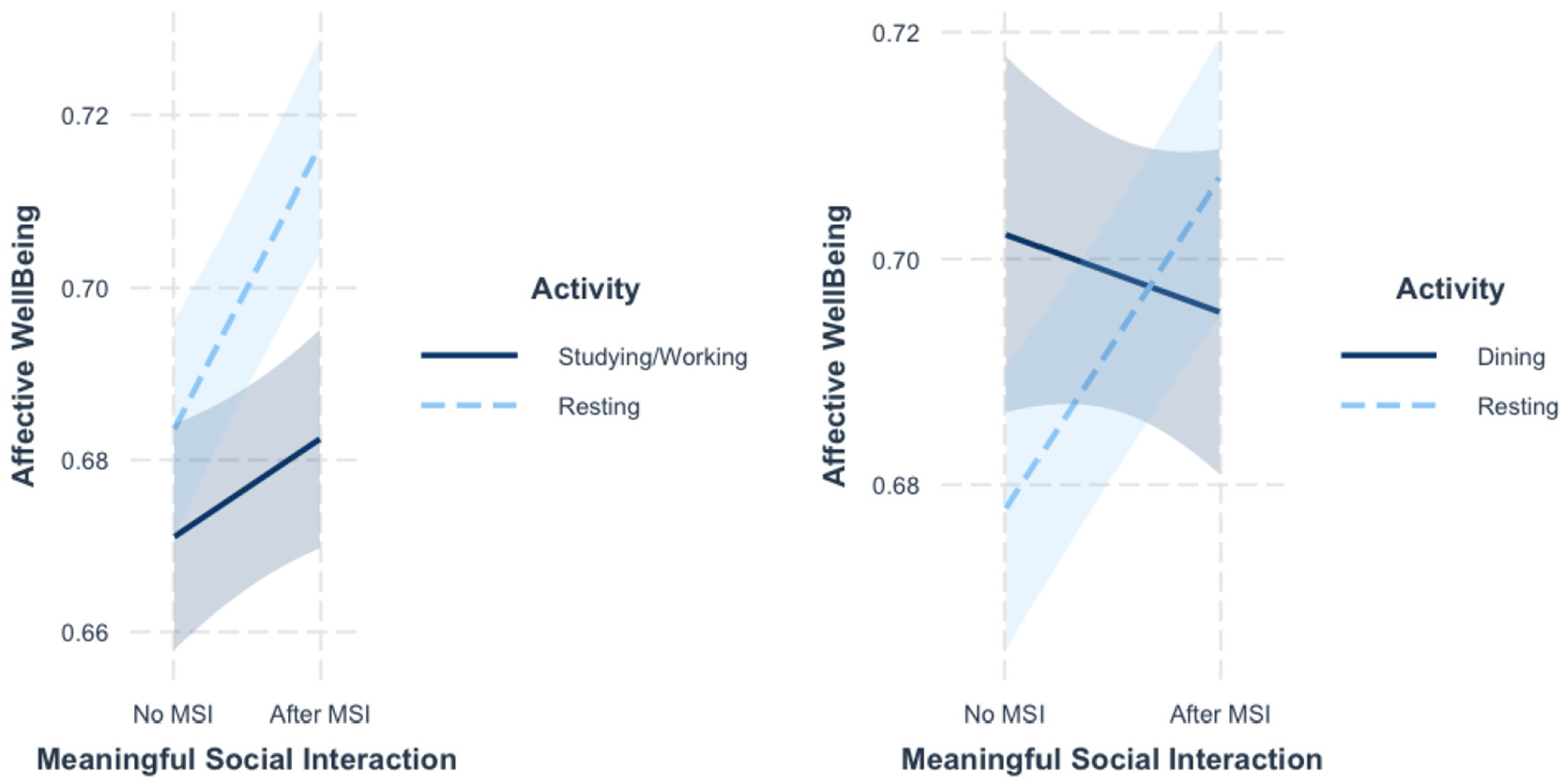
Moderation Effects of Co-Occurring Activities During Meaningful Social Interactions
Discussion
Using three intensive longitudinal datasets, we examined the relationship between engaging in meaningful social interactions and momentary well-being outcomes across a range of different contexts. Across all three samples, we found that meaningful peer social interactions were associated with lower momentary loneliness and greater affective well-being, compared to not engaging in such interactions. Overall, our results for the main effects of meaningful social interactions on subsequent well-being corroborate findings from past research in daily life settings for affective well-being (Choi et al., 2017; Kuper et al., 2023; Mehl et al., 2010; Milek et al., 2018; Quoidbach et al., 2019), and add new findings for loneliness and the role of contextual factors in explaining momentary well-being outcomes.
In regards to interaction partners, the pattern of findings was mixed across samples for both the broader category of strong versus weak ties, as well as for the narrower interaction partner categories. But for communication channels, we found that engaging in meaningful social interactions via computer-mediated channels (and direct messaging in particular) was associated with subsequent greater loneliness and lower affective well-being, compared to having such interactions in person. These findings support past research by underscoring the relative value of face-to-face communication over CMC for momentary well-being (e.g., Kim et al., 2007; Kroencke et al., 2022; Ruppel et al., 2016; Vlahovic et al., 2012), even when the social interactions occurring via computer-mediated channels are deemed to be subjectively meaningful. Here we focused on college students who are likely more comfortable and proficient using digital communication platforms (e.g., direct messages; Haase et al., 2021), so it is unclear whether the associations between meaningful social interactions and CMC channels observed also hold among older adults.
In terms of places and activities, our findings suggest that being outdoors, in social and public places, and exercising were associated with positive well-being outcomes, while studying or working and consuming media were associated with negative well-being outcomes. However, only two replicable findings were observed for the moderating effect of co-occurring activities: meaningful social interactions occurring while studying or working, and while dining were associated with weaker increases in affective well-being, compared to meaningful social interactions that occurred while resting. These findings suggest that the positive effects of meaningful social interactions on well-being may be reduced when the interaction is co-occurring alongside other activities that demand attention or interfere with goal pursuit. Past research about the negative well-being outcomes associated with multitasking behavior supports this possibility (e.g., negative outcomes have been associated with media multitasking, such as engaging in computer-mediated social interactions while doing other things; van der Schuur et al., 2015).
Cumulatively, our findings suggest that both places and activities have reliable main effects on momentary well-being. However, the co-occurring activities people engage in while having meaningful social interactions may be more relevant for explaining subsequent momentary well-being outcomes, as compared to the places in which the meaningful social interactions occur. The findings provide little evidence for places modulating the effects of social interactions on feelings of wellness but support past research that emphasizes the role of the physical environment, especially social and public places, in explaining well-being (Farber et al., 2014; Graham et al., 2015; Meagher, 2020; Müller et al., 2020; Oldenburg, 1998; Purnell, 2015). Notably, given the present research was conducted from 2019 to 2021, the pattern of results might be driven to some degree by changes to people’s social lives during these years, including the places and activities that people encountered during their everyday social interactions. For many people, the onset of the pandemic likely homogenized the physical environments in which meaningful social interactions took place (e.g., the home, outdoors), but may have also heterogenized the activities that people engaged in while having such interactions (e.g., playing games online; having virtual dinners).
Our findings should be considered with three main limitations in mind that point to directions for future research. First, we examined our research questions using longitudinal datasets and correlational statistical methods, hence we cannot disentangle the causal associations between our variables of interest.
Second, our samples were recruited in the cultural context of a West Coast university community in the United States, so future studies should aim to recruit participants from other populations, countries, and cultures to test the external validity of our findings. Given that cultural factors have been linked to patterns of social behavior (Oishi et al., 2008), it is also plausible that the extent to which well-being effects of socializing are moderated by contextual variables is more broadly shaped by the culture in which people are socializing.
Third, the self-report measures used in our study design could be improved upon in future work. For example, the measure of meaningful social interaction we used asked participants to indicate whether one had occurred, instead of asking them to rate the degree to which their interactions were meaningful. Adopting a rating scale would provide more granularity in the assessments and permit a more nuanced assessment of the extent to which the interactions were deemed meaningful. Another potential limitation of our measures is that we did not include subjective perceptions of the contexts in which the social interactions occurred. We assessed relatively objective contextual information (e.g., situational cues such as where the interactions occurred, and who was involved), instead of asking people to report on their subjective perceptions of the surrounding context (e.g., situational characteristics; Rauthmann et al., 2015). Thus, a promising future direction lies in better understanding how subjective perceptions of the situations in which meaningful social interactions occur relates to momentary well-being outcomes.
Supplemental Material
sj-docx-1-spp-10.1177_19485506241248271 – Supplemental material for Meaningful Peer Social Interactions and Momentary Well-Being in Context
Supplemental material, sj-docx-1-spp-10.1177_19485506241248271 for Meaningful Peer Social Interactions and Momentary Well-Being in Context by Mahnaz Roshanaei, Sumer S. Vaid, Andrea L. Courtney, Serena J. Soh, Jamil Zaki and Gabriella M. Harari in Social Psychological and Personality Science
Footnotes
Handling Editor: Richard, Slatcher
Authors’ Note
This manuscript will undergo peer review, copyediting, typesetting, and reviewing of resulting proofs before it is published in final form. Code needed to reproduce all analyses reported in the paper and supplementary materials are publicly available at the Open Science Framework. Data needed to reproduce all analyses will be made available after a peer review of the manuscript is complete.
Author Contributions
Author contributions for this manuscript were as follows: Conceptualization: MR, SSV, ALC, GMH; Data Curation: MR, ALC; Formal Analysis: MR; Funding Acquisition: MR, JZ, GMH; Investigation/Data Collection: MR, ALC, JZ, GHM; Methodology: MR, SSV, GHM; Project Administration: MMR; Supervision: GMH; Validation: MR, SSV; Visualization: MR; Writing—Original Draft: MR, SSV, GMH; Writing—Review and Editing: MR, SSV, SJS, ALC, JZ, GMH.
Declaration of Conflicting Interests
The author(s) declared no potential conflicts of interest with respect to the research, authorship, and/or publication of this article.
Funding
The author(s) disclosed receipt of the following financial support for the research, authorship, and/or publication of this article: This research was supported by a Stanford Human-Centered AI (HAI) seed award and a National Institute of Health award (R01 MH125974). The funders had no role in study design, data collection and analysis, decision to publish, or preparation of the manuscript. The authors did not report any conflict of interest.

Supplemental Material
Supplemental material for this article is available online.
Notes
Author Biographies
References
Supplementary Material
Please find the following supplemental material available below.
For Open Access articles published under a Creative Commons License, all supplemental material carries the same license as the article it is associated with.
For non-Open Access articles published, all supplemental material carries a non-exclusive license, and permission requests for re-use of supplemental material or any part of supplemental material shall be sent directly to the copyright owner as specified in the copyright notice associated with the article.
