




Abstract
Civic engagement is essential for responding to societal crises, yet only some people take action. This study investigates how personality is connected to who engages during a crisis and how they engage. We analyzed the reactions of German civil society to the war in Ukraine to examine how the Big Five traits and empathy relate to benevolent (e.g., volunteering or donating) and activist (e.g., protesting) engagement. To test the robustness of our effects, we analyzed immediate (within the first 3 months of the war), late (8–15 months after the beginning of the war), and sustained (both immediate and late) engagement. In a longitudinal sample (N > 700), hierarchical regressions showed that personality and empathy were associated with immediate, late, and sustained engagement. Extraversion, openness, and empathy positively predicted both benevolent and activist engagement; conscientiousness had negative effects on both engagement forms.
Civic engagement is vital in democratic societies. Social movements shape political discourse and voting behaviors (Stephan & Schürmann, 2025), billions of Euros in donations fund essential programs worldwide, and volunteering is often described as a “motor of democracy” (German Federal Ministry of the Interior and Community, 2025). Its relevance becomes especially clear during crises, such as wars, natural disasters, or political unrest. This was evident when Russia launched its war of aggression against Ukraine, prompting global engagement. In Germany, a country with close political and economic ties to Ukraine and one of the largest intakes of Ukrainian refugees, citizens quickly and consistently volunteered, donated, protested, and supported in various ways. Since this engagement was completely voluntary, it raises the question of who chooses to become involved. This study examines the Big Five personality traits and empathy as psychological predictors of different forms of engagement in Germany following the war in Ukraine, aiming to clarify the role of individual differences in civil society processes.
Civic Engagement
For this article, we use a widely applied psychological definition of civic engagement. Following Adler and Goggin (2005), civic engagement is defined as “[. . .] how an active citizen participates in the life of a community to improve conditions for others or to help shape the community’s future” (p. 241). This broad definition includes behaviors such as volunteering, donating, and protesting. To differentiate its facets, Thomas and McGarty (2018) distinguish between benevolent and activist engagement. Benevolent engagement focuses on alleviating another person’s suffering through charity, philanthropy, or assistance and the transfer of resources (e.g., time, money, information). Activist engagement focuses on systemic change, using collective action to target a system or third party (i.e., governments, individuals holding political power) rather than direct resource transfer (Thomas & McGarty, 2017). Although often labeled differently (social/civic/community engagement or traditional philanthropy vs. collective action or political/manifest political engagement), this distinction has also been made in previous works (Adler & Goggin, 2005; Barrett & Brunton-Smith, 2014; Berger, 2009; Ekman & Amnå, 2012; Lantos et al., 2020).
In both forms, citizens are often engaged long-term by volunteering in community settings or by participating in a social movement (Simonson et al., 2021). However, individuals also engage irregularly in response to societal crises (Jacobsen et al., 2023). Civic engagement can then take other forms than usual, like cleanup after a natural disaster or assistance for refugees.
Who shows civic engagement is influenced by sociodemographic factors: Higher education, employment, and higher income positively predict volunteer engagement, whereas a migration background can be a negative predictor (Jacobsen et al., 2023). Marital status, age, and household size might also play a role (Huyser et al., 2017). In Germany, men were historically more engaged than women, but recent studies suggest equal participation (Jacobsen et al., 2023; Simonson et al., 2021).
Personality and Engagement
Civic engagement is voluntary and rarely financially reimbursed. It can take various forms, from online activities to participation in groups. Its autonomy and flexibility may make civic engagement especially sensitive to personality effects, making it a compelling subject for personality research. Indeed, initial research examining the relationship between overall civic engagement and personality finds robust relationships (Rico-Bordera et al., 2023; Stahlmann et al., 2024). Little is known, however, about whether these findings apply to crisis-related engagement, which often unfolds in unpredictable, continually evolving situations with less structured organizations or plans. These circumstances could suggest distinct personality effects.
The Big Five as Predictors of Benevolent Engagement
Prior research has examined how the Big Five personality traits predict benevolent engagement across contexts. Extraversion consistently shows a significant positive influence: It predicted active membership in civil society organizations in a Danish sample (Dinesen et al., 2014), volunteering in a South Korean (Ha, 2019) and a Dutch sample (Bekkers, 2005), engagement in the context of the AIDS (Omoto et al., 2010) and the COVID-19 pandemic (Hamdani et al., 2024; Mak & Fancourt, 2022), volunteering in palliative care (Claxton-Oldfield & Banzen, 2010), membership of different civic groups in a cross-country sample (Weinschenk, 2017) and was the strongest personality predictor of volunteering in a recent meta-analysis (Bleidorn et al., 2025). This may be due to the social and in-person nature of volunteer work or extraverts’ larger social networks, which increase contact with organizations or individuals needing support. However, some studies report no significant relationship (e.g., Habashi et al., 2016; Rico-Bordera et al., 2023).
Openness (e.g., Bekkers, 2005; Bleidorn et al., 2025; Claxton-Oldfield & Banzen, 2010; Ha, 2019; Mak & Fancourt, 2022; Rico-Bordera et al., 2023) and agreeableness (e.g., Capra et al., 2021; Claxton-Oldfield & Banzen, 2010; Ha, 2019; Habashi et al., 2016; Mak & Fancourt, 2022; Rico-Bordera et al., 2023) are consistent positive predictors for benevolent engagement. Open individuals might be more drawn to novel environments and challenges or the cultural-sector roles common in volunteer work. Agreeable individuals might be attracted to social-sector roles due to their high levels of compassion.
The effect of conscientiousness might be context-dependent, as it has been found to predict benevolent engagement positively (Mak & Fancourt, 2022; Rico-Bordera et al., 2023), negatively (Bekkers, 2005), or not at all (Bekkers, 2006), depending on the study. Emotional stability shows mixed or negligible effects across studies, with few reporting positive effects (e.g., Bekkers, 2005, 2006; Claxton-Oldfield & Banzen, 2010; Ha, 2019) but many others reporting nonsignificant or mixed results (e.g., Bekkers, 2006; Habashi et al., 2016; Mak & Fancourt, 2022; Rico-Bordera et al., 2023; Weinschenk, 2017).
It remains unclear how the Big Five are associated with benevolent engagement in public crises. Primary evidence from the AIDS and the COVID-19 pandemic is mixed, identifying openness or extraversion as the most relevant trait (Hamdani et al., 2024; Mak & Fancourt, 2022; Omoto et al., 2010). To our knowledge, no research has addressed how personality predicts the temporal aspect of public-crisis-related engagement (i.e., engagement immediately after the crisis onset vs. weeks or months later vs. continued engagement).
The Big Five as Predictors of Activist Engagement
Extraversion is frequently linked to various forms of activist engagement, including protest participation, attendance of political meetings, and collective action (Huber et al., 2021; Weinschenk, 2017). This has been shown through various behaviors in settings like protesting in Spain (Gallego & Oberski, 2012) and Taiwan (Wang et al., 2019), online political engagement in Sweden (Russo & Amnå, 2015), activist engagement in Germany (Johann et al., 2020), online and offline political engagement in Belgium (Quintelier & Theocharis, 2012), attending political meetings or rallies in the United States (Mondak et al., 2010), and active political party membership in Denmark (Dinesen et al., 2014). The effect may stem from extraverts’ comfort in social situations, their outspoken nature about political issues (Gallego & Oberski, 2012), or their higher awareness of upcoming events due to larger social networks.
Openness likewise shows strong positive associations and sometimes competes with extraversion in predictive power (e.g., Brandstätter & Opp, 2014; Gallego & Oberski, 2012; Jordan et al., 2014; Mondak et al., 2010; Quintelier & Theocharis, 2012; Russo & Amnå, 2015). This might be due to the stimulation that open individuals seek from activism, their heightened sense of political efficacy, or their strong interest in political issues (Gallego & Oberski, 2012).
Agreeable individuals are generally less likely to engage in activism (e.g., Brandstätter & Opp, 2014; Gallego & Oberski, 2012; Russo & Amnå, 2015; Wang et al., 2019), possibly due to its confrontational nature. Similarly, conscientiousness also often emerges as a negative predictor (e.g., Johann et al., 2020; Mondak et al., 2010; Quintelier & Theocharis, 2012; Russo & Amnå, 2015; however, see Wang et al., 2019, for a positive effect). This may reflect a sense of civic duty centered on conventional acts like voting, which usually do not include activism (Johann et al., 2020). Findings on emotional stability are inconsistent, with mostly insignificant or weak effects (e.g., Brandstätter & Opp, 2014; Gallego & Oberski, 2012; Johann et al., 2020; Jordan et al., 2014; Mondak et al., 2010; Quintelier & Theocharis, 2012; Russo & Amnå, 2015). To our knowledge, no studies have explored how personality traits are connected to political engagement shown in response to a societal crisis, or how these effects may evolve over time.
The Role of Empathy
Given the interpersonal nature of benevolent and activist engagement, we included empathy in our study. Empathy, defined as the ability to perceive and understand the emotions and perspectives of another person (Cuff et al., 2014), has been shown to shape attitudes related to societal emergencies like refugee movements (Demel et al., 2025).
Trait empathy can be categorized as a facet-level personality characteristic partly mapped within the Big Five space but also has sub-facets outside of it (Mooradian et al., 2011). It is most strongly associated with agreeableness, but also shows positive correlations with openness and extraversion, emotional stability, and conscientiousness, although the latter three are weaker or mixed, potentially depending on the study context (Melchers et al., 2016; Mooradian et al., 2011; Song & Shi, 2017).
Empathy is a well-established predictor of benevolent and other prosocial behaviors. It positively influences informal civic helping behaviors (e.g., Politi et al., 2023; Silke et al., 2020; Xiao et al., 2021) as well as formal volunteering (Penner, 2002) and donating (Luengo Kanacri et al., 2016), possibly through fostering positive attitudes toward outgroups (Taylor & McKeown, 2021) or via its strong link to altruistic values (Persson & Kajonius, 2016). Initial findings suggest that empathy positively influences benevolent engagement with Ukrainian refugees in Italy (Destro et al., 2024) and that state empathy mediates the relationship between the Big Five and helping behavior and donating (Habashi et al., 2016). Similarly, empathy predicts activist engagement, especially when it is outgroup-related, like protesting on behalf of an oppressed minority (Adida et al., 2018; Santos, 2020; Selvanathan et al., 2017; Taylor & McKeown, 2021). To our knowledge, no studies have examined the temporal stability of empathy’s role in civic engagement after a crisis. This raises the question of whether compassion fatigue sets in after a few months, dampening empathy’s impact on late and sustained engagement.
This Study
In this study, we examine how the Big Five personality traits and trait empathy are linked to civic engagement in response to a crisis. We use data on civic engagement in German civil society in response to Russia’s ongoing war against Ukraine as a case study. Although not a belligerent, Germany provides a compelling case for this research: It is in geographic, political, and psychological proximity to Ukraine, has taken in over 1 million Ukrainian refugees (UNHCR, 2025), and has provided over 14.7 billion Euros in aid (Kiel Institut für Weltwirtschaft, 2024). Germany’s political response—including military aid, refugee management, increased defense spending, and energy sanctions—has sparked significant domestic debate (Masch et al., 2023). This context offers a unique opportunity to investigate crisis-related benevolent and activist engagement simultaneously (see also Kende et al., 2017).
Since there are few previous findings on personality effects on crisis-related engagement, we made no predictions on how well findings on “regular” engagement transfer. However, based on various considerations, we assume at least partially context-specific effects: Crisis-related engagement can strongly differ from “regular” engagement in its goals and activities—while everyday engagement in Germany occurs mainly in sports-related or cultural contexts (Simonson et al., 2021), crisis-related engagement is often humanitarian. This could elicit stronger agreeableness effects. Crisis engagement also requires flexibility and quick adaptation to new circumstances, potentially strengthening the relevance of trait openness. It is also imaginable that engagement intensity is higher and that different emotions play a role in crisis-related engagement, with a greater presence of shock, anxiety, or anger. This potentially increases the importance of emotional stability. Hence, previous findings about personality effects on “regular” engagement might not be readily transferred.
We use a longitudinal data set from a large and diverse German sample to assess the role of the Big Five and empathy. We assume that these traits explain variance in engagement beyond sociodemographic measures and that their effects remain robust for engagement shown immediately following the outbreak of the war, engagement shown a year later, and sustained engagement.
Materials and Methods
Sample and Data Collection
This study draws on data from a panel survey examining how individuals in Germany responded to Russia’s war against Ukraine. The overall panel consisted of 14 waves of data collection. The following waves are relevant for this study: Wave 1 (mid-March 2022, sociodemographics), Wave 2 (late March 2022, Big Five and empathy), Wave 4 (mid-May 2022, immediate engagement), and Wave 10 (late May to early June 2023, late engagement). Participants were recruited through a panel provider (bilendi/respondi), using sampling quotas to ensure the sample was largely representative of German citizens ages 18 to 69 years in terms of gender, age, educational level, and federal states. Excluded from the sample were participants outside the predefined age range of 18 to 69 years (n = 5), speeders who completed the first survey wave in under 2 min (n = 661), cases with duplicate IDs or missing duration data (n = 11), and participants outside quota-defined gender categories (n = 6). For our final three samples, we only considered participants with data in the waves relevant to our outcomes and complete predictor data, resulting in sample sizes of N = 1,082 (immediate engagement), N = 851 (late engagement), and N = 738 (sustained engagement). We examined sample attrition and accession using multiple logistic regression. A younger age, female gender, and higher scores in openness predicted being in the dropout group (compared to longitudinal participants). Detailed results are reported in Table A1 in Online Appendix.
Measures
Outcomes
Participants were surveyed twice about their involvement in activities related to the war in Ukraine or those affected by it: first in mid-May 2022, referring to actions taken since the war began in February 2022 (immediate engagement), and again in May/June 2023 regarding actions since January 2023 (late engagement). Participants who were active at both time-points were classified as showing sustained engagement. This classification resulted in six outcome measures: immediate, late, and sustained benevolent engagement, as well as immediate, late, and sustained activist engagement. These measures were developed independently and are not mutually exclusive; participants engaged at both time-points were counted as “engaged” in the immediate, late, and sustained samples. Thus, a positive score in any given outcome does not imply engagement exclusively in this outcome.
Benevolent engagement was measured using seven items covering donations, volunteering, information sharing, offering housing, and other forms of support. Responses were given on a three-point scale, with the answer choices being “no, never,” “yes, once,” and “yes, multiple times.” To binarize the scale, participants who answered “no, never” on all items were classified as not engaged, whereas those who selected “yes, once” or “yes, multiple times” for at least one item were classified as engaged.
Activist engagement was measured using seven items addressing behaviors such as demonstrating, boycotting, contacting politicians, participating in political parties, and other types of engagement. 1 Answer choices and the binarization of the scale were identical to the benevolent engagement scale. Both scales, in the original German wording and an English translation, are available in Online Appendix (Tables A2 and A3).
Predictors
The Big Five were measured using a short version of the Big Five Inventory (John et al., 1991) with 15 items, the BFI-S (Gerlitz & Schupp, 2005). All items were answered on a 7-point Likert-type scale. Trait scores were computed by averaging the respective items and subsequently standardized for all analyses. The BFI-S shows acceptable test–retest reliability, convergent validity, and construct validity (Donnellan & Lucas, 2008; Gerlitz & Schupp, 2005; Hahn et al., 2012). Due to the scale’s brevity, internal consistencies are moderate (Lang et al., 2011). Here, internal consistencies were α = .78 for extraversion, α = .54 for agreeableness, α =.68 for conscientiousness, α =.70 for openness, and α =.75 for emotional stability.
Empathy was measured using the short version of the Saarbrücker Persönlichkeitsfragebogen, SPF-K (Paulus, 2009, 2020), the German version of the Interpersonal Reactivity Index (Davis, 1980, 1983). The SPF-K includes four items measuring trait empathy with its two facets empathic concern and perspective taking. Responses are given on a 5-point Likert-type scale, with higher scores representing higher trait empathy. Scores were standardized prior to all analyses. The SPF-K demonstrated good internal consistency with α = .79.
The sociodemographic variables included in the models were gender (male or female; individuals identifying as non-binary or those who did not respond were excluded due to quotas), age (in years), education (low vs. high; see Online Appendix A5), and income (low: below 2,000€, vs. high: 2,000€ or above in monthly net household income, approximating the German median; Spannagel & Zucco, 2022). To assess non-linear age effects, a quadratic age term was included in all models. Table A4 in Online Appendix depicts descriptive information for all outcomes and predictors. Table 1 shows bivariate correlations for the “immediate” sample, the corresponding tables for the “late” and the “sustained” sample are provided in Online Appendix (Table A6 and Table A7). In the “immediate” sample, 33.5% of participants were not engaged, 9.3% showed only activist engagement, 23.3% only benevolent engagement, and 33.9% participated in both types.
Variances and Bivariate Correlations Between Variables in the “Immediate” Sample.
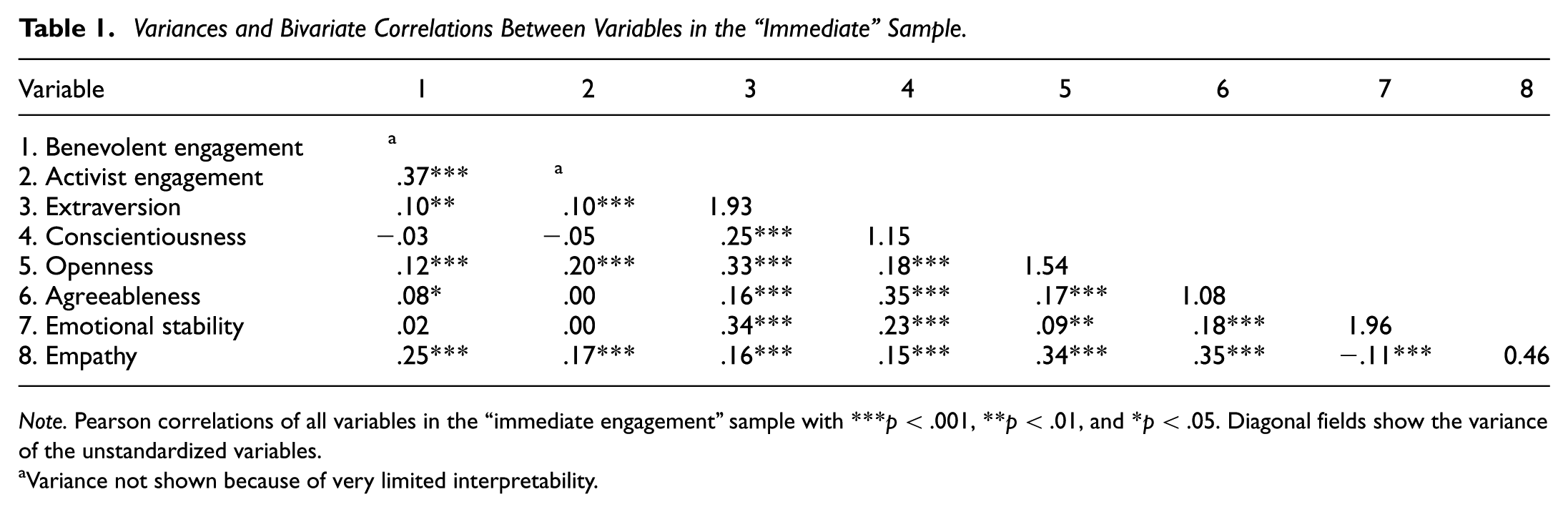
Note. Pearson correlations of all variables in the “immediate engagement” sample with ***p < .001, **p < .01, and *p < .05. Diagonal fields show the variance of the unstandardized variables.
Variance not shown because of very limited interpretability.
Analyses
As a first step, we constructed base models, including only sociodemographic variables (age, age2, gender, education, and income) as predictors in six multiple logistic regressions. The outcome measures were immediate, late, and sustained benevolent and activist engagement.
In a second step, all five personality traits were added. To evaluate whether personality traits explain additional variance beyond sociodemographics, we compared the extended models to the baseline models using χ2-tests and the Akaike Information Criterion (AIC). As standardized measures, we reported Nagelkerke’s pseudo-R 2, which ranges from zero to one and is roughly comparable to Ordinary Least Squares (OLS) R 2, and the adjusted McFadden pseudo-R 2, which accounts for model complexity by penalizing the inclusion of additional predictors (Smith & McKenna, 2013).
In a third step, we included empathy into each model. Following the same procedure as before, we compared these extended models to those containing only the Big Five and sociodemographics using χ2-tests, the AIC, Nagelkerke’s pseudo-R 2, and the adjusted McFadden pseudo-R 2. We assessed if our models met the assumptions of logistic regression and found this to be the case. The results of our assumption tests are reported in Online Appendix D.
Transparency and Openness
All data-exclusions, measures, and the sample compositions are fully reported. All analyses were conducted in RStudio version 2023.06.1 (Posit Software, 2023) using R version 4.3.2 (R Core Team, 2023). We used the packages dplyr, psych, car, fmsb, and DescTools for our main analyses (Fox et al., 2021; Nakazawa, 2024; Revelle & Northwestern University, 2024; Signorell, 2024; Wickham et al., 2023). Due to the rapidly evolving circumstances of the war and the ad hoc project development, it was not feasible to preregister the study design, hypotheses, or analysis plan prior to data collection. The analysis scripts, codebook, appendix, and data are available at https://osf.io/fb7yh.
Results
Model Comparisons
Including the Big Five significantly improved base models for both types of engagement across all timeframes (all p≤ .001). Adding empathy to the Big Five models further improved model fit (all p < .001). The results of the χ2 model comparisons are reported in Table B1 in Online Appendix, while Table 2 displays the corresponding fit indices.
Fit Indices for Models predicting Benevolent Engagement.
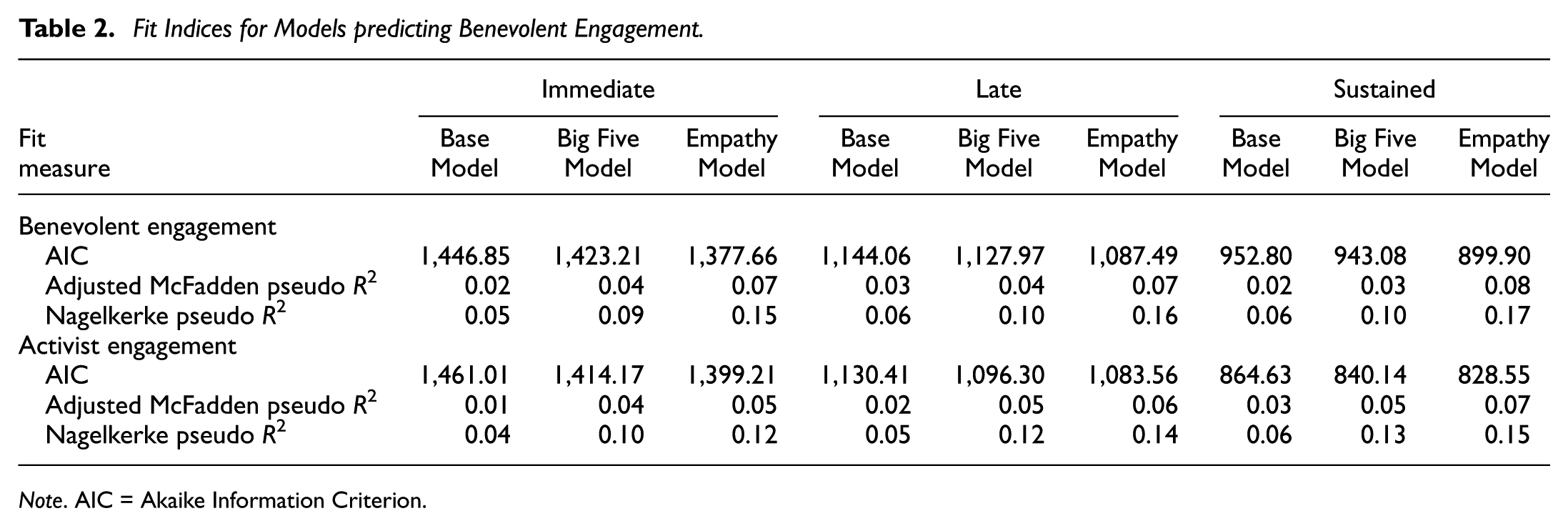
Note. AIC = Akaike Information Criterion.
Predictors of Benevolent Engagement
For brevity, no statistical parameters are reported below. Please see Tables B2–B7 in Online Appendix for estimates, standard errors, 95%-confidence intervals, and p-values for all predictors.
Younger people, those with a higher education, and higher incomes were more likely to show immediate, late, and sustained benevolent engagement. A small but significant quadratic age effect was observed for immediate and late engagement, indicating younger individuals were more engaged than middle-aged and older individuals, whose engagement levels were comparable. In the models including the Big Five, higher levels of extraversion, openness, and agreeableness—and lower conscientiousness—were associated with greater likelihood of benevolent engagement. When empathy was included, the positive effects of extraversion, openness, and agreeableness diminished to non-significance, while the negative effect of conscientiousness remained stable. Figure 1 illustrates the odds ratios of the Big Five with and without empathy.

Effects of the Big Five and Empathy on Benevolent Engagement
Empathy was a strong and consistent predictor of benevolent engagement across all three measurement timeframes, with an increase in one standard deviation in empathy almost doubling the odds of sustained benevolent engagement.
To assess the robustness of our findings, we ran two additional analyses. First, we retested all Big Five traits and empathy as individual predictors, both with and without controlling for sociodemographics. We again found positive effects on engagement for extraversion, openness, agreeableness and empathy, while conscientiousness was no longer a significant negative predictor. Results are reported in Tables B8 and B9 in Online Appendix. Second, we reexamined models with five and six separate categories of income and education. Except for an additional negative effect of conscientiousness on late engagement, all personality effects remained unchanged. The analysis showed that the positive effects of the high-income group were largely driven by those with a monthly net household income of 4000–5999€ (Tables B10–B12 in Online Appendix).
Finally, we examined the effects of the Big Five and empathy on every individual (binary) benevolent engagement item (see Figure B1 in Online Appendix). Effects were overall similar across behaviors. Helping refugees with their arrival in Germany and taking in refugees into one’s home depended most strongly on personality.
Predictors of Activist Engagement
Individuals with a higher education were more likely to engage in activist engagement across all measurement periods, and higher incomes predicted late engagement. In contrast, women were less likely to show late activist engagement. Regarding the Big Five, extraverted, open, and less conscientious individuals were more likely to be engaged in all three measurement periods. Emotional stability was a negative predictor of late and sustained activist engagement. Consistent with findings for benevolent engagement, individuals with a higher trait empathy were more likely to show activist engagement in all three measurement periods. The inclusion of empathy in the models had minimal impact on the predictive power of the Big Five; all effects remained significant, except emotional stability, which no longer predicted sustained engagement. Figure 2 shows the odds ratios of the psychological predictors.
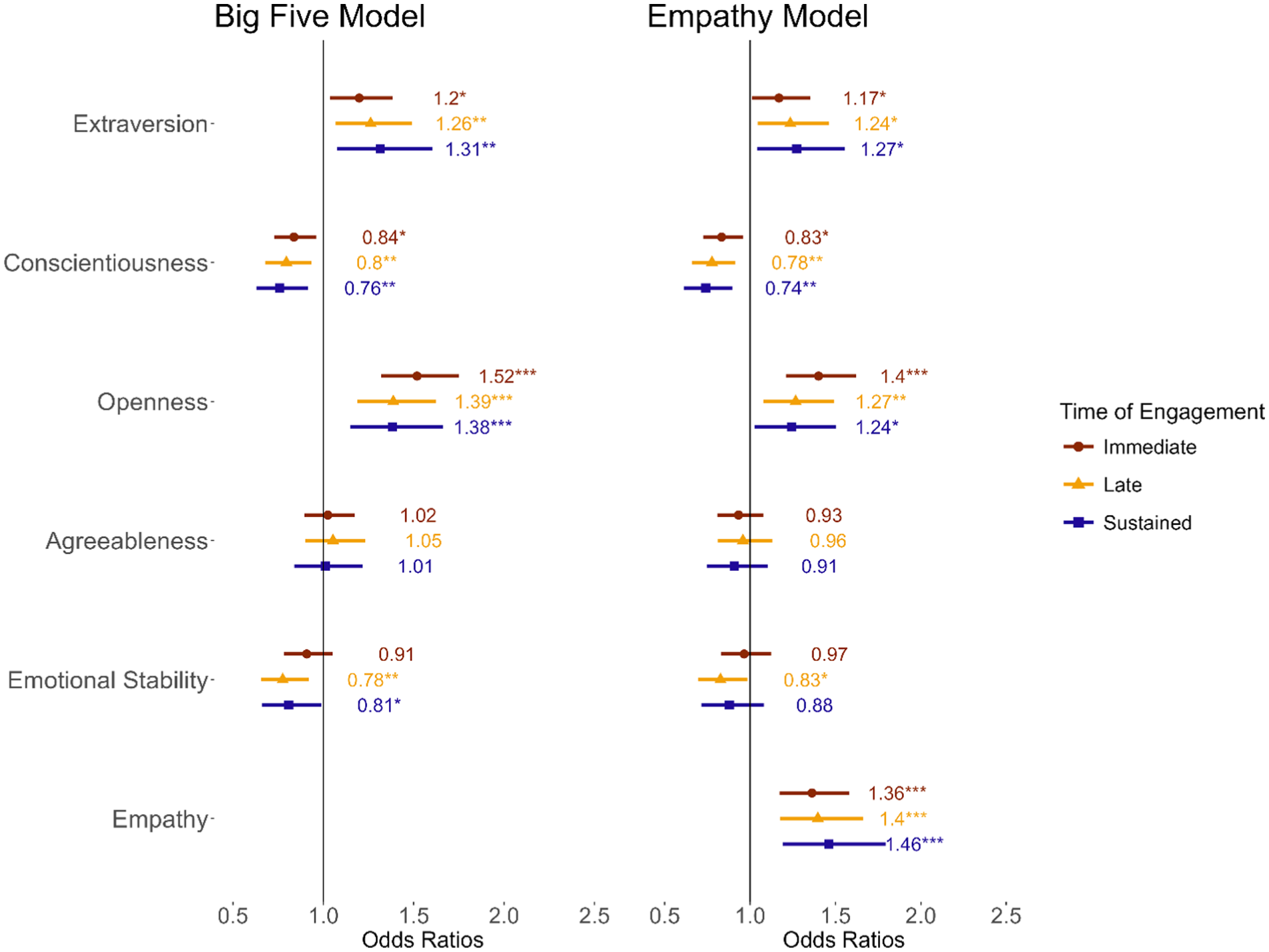
Effects of the Big Five and Empathy on Activist Engagement
We again retested all traits as individual predictors, both in simple bivariate regressions and in regressions controlling for sociodemographics. Akin to the multivariate models, openness, extraversion, and empathy emerged as positive predictors, while conscientiousness (and emotional stability) were negatively associated with engagement (Tables B8 and B9 in Online Appendix). In addition, we again retested all models with separate education and income categories. All personality effects remained the same (Tables B13–B15 in Online Appendix).
Finally, we examined the relationship of the Big Five and empathy with all activist engagement items individually (see Figure B2 in Online Appendix). Effects were similar across items. The personality traits seemed to be connected most strongly to participating in demonstrations, contacting politicians or officials and political party engagement.
Discussion
This study investigated how the Big Five personality traits and empathy predicted civic engagement in response to a political crisis, using Germany’s civil society response to Russia’s war against Ukraine as an example case. We examined both benevolent and activist engagement across two measurement phases—shortly after the war’s onset and 1 year later—and individuals who showed engagement in both phases, classified as showing sustained engagement.
In the base models, a higher education and income predicted both forms of engagement, while a younger age was linked specifically to benevolent engagement. These patterns remained largely stable after adding personality traits. In the Big Five models, openness and extraversion were consistent positive predictors, conscientiousness was negatively associated.
The effects found in this study are overall comparable to those found for engagement in non-crisis circumstances (see e.g., Bekkers, 2005; Ha, 2019; Quintelier & Theocharis, 2012; Russo & Amnå, 2015), but highlight two novel insights: First, openness emerged as the strongest Big Five predictor of both types of engagement. Its relevance might stem from the novelty and uncertainty of a crisis, which likely appeals to individuals who are more willing to face unknown challenges and follow current political events (Gallego & Oberski, 2012; Jordan et al., 2014).
Second, the negative effect of conscientiousness underscores the importance of differentiating types of civic behaviors and citizens’ perception of them. Conscientious individuals tend to engage politically mainly via duty-oriented behaviors such as voting (Johann et al., 2020), probably because they are more likely to see it as a normative civic responsibility (Gallego & Oberski, 2012). In contrast, benevolent and activist engagement, even when shown in reaction to societal crises, is often not perceived as a civic obligation. Therefore, conscientious individuals, who tend to be more conforming and obedient toward authorities (Bègue et al., 2015), prioritize task efficiency and effectiveness (John, 2021), and are already more heavily committed to other, personal goals (Costantini et al., 2020), might be less interested in joining spontaneous, non-mandatory, and possibly inefficient benevolent and activist actions. These findings on conscientiousness should be interpreted cautiously, however, as only sustained activist engagement showed a significant negative association in the single-trait models.
Adding empathy significantly improved prediction of both engagement types—its effect size exceeded that of the Big Five in all but one model. Notably, a one standard deviation increase in empathy almost doubled the odds of sustained benevolent engagement. These findings offer three valuable insights: First, engagement is inherently social. Even individually performed actions (e.g., donating, boycotting, or signing an online petition) are often driven by a felt connection to others’ needs. Empathy fosters this connection, motivating people to act on behalf of others, even in the absence of direct interaction. Particularly in a situation that requires outgroup-directed engagement, as was the case in our German study context, empathy might be relevant for becoming active: It has been shown to have a positive influence on outgroup-helping (Johnston & Glasford, 2017), potentially due to increased perceived closeness to outgroup members (Demel et al., 2025) or heightened group consciousness (Thomas & McGarty, 2017). Yet, evidence also suggests that its influence on ingroup-helping might be even larger than on outgroup-helping (Stürmer et al., 2006), indicating that the effect of empathy on engagement extends beyond outgroup-related crises.
Second, empathy may predict engagement more strongly than the Big Five because it is conceptually closer to action than these five broader traits (see Mooradian & colleagues, 2011, for considerations of the structural relations between the Big Five and empathy).
Third, the difference in Big Five effects on the outcomes with and without empathy in the models could indicate different pathways through which these traits are connected to benevolent and activist engagement: For benevolent engagement, the positive effects of extraversion, openness, and agreeableness are no longer significant when including empathy in the model, while the negative effect of conscientiousness even increases. This could be an indicator that extraversion, openness, and agreeableness are connected to benevolent engagement through mediator variables linked to empathy.
To test potential mediators using our data set, we examined participants’ benevolent attitudes toward Ukrainian refugees. 2 While they were positively associated with benevolent engagement, r(1080) = .22, p < .001, these attitudes were, however, not significantly correlated with extraversion, r(1080) = .03, p = .266, or openness, r(1080) = .06, p = .066, and only weakly with empathy r(1080) = .19, p < .001, and were therefore not investigated further as a common mediator for the Big Five traits and empathy. Other potential mediators might be prejudice against refugees, which is more pronounced in less open, less agreeable, and less empathetic individuals (Miklikowska, 2018; Talay & De Coninck, 2020), or universalism values, which are positively predicted by both openness and empathy (Persson & Kajonius, 2016; Roccas et al., 2002).
For activist engagement, all Big Five effects remained significant when empathy was included (except for emotional stability on sustained engagement, which fell below significance). This suggests extraversion and openness may influence activist engagement via mediators less tied to empathy. To examine possible mediators in our data set, we analyzed political interest 3 and political orientation. 4 Political interest was associated with activist engagement, r(1080) = .25, p < .001, extraversion, r(1080) = .15, p < .001, and openness, r(1080) = .20, p < .001,—but almost equally as strongly with empathy, r(1080) = .13, p < .001. Since mediation could only be tested correlationally here, causal inference was not possible.
A left-leaning political orientation was positively related to activist engagement, r(1080) = .10, p < .001, but not extraversion, r(1080) = -.03, p = .31, or openness, r(1080) = .05, p = .11, and instead was modestly correlated with empathy, r(1080) = .16, p < .001. This rules out political orientation as a good mediator independent of empathy. Other potential mediators include—for openness—interest in abstract thinking or political knowledge (Gallego & Oberski, 2012) and—for extraversion—larger social networks that spread information about activist actions (Malcolm et al., 2021) or greater political discussions with others (Hibbing et al., 2011). Future research should explore the specific pathways connecting the Big Five and engagement.
Finally, our results showed that sociodemographics, the Big Five, and empathy effects were consistent across all three measurement periods. They always remained in the same direction and similar in magnitude, with no evidence of personality-based compassion fatigue.
Some specific effects emerged for agreeableness (immediate benevolent engagement) and emotional stability (late and sustained activist engagement). In the models including empathy, only emotional stability on late activist engagement remained significant. Agreeableness likely promoted immediate benevolent engagement, perhaps due to compassion evoked by heightened media coverage during this time. Less emotionally stable individuals, on the other hand, might have engaged more as activists, possibly driven by threat sensitivity over time. These findings should be interpreted cautiously given mixed effects and moderate agreeableness reliability.
Strengths, Limitations, and Impulses for Future Studies
This study used a longitudinal design with three measurement periods to simultaneously investigate benevolent and activist engagement, providing an exhaustive picture of civic engagement shown in reaction to a new crisis. The data were collected in the context of the Russian war in Ukraine, offering ample opportunities for German civil society to engage benevolently and politically.
However, there are some limitations that should be considered: First, we used short scales to measure the Big Five and empathy, some with only moderate reliability (e.g., Agreeableness). This was expected (our Big Five alphas were similar to Gerlitz & Schupp, 2005) due to few items representing broad constructs (Soto & John, 2017). Nevertheless, a lack of reliability can lead to Type-I errors (Westfall & Yarkoni, 2016). A replication with longer, more reliable scales is advised.
Second, the sample sizes differed across measurement periods, varying power to find significant effects. While this complicates interpretation of inconsistent effects, our findings were largely coherent across samples (see Online Appendix C for sensitivity analyses).
Third, we used binary outcome variables to assess engagement likelihood. While dichotomization limits variance, it preserves scale validity: Items reflected concrete behaviors rather than a single latent construct, with varying effort required. A higher number of checked items would have indicated a greater diversity of engagement types rather than higher intensity, and the behaviors differed markedly in required effort (e.g., hosting refugees vs. sharing information online). Given that engagement intensity could not be meaningfully captured even with our response scale (“never,” “once,” “multiple times”), dichotomization provided a more valid basis for interpretation. Fortunately, evidence suggests personality effects are comparable across binary and continuous scales (Bleidorn et al., 2025). Future studies might complement our findings by examining time and effort spent, or frequency of engagement.
Fourth, our data come from a democratic context where civic engagement is valued and generally not persecuted. Our findings might not generalize to autocratic regimes (Chang et al., 2021).
Finally, we employed correlational analyses. While stable personality traits likely influence behavior shown punctually in response to a crisis, causality cannot be proven.
Practical Application and Conclusion
Our results indicate that older individuals, those with lower education and income, and less open, more introverted, and more conscientious persons are less likely to be engaged during crises. Given that engagement benefits not only the “target” of the action but also democracy (Quintelier & Van Deth, 2014) and the engaged individuals themselves (Chan et al., 2014; Klar & Kasser, 2009; Sagiv et al., 2022), and that equal engagement opportunities are a societal goal (Bundesministerium für Bildung, Familie, Senioren, Frauen und Jugend [BMFSFJ], 2024), engagement should be structured to be appealing and accessible for all. For example, integrating engagement into daily life in an easier and less costly way, without requiring an active search for opportunities, might attract older, less open, or lower income individuals, whereas framing crisis-related engagement as a civic duty could encourage more participation among highly conscientious persons. As empathy can be enhanced through interventions (Weisz & Zaki, 2017), empathy trainings may also foster crisis-related engagement (see also Adida et al., 2018).
In summary, in our study, extraversion and openness positively predicted benevolent and activist engagement, while conscientiousness was negatively related to engagement. Empathy is an important predictor for both types, particularly benevolent, and may operate via pathways that mediate Big Five effects differently for benevolent vs. activist engagement. Our results also showed similar patterns for immediate, late, and sustained engagement, suggesting robust personality effects. These insights can help stakeholders make engagement opportunities more equitable.
Supplemental Material
sj-docx-1-spp-10.1177_19485506251413297 – Supplemental material for Who Gets Involved in a Crisis? The Role of the Big Five Personality Traits and Empathy in Benevolent and Activist Engagement
Supplemental material, sj-docx-1-spp-10.1177_19485506251413297 for Who Gets Involved in a Crisis? The Role of the Big Five Personality Traits and Empathy in Benevolent and Activist Engagement by Luise Hamdani, Ronja Demel, Swen Hutter and Jule Specht in Social Psychological and Personality Science
Footnotes
Acknowledgements
We thank Hanna Schwander, David Schieferdecker, and Lena Masch for their work within the “Ukraine” subproject of the project Social Cohesion and Civil Society. Interaction Dynamics in Times of Disruption. We also thank Lara Zillmann and Theresa Pausch for their support with statistical analyses and graph designs. We wish to express our sincere gratitude to both reviewers for their constructive feedback and ideas for additional analyses.
Handling Editor: Eranda Jayawickreme

Funding
The authors disclosed receipt of the following financial support for the research, authorship, and/or publication of this article: This work was supported by a grant from the Berlin University Alliance in the context of the Grand Challenge Initiative on Social Cohesion (Grant Number: 111_MC-SocCoh-4). Luise Hamdani is a recipient of the Elsa-Neumann-Scholarship of the Federal State of Berlin.
Declaration of Conflicting Interests
The authors declared no potential conflicts of interest with respect to the research, authorship, and/or publication of this article.
Supplemental Material
Supplemental material for this article is available online.
Notes
References
Supplementary Material
Please find the following supplemental material available below.
For Open Access articles published under a Creative Commons License, all supplemental material carries the same license as the article it is associated with.
For non-Open Access articles published, all supplemental material carries a non-exclusive license, and permission requests for re-use of supplemental material or any part of supplemental material shall be sent directly to the copyright owner as specified in the copyright notice associated with the article.
