



Abstract
It is established that romantic relationships can benefit well-being and buffer against loneliness. But is that true for everyone? We put this foundational tenet of relationship science to the test by examining whether asexual people (i.e., people who generally do not experience sexual attraction and desire) benefit from romantic involvement. Results from the BBC Loneliness Experiment showed that, unlike heterosexual (N = 36,464) and other sexual minority people (N = 3,684), asexual people (N = 1,443) did not benefit—or did not benefit as strongly (depending on model choice)—from being in a romantic relationship, experiencing similar levels of loneliness regardless of relationship status or relationship satisfaction. However, being in a satisfying relationship did protect asexual people against expectations of loneliness in old age. These results highlight the importance of including populations that are typically excluded from research to test the robustness of established theories and findings in relationship science.
It is well established within the scientific literature that romantic relationships, particularly high-quality ones, benefit well-being (Diener et al., 2000; Holt-Lunstad et al., 2010, 2015; Purol et al., 2021; Robles et al., 2014), including buffering against feelings of loneliness (Adamczyk, 2016). Although recent work has examined moderators of these benefits (e.g., gender; Girme et al., 2023; Wahring et al., 2024), most research still rests on two normative assumptions: allonormativity, the belief that everyone experiences sexual desire and attraction, and amatonormativity, the belief that sexual romantic relationships are central to a normal and fulfilling life (Conley et al., 2012; Tessler, 2025). These assumptions exclude asexual people—those who tend to experience little or no sexual attraction and desire (though such experiences are heterogeneous, as discussed below; Bogaert, 2004; Brotto & Milani, 2022; Copulsky & Hammack, 2023; Hille, 2023). Estimates suggest that 0.4%–3% of adults identify as asexual (Bogaert, 2004; Greaves et al., 2017; Höglund et al., 2014), a similar percentage to other sexual minority groups (e.g., 2% of people in the United Kingdom identifying as bisexual, 1.8% as gay or lesbian; Office for National Statistics, 2025). While research on sexual minorities has grown exponentially in recent years (Angelis et al., 2023; Mangas & Sierra, 2025), academic interest in asexuality is still nascent (Guz et al., 2022; Hille, 2023; Kelleher et al., 2023), with literature on romantic relationships and well-being having yet to include asexual experiences. That exclusion limits the generalizability of the foundational and widely accepted idea in relationship science that involvement in (satisfying) romantic relationships is generally beneficial.
Although at lower rates than allosexual people (i.e., people who do not identify as asexual), asexual people can still experience romantic desire (around 74% of asexual people; Antonsen et al., 2020) and enter into romantic relationships (Greaves et al., 2017). However, whether asexual people similarly benefit from romantic relationships as their heterosexual and other sexual minority peers has yet to be examined. In the present investigation, we compare asexual, other sexual minority, and heterosexual people to test whether being in a romantic relationship, or being in a satisfying romantic relationship, is protective against loneliness for all groups. By doing so, we (a) include a population largely excluded within relationship research and (b) test the robustness and boundary conditions of a fundamental tenet within relationship science—that romantic relationships boost well-being.
It is important to clarify that the term “asexual” is often used as an umbrella category encompassing a range of identities (e.g., graysexual, demisexual) and diverse experiences of sexual and romantic attraction and desire (Copulsky & Hammack, 2023). For example, some asexual people experience sexual attraction and desire, or can in certain situations (Carvalho & Rodrigues, 2022; Nimbi et al., 2024); some asexual people also identify as aromantic, meaning they do not experience romantic desire (Tessler, 2025). These differences may shape relational experiences and the role such relationships play in well-being. In the present study, we adopt the broad terminology (“asexual people”) for comparability with prior research comparing asexual and allosexual people on well-being (e.g., Rothblum et al., 2020) and because our measure of sexual orientation assessed asexual identity as a single category, while acknowledging that asexuality represents a heterogeneous spectrum of identities and experiences.
Loneliness and Romantic Relationships
One of the main benefits of romantic relationships is that they can protect against loneliness (Buecker et al., 2021; Diener et al., 2000). Loneliness is the subjective experience characterized by feeling a lack of companionship and a sense of isolation from others (Cacioppo et al., 2015). This experience arises when there is a perceived mismatch between desired and actual quantity and/or quality of one’s social connections and is associated with negative well-being consequences (Cacioppo et al., 2015; Hawkley & Cacioppo, 2010; Leigh-Hunt et al., 2017). As a main source of companionship and support, romantic relationship status is one of the primary predictors of loneliness. Single people report greater levels of social isolation and loneliness on average compared to their romantically involved peers (Adamczyk, 2016; Ta et al., 2017). The effects of romantic relationships are documented across relational transitions, with people reporting a reduction in feelings of loneliness when entering a romantic relationship and an increase in loneliness after a break-up or divorce (Buecker et al., 2021).
However, the benefits of romantic relationships cannot be understood by examining relationship status alone (DePaulo & Morris, 2005; Purol et al., 2021). Researchers have challenged the idea that romantic relationships are beneficial in and of themselves, proposing relationship quality as a more appropriate barometer for understanding the effects of relationships on well-being (e.g., Hsieh & Hawkley, 2018; Pepping et al., 2024). Indeed, not all romantic relationships are satisfying ones; unsatisfying relationships not only diminish the benefits on well-being but can instead contribute to greater feelings of isolation and loneliness (Hsieh & Hawkley, 2018; Warner & Kelley-Moore, 2012). In contrast, highly satisfying romantic relationships are strong positive predictors of well-being (Finkel et al., 2014; Proulx et al., 2007), offering companionship and support (Sedikides et al., 1994) that can alleviate feelings of loneliness (Hawkley & Cacioppo, 2010).
While studies consistently show that (high-quality) romantic relationships benefit well-being, most findings primarily stem from heterosexual samples (McGorray et al., 2023; Williamson et al., 2022); studies suggest the benefits generally extend to sexual minorities as well (e.g., Elizabeth et al., 2025; Newcomb, 2020). However, asexual people have historically been excluded from those investigations (e.g., Hsu & Mernitz, 2024), an exclusion that poses questions to the generalizability of previously reproducible findings. This omission is noteworthy given initial evidence of both relational differences (e.g., asexual people report lower romantic investment; Edge et al., 2021) and similarities (e.g., asexual people similarly enjoy emotional intimacy with partners; Winter-Gray & Hayfield, 2021) between asexual and allosexual people that may or may not shape the role that romantic relationships play in well-being.
Furthermore, though research is limited, some evidence suggests that asexual people report worse well-being than allosexual people (depression, Lech et al., 2024; anxiety, Yule et al., 2013), making it important to understand resilience factors—such as romantic involvement—that may be associated with greater well-being in this group. As such, whether or not asexual people, similar to allosexual people, benefit from romantic relationships remains an open and important question that can not only shed light on a population that is largely invisible in mainstream literature but whose experiences can also greatly inform a field that generally assumes—with good empirical reasons—that romantic relationships are a cornerstone for well-being.
Romantic Relationships and Well-Being of Sexual Minority People
Sexual minorities (e.g., gay, lesbian, and bisexual people) face elevated risks of mental health challenges and poorer well-being compared to heterosexual people (e.g., Krueger et al., 2018; Lee et al., 2016), including higher degrees of loneliness (Hsieh & Hawkley, 2018; Kim & Fredriksen-Goldsen, 2016), largely due to discrimination and stigmatization (Doyle & Molix, 2016; Meyer, 2003). Given these well-being discrepancies, research has focused on protective factors that buffer against these well-being threats. Romantic relationships can serve this role, as social support can help alleviate the stress caused by minority stressors (e.g., microaggressions, internalized stigma; Baams et al., 2014; Donnelly et al., 2019). Indeed, (high-quality) romantic involvement has been associated with better mental health in sexual minority adults (Donnelly et al., 2019; Feinstein et al., 2016; Kornblith et al., 2016; Sarno et al., 2022; Whitton & Kuryluk, 2014). In two studies focusing on loneliness, lesbian, gay, and bisexual adults reported higher loneliness compared to their heterosexual peers, but romantic relationship involvement provided a buffer against higher loneliness for all groups (Hsieh & Liu, 2021), and was even more strongly related to lower levels of loneliness for the sexual minority compared to the heterosexual groups (Elizabeth et al., 2025). However, these studies have not explicitly included or tested whether the buffering effects of romantic relationships similarly apply to asexual people.
Although research is limited, results are mixed on whether asexual people report worse well-being and relationship outcomes compared to other sexual minority people (Lech et al., 2024; McInroy et al., 2022; Rothblum et al., 2020; Xu et al., 2023; Yule et al., 2013). Furthermore, most studies comparing asexual people with other groups have compared asexual with heterosexual individuals only or have grouped allosexual participants into one comparison group collapsing across heterosexual and sexual minority orientations (for exceptions, see Xu et al., 2023; Yule et al., 2013). This limits understanding of whether the experiences of asexual people are unique to their identity or are in part due to belonging to any sexual minority group. It is plausible that asexual people, like other sexual minority (and heterosexual) people, may benefit from romantic relationship involvement given that the ingredients theorized to protect and boost well-being (i.e., support, emotional intimacy; Kansky, 2018) are also present within the romantic relationships of asexual people (Hille, 2023). At the same time, asexual people face additional challenges and stigmatization in light of normative societal assumptions about sexuality and intimacy (Gupta, 2015), contributing to the double exclusion of asexual people from both heterosexual and queer spaces and communities (Tessler, 2025; Worthen & Laljer, 2021). These factors may contribute to greater relationship challenges (Dawson et al., 2016; Vares, 2018) and increased loneliness (Higginbottom, 2024; Yule et al., 2013), potentially limiting the protective role and benefits of romantic relationships. The present research addresses this knowledge gap by testing, for the first time, whether romantic relationship involvement protects asexual people against feelings of loneliness.
The Current Study
The goal of the present research was to examine whether asexual people benefit from romantic relationship involvement in terms of loneliness. To do so, we use a large-scale cross-national survey to examine (a) differences in loneliness, romantic relationship involvement, and relationship satisfaction among asexual, other sexual minority, and heterosexual participants, and (b) the interaction between sexual orientation and relationship status/satisfaction to test, for the first time, whether the benefits of romantic relationships on loneliness extend to asexual people.
Transparency and Openness
The present investigation uses data from a larger study on the social determinants of loneliness. Material, syntax, and data to reproduce the analyses can be found on the project’s OSF page: https://osf.io/vte3c/?view_only=5aa130458d804a11b608ee4da8557768. The analysis was not pre-registered. We report all data exclusions below.
Methods
Participants and Procedure
Participants were drawn from the BBC Loneliness Experiment, a large-scale online survey launched and promoted by BBC Radio 4 and BBC World Service between February and May 2018 to assess experiences of loneliness. The study was approved by the ethical review board of the host institution. Interested participants could access the study online and provided informed consent after reviewing study information. A total of 55,060 people ages 16–99 years (M = 49.5, SD = 15.5) accessed the survey. Participants primarily lived in the United Kingdom (70.7%), identified as female (66%; 33% identified as male, and 1% identified with another category or preferred not to answer), and worked full- or part-time (61.4%; 6.1% were students; 3.4% engaged in non-paid work; 5.7% were unemployed; and 23.5% were retired). For more information on the BBC Loneliness Experiment, including full demographic information, see Barreto et al. (2021) and the project’s Open Science Framework page (Qualter et al., 2024; https://osf.io/pw74v/). In our study, after exclusion criteria, we included 41,591 participants who provided data on their sexual orientation, 41,525 who provided data on their relationship status, and 39,770 who provided data on their feelings of loneliness (see Figure 1).
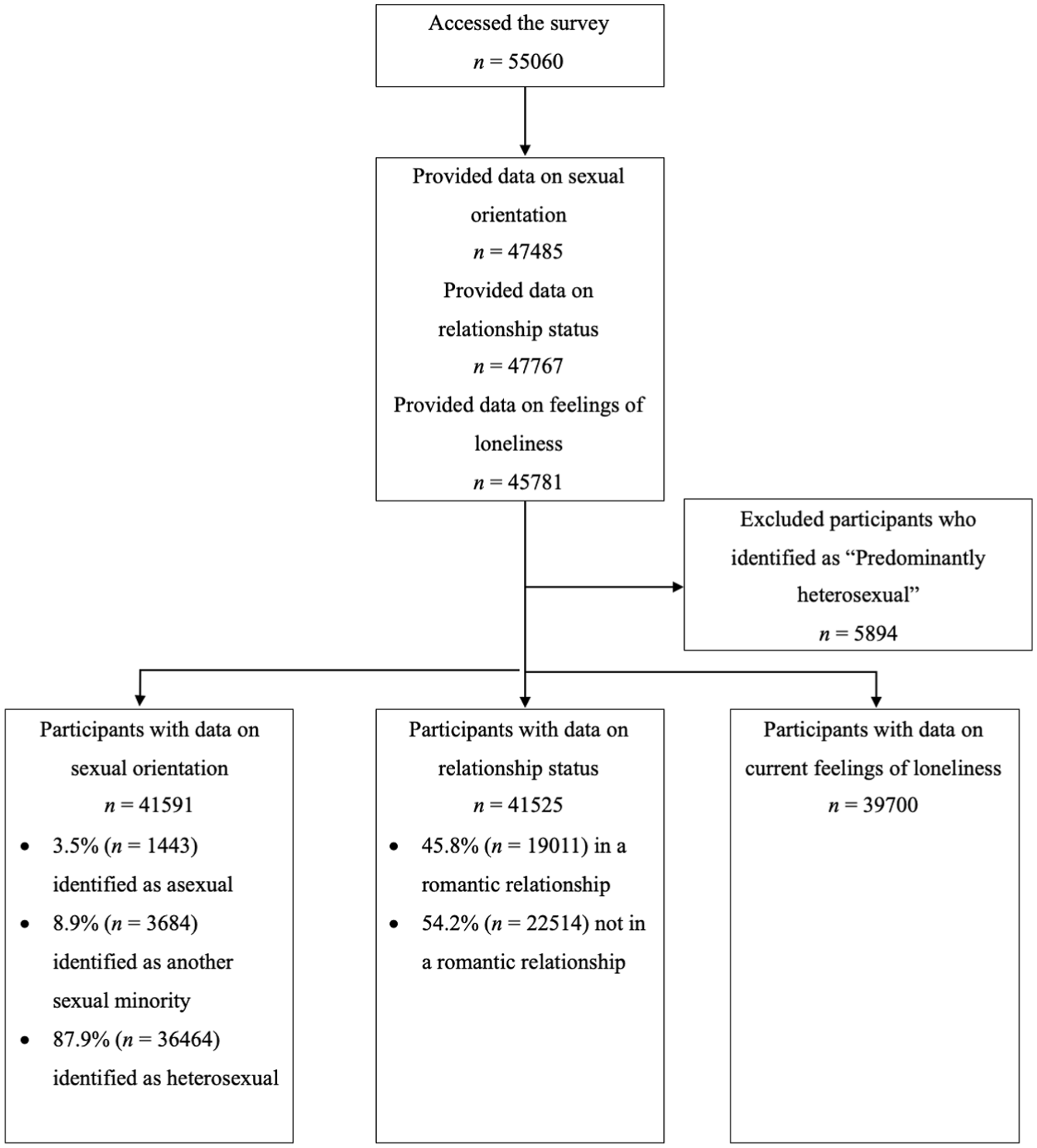
Flowchart of Included Participants.
Because the present project utilized secondary data, sensitivity power analyses were conducted in G*Power (Faul et al., 2009). Results revealed that the study had 80% power to detect a small effect of at least f = 0.01 for the analyses comparing loneliness across groups and a small interaction effect of at least f = 0.02 for the analyses examining whether romantic relationship status or satisfaction moderates the association between sexual orientation and loneliness.
Measures
Participants completed items measuring sexual orientation, romantic relationship status, relationship satisfaction, current loneliness, and expected loneliness in old age (see Table 1 for full measurement information).
Measurement Information of Key Variables.

Participants also reported demographic information, including age and gender. Given the role of age and gender in feelings of loneliness (Beutel et al., 2017; Maes et al., 2019), we tested these two variables as covariates or moderators in supplementary models. Controlling or treating these variables as moderators did not meaningfully change the pattern of results presented below, and we present them in the Supplemental Analyses.
Statistical Analyses
Analyses were conducted using SPSS Statistics (Version 28.0.1.1). Descriptive statistics for the variables of interest are broken down by sexual orientation and presented along with tests of group differences in Table 2.
Sample Characteristics and Group Differences.
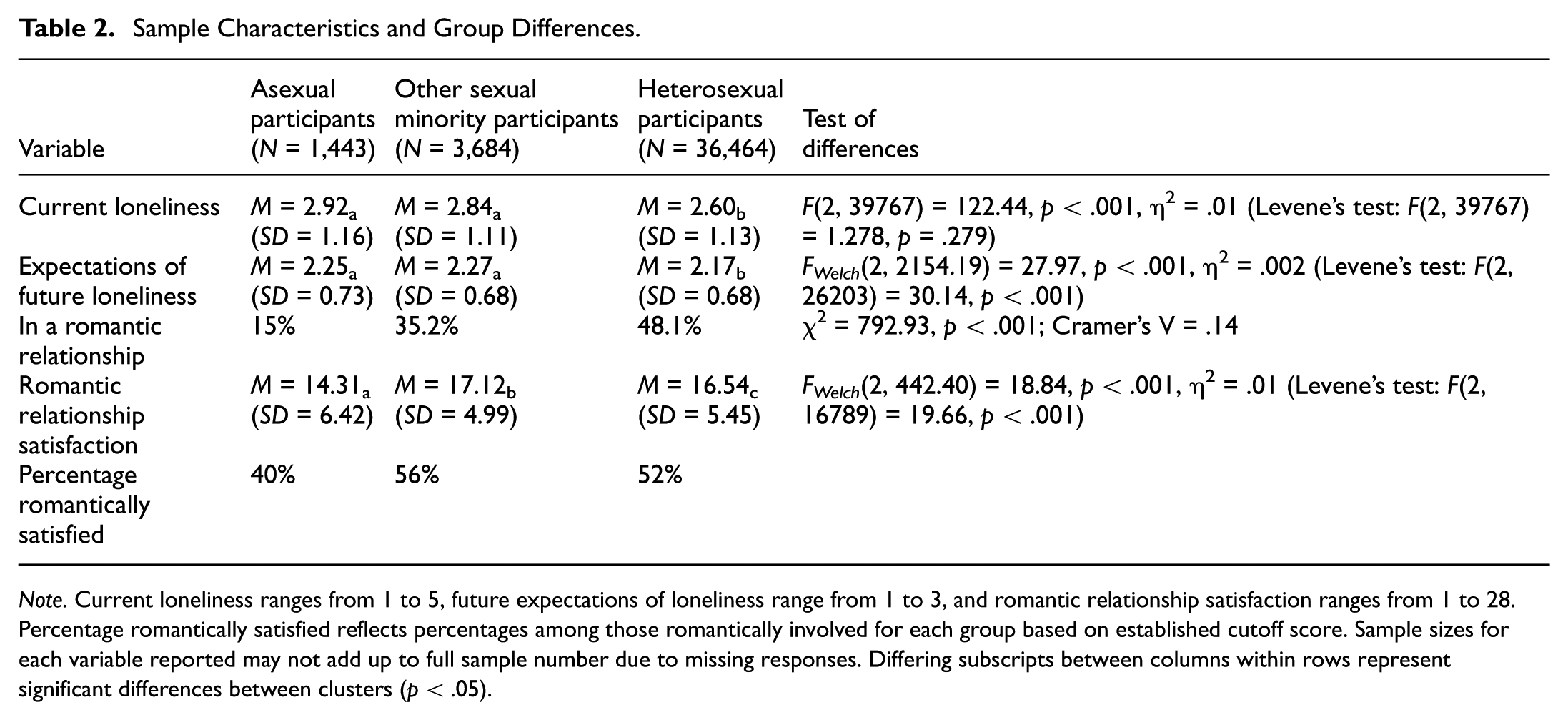
Note. Current loneliness ranges from 1 to 5, future expectations of loneliness range from 1 to 3, and romantic relationship satisfaction ranges from 1 to 28. Percentage romantically satisfied reflects percentages among those romantically involved for each group based on established cutoff score. Sample sizes for each variable reported may not add up to full sample number due to missing responses. Differing subscripts between columns within rows represent significant differences between clusters (p < .05).
Our first aim was to examine differences among asexual, other sexual minority, and heterosexual participants in current and expected future loneliness, romantic relationship involvement, and relationship satisfaction. One-way analyses of variance were used for continuous outcomes (current loneliness, expected future loneliness, relationship satisfaction), and a chi-square test for the categorical outcome (relationship status). Levene’s test assessed the assumption of homogeneity of variances. When the assumption was met (p > .05), Tukey’s HSD test was employed for post hoc pairwise comparisons; when violated (p < .05), Welch statistics and Games–Howell post hoc tests were used.
Our second aim was to test whether relationship status (dichotomous variable: single or in a romantic relationship) or satisfaction (multi-categorical variable: single, romantically satisfied, romantically dissatisfied) moderated the relationship between sexual orientation group and loneliness (current or expected). We employed general linear models, which are robust to assumption violations (e.g., homoschedasticity, normality; Schmidt & Finan, 2018), applying Bonferroni correction for multiple comparisons. For models testing differences in expectations of loneliness, participants aged 65 years or older were excluded to limit as much as possible that future expectations of loneliness would simply capture current levels of loneliness.
Results
Differences in Loneliness, Romantic Relationship Involvement, and Relationship Satisfaction
Loneliness
Significant differences in current loneliness emerged across sexual orientation groups. Post hoc tests showed that asexual and other sexual minority participants (ps < .001) were lonelier on average than heterosexual participants, but there was no significant difference between asexual and other sexual minority individuals (p = .085). For expectations of loneliness in old age, group differences were again significant. Post hoc tests revealed that asexual and other sexual minority participants (ps < .001) expected greater future loneliness than heterosexual participants, but asexual and other sexual minority participants did not differ from each other (p = .82).
Romantic Relationship Involvement
A chi-square test of independence showed a significant association between sexual orientation and romantic relationship involvement. Specifically, while 48.1% of heterosexual participants reported being in a romantic relationship, only 35.2% of other sexual minority and 15% of asexual participants were romantically involved.
Relationship Satisfaction
Including only those in romantic relationships, relationship satisfaction differed across sexual orientation groups. Post hoc tests indicated a significant difference among all groups, with asexual participants less satisfied than other sexual minority (p < .001) and heterosexual participants (p < .001). Heterosexual participants were less satisfied than other sexual minority participants (p < .001).
Overall, results suggest that asexual people were currently and expected to be lonelier than heterosexual people, but not lonelier than other sexual minority people, were the least likely to be in a romantic relationship, and, when romantically involved, the least romantically satisfied (see Table 2).
Do Romantic Relationship Involvement and Satisfaction Protect Against Current Loneliness?
Relationship Status
Next, we tested whether romantic involvement buffered against current feelings of loneliness. In a model including romantic relationship status, sexual orientation group, and their interaction, a significant interaction was observed (see Table 3). While loneliness differed within the other sexual minority and heterosexual groups based on whether they were in a romantic relationship or not (ps < .001), there was no significant difference among these relationship categories for the asexual group (p = .315). Specifically, romantically involved sexual minority and heterosexual people reported significantly lower loneliness compared to their single peers. These differences were not present for asexual people, who reported similar rates of loneliness regardless of whether they were romantically involved or not.
Results of the General Linear Models Testing Whether Relationship Status Moderated Association Between Sexual Orientation and Loneliness.

Note. Values for each group on current loneliness and expectations of loneliness represent mean and standard deviations (in parentheses). Reported F, η2, and p values correspond to the overall interaction term from the general linear model; p values under “Differences within groups” indicate within-group comparisons.
Figure 2 illustrated these differences across groups. Thus, while romantic involvement was associated with lower levels of loneliness for other sexual minority and heterosexual people, romantic relationships did not protect against loneliness for asexual people.

Levels of Current Loneliness by Sexual Orientation and Relationship Status.
Relationship Satisfaction
Second, we examined whether relationship status and satisfaction using the multi-categorical variable (romantically satisfied, romantically unsatisfied, and single participants) moderated the association between sexual orientation group and loneliness. A significant interaction emerged (see Table 4). Similar to the analyses only considering relationship status (and not satisfaction), while loneliness differed within the other sexual minority and heterosexual groups based on whether they were in a satisfied relationship or unsatisfied relationship, or single (ps < .001), no significant difference emerged among these relationship categories for asexual people (p = .137). Specifically, unsatisfied and single other sexual minorities, and unsatisfied and single heterosexual people reported significantly higher loneliness compared to their relationally satisfied peers. These differences did not emerge for asexual participants, who reported similar rates of loneliness regardless of whether they were in unsatisfying or satisfying relationship, or single.
Results of the General Linear Models Testing Whether Relationship Quality Moderated Association Between Sexual Orientation and Loneliness.

Note. Values for each group on current loneliness and expectations of loneliness represent mean and standard deviations (in parentheses). Reported F, η2, and p values correspond to the overall interaction term from the general linear model; p values under “Differences within groups” indicate within-group comparisons.
Figure 3 illustrates those differences. This suggests that, even when accounting for relationship satisfaction, being involved in a romantic relationship was not protective against loneliness for asexual people in the same ways as it was for other sexual minority and heterosexual people. 1
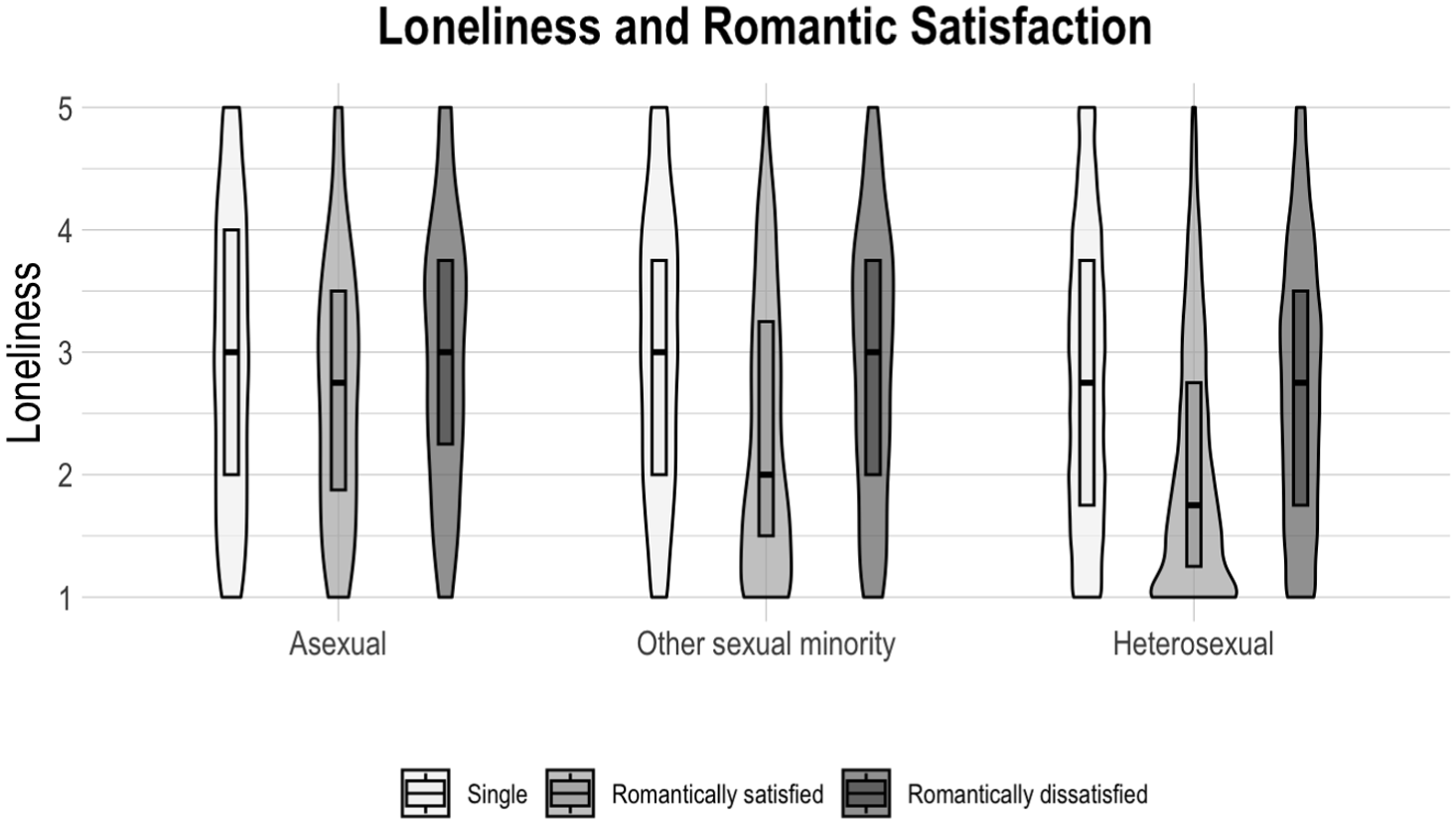
Levels of Loneliness by Sexual Orientation and Relationship Satisfaction.
Do Romantic Relationship Involvement and Satisfaction Protect Against Expectations of Loneliness in Old Age?
Relationship Status
We also explored expectations of loneliness in old age. Results revealed a significant interaction between sexual orientation and relationship status (see Table 3). Similar to results regarding current loneliness, other sexual minority and heterosexual participants differed on expectations of loneliness based on relationship status (ps < .001), with romantically involved sexual minority and heterosexual participants reporting lower loneliness compared to their single peers. There was no significant difference within the asexual group (p = .231) between those romantically involved and those that were not, suggesting that romantic relationships did not protect against future expectations of loneliness for asexual people, similar to the results examining current feelings of loneliness.
Relationship Satisfaction
Finally, we examined whether relationship satisfaction moderated the relationship between sexual orientation and future expectations of loneliness. Results revealed a non-significant interaction (see Table 4). In fact, just like other sexual minority and heterosexual groups (ps < .001), asexual people also differed in expectations of loneliness (p = .005) based on whether they were in a satisfied relationship or unsatisfied relationship, or were single. For all groups, people expected to be lonelier when currently in an unsatisfied relationship or single, and less lonely when in a satisfying relationship. This suggests that asexual peoples’ future expectations of loneliness may be attenuated by being involved in satisfying romantic relationships in a similar way as for heterosexual and other sexual minority people.2,3
Discussion
Strong cultural norms across countries, supported by decades of research in social psychology and relationship science, highlight the importance and benefits of romantic relationships for well-being (Apostolou et al., 2023; Braithwaite & Holt-Lunstad, 2017; Kansky, 2018). Included among those benefits is the documented role of relationships in protecting against loneliness (Buecker et al., 2021; Diener et al., 2000). Utilizing data from an international sample comparing loneliness across asexual, other sexual minority, and heterosexual participants, we found asexual people reported higher loneliness than heterosexual people (though not higher than other sexual minority people), were the least likely to be in a romantic relationship, and were the least satisfied when romantically involved. Crucially, while the other sexual minority and heterosexual groups benefited from being in a romantic relationship, particularly in a satisfying romantic relationship, asexual people reported similar rates of loneliness regardless of their relationship status or satisfaction level. However, follow-up analyses treating relationship satisfaction as a continuous rather than categorical variable suggested that satisfaction was also associated with lower loneliness among romantically involved asexual people, although this association was significantly weaker than for the other groups. Thus, relationship satisfaction may still play a role in asexual people’s well-being but may be associated with significantly smaller advantages compared to those for allosexual people. That is, while the pattern of results for other sexual minority and heterosexual individuals replicated established findings on the benefits of relationships, this pattern did not replicate for asexual individuals, whose relationships were not associated with well-being benefits, or were less strongly so, at least for current feelings of loneliness. In contrast, expectations of loneliness in old age were attenuated by being in a satisfying relationship for all groups. By separating heterosexual and other sexual minority people, our findings suggest there is something unique about asexual people’s experiences that cannot only be attributed to being a sexual minority. This is particularly noteworthy considering recent findings showing romantic involvement to be even more strongly associated with lower loneliness among lesbian, gay, and bisexual participants compared to heterosexual participants (Elizabeth et al., 2025). One explanation is that sexual minority individuals, who experience higher average levels of loneliness than heterosexual people (Hsieh & Liu, 2021), may have more to gain from a high-quality romantic partnership. In our study, although asexual participants reported similarly elevated loneliness relative to other sexual minority groups, romantic relationships were not associated with a comparable reduction in loneliness. Possible explanations are discussed below.
The present research tests the amatonormative belief that romantic relationships are universally beneficial for well-being and examines the generalizability of one of the most replicated findings in relationship research, exemplifying a potentially important boundary condition. Our findings underscore the importance of expanding social psychological and relationship research beyond the allonormative and amatonormative frameworks and samples that have historically dominated the field (McGorray et al., 2023; Williamson et al., 2022). These frameworks exclude and isolate asexual people (Kelleher et al., 2023) and also limit understanding of the role that romantic relationships play in well-being more generally. Existing research typically operates in contexts where romantic sexual relationships are privileged over other relationships as primary sources of companionship and fulfilment (Finkel et al., 2014). As such, it is unsurprising that research has consistently shown that romantic relationships (or a lack thereof) strongly influence well-being (Kansky, 2018), an influence that has only increased over the last few decades as romantic relationships have become increasingly central to the self (Finkel et al., 2014; Yilmaz et al., 2022). This centrality was reflected in our findings. While other sexual minority and heterosexual participants benefited from (satisfying) romantic relationship involvement, they also struggled when romantically unattached or unsatisfied; asexual participants did not appear to reap the benefits nor drawbacks of (un)satisfying romantic involvement on current levels of loneliness—or at least not as strongly. One explanation may lie in the unique challenges faced by asexual people. Stigma and delegitimization due to normative assumptions about sex and intimacy in society (MacInnis & Hodson, 2012) may contribute to greater feelings of loneliness and challenging relationship dynamics for asexual people (Dawson et al., 2016; Vares, 2018) that even satisfying relationships may not be able to overcome at all, or to the same degree as other sexual minority and heterosexual relationships. Another possibility is that asexual people operate outside of amatonormative scripts (Higginbottom, 2024), which may make romantic relationships less central in determining well-being. For asexual people, the benefits of emotional intimacy and social support may be derived from non-romantic relationships or other forms of connection (e.g., queer platonic relationships—non-sexual, non-romantic relationships with high degrees of emotional intimacy; Rothblum et al., 2019; Vares, 2019) that were not captured in the present research. This aligns with emerging research challenging the primacy of romantic relationships and recognizing the diversity of relational needs and configurations that support well-being (Balzarini & Muise, 2020; Conley et al., 2012; Girme et al., 2023). Future research should explore how other relationships (e.g., friends, family) link to well-being for asexual versus allosexual people, testing whether romantic or other relationships offer unique advantages across groups. Furthermore, given the diversity of asexual people in regards to attitudes toward sex and romantic relationships (Antonsen et al., 2020; Copulsky & Hammack, 2023), which may shape both exposure to stigma (Rothblum et al., 2020) and the centrality placed on romantic relationships (Antonsen et al., 2020), it is possible that the patterns found in the present study may not be uniform across all asexual subgroups, though we are not able to test this possibility with the present data. We return to this point on heterogeneity in asexual identities and experiences below.
Interestingly, while romantic involvement was not associated with asexual people’s current feelings of loneliness (or was associated significantly less strongly), being in a romantically satisfying relationship was associated with lower expectations of loneliness in old age across all groups. Although speculative, one possibility is that current loneliness may reflect immediate experiences such as recent social interactions, stressors, and unmet needs specific to asexual people (e.g., exclusion, delegitimization, and invisibility in society; MacInnis & Hodson, 2012) that may not be easily overwritten, even by being in a satisfying relationship. However, future expectations of loneliness may reflect anticipatory beliefs that can be shaped by optimistic predictions or biases (Lench et al., 2019). As such, being in a satisfying relationship may increase confidence that things will be better in the future, buffering worries or fears about future loneliness.
It is noteworthy that asexual participants were not only the least likely to be in a romantic relationship, they were also the only group in which the proportion of individuals in unsatisfying romantic relationships exceeded those in satisfying ones. While this pattern may reflect limitations related to sample size within the asexual group, it may also speak to meaningful differences in the relational experiences of asexual people. However, as previously noted, it is also important to acknowledge that asexuality, while often treated as a single category, encompasses a diverse set of identities and experiences. This heterogeneity was not captured in the present research, limiting further exploration of potential similarities and differences in the findings across asexual identities. For example, while most asexual people are interested in and desire romantic relationships (e.g., 74% of asexual people according to a study by Antonsen et al., 2020), this is not the case for aromantic people (Antonsen et al., 2020; Hille et al., 2020), who may or may not also use the label asexual. As such, aromantic people, who are less likely to seek or value romantic connection (Carvalho & Rodrigues, 2022) and thus are less likely to be within the romantically involved asexual group in our study, may be particularly likely to experience romantic relationships as sources of social pressure rather than well-being in a society shaped by amatonormativity. Similarly, asexual (and aromantic) individuals also differ in their attitudes toward sexual activity, ranging from sex-averse to sex-favorable dispositions (Carvalho & Rodrigues, 2022; Copulsky & Hammack, 2023), and these variations may shape the benefits or challenges associated with romantic compared to other relationships. In fact, potentially reflecting a greater heterogeneity in romantic relational experiences, it is interesting to note that asexual participants in the present study demonstrated the greatest variability (i.e., standard deviation) in relationship satisfaction, though the extent to which this might reflect differences across asexual identities and experiences cannot be explored in this data. Given differences between asexual groups in histories, attitudes, and desires toward sex and romance (Carvalho & Rodrigues, 2022; Copulsky & Hammack, 2023), future work should specifically examine whether romantic or other relationships differently influence well-being across various asexual identities.
Conclusion
The present findings show that, although romantic relationships can boost well-being, not everyone benefits from romantic relationship involvement to the same extent. As the first study to test the potential protective role of romantic relationships for well-being in asexual people, this research contributes to the growing research on asexuality, enriches relationship science by recognizing a potential boundary condition, and offers an important lens through which to examine established theories and findings on the (supposed) benefits associated with romantic relationships.
Supplemental Material
sj-docx-1-spp-10.1177_19485506261437286 – Supplemental material for Does Romantic Involvement Benefit Everyone?
Supplemental material, sj-docx-1-spp-10.1177_19485506261437286 for Does Romantic Involvement Benefit Everyone? by Giulia Zoppolat, Manuela Barreto, Pamela Qualter, Jasmine Crosbie and David Matthew Doyle in Social Psychological and Personality Science
Footnotes
Handling Editor: Yuthika Girme

Funding
The authors disclosed receipt of the following financial support for the research, authorship, and/or publication of this article: This work was supported by the Wellcome Trust (209625/Z/17/Z) and an ERC Starting Grant supplied by the European Research Council to DD (ERC-StG 101042028). However, views and opinions expressed are those of the authors only and do not necessarily reflect those of the Wellcome Trust, European Union, or the European Research Council. Neither the European Union nor the granting authority can be held responsible for them.
Declaration of Conflicting Interests
The authors declared no potential conflicts of interest with respect to the research, authorship, and/or publication of this article.
Supplemental Material
The supplemental material is available in the online version of the article.
Notes
Author Biographies
References
Supplementary Material
Please find the following supplemental material available below.
For Open Access articles published under a Creative Commons License, all supplemental material carries the same license as the article it is associated with.
For non-Open Access articles published, all supplemental material carries a non-exclusive license, and permission requests for re-use of supplemental material or any part of supplemental material shall be sent directly to the copyright owner as specified in the copyright notice associated with the article.
