



Abstract
The aim of this research was to assess climbers’ adherence to the Mediterranean Diet (MD) and to explore its association with climbing background and demographic characteristics of this athletic population. The research was conducted as an analytical cross-sectional study using a modified PREDIMED questionnaire disseminated in four climbing gyms in Lisbon, Portugal. The study included 278 climbers, 188 males and 90 females, with a mean age of 30.8 ± 7.4 years. On average, participants had been climbing for 1 to 3 years, with a frequency of 2.4 sessions per week. Results indicated a medium level of adherence, with a mean score of 8.47 ± 2.08 out of 14 points, with, low daily consumption of fruits and low weekly consumption of fish/shellfish. These findings underscore the need to improve climbers’ awareness of appropriate dietary choices, particularly by promoting adequate consumption of fish and fruit as important components of a balanced diet. Future studies should adopt interventional designs to elucidate the specific effects of the MD on recovery and performance in climbing.
Introduction
Sport climbing became an Olympic sport in 2021 and since then its popularity has been growing. 1 Yet, the available literature on the dietary habits of this specific athletic population remains limited.1–3 Strength-to-weight ratio seems to be one of the most important physical characteristics for climbing performance, and previous small-sample studies showed low energy intake in climbers.1,3,4 In general, climbers believe that nutrition is important for their performance, and many consume an omnivorous diet. 4
On the other hand, the Mediterranean diet (MD) has gained increasing attention due to its well-documented benefits in the management of cardiovascular disease, type-2 diabetes, obesity, inflammatory diseases, degenerative diseases, and cancer. 5 The adherence to the MD was also associated with self-reported mental and physical health, as well as with higher scoring for self-perceived health. 6 Despite its widely recognized benefits, its effects in specific population groups, including climbers, remain unexplored.
The Mediterranean diet is a set of dietary habits typical of countries in the Mediterranean area. The main characteristics of the MD include 7 : high consumption of plant-based foods; utilization of fresh, seasonal, and local ingredients; utilization of olive oil and nuts as the main sources of fat; moderate consumption of dairy products; moderate consumption of fish, white meat, and eggs; minimal consumption of products rich in sugars or saturated fats; limited consumption of red meat; adequate water intake; moderate consumption of red wine. In recent decades, the MD has shown to improve endurance, jump performance, power, anaerobic capacity, and circumference measures in athletes.8,9
Food that athletes consume affects their body composition, energy availability, speed of recovery, as well as their overall performance. 7 Carbohydrates should account for 55–65% of total daily energy intake in athletes to meet energy demands, proteins should contribute approximately 10–30% of total calories depending on individual training needs, and fats should provide 25–35% of daily caloric intake, as their high energy density makes them beneficial for various sports. 7 The MD aligns with these ratios, emphasizing whole grains, lean protein from white meat, fish, and eggs, and fats from olive oil and nuts. It also ensures adequate micronutrient intake, supporting biological processes relevant to sport, such as oxygen transport, energy use, protein and bone metabolism, and immune system function. 7
Physical activity increases mitochondrial activity and free radical production, and together with mechanical stress, this contributes to oxidative stress and inflammation. 10 Therefore, the MD, rich in antioxidants, could potentially help protect cells, reduce inflammation, and support recovery, thereby possibly enhancing athletic performance. However, these proposed effects remain hypothetical.
Sport climbers may additionally need to focus on dietary patterns because of the repetitive high mechanical loads on small connective tissue structures, especially in the fingers and wrists, while often emphasizing a high strength-to-weight ratio, which may influence energy availability and recovery. In sport climbing, the major sites of injuries are ligaments, tendons, and joint capsules of the upper extremities. 11 Previously published studies suggest that: various nutrients may be useful in improving tendon growth and healing 12 ; essential fatty acids and antioxidants in combination with physiotherapy could help treat chronic tendon disorders 13 ; and the beneficial effects of the MD enhance the relationship between quality of life and injury prevention. 14 Therefore, diets such as the MD could be supportive, but further longitudinal and interventional research is necessary to determine whether the MD directly contributes to injury prevention or recovery in population of climbers.
The adherence to the MD has been studied across many sports, but not climbing. 10 Therefore, the specific aim of this study was to assess climbers’ adherence to the MD in Lisbon, Portugal, and to explore its association with climbers’ training history and sociodemographic characteristics. By focusing on climbers, this study adds sport-specific data to the existing literature on the MD adherence in athletes. Considering Lisbon's Mediterranean context, on the one hand, and the climbers’ commitment to performance-oriented dietary practices, on the other hand, it was hypothesized that this population would show a high adherence to the MD.
Materials and methods
This analytical cross-sectional study was conducted in January and February 2024 using a modified PREDIMED questionnaire which is widely used to estimate the degree of individual's adherence to the MD. 15 It contains 14 questions and answers in accordance with the MD habits carry one point, while other answers do not bring any points.
Copies of the paper version of the questionnaire were disseminated in four climbing gyms in Lisbon, Portugal. The questionnaire was self-administered, it took participants approximately 15 min to complete, and a researcher was present on-site to provide clarification and additional information when needed.
Participants
Participants were recruited in the following climbing gyms in Lisbon: Vertigo, 9.8 Gravity Climbing, Climb Up, and Rocodromo do Areeiro. Participants were eligible for inclusion if they engaged in climbing or bouldering on a regular basis, defined as at least once per week. Participation in this study was entirely voluntarily and without compensation. The purpose of the research was explained to all participants before obtaining their informed consent. Participants were also informed of their right to withdraw from the study at any time without any consequences.
Questionnaire
The questionnaire used in this study consisted of two parts. General information included demographic and climbing-related data, including gender, age, nationality, years of climbing experience, weekly frequency of climbing, height and mass. Information on height and body mass was used to calculate Body Mass Index (BMI), which was subsequently categorized according to World Health Organization guidelines as underweight (<18.5 kg/m2), normal weight (18.5–24.9 kg/m2), overweight (25.0–29.9 kg/m2), and obese (≥30.0 kg/m2). Adherence to the MD was assessed using the PREDIMED questionnaire. Both the English and Portuguese versions were provided to accommodate participants’ language preferences.
Five modifications were made to the original PREDIMED questionnaire to adapt it for this study. The original question on fruit consumption included fruit juices, but those were excluded in our study since an update of the KIDMED questionnaire 16 states that intake of fruit juice is not recommended and that it is negatively associated with the prevention of type-2 diabetes. In addition, the unit of fruit was not defined in the original questionnaire. To address this, we decided to define it and to add examples. The definition and examples were given in accordance with the guide of fruit and vegetables portion sizes of the National Health Service (a government-funded medical and health care services in the United Kingdom), wherein an adult fruit portion is approximately 80 g. In the question regarding sweetened and carbonated beverages, a single serving was defined as 330 mL, corresponding to the volume of one standard can. For the question on wine consumption, one glass of wine was specified as 150 mL, in accordance with the guidelines of the National Institute on Alcohol Abuse and Alcoholism (NIAAA). According to the NIAAA, a standard drink in the United States contains roughly 14 grams of pure alcohol, which is found in five ounces (about 150 mL) of wine with 12% alcohol content. 17 The original question on meat consumption assumed regular meat intake. To account for dietary diversity, three additional response options were included: “I am vegan,” “I am vegetarian,” and “I do not eat meat.” Each of these options was awarded one point, reflecting the principles of the MD, which includes small quantities of white meat but also emphasizes plant-based eating patterns.
Research protocol
The ethical approval for this research was obtained from the Faculty of Pharmacy, University of Belgrade, Research Ethics Committee (number 1765/2) and it was carried out in accordance with the general ethical principles, common in this field of research. The questionnaire contained no questions or statements that could be considered a threat to personal integrity.
Data analysis
The collected data were processed in accordance with the established scoring rules, with one point assigned to each response that met the predefined criteria. The points were then presented on a scale from 0 to 14. The total score indicated the level of adherence to the MD. PREDIMED score below 5 indicated a poor level of adherence, between 5 and 10 a medium level of adherence, and above 10 a high level of adherence. 15
All collected data were entered into a Microsoft Excel database created specifically for this study, and statistical analyses were performed using SPSS (Statistical Package for the Social Sciences), version 28.0.0.0. Descriptive statistics (mean, standard deviation, minimum, and maximum) were used to summarize participants’ characteristics and PREDIMED questionnaire scores. The distribution of continuous variables was assessed and found to deviate from normality; therefore, non-parametric statistical tests were applied. The Mann–Whitney U test was used to compare differences between two independent groups when the dependent variable was continuous; while the Spearman's rank correlation coefficient was used to assess the strength and direction of monotonic associations between continuous or ordinal variables. Associations between categorical variables were examined using the Chi-square test of independence for evaluating relationships between nominal variables. When significant associations were identified, Phi and Cramer's V coefficients were calculated to estimate the strength of the relationship. Inferential analyses were conducted at a 95% confidence level, and p-values less than 0.05 were considered statistically significant.
Results
Characteristics of participants
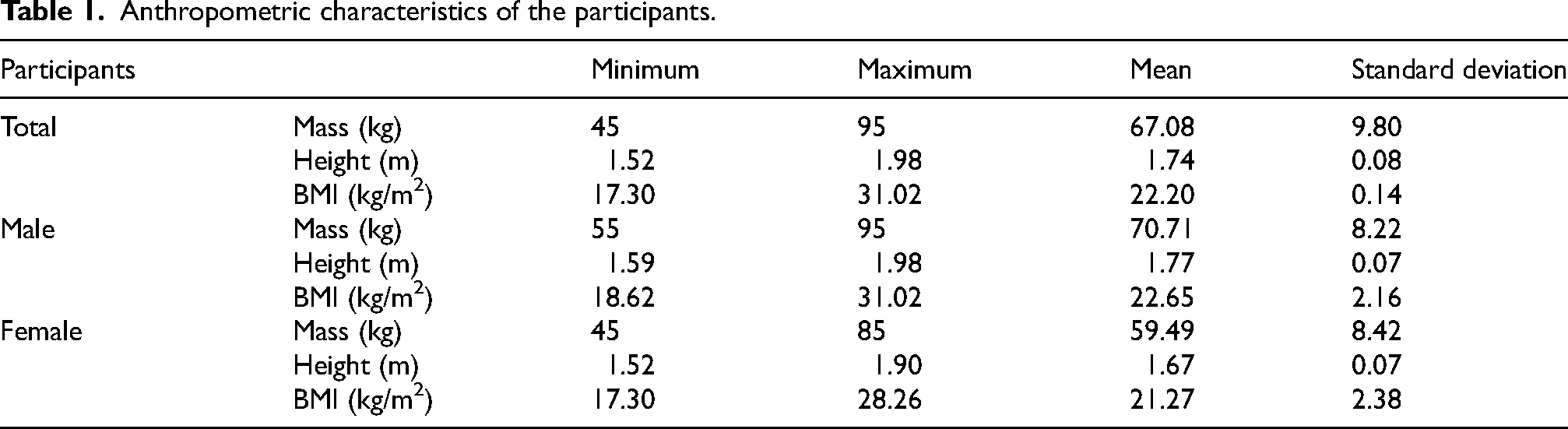
A total of 278 participants, comprising 188 males (67.6%) and 90 females (32.4%), were included in this study. The participants’ age ranged from 18 to 57 years, with a mean age of 30.8 ± 7.4 years. Their anthropometric characteristics are summarized in Table 1. The BMI values of the majority of participants (85.7%) were within the normal range (18.5–24.9 kg/m2).
Anthropometric characteristics of the participants.
The majority of participants were Portuguese (65.5%); then followed Italians (5.7%), Germans (5.0%), French (4.7%), and Brazilians (4.3%). Overall, participants from Mediterranean countries accounted for a total of 77.7% of the sample.
The number of training sessions per week ranged from 1 to 6, with an average of 2.4 sessions. Prior to participating in this study, almost one half of the participants (46.8%) had been practicing climbing for 1 to 3 years.
Level of adherence to the Mediterranean diet
The questionnaire scores ranged from 1 to 14, with a mean score of 8.47 (Table 2), indicating a medium level of adherence to the MD. 14 Our results showed 7.9% of participants with a low adherence, 58.3% with a medium adherence, and 33.8% with a high level of adherence to the MD.
Scores on PREDIMED questionnaire.

No significant correlation was found between the number of training sessions per week and PREDIMED score (Spearman's ρ = −0.049, p = 0.416). Differences in PREDIMED score between genders and nationalities were also not statistically significant (Table 3). Median values were highly similar across all groups, with limited variability observed in adherence scores.
Association between the PREDIMED score, gender and nationality.

Consumption of different food groups among climbers
Approximately two-thirds (65.1%) of the investigated climbers consumed 2 or more servings of vegetables daily. A similarly high percentage (65.8%) consumed 3 or more servings of legumes (beans, chickpeas, peas, lentils, soybeans) per week (1 serving = 150 g). On the other hand, only one-third (34.5%) of the participants consumed 3 or more units of fruit daily. Most climbers (89.9%) consumed olive oil as the main culinary fat, although only 35.3% consumed 4 or more tablespoons per day. Other culinary fats, such as butter, margarine, and cream, were mostly consumed in quantities lower than 12 g (one serving) per day by 81.7% of the participants, in line with the MD guidelines. Fish and/or shellfish were consumed 3 or more times per week by a third of the population (33.1%). Additionally, 56.5% of climbers consumed 3 or more servings of nuts, including peanuts, per week. Wine was rarely consumed among the investigated climbers, with only 10.8% consuming more than 7 glasses per week. Regarding the consumption of red meat, hamburgers and/or meat products, 71.9% of the climbers consumed less than one serving per day. Furthermore, 59.0% preferred white over red meat, and 11.5% of the population were vegans, vegetarians or did not consume meat. The majority of climbers (60.8%) consumed homemade sweets and/or pastries fewer than 3 times per week. In addition, 91.7% consumed fewer than 1 sweetened and/or carbonated beverage per day. A significant portion of climbers (78.8%) consumed dishes seasoned with sofrito (a sauce made with tomato, onion, leek, or garlic and simmered with olive oil) 2 or more times per week.
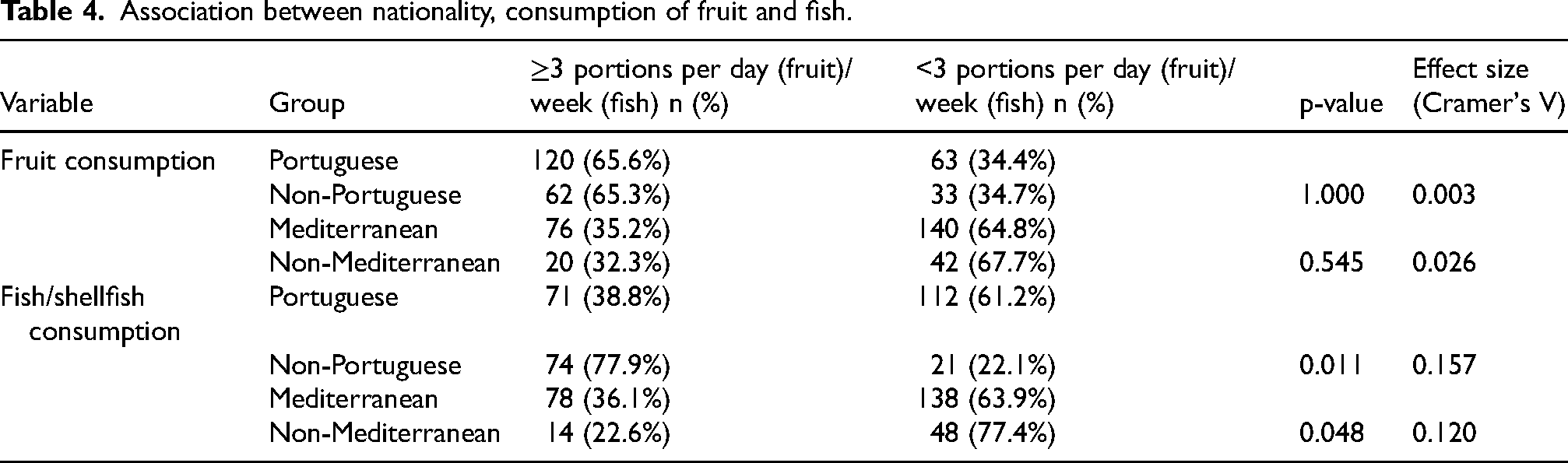
The low intake of fruit and fish/shellfish in this population was further tested through its correlation with nationality (Table 4). Data are expressed as number of participants consuming ≥3 or <3 portions of fruit per day or fish/shellfish per week, stratified by nationality.
Association between nationality, consumption of fruit and fish.
Discussion
Our results generally align with the findings of the majority of previous studies that report a medium level of adherence to the MD among athletes, with only a few showing high and low adherence levels.18–38 The observed differences in PREDIMED scores between genders, nationalities, and training frequency were not statistically significant, suggesting that these factors may not have a strong influence on the MD adherence in this sample. However, it is important to interpret these null findings cautiously, as non-significant associations do not necessarily indicate the absence of any relationship; they may reflect limited sample size, variability within groups, or other unmeasured confounding factors that could mask potential effects.
In addition, our results suggest several nutritional risks among the investigated climbers, particularly with respect to insufficient daily consumption of fruits, and low weekly consumption of fish and/or shellfish. Fruit consumption did not differ significantly across nationalities, suggesting a broadly similar pattern across the sample for this food group. Fish consumption, however, appeared somewhat counterintuitive, as it was significantly higher among the non-Portuguese participants (Cramer's V = 0.157) and those from non-Mediterranean countries (Cramer's V = 0.120), indicating a small association between cultural background and fish intake. These findings suggest that cultural diversity within the sample may have influenced the obtained consumption of certain food groups, as individuals from different countries may have distinct dietary habits and varying preference for the Mediterranean foods. Additionally, the seasonal timing of data collection (January–February) could have affected both fruit and fish intake, due to potential limitations in the availability of certain fresh fruits and regional fish varieties during winter months.
The consumption of high amounts of fruit along with moderate consumption of fish and shellfish, are essential characteristics of the MD. These foods provide significant health benefits, but it is important to point out that the protective effects of the MD stem from the synergistic balance of various foods that ensure an adequate intake of both macronutrients and micronutrients. Fruits are a significant dietary source of antioxidants that help counteract oxidative stress caused by exercise. 38 Omega-3 fatty acids found in fish and shellfish can reduce the level of oxidative stress, thereby improving muscle performance and immune function. 18
According to our results, less than one-third of the population consumed wine in the amounts suggested by the MD. While regular and moderate wine consumption with meals is an important characteristic of the MD, the International Scientific Forum on Alcohol Research (ISFAR) has stated that there is no scientific basis to consider light-to-moderate alcohol consumption as unhealthy or as a significant contributor to disease risk. However, alcohol consumption for health benefits is not recommended. 39 And while the antioxidant properties of wine have attracted research interest, the low bioavailability of anthocyanins in wine hinders their ability to exert substantial health benefits. 40 Therefore, we do not consider low adherence to regular wine consumption a nutritional risk. It is also important to point out that the question on wine consumption in the questionnaire may not have been defined well, as points were awarded for consumption of seven or more glasses of wine per week, which included both moderate and high wine consumption.
Additionally, 11.5% of the population did not consume meat. Some climbers eliminated only meat from their diets, while others were vegans or vegetarians, implying even more strict dietary restrictions. This percentage is somewhat higher than the previously reported prevalence rate of vegans as 7% among the elite, 6% among the advanced, and 4% among the intermediate climbers. 4 While the advantages and disadvantages of vegan and vegetarian diets are beyond the scope of this research, it is important to note that every major dietary restriction can carry risks for athletes. For instance, when animal-based food is eliminated, special attention should be paid to the protein, omega-3 fatty acids, vitamin B12, calcium, and iron intake.
Despite extensive research on the MD adherence across various sports, climbing has remained underexplored. Several studies have explored the adherence to the MD in athletes and encompassed diverse athletic populations such as beach handball players, gymnasts, soccer players, swimmers, handball players, wheelchair basketball athletes, rugby players, tennis players, canoe polo athletes, and mixed cohorts of children and adolescents.10,18–38 Across these populations, adherence was generally classified as medium, with only a small proportion of athletes achieving high adherence scores, and several studies reporting positive associations between greater MD adherence, healthier body composition, and better physical fitness.
These studies also highlighted the dietary shortcoming in specific investigated groups. For example, soccer players have been shown to have suboptimal fruit and vegetable intake, 28 with approximately half failing to meet recommended consumption levels while roughly a half of them did not consume fruit and vegetables in recommended quantities. 32 Our results showed that while the majority of climbers consumed the recommended amount of vegetables daily, fruit consumption was low, consistent with the findings of the above mentioned studies.
Although we expected a high level of adherence to the MD among the climbers, our findings indicate a medium adherence, consistent with previous research carried out among athletes in the Mediterranean countries.18–38 This trend aligns with observations that the Mediterranean regions are gradually moving away from the traditional MD, 41 possibly due to its association with higher overall dietary costs. 42
Cultural and regional dietary habits in Portugal should be considered when interpreting these findings, given the high prevalence of overweight among Portuguese adults and the fact that poor diet, along with hypertension and overweight, is a leading contributor to years of life lost. 41 Pereira Rodrigues et al. report that the national data indicates a high burden of chronic conditions, including hypertension, obesity, and diabetes, largely associated with unhealthy lifestyles and suboptimal nutrition. Additionally, Portugal reflects the broader Mediterranean trend of declining adherence to the MD, likely driven by ongoing nutritional transition, globalization of food markets, and socio-economic changes. 41 These findings underscore the need for improved nutritional education across different sports and national contexts. Athletes should receive basic education on the principles and health benefits of the MD, along with personalized recommendations tailored to their specific sport, training volume and intensity, body composition, food allergies, or other individual requirements. This approach to sports nutrition may represent an effective strategy for enhancing athletes’ health and performance.
It is also worth noting that our study proposes modifications to the PREDIMED questionnaire that may enhance its clarity and practical applicability, and improve its alignment with recent research in the field. Possible modifications include: eliminating fruit juices from question 4, defining servings for foods and drinks, reformulating question 8 on wine consumption, adding more answer options in question 13, adding a question about hydration, which is critical in any dietary pattern.
Finally, an important limitation of this study is the use of a modified questionnaire, as well as the inherent potential for inaccuracy in self-reported food consumption. Further, there are concerns about using BMI as an indicator of weight status, especially among athletes, since it provides no information about the distribution of body fat. BMI was retained despite its limitations because of its practicality, feasibility, and widespread use. Future studies could include measurements of central fat as a more specific criterion for assessing overweight and obesity. 43 Self-reported dietary data are also subject to recall and social desirability bias. The gym-based recruitment strategy and relatively small, geographically and socially limited sample may introduce selection bias and limit generalizability to other climbers. In addition, key potential confounders, such as training frequency, climbing level, energy expenditure, supplement use, smoking, and socioeconomic status, were not fully accounted for. The results rely on frequency-based intake without adjustment for total energy intake or training load, which limits interpretation of dietary adequacy for climbers. All these factors could significantly influence dietary patterns and should be considered in future research.
Overall research of the impact of the MD on performance is limited and the most recent review paper showed that a significant impact of the MD, despite its theoretical benefits, was found in only 40% of the reviewed studies. 44 Therefore, future research should focus on conducting randomized controlled intervention studies with larger sample sizes, specifically targeting athletes of the same skill level within a single sport. It is crucial to standardize and control both the quantity and quality of dietary intake while refining testing protocols to align with sport-specific performance measures. In the context of climbing, future studies should investigate the effects of the MD on athletic performance, recovery, injury prevention, and management. Additionally, future research should consider both total energy intake and training load alongside adherence to the MD, as adequate energy availability is critical for supporting performance, recovery, and overall physiological adaptation in athletes. 45 Furthermore, future research should also examine whether gut microbiome composition is linked to adherence to the MD, and whether this interaction can provide additional benefits for athletic performance, given the emerging evidence of the microbiota's role in mediating health outcomes associated with the MD. 46
Conclusions
Climbers in this study showed a medium adherence to the Mediterranean Diet, with notable nutritional gaps such as low fruit and fish intake. These findings underscore the need for targeted nutrition education and individualized guidance for athletes. Sports nutrition education programs for climbers should emphasize increasing antioxidant-rich fruits and omega-3–rich fish to support connective tissue health, and potentially performance, while ensuring adequate energy intake and proper nutrient timing around training. In addition, new tools validated to assess adherence to the MD in athlete populations are needed, and future studies should use controlled interventions to clarify its effects on climbing performance and recovery.
Footnotes
Acknowledgements
The authors would like to express their sincere gratitude to the Erasmus + Traineeship Mobility Program, funded by the European Commission, for providing support for this research. We also extend our thanks to the School of Agronomy, University of Lisbon; the Faculty of Pharmacy, University of Belgrade; and the School of Agriculture and Veterinary Medicine, University of Padua, for their assistance. Special thanks go to Vertigo, 9.8 Gravity Climbing, Climb Up, and Rocodromo do Areeiro climbing gyms for their generous support. Finally, we are grateful to the study participants for their time and dedication, which made this research possible.

Ethical approval and informed consent statements
This study was conducted in accordance with the ethical standards of the Declaration of Helsinki. Ethical approval was obtained from Research Ethics Committee, Faculty of Pharmacy, University of Belgrade (Approval number: 1765/2). Verbal informed consent was obtained from all individual participants included in the study.
Contribution of the authors
Kurmazovic N.: Methodology, Investigation, Data curation, Formal analysis, Writing – original draft.
Januário I.: Methodology, Conceptualization, Writing – review & editing.
Šobajić S.: Supervision, Conceptualization, Writing – review & editing, Final conclusions.
Marangon M.: Conceptualization, Writing – review & editing.
Đorđević B.: Supervision, Conceptualization.
Todorović V.: Supervision, Writing – review & editing.
Funding
The authors disclosed receipt of the following financial support for the research, authorship, and/or publication of this article: This research was funded by the Ministry of Science, Technological Development, and Innovation of the Republic of Serbia through two grant agreements with the University of Belgrade – Faculty of Pharmacy (Nos. 451-03-33/2026-03/200161 and 451-03-34/2026-03/200161).
Declaration of conflicting interests
The authors declared no potential conflicts of interest with respect to the research, authorship, and/or publication of this article.
Data availability statement
The data supporting the findings of this study are available from the corresponding author upon reasonable request.