



Abstract
The application of the Working Time Directive (WTD) 2003/88 has caused serious issues in those sectors needing 24 hours a day/seven days a week cover (24/7). Employers have explored whether they can take advantage of the opt-out from the 48-hour working week in Article 22 or rely on the range of derogations in the Directive. Of particular interest, however, is the use of the exceptions. These exceptions apply, for example, ‘where characteristics peculiar to certain specific public service activities, such as the armed forces or the police, or to certain specific activities in the civil protection services inevitably conflict’ with the WTD. The interpretation of the provisions on exceptions has led to a number of important cases, cases which will be considered in the article. I wish to argue that, consistent with its earlier approach, the Court has maintained that the WTD will, in principle, apply to workers, even in those sectors requiring 24/7 cover. With this as its starting premise, the Court has then set the bar high for when it will accept that any of the exceptions will apply. The Court has even indicated, in the Slovenian Army case, that the Directive will apply to the military, much to the consternation of some Member States, albeit developing a new carve out for ‘military commitment’ activities. The Court also pays close attention to the text of the exceptions to ensure that employers are not misusing them. I will argue that the exceptions are indeed exceptional.
Introduction
The interpretation of the Working Time Directive (WTD) 2003/88 has absorbed a vast amount of judicial time at both EU and at national level. Perhaps this is unsurprising given the lack of clarity in parts of the text of the Directive, requiring the courts to fill in the gaps. And the Court of Justice has taken a strong, almost purist, line to interpretation: the Directive is there to protect individuals and ensure their fundamental rights (social) rights are preserved. 1 The Court has used the Charter, especially Article 31(2) on the right of all workers to ‘limitation of maximum working hours, to daily and weekly rest periods and to an annual period of paid leave’, to bolster this position. 2 Most striking has been the broad scope given by the Court to Article 6 WTD (that the ‘average working time for each seven-day period, including overtime, does not exceed 48 hours’) which it has read to include, for example, on-call time. In SIMAP, 3 the Court said ‘time spent on call by doctors in primary health care teams must be regarded in its entirety as working time, and where appropriate as overtime, within the meaning of Directive [2003/88] if they are required to be present at the health centre’. 4
The expansive scope of the WTD has meant that sectors, particularly those providing 24 hours a day/seven days a week cover (24/7), have explored whether they can take advantage of the opt-out in Article 22 (the waiver to the 48 hours working week) 5 and the derogations (e.g. the derogation in Article 17 from Articles 3, 4, 5, 8 and 16 (on breaks and reference periods) which applies to ‘security and surveillance activities requiring a permanent presence in order to protect property and persons, particularly security guards and caretakers or security firms’ and other activities involving the need for continuity of service or production).
There is a further possibility open to employers in these 24/7 sectors: to rely on the (rather obscure and ill-drafted) exceptions to the WTD. These exceptions apply, for example, ‘where characteristics peculiar to certain specific public service activities, such as the armed forces or the police, or to certain specific activities in the civil protection services inevitably conflict’ with the WTD. Employers thought that using the exceptions meant that none of the provisions in the Directive applied to their staff, including Article 7 on annual leave from which there is no derogation. As we shall see, the picture is more nuanced than that.
The interpretation of the provisions on exceptions has led to a number of important cases, cases which will be considered in this article. I wish to argue that, consistent with its earlier approach, 6 the Court has maintained that the WTD will, in principle, apply to workers, even in those sectors requiring 24/7 cover. With this as its starting premise, the Court has then set the bar high for when it will accept that any of the exceptions will apply. The Court has even indicated, in the Slovenian Army case, 7 that the Directive will apply to the military, much to the consternation of some Member States, albeit developing a new carve out for ‘military commitment’ activities.
This article is structured as follows. First, it identifies the relevant provisions of the WTD and the Occupational Safety and Health Framework Directive (OSHFD) 89/319, which are in play (section 2). It then analyses the exceptions in Article 2(2) OFSHD and their interpretation by the Court of Justice before considering the exception created by the Court in the Slovenian Army case (section 3). Section 4 considers the health and safety caveat. Section 5 concludes.
The relevant provisions and definitions
I begin by identifying the key parts of the relevant legislation. This is necessary because a number of provisions are involved and their interrelationship is complex. First, Article 1 of the Working Time Directive (WTD) 2003/88 provides that the Directive lays down minimum safety and health requirements for the organisation of working time (Article 1(1)) and that it applies to (a) minimum periods of daily rest, weekly rest and annual leave, to breaks and maximum weekly working time; and (b) certain aspects of night work, shift work and patterns of work (Article 1(2) WTD).
The Directive applies to workers (see, e.g., Art. 2(1) WTD: ‘working time’ means ‘any period during which the worker is working, at the employer's disposal and carrying out his activity or duties, in accordance with national laws and/or practice’ (emphasis added)). The term ‘worker’ is not defined in the Directive itself but has been given an EU meaning by the Court, drawing on its case law on free movement of workers. So, for example, in Sindicatul Familia Constanţa and Others
8
the Court (Grand Chamber) said: 41. … [The term ‘worker’] must be defined in accordance with objective criteria which distinguish the employment relationship by reference to the rights and duties of the persons concerned. The essential feature of an employment relationship, however, is that for a certain period of time a person performs services for and under the direction of another person in return for which he receives remuneration…
42. It follows that an employment relationship implies the existence of a hierarchical relationship between the worker and his employer. Whether such a relationship exists must, in each particular case, be assessed on the basis of all the factors and circumstances characterising the relationship between the parties…
So, at the core of the definition lies hierarchy and dependence, criteria the Court thought were satisfied in the Sindicatul Familia Constanţa case. 9 The case concerned foster parents who had to provide, ‘in principle on a continuous basis, for the care and education of the children placed with them by a public authority, and in return for that work they receive remuneration’. The foster parents had to be approved and they also had to conclude a ‘special employment contract’ with the relevant specialist service for the protection of minors (SSPM). They had to allow the SSPM to supervise their professional activity and to assess the development of the child placed with them. The foster parents had the right to social security coverage and to professional training. The Court said: ‘It follows from all of these factors that the individual applicants … are, with respect to the public service to which they are contractually linked, in a hierarchical relationship, evidenced by permanent supervision and assessment of their activity by that service in relation to the requirements and criteria set out in the contract, for the purpose of fulfilling the task of protecting the minor, which is conferred on that service by law’. 10 The Court added that ‘Such an assessment is not called into question by the fact that foster parents … have broad discretion as to the daily performance of their duties or that the task conferred on them is a “task of trust” or a task of public interest.’ 11
Since the foster carers fell within the personal scope of the Directive, this raised a potentially serious problem for the provision of foster care services (if all time spent caring were to count, the 48-hour ceiling would be hit by the end of Tuesday). This is where the exceptions become relevant.
There are three exceptions which are found in the WTD and Directive 89/319 (the Occupational Safety and Health Framework Directive (OSHFD)), read together, and are now also derived from Article 4(2) TEU.
First, there is a total exception for seafarers. Article 1(3) WTD states: This Directive shall not apply to seafarers, as defined in Directive 1999/63/EC without prejudice to Article 2(8) of this Directive. (emphasis added)
The second exception can be found in Article 2(2) of Directive 89/319 (the OSH Framework Directive (OSHFD)) to which Article 1(3) WTD refers.
12
The first paragraph of Article 2(2) provides: This Directive shall not be applicable where characteristics peculiar to certain specific public service activities, such as the armed forces or the police, or to certain specific activities in the civil protection services inevitably conflict with it.
So, the first paragraph of Article 2(2) has two limbs: the exception applies where (1) characteristics peculiar to certain specific public service activities, such as the armed forces or the police, inevitably conflict with the WTD; or (2) to certain specific activities in the civil protection services which inevitably conflict with the WTD. The second paragraph of Article 2(2) then provides: In that event, the safety and health of workers must be ensured as far as possible in the light of the objectives of this Directive.
In other words, even where the employer successfully invokes the first subparagraph of Article 2(2) concerning any of the activities listed there, the employer must, under the second paragraph, still ensure health and safety of workers as far as possible.
The third exception is evolving. This is based not just on the first paragraph of Article 2(2) of the WTD, but also on Article 4(2) TEU. Under Article 4(2) TEU the Union is to respect, first, the equality of Member States before the Treaties as well as their national identities, inherent in their fundamental structures, political and constitutional; and, second, their essential State functions, including ensuring the territorial integrity of the State, maintaining law and order and safeguarding national security. Article 4(2) TEU adds that national security is to remain the sole responsibility of each Member State. As the Court said in the Slovenian Army case, ‘it should be noted that the principal tasks of the armed forces of the Member States, which are the preservation of territorial integrity and safeguarding national security, are expressly included among the essential functions of the State which the European Union must respect in accordance with Article 4(2) TEU’. 13 We return to the significance of this in section 3.4 below.
Looking at these provisions together, we can make the following observations:
The Working Time Directive 2003/88 apples to working time matters identified in Art. 1(2) WTD; In order to benefit from the protection of the WTD, individuals must fall within the personal scope of the Directive. This means they must be a ‘worker’, as defined in the case law of the Court of Justice; The individual must also work in a relevant sector. Given the breadth of sectors covered (the WTD applies to all sectors of activity both public and private (Art. 1(3) WTD), as defined in Art. 2(2), para. 1 OSHFD)), the Directive will apply to workers in most sectors. However, there are two exceptions to the application of the WTD laid down in the WTD:
The first is a total exception for seafarers (Art. 1(3), second para, WTD); The second is for ‘certain specific public service activities, such as the armed forces or the police, or to certain specific activities in the civil protection services inevitably conflict with it’ (Art. 1(3) WTD, which refers to Art. 2(2) OSHFD). In respect of this second exception, the safety and health of workers must be ensured as far as possible in the light of the objectives of this Directive (Art. 2(2), second paragraph (‘the caveat’)).It is a general rule of EU law that exceptions are narrowly construed. As the Court said in Sindacatul: ‘the exception under the first subparagraph of Article 2(2) of Directive 89/391 must be interpreted in such a way that its scope is restricted to what is strictly necessary in order to safeguard the interests which it allows the Member States to protect’.
14
For those working in the military there is an additional evolving exception concerning ‘military commitments, following the decision in the Slovenian Army case.
Exceptions
Introduction
As discussed above, there are two exceptions to the WTD, as provided for by the WTD read in conjunction with OSHFD: (1) seafarers; and (2) certain specific public service activities and certain specific activities in the civil protection services (see Figure 1). There has been no relevant case law on seafarers, and this will not be discussed further. However, the Article 2(2) exceptions have attracted considerable recent judicial attention, and these will be the focus of this section.
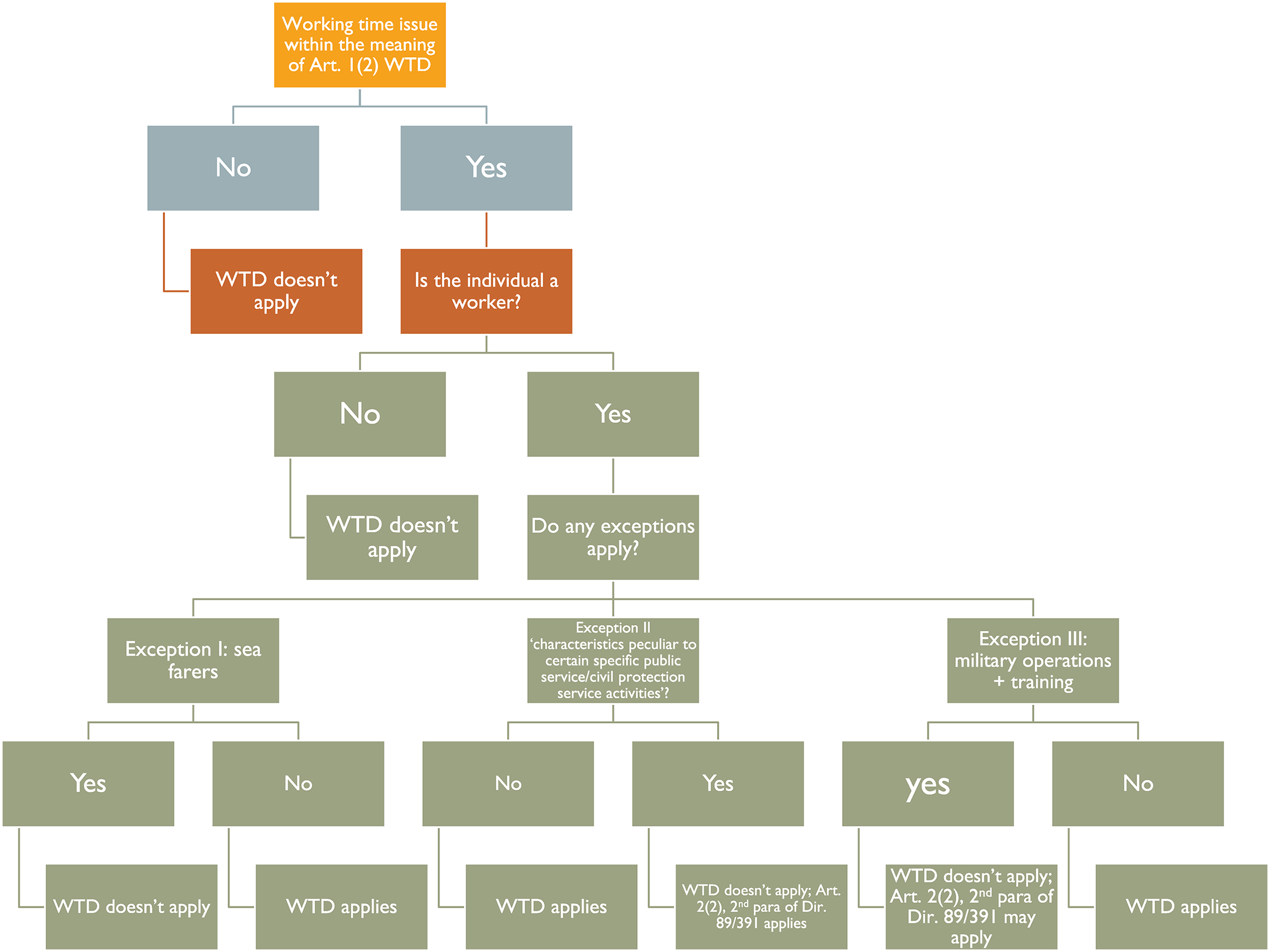
The exceptions and how they interrelate.
As discussed above, the first paragraph of Article 2(2) states that the Directive does not apply in two situations:
(i) where characteristics peculiar to certain specific public service activities, such as the armed forces or the police, inevitably conflict with the WTD; (ii) or to certain specific activities in the civil protection services, inevitably conflict with the WTD
The earliest case law dealt with the civil protection services and laid the groundwork for what was to follow. Therefore, we shall consider that first.
The first paragraph of Article 2(2) excludes from the scope of the Directive certain specific activities in the civil protection services which inevitably conflict with the WTD. This exception was considered by a judgment of the Grand Chamber in Pfeiffer and Others 15 and by Reasoned Order of the Court in Personalrat der Feuerwehr Hamburg. 16
Pfeiffer concerned ambulance crew members and Personalrat der Feuerwehr Hamburg concerned firefighters. In both cases the Court noted the narrowness of the exception in the first paragraph of Article 2(2), with the result that it held that the activity of emergency workers in attendance in an ambulance or an emergency medical vehicle in the framework of an emergency service for the injured or sick, run by a body such as the Deutsches Rotes Kreuz (German Red Cross), or firefighters in Hamburg, was not covered by the exclusion. 17 This is because the scope of OSHFD Directive had to be broadly construed and the exclusions from that scope, as provided for in the first subparagraph of Article 2(2), had to be interpreted restrictively. 18
It also noted that according to the first subparagraph of Article 2(2) of Directive 89/391, the civil protection services as a whole are not excluded but solely ‘certain specific activities’ of those services, the characteristics of which are such as inevitably to conflict with the rules laid down in the Directive. 19 This was emphasised in Feuerwehr: ‘that provision gives no reason for a Member State to consider that as a general rule all the activities carried out in the sectors concerned are covered by that exception’. 20 The Court added that the exclusion from the scope of Directive 89/391, broadly construed, had to be interpreted in such a way that its ambit was confined to what was strictly necessary in order to safeguard the interests which it enables the Member States to protect. 21 In other words, use of the exceptions is exceptional. Sectors as a whole are not excluded, nor are all activities in those sectors, just certain activities or tasks in those sectors. 22
So, when can they be used? In Pfeiffer the Court said that the exclusion in the first subparagraph of Article 2(2) of Directive 89/391 was adopted purely for the purpose of ensuring the proper operation of services essential for the protection of public health, safety and order in cases, ‘such as a catastrophe, the gravity and scale of which are exceptional and a characteristic of which is the fact that, by their nature, they do not lend themselves to planning as regards the working time of teams of emergency workers’.
23
In Feuerwehr the Court elaborated further: 53. An exception may be made to that interpretation of the first subparagraph of Article 2(2) of Directive 89/391 only in the case of exceptional events in which the proper implementation of measures designed to protect the population in situations in which the community at large is at serious risk requires the personnel dealing with a situation of that kind to give absolute priority to the objective of those measures in order that it may be achieved (emphasis added).
54. That must be so in the case of natural or technological disasters, attacks, serious accidents or similar events, the gravity and scale of which require the adoption of measures indispensable for the protection of the life, health and safety of the community at large, measures the proper implementation of which would be jeopardised if all the rules laid down in Directives 89/391 and [2003/88] were to be observed.
From Feuerwehr we learn that the exception will apply where ‘preserving the safety and health of the community at large must … temporarily prevail over the aim of those directives, which is to guarantee the health and safety of workers. In particular, it is not reasonable to require employers actually to prevent occupational risks or to draw up a work schedule for the staff of emergency services’ (emphasis added). 24 In other words, where there is a disaster of some kind, the interest of the community at large trumps the interests of the individual worker and his or her rights under the WTD but the disapplication of the Directive is only temporary, for the duration of the crisis.
By contrast, even if emergency workers tending the injured and sick must deal with individual events that are themselves unforeseeable, the activities involved ‘in normal conditions and which correspond moreover to the duties specifically assigned to a service of that kind are none the less capable of being organised in advance, including, in so far as they are concerned, the working hours of its staff’.
25
In other words, while the day-to-day events to which ambulance crew must respond cannot necessarily been foreseen in advance, responding to such events is what the ambulance and fire services do as part of the normal conditions of their work. It is possible to plan for 24/7 cover for these day-to-day events. The ambulance service thus ‘exhibits no characteristic which inevitably conflicts with the application of the [Union] rules on the protection of the health and safety of workers and therefore is not covered by the exclusion in the first subparagraph of Article 2(2) of Directive 89/391, the directive instead applying to such a service.’
26
In Feuerwehr Hamburg the Court ruled that the same applied to the activities of the operational crews of a public fire service which were not significantly different, as regards the context or nature of such activities, from those in the case in Pfeiffer and Others.
27
It held:
28
Directive 89/391 must therefore apply to the activities of the fire service, even when they are carried out by operational forces and it does not matter whether the object of those activities is to fight a fire or to provide help in another way, so long as they are carried out under normal circumstances, consistent with the task allocated to the service concerned, even though the actions which may be entailed by those activities are inherently unforeseeable and liable to expose the workers carrying them out to certain safety and/or health risks.
The result of this ruling is that apart from in very serious situations the exception set out in the first subparagraph of Article 2(2) does not apply to the ambulance and fire services.
Directive is not applicable where characteristics peculiar to certain specific public service activities inevitably conflict with it
The other strand of the exception set out in the first paragraph of Article 2(2) is that the WTD is not applicable where characteristics peculiar to certain specific public service activities, inter alia, the armed forces or the police, inevitably conflict with the WTD. The Court has broken down its analysis into three parts: whether the activity involves (i) ‘public service’; (ii) whether it concerns ‘specific (public service) activities’; and (iii) whether there are ‘characteristics peculiar to’ (certain specific public service activities). It analyses point (iii) in the light of the Pfeiffer line of case law considered above. We shall consider these issues in turn.
(i) Meaning of public service
First, the Court looks to see whether the activity comes within the scope of ‘public service’. The term ‘public service’ is not defined but was considered in Sindicatul, the case discussed above concerning foster parents. The Court insisted the term ‘public service’ ‘be given an autonomous and uniform interpretation throughout the European Union, which must take into account the context of that provision and the purpose of the legislation in question’. 29 The Court held that the criterion for exclusion is based ‘not on the fact that workers belong to one of the sectors of the public service referred to in that provision, taken as a whole, but exclusively on the specific nature of certain particular tasks performed by workers in the sectors referred to in that provision, which justify an exception to the rule on the protection of the safety and health of workers, on account of the absolute necessity to guarantee effective protection of the community at large’. 30
In other words, the Court adopts a functional rather than an institutional approach. This is important because differences may exist between Member States ‘in the practical organisation of tasks in the public interest that form part of the essential functions of the State’,
31
of which the activities of the armed forces, the police and civil protection services serve only by way of examples.
32
These observations enabled the Court to conclude, in the case: 56. It follows from the functional nature of such a criterion that the expression ‘public service’ within the meaning of the first subparagraph of Article 2(2) of Directive 89/391 applies not only to the sectors in which workers are organically attached to the State or to a public authority, but also to sectors in which workers carry out their work for a private person who performs, under the control of the public authorities, a task in the public interest which forms part of the essential functions of the State.
On the facts, the foster parents were all employed by a public authority, ‘tasked with ensuring the harmonious development of the minors placed with them, ensuring their integration into their own family and preparing them for reintegration into their original family or integration into an adoptive family’. 33 The Court stated that their work therefore ‘contributes to the protection of minors, which is a task in the public interest forming part of the essential functions of the State’. 34
The issue as to the meaning of ‘public service’ activities also arose in UO. 35 UO had a post with the Rapid Intervention Police Brigade (RIPB), a specific branch of the general Hungarian police corps which enjoyed special powers and undertook particular duties throughout Hungary, including border security tasks. This involved extraordinary alert duties and on-call duties outside normal working hours. The Court ruled that surveillance of the external borders of a Member State, in the event of an influx of third-country nationals, was an activity that came within the scope of public service within the meaning of the first subparagraph of Article 2(2) of Directive 89/391. 36
(ii) ‘Specific (public service) activities’
The next question is whether the activity presents certain specific features as compared with other activities coming within the scope of the public service in general or of law enforcement, in particular. 37 In Sindicatul, the Court held that ‘the specific nature of that activity compared to other child-protection-related activities results from the fact that it aims to integrate the foster child on a continuous and long-term basis, into the home and family of his or her foster parent’. 38 As a result, ‘such an activity must be considered to be covered by the specific activities referred to in the first subparagraph of Article 2(2) of Directive 89/391’. 39
The Court also ruled that the surveillance of the external borders of a Member State in UO constituted an activity which might present certain specific features as compared with other activities coming within the scope of the public service, 40 but with no further analysis.
(iii) Characteristics peculiar to certain specific public service activities
The third question is whether there are ‘characteristics peculiar to that specific public service activity [which] inevitably conflict with the application of Directive 2003/88 to that activity, in view of the absolute need to guarantee effective protection of the community at large’. 41 Here, the focus is on the operational aspect of the service provision and the Court draws on the Pfeiffer line of case law, specifically whether the activities do not ‘lend themselves to planning as regards working time’. 42
In Sindicatul the Court focused on the continuity of provision, namely, the efficiency of specific public activities which ‘must be continuous in order to ensure the effective performance of essential functions of the State’.
43
Generally, this means services performed in circumstances whose gravity and scale are exceptional, as the Court noted in Pfeiffer.
44
However, the Court noted that it also covers other situations, including specific public service activities having, ‘even when performed in normal circumstances, characteristics which mean that their very nature is absolutely incompatible with the planning of working time in a way that respects the requirements imposed by’ the WTD.
45
The Court noted that, save during periods such as those when the foster child is at school, foster parents perform their activity continuously, including during weekly rest days, public holidays, non-working days and annual leave - unless their separation from the foster child during that annual leave has been authorised.
46
It also recognised the special nature of foster care, with the (often particularly vulnerable)
47
minor being placed with a foster parent and being integrated, on a continuous and long-term basis, into the home and family of that foster parent. This is intended to allow ‘the child to develop, for as long as necessary, in a caring and educational environment conducive to harmonious development’.
48
This led the Court to conclude that: 72. In those circumstances, regularly granting foster parents the right to be separated from their foster child after a certain number of hours of work, or during periods such as weekly or annual rest days, which are generally considered opportune times to develop family life, would go directly against the objective pursued by the Romanian authorities to integrate foster children, on a continuous and long-term basis, into the home and family of the foster parent.
It concluded that ‘the characteristics peculiar to the work of foster parents … must be regarded as strictly precluding the application of Directive 2003/88 to such foster parents’. 49 This is different from the work of ‘relief parents’ in Hälvä, 50 whose working time was largely predetermined by the employment contracts that linked them to their employer given that, first, the number of 24-hour periods they had to work annually was fixed by contract and, second, at regular intervals their employer drew up advance lists indicating the 24-hour periods during which the relief parents would be responsible for running a children's home.
This analysis in Sindicatul provided a strong steer to the national court that although the foster parents fell within the personal scope of the WTD, they did not, in fact, benefit from the protection of the WTD because they fell within the exception in the first subparagraph of Article 2(2) OSHFD, albeit that the competent authorities had to ensure the safety and health of foster parents ‘as far as possible’ under Article 2(2) OSHFD.
The issue of whether the characteristics of certain specific public service activities inevitably conflict with the application of Directive 2003/88 also arose in UO. The Court noted that where certain public service activities do not, by their nature, lend themselves to planning as regards working time, it is one of the characteristics peculiar to such activities which justifies the application of the exception.
51
The Court then went on to argue that ‘The first subparagraph of Article 2(2) of Directive 89/391 thus safeguards the efficiency of those specific activities, which must be continuous in order to ensure the effective performance of essential functions of the State’. This suggests that the need for continuity is part of the planning requirement, but an assessment of continuity depends on the specific nature of the activity in question. The Court then drew a distinction between (see Figure 1):
- normal operations, even of those services requiring 24-hour a day cover, such as public health, public security and public order.
52
Here, the WTD would apply (as in Pfeiffer and Feuerwehr),
53
unless by the very nature of the activities it was ‘absolutely incompatible’ to plan working time in a way that respected the requirements imposed by Directive 2003/88 (Sindicatul)
54
(or, as we shall see below in the Slovenian Army case, activities carried out by members of the armed forces who, either because they are highly qualified or due to the extremely sensitive nature of the tasks assigned to them, are extremely difficult to replace); and - exceptional events, such as natural or technological disasters, attacks or serious accidents, the gravity and scale of which require the adoption of measures indispensable for the protection of the life, health and safety of the community at large, measures the proper implementation of which would be jeopardised if all the rules laid down in Directive 2003/88 had to be observed. Such circumstances ‘justified absolute priority being given to the objective of protecting the population, to the detriment of compliance with the provisions of Directive 2003/88, which might be temporarily disregarded within those services’ (emphasis added)
55
(i.e., as discussed above, this is not a permanent exclusion of the Directive).
In respect of ‘exceptional’ events, the broader interests of the community (‘the adoption of measures indispensable for the protection of the life, health and safety of the community at large’) trump those of the individual worker's interest in having the terms of the WTD protected (and thus the obligation on the employer to have to plan for them). However, the bar is set high (‘the gravity and scale of which require the adoption of measures indispensable for the protection of the life, health and safety of the community at large’). The Court also provided guidance on whether the threshold was met,
56
requiring the national court to take into account all of the relevant circumstances, including:
- the fact that the duties at issue extended over several months;
57
- whether an influx of third-country nationals at Hungary's external borders prevented surveillance of those borders from being carried out throughout the period at issue, under normal circumstances, in a manner consistent with the task allocated to the Rapid Intervention Police.
58
The referring court therefore had to take into account, first, the fact that, the service was specifically established to participate in carrying out urgent duties and, second, the case law of the Court, according to which the WTD applied to the activities of law enforcement agencies carried out under normal circumstances, and consistent with the task allocated to the service concerned, even though the actions entailed by those activities were inherently unforeseeable and posed a risk for the safety or health of workers.
59
- whether it was not possible, in the light of the gravity and scale of the circumstances, to organise the service concerned in such a way that each of its members could enjoy some rest time in accordance with the requirements laid down in Directive 2003/88.
60
Specifically, the national court had to determine whether it was impossible, at the very least, from a certain point during the period at issue to provide for a staff rotation mechanism enabling each worker to be guaranteed some rest time, as required by Directive 2003/88.
61
This suggests the Court was sceptical that the ‘exceptional circumstances’ threshold had been met in this case. If it was not, then the service would be considered part of a ‘normal’ operation and the WTD would apply.
In the Slovenian Army case the Grand Chamber again considered the normal/exceptional circumstances dichotomy, this time in respect of service in the army. In his capacity as a non-commissioned officer in the Slovenian army, BK performed uninterrupted guard duty for seven days per month, during which time he was required to be contactable and present at all times at the barracks where he was posted. That guard duty included both periods during which BK was required to carry out actual surveillance activity and periods during which he was required only to remain available to his superiors. In the event that the military police or an inspection or intervention team arrived unannounced, he was required to record that event on a registration form and to carry out the tasks assigned to him by his superiors. The question was whether the WTD applied to him or whether the army could rely on the exception set out in the first subparagraph of Article 2(2).
The Court began by noting that the first paragraph of Article 2(2) of Directive 89/391 could not be interpreted as meaning that all members of the armed forces of the Member States were permanently excluded from the scope of the WTD. 62 This is consistent with its broad reading of the purpose of the WTD. It then looked at the ‘planning requirement’. It noted that not all activities carried out by military personnel had such particularities which made it impossible to plan working time in a manner compliant with the requirements laid down in Directive 2003/88. 63 It noted, in particular, that certain activities which could be carried out by members of the armed forces, such as those connected, in particular, to administrative, maintenance, repair and health services, as well as services relating to public order and prosecution, could not be excluded in their entirety from the scope of Directive 2003/88. 64
The Court then looked at the ‘continuity requirement’. It confirmed the exceptional events limb (‘where members of the armed forces are faced with circumstances whose gravity and scale are exceptional’ then the WTD exception applies). 65 It noted that where it appeared impossible to protect the population while organising the activities of the armed forces in such a way that each of their members could benefit from the guarantees provided for by Directive 2003/88 with regard to working time and rest periods, in particular by means of a staff rotation mechanism, the WTD exception would apply.
But it also developed the exception to the ‘normal operations’ limb (which, as discussed above, is how the Court explained the Sindicatul ruling in UO). It held that certain categories of military activity fell entirely outside of the scope of Directive 2003/88 where those activities were so particular that they were always absolutely incompatible with the requirements imposed by that Directive:
66
76. That is true of activities carried out by members of the armed forces who, either because they are highly qualified or due to the extremely sensitive nature of the tasks assigned to them, are extremely difficult to replace with other members of the armed forces by means of a rotation system which would make it possible to ensure both compliance with the maximum working periods and the rest periods provided for by Directive 2003/88, and the proper performance of the essential tasks assigned to them.
In other words, even in ‘normal’ circumstances (where the WTD will apply), there are exceptions, including the work of foster parents (Sindicatul) and certain activities of members of the armed forces, to which the exception to the WTD will apply.
The Slovenian Army ‘military commitment’ exception
While much of the judgment in the Slovenian Army case was about fitting the military into the existing framework of the Directive as interpreted by the Court, in particular in the light of Sindicatul and UO, the most striking and controversial aspect of the judgment was the apparent development by the Court of an additional category of exception, using the first paragraph of Article 2(2) and Article 4(2) TEU, to justify it (see Figure 1, ‘exception III’). It applies to those military personnel ‘called upon to assist in operations involving a military commitment by the armed forces of a Member State, whether they are deployed, permanently or on a temporary basis, within its borders or outside of those borders’.
67
This exception applies even during peacetime.
68
The Court stated: 77. …[To] carry out an activity which, pursuant to Article 1(3) of Directive 2003/88, read in conjunction with the first subparagraph of Article 2(2) of Directive 89/391, and in the light of Article 4(2) TEU, must, by its very nature, be excluded in its entirety from the scope of Directive 2003/88.
78. Compliance with the requirements laid down by Directive 2003/88 in the course of those operations would put at considerable risk the success of those operations, that success being predicated on the total commitment, over long periods, of the members of the armed forces involved, and would consequently also put at considerable risk the proper performance of the essential functions of safeguarding national security and preserving the territorial integrity of the Member States.
The Court explained why it was doing this: regard had to be had to the possible interdependence not only between those operations, but also between them and other activities carried out by members of the armed forces; as the application of the rules of that Directive to the latter activities would require the authorities concerned to set up a rotation system or a system for planning working time, such application would inevitably be to the detriment of those same operations, and contrary to the requirements of Article 4(2) TEU. 69 Therefore, if it proved to be necessary for the proper performance of actual military operations, it could not be ruled out that certain activities of the armed forces which did not relate directly to those actual military operations also fell outside the scope of Directive 2003/88 but only for the duration of those operations (emphasis added). 70
In paragraph 80, the Court added to the list of those to whom the exception applies: just members of the armed forces on active service, but also ‘all activities which form either part of the initial training of military personnel – and compulsory military service, which must receive the same treatment – or part of the operational training which members of the armed forces are subsequently required to perform regularly, are excluded from the scope of Directive 2003/88’. The reason for this is because it is necessary ‘to expose military personnel, during their initial and operational training, to situations which reproduce as accurately as possible the conditions, including the most extreme of conditions, in which actual military operations take place’. 71
At paragraph 88 the Court concluded that a security activity performed by a member of military personnel was excluded from the scope of the WTD:
- where that activity takes place in the course of initial or operational training or an actual military operation; or - where it is an activity which is so particular that it is not suitable for a staff rotation system which would ensure compliance with the requirements of that Directive; or - where it appears, in the light of all the relevant circumstances, that that activity is carried out in the context of exceptional events, the gravity and scale of which require the adoption of measures indispensable for the protection of the life, health and safety of the community at large, measures whose proper implementation would be jeopardised if all the rules laid down in that Directive had to be observed; or - where the application of that Directive to such an activity, by requiring the authorities concerned to set up a rotation system or a system for planning working time, would inevitably be detrimental to the proper performance of actual military operations.
All of this indicates that the Court is moving in the direction of carving out a wider approach under the Directive, in the name of national security, than may have been initially intended by the drafters. If the caveat applies in this case, its scope remains ill-defined.
The caveat
Given that the WTD is a health and safety measure, and is read in the light of OSHFD, it would be expected that there may be some residual obligation to protect the health and safety of workers even where there is an exclusion. However, it does appear that this is only the case in respect of the exception set out in the first paragraph of Article 2(2). It does not apply to seafarers.
The second paragraph of Article 2(2) provides that ‘In that event, the safety and health of workers must be ensured as far as possible in the light of the objectives of this Directive.’ Does it apply to the third exception, a security activity performed by a member of military personnel, as considered in the Slovenian Army case? The answer is likely to be yes. Paragraph 77 states that all activity by military personnel called upon to assist in operations involving a military commitment ‘must, by its very nature, be excluded in its entirety from the scope of Directive 2003/88’ (emphasis added). Paragraph 77 also refers to the first subparagraph of Article 2(2) of Directive 89/391, which paves the way for the application of the caveat in the second subparagraph. 72
Even where the caveat does apply its scope is ill-defined. In Sindicatul the Court held that where the exception is successfully invoked, the safety and health of workers had to still be ensured as far as possible in the light of the objectives of this Directive (Art. 2(2), second paragraph). 73 Since, according to the Court in Sindicatul ‘the contract concluded between a foster parent and the public authority or authorised private body must allow the foster parent to have “free time”, it follows that there are periods during which the foster parent is not required to actively look after his or her foster child, for example while the child is at school, which allows him or her to manage those periods without major constraints’. 74 The Court also noted that ‘foster parents are not required to stay at their residence but are free to move about, particularly for leisure purposes, provided, in principle, that their foster children accompany them’, 75 that foster parents could apply to the competent authority for authorisation to be separated from the child during certain periods of the year, and that it was clear that such authorisation was to be granted as long as the competent authority considered it would not undermine the successful execution of the task entrusted to the foster parents. 76 With little interrogation, the Court accepted that ‘the Romanian authorities have ensured, in accordance with the second subparagraph of Article 2(2) of Directive 89/391, as regards the arrangement of their working time, the safety and health of the foster parents as far as is possible’.
In UO the obligation set out in the second paragraph of Article 2(2) was merely acknowledged. 77 No detail was provided. This provides little steer to employers and indeed national courts as to how to manage this residual obligation in what are often difficult circumstances. As Sindicatul shows, it seems that the Court will accept fairly minimal compliance, but this may be due to the special circumstances of fostering arrangements.
Conclusions
The case law under Article 2(2) OSHFD is clearly in a state of flux. The jurisprudence is not always clear and it is multi-levelled. As UO shows, there are a range of factors that employers and national courts must take into account. The essence is reasonably clear – there is not a blanket exclusion from the WTD for those working in the public service, engaged in the civil protection services or even in the military. This is consistent with the Court's starting point that working time protection is a fundamental social principle. Exceptions therefore need to be narrowly construed. The problem is that the drafting of the exceptions is somewhat opaque, and the Court has had to flesh out what they mean in fact-specific contexts (foster parents, border guards and the military). This has put the Court into a difficult, quasi-legislative position. However, the nuances and elements of the analysis make the case law difficult to navigate, the lack of commentary does not help either and employers are left trying to work out how to do right in legally and factually complex situations. Of particular uncertainty is how the planning requirement and the continuity requirement fit together. Are they mutually exclusive or is it that the planning requirement is a means of delivering the continuity requirement?
Even if the exceptions set out in the first paragraph of Article 2(2) apply, they are not a total get out of jail free card. With the exception of foster care and military commitment, the exceptions last only for the duration of the particular crisis/military operation and, even then, are subject to the health and safety caveat set out in the second paragraph of Article 2(2). Once the crisis has passed, the WTD continues to apply as normal. All of this points to employers having to carry on exploring the scope for derogations under the WTD itself, particularly under Articles 17 and 22, and the operation of these derogations is not always straightforward.
Footnotes
Declaration of conflicting interests
The author(s) declared no potential conflicts of interest with respect to the research, authorship, and/or publication of this article.
Funding
The author(s) disclosed receipt of the following financial support for the research, authorship, and/or publication of this article: This work was supported by the ESRC UK in a Changing Europe, Honeypot Britain, ES/N015436/1.