




Abstract
Title X of the EU–UK Trade and Cooperation Agreement addresses cooperation between these two entities with regards to Anti-money laundering and counter terrorist financing. While these provisions state a common desire to pursue common efforts in this domain, there is no denying that Brexit will impact existing and contemplated cooperation channels.
Keywords
Introduction
As set out in Council Conclusions dated 5 December 2019, ‘the fight against money laundering and terrorist financing remains a high priority for the European Union’. 1 It is thus no surprise that this hot topic should be addressed by the Trade and Cooperation Agreement (TCA) in Part III, Title X.
While being a hot topic, one must nonetheless note that Anti-Money Laundering and Countering the Financing of Terrorism (AML/CFT) are hardly contentious issues, at least with respect to their goals. As a result, even with the UK and the EU going separate paths, there is, at first glance, no reason why they should be divided on these matters. One can therefore wonder: does the TCA change anything in relation to AML/CFT issues for the EU and the UK, or is it merely stating the obvious?
Unsurprisingly, the TCA first addresses both Parties’ commitment to keep on working together to prevent and combat money laundering and terrorist financing, in line with their joint efforts in the past few years (see the section ‘Staying on course…’). However, there is no denying that by leaving the EU ship, the UK also leaves a specific cooperation framework, as well as prospects of further reinforcing it (see the section ‘… On two separate ships’).
Staying on course…
At the EU level, there have been substantial developments on the AML/CFT front in the past decade. This has particularly been the case since 2015, with the adoption of the 4th, 5th and 6th AML Directives, 2 as well as that on facilitating the use of financial information for combating crime dated June 2019. 3
The UK resolutely participated in these EU-led legislative changes by transposing the relevant Directives and building up and reinforcing its AML/CFT legislative and regulatory framework accordingly. Interestingly, when the UK chose to opt out of the 6th Directive dated 12 November 2018, the government claimed it had done so not because it disagreed with its contents, but because the UK ‘already [went] much further’ than the Directive’s measures. 4
As a result of this voluntarist policy with respect to AML/CFT in the past years, the EU has succeeded in shaping an efficient – though improvable – framework to which the UK fully adhered (Figure 1). Diagram published by the European Commission on 19 July 2018
5
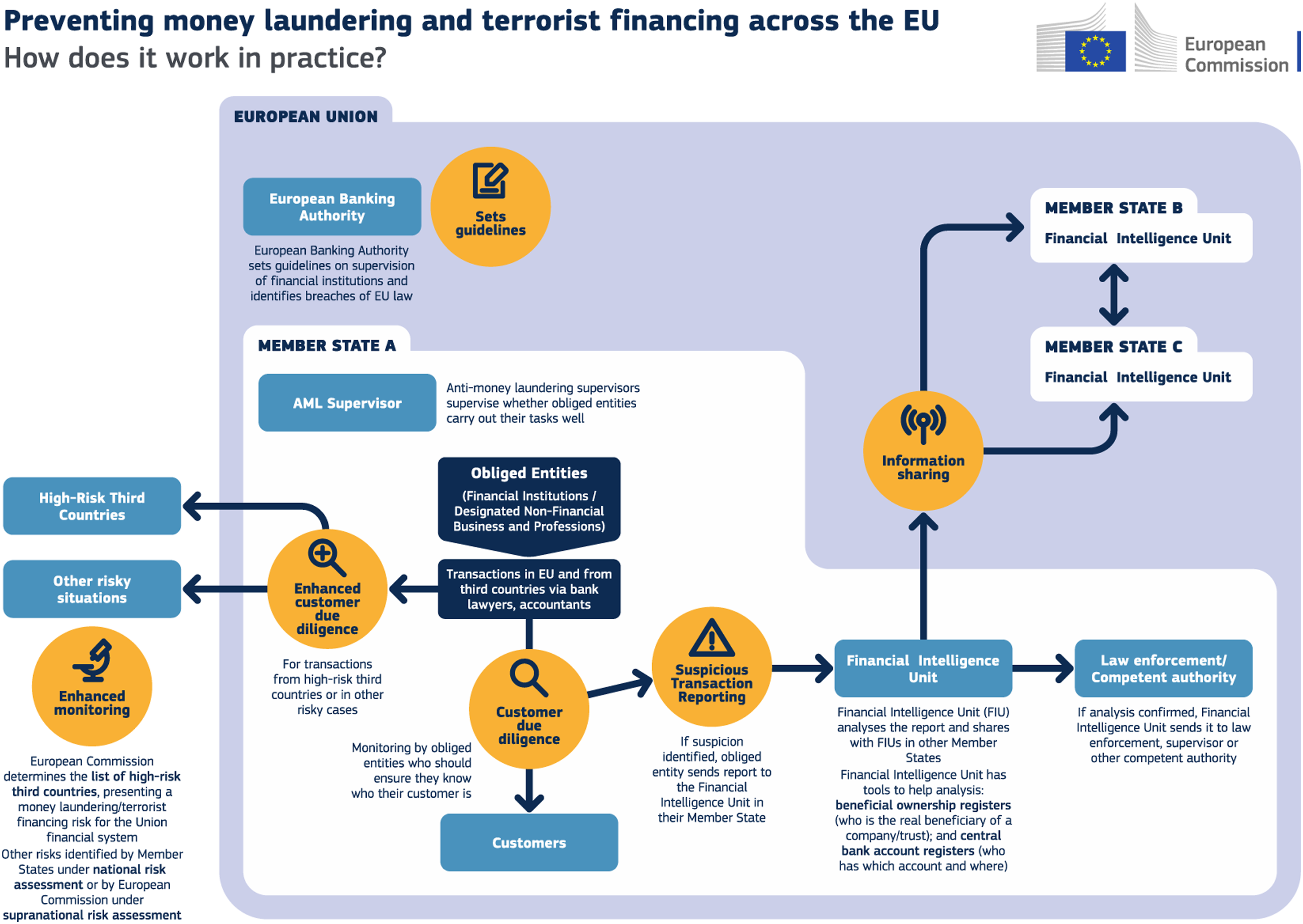
Considering these recent and joint efforts, there is arguably no reason why the UK and the EU should now depart on this topic. Moreover, Art LAW.AML.127 of the TCA clearly states both Parties’ intention to ‘support and strengthen action by the Union and the United Kingdom to prevent and combat money laundering and terrorist financing’.
Art LAW.AML 128 then focuses on general ways and measures by which both Parties will keep on working together towards their shared AML/CFT objectives: International cooperation: Art LAW.AML.128(1) emphasises the need to ‘support international efforts’ with regards to AML/CFT. In this respect, the EU and the UK will keep on working jointly in the context of Financial Action Task Force (FATF) of which they are both members. It is worth noting that FATF recommendations are expressly mentioned by Art LAW.AML.128(3). The EU and the UK will also be able to cooperate through the Egmont Group, which is a platform for national Financial Intelligence Units (FIUs). This platform enables these dedicated bodies to share expertise and information with respect to AML/CFT issues. The European Commission and Europol have observer status to the Egmont group, and the UK National Crime Agency is an active member of it. Information sharing: Information sharing is one of the cornerstones and probably one of the strengths of the EU AML/CFT framework, as is visible in the diagram above, notably through FIUs. The importance of maintaining a principle of information sharing is thus unsurprisingly mentioned as part of the common measures to prevent and combat money laundering, in the form of a commitment in principle to ‘exchange relevant information, as appropriate within their respective legal frameworks’.
6
In addition to these two Articles recalling the objectives and measures envisaged, Title X of the TCA contains two further provisions devoted more specifically to the issue of beneficial ownership transparency, respectively for corporate and other legal entities 7 and for ‘legal arrangements’ (trusts and fiduciaries). 8
The important focus placed on this topic seems to acknowledge the significance of accessing beneficial ownership information to successfully track down suspicious financial flows.
Both Articles contain seven similar paragraphs that reflect the main provisions of the AML/CFT Directives on this subject, imposing on each Party: To ensure that legal entities/arrangements ‘maintain adequate, accurate and up-to-date information about beneficial owners’ and that their competent authorities ‘have timely access to such information’ through mechanisms that have to be put into place.
9
To ‘establish or maintain a central register holding adequate, up-to-date and accurate information about beneficial owners’,
10
that has itself to be ‘made available to its competent authorities without restriction and in a timely manner’.
11
To ensure that basic information about beneficial owners is made available to any member of the public but for limited exceptions (such as exposure of the beneficial owner to disproportionate risks of fraud, kidnapping, extortion, etc.).
12
To ensure that there are effective, proportionate and dissuasive sanctions against legal entities or arrangements which fail to comply with those requirements.
13
Finally, to ensure that its competent authorities ‘are able to provide the information referred to in paragraphs 2 and 3 to the competent authorities of the other Party in a timely and effective manner and free of charge. To that end, the Parties shall consider ways to ensure the secure exchange of information’.
14
The Agreement hence clearly ascertains that both Parties intend to keep up their efforts with respect to AML/CFT. However, they will do so separately from now on, which could have certain consequences, as set out below.
… On two separate ships
As expressly provided for by the TCA, 15 information sharing will now depend on national legal frameworks, rather than on a common set of commitments and rules to facilitate it, which could quite obviously impact information sharing and the overall cooperation process.
In this regard, Title X of the TCA is surprisingly silent on the mechanisms that the Parties intend to put into place to ensure an efficient exchange of information.
As mentioned above, apart from the objectives recalled, the subject of information sharing is only mentioned in general terms in Art LAW.AML.129(7) and Art LAW.AML.130(7) referred to above, regarding the commitment of the Parties to ensure that their competent authorities are able to share relevant information with each other.
But for this petition of principle, Title X of the TCA provides no mention of tangible ways or mechanisms through which such cooperation might be achieved to palliate the UK’s exit from the EU.
Although other titles under Part III of the TCA related to police cooperation and exchange of information, particularly Title IV regarding the cooperation on operational information, provide to some extent precisions in the ways information might be exchanged spontaneously or upon request, 16 the operational details of such processes mainly revert to the Parties’ respective domestic laws and do not elaborate on the ‘ways to ensure the secure exchange of information’ that should be specifically put into place for exchanging information relevant to AML/FT objectives.
Yet from one glance at the European Commission diagram shown above, it seems that Brexit will necessarily – if temporarily at least – alter the existing connection between EU Financial Intelligence Units (FIUs) and the UKFIU.
The cooperation between FIUs has been a long-lasting objective of the EU in its AML/CFT policy and one that has given rise to several provisions and mechanisms in the European legal framework so far.
As recalled in a study published in 2017 by the European Parliamentary Research Service (EPRS), ‘information exchange between the FIUs has been a European objective since the second half of the 1990s, culminating in the Council decision of 17 October 2000 concerning arrangements for cooperation between financial intelligence units of the member states in respect of exchanging information’. 17
Since then, the successive AML/CFT European Directives have been working for several years to develop systems of enhanced cooperation, in particular through the establishment of a system of interconnection of beneficial ownership registers, 18 spontaneous information sharing, 19 processing of requests for information from an FIU of another Member State, 20 restrictions and conditions that may be imposed at the time of transfer, 21 dissemination to competent authorities 22 or the generalisation of the use of the FIU.net network. 23
As it is no longer part of the EU, the UK seems inevitably exposed to the risk of losing the benefits of these various mechanisms, including access to the common FIU.net platform that has now been integrated into Europol since 2016.
Yet, as previously mentioned, no practical measure appears to have been envisaged in the TCA to specifically remediate the situation.
Such absence could well be explained by the fact that ‘fall back’ bilateral or multilateral agreements already exist at an international level, which similarly aim at ensuring a strong cooperation between FIUs and competent authorities: The Warsaw Convention on Laundering, Seizure and Confiscation of the Proceeds from Crime and on the Financing of Terrorism, ratified by the UK on 27 April 2015,
24
provides a legal framework for FIUs and structures international cooperation in this field, notably by requiring the States to take all necessary legislative measures to ensure the FIUs’ access to all relevant data,
25
cooperation between FIUs for the collection, analysis or investigation on suspicious operations,
26
or to allow FIUs to suspend or postpone an ongoing transaction at the request of a foreign FIU.
27
In addition, the above-mentioned Egmont Group of FIUs created a secure encrypted platform to share information over the Internet, called the Egmont’s Secure Web system (ESW), allowing its current 164 FIU members to make and respond to bilateral requests for information.
Information sharing can also take place in the broader context of police cooperation and exchange of information, which is addressed in Part III, Title II, IV, V and IX of the TCA, 28 the context of mutual legal assistance addressed in Part III, Title VIII of the TCA, 29 or of investigative assistance in respect of freezing and confiscation addressed in Part III, Title XI of the TCA. 30 In this regard, the efforts made to maintain operational ties between the UK and Europol could provide means to facilitate UK’s access to Europol’s resources. 31
Other channels thus exist to facilitate information sharing between the UK and the EU.
On the other hand, now that the UK is no longer a Member State, it is yet unsure whether and how these alternative communication channels will prove to adequately replace the easy access to specific EU channels that used to be in force between the UK and the EU, such as the interconnected FIU.net network.
In this regard, it was suggested in the above-mentioned study by the EPRS that although both the ESW and FIU.net allowed secure communication for the exchange of information, there was significant value added with the second, more sophisticated system, than with the ESW network, which ‘mainly works as a secure email connection’. 32
It is also worth noting that in its 2020 report, the UKFIU of the National Crime Agency (NCA) stated that 47% of financial intelligence requests received came from EU networks (FIU.net, ARO 33 and CARIN 34 ) and 47% of requests sent targeted the same EU networks. 35
The impossibility of relying on the existing EU networks could thus still impair information sharing and cooperation between the EU and the UK. From a practical point of view, this could also generate uncertainty and disturbances regarding the legal basis of future exchanges of information with the UKFIU or competent authorities, which in turn could affect the grounds for judicial enquiries and prosecution triggered as a result of such exchanges, and more generally the admissibility and value of evidence obtained through these channels.
In addition, the UK will not participate in the upcoming EU AML/CFT projects which were set out in the May 2020 Action Plan
36
to be implemented in 2021 and which include six pillars: Effective application of EU rules, under the monitoring of the European Banking Authority A single EU rulebook EU-level supervision of the private sector A coordination and support mechanism for Member State FIUs Enforcing EU-level criminal law provisions and information exchange A stronger EU in the world
These six objectives convey a clear political will to further address AML/CFT at the Union level rather than national levels and to reinforce and strengthen an EU-wide harmonised framework.
Ironically enough, this action plan aims at ‘closing the door on dirty money’, as put by the Commission: there is no denying that the UK has now left the EU building, and it remains to be seen whether or not it will shut the door behind….
Footnotes
Declaration of conflicting interests
The author(s) declared no potential conflicts of interest with respect to the research, authorship and/or publication of this article.
Funding
The author(s) received no financial support for the research, authorship and/or publication of this article.

1.
2.
Directive (EU) 2015/489 on preventing the use of the financial system for money laundering or terrorist financing (4th AMLD); Directive (EU) 2018/843 amending Directive (EU) 2015/849 on preventing the use of the financial system for money laundering or terrorist financing (5th AMLD); Directive 2018/1673 on combating money laundering by criminal law (6th AMLD).
3.
Directive (EU) 2019/1153 laying down rules facilitating the use of financial and other information for the prevention, detection, investigation or prosecution of certain criminal offences.
4.
6.
Art LAW.AML 127(2).
7.
Art LAW.AML.129.
8.
Art LAW.AML.130.
9.
Art LAW.AML.129(2) and LAW.AML.130(2)
10.
Art LAW.AML.129(3) and LAW.AML.130(3).
11.
Art LAW.AML.129(4) and LAW.AML.130(4)
12.
Art LAW.AML.129(5) and LAW.AML.130(5).
13.
Art LAW.AML.129(6) and LAW.AML.130(6).
14.
Art LAW.AML.129(7) and LAW.AML.130(7).
15.
Art LAW.AML.128.
16.
See articles by Wörner, Bock, Arnell and Davies, in this issue.
17.
18.
Art 29 and ff. European Parliament and Council Directive (EU) 2015/849 of the of 20 May 2015 on the prevention of the use of the financial system for the purposes of money laundering or terrorist financing, amending Regulation (EU) No 648/2012 of the European Parliament and of the Council and repealing Directive 2005/60/EC of the European Parliament and of the Council and Commission Directive 2006/70/EC [2015] OJ L 141/73, as amended by European Parliament and Council Directive (EU) 2018/843 of 30 May 2018 amending Directive (EU) 2015/849 on the prevention of the use of the financial system for the purposes of money laundering or terrorist financing, and amending Directives 2009/138/EC and 2013/36/EU [2018] OJ L 556/43 (5th AML Directive).
19.
Art 53(1) 5th AML Directive.
20.
Art 53(2) 5th AML Directive.
21.
Art 54 5th AML Directive.
22.
Art 55 5th AML Directive.
23.
Art 56 5th AML Directive.
24.
Council of Europe Convention on Laundering, Search, Seizure and Confiscation of the Proceeds from Crime and on the Financing of Terrorism, CoE [2005] European Treaty Series – No. 198 (hereafter ‘CoE 2005 Convention’)
25.
Art 12 CoE 2005 Convention.
26.
Art 46 CoE 2005 Convention.
27.
Art 47 CoE 2005 Convention.
28.
See articles by Wörner, Bock, Arnell and Davies, in this issue.
29.
See Oehmichen and Keith, in this issue.
30.
See Oehmichen and Keith, in this issue.
31.
See Wörner, Bock, Arnell and Davies, in this issue.
32.
33.
EU Asset Recovery Office.
34.
Camden Asset Recovery Inter-Agency Network.
35.
36.
European Commission, ‘Action Plan for a new single EU Anti-Money Laundering System’ COM (2020) 2800 final, <https://eur-lex.europa.eu/legal-content/EN/TXT/PDF/?uri=PI_COM:C(2020)2800&from=EN> accessed 23 January 2021.