




Abstract
The authors share their first impressions of the EU–UK Trade and Cooperation Agreement in criminal law. After looking at how the Agreement came about and speculating about alternatives, criticism regarding the Agreement is voiced. This concerns the lack of transparency in the legislative process on a general level. Regarding the individual provisions, further points of criticism as well as such of particular interest are identified with reference to the respective articles in this issue. The first impression that the Agreement was developed quickly, without systematic approach, and thus leaves many loopholes and uncertainties, is confirmed. To conclude, however, some positive achievements are also highlighted.
Keywords
The Trade and Cooperation Agreement (TCA) between the European Union and the European Atomic Energy Community, of the one part, and the United Kingdom of Great Britain and Northern Ireland, on the other part of 24 December 2020 (TCA) was established on the basis of Art 216 of the TFEU. 2 This Agreement is binding upon the institutions of the Union and on its Member States. 3 It is “provisionally” applicable as of 1 January 2021, pursuant to Art 218 TFEU. 4 How long this provisional status will last is today (31 January 2021) unknown. 5
The sudden appearance of the TCA, which has been negotiated in a totally untransparent manner, has given rise to much legal debate also in “Law enforcement and judicial cooperation in criminal matters,” the title of Part III of TCA.
The purpose of this special issue is to give a first, by nature non-exhaustive and “provisional,” overview on the parts of the TCA regulating criminal matters, outlining the main purposes, contents, and omissions. Further, first observations of practicing experts on international cooperation in criminal matters from the UK and EU Member States (Belgium, France, Germany, and Portugal) will be presented.
After a long period of silence between the beginning of a transition period 6 between the UK leaving the EU (Brexit) and the set deadline for a “deal” between the parties before 31 December 2020, this TCA came to light on Christmas eve of 2020. Both parties welcomed this last minute Blitzdeal as being better than no deal. The authors hope that the readers of this small compendium will be able to make their own assessment of whether this also holds true for the parts on criminal law (Part III) in the TCA.
However, before going into details of Part III 7 and its eight Annexes, 8 altogether at present amounting to 228 pages, that is, 1/5 of the entire TCA, some preliminary aspects must be addressed.
The EU, its Member States, and the UK are proud to be built on common values. One of the most important values is to be a genuine parliamentary democracy. What about the TCA, that is now already being applied, only 8 days after being presented to the public for the first time? Who was the legislator? What can the ex post involved 1 + 27 + 1 parliaments do more than blindly 9 nodding it off, as the British Parliament has already done its own fast-track control and acceptance within 3 days. 10
Where is the transparency in this legislative process? Who has the chance to comment on the work product that unknown drafters had no doubt been busy creating over the course of several months? Why is there, besides an EU draft of August 2020, 11 still no access to the full travaux préparatoires of the TCA, and why does it remain still classified as confidential?
The deluge of new law emanates from Brexit (a decision taken step by step by the people of the UK). We can leave aside some factors: fraudulent campaigns in favour of Brexit answered by frivolous attempts of a weak opposition in the UK, and humble silence on the part of the EU and its Member States, forgetting that a fundamental part of their own European body was about to be cut off. However, we must not forget the impetus of the British majority behind the vote to leave. Right or wrong, it was also the deeply rooted desire of the British people to regain sovereignty and independence. Was this endeavor based on misplaced obsession? In any event, this factor must be seriously taken into account when interpreting the TCA. Similarly, the EU Member States’ desire to keep the UK on board must be considered. Are the results before us legally a sound balance of these competing interests? And what is more: Are the interests of individuals sufficiently respected? And what does this mean for lawyers and other practitioners? What about the control of executive powers, including prosecutors, by independent and impartial judges? These last considerations are of particular importance, considering that the Court of Justice of the European Union (CJEU) is no longer available for the purposes of this Agreement (some call this a “conundrum” 12 ). However, the UK is still member to the Council of Europe (CoE), and hence subject to the jurisdiction of the European Court of Human Rights (ECHR).
But was there any alternative? The part on judicial cooperation in criminal matters of the TCA establishes a mixture of EU law, law of the CoE and elements of Schengen, diluted with new elements allegedly necessary for this deal, including the establishment of new political—not judicial—bodies such as a “Partnership Council” and a “Specialised Committee on Law Enforcement and Cooperation” which shall be responsible of solving disputes on how to apply the new provisions. This mixture is not only difficult to digest and hard to apply in practice but also is in large parts incomplete. To name just one example: The UK is now a third country like all other pan-European states 13 outside the Union, which cooperates primarily on the basis of CoE Conventions, 14 well established since 1957.
Sadly enough, but consistent after Brexit, the EU principle of mutual trust allowing for closer cooperation and mutual recognition no longer applies. 15 The common area of justice is replaced by “close and peaceful relations based on cooperation, respectful of the Parties’ autonomy and sovereignty.” 16
Consequently, a possible deal could have consisted in providing for the UK to return to the CoE’s pan-European system. And this is indeed what happened, at least to a large extent, in mutual legal assistance (MLA).
However, in an area in which the existing lack for mutual trust became most obvious in recent years, that is, extradition, the deal surprisingly pretends to treat the UK still as a Member State, adopting mainly the system of the European Arrest Warrant (EAW).
In this spirit, the TCA sticks to the EU terminology of “issuing” and “executing” State and only removes the word “European” from the EU–UK request for surrender, by naming it “Arrest Warrant,” and providing a new “Arrest Warrant Form,” 17 similar to the one we know from EAW. This terminology is misleading, as it is in reality a request for extradition. It is also confusing as the same term used in the UK for domestic arrest warrants is now used for those coming from EU Member States. This double use in terminology had already raised the confused question: Do we now only need one arrest warrant? In the absence of mutual trust and recognition, the answer can only be: No! Any request for extradition in future will only be admitted with the underlying domestic arrest warrant attached to it. 18 But the question alone shows already how dangerous these confusing terms of the TCA can be for future practice. In any event, to avoid this confusion, it is mandatory to speak about the domestic arrest warrant on the one hand, and the EU–UK arrest warrant, on the other.
Further, under the TCA, the UK is misleadingly entitled to request also for “surrender” instead of extradition, that is what it is. In law, we cannot afford to gamble with words. However, the one revolutionary and, from a criminal defense point of view, positive, novum in both MLA and the surrender procedure as well as in other areas of judicial cooperation is the explicit introduction of an important requirement: Proportionality. 19 However, it is not specified who will have the final say on this requirement (requesting or requested state). While the Arrest Warrant Form in ANNEX LAW-5 does not foresee any field in which the requesting authority should give reasons for the proportionality of a request, it is clear that a proportionality test will now be needed and somehow documented in any request for extradition or MLA request between the UK and EU Member States. Should there be reasonable doubt in the requested state on the proportionality of a requested measure, it becomes mandatory to contact the requesting state or, in case of evident disproportionality, to refuse the measure outright.
It might be of assistance to recall the sources of law in a systematic way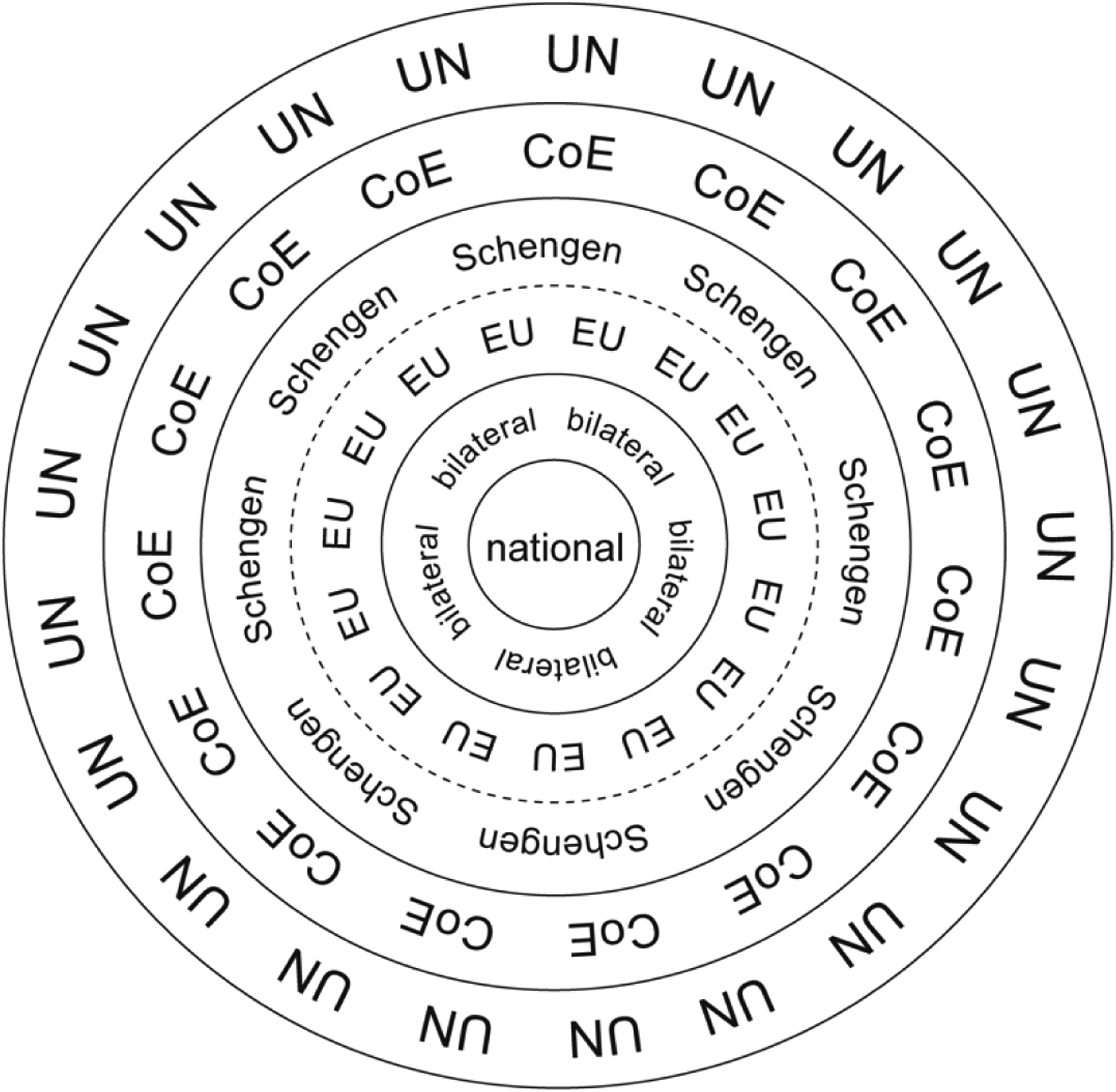
These circles should be read from the center (domestic law) to the outer circle (globally applicable norms, e.g., ICCPR 20 and UNTOC 21 ). Usually, the most specific and thus preceding rules are found in the center of the circle but have to be read “in light” of those norms established at the outer circles. Nothing in this diagram shall be misunderstood as a mandatory hierarchy. Having found relevant provisions on different levels, priority has to be established on a case-to-case basis. While the previous relations between the EU and the UK were clearly governed by EU law with explicit clauses, the present TCA is impossible to locate in this diagram, as it combines, for unknown reasons, elements of EU, Schengen, and CoE law.
The new provisions at a glance: Identified loopholes and uncertainties
The more in-depth analysis confirms the first impression—that the TCA was drafted in extreme haste, without a systematic approach, and, in consequence, leaves many issues unregulated and thus many questions unanswered. This is very unfortunate in judicial cooperation in criminal matters as legal certainty is indispensable in light of the individual freedoms at stake for the persons affected by such measures.
This starts already with the general provisions: It is unclear how individuals can rely on an agreement concluded between the government of one state and the European Union, and how it can be ensured that their fundamental rights be respected, in particular, ne bis in idem, as the Fundamental Rights Charter (CFREU) 22 is no longer applicable. As S. Schomburg 23 notes, further uncertainty is created by the establishment of the Partnership Council and the Specialised Committee: Who are the representatives present in these bodies, and what are their roles and rights?
In the area of extradition, Grange, Keith, and Kerridge 24 question why, if mutual trust and recognition no longer exist, deprivation of liberty by ticking boxes has not been abandoned at all. However, they note that the departure from mutual trust also has some benefits, such as the new safeguard provided by the political offense exception 25 and the principle of proportionality. 26 Depending on the notifications provided by the UK and the EU Member States, new grounds for non-execution of an extradition request may now be based on nationality 27 or lack of dual criminality. 28
With respect to MLA, Keith and Oehmichen 29 observe that the principle of proportionality, like in extradition, is now also introduced as general requirement, thus extending to all sorts of MLA requests (including freezing and confiscation), although it is yet to be seen how the authorities will handle disproportionate requests in practice. In that context, it is unfortunate that the standard forms provided for surrender and freezing and confiscation in the Annexes to the TCA do not foresee a specific field addressing proportionality. Uncertainty also exists as to how the future standard form for MLA requests will look like at all, as the European Investigation Order form can no longer be used and the CoE MLA system does not provide for ticking box forms.
With regard to the specific MLA regulated under the TCA for freezing and confiscation, Costa Ramos and Pons 30 note that the specialty rule has been strengthened, but that some grounds for refusal previously provided for in the CoE system, including ordre public, are no longer mentioned in the TCA; given their domestic constitutional background in some Member States, it remains to be seen whether and to which extent they will still be applied in practice under the TCA.
Information exchange was one of the focus areas of the TCA judicial cooperation matters. The first five titles following the general provisions are dedicated to information exchange between law enforcement authorities. 31
In terms of police cooperation, while the UK continues the exchange of information in this area, Arnell, Bock, Davies, and Wörner 32 highlight that the full extent of the UK’s future cooperation remains to be detailed in the working and administrative arrangements, that the UK still needs to develop its own interconnection software, and that police cooperation in general will likely be slowed down.
Surprisingly, when it comes to the exchange of financial data in the area of money laundering and terrorist financing, Grignon and Ascione Le Dréau 33 point out that the TCA does not provide any continuation of the information exchange through the specialised Financial Intelligence Units (FIUs), which may not only cut off the UK’s access to relevant FIU networks but also generate uncertainty and disturbances regarding the legal basis of future exchanges of information with the UKFIU or competent authorities.
The topic of information exchange is closely linked to data protection, but also to human rights. 34 As outlined already above, one of the biggest challenges of the TCA will be on how to uphold human rights. There is no court to enforce them, nor any possibility of the individual to lodge complaints against violations committed when applying the TCA. Nor is there any court appointed by law assisting in interpreting and applying the confusing and sometimes contradictory or non-existing provisions of the TCA, hence no judicial control. 35 To be controlled by an EU court was one of the emotional reasons triggering Brexit. This despite the traditional British senses for a reasonable balance of powers.
Furthermore, it is a great disappointment that the CFREU has not been included in the TCA, with the consequence that some core fundamental rights such as the internationalized principle of ne bis idem (double jeopardy), a long developed unique jewel within the EU, is no longer applicable between EU Member States and the UK. 36
For the TCA, the CJEU was replaced by dispute settlement mechanisms provided in Part III of the TCA. These mechanisms are, as Janet 37 points out, purely political rather than jurisdictional, and presuppose a readiness of the parties to negotiate in good faith that finds little to no support when looking at the cumbersome, long, and tough negotiations surrounding Brexit during the last 4 years.
As to data protection, cooperation with the EU requires a higher level of data protection than the UK may be able to concede. And the adequacy decision required by the CJEU’s case law is yet another issue that the TCA did not solve but postpone. As van de Heyning 38 stresses in her analysis, in light of the UK’s little interest in data protection, it is hard to imagine that the EU would reach an adequacy decision passing the CJEU’s review under those circumstances.
In relation to future cooperation of the UK with EU judicial agencies and bodies such as the European Agency for Criminal Justice Cooperation (Eurojust), the European Anti-Fraud-Office, and the European Public Prosecutor’s Office (EPPO), Niblock 39 notes the continued reluctance of the UK vis-à-vis a pan-European prosecutor, which finds its confirmation in the TCA, which is completely silent on the EPPO. At the same time, she draws attention to the closely regulated cooperation with Eurojust, which may lead to the UK authorities in practice finding themselves encountering the EPPO, albeit indirectly, by way of their anticipated work with Eurojust.
Finally, it is striking that one core area of judicial cooperation, that is, transfer of sentenced persons, has not been addressed at all. This subject matter was previously governed by the EU Framework Decision on the Transfer of Persons, 40 which no longer applies to the UK. Consequently, the CoE Convention on the Transfer of Sentenced Persons of 21 March 1983 with its additional Protocols 41 will now apply. It unites globally 68 Member States.
To name the few positive aspects of the TCA—besides its very existence, which must already be praised as quite an achievement after the tough and lengthy Brexit negotiations—we should recall that at least: 1. The principle of proportionality has been explicitly integrated as a prerequisite for any judicial cooperation in the framework of the TCA, thus going beyond the system provided under written EU law.
42
However, the EU system cannot be less protective to that end than the TCA system. It follows that this globally acknowledged principle is also obliging the remaining Member States in extradition cases within the Union of 27 (requesting/issuing State and requested/executing State). 2. In extradition cases, double legal representation (i.e., right to a lawyer not only in the executing but also in the issuing state) and the “real risk” test established in Aranyosi
43
are now explicitly guaranteed in statutory law.
44
3. The ECHR is still applicable and (potentially) conditional for judicial cooperation in criminal matters. 4. A high standard of data protection is also upheld and may be likewise conditional for judicial cooperation in criminal matters. 5. In case of dispute, diplomats are forced to find an amicable solution acceptable for everybody. In case such disputes arise during surrender procedures, this can only mean temporary release of the requested person, as it is likely that the lengthy negotiations diplomats will need will, at some point, require the release of the requested person, in view of the overarching proportionality principle.
Footnotes
Declaration of conflicting interests
The author(s) declared no potential conflicts of interest with respect to the research, authorship, and/or publication of this article.
Funding
The author(s) received no financial support for the research, authorship, and/or publication of this article.
1.
Trade and Cooperation Agreement between the European Union and the European Atomic Energy Community, of the one part, and the United Kingdom of Great Britain and Northern Ireland, of the other part, [2020] OJ L 444/14, < > accessed 23 January 2021 (TCA). All provisions cited in this piece without further reference belong to the TCA. As watermarked on each page of the first published version dated 24 December 2020: This document has been agreed between the European Union and the United Kingdom and is provided for information only. No rights may be derived from it until the date of application. The numbering of the articles is provisional. This caveat still applies, for instance, Art FINPROV.3 is followed by Art FINPROV.6, and the numbering is not consecutive throughout the TCA, leading to several numbers being used twice (e.g., Art LAW.MUTAS.122 is followed by Art LAW.EXINF.120 etc.). This is why, unfortunately, reference must always be made to the full name of the relevant provision.
2.
Consolidated version of the Treaty on the Functioning of the European Union [2012] OJ C 326/47 (TFEU). Art 218 TFEU regulates the procedure the European Union needs to follow when making agreements with Third Countries.
3.
Art 216(2) TFEU.
4.
Consolidated version of the Treaty on the Functioning of the European Union [2012] OJ C 326/47 (TFEU). Art 218 TFEU regulates the procedure the European Union needs to follow when making agreements with Third Countries.
5.
Cf. Art FINPROV.11: (1). This Agreement shall enter into force on the first day of the month following that in which both Parties have notified each other that they have completed their respective internal requirements and procedures for establishing their consent to be bound. (2) The Parties agree to provisionally apply this Agreement from 1 January 2021 provided that prior to that date they have notified each other that their respective internal requirements and procedures necessary for provisional application have been completed. Provisional application shall cease on one of the following dates, whichever is the earliest: (a) 28 February 2021 or another date as decided by the Partnership Council, or (b) the day referred to in paragraph 1. (3) As from the date from which this Agreement is provisionally applied, the Parties shall understand references in this Agreement to “the date of entry into force of this Agreement” or to “the entry into force of this Agreement” as references to the date from which this Agreement is provisionally applied.
6.
7.
81 pages long (about 180 Articles) and thus constituting ¼ of the whole text of the TCA (434 pages) excluding the annexes and appendices.
8.
About 150 pages long—at least eight annexes: ANNEX LAW-1 [EXCHANGES OF DNA, FINGERPRINTS AND VEHICLE REGISTRATION DATA] forms an integral part of Title II [Exchanges of DNA, fingerprints and vehicle registration data] of Part Three; ANNEX LAW-2 [PASSENGER NAME RECORD DATA] forms an integral part of Title III [Transfer and processing of passenger name record data] of Part Three; ANNEX LAW-3 [FORMS OF CRIME FOR WHICH EUROPOL IS COMPETENT] forms an integral part of Title V [Cooperation with Europol] of Part Three; ANNEX LAW-4 [FORMS OF SERIOUS CRIME FOR WHICH EUROJUST IS COMPETENT] forms an integral part of Title VI [Cooperation with Eurojust] of Part Three; ANNEX LAW-5 [ARREST WARRANT] forms an integral part of Title VII [Surrender] of Part Three; ANNEX LAW-6 [EXCHANGE OF CRIMINAL RECORD INFORMATION – TECHNICAL AND PROCEDURAL SPECIFICATIONS] forms an integral part of Title IX [Exchange of criminal record information] of Part Three; ANNEX LAW-7 [DEFINITION OF TERRORISM] forms an integral part of Title III [Transfer and processing of passenger name record data], Title VII [Surrender] and Title XI [Freezing and confiscation] of Part Three; ANNEX LAW-8 [FREEZING AND CONFISCATION] forms an integral part of Title XI [Freezing and confiscation] of Part Three.
9.
Blindly,” with all due respect, meaning: as usual in BREXIT matters: after careful review of all relevant norms.
11.
12.
Art COMPROV.13(3). See also Grange, Keith, and Kerridge, in this issue.
13.
Apart from Belarus, because it is the only Member State of CoE that has not abolished the death penalty.
14.
15.
Regrettably, the impression of “losing mutual trust,” even questioning the rule of law, at present is rather linked to a few other Member States of the EU.
16.
Art COMPROV.1: Purpose: This Agreement establishes the basis for a broad relationship between the Parties, within an area of prosperity and good neighborliness characterized by close and peaceful relations based on cooperation, respectful of the Parties’ autonomy and sovereignty.
17.
ANNEX LAW-5.
18.
Cf. The well-established case law of the CJEU, including the most recent one dated 13 January 2021: Case C-414/20 MM [2021] ECLI:EU:C:2021:4.
19.
Art LAW.MUTAS.116(1) (a); Art LAW.SURR.77; Art LAW.CONFISC.1(5); cf. also Art LAW.PNR.34(4); Art LAW.PNR.37(2); Art LAW.EUROPOL.53(1); Art AW.GEN.4(1) (d), (e); Art LAW.AML.127(5), (6); Art LAW.AML.130(5); Art INST.35(3); Art INST.36(4).
20.
International Covenant of Civil and Political Rights of 19 December 1966, UN [1966] United Nations Treaty Series, vol. 999, p. 171 (ICCPR).
21.
United Nations Convention against Transnational Organized Crime, UN [2000] United Nations Treaty Series, vol. 2225, p. 209 (UNTOC).
22.
Charter of Fundamental Rights of the European Union [2012] OJ C 326/02.
23.
In this issue.
24.
In this issue.
25.
Art LAW.SURR 82.
26.
Art LAW.SURR.77.
27.
As some Member States do not extradite their own citizens to third countries, cf. Art LAW.SURR.83.
28.
Art LAW.SURR.79.
29.
In this issue.
30.
In this issue.
31.
Titles II-VI of the TCA.
32.
In this issue.
33.
In this issue.
34.
It is notable that when it comes to information exchange with Europol, the TCA drafters were satisfied that the parties ensure that the information collected, stored, and transferred has not been obtained in violation of human rights, “as far as possible,” cf. Art LAW.EUROPOL.52(3).
35.
On this matter, see also S. Schomburg, in this issue.
36.
For details, see W. Schomburg, A. Oehmichen, and K. Kayß, in this issue.
37.
In this issue.
38.
In this issue.
39.
In this issue.
40.
Council Framework Decision 2008/909/JHA of 27 November 2008 on the application of the principle of mutual recognition to judgments in criminal matters imposing custodial sentences or measures involving deprivation of liberty for the purposes of their enforcement [2008] OJ L 327/27.
41.
Convention on the Transfer of Sentenced Persons, CoE [1983] European Treaty Series–Nos. 112, 167 (not yet ratified by all Member States of EU), 222 (not yet entered into force) last visited 29 January 2021.
42.
Cf. A. Oehmichen and B. Keith, in this issue.
43.
Case C-496/16 Aranyosi [2017] ECLI:EU:C:2017:866.
44.
Cf. E. Grange, B. Keith, and S. Kerridge, in this issue.