



Abstract
Nowadays, the use of non-edible vegetable oils as the raw material for polymer development is growing in interest because of the scarcity and high demand for crude oil and also because of its eco-friendly approach. The utilization of non-edible oil to synthesize the applicable polymers reduces the usage of petrochemicals. To eliminate the reliance on petrochemicals, it is important to search for and extract alternate and domestic non-edible oils suitable for the synthesis of polymeric materials. This is now a promising research approach. The outstanding feature of indigenous, non-edible Madhuca indica oil (MO) is its chemical structure, with unsaturated sites and esters that are considerable ingredient polyols for the development of polymers. This review discusses the origin, structure and extraction of MO and systematically focuses on the recently developed polymers using oil as a renewable source of polyols. We have briefly reviewed MO-based polymeric materials such as alkyd resins like pentaalkyds for scratch resistance, glycerol alkyds for fly-ash coating, pentalkyd LC resins for display coating applications and epoxies of MO for biological coating materials. Also, the important polyurethanes in the pathways of MO-based fatty amide are transformed into the polyetherimide polyols through a step-growth reaction with bisphenol-A or bisphenol derivatives, which again react with isocyanates to produce MO-based PU for excellent adhesion and coating applications. Another type of waterborne polyurethane is made from polyesteramides. These PU coatings are used in the paint and pigment industries. We reviewed their synthesis and widespread use in coatings and composites.
Introduction
The industrial revolution led to a series of play innovations that have impacted every aspect of human life until now. The price ultimately pays back, and industrialisation has created a number of environmental problems. The major role in such issues is related to the usage of petrochemical resources. Not only that, but there has been a big rise in the population, which has led to the depletion of natural resources.1,2 In such cases, researchers have been led to look for new ways to make different renewable resources, which limits the use of petrochemical resources.3,4 Currently, many renewable resources are widely used on a larger scale for the development of polymeric materials due to their many benefits over their petroleum counterparts.5,6 The most preferred natural materials are vegetable oils (VOs), cellulose and bio-fibres for polymer development. These materials have the potential to be used as green monomers or intermediates for polymer synthesis and have received great attention in the development of newer polymeric materials.7–10
Vegetable oils
The concern for human health effects on the environment is an important driving force for replacing part or all of the petroleum-based precursors for polymer development with those obtained from agricultural precursors. VOs are among the most significant renewable materials for polymers because of their widespread availability, natural biodegradability, low cost, minimal ecotoxicity and nontoxicity to humans.11–14 The VOs are extracted from seeds or, less often, from other pieces of plants. India is rich in forest resources and has a wide variety of trees that produce a large number of oilseeds. VOs are ester compounds made up of three unsaturated and/or saturated fatty acids joined by a glycerol molecule, such as ricinoleic acid, oleic acid, linoleic acid, erucic acid, petroselinic acid and ferulic acid.15,16 The chemical structure of the typical triglyceride present in the VOs is presented in Figure 1. Typical triglyceride molecule present in VO.
The physico-chemical properties of VOs largely depend on the length of the fatty acid part and the degree of unsaturation. The oil properties can be analysed by different parameters like saponification value, acid value, peroxide value and iodine value, which ultimately control the main characteristics of polymers synthesised from VOs. 17 VOs have a wide range of chemical structures along with reactive sites (epoxy, unsaturation and ester groups) that can be chemically changed into different customised polyols, which are used in polymer development. 18
Dependent upon the necessity in the ecosystem, VOs can be classified as edible oils (which can be used in food) and non-edible oils (which cannot be added to food). Cottonseed, sunflower, mustard, coconut, olive oil, palm, rice bran, peanut, soybean and canola are examples of edible VOs. Because there are still dangerous chemicals in the oils, non-edible VOs are not safe for humans to eat. 19
Non-edible VOs
Non-edible oil’s physico-chemical characteristics.

Non-edible VOs are used to prepare polymeric binders for coating formulations, flooring materials and various resin-based applications. These oils have also been widely used in the preparation of inks, lubricants, diluents, agrochemicals, plasticizers, coatings, smart materials, food, composite materials and so on.32–34 Various non-edible VOs as the raw materials have many advantages, like the flexibility of planting non-edible oil feedstocks in non-agricultural lands with little fertility, cultivated in very low rainfall/dry zones as well as higher rainy/wet zones, do not contest with already available agricultural resources, can be utilised in additional chemical processes or burnt to generate heat and power, can repair degraded lands, reduce CO2 emissions and have strong resistance to disease and insect pests. 35 The main benefits of non-edible VOs are the natural portability of their liquid, being easily available, renewable, high heat content, low sulphur composition, residual aromatic content and being biofreindly. Amongst many non-edible oils, the rich source of M. indica oil (MO) in India is now being used by polymer chemists for the development of various materials and may be the future choice of renewable sources as precursors for polymer synthesis and development.
Madhuca indica oil: Versatile raw material
The M. indica tree is found in the tropical region of India, where it does not require much attention. Figure 2 shows the picture of the M. indica tree and the detailed specifications of the plant. It is a nontraditional plant, also known as the Indian butter tree, as it solidifies at room temperature. The MO is obtained from the seeds of M. indica.
36
Madhuca indica seed contains some elements, such as carbon, calcium, nitrogen, magnesium, phosphorus and sodium.
37
Real image of Madhuca indica tree and its detail categorization.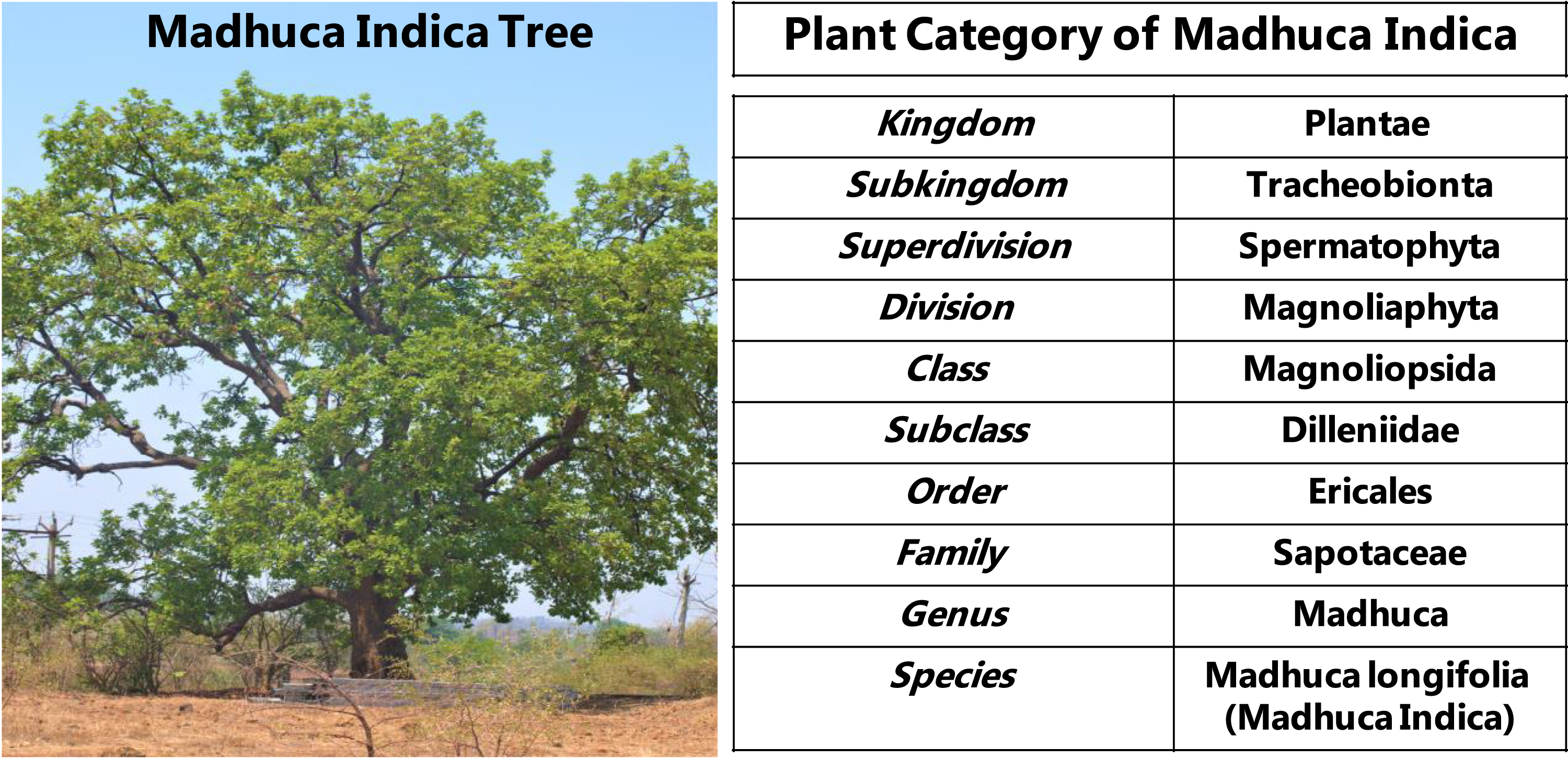
The dried, fallen seeds of M. indica were obtained from the local area. The oil from the M. indica seed has been extracted using the proper pathway. MO was extracted using solvent extraction with n-Hexane (65–70°C), pressing with a screw-press oil expeller and a combined pressing with solvent extraction technique.38,39 The pathway of the extraction of MO from its M. indica agricultural source has been shown in Figure 3. Pathway of the extraction of MO from agricultural resources.
As per the Trifed, Institute of Ministry of Tribal Affairs, India, “M. indica oil has moisturising properties, which are used in skin diseases, rheumatism and headaches. It is a laxative and is used to treat constipation, piles and hemorrhoids, as well as an emetic. In addition, it was employed as an illuminant and hair fixer by native tribes.
40
MO has the appearance of a pale yellow colour with a pleasant odour and taste. MO seed fruits contain 16.9% protein and 51.5% oil. The fatty acid composition of MO showed the presence of 46.3% (Z)-octadec-9-enoic acid and 17.9% cis, cis-9,12-octadecadienoic acid as the prime unsaturated and 17.8% hexadecanoic acid and 14.0% octadecanoic acid as the main saturated fatty acids, which is displayed in Figure 4.
41
Table 2 lists a lot of different studies about the fatty acid composition of MO.21,36,37,41–44 General fatty acids found in the MO. Fatty acid composition of MO.

FTIR data of MO.

Physico-chemical properties of MO.

aUnit of values mg (KOH)/g.
bUnit of Value gI2/100g.
Because we know about the chemistry of MO, the best way to use it has been to make biodiesel.52,53 But researchers also want to use these sources to make a variety of useful polymers.
Madhuca indica oil-based polymers
Reported MO-based polymers along with used raw materials and end applications.


Various routes to synthesize MO-based polymers.
Alkyd resins
Alkyds are polyesters of modified oil composed of polyols, a multifunctional acid (i.e. isophthalic acid, phthalic acid or trimellitic acid) and an unsaturated fatty acid formed by a polycondensation process and are a notable polymer for surface-covering applications. 55 Based on the amount of VO in the alkyd resin, they are categorised as long (55–68%), medium (43–54%) and short (30 – 42%). The two main routes for the preparation of alkyds are the fatty acid process and the monoglyceride process. 56
Saxena et al.
39
synthesised a medium-length pentalkyd polymer using pentaerythritol and phthalic anhydride as the monomers. The synthesised resin was non-drying in nature and was found to be comparable to commercial resin. This pentalkyd was converted into the baking system or air drying resin by curing it with melamine-formaldehyde at a high temperature. The resin possesses good film properties like scratch resistance, adhesion and better resistance to alkali. The general synthesis of pentalkyd from MO is shown in Figure 6. Synthesis of pentalkyd from MO [47].
The glycerol alkyd resin was synthesised using the fusion technique and was well characterised by Tiwari et al. 48 This glycerol alkyd resin was also modified using melamine-formaldehyde and cured at a high temperature. The resin was then formulated using fly ash, almost 40% as an extender for the fly ash coating applications. Such alkyd resins are suitable for better coating applications in corrosive environments too. Tiwari et al. 47 also successfully copolymerized MO-based pentaalkyd resin using the p-hydroxy benzoic acid as a mesogenic group to obtain a liquid crystalline (LC) form (shown in Figure 5). The scratch and hardness resistance of the pentaalkyd LC resins were found to be improved. It has been shown that the MO-based LC resins have better viscosity, hardness and drying time than their amorphous counterparts.
Epoxy resins
Epoxidation of oil can be accomplished through a variety of methods, including peracid epoxidation, chemo-enzymatic epoxidation, also monomer hydrogen peroxide with dioxirane as a catalyst, and others.
57
Epoxies with the relevant curing agents (amines, amides, acids and anhydrides) can be cured to produce polymers with the desired properties.58–60 Pure VO epoxies have a ‘greener’ composition of 100%. It shows better flexibility and quite high corrosion resistance, especially against chemicals and moisture, due to its long waterproof chains.
61
Epoxy resins are also compatible with a variety of materials and have a proclivity for wetting surfaces, making them ideal for composite applications. As a result, they are frequently employed as coatings, incorporating materials, potting materials, casting compounds and other similar applications.62,63 The synthesis of epoxy resin from MO is displayed in Figure 7. Synthesis of epoxy resin from MO [64].
In situ, with hydrogen peroxide as an oxygen donor and glacial acetic acid as an active oxygen carrier, MO was epoxidised in the presence of an inorganic acid as a catalyst. Catalytic loading with sulphuric acid was shown to be more successful with regard to oxirane conversion. 50 The epoxy resin of MO will be effective in biological coating applications. The results of the epoxidised MO showed that MO is a valuable source for the creation of value-added epoxy resins.
Polyurethanes
Polyurethane (PU) is made by a polyaddition reaction between diols and diisocyanates or other compounds. PU contains different functional groups, likewise urethane, amide, ester, vinyls, acrylics, double bonds and others.65,66 MO was used as a raw material for the manufacture of MO-based fatty amide (MFA) by a base-catalysed aminolysis reaction. The synthesised MFA was transformed into the polyetheramide polyols by a step growth reaction with bisphenol-A or bisphenol derivatives (seen in Figure 5). Polyetheramide polyols react with different isocyanates like aliphatic and aromatic to produce MO-based PU.42,45 The synthesis of the PU using the MO is shown in Figure 8. Synthesis of polyurethane from MO [21].
Raychura et al. 45 synthesised a MO-based PU polymer that could be reacted with isocynates and a polyetheramide polyol made with the MFA and the diglycidyl ether of bisphenol-A (DGEBA). The developed PU was applied to the wood substrate as a protective coating and was noted to have 100% adhesion to the wood surface. It was also found that the syntheiszed PU showed better hardness and good thermal stability similar to those of other VO-based PUs. These PUs had no discernible fungicidal or microbicidal effects on microbial or fungal strains. 54 The PU coating on metal plating provides a protective measure against oxygen, which reduces the rate of corrosion by reducing the presence of oxygen, H+ ions and water on metal surfaces.67,68 Due to polar urethane and ether parts, the PU coating resulted in excellent chemical resistance and outstanding mar resistance reported by Pawar et al. 21 Not only that, the outstanding flexibility is granted by the ether linkages and polar urethane as well as the lengthy fatty amide chains, which also enhance adhesion to the substrate. As a result, MO-based PUs have exceptional potential in coating binder formulations. Yemul et al. 46 reported that polyesteramides are polymers that are used to create PU dispersions and coatings considered waterborne polyurethane (WPUs). It uses dicarboxylic acid, which is a sustainable and natural resource. The synthesised MO-based WPU dispersion has almost identical coating properties to that of a synthetic polyester diol-based PU dispersion coating. However, due to the presence of a triglyceride structure that is more susceptible to hydrolysis than petroleum resource-based PU, the MO-based PU films showed low thermal stability.
As for the overall inputs, as a novel and valuable feedstock, MO may be a promising raw material for the synthesis of various polymers with superior properties and applications in coatings.
Concluding remarks
The utilisation of non-edible vegetable oil furnishes a scope for waste seed to prepare value-added materials and also reduces the demand for edible oil and petrochemical feedstocks. The scope of this renewable source, amongst many non-edible oils, the rich source of indigeneous M. indica oil (MO), is now being used by polymer chemists for the development of various important polymers such as alkyds, epoxies and polyurethane. Modified MO is an important precursor in the synthesis of polymers. MO-based polymers that can be used for coating and other value-added applications are shown to show how far polymer development can go.
According to the current scenario, MO is largely used in biodiesel production. But biodiesel synthesis is a time-consuming multistep process and costly affair, and so many countries have started to follow the electricity-based transportation goods as an increased awareness of green energy supplies such as windmills, solar cells, tidal power and hydroelectric power plants. In such circumstances, the need for MO for biodiesel production can be decreased, and it will be more commonly available for the manufacturing of polymeric materials. On the other hand, MO-based polymers can compete with petro-based resins, which will increase the market for polymers made from renewable sources, especially polyurethane, alkyd and epoxy resin coatings.
Footnotes
Acknowledgements
The authors are highly acknowledged the SHODH-Scheme of Developing High quality research, Education Department, Gujarat, India and CoE of Polymers, Applied Chemistry Department, Faculty of Technology and Engineering for necessary facilities.
Declaration of Conflicting Interests
The author(s) declared no potential conflicts of interest with respect to the research, authorship and/or publication of this article.
Funding
The author(s) disclosed receipt of the following financial support for the research, authorship and/or publication of this article: This work was supported by The Maharaja Sayajirao University of Baroda grant number GCU/RCC/2021-22/21-32/509.
