



Abstract
This comprehensive review addresses the vital environmental concerns posed by conventional petroleum-based plastics, particularly in the context of the packaging industry’s extensive reliance on these materials. As nearly 99% of plastics originate from non-renewable petrochemical sources and their non-biodegradable nature leads to widespread waste accumulation and harmful emissions upon disposal, the need for sustainable alternatives has become paramount. This paper explores the escalating environmental and health repercussions linked to traditional plastics, underscored by global initiatives, including restrictions on single-use plastics, aimed at mitigating these challenges. In response, the paper highlights the growing interest in environmental friendly biopolymers, which can be sourced from renewable biological materials or synthesized from biopolymers such as starch, casein etc. The classification of biopolymers into three primary categories; natural biopolymers, microbial fermentation-derived biopolymers, and polymerized monomers from biomass is comprehensively examined. Furthermore, the paper emphasizes the pivotal role of biopolymer properties, such as barrier characteristics, mechanical strength, heat resistance, biodegradability, flexibility, food contact safety, and cost-effectiveness, in determining their suitability for packaging applications. It also stresses the importance of conducting life cycle assessment (LCA) to holistically evaluate the environmental sustainability of biopolymers. This review highlights the potential of integrating biopolymers into packaging materials as a promising avenue to reduce the adverse environmental impact of traditional plastic production. These biodegradable materials, with their diverse properties and renewability, offer a sustainable approach to mitigating plastic waste and lowering greenhouse gas emissions. However, further research, development, and collaborative efforts are essential to optimize biopolymer performance, reduce production costs, and facilitate broader adoption. Embracing biodegradable polymers represents a commitment to resource efficiency, waste reduction, and environmental preservation, fostering a more sustainable and eco-friendly future.
Keywords
Introduction
The growing concerns of global warming, widespread carbon emissions, and the pervasive presence of microplastics in today’s society highlight a crucial need for sustainable alternatives in polymer production. Presently, the petrochemical industries, responsible for nearly 99% of the global plastic output, play a significant role in exacerbating these pressing environmental concerns. 1 The enduring nature of conventional plastics, coupled with their non-biodegradability, has resulted in their persistent accumulation in landfills, posing an ongoing threat to ecosystems worldwide.2–4 In India, the packaging industry consumes approximately 43% of the total annual synthetic polymer production, surpassing the global average of 39%.5,6 This has contributed to the mounting waste problem, prompting initiatives to reduce single-use plastics; several countries restricted the use of plastic straws, cutlery, and stirrers since 2021.
The production and processing of plastics are energy-intensive processes, resulting in substantial greenhouse gas emissions and contributing to global warming. Burning plastics releases hazardous emissions, posing threats to both the environment and public health.1,7,8 The resistance of plastics to degradation has made plastic waste a persistent issue for many years.
Recognizing the severe environmental and health implications associated with petroleum-based plastics and the continued demand for their use across various industries, research on environmentally friendly plastics has seen significant interest in recent decades. The European Union Sustainable Development Strategy and the United Nations 2030 Sustainable Development Goals 9 have further accelerated the call for transitioning from petroleum-based to bio-based plastics or biopolymer-derived packaging materials, which offer enhanced effectiveness, safety for humans, and greater eco-friendliness. Biopolymer-derived plastics consume 65% less energy; emit 30%–80% fewer greenhouse gases compared to petroleum-based plastics.10,11 These biodegradable polymers are sourced from renewable materials and exhibit properties similar to conventional plastics like polyethylene, polypropylene, and polyethylene terephthalate (PET).12,13 Consequently, incorporating biopolymers into packaging materials emerges as a key innovation to mitigate the environmental impact of plastic production, while also facilitating carbon dioxide absorption and improving the overall carbon footprint.
In recent years, various investigations into food packaging films have delved into diverse facets of their properties and applications. For example, Lauer and Smith (2020) explored poly (lactic acid)-based films, examining their compatibility with other polymers. 14 Their findings underscored the substantial influence of polymer immiscibility and phase discontinuity on film performance. 15 Khosravi et al.’s study in 2020 & 2022 focused on forecasting the mechanical properties of widely used PLA/POE systems in food packaging, aiming to discern model parameters and comprehend yielding and strain hardening phenomena within these blends.16,17 Porta et al. (2020) investigated the incorporation of silver nanoparticles into biopolymer-based materials for active food packaging, revealing enhancements in the physical and mechanical properties of edible films, with potential protective benefits against microorganism growth. 18 Rhim et al.’s exploration in 2007 highlighted the potential of natural biopolymer-based nanocomposite packaging materials, proposing that nanocomposite technology could address the low mechanical properties and water resistance of natural polymer-based packaging, resulting in improved properties such as increased modulus and strength, reduced gas permeability, and enhanced water resistance. 19 Kuang et al. (2022) innovatively examined the utilization of special external fields to regulate the formation of morphological structures in biodegradable polymers, contributing to performance enhancement. 20 Howell (2023) directed their efforts towards generating plasticizers from renewable, inexpensive, nontoxic biobased precursors. 21 Lastly, Nurhania et al. (2023) provided insights into the physical properties, chemical composition, factors impacting fiber quality, and their correlation with mechanical properties. 22
The collective findings of these studies significantly contribute to the broader comprehension of food packaging materials and their prospective applications in the industry. This body of research enhances our knowledge of the intricate dynamics governing the performance and potential advancements in food packaging technologies.
As we delve into the comprehensive landscape of biopolymer-based packaging materials, it becomes apparent that existing literature has paved the way for significant advancements, yet critical gaps persist. This review embarks on a mission to synthesize, analyze, and extend the current understanding of biopolymers in packaging applications. By amalgamating findings from diverse sources, we not only highlight the evolution of biopolymer utilization but also identify nuanced challenges and opportunities. The necessity of our work lies in the emerging complexities and advancements in sustainable packaging, demanding a cohesive narrative that not only encapsulates prior reviews but also extends into unexplored territories. As we navigate through key findings and insights, our goal is to provide a robust foundation for future research, guiding scholars, industry professionals, and policymakers in harnessing the full potential of biopolymers for environmentally friendly packaging solutions. Through this endeavor, we aspire to bridge existing gaps, stimulate further inquiry, and contribute to the collective knowledge that propels sustainable practices within the realm of packaging materials.
Origin and classification of bioplastic
Biopolymers, which can be derived from biological sources like plants, animals, and micro-organisms, or synthesized from natural materials such as sugar, starch, oils, and fats, form the basis of bioplastics.
15
These biopolymer-based packaging materials can be classified into three main groups based on their origin and production,23,24 as shown in Figure 1. Classification of biopolymers/biodegradable natural polymers.
Bioplastics are intentionally designed to undergo biodegradation with the help of fungi, bacteria, and enzymes when they reach the end of their useful life.
25
Just like biomass, biopolymers break down into carbon and water through the action of enzymes and microbes during degradation. The life cycle assessment (LCA) of biopolymers is depicted in Figure 2. To determine the biodegradation rate, the CO2 released during analysis is compared to the theoretical CO2 content present in the sample. Schematic representation of life cycle assessment (LCA) of a biopolymer.
Types of bioplastics suitable for packaging
In recent years, there has been a growth in the creation of diverse packaging materials using biopolymers.
26
Incorporating biopolymers into food packaging offers benefits such as safeguarding items during storage and transit, establishing favorable physicochemical environments to ensure food quality and safety, and prolonging shelf life.
27
This review cover various and the significant patterns concerning the use of biopolymers in food packaging applications. Figure 3 presents information regarding the compositions of edible films and coatings. Table 1 summarizes the classification of biopolymer based packaging material, its source, characteristics and applications. Details for edible films and coating compositions.

Natural biopolymers
Polysaccharides
Polysaccharides belong to a category of carbohydrates that can be polymerized into various structures with differing numbers of carbon atoms. In addition to carbon, these compounds comprise hydrogen, oxygen, small traces of alkali, alkaline earth, and heavy metals. 28 They consist of elongated chains of monosaccharides linked together through glycosidic bonds.
Starch
Starch, sourced from crops like cassava and corn, is a natural polysaccharide with potential as a biopolymer for food packaging due to its abundance, biodegradability, and affordability. It comprises amylose and amylopectin, forming a blend with distinct properties. Amylose is a linear polysaccharide of d-glucose units linked via α-1,4-glycosidic bonds, while amylopectin is branched, connected mainly by α-1,4-glycosidic bonds and occasional α-1,6-glycosidic bonds. Native dry starch, however, has limitations due to brittleness, high viscosity, and poor melt processability. BIOTEC® offers various TPS product lines, including Bioplast® for injection molding, Bioflex® for films, and Biopur® for foamed starch. 29 While native starch films possess moderate oxygen barrier properties, they lack adequate moisture barrier and mechanical properties for food packaging. Plasticization, grafting, and blending can enhance starch properties. Plasticizers like glycerol lead to thermoplastic starch behavior, enabling processing through extrusion and molding. Further research explores TPS plasticization using various substances. Blending TPS with polymers like PLA improves properties, making it more suitable for packaging. Despite advancements, pure TPS materials still fall short for packaging, but blending offers promise for achieving desired qualities. 30
Cellulose and its derivatives: abundant natural polymers for environmentally friendly packaging
Cellulose, an abundant natural polymer derived mainly from wood, serves as a fundamental component of plant cell walls and fibers. However, its inherent characteristics, such as high crystallinity and insolubility, pose challenges for film production. To overcome this, cellulose is dissolved in a mixture of sodium hydroxide and carbon disulfide, yielding cellophane film. Alternatively, cellulose can be chemically modified to produce water-soluble derivatives like cellulose acetate and hydroxyethyl cellulose. These derivatives offer diverse functionalities and find use in various applications, including biodegradable packaging. While cellulose acetate, xylan hemicellulose may lack optimal gas and moisture barrier properties, it excels in high-moisture environments. Industrial sectors like Mazzucchelli and Planet Polymer have introduced biodegradable plastics based on cellulose acetate and Xylan hemicellulose (Figure 4),
31
showcasing the potential of cellulose derivatives in driving sustainable packaging solutions. Figure 4 represents the process of film casting from beechwood, being a sustainable approach. Therefore, cellulose and its derivatives present a promising avenue for environmentally friendly packaging solutions, leveraging their natural abundance and versatile modification techniques.
32
Edible film preparation of of xylan hemicellulose.
31

Proteins
Recently, there has been a surge of interest in protein-based films, driven by their ability to form films, cohesiveness, cost-effectiveness, and biodegradability. These films offer favorable barriers against gases like oxygen and aromas, although their hydrophilic nature leads to high water vapor permeability.33,34 Protein films have been created from various sources, including gelatin, corn zein, wheat gluten (WG), soy protein (SP), casein, and whey protein.35,36
Gelatin
Gelatin, a water-soluble protein, is produced by thermally denaturing collagen with weak acid (gelatin type A) or alkali (gelatin type B). Collagen originates from animal skins and bones, comprising connective tissues, skin, and bones. 37 Its structure forms a triple helix, stabilized by hydrogen bonding between chains through amino and carboxyl groups. Denaturation breaks the triple helix, resulting in gelatin primarily composed of glycine, proline, and 4-hydroxyproline residues. 38 This yields a mixture of single- or multi-stranded polypeptides, each with left-handed proline helix conformations and consisting of 300 to 4000 amino acids. Gelatin serves as a gelling agent, forming transparent, elastic, thermo reversible gels when cooled below 35°C. It holds promise in tissue engineering and as a potential polymer for bio-based film production due to its emulsifying, adhesive, and dissolution properties. 39 However, its mechanical strength, particularly when wet, limits its use in packaging. 40 To reinforce gelatin-based films, techniques like vapor cross-linking, orientation, and fillers such as hydroxyapatite nanoparticles (nHAs) and tricalcium phosphate (TCP) have been developed. 41
Wheat gluten
Glutenin and gliadin make up the majority of the protein complex known as wheat gluten (WG). It is made up of water- and ethanol-insoluble prolamins, water- and ethanol-insoluble glutelins (70–80 wt%), and trace amounts of wheat oils, starch, and insoluble hemicellulose. 42 perties among plant proteins. 42 WG, recognized as a renewable resource, abundant, biodegradable, and cost-effective, has gained attention for sustainable food packaging. Its qualities make it suitable for edible films and biodegradable packaging, often processed through casting, extrusion, and compression molding. WG-based films exhibit remarkable oxygen and carbon dioxide barriers but lag behind in water vapor resistance, mechanical strength, and thermal attributes compared to traditional plastic films. 43 Enhancing WG properties involves lignocellulosic reinforcement fillers, promoting protein-polyphenol complex formation for improved flexural and tensile strength. 44 Additionally, WG/montmorillonite (MMT) films, achieved through melt mixing and thermoforming, demonstrated enhanced mechanical properties through the incorporation of up to 5 wt% MMT, surpassing effects from glycerol content and processing temperature alone. 45
Soy protein
Soy protein (SP) stands as an economically viable and renewable resource, abundant and sustainable. It comprises diverse globulins characterized by both polar amino acids like acidic and basic amino acids, and nonpolar amino acids in fractions like 2S, 7S, 11S, and 15S. The predominant elements within SP include -conglycinin (7S, around 35%) and glycinin (11S, nearly 52%). 46 Films derived from SP exhibit distinct attributes depending on their 7S and 11S fractions. Higher 11S fractions result in stronger films with reduced water absorption compared to those richer in 7S, attributed to the varying amino acid compositions of the two fractions. 47 Overcoming inherent brittleness and limited water resistance in SP-based films has prompted exploration of chemical treatments and plasticizers. Glycerol, ethylene glycol, and propylene glycol, among others, have exhibited superior performance over 1,3-propanediol. While glycerol and water significantly enhance film flexibility, they notably diminish tensile strength. 48
Casein: milk proteins
Biodegradable films can also be produced using milk proteins, with casein and whey protein being particularly significant in the field of packaging. 49 Casein, which constitutes 80% of total milk protein, is composed of three main components—α, β, and γ—each with molecular weights ranging from 19 to 25 kDa. 50 It forms colloidal micelles in milk, stabilized by calcium phosphate bridging. Acidification of milk to its isoelectric point (pH = 4.6) leads to casein precipitation. Subsequent neutralization through alkali addition converts acidified casein into functional soluble caseinates, including sodium and calcium caseinates. 50 Water-soluble caseinates can be transformed into biodegradable films through solubilization, casting, and drying. The emulsifying capability of water enables film formation. 51 These caseinate-based films are transparent, exhibiting favorable mechanical properties and oxygen barrier characteristics, although their water vapor permeability falls below that of WG- and SP-based films. 52 Whey protein, on the other hand, remains soluble in milk serum following casein coagulation during cheese or casein production. Comprising approximately 20% of total milk proteins, whey protein encompasses a blend of proteins, including β-lactoglobulin (about 57%, Mw of 18 kDa), α-lactalbumin (about 20%, Mw of 14 kDa), bovine serum albumin, and immunoglobulins, among others. The formation of whey protein films entails heat denaturation in aqueous solutions, breaking existing disulfide bonds and establishing new intermolecular disulfide and hydrophobic bonds. 50 Whey protein isolate (WPI)-based films exhibit promising mechanical attributes, moderate water vapor permeability, and commendable oxygen barrier properties. 53 However, the characteristics of WPI films are notably influenced by relative humidity (RH) and the type and concentration of plasticizer.
Microbial fermentation-derived biopolymers
Polyhydroxyalkanoates (PHA)
Polyhydroxyalkanoates (PHAs) are a type of bacterial polyester produced by various bacterial species when they undergo unbalanced growth conditions. These natural polymers are created through bacterial fermentation of sugars and lipids and are structurally composed of 3-hydroxy fatty acid building blocks. In 2008, around 55,115.57 tons of PHAs were manufactured commercially. PHAs possess thermo-mechanical properties similar to synthetic polymers like polypropylene.54,55 They are known for their biodegradability, biocompatibility, and the fact that they can be sourced from renewable materials.
PHAs offer numerous advantages, including reducing reliance on petroleum-based materials, minimizing greenhouse gas emissions, and being fully biodegradable. They find applications in biodegradable packaging, including bottles, containers, sheets, films, laminates, fibers, and coatings. PHAs can be synthesized into over 100 different monomers and copolymers, and they exhibit desirable properties such as strong tensile strength, printability, effective odor and flavor barriers, heat sealability, resistance to grease and oil, temperature stability, and ease of dyeing. These qualities make PHAs particularly suitable for use in the food industry.
For instance, the US-based company Metabolix produces “Metabolix PHA,” which is a blend of polyhydroxybutyrate (PHB) and poly (3-hydroxyoctanoate). 55 This product has received FDA approval for use in food additives and for making packages that match the performance characteristics of non-biodegradable plastics.
Polymerized monomers derived from biomasses
Polylactic acid
Polylactic Acid (PLA) is a type of polymer derived from biomass sources. PLA is produced through the polymerization of lactic acid, which can be obtained from renewable resources such as corn starch or sugarcane. It is considered a bioplastic because it is made from natural, plant-based feedstocks. 56
PLA has gained popularity as a sustainable alternative to traditional petroleum-based plastics due to its biodegradability and reduced environmental impact. It is used in various applications, 57 including packaging materials, disposable cutlery, food containers, 3D printing filaments, textiles, and more. PLA exhibits good mechanical properties, is transparent, and can be easily processed, making it suitable for a wide range of products while also contributing to the reduction of plastic pollution and greenhouse gas emissions.
Polylactic Acid (PLA) is a sustainable packaging material derived from renewable sources, offering biodegradability, transparency, and customizable properties. Its reduced carbon footprint and potential for compostability 56 make it an environmentally friendly choice for packaging, contributing to the reduction of plastic waste and greenhouse gas emissions while showcasing products attractively and preserving freshness.
Polyethylene furanoate
Polyethylene Furanoate (PF), a potential eco-friendly alternative to terephthalic acid, utilizes 2,5-furandicarboxylic acid (FDCA) as a bio-based precursor. The combination of FDCA and bio-MEG yields a novel 100% bio-based polyester known as poly (ethylene furanoate) (PEF). 58 PEF synthesis involves several methods, including polycondensation, ring-opening polymerization (ROP), and solid-state polymerization (SSP). While polycondensation is commercially relevant, its prolonged exposure to high temperatures of about 200°C escalates production costs and causes thermal degradation and discoloration. Conversely, SSP, a milder process, holds potential for PEF production, although achieving bottle-grade PEF remains a challenge. 59 SSP entails heating the partially crystalline polyester between its glass transition temperature (Tg) and melting point (Tm), a technique primarily employed in PET manufacturing for overcoming low molecular weight. 60 Avantium, a pioneering company, is actively developing PEF through bio-MEG and FDCA sourced from carbohydrate dehydration. Avantium’s innovative separation technology and catalyst promise economically viable FDCA production. With a projected annual production capacity exceeding 300,000 tons, the company has also forged collaborations with key players in the food and beverage sector.58,59
Polybutylene succinate
Polybutylene Succinate (PBS) is an environmentally friendly type of polyester formed by combining succinic acid and 1,4-butanediol through a process known as polycondensation. While it traditionally relied on petroleum-based sources, recent innovations have allowed for the production of bio-PBS using bacterial fermentation of renewable materials. 61 This method not only boosts sustainability but also reduces energy consumption compared to chemical manufacturing processes. Major industry players like Corbion and BASF are working on making bio-based succinate production economically viable, overcoming past challenges related to productivity and costs. Collaborations, such as the one between Mitsubishi Chemical and Ajinomoto, aim to commercialize bio-PBS using succinic acid derived from biomass. Companies like Myriant and Bioamber utilize fermentation technology to produce monomers, resulting in an annual bio-based succinic acid capacity of 200,000 tons. In addition to being environmentally friendly, PBS exhibits strong mechanical properties and is easily processed, comparable to polypropylene (PP) and surpassing polylactic acid (PLA) in toughness. It finds applications in various industries, including film, foaming, and food packaging.62,63 Although PBS can be somewhat inflexible, its mechanical properties and biodegradation rates can be improved by blending it with other biopolymers and fillers. Copolymers like poly (butylene succinate-co-adipate) (PBSA) and poly (butylene succinate-co-terephthalate) (PBST) are preferred for flexible packaging due to their enhanced flexibility and faster degradation. However, it’s worth noting that PBS biodegrades more slowly than PBSA in mature compost soil, and the rate of enzymatic hydrolysis and environmental degradation varies depending on factors such as PBS grade and compound composition. 63
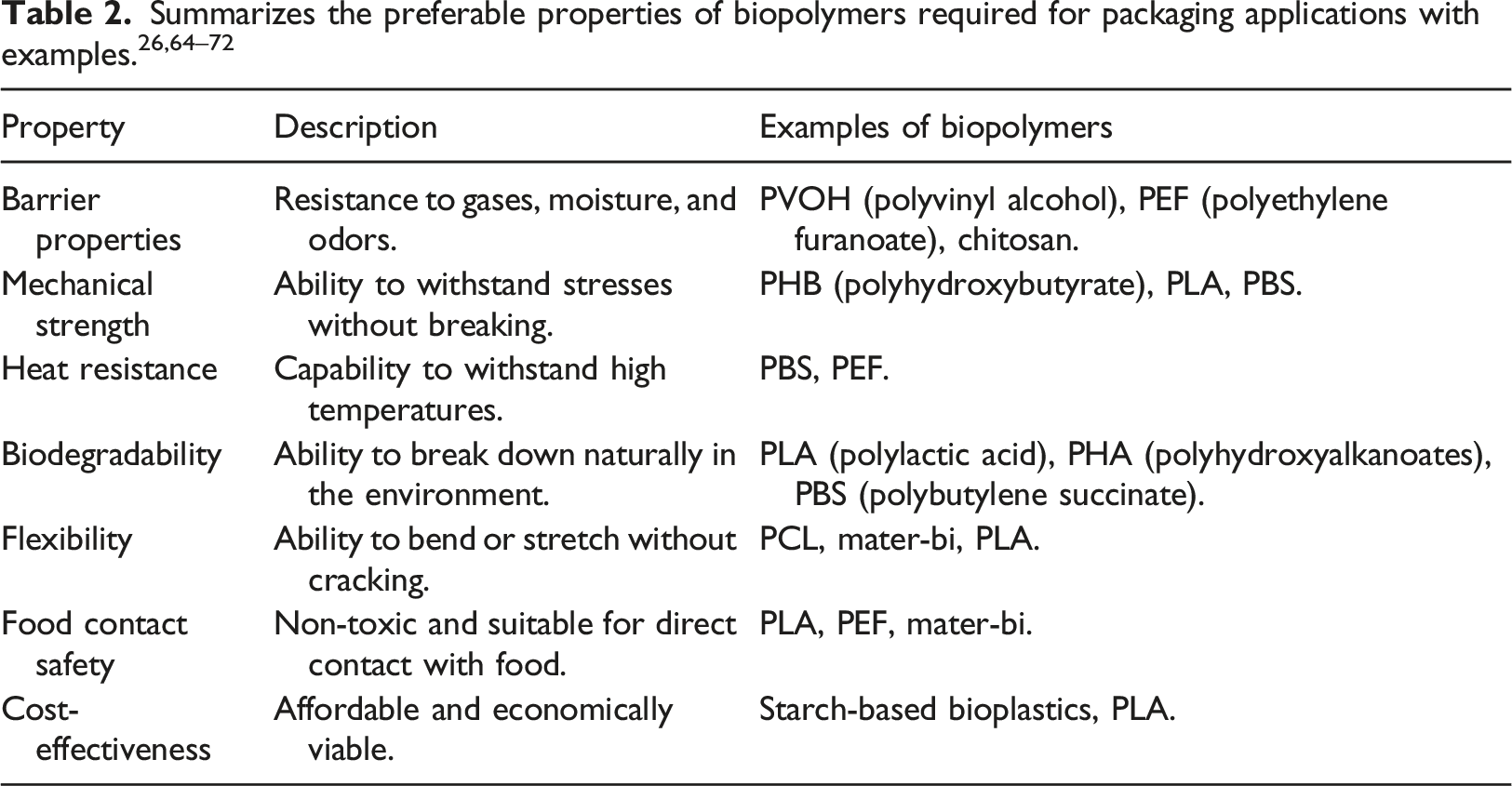
Preferable properties of biopolymers for packaging application
The thermal and mechanical properties
The thermal and mechanical properties of bio plastics play a crucial role in determining their suitability for specific applications. Industries like food packaging require high gas barrier properties, while the automobile industry demands competitive mechanical properties. 64 Various techniques are employed to enhance bio plastic properties, such as plasticization, polymer blending, and converting bioplastics into thermoplastics. The plasticization process can modify the thermal and mechanical characteristics of bio plastics, potentially raising their thermal degradation temperature. 65
Gas barrier properties in food packaging industry
Sustaining controlled water and oxygen permeability is a vital aspect of thermally processed food’s shelf life. The gas barrier characteristics of materials like PLA and its derivatives are significantly influenced by humidity. 66 Studies indicate that increasing crystallinity in films directly improves their barrier properties. Metalized multilayer films utilizing N2, CO2, and vacuum conditions have been shown to extend product shelf life. Plasticization of edible films, explored by researchers, displays a direct relationship between plasticization concentration and mechanical properties. 67 This results in reduced tensile strength (15–30 MPa) but increased elongation (25–45%) over time. 66 Excessive plasticization leads to elevated solubility in water and reduced traits like elastic modulus and glass transition temperature. Ensuring good mechanical and thermal properties is crucial to safeguard products against potential damage during storage periods.66,67
Moisture barrier property
Moisture barrier property in bio plastics refers to their ability to resist the intrusion of unwanted vapor. This property is defined by permeability, diffusivity, solubility across the barrier, and the packaging material’s affinity for moisture, which is measured by the water vapor transmission rate (WVTR).68,69 Although bio or bio-based materials are inherently hydrophobic, this trait diminishes their moisture barrier effectiveness. 70 Water absorption by packaging materials can lead to moisture regain in dry food or surface drying of frozen food, issues that can be mitigated with films possessing strong moisture barrier capabilities. Enhancing moisture resistance can involve external coating with hydrophobic or water-resistant materials like polyester, wax, and fatty acids, as well as crosslinking with inorganic fillers, blending with moisture-resistant substances, or reinforcing with natural fibers like jute, coir, and sisal. 71 Barrier properties are influenced by material morphology, including crystallinity and chain conformation, with higher crystallinity correlating with improved barrier characteristics.69,70 Elevating moisture barrier capabilities extends the shelf life of food products in the food packaging industry. Comparative studies on water vapor transmission rates between bio-based polymer materials and conventional petroleum-based materials suggest that bio-based materials exhibit comparable properties. 71
Biodegradability
Biodegradable plastics represent an environmentally friendly innovation in the packaging sector. Biodegradability implies that a material, whether a constituent, finished product, or waste, can be broken down into smaller compounds by naturally occurring microorganisms like bacteria, fungi, or algae in the surrounding environment.56,70 The biodegradation process is influenced by environmental conditions like temperature, moisture, available nutrients, and pH. 70 Biodegradation can be divided into two steps: degradation or fragmentation initiated by heat, moisture, and microbial enzymes, followed by biodegradation, which transforms larger molecules into smaller compounds through naturally occurring enzymes and acids. These smaller molecules can be absorbed through cell walls and metabolized for energy, ultimately producing carbon dioxide or methane. 56 Polymer degradation can occur via photodegradation, microbial action, or chemical reactions. Oxo-degradation is a specific type of degradation that employs oxidation and additives to accelerate the biodegradability of polymers. Additives regulate degradation in a controlled manner, often triggered by light, heat, or microorganisms. 70
Flexibility
Flexibility is a crucial attribute in biopolymers for packaging, allowing them to adapt to various shapes and forms without succumbing to brittleness or cracking. This property ensures that the packaging can endure bending, folding, or other stresses during handling and transportation, maintaining its structural integrity. 26 Flexible biopolymers also contribute to enhanced user convenience by enabling easy opening and resealing of packages, while offering protection to the packaged contents.
Food contact safety
Ensuring food contact safety is paramount in packaging applications, as biopolymers must meet stringent regulatory standards to prevent any potential transfer of harmful substances to the packaged food. Biopolymers used in food packaging should exhibit exceptional inertness and resistance to migration, preventing any unwanted interaction between the packaging material and the food. This property safeguards the quality, taste, and safety of the food product throughout its shelf life, instilling consumer confidence and upholding food safety standards. 72
Cost-effectiveness
Life cycle assessment of biopolymers
Life cycle assessment (LCA) of biopolymers serves as a tool for gauging the ecological sustainability and effectiveness of a material within its environmental context. The life cycle of biopolymers mirrors that of biomass, as both undergo decomposition into carbon and water facilitated by enzymatic and microbial actions.67,73 This biopolymer LCA is illustrated in Figure 2. Biodegradation rate is computed by dividing the released CO2 during analysis by the theoretical CO2 content in the sample. An essential parameter, EdK, quantitatively assesses the potential biodegradability of biodegradable polymers in natural settings. This involves introducing natural soil samples into bioreactors, evaluating the biodegradation rates of reference materials over a 2-week timeframe. Starch and polyethylene serve as these reference materials, assigning EdK values of 100 and 0, respectively. The determination employs the ISO 14,852 method, wherein evolved carbon dioxide is measured as an analytical parameter. 74
Biomaterials commonly employed in packaging, such as polylactic acid (PLA), polyhydroxyalkanoates (PHA), starch-based polymers, and cellulose-based materials, have drawn attention for their potential to mitigate environmental impact compared to traditional plastics. Evaluating their LCA involves considerations of carbon emission content under various end-of-life scenarios, spanning from landfilling to incineration. The distinctive environmental footprints of these biomaterials are shaped by factors including their composition, processing methods, and end-of-life treatments.
Therefore, addressing the primary biomaterials employed in packaging provides a holistic view of the environmental implications associated with adopting biopolymers. A comprehensive understanding of their life cycle assessments facilitates informed decision-making for sustainable packaging solutions, taking into account aspects such as carbon emissions across various disposal scenarios.
Discussion based on reviewed literature
The results of this study demonstrate the potential of biopolymer-based packaging solutions in improving food preservation and reducing waste. The discussion highlights the need for further research to investigate the specific molecular mechanisms involved in film formation and interaction with active compounds, which will ultimately lead to the development of more efficient and sustainable packaging materials. Additionally, exploring the various functionalities of biopolymers will contribute to the advancement of innovative solutions that meet the demands of a rapidly evolving food industry. Furthermore, understanding the environmental impact of biopolymer-based packaging is crucial in determining its overall sustainability. Life cycle assessments and studies on biodegradability and compostability will provide valuable insights into the long-term effects of these materials on ecosystems. By considering both the performance and environmental aspects, we can develop biopolymer-based packaging solutions that not only improve food preservation but also minimize the negative impacts on the environment. Thus, further research and development in biopolymer-based packaging has enormous potential to improve food packaging in a way that is economical, sustainable, and ecologically friendly.
Conclusion
While the integration of biopolymers presents a crucial advancement in mitigating the environmental impact of traditional plastic production, numerous challenges and limitations persist, demanding rigorous attention in future investigations. The expansion of biodegradable films into diverse industries, including food packaging, requires a strategic focus on optimizing performance parameters, minimizing costs, and refining production processes to enhance scalability. Despite the potential for environmentally friendly solutions, the limited current market presence of biopolymers signals the need for intensified efforts. Particularly in the domain of food packaging, the interactions between biopolymers and food constituents demand meticulous evaluation during processing and storage, necessitating further research to ensure safety and efficacy. As we look forward, the incorporation of emerging technologies such as nanotechnology and smart sensors into biodegradable polymers offers exciting possibilities to revolutionize packaging functionality and align with evolving consumer preferences. However, it is crucial to acknowledge the limitations of the present review, which may not comprehensively cover all emerging materials and techniques in the rapidly evolving landscape of biopolymer research. Addressing these challenges and refining the understanding of biodegradable polymers’ intricacies requires sustained innovation, interdisciplinary collaboration, and a unified commitment to integrating these materials into global materials practices. Only through these concerted efforts can we fully harness the potential of biodegradable polymers, signaling a profound commitment to resource efficiency, reduced reliance on fossil fuels, waste reduction, and the preservation of our environment for a greener and more resilient future.
Footnotes
Declaration of conflicting interests
The author(s) declared no potential conflicts of interest with respect to the research, authorship, and/or publication of this article.
Funding
The author(s) received no financial support for the research, authorship, and/or publication of this article.
