



Abstract
Scholars have used a variety of ways to examine personality at the team level, yet never has a dynamic, multilevel approach been taken to examine the structure of team personality, how it develops, and how and why it may influence team effectiveness. If the concept of personality at the team level is to be taken seriously, we argue that a consistent theoretical orientation is necessary to synthesize past findings and guide future research. To fill this need, we discuss the definition, function, structure, and emergence of team personality, culminating in the development of a dynamic multilevel model linking individual team member personalities to team personality. This model is the basis through which we describe the development, path dependence, and impact of team personality. We conclude by discussing the theoretical and practical implications of our model.
[T]here has been a large amount of research into the structure of individual personality (Barrick & Mount, 1991; Block, 1995; Costa & McCrae, 1985, 1995). It is readily apparent that this structure cannot be retained at the collective level. Indeed, the mere mention of “group personality” is enough to incur the disapprobation of researchers… Yet there is something to the notion of group personality. Groups do seem to differ in personality-like ways… Some groups are more helpful (i.e., conscientious) than others, whereas other groups are generally more outgoing and gregarious (i.e., extraverted).
As researchers have used the personality metaphor across levels of analysis, we note that the functional aspects of the concept have been generalized, not the structure (cf. Morgeson & Hofmann, 1999). Indeed, prior research has given little attention to what the underlying structural dynamics are of team personality (cf. Hofmann & Jones, 2005). We contend that in the emergence of team-level personality, the “psychological” aspect of individual personality takes on a social and sociological aspect—interpersonal interaction processes and patterns of communication have much to do with the emergence of team-level personality, resulting in a fundamentally different structure that is both dynamic and interactionist at the team level. We draw from the individual personality literature (e.g., Mischel & Shoda, 1995), general systems theory (Allport, 1955; Giddens, 1993), and modern multilevel theory (Kozlowski & Klein, 2000; Morgeson & Hofmann, 1999) to develop ideas on the definition, function, structure, and emergence of team personality from a dynamic multilevel perspective. Our goal is to expand the current thinking on team personality to move beyond prior functional generalizations and to consider more carefully the underlying dynamic structure of team personality. We then use this model as the basis through which we describe the development, path dependence, and impact of team personality. Ultimately, we hope to provide a solid theoretical foundation from which future research on higher level personality in collectives might progress.
Prior to the discussion of the concept of team personality, we want to clarify our definition of a work group or team. We define a work group or team as an interdependent collection of two or more individuals who share responsibility for specific outcomes (e.g., Sundstrom, De Meuse, & Futrell, 1990). These individuals interact socially with one another, exhibit task interdependence, possess one or more shared goals, and are embedded in a larger organizational setting (Hackman, 1992; Kozlowski, Gully, Nason, & Smith, 1999; Salas, Dickinson, Converse, & Tannenbaum, 1992). Our discussion of higher level personality centers on the team level of analysis, though it is likely that many of the ideas we develop could apply to any level of analysis above the individual level. Before turning to the development of our model, we briefly present past research on personality in teams.
Past research on personality in teams
While many definitions of individual-level personality have been formulated across different research traditions over the last century, Funder’s (2001, p. 198) review piece summarizes the past research and literature and suggests that personality refers to an individual’s “characteristic patterns of thought, emotion, and behavior, together with the psychological mechanisms—hidden or not—behind those patterns.” Recent prior approaches in both individual and team personality research have generally centered on the use of the Big Five/Five Factor model of personality (Big Five), which includes emotional stability, openness to experience, agreeableness, conscientiousness, and extraversion (cf. Barrick & Mount, 1991; Costa & McCrae, 1995; Goldberg, 1992). Prior approaches to assessing team-level personality have used different theoretical composition models to aggregate data from the individual to the team level, normally with a focus on the Big Five (e.g., Bradley, Klotz, Postlethwaite, & Brown, 2013; Halfhill, Sundstrom, Lahner, Calderone, & Nielsen, 2005; Moynihan & Peterson, 2001). Next, we briefly review these models.
In the additive composition model approach to team personality composition, observable external characteristics of individuals are aggregated to the team level. Researchers create a higher level personality construct as a summation (or average) of individual-level team member personality scores on a specific dimension, regardless of the variance between team members on those scores (Chan, 1998). Other recent approaches to team personality composition research include minimum/maximum (e.g., Barrick, Stewart, Neubert, & Mount, 1998), variance (e.g., Halfhill et al., 2005), and patterned forms of emergence (Kozlowski & Klein, 2000). Cumulative findings of this work suggest that team personality composition is an important antecedent of team effectiveness (Bell, 2007; Mathieu, Maynard, Rapp, & Gilson, 2008). Theoretical and practical implications of this research stream are just beginning to be explored. All of these approaches assess personality at the individual level (with the individual as the focal referent), typically using the Big Five, and then in some way develop a higher level, emergent construct from that data.
A limited number of studies have assessed the extent to which the team or higher level unit overall can be characterized using the concept of personality (e.g., Bettenhausen & Murnighan, 1991; Cohen & Denison, 1990; Davis-Sacks, 1990; Saavedra, 1990; Wang, Yi-feng, Tjosvold, & Shi, 2010). Hofmann and Jones (2005), for example, in response to calls for consideration of personality at higher levels of analysis (e.g., Smith & Schneider, 2004), advanced the concept of “collective” personality—the idea that personality could exist and be measured at the collective level—by using a referent-shift composition model (Chan, 1998) and applying it to Goldberg’s (1992) adjective-based measure of the Big Five. They reported numerous findings: within-unit agreement and between-unit differences in collective personality dimensions with respect to their sample; significant relationships between specific leadership styles and certain dimensions of collective personality; and significant relationships between collective personality and performance. In their discussion of these results, Hofmann and Jones (2005) theorized that the personality dimensions likely reflected observable behavioral regularities (i.e., norms and habitual routines) found within teams, providing empirical evidence bolstering arguments regarding the nature of social control in organizations (e.g., Barker, 1993; O’Reilly & Chatman, 1996). In other words, they suggested that collective personality may be a reflection of the set of informal rules that regulate individual behavior.
This idea of personality at a collective level of analysis may cause a shift in the way researchers conceptualize personality in teams. However, we suggest that more theoretical development is necessary in order to critically examine the concept of personality at higher levels of analysis and distinguish it from related concepts. Specifically, in our dynamic multilevel theory, we move beyond prior research to discuss deeper emergent structures, dynamics, and processes within a team that explain where these regularities originate and their path dependence. We begin our theory development by presenting a definition of team-level personality and describing its function. We then turn to the structure of team-level personality and outline its dynamic emergence in the team. Lastly, we use the model we develop to discuss the evolution of team personality over time, some possible factors that likely influence its development, and links to team effectiveness.
A dynamic model of team personality
With the exception of Hofmann and Jones (2005), prior research has not attempted to specifically define what personality at a higher level of analysis might be or what function it might serve. For their part, Hofmann and Jones (2005) suggested that collective personality describes behavioral regularities that occur in the collective. While this was an important step in terms of distinguishing collective personality as a construct different from climate and culture (e.g., Schneider & Smith, 2004), a broader and more inclusive definition is necessary in order to move work on this topic forward. Drawing from Funder’s (2001) individual-level personality definition, we define team personality as a team’s characteristic patterns of thought, emotion, and behavior, together with the social and psychological mechanisms behind these patterns, including internal social structure and processes. Hofmann and Jones’s (2005) behavioral regularities are included in this definition, but we expand the idea of team personality to include the internal social structure, interactions, dynamics, and processes inside the team that explain why it behaves in a characteristic way. Notably, our definition incorporates social mechanisms, path dependencies (i.e., actions depend on the current contextual conditions and what happened in the past), and feedback loops (i.e., recursive processes) that are critical to acknowledge in the movement from individual to team level of analysis. Also, while the definition is somewhat broad, we wanted to be sure that the definition presented here reflects the “whole team” as an entity—analogous to how the construct of individual personality reflects the gestalt of a given individual.
With respect to the function of team personality, in keeping with Morgeson and Hofmann (1999, p. 254), we adhere to the idea that a construct’s function is “any causal output of some component in a system.” Clearly, this is a broad interpretation of the function of a construct—while some branches of the functionalist school of thought narrowed the idea of “function” by adding teleological aspects such as the specification of purpose, ends, or adaptive value of an object (e.g., Hempel, 1965; Nagel, 1961; see Morgeson & Hofmann, 1999, for a complete discussion), we adopt the broader perspective of philosophers who wished to avoid some of the issues of the traditional functionalist arguments that stem from the addition of the teleological perspective (e.g., Bechtel, 1986; Cummins, 1975, 1983). We therefore focus simply on the causal outputs and effects of team personality.
While there are likely to be many causal outputs of team personality at multiple levels of analysis, ranging from team effectiveness to individual team member satisfaction, stress, and turnover, we focus on the observable, behavioral regularities that Hofmann and Jones (2005) initially identified. These behavioral regularities are both part of our definition of team-level personality and, in part, serve as one function of the construct. This particular function links the personality construct across levels of analysis—behavioral regularities occur at the individual level (cf. Mischel & Shoda, 1995) too, and these regularities, in part, represent within-person consistencies and between-person differences. Similarly, at the team level, the behavioral regularities that teams exhibit help to represent within-team consistencies and between-team differences. It is important to note here that the previous discussion makes the assumption that a given team has some discernible personality; we acknowledge, however, that all teams do not necessarily have developed personality structures or functions. We discuss this issue more in the following section on the emergence of team personality.
Dynamic structure and emergence of team personality
While the function of individual and team personality may be similar across levels of analysis, the structure is wholly different. The structure of individual personality resides in the neural networks and linkages between affect and cognition within each person’s mind (e.g., Mischel & Shoda, 1995); the structure of team personality, however, exists at the level of social interactions between team members. We draw here from organizational systems theory and from Morgeson and Hofmann (1999) to develop a new understanding of the general structure of team personality.
First, a great deal of prior research in various fields (e.g., sociology, social psychology, organization sciences) has noted the fact that collectives can and should be studied as systems of interaction (e.g., Allport, 1924; Cronin, Weingart, & Todorova, 2011; Giddens, 1979; Katz & Kahn, 1978; Parsons, 1937; Stogdill, 1959; Weick, 1979). As Morgeson and Hofmann (1999) note, in order to understand how collective structure of any sort emerges, one must first examine the components of collective action—and, at a very basic level, all collective action and behavior begins with a single individual behavioral act (Frese & Zapf, 1994; Parsons, 1951). Yet a number of situational and contextual factors might influence this act—and the various range of actions and the context within which they might occur would be what Allport (1955) referred to as the “ongoings” of the individual system. As individuals in a given collective “meet in space and time” (Morgeson & Hofmann, 1999, p. 252), interpersonal interaction will occur, giving rise to a discrete event. Over time, discrete events and subsequent interactions develop into an event cycle—and this interaction, as prior research has indicated, is the key to how collective constructs emerge (Morgeson & Hofmann, 1999). Essentially, discrete events provide the basis for ongoing interactions among members of the collective, which in turn builds path dependencies, the emergence of team regularities, and feedback loops.
In the context of the emergence of team personality, we propose that individual personalities are related to team personality. Yet, as general systems theory would indicate, the whole (team personality) is greater than the sum of the parts (individual personalities). As individual personalities interact with contextual and situational elements to result in situationally specific individual actions and behaviors (cf. Bowers, 1973; Ekehammar, 1974; Mischel, 1973), and then interact with each other, an open interaction system is created where shared event cycles become the basis for team-level cognition and affect. Team-level cognition plays an important role in building team coordination and effectiveness, particularly when teams perform nonroutine, complex, urgent, and unpredictable tasks (e.g., Lim & Klein, 2006; Mathieu, Heffner, Goodwin, Salas, & Cannon-Bowers, 2000). This team-level cognition might include shared, emergent perceptions/encodings, thoughts, beliefs, values, goals, and expectations of team members (e.g., Hinsz, 1990; Klimoski & Mohammed, 1994), in addition to more specific cognitive concepts such as common cause maps, shared frames, teamwork schemas, and transactive memory (e.g., Austin, 2003).
It is important to note that we consider team-level cognition to be comprised of both compositional and compilational processes (e.g., Kozlowski & Klein, 2000). In other words, while some aspects of team-level cognition are shared, emergent concepts at the team level, other aspects may be unshared but compatible (cf. Cronin & Weingart, 2007). Recent work on transactive memory systems, for example, suggests that teams consisting of members with highly specialized knowledge—and less common knowledge—perform better than teams without such knowledge specialization (e.g., Argote, Gruenfeld, & Naquin, 2001). For its part, team-level affect (or team “mood”) likely arises from the shared experience of context and event cycles of team members’ interactions (e.g., George, 1996; Sy, Côté, & Saavedra, 2005) and may also be directly and indirectly linked to team coordination and effectiveness (Kelly & Barsade, 2001).
Interestingly, while the connection between individual-level cognition and affect has been acknowledged and is relatively theoretically well-developed (e.g., Damasio, 1994; Forgas, 2002; Mischel & Shoda, 1995), this relationship remains relatively unexplored at the team level and across levels of analysis (George, 1996; Lim & Klein, 2006). We contend that team cognition and team affect play an important role in the dynamic emergence of team personality. Here, we briefly consider George (1996) for an illustrative example that (a) shows what might occur in terms of connections between cognition and affect as components of team personality and (b) also provides insights into feedback loops that might influence the way team personality dynamically emerges over time. We develop these ideas more fully in the next section.
Specifically, George (1996) noted that if teams have a high level of shared positive affect, individual team members may be more cognitively flexible. This shared positive affect could result in the development of certain types of shared encodings, mental models, and values, ultimately resulting in a team that would exhibit high levels of innovation and creativity in their task work. On the other hand, this shared positive affect could result in the development of more divergent individual viewpoints as a result of the increase in cognitive flexibility. To the extent that the team is able to resolve any conflicts or representational gaps (e.g., Cronin & Weingart, 2007) and forge a path forward, these more divergent individual viewpoints might also lead to high levels of innovation and creativity. Patterns of innovation and creativity in the team’s behaviors and output, in turn, might result in the team setting certain expectations for itself (either consciously or subconsciously), which would subsequently influence team performance, team affect, and the further development of team cognition in a complex feedback loop. The interactions of the system overall might lead someone to describe the team’s personality as “creative” or “open-minded.” It is clear that there is no single set path for the ways in which cognition and affect can influence each other at the individual and team levels. Ultimately, the dynamic multilevel interplay here is an example (and illustrates the complexity) of how team personality might emerge.
We summarize the emergence of the structure of team personality in Figure 1. In the following sections, we discuss the proposed linkages in the model in greater detail beginning with dynamic event cycle linkages.
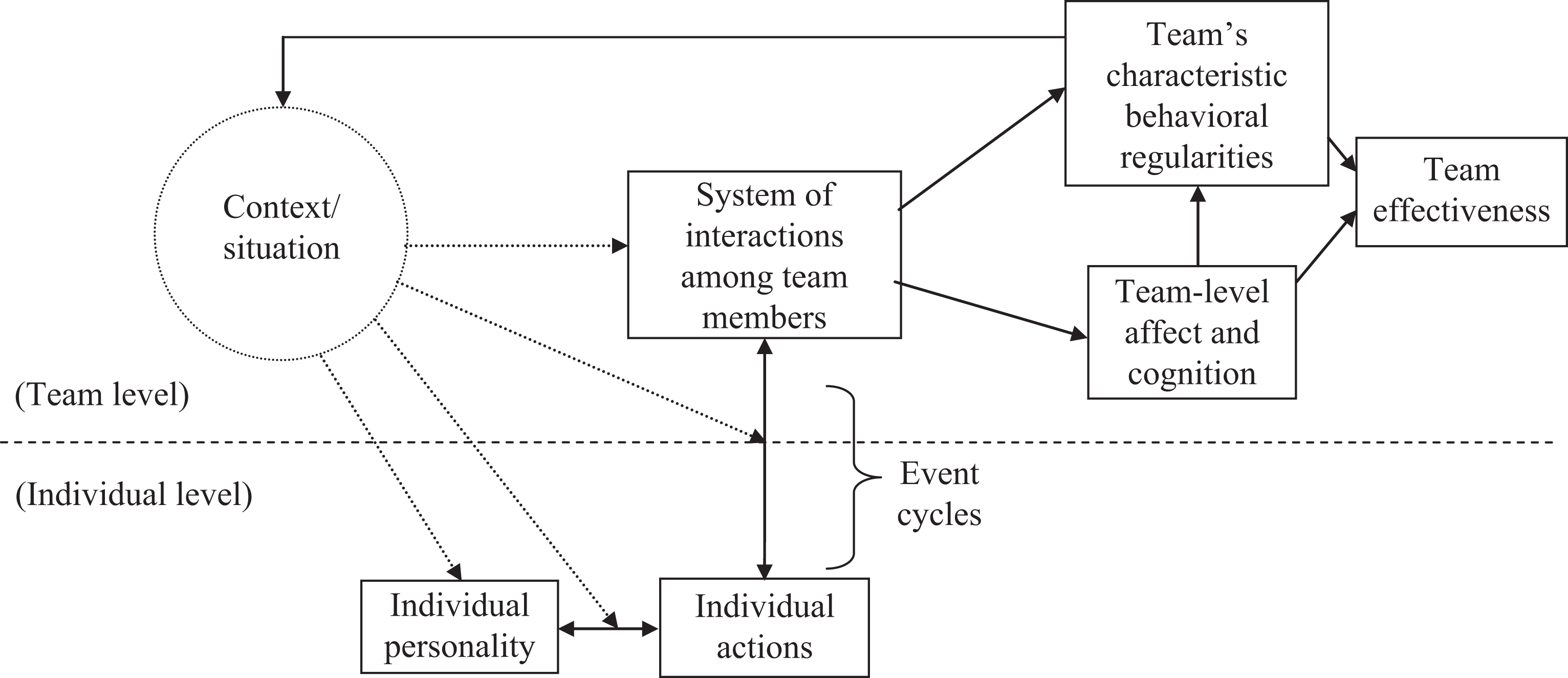
Emergence of structure of team personality.
Dynamic event cycles as multilevel linking mechanisms
In this section we describe the dynamic event cycles linking individual personality to team personality. We first describe the linkages between individual personality, context, and individual actions and then turn to the system of interactions among team members.
Individual personality and context to individual actions
Despite the fact that our model is intended to reflect the dynamic emergence of the structure of team personality, it is important to begin with a brief examination of the relationship between individual personality, context (or situation), and individual actions. While many theories have been proposed in the psychology literature linking personality to action, we use the interactionist perspective of Mischel and Shoda (1995) to illustrate this linkage. Briefly, they propose the cognitive-affective personality system (CAPS), in which each individual has a set of cognitive and affective units within their personality system connected to each other to form neural networks of associations that distinctively characterize each individual. The cognitive and affective units include “the person’s construal and representations of the self, people, and situations, enduring goals, expectations-beliefs, and feeling states, as well as memories of people and past events” (Mischel, 2004, p. 11). This is the essential structure of individual personality, according to this particular theory.
In the presence of specific situations or contexts, a subset of these units (and subsequent networks) activates, depending on the features of the situation that the individual encounters. The behavioral expression of this system can be described as resulting from a set of “if-then” relationships: for example, if a person is in situation A, then X behavior occurs, but if the same person is in situation B, then Y behavior occurs. These if-then relationships constitute the person’s behavioral “signatures,” or regularities, of personality (Shoda, Mischel, & Wright, 1994). Importantly, behavioral variability within the same individual is not simply explained by the presence of different situations or contexts; rather, the individual’s thoughts and feelings at a given point in time (as represented by the cognitive-affective units) might influence what happens next in the system, resulting in what Shoda, LeeTiernan, and Mischel (2002, p. 318) describe as streams of consciousness. While this is simply one model among many describing how individual personality results in behaviors and actions, computer simulations have demonstrated that the model does a reasonable job of explaining behavioral consistency within and across individuals (cf. Mischel, 2004). The theory is also a good fit here in that it is functionally equivalent to Hofmann and Jones’s (2005) approach to team personality, where collective personality describes behavioral regularities that occur in the collective.
Individual actions to systems of interactions among team members (and feedback loops): Event cycles
In the context of work teams, individual team members bring to the proverbial table their cognitive-affective units, their neural networks, and their behavioral regularities; they are influenced by the immediate context of the team, among other contextual influences (e.g., the task at hand, the available technology, the organizational culture, etc.). For example, team members who are more amenable to the situation may have had past positive experiences with teams, or may be extremely extraverted/social people, gaining energy from working with others and appreciating the challenge inherent in being part of team.
Once team members engage with each other to create the social system of the team, both bottom-up emergence processes and top-down influence processes begin. This is the heart of our multilevel model linking individual personality to team personality, in that this is where the cross-level “action” is. The very nature of this cross-level action is dynamic and fluid. As noted before, we adopt the same systems theory approach that both Morgeson and Hofmann (1999) and Kozlowski and Klein (2000) utilized. As Morgeson and Hofmann (1999, p. 251–252) note, drawing from Allport’s (1924, 1955, 1967) work: Individual action is limited by the surrounding context, and, thus, the admissible range of actions is influenced by a multitude of situational or contextual factors … [T]he actions of individuals will meet in space and time, resulting in interpersonal interaction. This interaction results in a discrete event, and subsequent interaction produces what can be termed an event cycle … [it] is the basic building block upon which all larger collective structures are composed.
Taking this approach, a researcher using a compilation-based approach to team personality emergence might understand a different causal chain linking individual personality to team personality. For example, one individual team member’s relatively low score on emotional stability may lead to certain neurotic behaviors in certain situations—even when other team members may actually have higher scores on emotional stability, representative of a minimum compilation model. Yet, these team members, through their interactions with each other and with others on the team, imbue the team with a general sense of calm and well-being, perhaps because their past experiences have led them to understand the importance of developing clear lines of communication and expectations of behavior with other team members. As a result, the team’s personality might actually be characterized by high emotional stability even though some individuals may score low on emotional stability.
In another example, a team that has a different combination of diverse individual personalities might have one team member with high conscientiousness, while other members have varying lower levels of conscientiousness, representative of a variance compilation or patterned compilation model (Kozlowski & Klein, 2000). As the team members work together and interact over time, the high conscientiousness team member continuously picks up the slack for the other team members, ensuring the details of work are completed on a timely basis. The team’s personality, at this point in time, could be described as high in conscientiousness. Over time, a harmful feedback loop may develop, where the other team members become less detail-oriented and reliable in their work, yet the team is given more work because of their perceived team personality. In the face of new demands, the high conscientiousness team member is likely to become overworked and burnt out. Once that individual starts to miss details, the overall work of the team will suffer. As time goes on, the high conscientiousness team member’s individual personality is less visible, allowing a new dominant regularity to emerge in which the team is seen as having low conscientiousness, as a result receiving fewer or less important projects.
We are not arguing that individual team members’ personalities are necessarily unrelated to the team’s personality; rather, these examples indicate that discontinuous compilation processes likely account for how the structure of team personality might be fundamentally different from the structures of individual team members’ personalities. Essentially, the interactions between individual team members (creating event cycles with feedback loops) build a system of interactions, which in turn develops team-level cognition, team-level affect, and team behavioral regularities. Together with the external context, these concepts and processes characterize the emergence of team personality.
However, the multilevel process linking individual and team personality may also be characterized as a top-down process as part of a larger feedback loop. If the team does have a discernible personality (i.e., if its behavioral regularities, team affect, and team cognition are relatively strong), we may begin to see the team’s personality influence the behavioral interaction patterns (and perhaps even the personality) of team members. Kozlowski and Klein (2000) discuss this issue with respect to the dynamic influence of time, using the example of organizational culture. They note that organizational culture begins as an emergent, bottom-up process as individuals involve themselves in sense-making and social construction. Over time, organizational culture likely becomes more routine and institutionalized; “new members are socialized and assimilated into enduring contexts that resist change” (Kozlowski & Klein, 2000, p. 22). Returning to our model, if teams have the chance to become relatively well-established and members develop patterns of interactions with each other, in addition to behavioral regularities at the team level, it is likely that new team members will adjust to the expectations of the team and become socialized and/or assimilate to the way the team works. Over time, this understanding of the context of the team will embed itself into the cognitive-affective personality system of the individual team member in question, resulting in new neural networks that influence how that team member behaves on the team in question. These experiences will also likely affect how the team member approaches other team assignments in the future, as the structure of his/her personality has likely been slightly altered by the interaction s/he has had with the team. Over time, the team’s personality solidifies further as these interactions between the individuals in the team and with the context in which they happen occur. The socialization literature stemming from the work on person–organization fit has elucidated many of these processes in greater detail (cf. Cable & Parsons, 2001; Chatman, 1989).
To review, we consider dynamic event cycles that include feedback loops and path dependence to be the multilevel linking mechanism connecting individual personality to team personality. Individual personality systems activate in the presence of specific contexts/situations to result in a set of individual behaviors; these behaviors reciprocally influence the behaviors of other team members to form a system of behavioral interactions among team members. This complex, dynamic, and recursive process takes place over time and involves both bottom-up discontinuous compilation processes as the structure of team personality is created, and top-down contextual influence processes after the team’s personality has started to solidify, and can become an influence on new team members and their interactions within the team and across other teams.
It is important to note here that we do not believe that all teams have an equally strong team-level personality; rather, we believe it is a continuum. Some teams may not have a chance to develop anything resembling behavioral regularities, perhaps because of the temporary nature of the tasks for which they are responsible; these teams would exhibit little to no team personality. Other teams, even with short lifespans, may “gel” quickly, with team members and other stakeholders forming perceptions and impressions of the team that are stable that are related to the teams’ behavioral regularities. Therefore, some teams may have relatively strong personalities; others may have relatively weak personalities; and still others may not have discernible personalities at all. This description is another way in which team personality is structurally different from individual personality—there is a great deal of variance along the team personality strength continuum, perhaps more so than at the individual level. Further, although individual personality is considered to be relatively stable, team personality is dynamic and evolves and changes over time as the team members interact with each other and with the context.
The road to team effectiveness
In the following sections, we consider how the interpersonal interactions among team members lead more specifically to team behavioral regularities, team cognition, and team affect, ultimately leading to team effectiveness (i.e., team performance, satisfaction, and viability; Campion, Medsker, & Higgs, 1993; Hackman, 1987; Sundstrom et al., 1990). We include team effectiveness in the model for two reasons. First, we theorize that aspects of team personality have an important direct and indirect impact on team effectiveness. Second, we consider team effectiveness as part of the model depicting the emergence of team personality because outcomes of the team’s behavioral regularities are likely incorporated into perceptions and judgments of the overall gestalt of the team. In other words, personality characterizations are made of teams based in part on how effective or ineffective they are. As an example, a team that has very conscientious behavioral regularities is probably in part characterized as such because those regularities have resulted in some level of effectiveness (or, have not yet resulted in ineffectiveness). If the regularities are persistent and enduring but unsuccessful in terms of outcomes, the team’s personality may be characterized as slow to learn, maladaptive, and/or dense. While we have included a feedback loop from team effectiveness to the context in Figure 1, we want to point out that we believe team effectiveness is even more fundamentally taken into account in the perception of the “whole team” as an entity—that is, in the emergence of team personality. Moreover, because the emergence of team personality is influenced by path dependence, the team’s history of effectiveness (or lack thereof) will have an important impact on all aspects of team personality.
In the following section, we further explicate the connections between interpersonal interactions and team effectiveness. To begin, there are likely at least two pathways, direct and indirect, through which the system of interpersonal interactions at the team level influences team behavioral regularities, which we describe next.
Interpersonal interactions to team behavioral regularities
In terms of the direct route, as team members reciprocally influence each other in the team system, it is likely that certain behavioral patterns will emerge at the team level. Team members develop networks with each other and with others outside the boundaries of the team, resulting in a complex web of interrelationships and pathways through which the work of the team is accomplished. For example, a team member working on a newly created product design team may need certain information regarding an old technology that is being repurposed for the new product. The team member might choose to study the technology independently and then present conclusions to the team, or the team member might first seek the advice of team members or their contacts as a way of gathering information on the technology in question. That decision and subsequent interaction may set up an expectation, behavioral regularity, and path dependence regarding whether team members do or do not ask each other (and others outside the team) for advice when completing research. Depending on what the pattern becomes and how successful the feedback from the pattern is, the team may be characterized as curious, open-minded, and willing to take risks to get the correct answer. In this way, the interactions among the system of team members can directly result in a behavioral regularity and ultimately influence perceptions of the team’s personality.
Interpersonal interactions to team affect and cognition to team behavioral regularities
The second pathway through which interpersonal interactions shape team behavioral regularities is indirect, through the influence of team affect and cognition. As interactions occur between team members, opportunities arise for team members to build both affect and cognition at the team level. With respect to team affect, this component is closely linked to the concept of group affective tone (e.g., George, 1990, 1996; Sy et al., 2005), which George (1990, p. 108) defined as “consistent or homogenous affective reactions in a group,” and Kelly and Barsade’s (2001, p. 100) group emotion, defined as “the group’s affective state that arises from … both the combinations of individual-level affective factors that group members possess as well as from group or contextual-level factors that define or shape the affective experience of the group.” While some prior research on affect has defined it narrowly in terms of positive and negative affective states (e.g., Watson & Tellegen, 1985), we adopt the broader idea that affect is a “subjective feeling state” that can range from diffuse moods to intense emotions (Ashforth & Humphrey, 1995). Therefore, we consider team-level affect to be comprised of shared moods, emotions, and feelings of team members. Team affect is a shared, emergent property of teams—if team members do not agree regarding their perceptions of the “mood” of the team, by definition there is no team-level affect. While it is theoretically possible for teams to lack a shared affective tone, a majority of teams reviewed in George (1996) did possess team-level affect, and group emotion has been recognized by both group members and outside raters (Barsade, 2000; Bartel & Saavedra, 2000).
As team members interact with each other over time, then the likely result will be a more shared set of affective reactions at the team level. These affective reactions may determine how a team approaches challenges, setbacks, and triumphs. It is possible that a team with extremely high levels of positive, shared affect may become overconfident and sloppy with respect to work; teams with extremely negative shared affect are likely to have trouble feeling efficacious. Both situations could result in negative feedback loops, which as a result would influence the behavioral regularities of the team. As one example, team members that recently received negative performance feedback might turn on each other, blaming one another for mistakes. As team members interact negatively with each other, an overall negative shared affective tone may settle on the team. From there, behavioral regularities are likely to be affected. Either team members decide to seek a solution and improve their collective performance, or they decide to disassociate from the team, creating process loss (Steiner, 1972) and some distance in the event that the team “tanks” again. The point, again, is that team member interactions result in shared affect, indirectly affecting behavioral regularities through that shared affect.
Team cognition, as we noted before, might include shared, emergent perceptions/encodings, thoughts, beliefs, values, goals, and expectations of team members (e.g., Hinsz, 1990; Klimoski & Mohammed, 1994), in addition to more specific cognitive concepts such as common cause maps, shared frames, teamwork schemas, and transactive memory (e.g., Austin, 2003). Some theories of team cognition state that shared mental models serve the function of enhancing team members’ coordination and effectiveness, particularly when performing nonroutine, complex, urgent, and unpredictable tasks (e.g., Lim & Klein, 2006; Mathieu et al., 2000). In keeping with Mathieu and colleagues (Mathieu, Heffner, Goodwin, Cannon-Bowers, & Salas 2005; Mathieu et al., 2000) and Lim and Klein (2006), we consider team cognition to be comprised of taskwork (e.g., the realm of technology/equipment and job/task itself) and teamwork (e.g., team interaction and communication) mental models. Like Cronin and Weingart (2007), however, we recognize that team cognition may arise through more compilational processes, resulting in compatible, rather than necessarily shared, ideas about these issues. This is particularly important to recognize for teams that are formed with the explicit purpose of maximizing divergent thinking to result in creative outcomes (e.g., functionally diverse teams). As Cronin and Weingart (2007, p. 770) note, the goal of these teams is “to engender enough understanding to facilitate communication and accurate interpretation,” while avoiding homogenization of team members’ cognitive representations. Therefore, these cognitive structures and representations reside in the minds of individual team members and, to the extent that they are shared or compatible, help a given team collectively make sense of situations and coordinate activities in order to complete tasks. At the team level, this cognition then leads to more behavioral regularities. Thus, another indirect path appears from the system of shared interactions among team members, through team cognition, to influencing behavioral regularities.
For example, as work begins on a client project, team members may not have an understanding of who has the best expertise for certain parts of the project. As each team member works on the project and solicits help from other team members, individuals may develop compatible cognitive models of which team member has what kind of expertise for the project. These may or may not be shared with other team members, in that the specific external knowledge that each individual team member seeks may be different. As the team works on other projects in the future, this set of compatible cognitive representations of “expertise location” will help create behavioral regularities in the team. Team members will know who to go to for specific skillsets and answers, although that knowledge will likely be tailored to their specific realm of individual questions. Further, as team members interact they may learn new concepts and learn from other team members (or, conversely, they may not learn through the interaction process), and as a result behavioral regularities may be affected. The learning could characterize the team as a smart, inquisitive, quick team. Conversely, not learning expertise from the interaction of team members could make the team seem slow, dense, or unresponsive.
As we have noted throughout this discussion, it is clear that team-level affect and cognition influence each other (and team behavioral regularities) in ways that are complex. First, individual-level influences between affect and cognition still occur (there is a budding literature on these connections; e.g., Mischel & Shoda, 1995). Second, cross-level influences are also occurring (e.g., team-level affect might influence individual-level cognition; team-level cognition might influence individual-level affect). Finally, team-level constructs reciprocally influence each other dynamically and systematically. Groupthink situations (e.g., Janis, 1972) may be good examples of the many connections between affect and cognition at different levels of analysis. During groupthink, a high level of cohesion within a team is hypothesized to lead to high levels of individual conformity, which then results in a lack of necessary cognitive disagreement and critical assessment at the individual level in order to evaluate decisions appropriately at the team level. From a team personality perspective, the high cohesion within teams clearly begins at the level of interpersonal interactions and may be both an outgrowth and a reflection of positive team-level affect. This positive affect may, in turn, have a top-down effect, impairing both individual cognitive functioning and ability of the team to develop accurate cognition regarding the issue.
Behavioral regularities and team affect and cognition to team effectiveness
As we have suggested, team personality is important to consider in part due to its influence on and relationship with team effectiveness. Interestingly, much prior work on the influence of team-level personality has linked team personality composition or collective personality directly to team performance (e.g., Barrick et al., 1998; Halfhill et al., 2005; Hofmann & Jones, 2005; Neuman, Wagner, & Christiansen, 1999). This link is evident despite past use of the input–process–outcome model as a guiding theoretical framework and Lawrence’s (1997) point that mediating processes might be helpful to consider in that they may provide insight into the “black box” through which team inputs (such as personality) influence team outcomes. Some prior research has considered the ways in which team processes likely mediate the relationship between team-level personality and team effectiveness (LePine, 2003, 2005; Moynihan & Peterson, 2001; Porter et al., 2003).
The team cognition literature has also begun to consider various team processes as mediating mechanisms through which team mental model similarity, compatibility, and accuracy influence team performance (e.g., strategy formation, coordination, cooperation, and communication; Mathieu et al., 2000). The emerging literature further suggests that team cognition has a positive influence on performance (e.g., Marks, Sabella, Burke, & Zaccaro, 2002; Marks, Zaccaro, & Mathieu, 2000; Mathieu et al., 2000; Smith-Jentsch, Mathieu, & Kraiger, 2005), with work on high reliability organizations claiming that cognition capabilities are critical for team performance (e.g., distributed cognition; Hutchins, 1995). Thus, it seems clear that certain types of behavioral regularities and team cognition are related to team effectiveness. As we noted before, however, we think that it is hard to tease out the team’s effectiveness from the overall gestalt of team personality. In other words, the outcomes of the team’s work may cause team members (and others outside the team) to ascribe meaning to various characteristics the team has exhibited. So, a team that is thought of as loose, creative, and carefree may be suddenly reclassified as careless, inappropriate, or underperforming if the performance feedback they receive is not positive.
The role of team development and contextual issues
The previous discussion largely assumes that team personality—team cognition and affect—may have already solidified for a given team. In keeping with this idea, our model is a snapshot of how team personality interacts with the context to result in stable, predictable behavioral regularities at the team level, which in turn influence both team effectiveness and team personality. However, team personality is dynamic and fluid over time, particularly if team membership changes dramatically or contextual demands result in a constant, high level of team learning (e.g., Nonaka & Takeuchi, 1995). Moreover, aspects of team personality must emerge over time and evolve—most teams do not have behavioral regularities, highly developed team cognition, or shared affect at the start of their existence, for example. We consider a number of models of team development over time in order to describe how team personality might develop (Gersick, 1988; Kozlowski et al., 1999; Tuckman & Jensen, 1977). We also acknowledge that the body of work that describes antecedents of shared cognition and affect (e.g., George, 1996; Klimoski & Mohammed, 1994) contains excellent reviews of specific antecedents and theories regarding how these concepts individually emerge. Therefore, we focus more on the gestalt of team personality as it emerges over time as teams develop.
Most theories of team development describe the stages and processes through which teams progress from a loose collection of individuals to a coordinated unit. While these theories are distinguishable, they all propose that teams pass through an introductory period (Phase 1 of Gersick’s 1988 punctuated equilibrium model; team formation in Kozlowski et al., 1999; and the forming stage in Tuckman & Jensen, 1977). As teams form, the process of team personality development begins. Team members begin to interact and form impressions of others, in addition to forming initial impressions and experiencing feelings about the team overall. At this time, impressions of the team’s personality may already be emerging. As an example, the most conscientious team member may be very detail-oriented on the first day everyone works together. Other team members may have a positive affective response to this, assuming the team will be organized and successful, influencing initial impressions and what the team’s personality will eventually be like. As the team works together, this initial impression may create a positive feedback loop in which perceptions further encourage all team members to be detail-oriented.
Introductory team formation in this early stage may come about as members opt into a team because they are attracted to the number, type, values, attitudes, and/or beliefs of other team members. This attraction may occur for several reasons: the similarity-attraction paradigm (Byrne, 1971), social identity theory (Tajfel, 1978), or self-categorization theory (Turner, 1982). This process may strengthen the existing team personality through a sort of institutionalized path dependence, where existing members socialize new members into “the way things are done around here.” Team members also may be deliberately selected into a given team by the organization. In selecting team members, certain selection criteria are considered in order to make the work team more effective; selection criteria such as similar orientation toward work and working, perhaps based on values and work habits (Klimoski & Jones, 1995), or functional compatibility to build innovation and creativity (e.g., Kanter, 1988). As these new teams move through their introductory period, they may spend a period of time developing cognitive maps regarding who team members are and how the team as a whole might work together in order to aid coordination. Teams may also use this time to work through each member’s diverse views and preferences. With time, team personality activates with the team’s context to develop into team-level behavioral regularities that eventually stabilize into predictable routines, path dependencies, and feedback loops. As this occurs, teams will develop a more stable and identifiable personality. These teams may retain essential characteristics of their personality, even despite attrition of original team members and introduction of new members, as the team’s behavioral regularities become routinized and more predictable. As noted in our discussion of team personality strength, however, we would expect to see team personality be more dynamic, fluid, and malleable over time than individual personality.
Discussion
Studies of team personality are continuing to evolve as advances in theory and measurement allow for a better understanding of how to conceptualize and operationalize personality at higher levels of analysis (e.g., Hofmann & Jones, 2005). We have made the argument that future research on this topic should move away from approaches that assume that the personality metaphor can be applied in an isomorphic way and towards a dynamic multilevel perspective. In so doing, we developed a new definition of team personality, discussed the function and structure of personality at both the individual and team levels of analysis, and developed a dynamic multilevel model linking the personality concept across levels of analysis. The model introduces dynamic event cycles as multilevel linking mechanisms and highlights that both bottom-up emergence processes (likely in the form of discontinuous compilation processes) and top-down influence processes occur as team personality takes shape. Clearly, much work remains to be done; we discuss some future research possibilities and implications of our work next.
Theoretical implications and future research directions
There are a number of theoretical implications that arise from the ideas presented here. First, we introduced a new definition of team personality that builds upon prior research at the individual level, yet also incorporates Hofmann and Jones’s (2005) understanding of team personality as behavioral regularities. Our definition highlights the similarity in function, but also incorporates the difference in structure, of personality at the individual and team levels of analysis. And, although the concept of team personality as we have defined it is broad and inclusive, we note that it is consistent with the degree of breadth in the individual-level literature. Indeed, as Funder (2001, p. 198) noted, the field of individual-level personality psychology “seeks to bring together the contributions of developmental, social, cognitive, and biological psychology into the understanding of whole persons and the dimensions of difference that allow them to be psychologically distinguished from one another.” While some might argue that the team literature does not need an analogous attempt at a unifying framework, we contend that team personality may be a useful overarching theoretical approach to better understand the relatively fragmented teams literature. Future research investigating the different aspects of this definition might bring the teams literature back to understanding the overall gestalt of the team and its internal (and external) social dynamics.
Another implication that we note is that team affect and cognition are two important pieces of the team personality puzzle; our model proposes that they are a critical indirect way in which teams develop behavioral regularities. One important issue for future research on team personality (and for the broader literature on teams) is the examination of how these concepts might be linked. As noted before, at the individual level, affect and cognition are critically linked as important aspects of our personalities; at the team level, the same is likely to be true. We need more theoretical and empirical research linking concepts from the two bodies of literature (i.e., team affect and cognition) in order to better understand the fundamentals of how they influence each other (and other concepts, such as behavioral regularities) at the team level.
An additional implication and key aspect of the model is the idea of discontinuous compilation processes occurring as individual team members interact with each other in various ways as they develop their social structure and network. We argue that this better describes the way that individual personalities interact and combine to form team personality than do composition models of emergence. This description has far-reaching implications for the study of personality in teams. While previous literature has made some sense of the body of empirical findings using the composition approach to study personality in teams (e.g., Bell, 2007), we advocate that the way forward in this literature is to acknowledge (and begin to model) the complexity associated with team member interactions over time. These interactions are not likely to be accurately described using simple additive models; rather, we must start considering how interactions with others influence individual team member behavior, and how that ultimately might manifest at the team level as behavioral regularities. In part, this approach will demand greater acknowledgement of the complexity of personality and behavior at the individual level. At the very least, multiple dimensions of individual personality must be taken into account simultaneously in the consideration of how team personality may emerge (e.g., considering the constellation of individual personality characteristics and their relative strength as compared to other team members and their interactions). More difficult, however, will be the charge to attempt to model interaction processes between team members in a parsimonious, yet realistic, way.
In any case, our model provides a good starting point for those seeking to investigate intrateam antecedents of team personality development. One possible theoretical point of entry to advance the literature would be the literature on social networks. We know from this literature that similar people tend to interact with one another (e.g., Blau, 1977; Granovetter, 1973), moving in similar circles and seeking each other out (e.g., Brass, 1985; Ibarra, 1992). Team members may have similar behavioral regularities at the individual level, which likely would accelerate the development of behavioral regularities at the team level. This, in turn, may mean that teams spend less time on the introductory stages of development and are able to complete taskwork in a more efficient manner. Further, other intrateam factors, such as team member participation and involvement levels, as well as leadership, may also influence the development of team personality. These intrateam factors are based on interactions within and outside the team, and further research may help reveal how team personality evolves over time and changes with these factors.
Practical implications
The dynamic multilevel approach to team personality proposed here may allow practitioners to better understand what makes an effective team. As we note before, prior approaches to team personality—including Hofmann and Jones (2005)—have not considered specific pathways through which team personality influences team behavior and the important role that dynamic interactions between and among team members may play. The importance of both norms and habitual routines as leverage points for effective teams has been acknowledged in prior literature (e.g., Gersick & Hackman, 1990; Hackman, 1992); we suggest that the reason for this is that they help to develop team behavioral routines more quickly (effectively helping to create a given team’s personality faster than allowing it to develop on its own without intervention). As more empirical research is conducted in order to determine the true nature of the relationship between team affect and cognition, we will be able to provide more practical guidance to teams interested in increasing efficiency and synergy. Practitioners might consider team personality and its development as a leverage point to build more effective teams. At the very least, the concept of “personality” is an easily understood metaphor for discussing teams; having more research that speaks directly to the concept of personality in teams would likely be very accessible for practitioner audiences.
More implicit practical implications of our model include the importance of careful team member selection and need to monitor teams in their contexts. This theoretical approach underscores the need for human resource decisions to take into account individual personality as team assignments are considered, because development of team personality is likely heavily influenced by members within the team and the way they interact with each other. This influence will have an important impact on behavioral regularities that develop at the team level and subsequent routines and decision heuristics that teams adopt when faced with different situations.
In conclusion, the team personality literature has made great advances in the last two decades, due in part to tremendous progress in the area of multilevel theory. Although there is much more work to be done, the overall literature on work teams can gain much from a greater theoretical understanding of a dynamic, multilevel theory of team personality. We hope to have provided a start in this direction.