



Abstract
Recruitment sources, the means through which job seekers learn about organizations and job openings, are related to many organizational and job seeker outcomes. However, although many mechanisms have been proposed to explain recruitment source effects, each mechanism appears to address only one part of a larger process. Our theoretical understanding of this phenomenon is limited by the lack of a comprehensive model integrating these perspectives, and such an integration is possible by differentiating among the ways that job seekers use recruitment sources. In this article, I outline three distinct functions of recruitment source use. I then propose a model that integrates these functions with the proposed mechanisms and show how the model can be used as a springboard for increasing our theoretical understanding of the phenomenon and advancing future empirical research on the topic.
Recruitment sources, also called job-seeking strategies, recruitment methods (Breaugh, 2008), or media (Allen, van Scotter, & Otondo, 2004; Ehrhart & Ziegert, 2005) are the means through which job seekers learn about job openings or organizations. To optimize their selection systems, organizations desire a large pool of qualified applicants, and using recruitment sources such as Internet search engines or referrals form the preliminary steps of this process (Barber, 1998). Recruitment sources differ in their ability to communicate job leads, thus influencing applicant pool size, and they also differ in their ability to communicate information about the organization, influencing job seeker attitudes and behavior toward the organization. Therefore, organizations need a firm understanding of recruitment source processes and effects. They need to understand how applicants use recruitment sources, they need to know the likely effects of common sources, and they need to know how to optimize job seeker strategy use and compensate for suboptimal use. Additionally, job seekers have limited temporal resources and must choose among sources that may differ in effectiveness. It is thus essential that they, and those who counsel them, know which sources are best, what motivates individuals to use sources, and how to make them maximally effective.
Several mechanisms have been proposed to explain recruitment source effects. However, this literature’s potential usefulness is limited. Although they have been used separately or sometimes presented as competing, each one concentrates on part of a bigger picture. Furthermore, integrating them is more complex than merely piecing them together—careful investigation reveals that they also vary in the very definition of “source use.” Consequently, organizations and job seekers may adopt the “right” sources yet fail to maximize the source’s benefits. For instance, using a source merely for providing job leads may not yield the same effects as employing that same source to describe the work environment. This issue can be corrected by integrating the mechanisms into a holistic, theoretically grounded model that explicitly considers the ways in which sources can be used. This article articulates this overarching process in the hopes of facilitating future research and optimizing recruitment source use by organizations and job seekers.
A brief review of recruitment source research
Although a body of literature exists on overall job search effort (e.g., Boswell, Zimmerman, & Swider, 2012), a separate literature has examined the use and effects of recruitment sources. When interpreting this literature, one potentially problematic issue is the frequent treatment of recruitment source as a categorical variable (e.g., participants are asked to report a single source rather than the extent to which they used each possible source). Thus, analyses are based on comparisons among only the sources measured in each study. Therefore, this brief review presents only a sample of the full set of comparisons that have been made, and when this review mentions particular “superior” or “inferior” sources, it is important to remember that the conclusions might depend on the comparison sources chosen by each researcher. A second noteworthy characteristic of this literature is its focus on the individual level of analysis, although some research (e.g., Drentea, 1998) has looked at higher level outcomes. Within individual characteristics, researchers have tended to focus either on outcomes of primary interest to organizations (e.g., job performance, turnover) or to job seekers (e.g., time to reemployment).
The majority of studies on recruitment source have concentrated on posthire outcomes such as performance or withdrawal behaviors. Much of this literature was summarized by Zottoli and Wanous (2000), whose review of previous meta-analyses, as well as their own analysis, confirmed recruitment source’s relationship with these outcomes, with effect sizes (ds) of .08 for performance and .18 for withdrawal. In general, sources viewed as inside the organization (e.g., current employees) were found to be superior.
While Zottoli and Wanous (2000) focused on performance and withdrawal, research has also linked recruitment sources like referrals to improved prehire outcomes such as the likelihood that applicants will progress through the process or receive an offer (e.g., Barber, Daly, Giannantonio, & Phillips, 1994; Breaugh, Greising, Taggart, & Chen, 2003; Kirnan, Farley, & Geisinger, 1989). Recruitment sources perceived as more informative have also been tied to increased likelihood of applying to organizations (Ryan, Horvath, & Kriska, 2005).
Other studies connected recruitment source to posthire variables. Newspapers and other sources may relate to increased absenteeism (Breaugh, 1981; Griffeth, Hom, Fink, & Cohen, 1997; M. S. Taylor & Schmidt, 1983). Referrals may have greater satisfaction with one’s job or supervisor, job involvement, and organizational commitment than those using sources like newspapers or college placement offices (Breaugh, 1981; Griffeth et al., 1997; Latham & Leddy, 1987; Moser, 2005; Saks & Ashforth, 1997; Vecchio, 1995). Sources such as rehires may have greater coping ability than referrals or individuals recruited through newspapers (e.g., Griffeth et al., 1997; Saks, 1994).
Complementing organizational interests, some studies examined recruitment source from the job seeker’s perspective. For instance, networking may reduce time to reemployment (Tziner, Vered, & Ophir, 2004). Referrals from current employees and individuals found through organizational recruiters tend to find jobs with better pay or wage growth (e.g., Bridges & Villemez, 1986; Coverdill, 1998; Vecchio, 1995). Recruitment source has also been tied to the prestige or skill level of jobs found (Marsden & Hurlbert, 1988; Reid, 1972) or the gender homogeneity of the job found (Drentea, 1998).
The effects discussed before are not consistently identified. Some studies did not find relationships between recruitment source and job performance, turnover, salary, organizational commitment, or role clarity (Reid, 1972; Saks, 1994; Swaroff, Barclay, & Bass, 1985; M. S. Taylor & Schmidt, 1983; Williams, Labig, & Stone, 1993). Others found that the relationships studied were moderated by race (Caldwell & Spivey, 1983; Green, Tigges, & Diaz, 1999) or gender (Coverdill, 1998; Huffman & Torres, 2001). For instance, Coverdill found that men hired through personal contacts were less likely to be involuntarily terminated, but women hired via personal contacts were more likely. Typically, such inconsistencies may be considered as error and accounted for through procedures such as meta-analysis (e.g., Zottoli & Wanous, 2000). However, some of these differences may be due to more than sampling error. Other factors, such as researchers’ and participants’ conceptualizations of what it means to use a source, may also be responsible for variance in the effects found by previous research.
Proposed mechanisms explaining recruitment source effects
Researchers have proposed several explanations for recruitment source effects and Zottoli and Wanous (2000) provided an early summary. The present review draws in part upon their work, while reorganizing and renaming some of the mechanisms to facilitate their integration. That is, these mechanisms currently exist as a haphazard collection; there has not yet been a formal discussion of how these mechanisms relate to each other or which mechanisms may be appropriate for which purposes. In actuality, many mechanisms share similar features that can be used both to organize the mechanisms into conceptually meaningful groups and to facilitate the connection between them and broader psychological theories—ultimately allowing for an overarching, theoretically supported model of recruitment source processes. See Table 1 for an organizational overview.
Proximal outcomes, source functions, supporting mechanisms, and supporting theories.

Some mechanisms propose that recruitment source effects accrue via the number of job openings found by job seekers. The ease of movement/breadth of search mechanism (Decker & Cornelius, 1979) proposed that individuals recruited through some sources may believe that relatively more jobs are available, given the success of their searches. Consequently, they may be more willing to search for alternatives and take new jobs. To date, only one study has examined this mechanism and the results did not appear to support the hypothesis (Breaugh & Mann, 1984). However, while Decker and Cornelius discussed perceived ease of movement, recruitment source may also relate to actual ease of movement. Individuals searching via particular means may actually find more leads. For instance, an Internet job board may yield more potential leads than networking with a single colleague would. As some research indicates that a substantial number of employed individuals regularly investigate job openings even in the absence of an active search (Rafaeli, 2006), these effects could exist long into an individual’s tenure with an organization. The effects of this mechanism may also be more passive. For instance, employees who used a headhunter for their previous searches may be more likely to be contacted by that headhunter again if a subsequent opening arises.
The individual differences mechanism (Schwab, 1982) may also relate to job seeker knowledge of available jobs. Schwab proposed that different sources reach different types of job seekers, but he did not explicitly discuss which individual differences would relate to source use. Characteristics such as personality traits, socioeconomic status, or life circumstances may relate to overall job seeker effort (thus leading to the discovery of more leads) or to the use of sources richer in leads.
Although some of the effects of these two mechanisms could be justified on purely logical grounds (e.g., sources that result in more leads should relate to greater job seeker success), they can also be easily connected to several psychological theories. For instance, expectancy theory (Vroom, 1964) postulates that a given behavior is more likely when individuals believe that they can successfully engage in the behavior (expectancy) and when successful completion is closely tied (instrumentality) to important outcomes (valence). Individuals using sources perceived to be “high yield” should have high expectancies that they would be able to successfully use that strategy in the future, as well as high instrumentalities that such a search would once again yield good leads. Social cognitive theory (Bandura, 1997), would make similar propositions through its related construct of self-efficacy—individuals who have been successful finding job leads through a strategy may have higher self-efficacy for using it. Consequently, they may be more likely to persist in a given search (reducing their likelihood of accepting any particular offer) and may be more likely to leave an organization. Similar support can be found in the literature on organizational turnover (e.g., Griffeth, Steel, Allen, & Bryan, 2005; Hom, Griffeth, & Sellaro, 1984), which considers perceived employment alternatives as a precursor to leaving an organization.
Other mechanisms operate through the amount of knowledge that job seekers accrue about the prospective job or organization. According to the met expectations mechanism (Reid, 1972), individuals entering the organization via some sources are less likely to leave the organization (or to have lower performance) because their sources provided a more accurate prior understanding of the job. Empirical support for this hypothesis has been provided by Griffeth et al. (1997; 2005), Moser (2005), and Saks (1994). Similarly, the job seeker prescreening mechanism, originally discussed within a set of mechanisms known as “realism” or “realistic information” (e.g., Hill, 1970; Ullman, 1966), asserts that individuals using information-rich sources may be more likely to self-select out of an application process due to a perceived lack of fit. In support of this mechanism, some studies related different sources to fit perceptions (Jattuso & Sinar, 2003; Ryan et al., 2005; Werbel & Landau, 1996) or to actual or perceived knowledge of the organization (Blau, 1990; Breaugh & Mann, 1984; Quaglieri, 1982; G. S. Taylor, 1994; Werbel & Landau, 1996). For instance, Werbel and Landau found that employee referrals and self-initiated applicants had stronger fit perceptions than job seekers who used corporate recruiters or college placement offices.
In addition to the mechanisms listed before, I propose two other mechanisms by which information about the job or company can impact job seeker and recruitment outcomes. The information heuristic mechanism involves the amount of information known about an organization. That is, irrespective of the specific nature of the information gleaned, job seekers with more information about a company or job may, as a result of their familiarity with the organization, be more attracted to the organization and more likely to accept a job offer. For instance, Ryan et al. (2005) found organizational familiarity related to applicant attraction. Therefore, sources that supply more information may increase applicant attraction. Next, in the source heuristic mechanism, I propose that characteristics of the source itself may affect job seeker attitudes. First, the fact that an organization uses the source at all may convey information about its culture (e.g., organizations advertising on Internet job boards may be seen as more technology savvy than those using newspapers). For instance, Cromheecke, van Hoye, and Lievens (2013) found that using a novel recruitment medium (a postcard) influenced applicant quantity and quality. While they did not explicitly measure organizational perceptions, it is possible that a portion of their effect may be attributed to the message communicated through the use of a postcard. Second, the amount of perceived source-based prescreening may give job seekers impressions regarding their fit with the organization or the quality of the job (cf. Sicilian, 1995; Williamson, Lepak, & King, 2003).
Two overarching theoretical perspectives support this group of mechanisms. Ehrhart and Ziegert (2005) named the first perspective the “environment processing metatheory.” In Vroom’s (1964) expectancy theory, information about an organization could increase perceptions of the valence of the job in question (e.g., knowing more about a benefits package could increase organizational attraction), or could strengthen the instrumentalities associated with taking the job (e.g., solidifying beliefs that working for the company would accelerate one’s career). Beach’s (1990) image theory suggests that job seekers compare their model of a good job opportunity to their perceptions of the organization, highlighting the importance of the amount of information a recruitment source provides. The source heuristic mechanism is supported through signaling theory (e.g., Rynes, 1991; Spence, 1973). Signaling theory proposes that, in the absence of a complete set of information, individuals rely on whatever pieces of information they do have—such as the characteristics of the recruitment source. Finally, the information heuristic relates to Zajonc’s (1968) exposure-attitude hypothesis, which argues that repeated exposure to an object (e.g., as the result of more pieces of information) increases attitudes toward it.
Ehrhart and Ziegert (2005) also discuss an “interactionist processing metatheory” that relates job seeker behavior to perceived organizational fit (also see discussions of fit theories by Kristof-Brown & Guay, 2011, among others). For instance, Murray’s (1938) need-press theory describes how individuals compare their needs to the organization’s ability to meet them. The amount of information provided by a recruitment source would be an important determinant of this judgment. Similarly, Schneider’s (1987) attraction-selection-attrition model discusses how job seekers tend to look for good-fitting organizations (similar to the job seeker prescreening mechanism) and may tend to leave organizations where they do not fit (similar to the met expectations mechanism). These effects may also be supported by the literature on realistic job previews (e.g., Wanous, 1992) that has shown how providing job seekers with more accurate information may reduce turnover.
While the mechanisms reviewed before discuss how job seekers acquire information about job openings or about the organizations themselves, job seekers may also acquire other resources through recruitment sources. Ullman (1966) and Breaugh (1981) articulated what I term the special treatment mechanism. Breaugh proposed that individuals using particular sources (particularly current employees) receive better outcomes. For instance, new hires referred by current employees may be more effectively socialized into the organization (Skolnik, 1987). Referrers may likewise procure greater resources for the referred. Differences in the success of referred individuals may also be attributed to perceived pressure from referring employees; referred employees may work harder to avoid harming the referrers’ reputations. Although this mechanism was proposed to address posthire outcomes (Breaugh et al., 2003), it may also be useful in prehire contexts. For example, if organizational recruiters know that an applicant has a high-profile contact within the organization, they may be more likely to treat the applicant more positively.
The special treatment mechanism can be supported through several psychological theories. Substantial literatures on organizational justice perceptions and applicant reactions (e.g., Greenberg, 2011; Truxillo & Bauer, 2011) discuss how more positive treatment may lead to greater organizational attraction, commitment, and job performance. Similarly, recruitment sources’ provision of actual advantages to employees may be accounted for through constructs such as nepotism (e.g., van Hooft & Stout, 2012).
Two final mechanisms focus not on the resources recruitment sources provide to job seekers, but instead on whether these resources will be acquired. The source prescreening mechanism (e.g., Hill, 1970; Ullman, 1966) proposes that sources differ in the extent to which they make job openings (or potentially other resources such as information or special treatment) available to job seekers. Some sources (particularly informal sources such as current organizational employees) may not assist individuals perceived to be unqualified. Stated this way, it is apparent that the mechanism may function as a boundary condition or precursor to the successful functioning of other mechanisms. This mechanism can be tied to psychological theories on prosocial behavior (e.g., Penner, Dovidio, Piliavin, & Schroeder, 2005), schemas (e.g., Hebl & King, 2013), or discrimination (e.g., Dion, 2003), to establish sources’ motivations to help job seekers.
The individual differences mechanism was briefly discussed earlier as supporting the differential acquisition of job leads, but job seeker characteristics may serve a larger role. For instance, individual differences may influence job seeker decisions to use particular recruitment sources or to use recruitment sources in different ways. Expectancy theory (e.g. Vroom, 1964) or social-cognitive theory (Bandura, 1997) could explain how job seeker perceptions of their ability to use a recruitment source, or the perceived benefits of recruitment sources, would relate to recruitment source use. Individual differences are also likely to operate within other mechanisms. For instance, in the job seeker prescreening mechanism, information acquired about an organization may interact with job seeker characteristics when determining fit perceptions. In the source prescreening mechanism, job seeker characteristics may influence sources’ decisions to provide job leads, information, or special treatment.
Proximal outcomes and source functions
It is clear that the collection of proposed recruitment source mechanisms can be organized into conceptually meaningful groups (see Table 1). Most mechanisms focus on the acquisition of particular resources, which I term proximal outcomes. These outcomes are independent of any particular recruitment source, although sources may differ in their ability to provide each outcome. Therefore, it is also important to consider the purpose for which job seekers use a recruitment source (i.e., what outcomes they are attempting to acquire). I label these purposes the functions of recruitment source use. As described next, each proximal outcome is maximized when job seekers use a source for the function commensurate with that outcome. (Later in this manuscript, I discuss boundary conditions on these relationships.)
Each proximal outcome can be tied to a source function. From the perspective of the job availability function, job seekers use a source to acquire knowledge of job openings (the proximal outcome). Finding a lead in a newspaper advertisement could be classified as “using” a newspaper from this perspective. Job seekers asking friends if their companies were hiring would be similarly classified. Most studies that provided a specific definition of source use have used this definition (Breaugh et al., 2003; Bridges & Villemez, 1986; Jattuso & Sinar, 2003; Latham & Leddy, 1987; Marsden & Hurlbert, 1988; Quaglieri, 1982; G. S. Taylor, 1994; Wanberg, Kanfer, & Banas, 2000; Werbel & Landau, 1996; Williams et al., 1993).
In the job information function, job seekers seek to acquire knowledge of the job or company—details about particular job openings, the organization, or the work context. Job seekers may use the same sources mentioned in the previous section, but for different purposes. For instance, job seekers can use newspapers not only to find job openings, but to learn about the organization (through the job advertisements as well as through other articles about the organization). Applicants can also browse a company’s website to find information about its work environment, or can ask their contacts about their experiences with the organization.
Finally, in the job advocacy function, job seekers attempt to receive an advantage over other applicants. That is, some sources might “put in a good word” for the applicant, mentor the applicant after hire, or lobby for resources for the newly hired employee. These sources may also act indirectly. That is, even if a source does not lobby directly on the job seeker’s behalf, associations between applicants and sources may become known to the organizational members involved in personnel decisions, and this knowledge may influence how applicants are treated. Although qualified applicants will be advantaged in a valid selection system, the advantages discussed here are separate. Advantages supplied through the job advocacy function supplement or compensate for job-related qualifications, although perceptions of job seeker quality may help determine whether sources will provide such advantages.
In summary, by organizing the proposed mechanisms through which recruitment source effects operate, it is clear that job seekers use recruitment sources for three different functions. The proximal outcomes acquired through these functions are then linked to traditional recruitment outcomes such as applicant cognition and behavior, applicant pool quality, job performance, and turnover. Furthermore, job seeker choices to use each function, as well as their success, depend on individual differences as well as recruitment source resources and decisions.
An integrative model of recruitment source use, functions, and mechanisms
Organizing the proposed recruitment source mechanisms on the basis of their functions, proximal outcomes, and other properties enables the synthesis of a more comprehensive model of recruitment source processes and effects. Figure 1 presents such a model. The core of the model is indicated by the gray box. Source use increases the likelihood of acquiring at least one of the proximal outcomes: knowledge of job openings, knowledge of the job or company, or advantage over other applicants. However, these relationships are moderated by several factors, including the function for which the source is used. It is important to note that the model does not explicitly mention any of the proposed mechanisms. Rather, the model itself is an integration; the constructs and relationships included in the model are based on the processes inherent in each mechanism.
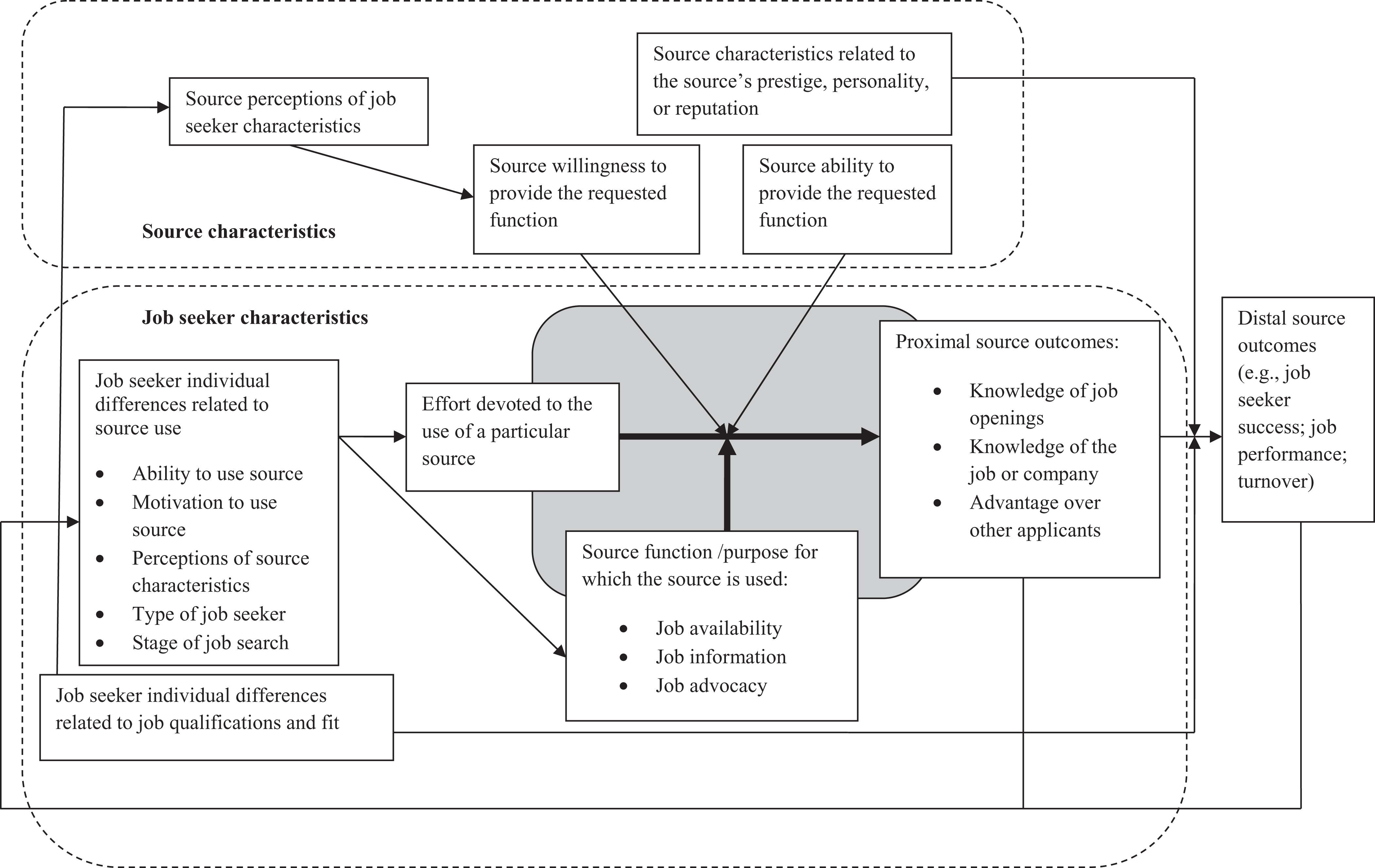
A proposed model of the relationships between source use, source function, and outcomes.
The model is intended to exist primarily at the individual or within-individual level of analysis. That is, most constructs exist for each job seeker at a given point in time, and they can exist for multiple sources simultaneously if job seekers use multiple sources. Some variables are properties of the job seeker, while others are properties of the source(s) being used by that job seeker. However, some distal outcomes, such as the potential validity of a selection device, are emergent properties of groups of job seekers using a particular source for a particular function. Finally, although time is not the principal focus, the model does contain temporal aspects. Factors such as the stage of job search will change over time, and these changes will influence source use and effects. Furthermore, the model depicts what Mitchell and James (2001) call cyclical recursive causation—feedback from prior source use should alter perceptions and subsequent use of these sources (Horvath & Schmidt, 2014).
Antecedents of proximal outcomes
The core of the model shows that proximal outcomes accrue from an interaction between four variables; four preconditions must be satisfied for a job seeker to acquire a particular proximal outcome. The first two, when combined, form the concept of “using a source for a particular function” discussed earlier. However, it is clear that this concept is a product of two conditions: effort and direction. First, job seekers must make use of the source in question (“Effort devoted to the use of a particular source”). This is the most central relationship in the proposed model, as proximal outcomes will not be accrued unless job seekers first decide to engage with the source. Here, effort is a continuously scaled conceptualization of the time or energy exerted toward source use, and can range from no use at all to using the strategy extensively during job-seeking. Effort also serves as a primary mediating mechanism of the relationship between individual differences and proximal outcomes, in effect explaining why particular individual differences are beneficial. Second, job seekers must use the source for the commensurate function. In other words, job seekers will be more likely to acquire knowledge of job openings if they employ the source specifically to acquire job leads rather than for another purpose (such as merely asking for information about the company). The final two preconditions relate to the sources themselves. A proximal outcome may be limited if the source is unwilling to provide it (e.g., through prescreening). Additionally, job seeker use of a source for a particular function may not be effective if the source is not able to provide the outcome (e.g., if the source is not aware of job openings, has no information about the job or organization, or cannot influence the hiring process).
Antecedents of job seeker source use
In Proposition 2a and 2b I argued that job seekers must use a source for a specific function to obtain the related outcome. Several factors may affect job seeker source use decisions. First, job seekers must have the ability to use the source. For instance, jobs for CEOs are typically not advertised in newspapers, and college placement offices are available only to students.
Second, job seekers must be motivated to use the source. One primary driver of source use motivation is overall job search motivation; greater motivation to find a job should increase motivation to use recruitment sources. A growing literature on overall job-seeking motivation (e.g., Boswell et al., 2012; Wanberg, Zhu, Kanfer, & Zhang, 2012; Wanberg, Zhu, & van Hooft, 2010) has the potential to be integrated into this portion of the model.
While overall job-seeking motivation may lead to overall source use, it does not explain focusing on specific sources and functions. The theory of planned behavior (e.g., Ajzen, 1985) states that attitudes toward a behavior will increase the behavior. Therefore, perceptions of sources, particularly perceptions of the source’s ability to produce a desired proximal outcome, should drive both strategy and function choice. To date, there has been little empirical investigation of job seeker perceptions of source characteristics, although Horvath, Celin, Murcko, Bate, and Davis (2012) recently developed a measure for such research.
Job seeker decisions may also relate to the type and stage of the search. Boswell et al. (2012) differentiated among types of job seekers, each of whom may have different motivations. For instance, currently employed individuals may be less motivated than unemployed job seekers to find a wide range of jobs, and may instead focus on determining their fit with potential employers. Similarly, Boswell, Boudreau, and Dunford (2004) differentiated between motives for job-seeking: separating from one’s current employer versus gaining leverage against one’s current employer. Van Hoye and Saks (2008) found that different motives were differentially related to the use of different strategies. For instance, job seekers who were motivated by a desire to remain aware of the job market were more likely to use passive strategies such as newspapers. Additionally, several models of recruiting (e.g., Barber, 1998) differentiate between initial stages of seeking leads versus later stages of evaluating jobs and accepting job offers. Job seekers in earlier stages may be more likely to use sources for the job availability function while individuals in later stages may focus on other functions.
Source characteristics
Relationships between source use and proximal outcomes also depend on the source itself. The model incorporates two particularly salient characteristics. First, the source must be “willing” to provide the outcome. Sources such as current employees of the company may not be willing to share job leads, company information, or advocate for job seekers who are perceived as poor fits (as a result, the model shows a path from job seeker characteristics to this construct). A range of other source characteristics (e.g., personality, motivation, biases) may also lead to choices to assist job seekers. For other sources, such as newspapers, the concept of “willingness” is figurative, because the source does not make deliberate choices.
Second, the source must be capable of providing the proximal outcome. For instance, some sources have greater access to a variety of jobs (e.g., Internet job boards), so they may be able to provide more leads. There may also be differences within source type. For instance, network contacts with weaker ties to job seekers may provide more leads that have not already been discovered through other means (Granovetter, 1983). In terms of information about the job or organization, sources internal to the organization will be the most effective. Finally, sources with more power (either inside or outside the organization) would be more able to provide an advantage to job seekers.
Integrating source use mechanisms with antecedents of proximal outcomes
Although the model makes no explicit mention of recruitment source mechanisms, their contribution is readily apparent in this portion of the model. The source prescreening mechanism is captured fully in Proposition 4 and the ease of movement/breadth of search mechanism is reflected in Proposition 5a. The individual differences mechanism operates in many portions of the model. Proposition 3 relates several individual differences (e.g., motivation) directly to source use. Proposition 4 indirectly incorporates job seeker individual differences, as it asserts that sources’ motivation to provide proximal outcomes will be influenced by perceptions of job seeker characteristics. Proposition 4 clarifies that it is the source’s perceptions of these characteristics, not the characteristics themselves, that influence motivation.
Consequences of proximal outcomes
Given the number of potential distal outcomes, it is beyond the scope of this paper to articulate the full range of propositions relating each proximal outcome to all possible distal outcomes. Therefore, only a sample of potential outcomes is reviewed next.
Relationships between proximal and distal outcomes
Greater knowledge of job leads should result in many outcomes. For instance, job seekers with more leads should be able to find jobs more quickly or accept superior jobs (in terms of pay, benefits, location, etc.) on the basis of their ability to be more discriminating. This proximal outcome may also have implications from an organizational perspective. If greater numbers of applicants know about a wide variety of other jobs, it could reduce the organization’s application and job offer acceptance rates, lengthening searches and increasing the need for active recruiting efforts.
Several distal outcomes may accrue from knowledge of the job or company. For instance, individuals with greater knowledge may be better able to gauge their fit with the position. As a result, they may be superior performers in the jobs that they eventually land. Similarly, individuals who know more about the job or company may be more satisfied with their jobs and less likely to leave the organization, as suggested by the literature on realistic job previews (e.g., Wanous, 1992).
Not all relationships between proximal and distal outcomes are direct. Some mechanisms suggest interactions between knowledge of job openings and knowledge of the job or company. Having many job leads may not be beneficial if job seekers have limited or inaccurate information about the position—they may still unknowingly accept poorly fitting jobs. Similarly, individuals with greater knowledge of the job or company but limited opportunities may be forced to take less optimal positions, leading to lower job quality, fit, job performance, satisfaction, and greater turnover. From the organization’s perspective, applicants’ abilities to be more discriminating may also result in lower job offer acceptance rates.
Finally, individuals with advantages over other applicants may be more likely to be hired by the organization. Such assistance may continue into job seekers’ tenure in the organization, creating advantages such as better internal network contacts or more developmental assignments. Additionally, job seekers’ awareness of their advantages may induce positive attitudes toward the organization, reducing turnover and increasing job performance. However, outcomes on the organizational side are likely to be more negative. If referrers are advocating for less qualified individuals, the net result could be lower overall job performance and a selection system with lower observed validity.
Mechanisms explaining the relationships between proximal and distal outcomes
Several mechanisms support this portion of the model. The ease of movement/breadth of search mechanism is captured in Proposition 8, as job seekers with more knowledge of job openings can be more discriminating and may be more likely to learn of additional openings even after hire. Proposition 8 also incorporates the job seeker prescreening mechanism. Prescreening will only occur given sufficient employment options. The individual differences mechanism is also intrinsically tied to this mechanism, as it indicates that not all job seekers will prescreen in the same way—they will choose jobs perceived to be better matches. The met expectations mechanism informs Propositions 7 and 8. Individuals with greater knowledge of the job or company are, given sufficient alternatives, more likely to select out of worse-fitting jobs. However, individuals lacking sufficient information are likely to take poorer jobs, leading to a greater likelihood of turnover. Proposition 9 is largely supported by the special treatment mechanism.
Two other mechanisms merit additional propositions. The information heuristic mechanism suggests a direct link between applicant attraction and knowledge of the job or company. As I could find no recruitment source research that has previously investigated this link, I offer it as a proposition.
Like the information heuristic mechanism, the source heuristic mechanism has not received much attention in previous literature. Furthermore, it does not fit cleanly as either an antecedent or consequence of proximal source outcomes. It asserts that source characteristics (such as attractiveness, perceived prestige, or perceived amount of prescreening) may affect organizational attraction. Such an influence presupposes that job seekers were able to use and acquire information or advocacy from the source in question, so this link is included as an interaction in Proposition 11.
Discussion
The literature has shown that recruitment source relates to a wide variety of outcomes relevant to individuals and organizations. However, while many mechanisms have been proposed to explain these effects, each mechanism in isolation explained only particular parts of an overall process. In response, I examined the conceptual differences and similarities among the mechanisms, synthesizing them into the model in Figure 1.
This integrative model immediately extends recruitment source theory in two primary ways. First, it shows that job seekers could use the same source for different functions, acquiring different types of outcomes as a result. Relatedly, it shows that there are three primary proximal outcomes that allow for clear conceptual linkages between recruitment sources and distal outcomes. In contrast, previous research has not consistently considered the ways in which job seekers can use a source, introducing error into recruitment source measurement and obscuring a complete understanding of recruitment source effects.
Second, by organizing recruitment source processes around the functions of source use, the model allows for a better understanding of the proposed mechanisms for recruitment source effects. This organization reveals that the mechanisms are not in direct competition to be the valid model of recruitment source effects. Rather, different mechanisms support different elements of the process, as represented in various areas of the model. For instance, the model indicates that mechanisms differ with respect to when during the process they operate. Source prescreening impacts the extent to which job seekers acquire the proximal outcomes. Other mechanisms operate consequent to the acquisition of the proximal outcomes, and some (i.e., individual differences and breadth of search) operate throughout the model.
An additional advantage of organizing mechanisms around the functions of source use is that it enables a differentiation of the types of effects proposed by each mechanism. Some mechanisms (e.g., special treatment) propose direct relationships with outcomes (e.g., a direct relationship between advantage over other job seekers and distal outcomes). In contrast, the job seeker prescreening mechanism is actually an interaction between two proximal outcomes (i.e., knowledge of job openings and knowledge of the job or company). This conceptualization should allow for novel lines of future research, as it could allow researchers to predict theoretically grounded interactions between the use of particular sources (via the interaction between the proximal outcomes).
Another example of the ability of the model to facilitate theoretical development involves the individual differences mechanism. This mechanism has been criticized in the past for not offering clear predictions regarding which specific individual difference characteristics will relate to outcomes. The present model shows that, in addition to having direct effects on effort, this mechanism can also be viewed in conjunction with other mechanisms (e.g., source prescreening or job seeker prescreening). Such increased detail may facilitate more specific predictions for the individual differences mechanism. For instance, in early parts of the model, it suggests that the relevant individual differences would be those related to source prescreening (i.e., those that potential sources would use to evaluate job seekers). Other relevant characteristics at this point of the model would be those predicting job seekers’ motivation to use particular sources for particular functions. Later in the model, the relevant characteristics would be those related to job seeker prescreening (i.e., those characteristics that job seekers would view as relevant to their satisfaction or fit with the job openings).
Implications for future research and practice
One important direction for future research is to verify the theoretical underpinnings of the model empirically. While the model was developed via logical inferences and previous research, future empirical research is needed. For instance, there has yet to be an empirical test of the assertion that job seekers use recruitment sources for different functions. Likewise, I introduce three proximal outcomes as mediators of the traditional source–outcome relationships. Operationalizations of these outcomes will need to be created and validated prior to investigating the functioning of these constructs.
Second, this model is merely intended to be a starting point for theoretical development. Future researchers are encouraged to extend the framework. For instance, the model asserts that job seekers use recruitment sources for three functions—to find out about job openings, to find out information about the job or organization, or to gain an advantage over other applicants. It is possible that these outcomes are not necessarily exclusive—seeking one outcome may lead inadvertently to other proximal outcomes. Future research should explore when this is most likely to occur. Additionally, other functions or proximal outcomes may exist. For instance, individuals may want to acquire knowledge of job openings not for their own gain, but in order to help a colleague. Although the purpose of acquiring this proximal outcome is different from that of a job seeker, it may or may not have the same effects on the acquirer’s attitudes and behavior. Another possible extension of the model involves delving within source types (Breaugh, 2008; Zottoli & Wanous, 2000). The model predicts that characteristics of particular sources will be an important factor, and this applies to between-source (e.g., newspaper vs. referral) as well as within-source differences (e.g., different networking contacts). Future research can elaborate upon this model by identifying, for each type of source, the characteristics that differentiate between more and less effective examples of that source. Ample literature is available for starting points. For instance, within the realms of networking, research differentiated between contacts with strong versus weak ties with the job seeker (e.g., Granovetter, 1983), and among the behaviors of building, maintaining, and using networking contacts (Wolff & Moser, 2009).
Next, this model should be integrated with other theories of job-seeking. For instance, in Boswell et al.’s (2012) typology, individuals who had just lost their jobs may be more “vulnerable” to source prescreening if the loss creates a stigma. Wanberg et al. (2012; 2010) applied a self-regulatory perspective to job search motivation, relating several factors to job seeker effort. The leftmost portion of the present model (i.e., effort devoted toward the use of a particular source) is very similar to their focal variable, although the present model considers effort devoted to more specific activities. Future research should explore how overall motivation links to motivation to use particular recruitment sources. Similarly, future research should extend the dynamic, self-regulatory component of the model, articulating the processes by which individuals react to successes or challenges acquiring both proximal and distal outcomes. For instance, Liu, Wang, Liao, and Shi (2014), in a longitudinal study, related changes in recruitment source self-efficacy to subsequent use. However, they studied aggregate source use and attitudes; research has not yet studied such effects at the level of a single source.
Finally, differentiating between source use functions permits a richer consideration of recruitment source effects. For instance, it may be possible to create multiple theoretically derived source typologies. One typology could group recruitment sources based on their knowledge of job openings, another could sort sources based on the amount of job or company information provided, and a third could differentiate sources on the basis of the advantage they give job seekers. Some typologies may be similar to the inside/outside distinction noted by others, as inside sources may have relatively greater amounts of information about the job or company or may be able to advocate for a job seeker. However, while inside sources may have knowledge of particular job openings not advertised elsewhere, they may not have access to a wide range of potential leads. Therefore, a typology based on knowledge of job openings may be qualitatively different from the inside/outside distinction.
In addition to stimulating research on recruitment source, the proposed model also has implications for practice. First, the model outlines a broader range of factors that organizations should consider when making recruitment source decisions. Organizations should encourage sources such as current employees to provide multiple proximal outcomes rather than just those requested by job seekers. To facilitate such efforts, they should also ensure that such sources have the ability to provide proximal outcomes (e.g., through timely communication of job openings, accurate company knowledge, and internal networking). Organizations should also train such sources against inadvertent prescreening biases (e.g., on the basis of legally protected characteristics) that might lead to unfair hiring decisions. The model suggests that bias may occur in the provision of any of the three proximal outcomes—not just job leads—and that a lack of any of the proximal outcomes might introduce unfairness into the selection system.
The previous recommendations are most possible when current employees are the source in question. However, it may not be as easy for organizations to train, provide resources to, or reduce bias of other sources (e.g., Internet sources; referrals external to the organization). When organizations have less control, they can still take action to compensate for anticipated deficiencies in any of the proximal outcomes. For instance, organizations whose applicants are using sources primarily high in knowledge of job openings but low in the other outcomes should ensure that, early in the selection process, they deliberately provide extensive information. They may also compensate for lack of advantages over other applicants from some sources through programs such as applicant mentoring (e.g., Spitzmuller et al., 2008).
The model also highlights several ways in which the applicant pool as a whole may be affected. If source prescreening is job-related, or if job seekers have both enough leads and enough information so that they appropriately select themselves out of inappropriate positions, an organization’s applicant pool may gain a higher proportion of qualified applicants. However, negative effects are also possible. For instance, sources may screen out qualified applicants on the basis of other characteristics. Inaccurate or insufficient information about the organization may lead to job seeker prescreening out of the process, particularly among high-quality applicants likely to have other opportunities. Advocacy-related advantages given to less qualified applicants may also decrease the validity of a selection system. These examples also highlight the need to understand not only which sources are used by the most qualified applicants, but also which proximal outcomes are sought by qualified applicants from each source. While Breaugh et al. (2003), among others, can inform the former, future research needs to address the latter question.
On the job seeker side, job seekers or vocational/career counselors should examine not only the sources that job seekers are using, but the ways in which they use the sources. Job seeker success may be enhanced through broadening the types of resources sought or through engaging with sources better able to provide the desired proximal outcomes.
Conclusion
Decades of research have shown that job seeker use of recruitment sources has important relationships with outcomes relevant to both the job seeker and organizations. However, despite progress in providing theoretical explanation and organization to the literature (e.g., Zottoli & Wanous, 2000), more work remains to be done. The model proposed here provides an organizational framework that will help to bring order to a literature whose theories and constructs have yet been only weakly integrated.
Footnotes
Acknowledgements
The author would like to thank Matthew R. Millard and Aaron M. Schmidt for their helpful comments on this manuscript.