



Abstract
We review and develop two alternative conceptualizations of meaningful work: a predominant perspective we label realization and an underdeveloped, yet critical, perspective we label justification. We develop each conceptualization by identifying the core problem meaningful work is thought to address and accompanying solutions. Next, we build from this distinction to propose a research agenda that advances scholarly understanding of meaningful work from a justification perspective. Through building this research agenda, we elevate scholarly understanding on meaningful work by illuminating new foci for research, highlighting the relevance of social-cultural mechanisms, and suggesting alternative outcomes.
Meaningfulness—and meaningful work more specifically (Pratt & Ashforth, 2003; Rosso, Dekas, & Wrzesniewski, 2010)—has played an often implicit, yet pervasive role within organizational studies. For example, meaningfulness is considered an experience for leaders to incite in followers (e.g., Podolny, Khurana, & Hill-Popper, 2005; Shamir, House, & Arthur, 1993), one of four cognitions central to empowerment (Spreitzer, 1996), a key mechanism for the creation and maintenance of institutions (Selznick, 1957), a core psychological state in theories of job design (Hackman & Oldham, 1980), and a central motivation for identity construction (Pratt, 2000; see also Vignoles, Regalia, Manzi, Golledge, & Scabini, 2006). Even for classic social theorists such as Weber, exploring the drivers and barriers to meaningfulness in work was a core concern (see also Wuthnow, 1987). Indeed, meaningful work is considered important beyond the distal benefits it provides. Rather, its provision is an important humanistic endeavor in and of itself (Michaelson, 2005; Podolny et al., 2005; Pratt & Ashforth, 2003).
Recently, however, a chorus of voices has suggested renewed attention to understanding meaningful work. For organizational scholars, a small but growing amount of research on callings (e.g., Berg, Grant, & Johnson, 2010; Bunderson & Thompson, 2009; Cardador, Dane, & Pratt, 2011) and job crafting (Wrzesniewski & Dutton, 2001) has brought meaningful work to the fore (for reviews see Pratt & Ashforth, 2003; Rosso et al., 2010). Calls for greater attention to meaningful work extend to industrial-organizational psychology where scholars have called for greater understanding of the experience of meaningfulness (Weiss & Rupp, 2011). Its importance to individuals in organizations and to theories of organizational behavior have led scholars to claim that how individuals find meaningfulness in work “should arguably be one of the most important questions for organizational scholarship” (Podolny et al., 2005, p. 1).
At the same time, meaningful work has emerged as a central interest for workers and practitioners. Studies suggest meaningful work is more desired than happiness or wealth (King & Napa, 1998) and young workers “talk incessantly about meaning,” citing the absence of meaningfulness as a key reason for turnover (Lancaster & Stillman, 2010, p. 86). For example, over 50% of young workers would accept a lower wage or diminished role if their work contributed to something “more important and meaningful” (Kelly Global Workforce Index, 2009). Others echo these views suggesting “meaningful work is one of the most important things we can impart to our children” (Gladwell, 2008), and highlighting the contemporary barriers and enablers of meaningful work (Crawford, 2009; De Botton, 2010; Hoffman, 2010; Sennett, 2006, 2008; Ulrich & Ulrich, 2010). As some suggest, “meaning is the new money” (Erickson, 2011).
With this new attention, however, new puzzles have arisen regarding meaningful work. To illustrate, recent research suggests that ostensibly “enriched” work may still lack meaningfulness. For instance, Berg et al. (2010) examine workers such as educators and marketers, Cardador et al. (2011) focus on physicians, and Sennett (2006) examines bankers and advertising executives. These workers seem a far cry from the laborers on assembly lines—and others who face dull and monotonous tasks—who have traditionally been the focus of interventions to cultivate meaningful work (e.g., Hackman & Oldham, 1980). Practitioners reflect these sentiments suggesting that even professionals find meaningful work precarious: Having achieved mastery and at least some degree of wealth, they crave the one thing most companies still don’t explicitly offer them—purpose. We’ve heard from associates at all the big management consultancies, analysts at the largest investment banks, developers at the most prominent technology companies, and senior managers from Fortune 50 corporations, and they all tell us the same things. (Koloc 2013)
Such puzzles, along with a close reading of the literature on meaningful work, suggest that what has been viewed as a unitary construct may, in fact, obscure fundamental differences in how meaningfulness is conceptualized. For instance, some define experienced meaningful work as a key psychological state (e.g., Hackman & Oldham, 1975) whereas others suggest meaningful work answers a prompt to justify: “why am I here?” (Pratt & Ashforth, 2003). Research on callings—a central perspective to examine meaningful work—provides an illustrative example. On the one hand, some view callings as “a consuming, meaningful passion people experience toward a domain” (Dobrow & Tosti-Kharas, 2011, p. 1003), emphasizing the personal engagement and enjoyment that callings bring. On the other hand, callings can also be “a transcendent summons, experienced as originating beyond the self” (Dik & Duffy, 2009, p. 427). This view emphasizes duty and obligation, which results from a process of “finding” or “discovery” (Bunderson & Thompson, 2009). While both use the same term, they conceptualize callings in fundamentally different ways, suggesting different mechanisms for how callings develop, as well as distinct consequences.
We propose that unearthing basic conceptual differences in meaningful work is important because they imply different kinds of barriers or “core problems” that limit meaningful work in organizational settings. An important upshot of recognizing these different core problems is the ways in which they direct theorizing around solutions by which meaningful work is effectively cultivated. Therefore, our central proposition is that disentangling these different core problems is theoretically significant because it exposes critical blind spots in scholarly understanding regarding effective remedies to develop meaningful work. Ultimately, we propose that clarifying these differences invites an alternative, yet complementary research agenda that significantly broadens scholarly inquiry into the antecedents, processes, and outcomes of meaningful work in organizational settings. In turn, this positions scholarly research to deliver insights regarding the puzzle we have raised: how to meet demands for meaningful work even when it appears that the characteristics of the work itself should be eliciting meaningfulness.
Our paper proceeds as follows. We begin by drawing upon a broad body of literature to identify and build out two distinct, ideal-type conceptualizations of meaningful work—a dominant perspective we label realization and an underdeveloped perspective we label justification. In brief, our central claim is that perspectives fundamentally differ according to the core problem, or barrier to meaningful work, and theorized solutions. The core problem and solution inherent to each perspective suggests very different assumptions about what meaningful work is and how to develop it in organizational settings. We then advance a research agenda focused on the underdeveloped justification perspective.
What is meaningful work? Toward a dual conceptualization
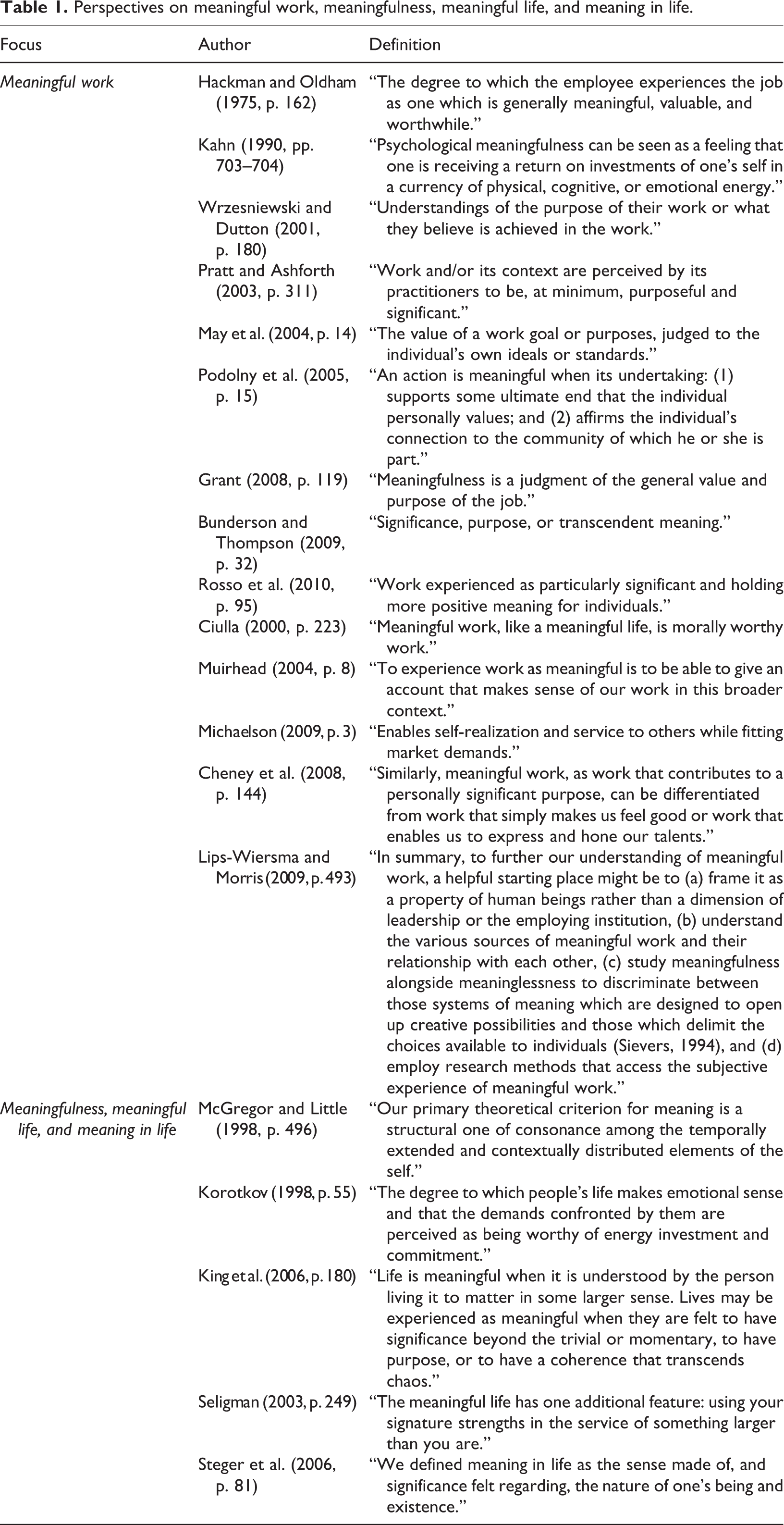
We conducted a broad review to explore what meaningful work is, drawing upon organizational studies, psychology, sociology, and to a lesser degree, philosophy and business ethics (see Table 1). Conceptualizations of meaningful work within organizational studies often rely upon examinations of meaningfulness generally. Likewise, research out of positive psychology has increasingly focused on meaningfulness in life. Because meaningfulness is a broader term than meaningful work, and because some scholars within organizational studies draw upon this broader term—especially those taking what we call a justification perspective—we included these perspectives in our review. Here we follow others (Rosso et al., 2010) and use the terms meaningfulness and meaningful work interchangeably.
Perspectives on meaningful work, meaningfulness, meaningful life, and meaning in life.
Central characteristics
Despite its broad and diverse application, there is some consensus around the central characteristics of meaningful work. Perhaps most generally, it is characterized as an individual-level phenomenon, illustrated by terms such as “perceptions” (Pratt & Ashforth, 2003), “understandings” (King, Hicks, Krull, & Del Gaiso, 2006; Wrzesniewski & Dutton, 2001), “judgments” (Cheney, Zorn, Planalp, & Lair, 2008; Grant, 2007; May, Gilson, & Harter, 2004; Podolny et al., 2005), “feelings” (Kahn, 1990; King et al., 2006; Steger, Frazier, Oishi, & Kaler, 2006), “sense made” (Korotkov, 1998; Steger et al., 2006), “accounts” (Muirhead, 2004), or even more directly as “experiences” (Hackman & Oldham, 1975; Rosso et al., 2010). More specifically, literature suggests the core of this phenomenon is positivity associated with an individual’s work. Taking each element of this definition in turn (positivity and work), meaningful work can be described as a positive phenomenon. Thus, whereas “meanings” of work may be positive, negative, or neutral, “meaningful” refers to positivity, though as we detail in what follows, meaningfulness may not always be experienced in terms of positive emotions (Pratt & Ashforth, 2003). To illustrate, definitions and discussions use terms such as amount of “positive meaning” (Rosso et al., 2010), “significance” (Bunderson & Thompson, 2009; Cheney et al., 2008; Pratt & Ashforth, 2003; Rosso et al., 2010; Steger et al., 2006), “value” (Frankl, 1959; Grant, 2007; Hackman & Oldham, 1975; May et al., 2004; Muirhead, 2004; Podolony et al., 2005) or “worth” (Ciulla, 2000; Hackman & Oldham, 1975; Korotkov, 1998; Lips-Wiersma & Morris, 2009). To further specify the nature of this positivity, scholars suggest meaningfulness is an indicator of eudemonia as opposed to hedonic notions of pleasure (e.g., Ryff, 1989; Seligman, 2003; Waterman, 1993). That is, notions of pleasure or positive emotion are not central to the characteristic of positivity in meaningful work.
While eudaimonia is central, scholars have offered varying interpretations and perspectives on eudemonia without a clear consensus (see Kashdan, Biwas-Diener, & King, 2008; Waterman, 2008). Some construe eudemonia in regard to notions of self-actualization and self-realization: “Eudaimonia has been described variously as happiness that emerges as a function of the satisfaction of organismic needs, self-realization or actualizing one’s potential [emphasis added]” (Heintzelman & King, 2014, p. 562). Other scholarship discusses eudaimonia in terms of activity endowed with virtue such that “one has ‘what is worth desiring and worth having in life’” (Telfer, 1980, p. 37, as cited in Waterman, 1993). As we note next, this difference is telling of broader divisions within conceptualizations of meaningful work.
Finally, meaningful is an adjective that modifies a noun. For organizational scholars, this noun is broadly associated with some facet of work. Perhaps surprisingly, research on meaningful work rarely defines work. Our review, however, identified two common themes regarding how work is viewed. First, when scholars refer to work they often imply the sphere of life commonly referred to as “paid labor” (Brief & Nord, 1990). Second, meaningful work is often discussed as a phenomenon that references a facet of an individual’s current working life. For example, Pratt and Ashforth’s (2003, p. 312) examination focuses on fostering meaningful work “in the workplace.” Likewise, theories of job design and job crafting focus on meaningfulness as a function of individuals’ current work conditions and not general questions about their thoughts and feelings toward the domain of work. However, the specific aspects of one’s current work life that meaningfulness references may vary. To illustrate, for some, work is viewed through the lens of discrete work activities and tasks (Wrzesniewski & Dutton, 2001), personal projects (McGregor & Little, 1998), a collection of tasks in the form of a job (Hackman & Oldham, 1980), one’s broader work career (Hall & Chandler, 2005), or work within one’s life or existence (Bellah, Madsen, Sullivan, Swidler, & Tipton, 1985/1996; Bunderson & Thompson, 2009).
Within these broad areas of agreement, however, important distinctions remain. Our central proposition is that two basic perspectives on meaningful work become apparent in light of how scholars implicitly or explicitly conceive of the core problem or barrier to meaningful work, and consequently, the corresponding solutions scholars forward to facilitate meaningful work. Put differently, premises about the nature of the problem that prevents meaningful work and their corresponding solutions illuminate fundamentally different assumptions about what meaningful work is. These distinctions became particularly apparent by examining discussions of meaningfulness and meaningful work in Table 1 within the broader context of the books and articles in which they appear.
We unpack these two ideal-type perspectives of meaningful work that we label “realization” and “justification.” We use the term “ideal-type” to denote that each perspective is a pure type—an analytical abstraction of specific features—that is not intended to capture every nuanced difference and characteristic of how scholars conceive of meaningful work. The value of ideal-type distinctions is that they illuminate important underlying assumptions that can guide new theory building and testing (Doty & Glick, 1994).
A realization perspective
We use the term “realization perspective” to denote treatments of meaningful work that center on meaningfulness via fulfillment of needs, motivations, and desires associated with self-actualization. This perspective becomes apparent in light of the core problem scholars implicate as the barrier to meaningful work, and by implication, the theorized solutions to address this core problem.
Core problem
One way to illuminate key differences regarding conceptualizations of meaningful work comes from identifying the underlying core problem scholars imply needs remedying in order to facilitate it. Scanning across studies that implicate meaningfulness and meaningful work, one common underlying problem appears to focus on what some have conceptualized as alienation. Following others, we refer to alienation as a “worker’s ‘separation’ from effective control over his [sic] economic destiny; of his [sic] helplessness; of his being used for purposes other than his own” (Dean, 1961, p. 754; see also Seeman, 1959). We use this term for two reasons. First, Hackman and Oldham (1975, p. 159) use the same term in the opening line of their paper as a key problem and motivation for formulating the job characteristics model—a foundational paper in organizational behavior that focuses on meaningfulness.
Second, alienation usefully captures the overly narrow, routine, prescribed, controlling, and ultimately constraining work conditions scholarship documents as problematic to meaningful work. For instance, some scholarship on meaningful work equates alienation in terms of “prescription and domination” (Lips-Wiersma & Morris, 2009, p. 494), suggesting a key barrier to meaningful work is constraint and limited autonomy. Indeed, these work conditions, perhaps best exemplified in Taylorism and scientific management (F. W. Taylor, 1911), and its focus on efficiency, control, and standardization, were motivating factors behind the job characteristics model (Hackman & Oldham, 1980). One sees similar problematic working conditions serving as a motivating backdrop to research on meaningful work as seen in other constraining contexts such as assembly line work (Blauner, 1964), call centers (Grant, 2008), machinists (Hackman & Oldham, 1980), and hospital cleaners (Wrzesniewski & Dutton, 2001). These problems remain well researched due to impoverished working conditions facing many workers today. Meaningful work is therefore a relevant and important phenomenon in organizational studies because certain work conditions can produce alienation, a correspondingly lack of meaningfulness, and ultimately lower well-being, motivation, and performance (Hackman & Oldham, 1980).
Solution
If the core problem or barrier to meaningful work is constraining work conditions that drive alienation, then it is not surprising that solutions focus on enriching individuals’ work. This logic is embedded in several influential theories of meaningful work. For instance, Pratt and Ashforth (2003) suggest one main avenue to produce meaningfulness is through practices on enriching individuals’ work: what they describe as “meaningfulness in work” practices. Other influential theoretical perspectives commonly referenced in the meaningful work literature including the job characteristics model (Hackman & Oldham, 1980), relational job design (Grant, 2007), and job crafting (Wrzesniewski & Dutton, 2001) similarly focus on enriching work. 1 What varies across these different theories is the “agent” that enriches the work, either in a relatively top-down fashion (e.g., job design and relational job design) or a bottom-up fashion (e.g., job crafting).
Work enrichment counters alienation, and correspondingly produces meaningfulness, by specifically enabling achievement of certain psychological needs, motivations, and desires that were prevented in constraining work contexts: specifically the realization of the self. Given alienation is conceptually tied to notions of prescription, domination, inauthenticity, and limited autonomy, the logical focus of work enrichment efforts centers on generating the opposite of these constraining conditions: autonomy, authenticity, self-efficacy, and the like. It is therefore perhaps not surprising to find that discussions of meaningful work have been closely tied to various psychological needs, motivations, and desires including self-efficacy, autonomy, competence, authenticity, and self-worth (for summary see Rosso et al., 2010). For instance, a meta-analysis of the job characteristics model found that meaningfulness is closely associated with autonomy, skill variety, and performance feedback (Fried & Ferris, 1987). Subsequent research has found that job enrichment—composed of characteristics such as variety of skills, task accomplishment, and autonomy among others—and job engagement—being fully involved, emotionally invested, and intrinsically motivated—have a strong positive association with meaningfulness (May et al., 2004). What all these theories and findings suggest, however, is that enriching work to enable opportunities for workers to overcome these constraining working conditions is conceptually bound with notions of meaningful work.
In aggregate, meaningfulness derived from the aforementioned psychological needs, motivations, and desires that overcome alienation, which are achieved through work, echo theories of self-determination (Ryan & Deci, 2000) and discussions of self-realization (Waterman, 1993). Indeed, self-determination theory focuses on issues of autonomy and competence, and discussions of self-realization focus on personal expression, authenticity, and self-worth (Waterman, 1993). Similarly, scholars of meaningful work use similar terms suggesting meaningful work is tied to notions of self-realization (Michaelson, 2009) or return on investments of the self (Kahn, 1990; see Table 1). Psychologists similarly suggest meaningfulness is fundamentally about realizing the self, describing meaningfulness as “the consonance among elements of the self” (McGregor & Little, 1998, p. 505). Enriching work, then, produces meaningful work through the fulfillment of various needs, desires, and motivations central to self-realization by countering conditions that alienate the self from work.
Summary
Taken together, the previous review illustrates a general logic. Constraining work conditions produce alienation and prevent meaningful work by limiting the ability to realize the self. Solutions, therefore, focus on enriching work conditions such that individuals can realize the self through work, and correspondingly, work meaningfulness. Thus, the “positivity” inherent in meaningful work is conceptualized by the self being or becoming fully expressed and realized in one’s work. 2
A justification perspective
Beyond the realization perspective, we propose a second, albeit less developed perspective on meaningful work; one whose existence can be ascertained in threads interwoven across organizational studies, psychology, and sociology. This perspective implicates an underlying core problem focused on the subjective experience of uncertainty and ambiguity regarding the value or worth of one’s work. Correspondingly, solutions in this perspective seem to focus on enriching social meanings and individuals’ meaning-making such that individuals can develop an account or justification regarding why their work is worthy or valuable. This core problem and corresponding solution are suggestive of a second general perspective on meaningful work—namely, that meaningful work fundamentally involves accounts that justify the worthiness of work. In light of these assumptions, we label this perspective, justification.
Core problem
Scholarship that examines meaningful work from a justification perspective begins with a core problem that fits what some describe as anomie. 3 By anomie we mean the subjective experience of uncertainty and ambiguity regarding basic norms, values, and conceptions of value or worth (Durkheim, 1893/1984; see also Seidman, 1985). Some describe anomie as “a painful uneasiness or anxiety, a feeling of separation from group standards, a feeling of pointlessness or that no certain goals exist” (cited in Dean, 1961, p. 754). Thus, what some conceptualizations of anomie generally capture, and what is central to the justification perspective, is the problem of when individuals face uncertainty and ambiguity regarding basic definitions of worth, morals, or “goodness.” As we will illustrate in the following lines, we use this term because it provides a broad overarching label that effectively captures many scholars’ discussions of relevant problems associated with meaningfulness.
This core problem of uncertainty and ambiguity over standards of worth is illustrated in several treatments of meaningfulness and meaningful work. To illustrate, Baumeister (1991, p. 119) argues that justifying the worth of one’s work is the central problem of meaningfulness, “The only need for meaning that work often fails to satisfy is value. From society’s perspective work is often deficient in justification.” Baumeister (1991, p. 92) goes on to argue that the social accounts that currently provide worth tend to be more uncertain and ambiguous than in previous times: “Modern individuals find their sources of justification to be fewer, to be fuzzier, and to be more full of gaps and ambiguities, in comparison with people who lived in previous eras.” This seemingly echoes Frankl’s (1959, p. 129) discussion of the “existential vacuum” and the “Sunday neurosis” where individuals “become aware of the lack of content in their lives when the rush of the busy week is over and the void within themselves becomes manifest.” This theme of difficulty justifying worth is also central to Bellah et al.’s (1985/1996) Habits of the Heart—a well-cited piece in discussions of meaningful work within organizational studies—that identified the limitations of Americans’ “moral discourse.” In particular, they argued the central problem that Americans face is how they justify the moral value of their lives and work: “For most of us, it is easier to think about how to get what we want than to know what exactly we should want” (Bellah et al., 1985/1996, p. 21).
Comparable notions can be found in other treatments. For instance, Gardner, Csikszentmihalyi, and Damon (2001, p. 5) allude to a similar problem in their examination of professionals and meaningful work: the central problem for professionals is not “creature comforts” but the construction of accounts that provide “the ability to know the right thing to do and remain in their professions.” Within the sociology of work literature, Sennett (2006, p. 1983) argues that individuals lack “values” or “anchors” to competently justify what makes work worthy: “What they [workers] need most is a mental and emotional anchor; they need values which assess whether changes in work, privilege, and power are worthwhile.”
Finally, Weber’s discussions of meaningfulness emphasized the challenges posed by modernity, and in particular, the problem of an “existential dilemma” that occurs when major institutions lose their ability to justify. Seidman (1983, p. 268) summarizes Weber’s view accordingly: Humans need to make sense of those occurrences which appear unfathomable; religion elaborates theodicies and interpretations of life which explain the extraordinary and justify the routine orders of daily life…Thus the question arises: in so far as science cannot speak to the need for a meaningful cosmos, and religion has lost its cognitive preeminence, how and in what form is the individual to endow life with meaning and purpose. Weber concluded that the modern individual faces an existential dilemma unknown in its intensity and clarity to previous epochs: the problem of meaning.
Note the previous discussion focuses on problems of uncertainty and ambiguity in regard to worthiness or value. Thus, meaningfulness and meaningful work do not seem to focus on understandings of “why does” or “why must” one work. Rather, meaningful work seems to answer some question like, “why is my work worth doing?”
Taken holistically, the previous review implies a different core problem than the realization perspective. In the realization perspective, meaningful work addresses the problem of when individuals face working conditions that constrain the ability to realize the self in what one does, and correspondingly, meaningfulness. Put another way, the central problem here are conditions that prevent, constrain, withhold, or suppress individuals in their pursuit of meaningfulness via self-realization through work. In a justification perspective, the problem is perhaps more existential in nature—it suggests fundamental uncertainty or ambiguity regarding the basic worth or value of the work individuals are engaged in. Thus, in the justification perspective, the value or worth of individuals’ work is not predetermined, known, or easily accounted for. Worth is not inherent in the nature of the tasks one performs. Rather, it is “up for grabs” and must be interpreted and constructed. The core assumption, then, is that individuals are meaning-makers facing a world that can appear, at times, senseless and devoid of value. Therefore, the problem is not so much impoverished and constraining working conditions, but a situation of impoverished and uncertain meanings.
Core solution
If the core problem in this perspective is impoverished meanings, then the solution is to create “better” meanings. Although less research has specifically focused on solutions to this core problem, literature generally suggests that focusing on individuals’ account-making activity can correspondingly provide insights on building meaningful work. We refer to these general solutions as “account-making” because they align with prior discussions of how individuals justify worth in situations characterized by uncertainty and ambiguity. For instance, Wuthnow (1996, p. 93) drawing upon C. Taylor (1989), describes accounts in the following way: An account goes beyond the mere assertion that we desire (or do not desire) to work—perhaps because we need to eat or want to buy something nice for ourselves. An account provides a legitimate answer to the question, “Why is this desire of value?”
This account-making activity is illustrated in several works. For instance, Frankl (1959, p. 126) draws on Nietzsche to suggest that, “He who has a why to live can bear almost any how.” That is, the ability to develop an account for “why” someone engages in action can build a sense of meaningfulness, by adequately justifying it as worthy. Pratt and Ashforth (2003) draw upon Frankl to similarly argue that meaningful work answers a question that prompts justification: “why am I here?” (see also Lips-Wiersma & Morris, 2009). Similarly, Baumeister’s (1991, p. 92) extensive discussion of the value gap—a situation characterized by “the relative lack of firm, consensually recognized values”—highlights the importance of shared values in individual account-making. Specifically, Baumeister focuses attention on the role of culture in providing various “value bases”—rationales that sufficiently justify or legitimize the value or worth of an action—including tradition, the self, and religion amongst others. Such value bases are important means by which individuals account for their work and working lives as worthy. Pratt and Ashforth (2003) similarly suggest that social practices that enrich meanings surrounding individuals may be the lot of transformational/visionary or charismatic leaders who engage in building organizational cultures and ideologies in order to foster meaningful work.
This specific connection to the role of charismatic-transformational leadership in fostering meaningful work echoes other research that suggests that meaningfulness comes about through “infusing work and organizations with moral purpose” (Shamir et al., 1993, p. 578). In particular, leaders are construed as agents that attempt to shape followers’ understanding of the valor and worth of their efforts—as they say, “that by making the effort, one makes a moral statement” (Shamir et al., 1993, p. 582). 4 In short, this research suggests that the “raw material” for accounts and account-making may lie, at least in part, outside of individuals, such as in organizational and societal cultures, and may be communicated to workers via organizational members, such as leaders.
This focus on meaningful work as account-making—that is, justifying value in the face of uncertainty—is further illustrated in the terms used to define meaningful work. To illustrate, scholars use terms such as sense made (Korotkov, 1998; Steger et al., 2006), understandings (Wrzesniewski & Dutton, 2001), searching (Frankl, 1959), justification (Bellah et al., 1985/1996; M. Weber, 1930), and even accounts (Muirhead, 2004) in definitions and discussions of meaningfulness (see Table 1). Likewise, meaningfulness is often defined with the term purpose (Grant, 2008; King et al., 2006; May et al., 2004; Pratt & Ashforth, 2003; Wrzesniewski & Dutton, 2001), which speaks to reasons or explanations.
Summary
The discussion in the previous lines suggests a second broad perspective on meaningful work. From this perspective, subjective uncertainty and ambiguity regarding why one’s work is worth doing—what some refer to as a problem of anomie—is the principal barrier to meaningful work. Workers face situations where the social meanings that surround them are insufficient in rendering their work as worthy. More generally, this assumes that meaningful work involves account-making, where individuals seek to justify their work as possessing positive worth. As a result, solutions have tended to focus on enriching this account-making activity, often by enriching the social meanings in their environment. Thus, the “positivity” inherent in meaningful work from a justification conceptualization is the ability to account for one’s work as worthy.
Illustrating two perspectives: Research on callings
Returning to our example from the Introduction, research on callings provides an illustration of these two perspectives. One view of callings emphasizes personal passion and intrinsic fulfillment, which imply a realization perspective. Here callings have been defined as “a consuming, meaningful passion people experience toward a domain” (Dobrow & Tosti-Kharas, 2011, p. 1003), which is operationalized through items that index qualities such as personal passion, satisfaction, enjoyment, and involvement (Dobrow & Tosti-Kharas, 2011). A similar notion is found in definitions that capture “fulfillment that doing the work brings to the individual” (Wrzesniewski, McCauley, Rozin, & Schwartz, 1997, p. 22). Underlying such views is an image of realization—that one experiences meaning when one is inspired, personally passionate, agentic, and living in accordance with one’s true potential and talents. It is then perhaps not surprising that constructs such as work engagement, job involvement, and intrinsic motivation are strongly correlated with this conceptualization of callings (Dobrow & Tosti-Kharas, 2011).
A very different view on callings, however, is illustrated in the classical or “neo-classical” conceptualizations. Here, callings appear alongside existential questions related to the worth of one’s working life and why an individual exists more generally. For example, in “classical” formulations, one had a duty to discover where one’s talents and skills in work could best be realized in order to glorify God (M. Weber, 1930). Similarly, while neo-classical definitions of callings drop references to God, they emphasize the notion of discovering or “finding one’s destined place in society, and more specifically, within the occupational division of labor” (Bunderson & Thompson, 2009, p. 38). The notion of fate or destiny is similarly suggested in definitions of callings that emphasize “a transcendent summons, experienced as originating beyond the self” (Dik & Duffy, 2009, p. 427).
Moreover, the use of words such as “find,” “discover,” and “destiny” suggests that callings in this view are elusive, need to be confirmed, and therefore are not readily apparent. That is, one needs to engage in account-making to know whether the signs one receives are indicative one has indeed “found” one’s calling. What is at issue, therefore, is not simply the degree to which one is passionate about and fulfilled by a particular occupation or work activity. Rather, the question is whether this passion is evidence of the place one is destined to fill. Echoing our points about justification, Baumeister (1991, p. 126) notes, “Work tends to have a shortage of value and justification…Callings are typically linked to some powerful value base, and so this sort of work may be experienced as highly legitimized and justified.”
While research in this area is sparse, research on neo-classical callings shows an association with these types of callings and sacrifice, responsibility, and moral duty. These appear somewhat distinct from the notions of intrinsic motivation and personal passion as found in other conceptualizations of callings referenced before (Dobrow & Tosti-Kharas, 2011). Taken together, research on callings illuminate assumptions that embody two perspectives offered here: realization and justification.
Comparing perspectives
Our discussion of these two perspectives raises questions regarding the way in which they converge and diverge, as well as the implications of the distinction between the two perspectives. Regarding convergence, we suggest both perspectives address issues of meaningfulness and both are highly relevant in today’s workplaces. Indeed, as long as workers experience alienation and anomie, both perspectives are important to understanding how and why meaningful work is cultivated in organizations. Thus, scholarly understanding of meaningful work is necessarily limited without due consideration of each.
A puzzling point of both convergence and divergence, however, is that perspectives may employ similar terms or concepts, but imply quite distinct interpretations regarding their connection with meaningful work. Put differently, the assumptions underlying each perspective suggest the same term or concept takes on a quite different role in meaningful work. We illustrate the divergent implications found in each perspective in an example focused on the term “self-efficacy.”
Drawing from a recent review of the meaningful work literature (Rosso et al., 2010), it has been suggested that “self-efficacy” is conceptually tied to meaningful work. According to the realization perspective, self-efficacy drives meaningful work because it combats the constraining, impoverished working conditions implied in this perspective. What is more, self-efficacy is a critical psychological mechanism linking characteristics of work with meaningfulness. Thus, meaningfulness derived from performing tasks on my own (autonomy) may facilitate meaningfulness because it increases self-efficacy. From a justification perspective, however, self-efficacy acts like a compelling account that individuals employ to justify to themselves, or to others, why their work is worthy. One does not find meaningfulness because the work provides self-efficacy. Rather, the label “self-efficacy” is part of the raw materials for an account or rationale that I tell others and myself about why my work possesses positive worth.
Due to this overlap in language, it is easy to see why the perspectives have traditionally been difficult to discern. However, we believe the different implications and interpretations of the same term reflect an even deeper divergence between the perspectives. At a general level, one could view the previous example to suggest that realization and justification perspectives are just two “paths” to the same “destination”: meaningfulness. However, we believe such a conclusion would be incomplete at best, and possibly misleading.
We propose that although both perspectives broadly share a focus on positivity associated with an individual’s work, the nature of the problem they implicate and the basic question they appear to ask imply two distinct “destinations” regarding the nature of meaningful work. Put differently, we suggest that each perspective implies a distinct type of “meaningfulness.”
The general ways in which realization and justification perspectives converge and diverge seem roughly akin to the relationship between organizational commitment and organizational identification. Regarding convergence, both organizational commitment and organizational identification, at a very broad level, discuss an individual’s attachment to an organization making them focused on a broadly similar phenomenon. This also appears to be the case with realization and justification perspectives in that they focus on “positivity” associated in an individual’s work. At the same time, like identification and commitment, these terms diverge and are still conceptually distinct (van Knippenberg & Sleebos, 2006). One way to conceive of this divergence between organizational identification and organizational commitment is in terms of the questions they ask: What both of these views [attitudinal and economic views of commitment] lack, however, is a deeper understanding of the differences between organizational identification and organizational commitment. Perhaps the most salient distinction is that identification explains the individual–organizational relationship in terms of an individual’s self-concept; organizational commitment does not. As such, the two seem to ask very different questions. Organizational commitment is often associated with “How happy or satisfied am I with my organization?”…Organizational identification, by contrast, is concerned with the question, “How do I perceive myself in relation to my organization?” (Pratt, 1998, p. 178)
One implication of a justification perspective, however, is that it “relativizes” meaningful work. That is, it suggests that the ways in which individuals justify the worth of their work—for instance, in terms of individual financial success, realizing the self, helping others, or glorifying God—may be equally viable. Of course, these and the other claims we have made need to be empirically verified. Moreover, they beg further questions such as, are accounts around self-fulfillment better than other accounts (e.g., “providing financially for one’s family”)? Does achieving “meaningful work” from these perspectives differ in terms of antecedents and outcomes? It is to these and similar questions that we now turn.
Research agenda
In this section we propose a research agenda that builds from a justification perspective on meaningful work. We focus our attention here given the underdeveloped nature of this perspective, and because theories central to a realization perspective (e.g., job design) have been explored in detail (see Rosso et al., 2010, for review). As we have suggested, the realization perspective arose, at least in part, to help explain how changes in work (e.g., routinization, assembly lines, etc.) alienated individuals from the tasks they performed. Not surprisingly, a fair amount of research has focused on improving the nature of the work itself. From a justification perspective, however, the core problem is uncertainty and ambiguity regarding worth. We have implied that this perspective may have arisen, at least in part, from a decline in traditional “account granting” institutions (e.g., religion). We further have suggested that individuals create accounts to help overcome this problem. Thus, our research agenda begins by exploring the nature of accounts, specifically: where do accounts come from and how do individuals engage in account-making? We then turn our attention towards better understanding what outcomes might emerge from “successful” account-making. That is, we explore what outcomes might be associated with meaningfulness that comes from overcoming anomie related to work. We also explore how meaningfulness from each perspective might relate to one another.
Where do accounts come from?
Earlier, we have suggested that accounts are shaped, at least in part, by the social context. But where do individuals (as well as their coworkers and leaders) find accounts? Building from our arguments outlined here, the accounts individuals make to justify the worth of their work are largely a function of social, cultural, and institutional contexts (Baumeister, 1991; M. B. Scott & Lyman, 1968; M. Weber, 1930; Wuthnow, 1996). That is, social, cultural, and institutional contexts delimit the acceptable, reasonable, and feasible ways in which individuals explain, legitimize, and make sense of their behavior. In this way, these contexts constitute the “toolkits” or resources—scripts, schemas, narratives, symbolic boundaries, collective identities, symbols—individuals draw upon to construct and account for the worth of their work (see Swidler, 1986; K. Weber & Dacin, 2011). The notion that an individual’s ability to account for the worthiness of their work is largely a function of social, cultural, and institutional contexts is implicated in scholarship that we have attributed to a justification perspective. To illustrate, scholars and colleagues such as Weber (1930) and Bellah (1985/1996) suggest that justifying why one’s work is worthy comes from cultural and institutional sources. Indeed, Baumeister, Vohs, Aaker, and Garbinsky note (2013, p. 506) that meaningfulness, at its core, is cultural in nature: Appraising the meaningfulness of one’s life thus uses culturally transmitted symbols (via language) to evaluate one’s life in relation to purposes, values, and other meanings that are also mostly learned from culture…meaning itself is not personal but rather cultural…An individual’s meaningfulness maybe be a personally relevant section of that giant, culturally created and culturally transmitted map.
Yet, scholarship suggests that these accounts of worth are not a truism and instead vary across time, class, and culture (e.g., Baumeister, 1991; M. Weber, 1930). This raises basic questions about why some social accounts that confer worth prevail over others and the mechanism by which these accounts change. Why, for instance, are “making lots of money” or “following God’s path” seemingly less prevalent accounts of worth in certain contexts and certain times compared with others? Likewise, studies suggest workers increasingly look to work for an organization that espouses a “higher purpose” (Kelly Global Workforce Index, 2009; Lancaster & Stillman, 2010). In light of this, why have accounts such as “shareholder value” or even “greed is good” become seemingly absent in how workers construe the worthiness of their work? Is there a relationship between more macro societal meanings and specific accounts of worth associated with work? Finally, why do accounts pervade in some contexts and not others? Again, content analysis could at least track the prevalence of different “motives” within different contexts across different time periods. But it might take a broader historical or institutional analysis to better tease out how changes in cultural institutions might promote or constrain certain accounts.
Furthermore, in light of the social, cultural, and institutional sources of accounts, scholars should also examine the specific features of these accounts that effectively confer worthiness to individuals’ work. Put differently, are all accounts equally effective? Why might some social, cultural, or institutionally based accounts be more effective in generating individuals’ perceptions that their work is worthy? Questions such as these suggest the need to better understand the account-making process.
How does account-making happen?
As noted, research needs to not only understand “where” accounts can be found, but also how they are used. Put another way, what is the process by which accounts are created, adopted, and used by individuals? Given the paucity of research in this area, inductive qualitative studies of “account-making” would go a long way towards understanding this meso-level process. In particular, ethnographic methods, given their focus on cultural understandings might be particularly critical (Pratt & Kim, 2012). Before this happens, however, researchers should first explore research in cultural sociology that has looked at the relationship between individuals and culture more generally (see Swidler, 1986 and Vaisey, 2009, for different explanations of this relationship).
One particularly promising cultural mechanism to examine this question of cultural account transmission, and account-making more generally, is through the concept of framing. Indeed, framing is one central mechanism used to examine cultural processes (Small, Harding, & Lamont, 2010). Framing focuses attention on how information is communicated, construed, and packaged by one party in order to affect the beliefs, motivations, and actions of another (Cornelissen & Werner, 2014). This mechanism offers an attractive starting point because it offers a lens on the processes and features of communication through which action and goals are justified. For instance, the concept of strategic framing within the social movement literature explores the various dimensions of diagnostic, prognostic, and motivational frames that identify, motivate, justify, and sustain action relative to a social problem (Benford & Snow, 2000). Therefore, framing could be a particularly fruitful avenue to examine drivers of meaningful work from a justification perspective because it focuses on how action and goals are justified and explicitly connects with the broader social, cultural, and institutional context from which accounts are generated.
There are several important questions to explore within this line of inquiry. One natural starting place would be to examine the rationales and vocabularies of motives (Mills, 1940) embedded in mission statements, stories, and the like that organizations use to communicate why they create goods and provide services. For instance, what frame content effectively promotes worthiness and why? Selznick (1957, p. 151) long ago argued that meaningfulness is created through “socially integrating myths” that “state, in the language of uplift and idealism, what is distinctive about the aims and methods of the enterprise.” Although he proposed this should occur, he failed to say how (W. R. Scott, 1987). Additionally, some organizations today—even for-profit organizations—espouse they exist for a “higher purpose.” Why might this kind of content effectively generate worthiness for members as opposed to other kinds of content? One answer might be found in the ways in which organizational accounts generate cultural “resonance” with broader themes in society (Glynn & Watkiss, 2012).
Similarly, scholars should also ask, “under what conditions will organizational members accept particular accounts, especially from their organizations?” For example, the accounting firm KPMG recently launched an internal initiative that framed their accounting work as facilitating the election of Nelson Mandela and the launch of NASA’s first space station (Feintzeig, 2015). This raises theoretical questions about what is required to make these lofty frames resonate such that workers—in this case, accountants—conceive of their work as worthy because it seemingly supports social change or national patriotism? For instance, do workers require certain kinds of “evidence” that help make the account a tangible reality? What framing strategies are required to effectively link “financial accounting” with “patriotism and social change?” One potential starting point for theorizing comes from research on mediatory myths (Abravanel, 1983). This research examines the framing work required to address gaps between an organization’s ideological commitments and the politics and practices through which their ideological commitment are said to be enacted through.
Taken together, this line of inquiry enriches understanding of meaningful work by shifting attention to the social, cultural, and institutional contexts in which these accounts of worth originate. Note that such an analytical focus is largely absent in a realization perspective. Thus, the addition of a justification perspective, and this associated line of inquiry, provides a compelling and specific theoretical rationale to answer recent calls for greater attention to the role of social, cultural, and institutional contexts in meaningful work (see Rosso et al., 2010). Additionally, this shift in attention also points to mechanisms that move beyond the self, suggesting meaningful work may be structured “from the outside in” thereby expanding our understanding beyond psychological mechanisms that are the traditional focus within organizational studies (Rosso et al., 2010; see Wrzesniewski, Dutton, & Debebe, 2003 for exception).
Outcomes from a justification perspective
We have suggested that justification and realization perspectives are indeed two distinct “types” of meaningfulness, not simply two paths to the same outcome. This begs the question of whether there might also be distinct outcomes associated with achieving meaningfulness (i.e., successful “account-making”) from a justification perspective as compared with a realization perspective. Indeed, as the previous example of callings illustrates, outcomes seemingly vary depending on the perspective one adopts. In what follows we speculate about how two potential outcomes might vary between perspectives and encourage scholars to examine if and how these and other outcomes of meaningfulness may differ between perspectives.
First, we might expect that achieving meaningfulness from a justification perspective would result in greater persistence in work activities involving self-sacrifice. Indeed, central to Bunderson and Thompson’s (2009) study of zookeepers is the notion that persistence in this job involves having a reason for giving up pay, family time, and prestige to care for animals, sometimes under very challenging circumstances. Providing an account of worth can sustain volitional persistence in the face of these obstacles and challenges by serving as a symbolic touchstone to legitimize effort. As Wuthnow (1996, p. 133) argues: Staying committed to one’s work is an ongoing process (which is why people burn out, become discouraged, and make career changes). What sustains commitment in this ongoing way is not so much the monthly paycheck or the annual promotion, but the ability to call up stories about why we are doing what we do.
Second, because accounts that confer feelings of worthiness do so, in part, because of the account’s resonance with social norms and values (Selznick, 1957; Wuthnow, 1996), we also suggest that a distal outcome of experiencing meaningful work via a justification perspective maybe an increased experience of social validation and support. For instance, when work is justified as worthy because it helps the environment—as opposed to, for instance, helping shareholders—individuals can experience connection with shared cultural expectations of what is good, appropriate, and worthwhile. As Wuthnow (1996, p. 95) suggests: Accounts are the connective tissue between activities and their social context. Their role or purpose is to render activities meaningful and legitimate in relation to certain features of their normative milieu. Accounts of work link this activity with some part of the culture in which it occurs.
While discovering the differences in outcomes across the two perspectives would be a fruitful area of research, another promising avenue is to examine whether and how the two types of meaningfulness might work together (or not) in producing outcomes. In particular, if and how does achieving or not achieving meaningfulness from either perspective affect achieving or not achieving meaningfulness from the other perspective? There are certainly a host of potential relationships between these two perspectives, and speculating about all the permutations is beyond the scope of this paper. That being said, we briefly speculate some ways in which scholars could explore if and how they relate to one another.
To illustrate, the empirical puzzle that opened this paper centered on how even professionals—those who are perhaps most likely to experience enriched work conditions conducive to meaningful work from a realization perspective—somehow seemed to still lack meaningfulness. On the face of it, this example would suggest that the two types of meaningfulness are not completely compensatory. That is, having meaningfulness from overcoming alienation does not stop people from searching for meaningfulness that comes from overcoming anomie. But we do not know if individuals who have meaningfulness that comes from overcoming anomie might nonetheless seek out meaningfulness from overcoming alienation. These are empirical questions.
The relationship between the different types of meaningfulness may depend, at least in part, on the particular situation. In the previous example, work conditions were such that realization was possible, but justification was difficult. But what if that was not the case? Take for instance, a worker who experiences enriched work conditions, and through actualizing their self, comes to experience their work as meaningful. This experience, in turn, may prompt individuals to justify the worth of their work in a similar way—namely, the work I do is worthy because it enables me to develop my skills, pursue my passions, and grow as a person. In this sense, the experience of meaningfulness from a realization perspective may facilitate meaningfulness from a justification perspective. However, given what we have argued about a justification perspective, such “alignment” would be most likely to occur in cultures that have built-in accounts for justifying one’s work in this way. Again, this is an important avenue for future research to further disentangle and empirically examine how these perspectives relate to one another.
Summary and conclusion
Meaningful work has been and is again becoming a central issue in organizational scholarship. We propose that research in meaningful work has tended to lump different types of meaningfulness in the same way. In doing so, research has failed to capitalize on two potential sources of “positivity” that may come from one’s work: (a) realizing one’s self through work, and (b) being able to account for worth of one’s work. By recognizing the latter source, scholars and practitioners can not only solve new puzzles (e.g., the lack of meaningfulness in seemingly enriched work), but can look to new sources (e.g., cultures and accounts) for fostering meaningful work.
Footnotes
Declaration of Conflicting Interests
The author(s) declared no potential conflicts of interest with respect to the research, authorship, and/or publication of this article.
Funding
The author(s) received no financial support for the research, authorship, and/or publication of this article.