




Abstract
Given the steady increase in new leadership models and approaches introduced to the field, we provide a systematic review on the topic of construct proliferation in the leadership style literature. Construct proliferation suggests that newly designed constructs are too similar to existing ones and, consequently, lack discriminant validity. In our review, we tackle the issue of construct proliferation from two perspectives. First, we present explanations and evidence indicating construct proliferation. Then, we take the opposing stance and provide arguments (as well as empirical evidence) against it. This comparison results in a discussion in which we provide cues for future leadership style research that builds on the realization that we need a more nuanced awareness of where construct proliferation exists and where it does not.
Introduction
Organizational leaders are crucial contributors to the success and survival of organizations. They are responsible for implementing an organization’s mission through motivating followers, setting goals, and structuring work assignments (Yukl, 2010). As their importance is widely acknowledged in academia, decades of research have been devoted to gain insights into how effective leaders can be differentiated from ineffective ones (Day & Antonakis, 2012). Although dispositional and contingency theories have received academic attention, the majority of empirical and conceptual work has focused on leaders’ actual leadership behavior and behavioral styles (Day & Antonakis, 2012). A conceptual focus on leadership styles has become prevalent, as research shows that styles (or sets of behaviors) are more salient and more observable compared to leader traits (Zaccaro, 2007), can be developed through leadership training (Barling, Weber, & Kelloway, 1996), and, importantly, are proximal determinants to various leadership outcomes including task and contextual performance, satisfaction, and well-being (Judge & Piccolo, 2004; Ng & Feldman, 2015). In particular, the 2000s and 2010s have seen an unprecedented increase in different models and styles of leadership introduced to and discussed in the literature. Illustrative of this development, Meuser et al. (2016) counted up to 49 different leadership approaches and theories in published leadership research between 2000 and 2013. While early leadership style research followed a rather parsimonious and simple approach to the actual behaviors of effective leaders (Fleishman, 1953), the magnitude of different angles proposed in recent years is in drastic contrast.
Given this development, researchers are starting to address issues of potential conceptual redundancy among the different leadership styles (Borgmann, Rowold, & Bormann, 2016; Hoch, Bommer, Dulebohn, & Wu, 2018; Meuser et al., 2016; Rowold & Borgmann, 2013). In other words, developments from recent years may have led to a point where leadership theory suffers from construct proliferation (Le, Schmidt, Harter, & Lauver, 2010). Construct proliferation stands for the notion “wherein the observed correlations of new constructs with existing constructs are so similar and their patterns of correlation with other variables are so alike to suggest that they may be redundant” (Cole, Walter, Bedeian, & O’Boyle, 2010, p. 1552). Construct proliferation is particularly problematic as it indicates a lack of discriminant validity among variables of interest and, subsequently, represents a violation of the law of parsimony (entities are not to be multiplied unless necessary). To put this issue into perspective, Le et al. (2010, p. 112) stated that “science that ignores the mandate for parsimony cannot advance its knowledge base and achieve cumulative knowledge.”
Building on Yukl, Gordon, and Taber (2002), we address the issue of construct redundancy in the leadership style literature. Specifically, we focus on a selection of leadership models and constructs as potential subjects of construct proliferation. The different leadership styles considered in this paper are initiating structure, consideration, transformational leadership, transactional leadership, laissez-faire, ethical, charismatic, servant, authentic, and instrumental leadership. Although we provide a rationale for this selection in a later section, it should be noted that our focus is exclusively on hierarchical leadership. That is, leaders, as the sources of leadership, are in the superior hierarchical position compared to their followers, who are the recipients of leadership. Bottom-up or peer leadership such as shared leadership styles are also promising approaches to the study of leadership but are explicitly not part of this work.
There is preliminary research on construct proliferation in the domain of leadership style research (Graen, Rowold, & Heinitz, 2010; Shaffer, DeGeest, & Li, 2016). Still, insights into this field remain limited as existing work either covers multiple leadership models but applies a single-study and single-method design (Shaffer et al., 2016), or has a broad, often meta-analytical empirical foundation while covering only a handful of leadership models (Hoch et al., 2018). In this paper, we extend research by considering a plethora of leadership styles and by reviewing and integrating diverse empirical approaches. In so doing, we provide a comprehensive assessment of the state of construct proliferation in leadership style research with a focus on pro- and contra arguments and evidence. The goal is to develop a theoretical heuristic as well as an extended step-by-step template that should assist leadership researchers in their efforts to design and conduct future studies capable of overcoming issues related to construct proliferation, which are prevalent in contemporary research.
A taxonomy of leadership style constructs
In order to discuss potential construct proliferation between leadership style constructs, a metamodel of leadership styles would be helpful. Yukl et al. (2002) created such a metamodel where many, if not all, contemporary approaches to leadership styles can be viewed as manifestations of one of three metacategories of leadership styles. First, relations-oriented leadership styles include styles where the leader supports and coaches his/her followers and shows interest in their well-being. Second, the metacategory of task-oriented leadership styles has its focus on the definition of tasks and rewards. Here, the leader monitors followers’ performance and sets performance goals and standards. Yukl et al.’s (2002) third metacategory addresses change-oriented leadership styles: the leader encourages innovative behavior on the followers’ side and develops and communicates a value-based vision for the future, which often includes a sense of purpose.
We follow Yukl et al.’s (2002) model since it provides a parsimonious description of many of the contemporary leadership styles discussed (defined in what follows). Also, in a recent meta-analysis, Borgmann et al. (2016) confirmed that this model provides a valid description of the leadership styles of transformational, transactional, and laissez-faire leadership as well as initiating structure and consideration leadership.
Table 1 assigns several of the most frequently discussed leadership constructs at present to Yukl et al.’s (2002) three metacategories of leadership styles. This assignment was based, firstly, on the empirical results from Borgmann et al.’s (2016) meta-analysis, and secondly, on the authors’ own reading of the leadership style literature. It should be noted that the assignment of one specific leadership construct to one specific metacategory does not mean that some part of this leadership construct may not have features of a second metacategory, but simply indicates the main content of this specific leadership style.
Yukl et al.’s (2002) meta-categories of leadership styles.
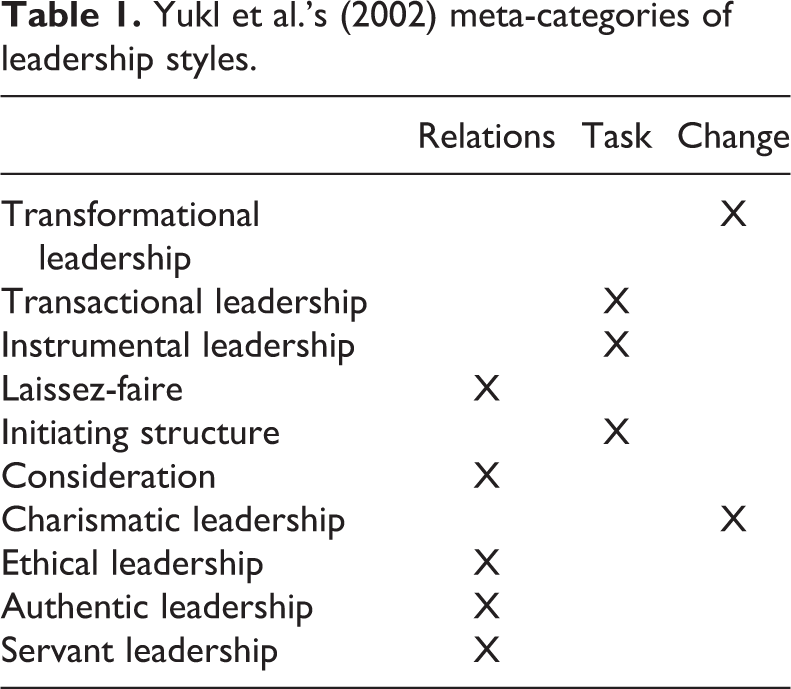
The leadership styles included in Table 1 either previously or currently make up a major proportion of leadership researchers’ interest (Day & Antonakis, 2012). This interest has resulted in a large body of concurrent empirical research (Judge & Piccolo, 2004; Judge, Piccolo, & Ilies, 2004). Additionally, from a conceptual standpoint, they offer very different angles on the leadership style phenomenon. This is particularly important for the contemplation of construct proliferation, as theoretical distinctiveness of focal constructs is a prerequisite to expect concurrent empirical nonredundancy (Le et al., 2010).
Contemporary approaches to leadership styles
Early behavioral leadership models emerged from several studies in the 1940s and 1950s. These studies resulted in the distinction between consideration and initiating structure as two distinct leadership styles (Fleishman, 1953; Yukl, 2010). Consideration is best understood as follower-centered leadership behavior. Leaders who score high on consideration take care of followers’ needs and abilities and provide individual support. Initiating structure is about providing the necessary structures to ensure goal attainment. Leaders with a high rating on this leadership style focus on the structuring of followers’ work tasks and set clear deadlines. Although consideration and initiating structure dominated leadership research until the 1980s, they have received comparably less academic attention as of late (Judge et al., 2004). Still, meta-analytic results indicate substantial correlations with indicators such as leadership effectiveness (consideration: ρ = .39; initiating structure: ρ = .40; Judge et al., 2004).
Since the 1980s, the leadership triad of transformational leadership, transactional leadership, and laissez-faire has developed into the most researched leadership model to date. These three leadership styles cover the allegedly full range of leadership from the absence of leadership, to contingently rewarding followers’ accomplishments, to inspiring followers towards higher goals that go beyond self-interest (Bass, 1985, 1997). Transformational leadership is essentially about motivating followers to overcome egocentric motives towards the achievement of team-related goals. Transformational leaders realize this by engaging in different behaviors. For example, they identify a positive and attractive long-term vision, foster group goals, act as credible role models, strive for excellence, challenge the status quo, and provide individualized support (Podsakoff, MacKenzie, Moorman, & Fetter, 1990). According to Judge and Piccolo’s (2004) meta-analysis, transformational leadership is positively correlated with follower motivation (ρ = .53) and job satisfaction (ρ = .58). Transactional leadership is a quid pro quo approach in which leaders and followers engage in transactions. Transactional leaders clarify expectations and provide followers with desired rewards based on the fulfillment of expectations and goals (Podsakoff et al., 1990). Judge and Piccolo (2004) report substantial relationships with follower job satisfaction (ρ = .64) and leader effectiveness (ρ = .55). In contrast to the active leadership styles of transformational and transactional leadership, laissez-faire stands for the avoidance and absence of leadership. Laissez-faire leaders avoid answering urgent questions, are absent when needed, and thus are viewed as less effective (ρ = −.54; Judge & Piccolo, 2004).
Similar to transformational leadership, charismatic leadership centers on the idea of heightening followers’ motivation and instilling a sense of purpose. Descriptions of charismatic leadership focus on leaders’ extraordinary behaviors such as the communication of a vision, unconventional behaviors towards followers, and risk taking (Conger, Kanungo, Menon, & Mathur, 1997). By exhibiting these behaviors, charismatic leaders inspire and motivate followers to go beyond their self-interests. These behaviors also set charismatic leaders apart from noncharismatic leadership, with the former then being idealized by followers and becoming the model of behavior (Bass & Stogdill, 1990). According to DeGroot, Kiker, and Cross’s (2000) meta-analysis, charismatic leadership is positively related to leader effectiveness (ρ = .74) and follower effort (ρ = .73).
Given recurring scandals of ethical transgression of organizational leaders, research has more recently increased its focus on the ethical dimension of leadership. Ethical leadership emerged in the 2000s and focuses on the demonstration and promotion of normative appropriate conduct towards followers (Brown & Trevino, 2006; Brown, Trevino, & Harrison, 2005). Ethical leaders are honest, of high integrity, and trustworthy. They act as visible and credible role models, engage in transparent communication, and reinforce followers’ ethical behavior (i.e., rewarding ethical conduct and disciplining unethical conduct). As with the full range leadership styles, there is meta-analytic evidence on the organizational relevance of ethical leadership with positive relationships of ρ = .56 with job satisfaction, ρ = .61 with follower ethical behavior (Bedi, Alpaslan, & Green, 2016), and ρ = .33 with organizational citizenship behavior (OCB; Ng & Feldman, 2015).
Extending the full range model of leadership towards functional and pragmatic leader behaviors, instrumental leadership was only introduced to the literature recently (Antonakis & House, 2014). Instrumental leaders apply their expert knowledge on monitoring the environment and performance, and they implement strategic and tactical solutions. Key to instrumental leadership are the behavioral facets of environmental monitoring, strategy formulation and implementation, path-goal facilitation, and outcome monitoring (Antonakis & House, 2014; Rowold, 2014). Although research on instrumental leadership remains in its very early stages, there is emerging evidence on its organizational relevance (Antonakis & House, 2014; Rowold, 2014; Rowold, Diebig, & Heinitz, 2017).
Defining the core process of authentic leadership, Gardner, Avolio, and Walumbwa (2005) noted that, “our central premise is that through increased self-awareness, self-regulation, and positive modeling, authentic leaders foster the development of authenticity in followers. In turn, followers’ authenticity contributes to their well-being and the attainment of sustainable and veritable performance” (2005, p. 343). Authentic leaders are viewed as high on moral character. Moreover, they are aware of not only how they think and behave but also how they are perceived by others in terms of their own values (Avolio, Gardner, Walumbwa, Luthans, & May, 2004). This definition implies that authentic leadership can be categorized as a follower-centric leadership style. Authentic leadership is positively related to follower engagement (ρ = .47), affective commitment (ρ = .53), and trust in the leader (ρ = .69; Hoch et al., 2018).
Servant leadership refers to leaders’ behaviors of “personal integrity and serving others, including employees, customers, and communities” (Liden, Wayne, Zhao, & Henderson, 2008, p. 161). Servant leaders show sensitivity for followers’ needs and aim to empower them (Spears & Lawrence, 2002). Characteristics of servant leaders include listening, empathy, foresight, and commitment to the growth of others (Spears, 2010). The organizational benefit of servant leadership is indirect. Through facilitating the development and well-being of followers, long-term organizational goals will subsequently be achieved. Hoch et al. (2018) showed that servant leadership is positively related to job satisfaction (ρ = .53) and OCB (ρ = .53).
The case in favour of construct proliferation
To assess the state of construct proliferation in leadership style research, the main section of this review is devoted to the presentation of arguments for both cases—in favour and against construct proliferation. As noted by several authors (Graen et al., 2010; Hoch et al., 2018; Shaffer et al., 2016), new leadership styles are often designed without taking into account prior leadership constructs or theories. Thus, it is likely that a problem of construct proliferation in leadership research exists. In the following section, we first provide theoretical rationales that support the assumption that there is construct proliferation in leadership style research, and subsequently, add empirical evidence of this problem.
First, and based on an extensive literature review, Rowold and Borgmann (2013) provided several theoretical rationales for potential overlap between leadership constructs. On the one hand, they observed that within most leadership theories, no—or very little—theoretical processes of the respective leadership constructs were mentioned. For example, in the Ohio studies (Fleishman, 1953), the leadership constructs of consideration and initiating structure were identified on the basis of factor analyses, and without theoretical rationales. On the other hand, Rowold and Borgmann (2013) derived several dimensions of leaders’ behavior underlying the respective leadership constructs. For example, all leadership constructs share that leaders were highly active in their behavior towards their respective followers. Second, several constructs (e.g., transformational leadership and consideration) utilized role modeling and aimed at eliciting followers’ trust. Third, controlling followers was common to both transactional leadership and initiating structure, but it was not a property of transformational leadership and consideration. These examples highlight the fact that multiple leadership behaviors can be reduced to a small set of underlying mechanisms, yielding the question whether the absolute number of leadership constructs can be reduced.
These arguments were echoed by van Knippenberg and Sitkin’s (2013) critique of transformational leadership theory. What is missing from the literature, then, is a detailed description of well-established (e.g., social psychological) theories that would help to clarify the processes underlying leadership constructs. For example, Bandura’s (1977) social learning theory includes role modelling, an effective influencing behavior. This theory could be utilized to explain leadership mechanisms underlying several leadership behaviors such as transformational leadership and consideration. The same applies to classical and well-established theories of motivation, such as Ryan and Deci’s (2000) theory of intrinsic–extrinsic motivation. For instance, while transformational leadership and consideration aim at eliciting follower’s intrinsic motivation, transactional leadership and initiating structure are closer to extrinsic motivation. Thus, it might be concluded that all four aforementioned leadership constructs can be described more parsimoniously within Ryan and Deci’s (2000) motivational theory.
Regarding the potential overlap between leadership constructs, considerably more empirical than theoretical papers have been published. For example, in a meta-analytic study, DeRue, Wellman, Nahrgang, and Humphrey (2011) aimed at developing an integrated model of leader traits and leadership behaviors. From their results, a strong convergence between transformational leadership, transactional leadership, initiating structure, and consideration emerged (0.17 < ρ < 0.80). Likewise, Piccolo et al. (2012) showed that considerable convergence between these leadership constructs existed (0.21 < ρ < 0.84). Moreover, these authors noted that “the correlation between transformational leadership and consideration [i.e., ρ < 0.74, and to initiating structure, ρ < 0.50] is above conventional levels of scale reliability, suggesting that there is great overlap in these behaviors” (p. 577).
Whereas these first meta-analyses and empirical studies relied on single-source and single-method data, Rowold and Borgmann (2013) applied a more rigorous research design in order to explore the potential overlap between leadership constructs. With multitrait multimethod (MTMM) analyses, both followers’ and leaders’ ratings of leadership behavior are collected, allowing for separation of method variance and variance that is due to “traits” (or, in this case, leadership style constructs; more information on MTMM procedures is provided in what follows). Nevertheless, despite controlling for method variance, Rowold and Borgmann (2013) found strong convergence between the leadership constructs of transformational and transactional leadership, consideration, and initiating structure (mean |r| = .51). Interestingly, these authors observed that “approximately the same amount of variance in the data was due to the rating sources as it was to the leadership constructs, suggesting strong method effects in leadership research” (2013, p. 20).
Next, in their meta-analysis, Rowold, Borgmann, and Diebig (2015) confirmed that the aforementioned leadership constructs were highly correlated (0.26 < ρ < 0.74). Moreover, although they included additional leadership constructs such as laissez-faire and leader–member exchange (LMX), they found that all leadership constructs loaded significantly on one overall leadership factor and suggested that this factor was sufficient for explaining variance in leadership constructs. Echoing this line of argumentation, Gottfredson and Aguinis (2017) meta-analytically showed that the effects of consideration, initiating structure, contingent reward, and transformational leadership on follower performance are all transmitted through LMX. This finding “points to a common underlying mechanism that parsimoniously explains how leaderhsip behaviors relate to follower performance” (Gottfredson & Aguinis, 2017, p. 558).
The first systematic research effort to view multiple leadership behaviors through the perspective of an integrative leadership taxonomy was a paper by Borgmann et al. (2016). In a series of meta-analytic structural equation models, Borgmann et al. (2016) tested whether Yukl et al.’s (2002) taxonomy was appropriate to explain the various relationships (and overlap) between transformational, transactional, consideration, initiating structure, as well as laissez-faire leadership. The results provided support for this assumption and, thus, demonstrated that multiple leadership behaviors can be described by three metacategories of leadership. Nevertheless, more parsimonious models such as those with one or two metacategories fitted the data worse than Yukl et al.’s three-category model. In conclusion, several meta-analyses provided support for construct proliferation in leadership research.
As for authentic leadership, there is now meta-analytic evidence that this leadership construct has strong empirical overlap with transformational leadership (e.g., ρ < 0.74; Banks, McCauley, Gardner, & Guler, 2016). In addition, the utility of authentic leadership to explain incremental variance in outcome criteria, beyond that of transformational leadership, is very small at best (Hoch et al., 2018). Thus, it might be concluded that authentic leadership is a good example of redundancy.
In relation to charismatic leadership, little research has aimed to compare the effect of this leadership style in contrast to other leadership behaviors. For example, in their study, Rowold and Heinitz (2007) revealed that transformational leadership was augmented by charismatic leadership, and vice versa. However, this effect held only for the case of subjective performance. For objective performance (i.e., profit), charismatic leadership did not explain incremental performance over and above transformational leadership. Thus, it might be concluded that there is not enough empirical evidence that demonstrates the uniqueness of charismatic leadership.
The case against construct proliferation
The preceding section gave an overview of existing research providing support for the assumption that the leadership literature suffers from construct proliferation. It is encouraging to see that researchers are increasingly eager to discuss this important issue in order to advance the field. Still, our reading of this research—which of course also includes our own work—concludes that leadership research does indeed suffer from proliferation. Consequently, we view it as necessary to also take the opposing stance to gain a more comprehensive understanding. Therefore, in the following discussion, we present arguments and empirical evidence against the assumption that there is construct proliferation. We provide three empirical examples as to why different leadership constructs are more distinct from one another than their bivariate, zero-order correlations would suggest. Emphasizing the role of method effects, the first two examples focus on the relationships between (a) transformational and transactional leadership behaviors and (b) the full range leadership styles and ethical leadership. The third example focuses on the interrelation between full range leadership styles and instrumental leadership as an example of bias from omitted variables.
Transformational versus transactional leadership
On a conceptual level, transformational leadership’s core of motivating followers to overcome egocentric motives towards the achievement of team-related goals through an inspiring, value-laden vision beyond expectations can clearly be differentiated from the quid pro quo approach of transactional leadership. Yet, existing empirical evidence challenges this clear-cut conceptual distinction. Previous studies report substantial correlations between both leadership styles questioning their discriminant validity. For example, in their meta-analysis, Judge and Piccolo (2004) report a correlation of ρ = .80 between transformational leadership and the contingent reward subdimension of transactional leadership. Based on such findings, Krüger, Rowold, Borgmann, Staufenbiel, and Heinitz (2011) called for a greater focus on method effects that might have contributed to such high bivariate correlations. As leadership is commonly rated by a leader’s followers, this same-source same-method bias may have caused such inflated high correlations (Podsakoff, MacKenzie, & Podsakoff, 2012).
In their work, Krüger et al. (2011) used an MTMM approach to clarify the different sources of shared variance. The basic idea of MTMM analyses goes back to Campbell and Fiske (1959), who stressed that each test score is a composite of effects due to the trait of interest and effects due to the particular method used. Using a (confirmatory factor analysis) CFA-based MTMM approach, indicators from different sources (e.g., self- and other-ratings) were modeled as loading on the intended trait of interest (e.g., articulating of a vision, providing an appropriate model) and on their specific method factor (self- or other-rating method factor). An example of the structure of a CFA-MTMM is illustrated in Figure 1. The main advantage of such a CFA-MTMM is that it allows for decomposing test scores into proportions of “pure” trait, method, and random error (Chang, Connelly, & Geeza, 2012). Krüger et al. (2011) used a multisource sample of 178 leaders and 834 followers from different organizations and professions. To exclude same-source bias, leaders provided self-ratings and followers provided follower ratings on six facets of transformational and one facet of transactional leadership captured with Podsakoff et al.’s (1990) Transformational Leadership Inventory (TLI).
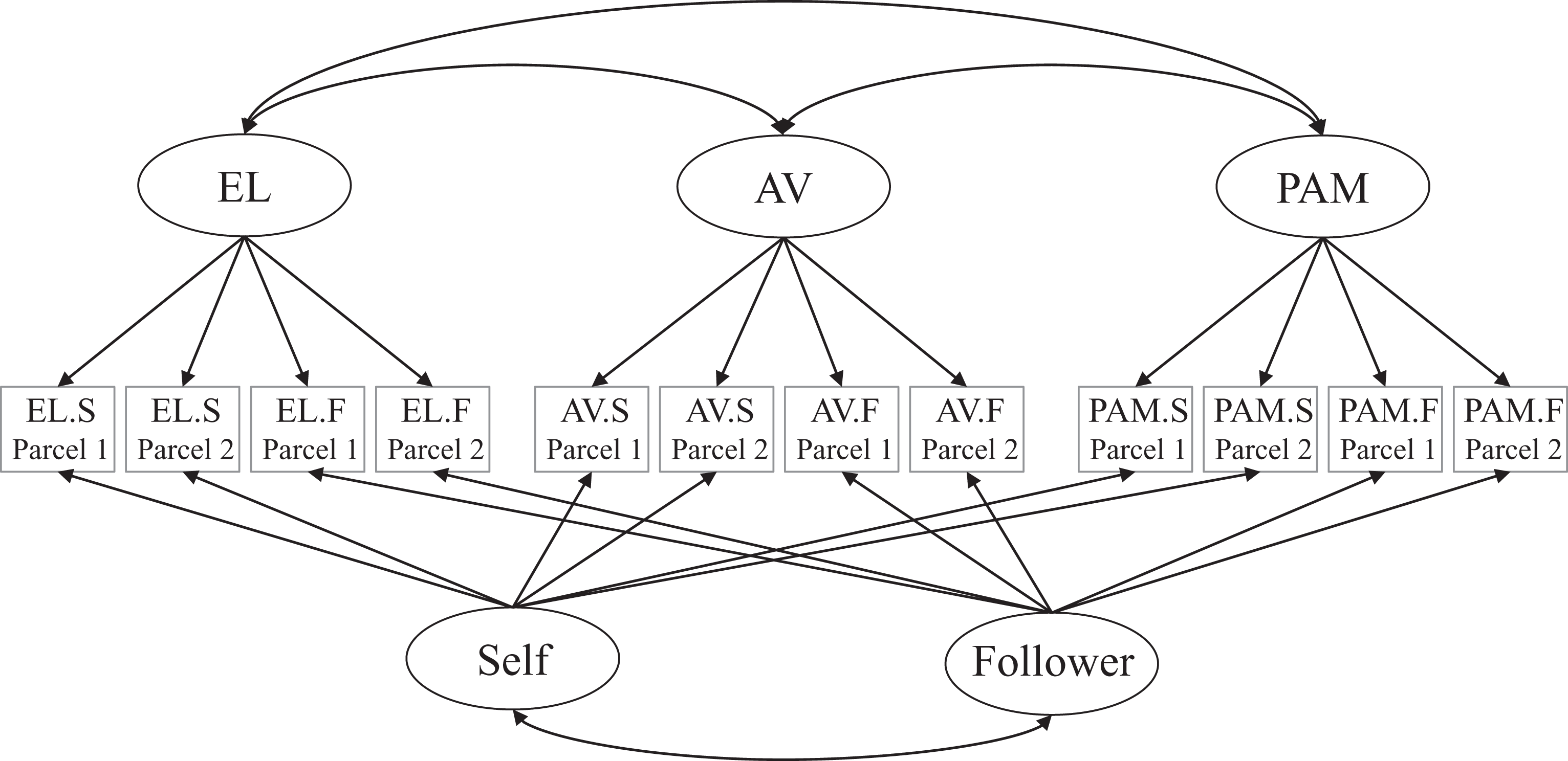
Outline of the principles underlying the MTMM analysis.
Results of this study reveal interesting findings relevant for assessing the issue of construct proliferation in the leadership literature. Consistent with other findings, the bivariate correlations among the seven follower-rated leadership styles were very high (mean |r| = .64). The highest correlation of r = .86 emerged for the relationship between the transformational leadership facets of articulating a vision and fostering the acceptance of group goals. Such high correlations could lead to the conclusion that the seven dimensions of leadership are not empirically distinct from one another. However, the MTMM analysis showed that the method of self- versus follower rating accounted for nearly half (45%) of the variance of the different indicators. Importantly, only a much smaller proportion (18%) of the indicators’ variance was explained by the respective trait. After partialling out the method factors, the estimated correlations among latent trait (i.e., leadership) factors revealed very different relationships. While the mean correlations for self-rated leadership had been |r| = .37 and |r| = .64 for follower ratings, the correlations decreased to |r| = .20 after controlling for method effects. A striking example of the potential bias from method effects refers to the relationship between providing an appropriate model and fostering the acceptance of group goals. The correlation was r = .76 for follower ratings, which indicates some level of overlap between the two theoretically distinct leadership facets. Interestingly, the correlation dropped to r = .06 after the method effects were partialled out.
In sum, Krüger et al. (2011) revealed that the typically high correlations among leadership styles are at least in some part due to the applied method of measurement. When such method effects are removed, the correlations between facets of transformational and transactional leadership empirically support the theoretically assumed distinction. These findings strengthen the discriminant validity of transformational and transactional leadership.
Full range leadership styles versus ethical leadership: An empirical example
A crucial requirement for the introduction of a new leadership construct is to show the added predictive validity. Servant leadership may be a good example of a newer leadership model explaining variance beyond established measures and being only moderately correlated to such. Hoch et al. (2018) demonstrated that in comparison to transformational leadership, servant leadership added incremental variance in outcome constructs such as job performance. Thus, when comparing servant leadership with transformational leadership, it appears that the former captures unique aspects of the leadership phenomena.
Research on ethical leadership is facing more severe obstacles regarding its discriminant validity from other, existing leadership styles. In this section, we address ethical leadership’s relationship with full range leadership styles in a comprehensive way by presenting an empirical example that follows Shaffer et al.’s (2016) step-by-step guide to assess construct proliferation. These four steps include literature review, analytical steps, study design, and a substantial interpretation of results.
Step 1: Literature review
Brown and Trevino argued in several papers on a conceptual basis why ethical leadership is a unique construct (Brown & Trevino, 2006; Trevino & Brown, 2007). Although overlap with components of both transactional (e.g., contingent feedback, rewarding and disciplining) and transformational leadership (e.g., active role modeling, individualized support) is acknowledged, its primary focus on the demonstration and promotion of ethical behavior is argued to make ethical leadership unique. Still, empirical research has yet to establish convincing evidence for ethical leadership’s discriminant validity. As was the case for transformational and transactional leadership, ethical leadership is usually highly correlated with other leadership styles. In their meta-analysis, Bedi et al. (2016) report very high correlations, especially with transformational leadership (ρ = .94) and transactional leadership (ρ = .87), and lower but still substantial relationships with laissez-faire (ρ = −.62).
While different studies have shown the incremental validity of ethical leadership above and beyond such leadership styles (Bormann & Rowold, 2016; Mayer, Aquino, Greenbaum, & Kuenzi, 2012), Bedi et al. (2016) and Hoch et al. (2018) have taken a more critical stance on ethical leadership’s contribution to the leadership literature. Bedi et al. (2016) discuss their meta-analytic findings as follows: “These results raise questions about the construct validity of ethical leadership and its distinctiveness from similar constructs” (p. 14). Consequently, they recommend further research on this matter. Addressing this call, Hoch et al. (2018) examined whether ethical leadership explained additional variance above and beyond transformational leadership. They conducted a separate meta-analysis to answer this question. Their analyses revealed that ethical leadership (ρ = .46) had similar mean relationships with their diverse measures of leadership outcomes as did transformational leadership (ρ = .43). As both leadership styles were highly correlated (ρ = .70) and ethical leadership contributed only little to the total variance explained above and beyond transformational leadership, Hoch et al. (2018) concluded that in its current form ethical leadership has relatively limited usefulness: “The empirical evidence does not suggest that…[ethical leadership] offer[s] much that transformational leadership does not already provide” (p. 23).
Step 2: Analytical steps and Step 3: Study design
What Hoch et al. (2018) and Bedi et al. (2016) did not consider, however, was whether method effects tied to the common approach of collecting follower ratings on leadership may have contributed to inflated high correlations. To address this issue, we present in the following an unpublished empirical example that contrasts ethical leadership with the leadership styles of the full range leadership model. We do so using a similar approach as Krüger et al. (2011). Specifically, we performed a CFA-based MTMM analysis on multisource ratings of leadership. The sample consisted of 285 leaders and 1,754 followers. We collected leader self-ratings and follower ratings using Brown et al.’s (2005) Scale for Ethical Leadership, the TLI (Podsakoff et al., 1990) for six facets of transformational and one facet of transactional leadership, as well as four items from Rowold (2011) for laissez-faire. Based on Krüger et al. (2011), we expected the correlations between ethical leadership and related leadership styles to decrease when taking the method effects into account. The structure of the CFA-MTMM is illustrated in Figure 1.
Step 4: Substantial interpretation of results
The results of our analyses provide valuable insights regarding the potential (non)redundancy of ethical leadership. 1 Echoing previous work, when considering follower ratings only, ethical leadership’s correlations with the other leadership styles were very high. As can be drawn from Table 2, mean correlations with the facets of transformational leadership, transactional leadership, and laissez-faire were |r| = .82. Critically, the bivariate correlations of ethical leadership with providing an appropriate model, fostering the acceptance of group goals, and individualized support were all above .90. According to Shaffer et al. (2016), correlations between constructs that reach or exceed a magnitude of .90 indicate construct redundancy. Using this approach, we would likely conclude that ethical leadership does not advance insights into leadership above established models.
Descriptive statistics and correlations for leadership variables.

Note: N = 285. Alpha coefficients depicted italicized on the diagonal. LF = laissez-faire; TA = transactional leadership; AV = identifying and articulating a vision; PAM = providing an appropriate model; FAG = fostering the acceptance of group goals; HPE = high performance expectations; IS = providing individualized support; ISN = intellectual stimulation; EL = ethical leadership.
*p < .05. **p < .01.
However, such drastic conclusions would be premature considering the MTMM-based results. Again, we found strong method factors that explained large portions of variance for all leadership constructs. On average, the indicators’ variance could be broken down into 17% trait effect, 51% method effect, and 32% measurement error. After decomposing test scores into proportions of trait, method, and error, we found interesting associations between the different leadership traits. The MTMM-based latent correlations between full range leadership styles and ethical leadership are shown in Table 3. Their mean correlation of |r| = .58 indicated a substantial decrease in empirical overlap and no correlations reached the critical magnitude of .90. When considering only statistically significant correlations as meaningful, ethical leadership was unrelated to articulating a vision (r = .24, ns), high performance expectations (r = −.64, ns), and intellectual stimulation (r = .31, ns). This finding is important as these nonrelationships are consistent with Brown and Trevino’s (Brown & Trevino, 2006; Trevino & Brown, 2007) assertion of the uniqueness of ethical leadership. For example, inspiring followers through the articulation of a vision—the core of transformational leadership—is unrelated to what existing work on ethical leadership focuses on. Whereas high performance expectations are another component of transformational leadership, ethical leadership emphasizes a different approach. Ethical leaders judge work not only by the result but also by the process, such as the ethical soundness of sales practices.
MTMM-based latent correlations between full range leadership styles and ethical leadership.
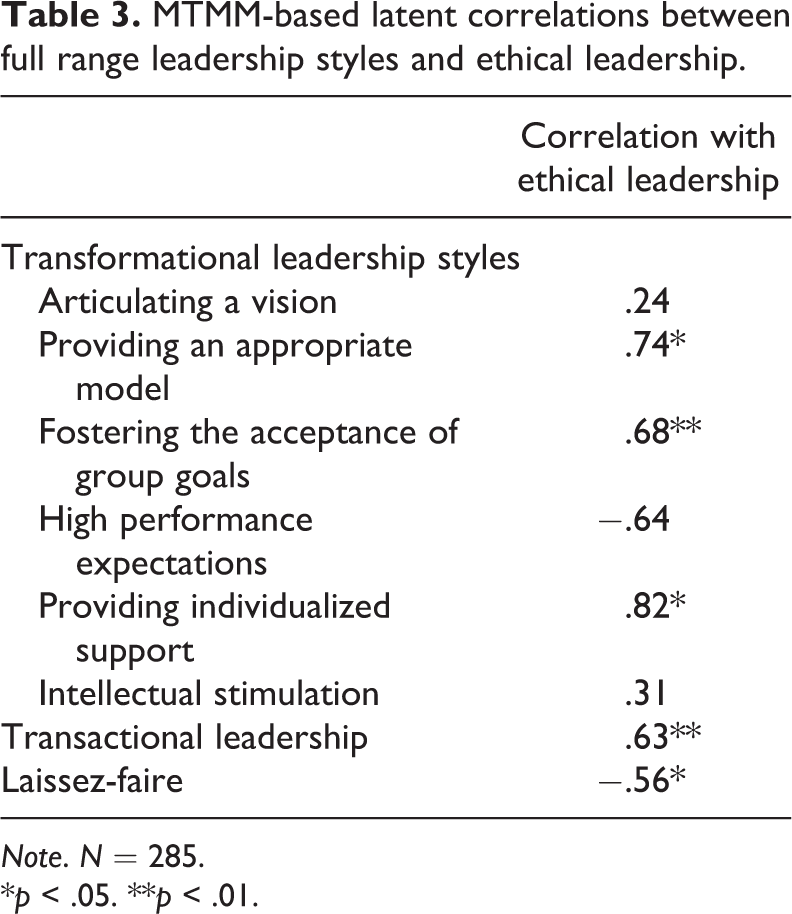
Note. N = 285.
*p < .05. **p < .01.
In sum, this analysis shows that the typically high correlations between ethical leadership and other related leadership styles may be overstated given the bias from single-source measurement. When omitting shared variance due to method effects, the relations decreased substantially. All in all, we believe these results strengthen the discriminant validity of ethical leadership while simultaneously underlining the issue of method effects.
A “fuller” full range leadership model
Although method effects may be one source of bias that could lead to the potentially premature conclusion of redundancy among contemporary leadership approaches, it is not the only (empirical) line of arguments against the claim of construct proliferation. A second one centers on the idea of bias stemming from omitted variables. Several researchers argue that the leadership models dominating today’s leadership research—most notably transformational, transactional, and laissez-faire leadership—fail to address the full range of behaviors effective leaders engage in (Yukl, 2010). Therefore, we need additional angles to fully understand the leadership phenomenon, paving the way for the introduction of new leadership models. In their work on instrumental leadership, Antonakis and House (2014) provide strong theoretical and empirical arguments as to why the functional aspects of leadership such as strategic planning and work facilitation are useful extensions. They acknowledge the difficulties coming with the introduction of new leadership models: “We realize that extending an already complex leadership theory is hard to justify at the outset. However, a more complete account of leadership is needed because leadership as a phenomenon is complex and multifaceted” (2014, p. 748). While interpersonal and transactional aspects are important to effective leadership, so are strategic and work facilitation considerations. Antonakis and House (2014) argue that if instrumental leadership is left unmeasured, omitted variable bias is likely to arise. In particular, effects of the remaining full range leadership styles on outcomes may be distorted and overstated given endogeneity bias (Antonakis, Bendahan, Jacquart, & Lalive, 2010).
We now take a closer look at the limited published empirical evidence on instrumental leadership. At first sight, similar problems concerning its (non)redundancy seem to be apparent as was the case with ethical leadership. Extant studies reported substantial correlations with transformational and transactional leadership which may raise doubts about the discriminant validity of instrumental leadership. In Rowold (2014), for example, the instrumental leadership dimension of path-goal facilitation was highly correlated with transformational leadership’s providing an appropriate model (r = .80) and fostering the acceptance of group goals (r = .75). However, the mean correlation between the four facets of instrumental leadership and six facets of transformational leadership (Podsakoff et al., 1990) was |r| = .59, indicating satisfactory levels of discrimination between the leadership styles. Similar results were obtained by Antonakis and House (2014). More problematic appear the results from Rowold et al. (2017). They reported a correlation of r = .89 between the higher order scales of instrumental and transformational leadership, which is very close to Shaffer et al.’s (2016) cut-off value of .90 for indication of construct redundancy. Still, considering the incremental predictive validity of instrumental leadership on outcomes above and beyond the full range leadership styles has been shown in different studies (Antonakis & House, 2014; Rowold, 2014; Rowold et al., 2017), it appears that instrumental leadership is a valuable contribution to a fuller understanding of leadership.
What is especially interesting regarding the empirical insights into instrumental leadership is the potential overstatement of transformational and transactional leadership if instrumental leadership is left unconsidered. Antonakis and House (2014) elaborate extensively on this issue and provide compelling support for weakened effects of the established leadership styles when instrumental leadership is controlled for. For example, regarding the prediction of satisfaction with the leader and leader effectiveness, the proportion of variance in the r-square due to transformational leadership decreased from an average of 67% to 41% upon the inclusion of instrumental leadership. Subsequently, the coefficients of the different facets of transformational leadership decreased substantially. Antonakis and House’s (2014) results appear very robust due to the applied two-stage least squares analytical approach, which purges coefficients of endogeneity bias due to single methods or measurement error (Antonakis, Bendahan, Jacquart, & Lalive, 2014). It is encouraging to see that there is a similar trend when applying traditional ordinary least squares (OLS) regression analysis (Rowold, 2014).
In sum, the case of instrumental leadership illustrates that there is theoretical and empirical justification to introduce new perspectives to the existing landscape of leadership models. In particular, it provides an illustrative example of the issue of omitted variable bias in previous leadership research.
To further examine whether this omitted variable bias is also an issue for ethical leadership research, we reanalyzed the data of a published study that included both ethical and transformational leadership (Bormann & Rowold, 2016). In this study, we tested the effect of ethical leadership on acquiescent silence (Knoll & van Dick, 2013) while controlling for transformational leadership amongst other variables. Both leadership styles were positively correlated with r = .77. Importantly, when adding both leadership variables simultaneously, only ethical leadership had a significant effect. To test whether we could also find evidence for omitted variable bias as proposed by Antonakis and House (2014), we reran the analyses for this review and conducted step-wise regression. In a first step, we only modeled transformational leadership as predictor, which was significant (β = −.35, p < .01). In a second step, we then added ethical leadership. Ethical leadership’s impact on acquiescent silence was significant (β = −.24, p < .01) and transformational leadership’s effect disappeared entirely (β = −.16, ns). This indicates another example of the overstatement of transformational leadership when other variables are left unconsidered.
Implications for leadership research
The aim of this review is to offer different perspectives on the issue of construct proliferation in leadership style research. In our comparison of arguments in favor and against construct proliferation, we tried to neither belittle one stance nor overstate the other. Still, it appears that concerns about limited distinctiveness among leadership constructs are generally legitimate. Considering the dominant way leadership style studies are conducted nowadays, we view evidence of the existence of construct proliferation as hard to deny. It is problematic to see independently introduced leadership constructs having substantial content-related overlap, going as far as they being used synonymously (van Knippenberg & Sitkin, 2013), reporting correlations among conceptually distinct leadership constructs exceeding .80 or .90, or newer leadership styles having limited incremental validity over more established ones. In our view, it is increasingly worrisome to continue the study of leadership styles without tackling issues regarding construct proliferation. Otherwise, failing to do so will eventually undermine the credibility of leadership research in general. Accordingly, the first position we take drawing on the arguments presented in this paper is that we do not need more constructs introduced to the literature before we take action to better sort the existing landscape of leadership styles.
So, devoting more academic attention to the field of construct proliferation in leadership style research is highly warranted. Yet, while we fully acknowledge the apparent evidence in favour of construct proliferation, we believe that the one-sided, critical stance of other researchers regarding the redundancy of especially newer leadership styles (Hoch et al., 2018; Rowold & Borgmann, 2013; Shaffer et al., 2016) may be premature. Based on our observations, which are addressed in The Case Against Construct Proliferation section, the main problems regarding the current state of research can be narrowed down to two issues. First, researchers’ modus operandi is that they only concentrate on their focal leadership variable of interest while neglecting other potentially important leadership controls for their studies. In other words, there is only little orientation how to systematically integrate leadership styles. Second, the standard has become to capture leadership styles by collecting follower ratings. We believe that addressing both issues should map the avenues of future work. It should eventually bring us to a level on which we can make better informed decisions that exceed single-study findings on whether to stop or continue research on different leadership styles. Drawing on this understanding, the focus of the following discussion is twofold: First, by synthesizing our consideration of arguments in favour and against the existence of construct proliferation, we develop a heuristic to organize and structure the existing landscape of leadership constructs. Second, we provide a guiding framework for how to set up future studies and subsequent data collection. Both streams should be understood with the goal of sorting the landscape of leadership styles in mind.
An integrated model of broad and narrow leadership constructs
When acting to sort the current landscape of leadership style research, a driving aim should be increased parsimony in terms of our understanding of what leaders do and do not do. In this regard, it is encouraging to see that Yukl et al.’s (2002) metacategories of leadership can be empirically confirmed and, in our view, define the boundaries of leadership research. In order to fully understand and organize the inner life of such broad categories, a consideration of the developments we have seen in personality psychology may be promising. The reemergence of trait approaches in organizational literature (Judge, Bono, Ilies, & Gerhardt, 2002) is in large part due to the development of one widely accepted conceptualization of personality, namely the Big Five model of agreeableness, conscientiousness, extraversion, neuroticism, and openness (Digman, 1990). Capturing personality on five distinct and broad factors is not just parsimonious, there is also strong evidence of the validity of this approach (Barrick & Mount, 1991). Still, the quest for higher levels of abstraction does not come without potential costs. Despite its broad validation and meta-analytic evidence, the Big Five model has found criticism (Hough, 1992). One aspect relates to the bandwidth-fidelity dilemma (Cronbach & Gleser, 1965), which suggests that predictor and criterion should be matched in terms of their level of specificity. With regard to the example of personality, broad traits like the Big Five are preferable in terms of predicting broad criteria like overall job performance (Ones & Viswesvaran, 1996), while narrow personality traits outperform broad traits in predicting specific behaviors (Paunonen & Ashton, 2001). Transferring this reasoning to the leadership domain, broad categories of leadership might be suboptimal in predicting specific outcomes.
The question now is how to define broad versus narrow leadership styles. We believe there are multiple, interesting ways to approach this issue, and we present different perspectives in the following discussion. Arguably, the most straightforward is a differentiation based upon conceptual focus (see Figure 2). Metacategories belong to the broad category by definition as they summarize multiple leadership styles. Additionally, but to a lesser extent, general, multidimensional leadership styles may fit this broad category as well. We posit leadership models to fit the broad category when their core of construct bases on multiple content-related pillars. For example, transformational leadership includes aspects such as inspiration, individual support, and intellectual stimulation. In a similar vein, transactional leadership covers management by exception (active and passive) and contingent reward. In contrast, we view narrow leadership constructs as models whose core of construct bases on a single pillar. For instance, ethical leadership is primarily about the demonstration of normatively appropriate conduct and servant leadership at its core is about serving followers. Broader outcomes on the other side include variables that likewise incorporate multiple aspects. Job performance or extrarole behaviors fit this category. Narrow outcome criteria again are more specific in their scope such as helping, silence, and voice (all of which are nested within the broader category of extrarole behaviors).
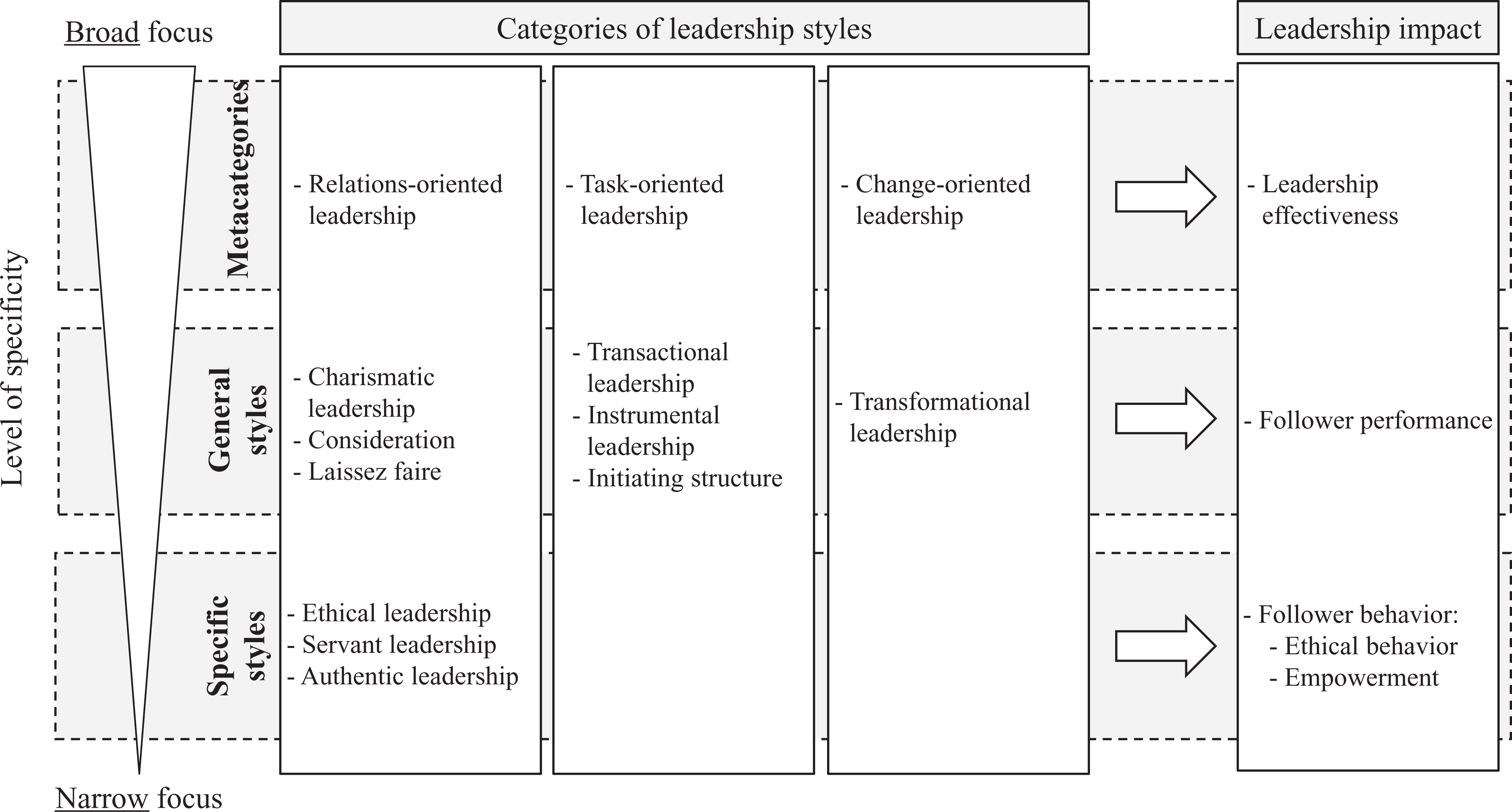
Exemplified broad versus narrow categorization of leadership styles.
Other possibilities of differentiating broad versus narrow leadership models could center on time-specific aspects. Broad leadership would then refer to general leadership styles (i.e., how leaders behave on average), while narrow leadership would refer to leadership behaviors displayed in specific moments, on certain days or weeks. In terms of broad versus narrow leadership in team settings, broad leadership could refer to behaviors addressed to the team as a whole, whereas narrow leadership would be directed at followers as individuals. Essentially, the exact classification is likely to remain subjective in nature and to be tied to particular cases.
Still, the key merit of theorizing the differentiation between broad versus narrow leadership models is that it provides a valuable heuristic regarding what to expect when comparing the effects of different leadership models. When narrower leadership styles fail to impact outcomes beyond broader leadership controls, this does not necessarily indicate construct proliferation. If the outcome is broad in nature such as job performance, then this is what would be expected in the first place. Only if narrow leadership styles do not outperform broader leadership styles in terms of predicting narrower outcomes (such as authentic leadership predicting follower authentic behaviors) would this be a stronger indication of construct proliferation. Following this delineation we posit the following propositions:
Practical implications for setting up future research
The aim of this next section is to provide a step-by-step guiding framework for how to set up promising future leadership studies building on our previous elaborations. Here, we follow the lead of others. Shaffer et al. (2016) provide detailed recommendations that aim at tackling the issue of construct proliferation. They identify four crucial steps: literature review, data analysis, study design, and substantial interpretation of results. Yet, we believe that building on our previous argumentation, we can make valuable extensions and thus can complement such recommendations.
Step 1: Literature review
As Shaffer et al. (2016) point out, promising (leadership) studies in terms of further tackling or overcoming the issue of construct proliferation start with a comprehensive literature review. To find the most relevant literature, different approaches are recommended, including backward searching (start with a relevant paper and look at cited references), forward searching (start with a relevant paper and find items that later cite it), and suggestions from colleagues and other experts. Although Shaffer et al.’s (2016) suggestions are valuable, they remain on a rather generalized level and do not provide specific orientation as to which variables matter when setting up leadership studies in different areas. A key issue in this regard is, in our view, to come to a well-informed decision on which leadership variables should be considered as control variables in order to persuasively show the incremental validity of the construct of interest (Hoch et al., 2018).
So far there is only very little conceptual rationale and guidance for which leadership variables should be controlled for when investigating different forms of leadership. Still, a more nuanced understanding for the inclusion or exclusion of control variables is needed as argued by Bernerth and Aguinis (2016). There are sporadic examples where there is a rationale for integrating different leadership models. Arguably, the most prominent and empirically tested one is the augmentation effect of transformational leadership above and beyond transactional leadership and laissez-faire (Judge & Piccolo, 2004). In a similar way, instrumental leadership is grounded in the proposition that it extends the full range model. Therefore, controlling for transformational leadership, transactional leadership, and laissez-faire leadership is straightforward (Antonakis & House, 2014). Interestingly, orientation for the integration of, for instance, ethical leadership or destructive forms of leadership with other variables, is by and large missing. At best, there is some indication of empirical trends. In the case of ethical leadership, several studies fail to include leadership controls at all (Avey, Palanski, & Walumbwa, 2011; Mayer, Kuenzi, Greenbaum, Bardes, & Salvador, 2009), while some incorporate transformational leadership (Bormann & Rowold, 2016; Hoch et al., 2018; Mayer et al., 2012), and others consider initiating structure and consideration (Lin, Ma, & Johnson, 2016). We observe similar patterns for destructive forms of leadership. While several studies do not consider leadership controls at all (Barnes, Lucianetti, Bhave, & Christian, 2015; Mawritz, Dust, & Resick, 2014), De Hoogh, Greer, and Den Hartog (2015) argue that it is important to contrast negative forms of leadership with positive ones to show unique contributions. Consequently, they included considerate leadership as a control variable for their investigation of autocratic leader behavior.
We believe that beyond such trends in leadership controls, our developed heuristic and subsequent propositions provide orientation regarding this crucial phase of study set-up. The broad versus narrow weighing can also be adapted to specific theoretical perspectives. Consider a case in which authors want to position their study on servant or authentic leadership in social exchange theory (Cropanzano & Mitchell, 2005). Social exchange theory describes organizational behavior as a function of social exchange relationships at work. Accordingly, a broad way to capture follower perceptions of the quality of their social exchange relationship with their leader would be to let them rate their leader’s transactional leadership, which at its core captures exchange relationships. Following our proposition, the narrower leadership models of servant and authentic leadership should then outperform transactional leadership in predicting the relevant outcomes. If they fail to do so, then the proposed social exchange take on such leadership styles does not add to what we already know from existing theory. Similar to the interplay between social exchange theory and transactional leadership, a broad operationalization of the key tenet of social learning theory (Bandura, 1977)—mimicking leader behavior—may be achieved by capturing transformational leadership with its focus on the leader’s role modeling.
Step 2: Multimethod assessment of leadership
In their section on study design, Shaffer et al. (2016) recommend to ideally collect data on a given leadership construct with two different scales at two different administration times. This is done with the goal of partialling out measurement error in mind—a point we will address in the following Step 3: Correction for Measurement Error section. Although Shaffer et al.’s (2016) suggestions are certainly valuable, one important limitation remains. When restricting the means of capturing leadership styles to ratings of a leader’s immediate followers, one constraint that will always remain is same-method bias (Podsakoff et al., 2012).
As we repeatedly stressed during our argumentation against construct proliferation, part of the reason for the suspiciously high correlations among conceptually different leadership styles may be related to the applied method. The empirical evidence that supports the existence of construct proliferation presented here relies almost entirely on follower ratings of supervisory leadership. As illustrated by Podsakoff et al. (2012), same-source correlations are higher than correlations between variables that were obtained using different sources of measurement. Furthermore, as demonstrated by Rowold and Borgmann (2014), interpersonal affect between the leader and followers potentially biases the leadership ratings provided by followers. In their study, six distinct leadership constructs revealed high loadings on a liking factor. Accordingly, Podsakoff et al. (2012) strongly recommend the use of different sources of measurement to yield conservative estimations of relationships of interest.
That applying mono-method assessment of constructs may be particularly problematic in the field of leadership research can be further underscored by considering the presented MTMM results and subsequent decomposition of leadership scores into proportions of trait, method, and error variance. In the three MTMM cases of Rowold and Borgmann (2013), Krüger et al. (2011), and our own example of full range model versus ethical leadership presented before, the applied method’s proportion of indicators’ variance ranged between 37% and 51%. In contrast, trait variance accounted for only 17% to 36%. To put these findings into perspective, these numbers indicate much stronger method effects and weaker trait effects compared to generalized findings from Cote and Buckley (1987). The latter analyzed 70 published MTMM analyses from multiple disciplines and reported that, on average, 42% of variance was due to trait and only 26% was due to method.
In light of this, we encourage researchers to be open-minded with regard to alternative methods of leadership assessments. Recent advancements from leadership research provide intriguing examples. For instance, coding of videotaped material (Lehmann-Willenbrock, Grohmann, & Kauffeld, 2013) or motion capturing (Meyer et al., 2016) can be used to capture leadership variables of interest and effectively overcome the overreliance on mono-method survey data.
Step 3: Correction for measurement error
Multimethod, multisource, or multioccasion assessment of leadership constructs is important in order to have the foundation to estimate the bias of different forms of measurement error. There are different analytical approaches to address this issue in a subsequent step. It is up to the researcher which path to follow as long as the observed raw data is corrected in an adequate manner. One promising way is described by Shaffer et al. (2016). Applying a disattenuation formula (Le et al., 2010), they estimated construct-level relationships among different leadership constructs while correcting for different forms of measurement error. An alternative way is the application of CFA-based MTMM analytical techniques. Illustrative of this, the different MTMM examples presented in the course of this paper revealed that method effects accounted for substantial proportions of indicators’ variances. As elaborated in the preceding second step, method effects appear to be even more pronounced in leadership research compared to other fields. After omitting these method effects from estimations, the association between leadership styles decreased considerably compared to the relationships of follower-rated leadership.
Step 4: Omitted variable test
The key merit of controlling for other leadership constructs is to gauge the added value of focal variables above and beyond others. In this process, it may not only be helpful to simultaneously enter the focal leadership construct along with the respective leadership control variable. There is value in building such models stepwise. Following the notion that narrow leadership models outperform broader ones in predicting narrow outcomes, it is to be assumed that upon entering the narrow construct to the equation, (a) the effect of this narrow construct will be significant and (b) the effect of the broader control variables will decrease. Following such an approach would provide information in terms of the extent of broad leadership’s potentially overstated effects (Antonakis & House, 2014). Moreover, we also recommend that researchers reverse order and rerun the analyses by entering the narrow leadership model prior to the broader one. This is a step that existing research has been applying only sporadically (Banks et al., 2016; Judge, Locke, Durham, & Kluger, 1998). Still, this step would be important to likewise garner a better understanding as to whether the effects of the focal, narrow construct are overstated or not. While these analytical recommendations are simple to perform, they effectively address the issue of omitted variable bias and therefore should be considered on a more regular basis.
Step 5: Interpretation of results
In a final step, researchers must then interpret the study results to the extent that they indicate sufficient evidence for either construct redundancy or uniqueness. In the case of suspiciously high correlations among constructs (even after correcting for measurement error) and limited incremental validity, there may be different conclusions to draw. As suggested by Shaffer et al. (2016), such findings may indicate that (a) constructs are unique, but the respective measures are too similar, (b) constructs share a causal relationship, or (c) constructs are empirically redundant. For more detailed information on these different alternatives, we refer the interested reader to Shaffer et al. (2016).
Beyond Shaffer et al.’s (2016) work, there are two additional points we want to address. First, we believe that our broad versus narrow heuristic may pave the way for studies focusing on leadership styles that already have accumulated preliminary doubts regarding their uniqueness (e.g., authentic leadership). For instance, showing that a narrow leadership style such as authentic leadership outperforms the broader transformational leadership in predicting a very narrow outcome, such as follower authentic behavior, would move the field forward by opposing extant research. Still, it may be questionable if the “niche” of incremental validity eventually becomes too small to warrant researchers’ as well as practitioners’ interest, especially if its multimethod assessment would require substantial resources. Second, another crucial question—one we admittedly avoided so far—is at what point we have accumulated enough empirical evidence to conclude that research on a specific leadership style should effectively be abandoned. In our view, this is a question that is tough to answer in a definite way. Yet, we firmly believe that, so far, we have yet to reach that point for any of the leadership constructs that are addressed in this paper. We need even more meta-analytic work in the nature of Hoch et al. (2018) and Rowold et al. (2015) that exceeds single-sample insights to eventually reach a consensus regarding the redundancy of a specific leadership model.
Limitations
There are several limitations to be mentioned regarding this review. First and foremost, our examination only focuses on a selection of leadership styles. We note that our selection is by no means exhaustive or exclusive and the assessment of construct proliferation could and should be expanded towards other models of leadership as well. With our focus on positive forms of leadership styles (with the exception of laissez-faire), this review forwards a rather conservative comprehension of leadership. Most notably, negative or destructive forms of leadership such as abusive supervision are gaining increased attention in recent years. Still, they were not considered here. Besides, by excluding any consideration of leader dispositions (e.g., personality, intelligence), we can only tap into part of what characterizes (in)effective leaders. Also, our top-down approach to the study of leadership also neglects any consideration of bottom-up or peer leadership. Finally, examinations of construct proliferation in leadership research could have taken an even stronger follower-centric perspective. For example, perceptual and memory processes may play a role whether respondents are able or not to reliably differentiate certain styles (Frone, Adams, Rice, & Instone-Noonan, 1986). These limitations warrant additional research.
Footnotes
Funding
The author(s) received no financial support for the research, authorship, and/or publication of this article.