



Abstract
An approximate approach is developed to estimate the residual carrying-capacities of fire and near-field blast-damaged reactive powder concrete-filled steel tube columns. The single-degree-of-freedom model is employed to calculate the initial deflections of fire-damaged reactive powder concrete-filled steel tube columns subjected to axial and blast-induced transverse loads, and then a modified formula including double coefficient is further proposed to predict the ultimate resistance. Then, a series of blast-resistance and load carrying-capacity tests on six large-scale reactive powder concrete-filled steel tube columns are conducted to validate the suitability of theoretical method presented in this article. Blast tests demonstrate that the blast-resistances of reactive powder concrete-filled steel tube columns are more sensitive to fire durations than to scale distances. In addition, it is indicated that ISO-834 standard fire exposures cause significant degradations of material properties and have remarkable effects on the residual carrying-capacities of reactive powder concrete-filled steel tube columns. No local bucking and burst could be observed in the residual carrying-capacity tests; also, there are no visible hinge-like deformations in the mid-span area, and the excellent fire-resistances and blast-resistances of reactive powder concrete-filled steel tube columns are experimentally verified. Analytical results show that the predicted axial load capacities of six reactive powder concrete-filled steel tube columns are in good agreement with experimental data. All damage indices of the test specimens are within 0.8, meaning only minor to severe damage is done to the reactive powder concrete-filled steel tube column during fire and blast attacks, which is consistent with the test results.
Keywords
Introduction
Concrete-filled steel tube (CFST) column has been increasingly used in civil engineering; especially, structures suffer impact or blast load due to its excellent performances such as higher strength, good ductility, and better fire-resistance (Song et al., 2010). In recent years, a new concrete composite member, known as ultra-high performance concrete filled steel tube (UHPC-FST), possesses a good application prospect as load-carrying member in many important constructions. Reactive powder concrete (RPC), known as ultra-high performance concrete, has excellent properties, including compressive strength ranging between 200 and 800 MPa, fracture energy between 1200 and 40,000 J/m2, and ultimate tensile strain at the order of 1%. RPC-FST is a member of UHPC-FSTs and is regarded as the new fire-resistant and blast-resistant composite structure with a series of advantages. Despite several studies on the behaviors of CFST members filled with high strength concrete have been conducted (Han et al., 2014), only few works have been carried out to investigate the RPC-FST members subjected to blast load. In addition, safety concern about combined effects of fire and blast was greatly raised by scientists and engineers ever since the 9/11 terrorist attacks in New York (2001). After the fire, if the member survives, its residual carrying-capacity needs to be re-assessed to check the suitability for continual use. Therefore, it is important to better understand the residual axial capacities of fire-damaged RPC-FST columns having experienced a blast event.
For the past few decades, much effort has been taken to investigate the fire-resistances (Kodur, 1999), axial capacities (Hong and Varma, 2009), mechanical performances (Han et al., 2005), and low-velocity impact resistances (Prichard and Perry, 2000) of CFST columns. However, limited work has been conducted to investigate the load-carrying capacity of CFST structures, in particular RPC-FST members, post-fire, and blast condition. Damage of bridge piers with CFST under blast loading was experimentally studied by Fujikura et al. (2008); it was found that CFST columns can be designed to provide adequate blast-resistance. Recently, Li et al. (2013) conducted a number of experiments to investigate the dynamic behaviors and failure modes of concrete-filled steel tubular columns (CSTC) under blast loading. It demonstrated that bending deformations occur in all CSTC. Furthermore, the maximum and residual displacements increased both with axial load and explosive charge weight. Zhang et al. (2015b) carried out a series of blast tests on CFST columns at the testing site of PLA University of Science & Technology, including four rectangular CFST columns. Test results illustrated that CFST columns have good resistance against blast load, and they have the potential to be widely used where blast events may occur. A close-range blast loading tests on double-skin tubes filled with ultra-high performance fiber-reinforced concrete (UHPFRC) were also carried out at the same testing site (Zhang et al., 2015a, 2015c), and the excellent performance of UHPFRC-FST column under blast loading was experimentally verified. The main advantage of the CFST column is the passive confinement effect which resulted from the steel–concrete interaction. Zhang et al. (2015b) and Han et al. (2004) clarified that the axial capacity, ductility and bending- resistance of a CFST column were much larger than the combined ultimate capacity of the steel tube and the concrete when acting alone. Moreover, it was found that the CFST columns with smaller permanent displacement had larger peak residual axial capacity. A lot of experiments were performed to investigate the axial compression of CFST member, and it was found that the axial load carrying-capacity of the CFST column can be enhanced greatly compared to that of the steel tube and concrete filler when acting alone (Wei et al., 1995). Several analytical models were also developed to predict the ultimate carrying-capacities of CFST members under different loads (Liang and Fragomeni, 2009).
This article develops an equivalent single-degree-of-freedom (SDOF) model, which accounts for both the effect of lateral blast load and secondary moment due to axial load, to predict the residual axial capacity of post-fire RPC-FST column subjected to near-field blast load. In this model, the real strength degradations of steel tube and core concrete due to thermal effect are characterized by an equivalent strength, in which the temperature distribution is simulated using the ANSYS codes. The P–δ effect is modeled similar to single-degree-of-freedom blast effect design spreadsheet (SBEDS) through equivalent lateral load (ELL; Salmon et al., 2009), but contrary to SBEDS, the column resistance function is determined based on the moment–load effect and strain rate–dependent moment. Then, the residual axial capacity of fire-damaged RPC-FST column is predicted by taking the permanent blast-induced deflection into account. Finally, near-field blast test on four large-scale RPC-FST columns after exposure to ISO-834 standard fire is carried out, and an experimental study on the residual carrying-capacities of six fire and blast-damaged RPC-FST columns is further conducted to validate the suitability of proposed method in evaluating the axial load capacities. In addition, the damage levels of fire and blast-damaged columns are also theoretically estimated. Above investigations would benefit to assess the reliabilities of CFST members which have suffered fire and blast attacks.
Equivalent SDOF model for beam-column
Axial load acting concurrently with the lateral blast load on a simply supported beam is commonly known as the beam-column member. The secondary moments caused by axial load will diminish its pure moment resistance, and the combination of the two loads is the so-called P–δ effect. The magnification method (Salmon et al., 2009), which has been widely used in the design work of beam column under static load to account for P–δ effect, is recommended by the UFC design guide (UFC 3-340-02) (US Department of Defense (USDOD), 2008) to be applied in beam-column subjected to axial gravity load and lateral blast load with slight modification. But the magnification factor is independent of the lateral load, and it is not applicable to a beam-column if the maximum lateral deflection exceeds its elastic deflection limit (Nassr et al., 2013).
The P–δ effect has been successfully included in the software SBEDS (US Army Corps of Engineers (USACE), 2008) through the application of an equivalent uniform lateral load to the column, in which the load is obtained by equating its associated maximum moment to the maximum moment caused by the applied axial load with an eccentricity equal to the given deflection. SBEDS also accounts for the strain rate effect on the material strength by introducing the dynamic increase factor (DIF). In this article, a popular and robust approach, that is, the SDOF model, is employed to describe the dynamic responses of beam-column under blast loading, in which the P–δ effect is modeled similar to SBEDS by ELL.
Elasto-plastic equation of motion
The structural member with continuous mass and stiffness can be usually converted into an undamped elastic-perfectly-plastic SDOF system with the equivalent mass and stiffness, as shown in Figure 1. The responses of beam-column member under blast loading are usually separated into two regimes: (1) the elastic state and (2) the plastic state. In this article, the column is assumed to carry only a constant axial load throughout the analysis process, and the dynamic component of axial load caused by blast could be negligible. It is consistent with a blast scenario involving a building with a facade featuring a relatively strong cladding or glazing and subjected to an external explosion (Nassr et al., 2013).
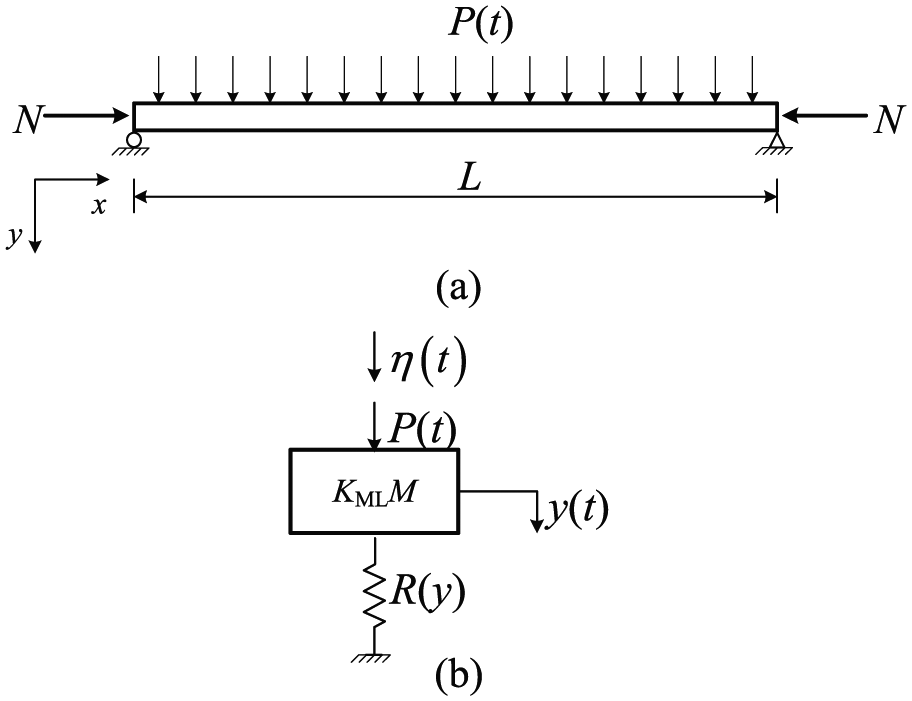
Equivalent SDOF system: (a) beam-column under blast loading and (b) equivalent spring–mass system.
In the SDOF model, the equivalent equation of motion for a beam-column under concentrated load can be generally described as


where

where
Simplification of near-field explosion
Blast loading is generally classified into four different types according to the distance from explosive charge to the surface of structure: (1) contact blast with no space between explosive charge and structure (Beppu et al., 2010), (2) close-range blast with scaled distance of 0.05–0.15 m/kg1/3 (Remennikov and Uy, 2014), (3) near-field blast with scaled distance of 0.15–0.12 m/kg1/3 (Nassr et al., 2013), and (4) far-range blast with scaled distance of over 0.12 m/kg1/3 (American Society of Civil Engineers (ASCE), 2011). The pressure is assumed to be uniformly distributed over the structural surface as the scaled distance is larger than 0.12 m/kg1/3 and the pressure variation along the structural member is usually neglected, that is, far-range blast; this assumption has been verified experimentally by Nassr et al. (2012). The simplest approach is to estimate the blast load with smallest scaled distance and use it as the equivalent uniform load over the whole member. This method is reasonable for the variation over the middle two-thirds of the member span length less than approximately 25%, which typically corresponding to the scaled distance is greater than 1.2–2.0 m/kg1/3 (Remennikov and Uy, 2014). It will cause a significant variation in the blast load applied to the different component if the explosive charge is relatively close to the structural member, that is, Z = R/W1/3 ⩽ 1.2 m/kg1/3, and the pressure on each point of structural component should be determined by combined pressure, standoff distance, and incident angle. In the SDOF model, this distributed blast pressure is simplified to an equivalent concentrated load because the response is most affected by loading applied near the mid-span region and least affected by loading applied near the supports.
As all the test columns, to be described later, are tested in the near-field, the pressure approximately spherically distributes over the structural surface. Therefore, the dynamic response of equivalent SDOF system is controlled by equation (1) with instantaneously applied total impulse (Remennikov and Uy, 2014). We assume that the impulse

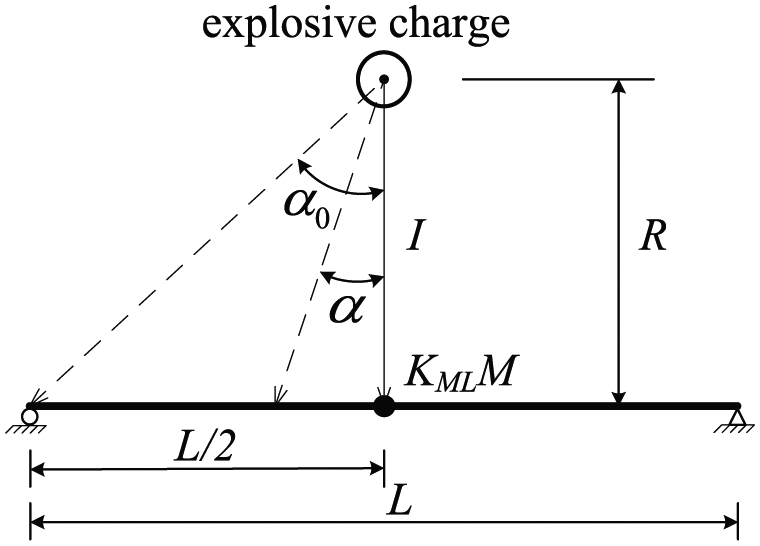
Blast impulse on beam-column.
Then, the total impulse can be obtained by the integration of equation (3) along the full height of the column and is given as

where
Equivalent mass–load coefficient
A two-stage deflected shape must be employed to describe the vibration mode of column under blast loading. In the elastic state, the vibration mode is represented by the deflected shape of a simply supported beam under concentrated load, while in the plastic state by a linear function corresponding to the deflected shape of the beam deforming as a mechanism with a plastic hinge at its mid-span. Therefore, the mass–load coefficient can be obtained based on the principle that the work and kinetic energy of equivalent mass–spring system are equal to those of the real simply supported beam


Resistance function of beam-column
For column under blast loading, the elastic resistance is derived by a simple supported beam under concentrated load, but the ultimate resistance is calculated assuming that plastic hinge forms directly at the mid-span section. The resistance function can be expressed, respectively, as (Nassr et al., 2013)


where
For simplicity, the steel tube and core concrete of CFST should be treated as one material, and the combined modulus of elasticity can be calculated using the confinement theory (Kang et al., 2007)

where


and



where
The moment capacity is associated with the applied axial load in the bean-column. The increase in the flexural load capacity due to axial load is determined by the below moment–load interaction relationship proposed by Cai (2003)

where

The axial load capacity of RPC-FST is calculated by using the following equation depending on unified theory (Tian et al., 2008)

where
Magnification factor of beam-column under near-field blast loading
The response of beam-column under near-field blast loading will undergo a free vibration stage due to the blast duration being very short compared to the natural period of the equivalent SDOF system (Remennikov and Uy, 2014). The blast duration due to a near-field detonation of 17.5–34 kg TNT charge is approximately in the range of 0.4–0.5 ms, which is significantly shorter than the natural period of 20–30 ms of the RPC-FST columns observed in the blast-resistance tests. It means that the displacement of structural member reaches its peak value after the blast action has disappeared. Thus, the equation of motion of beam-column under triangular impulses with zero rise time in the elastic range can be re-written as

and the initial condition at


where
The air shocks produced by explosive charge would attenuate exponentially, either incident shock wave or reflected shock wave. For convenience, in the theoretical analysis, the real pressure–time history of blast shock is usually simplified into an equivalent linearly decaying pressure profile (Li, 1985).

The displacement of concentrated mass and the dynamic magnification factor for equation (14) under blast impulse are given, respectively, as


where
There is

If the maximum displacement exceeds its elastic limit, that is,

where
The ultimate elastic displacement of beam-column under blast loading is presented by Li (1985)

where
The solution of equation (19) can be obtained according to the continuous condition between elastic range and plastic range. Supposing that

where

where

There is

where

The ductility ratio µ characterized the plastic capacity of structural member in the post-elastic state and is defined as the ratio of the maximum deflection of the column to its maximum elastic deflection. The utilization of µ as the design performance criterion can control the displacement ductility response of the member under blast loading, avoiding the too large displacement response, which may cause further damage or even destruction of the structural member. Usually, the maximum displacement for a given member is pre-determined in structure analysis. Cai (2003) has clarified that the CFST exhibits better energy-absorbing capacity under static transverse load; the maximum displacement would up to

Residual axial capacity evaluation of fire and blast-damaged column
Modified carrying-capacity of column member
Generally, the carrying-capacity of a column will depend on the length to diameter ratio and the eccentricity. A modified formula including double coefficient to predict the ultimate resistance of column is proposed by Cai (2003)

where


where
Influences of fire exposure and blast load
All material properties required in section “Equivalent SDOF model for beam-column” are temperature-dependent and strain rate-dependent parameter. At present, there is no available model that can be used to describe the behavior of RPC. In many literatures, the models for normal concrete can also be used for RPC without mixed fiber only by modifying the ultimate strength (Guo et al., 2017a). For fire-damaged CFST, Song et al. (2010) have demonstrated that the constitutive models of steel and concrete are basically the same as that at ambient temperature, but the ultimate strengths are only dependent on the maximum experienced temperature, but not affected by the current temperature during the elevated or cooling phase. In this article, the resistance–deflection curves of steel tube and core concrete are described by elastic-perfectly-plastic model, in which the post-fire strength should be modified by taking thermal effects into account.
It is verified that there is an evident temperature gradient in the core concrete during uniform heating phase, expect for the steel tube due to its good thermal conductivity (Guo et al., 2017b; Song et al., 2010). By convenience, equivalent strength is required in the numerical analysis. The core RPC is artificially divided into n annulus with a certain thickness according to the temperature gradient, which is pre-determined using ANASYS codes as described in Guo et al. (2017b). The equivalent cylinder compressive strength of core RPC after exposure to high temperature can be evaluated by the following formula

where
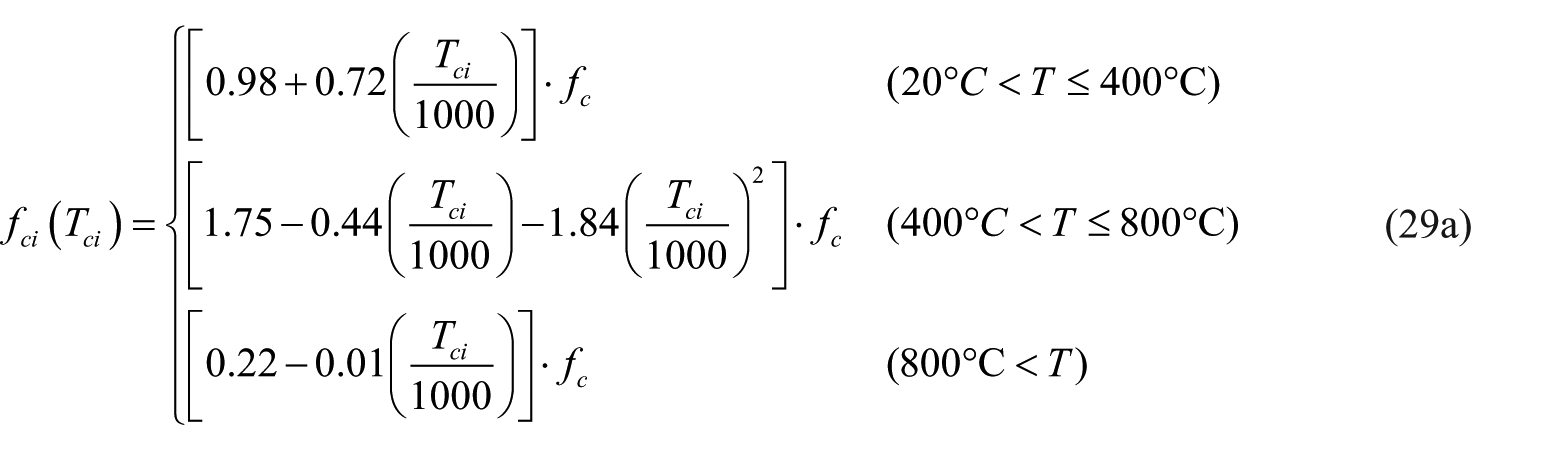
The post-fire strength of steel can be estimated by the following formula recommended by Wu (2003)

Using the similar calculation, the post-fire equivalent elastic modulus of RPC and steel tube can be determined by


where


The strain rate would lead to a significant change in the material properties of structure. An approximate approach to acquire the DIF of CFST, a ratio of dynamic strength to static strength, at ambient temperature is proposed by Xiao et al. (2009), and this method has been further promoted to predict the equivalent strain rate effect of CFST column after exposure to high temperature (Huo et al., 2012)

where
The calculation model proposed below by Comité Euro-International du Béton (CEB, 1988) and Cowper–Symonds (Jones, 1988) can be employed to estimated the rate enhancements of fire-damaged RPC and steel tube given in equation (32), only by taking the thermal conducts into account



where
In addition, the load-caused deformations are neglected in this article because (a) it is difficult to simulate the combined effects of axial load and high temperature by using current equipment, and (b) Song et al. (2010) have experimentally validated that the current axial load has little effect on the peak value and the ascendant branch or following descendant branch of N–εL of CFST. In addition, the load-induced εL is far less than the blast-induced ε (i.e. >6000 με, Guo et al., 2017a), and the pre-load-induced deformations could be neglected during the blast test.
Comparison of analytical results with experimental data
A series of tests on fire and blast-damaged RPC-FST columns under axial loading are performed to demonstrate and verify the promoted analytical method, in which the influences of fire duration and scaled distance on the load carrying-capacities are investigated. In this article, a three-step experimental study including separated elevated temperature test, blast-resistance test, and residual carrying-capacity test is successively conducted. The information of specimen fabrication and test program has been depicted in detail by Chen et al. (2016).
Test on a fire followed by an explosion or vice versa is almost impossible to perform despite it being caused by occasional accidents or terrorist attacks. For fire-damaged CFST, Song et al. (2010) have demonstrated that the ultimate strengths are only dependent on the maximum experienced temperature, but not affected by the current temperature during the elevated or cooling phase. Therefore, the elevated temperature has little influence on the blast response of structural member. In order to ensure the personnel safety, the blast tests must be carried out when specimens have cooled down to ambient temperature. In the fire exposure test, the fire duration of 105 min was chosen according to ultimate fire-resistance of concrete material, and 60 min was chosen as the average fire duration. The detailed information is summarized in Table 1, where W is the explosive charge weight, R is the standoff distance, and t is the fire duration.
Details of blast-resistance test.
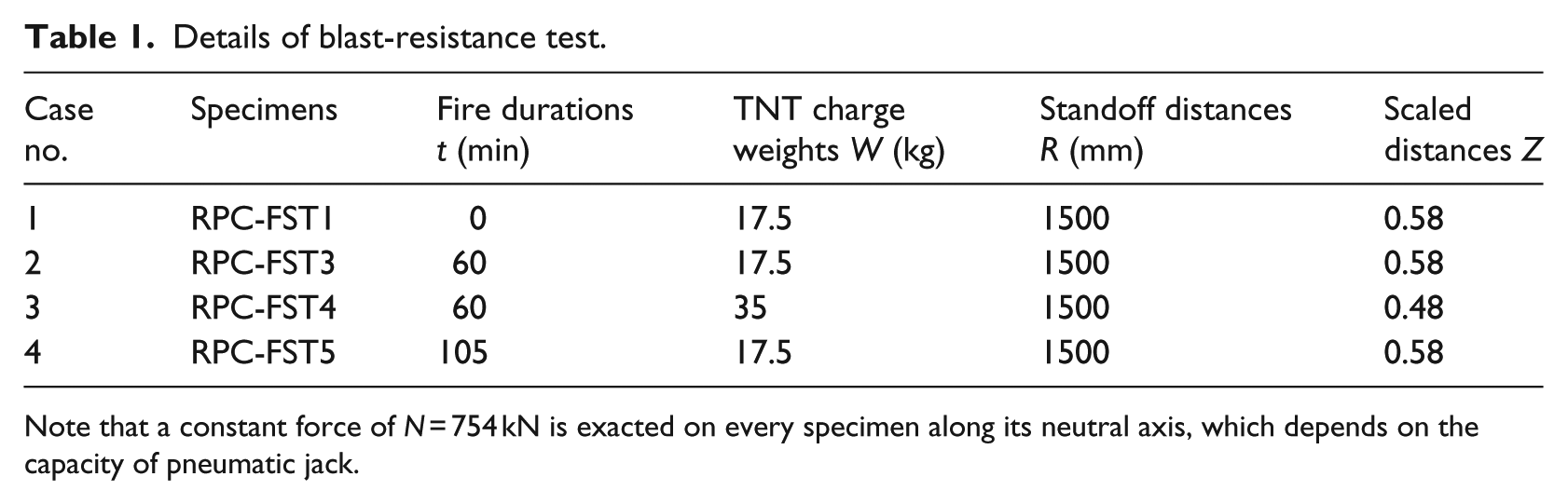
Note that a constant force of N = 754 kN is exacted on every specimen along its neutral axis, which depends on the capacity of pneumatic jack.
The recorded temperature–time curves corresponding to fire durations of 60 and 105 min, respectively, including heating phase and cooling phase, are shown in Figure 3. It is observed that the maximum recorded temperature is up to 950 C and 1040 C, respectively, in good agreement with the predicted temperature of ISO-834 standard fire (Song et al., 2010). The fire-damaged RPC-FST columns are given in Figure 4.
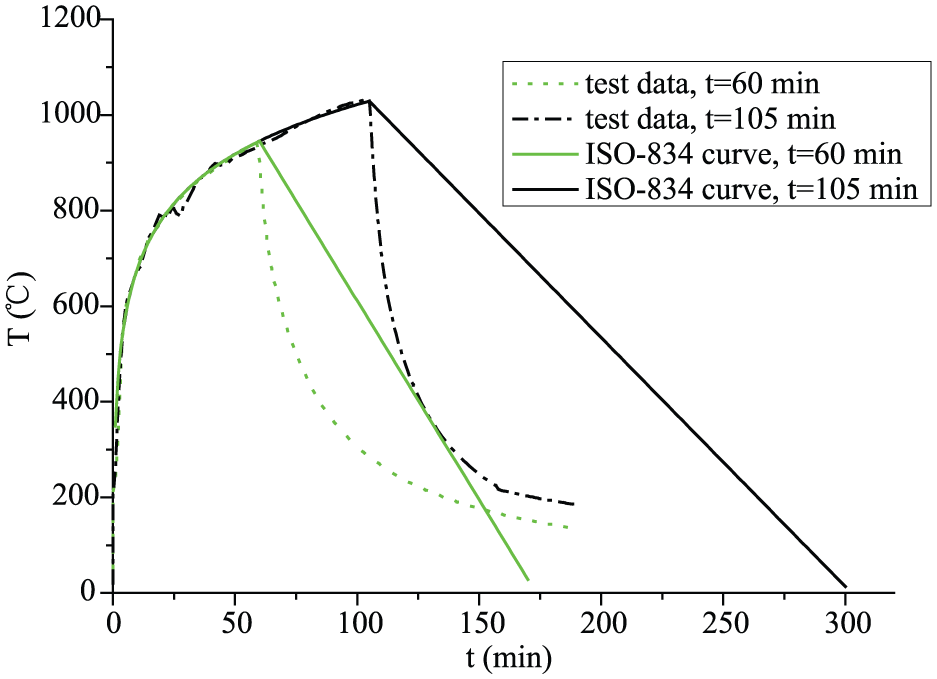
Temperature–time curves.
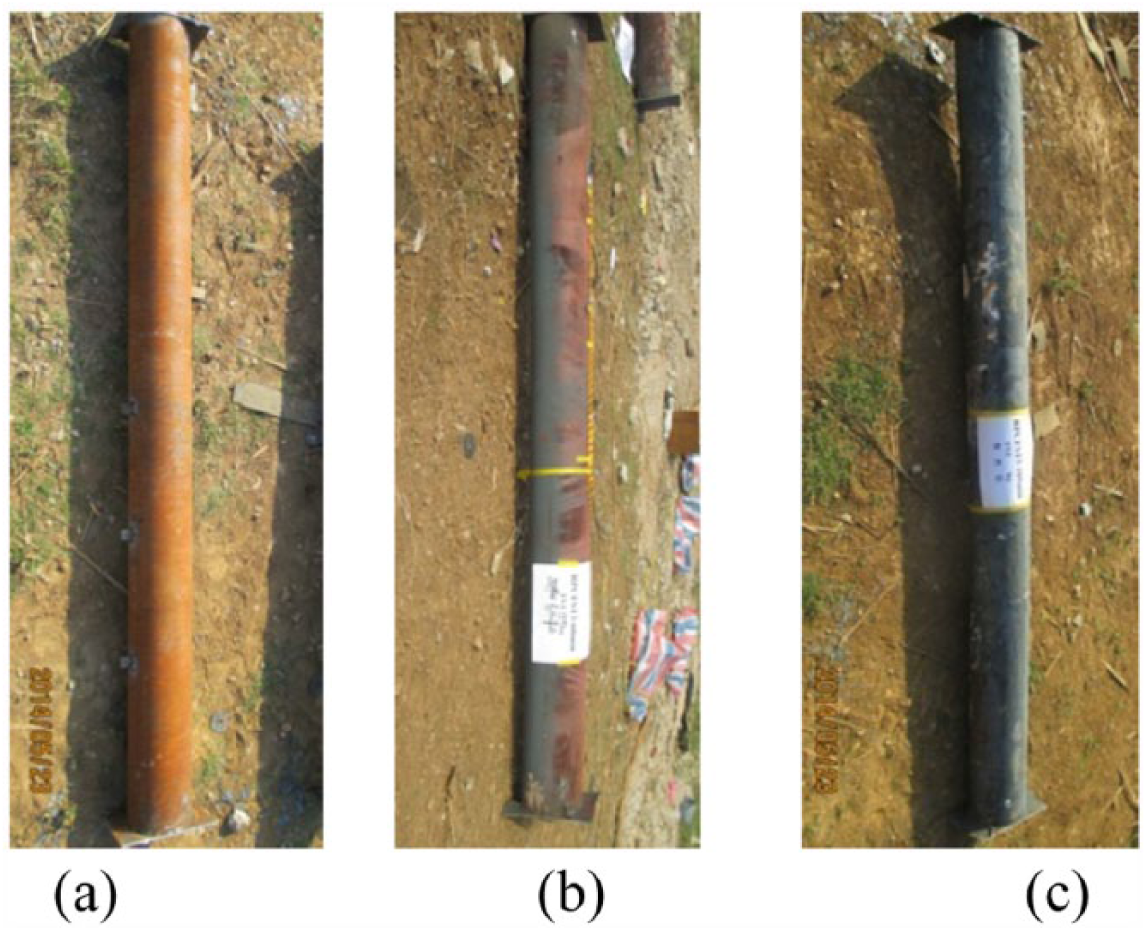
Global view of fire-damaged RPC-FST columns: (a) without fire exposure, (b) fire duration of 60 min, and (c) fire duration of 105 min.
As shown in Figure 5, all columns experienced a combination of global plastic flexural response and slight localized plastic deformation of the central zone, except that the column without fire exposure only undergoes a global beam mode–type deformation, but the RPC infill seems to provide an internal support to tube walls and prevent steel rupture, breaching failure, as well as local buckling failure of the tube walls at the mid-span. The maximum and residual displacements of all recorded points are summarized in Table 2. It can be clear that the maximum and residual displacements of RPC-FST column show significant dependencies on the explosive charge weight and fire duration. A ratio of residual displacement to full length of CFST column r = Dr/L (i.e. relative displacement) is proposed by Cai (2003), and it has been widely used to scale the elastic limit of a CFST member under lateral static loading. If r ⩾ 2%, it means that the column is in the plastic range, and plastic deformation occurs. It is obvious that most of the relative displacements of RPC-FST column are larger than 2% except RPC-FST1. Therefore, all fire-damaged RPC-FST columns have reached their elastic limit while subjected to blast loading.
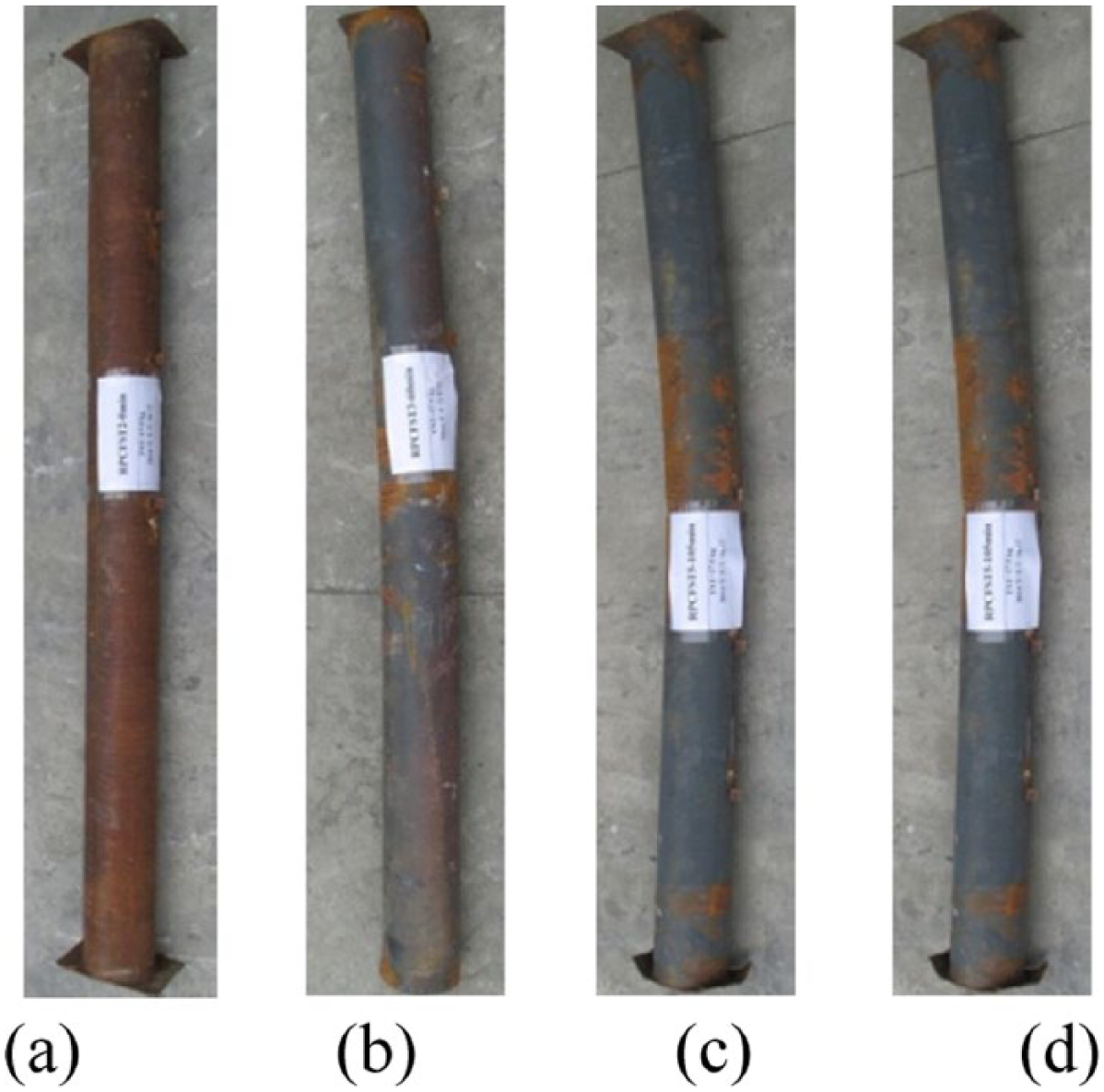
Failure appearances of fire and blast-damaged RPC-FST column: (a) RPC-FST1, (b) RPC-FST3, (c) RPC-FST4, and (d) RPC-FST5.
Maximum and residual displacements of measured point.

The maximum and residual displacements of each RPC-FST column are taken from Table 2, and they are linked by straight lines, which are used to represent the maximum and residual deflections. The influences of fire duration and scaled distance on the deflections of RPC-FST column are discussed, respectively. The maximum and residual deflections of RPC-FST column with different fire durations are shown in Figure 6 (corresponding to case 1, case 2, and case 4 listed in Table 2). It is evident that the deflection of RPC-FST column shows significant fire duration dependency, either the maximum deflection or residual deflection. Typical bending deformations can be observed in all columns. Moreover, the maximum displacements increase greatly with fire durations. The figures of residual deformation demonstrate that the residual deflection of RPC-FST column with a fire duration of 0 min, as shown in solid line in Figure 6(b), is obviously smaller than that with a fire duration of 60 or 105 min; it means that the concrete cannot resume its original strength after experiencing high temperature over 950 C. A curve of residual deflection with “V” type can be found when fire duration is up to 105 min, due to the hinge-like deformations being mainly concentrated near the mid-span zone while other areas remain elastic.
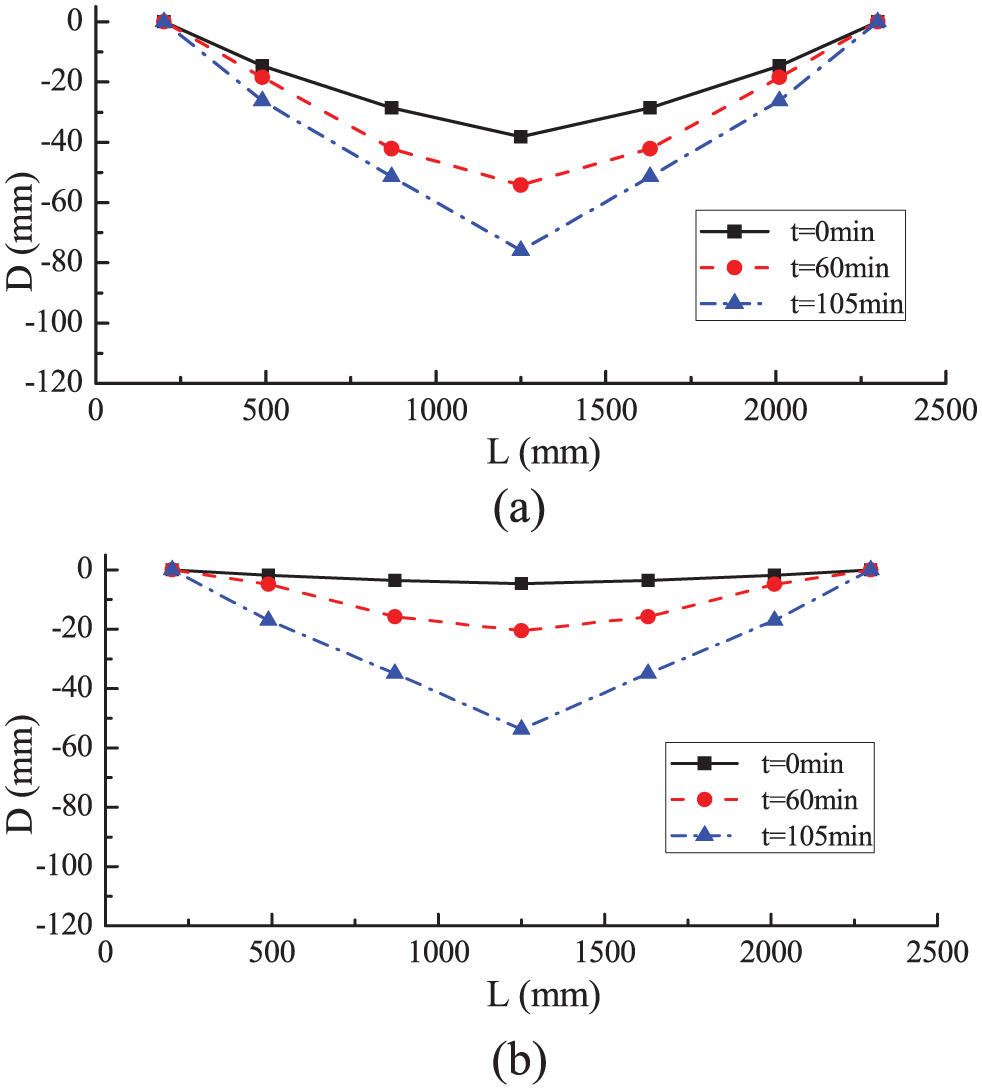
Influences of fire duration on deflections: (a) maximum deflections and (b) residual deflections.
The influences of scaled distance on the deflections of RPC-FST column with Z = 0.58 and 0.48 m/kg1/3 (corresponding to case 2 and case 3 listed in Table 2) are given in Figure 7. A smooth deflection curve is derived from either RPC-FST3 or RPC-FST4, which is similar to the deflection curve of beam member under uniform static loading. It is apparent that there are approximately three plastic inflections in RPC-FST column, one at the mid-span section and two nearing the fixed ends; even the deflection curve of RPC-FST4 seems smoother than that of RPC-FST3 because the smaller scaled distance (case 3) might cause more localized pressure. Typical bending deformations occur in the column with a scaled distance of 0.58 m/kg1/3, but the failure type tends to be bending-shear type for RPC-FST4 column with a scaled distance of 0.48 m/kg1/3 because the shear stress gradient nearing the support is very large and it reaches the ultimate combined strength prior to the tensile stress. Hence, a residual deflection with “U” type is achieved, as shown using dotted line in Figure 7(b). Strain is an important parameter to quantitatively scale the level of plastic deformation, but most of the strains in this test could not be captured due to the strain gauges being deboned by the tensile waves reflected on the bottom surface of RPC-FST column. Basically, the RPC-FST specimens maintain good integrity and no bulking or burst can be observed after fire attack. In addition, there were no visible hinge-like failure, or shear failure near support can be seen in the RPC-FST while subjected to blast load, which exhibits excellent fire-resistances and blast-resistances. It is quite different from the normal concrete member that suffered fire and the following blast attack,given in Zhao et al. (2015).
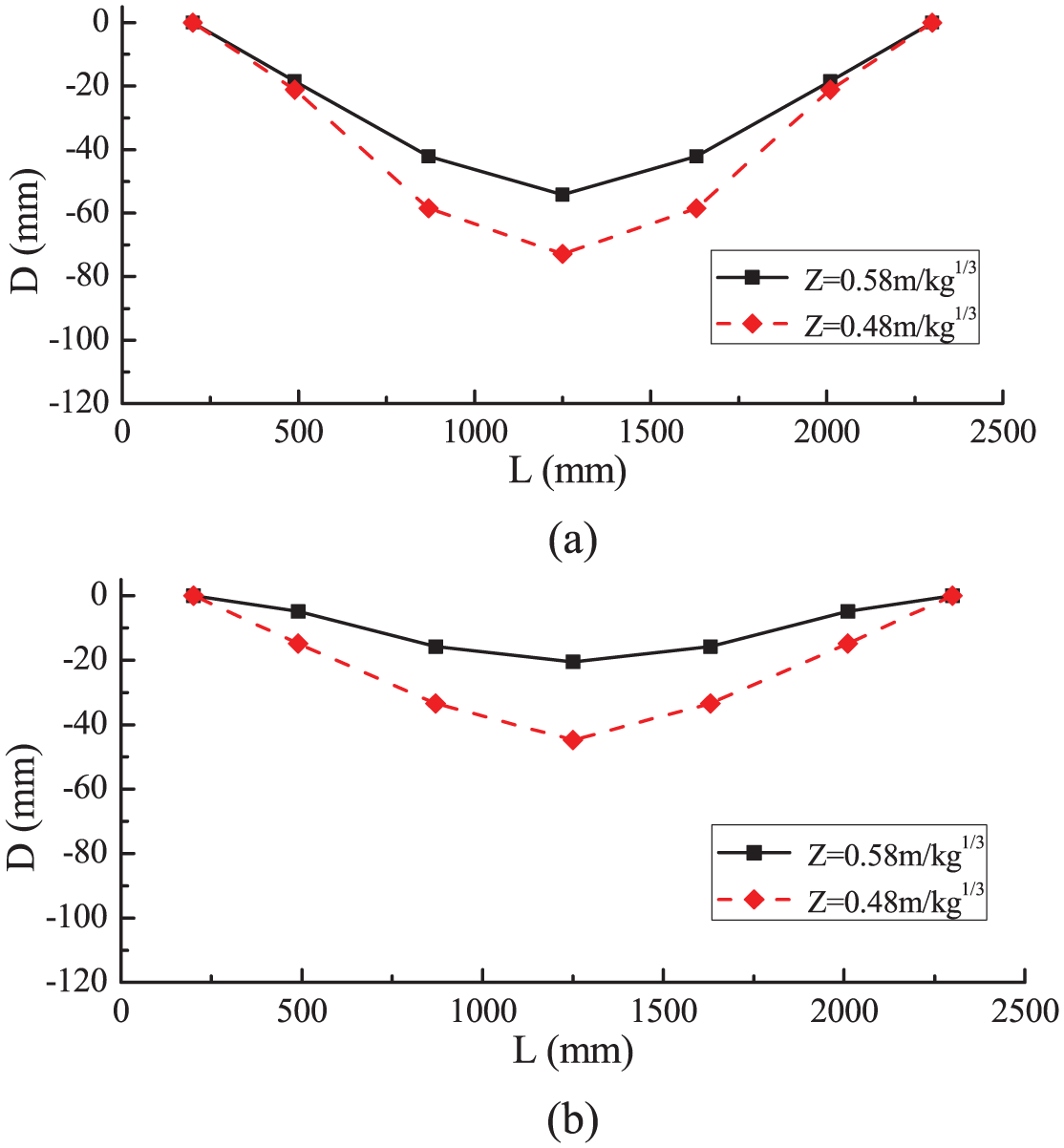
Influences of scaled distance on deflections: (a) maximum deflections and (b) residual deflections.
Residual carrying-capacity tests
Test descriptions
Six large-scale RPC-FST columns are prepared for residual carrying-capacity test, including four fire and blast-damaged columns which have been used in the blast-resistance tests, a fire-damaged column, and an intact column. In this section, the damaged level of fire duration and explosive charge on the residual carrying-capacities of RPC-FST column are experimentally investigated, which is of benefit to evaluate the reliabilities of RPC-FST column for its continuous use. The experimental details are summarized in Table 3.
Details of residual carrying-capacity test.

Note that the load-free permanent deflection of RPC-FST6 is caused by thermal effect during elevated temperature.
The residual carrying-capacity tests are carried out on the 5000-kN test system of Southeast University. In this test, measured parameters include the axial load capacities and axial and lateral displacements of RPC-FST column. The diagrammatic sketch of test set-up is given in Figure 8(a). Before loading, the RPC-FST column is set up straight in the test system and restrained by a column-cap at the end. The rotations of RPC-FST column at both ends are prevented and the column-caps are fixed on the bending-beam by four steel bolts. A special steel hoop near each column-cap is used to provide a safety protector against lateral instability, and it is to fasten on the upright steel columns of the test system. Three displacement gauges spaced at 415 mm are installed on the upright steel columns to measure the lateral load of the RPC-FST column, which is similar to that of the blast-resistance test. The top end of the column is connected to an actuator and controlled by the manual hydraulic system, and it can move up and down along the vertical direction. On the actuator, a force sensor is employed to record the axial load. A displacement gauge which has been fixed on the bending-beam is also used to record the axial compression of the RPC-FST column. Each kind of sensor is re-checked carefully before residual carrying-capacity test.
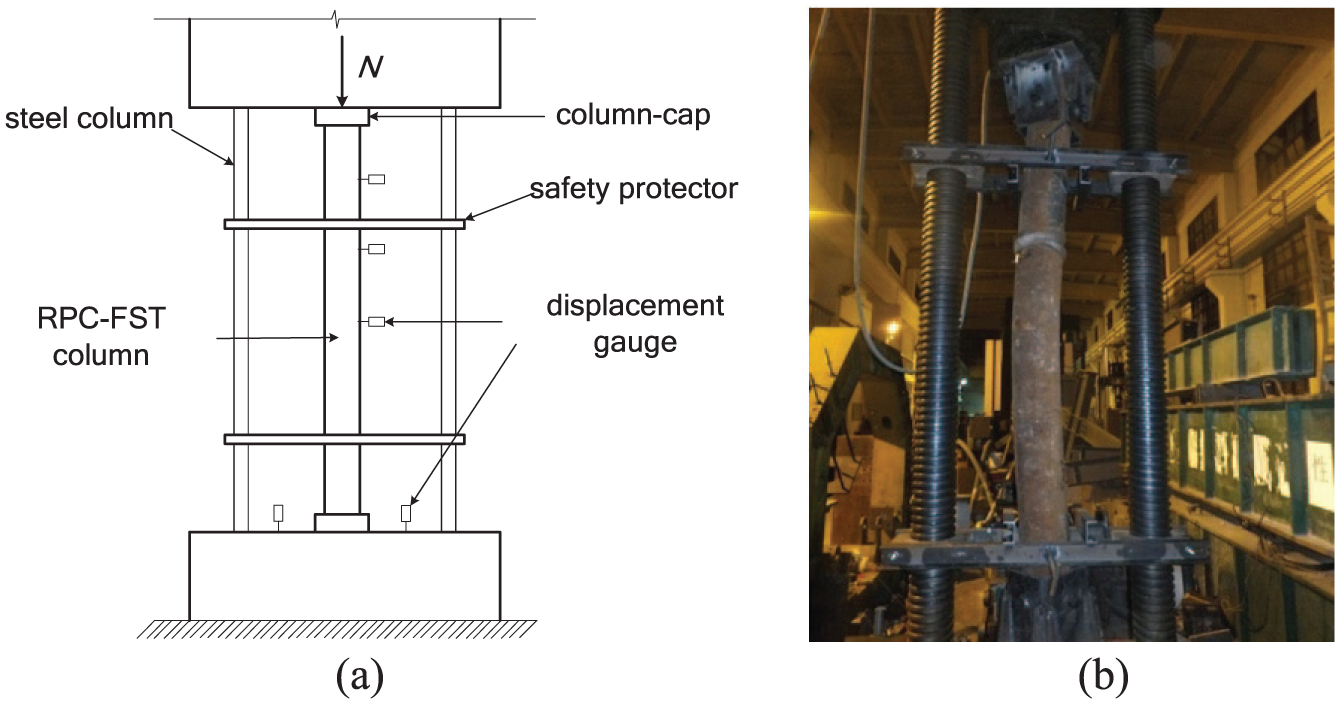
Test set-up: (a) test sketch and (b) specimen installation.
Before formal loading test, the axial capacities of each RPC-FST column are estimated theoretically by equation (26), and then a loading program is schemed in detail. During the residual carrying-capacity test, as shown in Figure 9, the axial load is applied step-by-step artificially on the RPC-FST column to avoid sudden collapse. The loading step is about 20% of ultimate resistance of column before the accumulated load reaches 75% carrying-capacity, and then the loading step would decrease to 10% of ultimate resistance until the RPC-FST column fails or the axial displacement continually grows with constant axial load. There is a time-span of about 15 min between either loading steps, which is helpful for the development of axial deformation before next loading step and the record of experimental data by lab assistant.
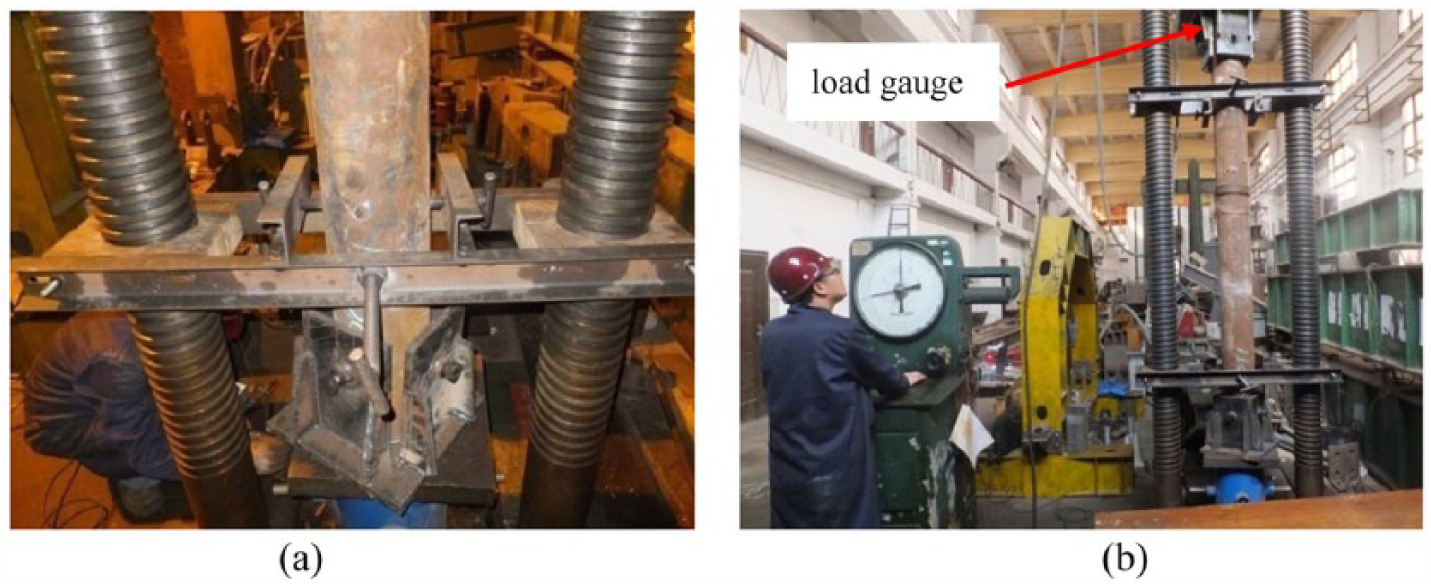
Residual carrying-capacity tests: (a) safety protector and (b) test loading.
Experimental results and discussions
Loading test should be terminated once the exterior load does not develop with axial displacement. The failure appearances of the post-test RPC-FST column are displayed in Figure 10, and the maximum lateral displacements and bearing capacities are summarized in Table 4. It is evident that bending deformations occur in all RPC-FST columns, and the bending levels are aggravated with fire duration or explosive charge. No local bucking and bulking could be observed; also, no visible plastic hinges similar to normal concrete column can be seen in the mid-span section. The good ductility and carrying-capacities of fire and blast-damaged RPC-FST column are experimentally verified. The local views of mid-span section of RPC-FST2, RPC-FST3, and RPC-FST5 are displayed in Figure 11. It is found that there are significant discrepancies in the failure appearances of specimens after residual carrying-capacity tests. For intact column RPC-FST2, the specimen is almost axially compressed until material failure due to a very small initial eccentricity; thus, the full length of column would sustain an entire compression, and the apparent orthogonal yield-lines could be seen in the local view. However, bending-failures will occur for fire and blast-damaged RPC-FST column with initial deflection, because the eccentric external load would lead to a bending-shear stress. Moreover, the local bending phenomenon tends to be evident with fire duration due to the remarkable deterioration of combined strength for fire-damaged column.
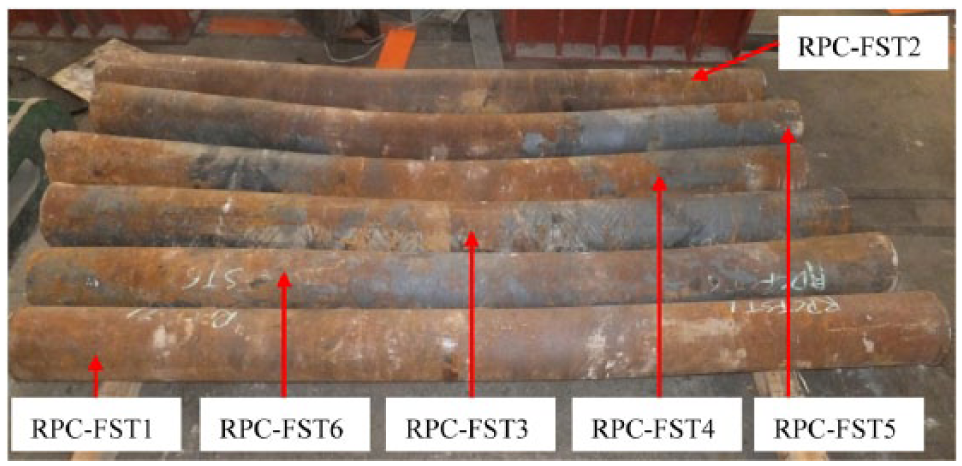
Post-test specimens.
Results of residual carrying-capacity tests.

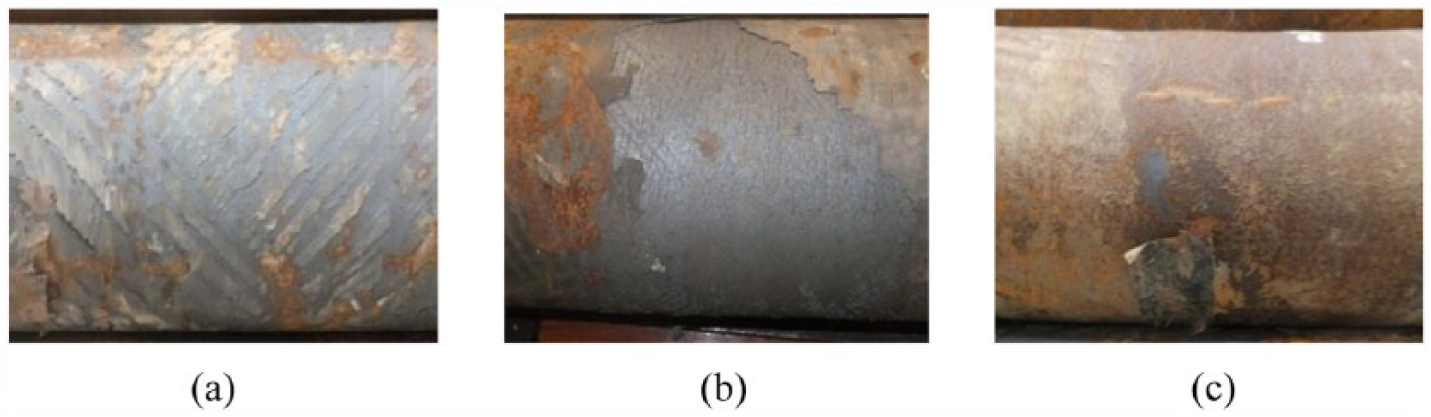
Local view of failure appearances: (a) RPC-FST2, (b) RPC-FST,3 and (c) RPC-FST5.
Experimental results show that both fire and explosive charge have remarkable influences on the residual carrying-capacities and maximum lateral displacements of the RPC-FST column. For RPC-FST2, an intact column, the carrying-capacity is up to 3041 kN with a maximum lateral load of 70 mm. But the carrying-capacities would decrease greatly if the RPC-FST columns have been subjected to fire attack or blast loading. It is well known that the carrying-capacities are associated with material property and initial deflection. The carrying-capacity of blast-damaged column without fire exposure (i.e. RPC-FST1) is much higher than that with fire exposure (i.e. RPC-FST3); furthermore, the carrying-capacity would further decrease to 1003 kN if fire duration is expanded to 105 min, as shown in Table 4. The reason might be that the material properties of RPC-FST column have been deteriorated in the elevated temperature tests; the residual deflections would increase with fire duration if the columns are subjected to blast loading in the following tests. It will aggravate the material failure or local bucking of RPC-FST column in the residual carrying-capacity test. The residual carrying-capacity of fire-damaged column (i.e. RPC-FST6) is only 1217 kN, which is slightly higher than that of RPC-FST5 due to its small initial deflection. The fire and blast-damaged column would get a larger lateral displacement than column only subjected to fire or blast attack; the maximum lateral displacements of column with fire duration of 105 min or scaled distance of 0.48 m/kg1/3 are over 100 mm. It is also found that the relative displacements of all columns are larger than 2.0%; it means that the six RPC-FST columns have exceeded their elastic limits.
The initial and residual deflections of six columns listed in Table 4 are displayed in Figure 12. It is demonstrated that there are hinge-like deformations near the mid-span sections for blast-damaged column with or without fire exposure due to the initial deflections caused by local blast loading. Furthermore, it is clear that the enclosed areas between initial deflection and residual deflection become plumper with elevated temperature due to the enhancement of deformability of RPC-FST (Guo et al., 2017).
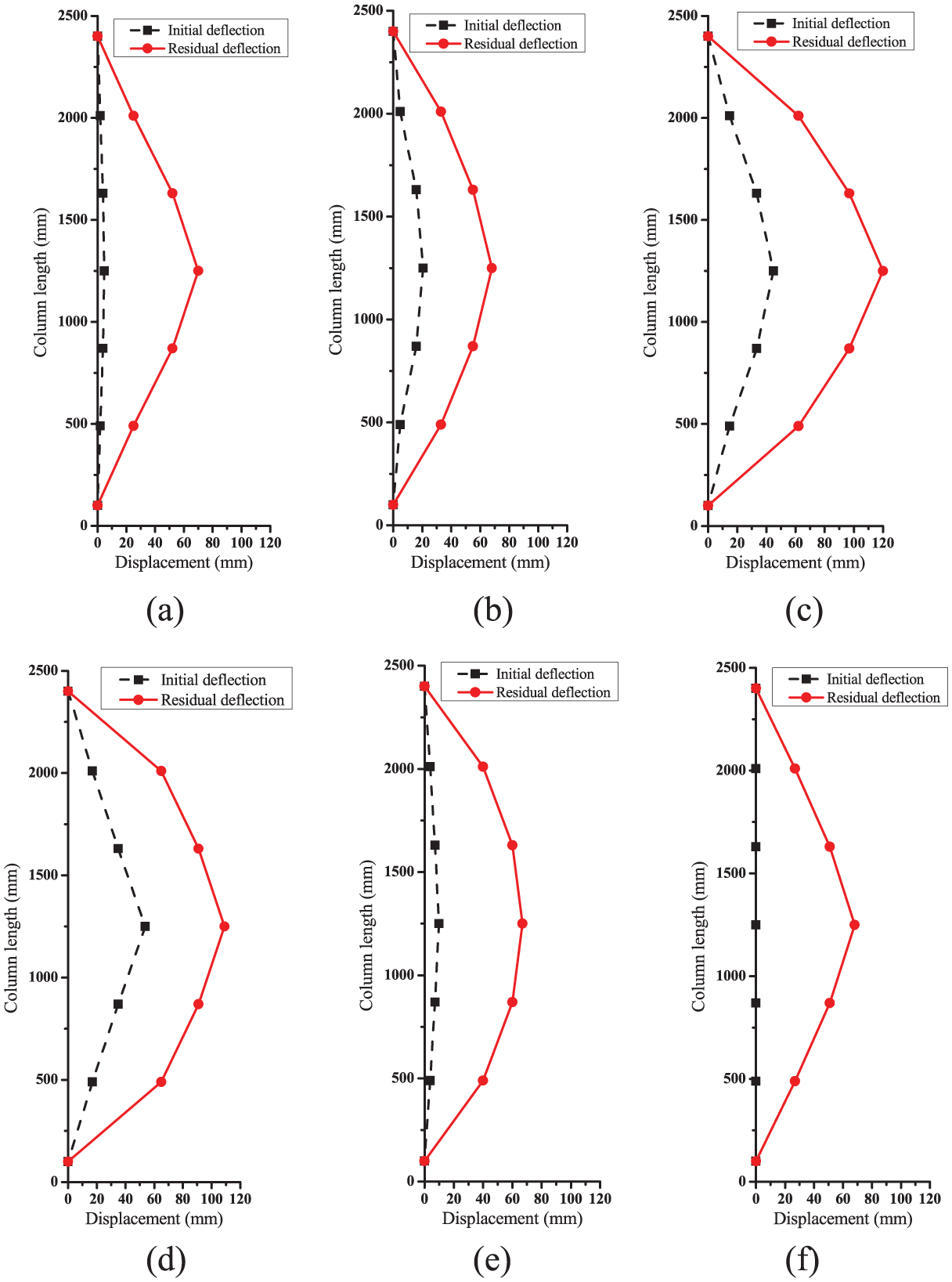
Deflections of RPC-FST column after residual carrying-capacity test: (a) RPC-FST1, (b) RPC-FST3, (c) RPC-FST4, (d) RPC-FST5, (e) RPC-FST6, and (f) RPC-FST2.
The axial load–displacement relationships of the above six specimens are given in Figure 13. It is evident that the overall behaviors of RPC-FST1 and RPC-FST2 followed a similar pattern; the load capacities of both columns declined immediately in a brittle manner after reaching their peak values, but the peak axial carrying-capacity of RPC-FST2 is significantly larger than that of RPC-FST1. They exhibit better axial load capacities and good stiffness than other columns subjected to fire attack due to their combined strengths that do not weaken by elevated temperature. However, the fire-damaged RPC-FST columns behaved in a more ductile manner under axial load. The initial stiffness (i.e. the slop of the ascending branch) of fire-damaged columns is obviously smaller than that of columns without fire exposure because the materials are softened by the high temperatures they have been subjected to. Furthermore, the plastic branches of axial load–displacement curves are prolonged with respect to that without fire attack and exhibit good ductility. The columns with the same fire duration show very similar trend regardless of the variations of explosive charge. In addition, the axial capacity–displacement curves in Figure 13 show that there are significant discrepancies in the carrying-capacities of blast-damaged column; the column without blast attack or being subjected to smaller blast loading shows better axial capacity than those subjected to larger blast loading. This verifies the theory that initial eccentricity caused by blast loading often result in a smaller axial capacity. Figure 14 shows the relative load carrying-capacities of fire and blast-damaged columns to that of intact column (i.e. RPC-FST2, a fire and blast-free column). It can be seen that the axial capacity of blast-damaged column RPC-FST1 remains 83.9%, compared to specimen RPC-FST2. But for fire-damaged column RPC-FST6, fire exposure decreases the peak axial load carrying-capacity by 60.0%. However, the carrying-capacities would further decrease if RPC-FST columns are subjected to combined attacks of high temperature and blast loading. The residual carrying-capacity of fire and blast-damaged column RPC-FST3 with Z = 0.58 m/kg1/3 only maintains 65.7% compared to the intact column RPC-FST2, which is only 77.6% of the RPC-FST1. But the high temperature would greatly weaken the load carrying-capacity of RPC-FST column; the residual bearing capacity of RPC-FST5 with Z = 0.58 m/kg1/3 decreases by 67%, while fire duration increased to 105 min. On the other hand, the residual carrying-capacity of RPC-FST4 with fire duration of 60 min decreases by 54.1% if the scaled distance decreases from 0.58 to 0.48 m/kg1/3. This finding indicates that both fire and blast loading have significant influences on the residual carrying-capacities of RPC-FST column, but the load capacities of column seem more sensitive to fire than to blast loading, which is similar to their blast-resistances.
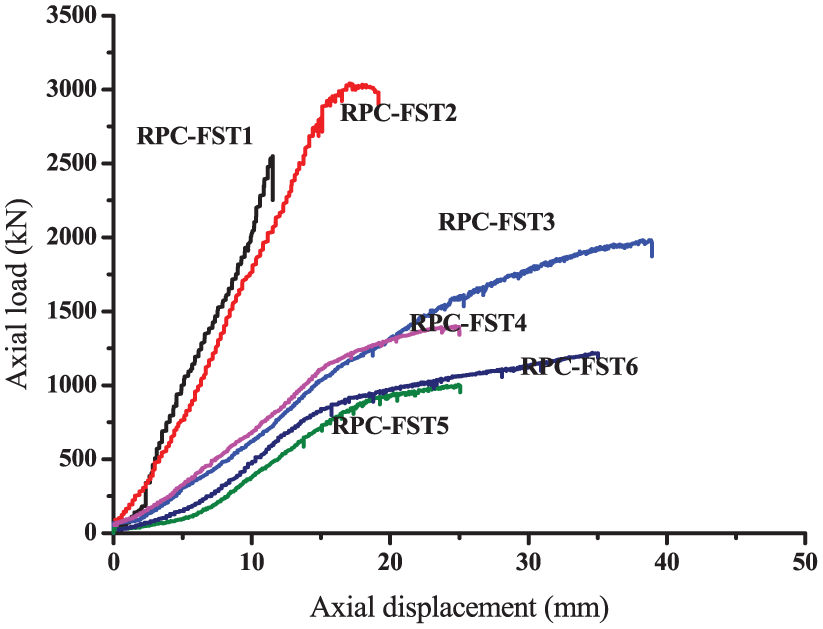
Axial load capacity–displacement relationships.
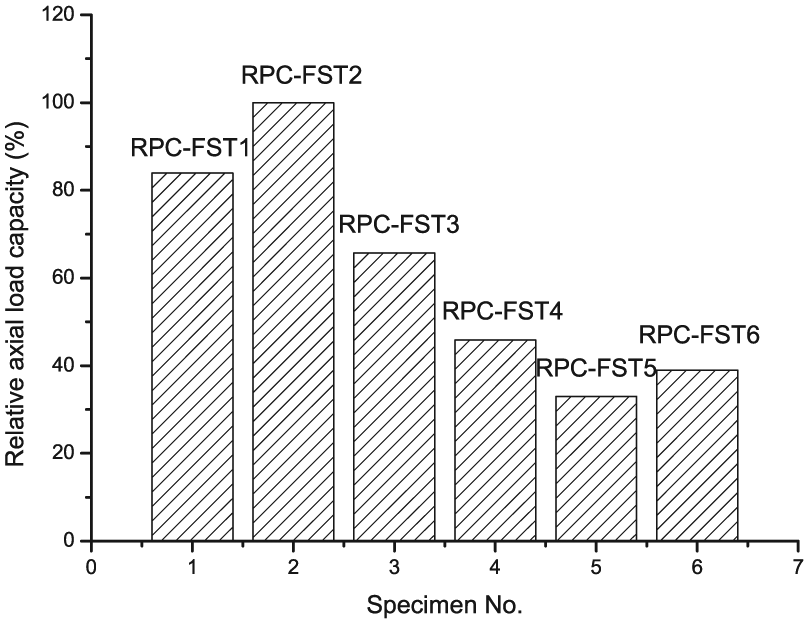
Residual carrying-capacity of RPC-FST column.
Comparison of analytical results with experimental data
Validations of theoretical method
The experimental data are employed to validate the reliabilities of analytical methods promoted in section “Residual axial capacity evaluation of fire and blast-damaged column’. The residual carrying-capacities of fire and blast-damaged column listed in Table 3 are estimated using equation (26), a modified predicting formula, in which the influences of length to diameter ratio, axial load, thermal conduction, and blast damage are taken into account. The equivalent strength and elastic modulus of core RPC and steel tube after exposure to fire based on equations (28) to (31) are given in Table 5. The response time-histories of mid-span section of six RPC-FST columns derived by the proposed method are given in Figure 15; it is demonstrated that the analytical results are in good agreement with experimental data. The fundamental parameters of fire-damaged RPC-FST columns are listed in Table 6 and the theoretical initial displacement of RPC-FST columns under blast impulse is given in Table 7. For near-field blast, the strain rates of at least 0.3 s−1 are used in the empirical formula (33).
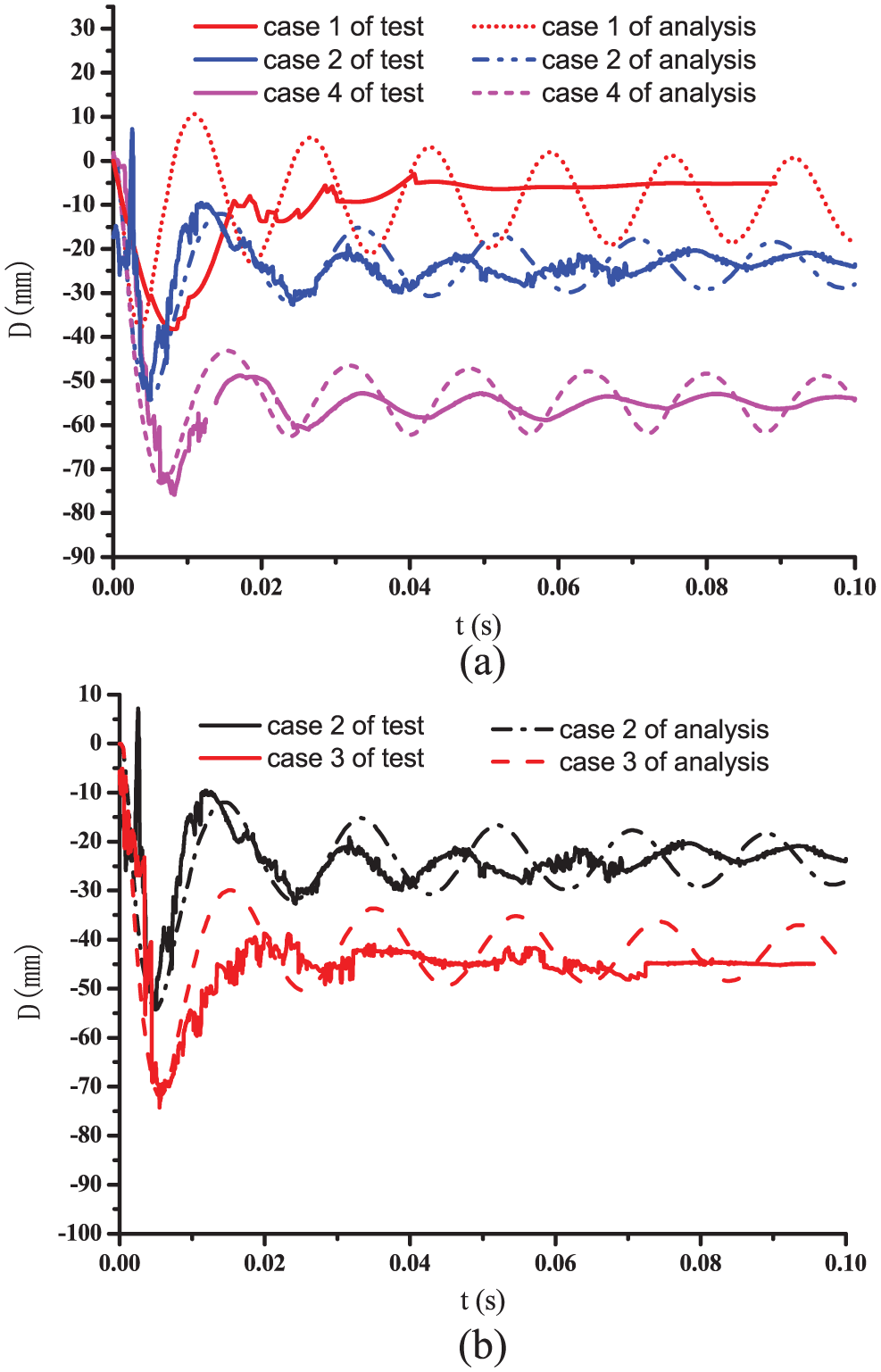
Time-histories of displacement: (a) influences of fire duration and (b) influences of scaled distance.
Equivalent material properties of steel and core RPC.

RPC: reactive powder concrete.
Fundamental parameters of fire-damaged RPC-FST columns.
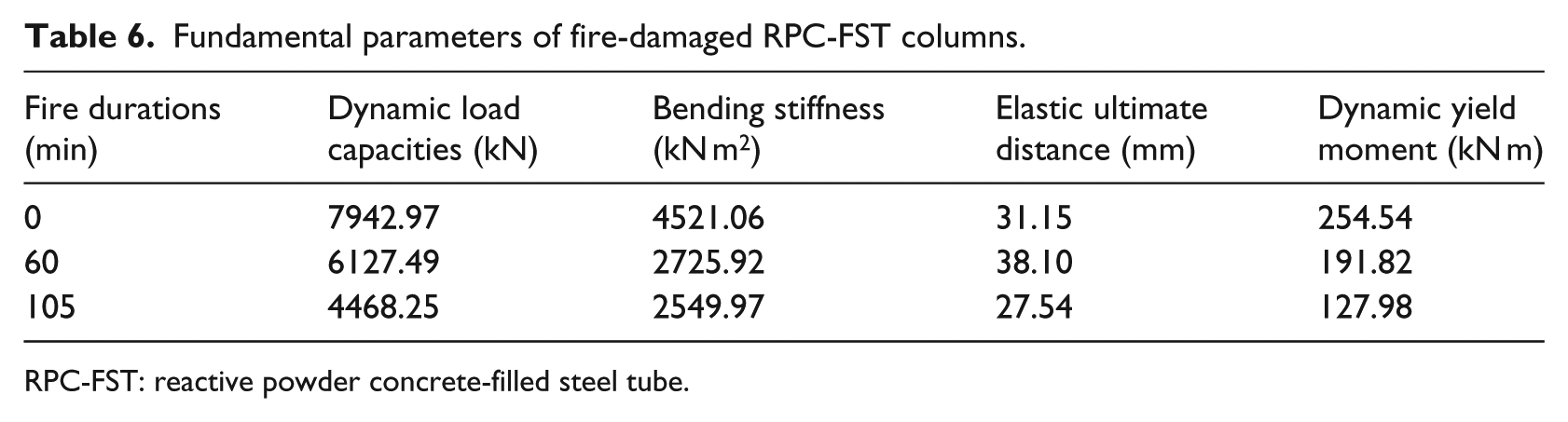
RPC-FST: reactive powder concrete-filled steel tube.
Theoretical initial deflections of RPC-FST columns.

The analytical carrying-capacities of six RPC-FST columns are listed in Table 8, compared to experimental data achieved in the residual carrying-capacity tests. It is demonstrated that the residual carrying-capacities of the RPC-FST column can be estimated with acceptable accuracy. The theoretical method proposed in this article would over-predict the axial load capacities of intact (RPC-FST2) or fire-damaged (RPC-FST6) columns, and the corresponding relative error is 12.2% and 21%, respectively. However, the residual carrying-capacities of fire and blast-damaged columns are under estimate by 6%–13%. The discrepancies tend to be apparent with fire duration; the relative error between theoretical results and experimental data is up to 12.9% for RPC-FST5. The reasons might be that the theoretical method proposed in this article assumes that there is an approximate plastic inflection in the mid-span section of blast-damaged RPC-FST column, and the initial deflection is obtained based on the SDOF model. But actually, either fire-damaged or intact RPC-FST column exhibits surprising ductility and maintains good entirety after suffering blast load, and no real plastic hinges occur in the mid-span section, which is evidently different from that in the normal reinforced concrete column under blast loading (Li et al., 2013). In addition, the increase in the relative error due to fire exposure is attributed to the better confinement effect, and it can be well explained by the steel–concrete interaction depicted in Guo et al. (2017). Therefore, the analytical method in this article would under-estimate the resistances of blast-damaged column.
Comparisons of residual carrying-capacities.

Damage assessments of RPC-FST column
The damage level is an important reference for structure member in its continuous use. Since the column is designed principally to support an axial load, the assessment criterion based on axial load carrying-capacity is employed to evaluate the damage level. It is defined as the ratio of residual axial load capacity of damaged specimen to the designed axial load capacity of undamaged specimen (i.e. RPC-FST2 in this article), known as the damage index Dc (Shi et al., 2008)

where
The damage index calculated by equation (34) is displayed in Figure 16. It indicates that all damage indices of the test specimens are within 0.8, meaning only minor to severe damage occurs in the RPC-FST column during fire and blast attack, which is consistent with the test results. The analytical results demonstrated that the Dc of RPC-FST1 is 0.08 and the Dc of RPC-FST3 is 0.46; thus, it can be classified as minor and moderate damage, respectively. However, the damage index of RPC-FST4, RPC-FST5, and RPC-FST6 is up to 0.6, 0.74, and 0.57, respectively; severe damage occurs. It is noticeable that the Dc of RPC-FST5 is larger than 0.7, obviously larger than that of RPC-FST4, meaning that the combined attacks of fire and blast load would greatly aggravate the damage degree of RPC-FST column, but the damage level seems more sensitive to fire duration than to explosive charge. No collapses occur in the test specimens although some columns have suffered serious fire exposure and small standoff distance of explosion.
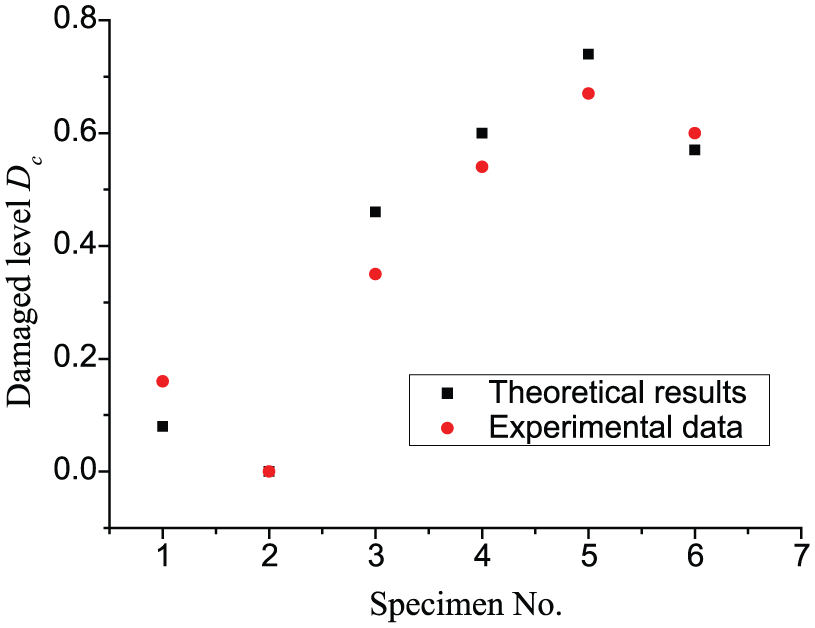
Damage levels of RPC-FST column.
Conclusion
An approximate approach is developed to predict the residual carrying-capacities of fire and blast-damaged RPC-FST columns. A two-step technique is proposed to achieve the residual axial load capacities of columns after suffering fire attacks and blast-induced transverse loads. In the first step, the SDOF model is employed to calculate the initial deflection of fire and blast-damaged RPC-FST column. Second, a modified formula including double coefficient is presented to predict the ultimate resistance. Finally, carrying-capacity tests on six large-scale RPC-FST columns are conducted to validate the suitability of the theoretical method promoted in this article, and the damage level of fire and blast-damaged RPC-FST columns is further evaluated.
The maximum displacement of fire-damaged RPC-FST column subjected to axial and blast-induced transverse loads is predicted by utilizing an advanced SDOF model, in which the thermal effect, secondary moment (P–δ effect) due to axial load, and strain rate are taken into account. A three-dimensional nonlinear transient thermal analysis code ANSYS is first used to pre-determine the temperature distributions of RPC-FST column based on standard fire. It is found that there is an evident temperature gradient in the cross section of column at elevated temperature, and the material properties of core RPC are sensitive to fire duration. Then, a beam-column model is presented to investigate the responses of RPC-FST column subjected to axial and blast-induced transverse loads. In this process, the dynamic analysis is separated into elastic and plastic regimes according to the ultimate resistance of RPC-FST column. Finally, a modified formula including double coefficient to predict the ultimate resistance of column is proposed.
A blast-resistance test and a residual carrying-capacity test are performed, respectively, in this article. It is demonstrated that the plastic hinge-like deformation tends to be apparent as fire duration increases from 60 to 105 min; furthermore, a residual deflection with “V” type is observed if fire duration is up to 105 min. Typical bending deformations occur in the specimens with scaled distance of 0.58 m/kg1/3, but the deformations transfer to bending-shear types when scaled standoff distance decreases. In addition, the blast-resistant capacity of RPC-FST column seems more sensitive to fire duration than to scale distance. No local bucking and bulking could be observed in the residual carrying-capacity test; also there are no visible plastic hinges in the mid-span section. It indicates that all damage indices of the test specimens are within 0.8, meaning only minor to severe damage occurs in the RPC-FST column during fire and blast attack, which is consistent with the test results. Comparisons between analytical results and experimental data indicate that the residual carrying-capacities of fire and blast-damaged RPC-FST column can be estimated accurately.
This work can be helpful in understanding the residual carrying-capacities of RPC-FST column after being subjected to ISO-834 standard fire and blast loading and provides a new approach for further reliability assessment of CFST column that has survived fire and blast attacks.
Footnotes
Declaration of conflicting interests
The author(s) declared no potential conflicts of interest with respect to the research, authorship, and/or publication of this article.
Funding
The author(s) disclosed receipt of the following financial support for the research, authorship, and/or publication of this article: This work was financially supported by the National Natural Science Foundation of China (Grant No. 51378498, 51578541) and the Natural Science Foundation of Jiangsu Province (Grant No. BK20141066).