




Abstract

© Press Association
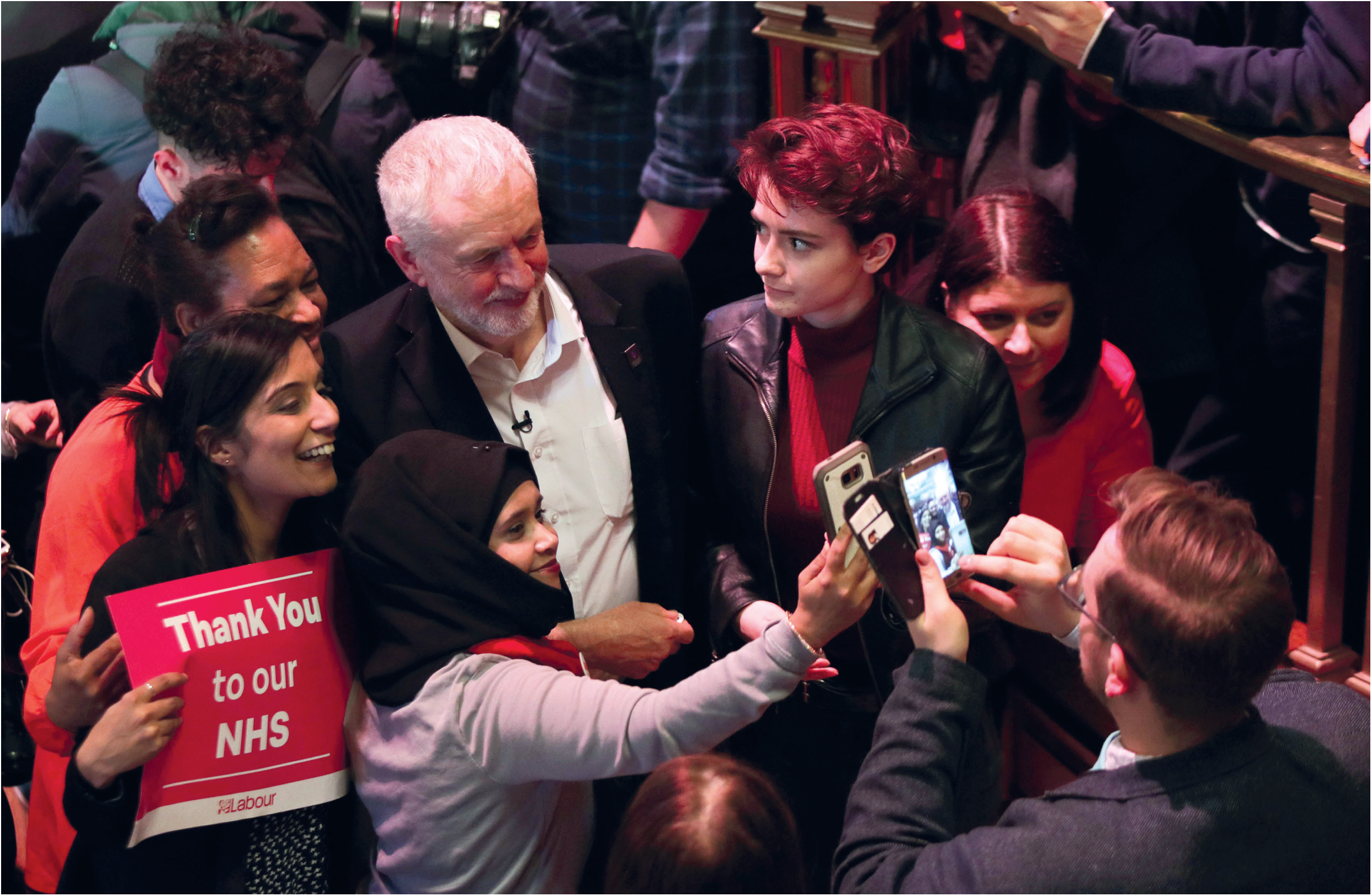
The shock 2017 General Election result was widely characterised as a ‘youthquake’, with a dramatic surge in support for Labour among younger voters.
The 2017 General Election result was described as a ‘youthquake’ – a shock result founded on an unexpected surge in youth turnout and the overwhelming support of younger voters for Jeremy Corbyn’s Labour party. Ipsos MORI data released after the election, ‘How Britain Voted in 2017’, revealed some dramatic changes amongst younger voters. Ipsos MORI and the Essex Continuous Monitoring Survey (Whiteley and Clarke 2017) both estimated an increase in youth turnout of around 20 percentage points. The gap in support for the two main parties amongst this cohort – 35 percentage points – was unprecedented in size.
The excitement generated by the election was such that the Oxford English Dictionary named ‘youthquake’ the 2017 ‘word of the year’. This decision created much controversy amongst political commentators who decried the hype around the choice of word (after all, the Labour party had not won the election!).
More interestingly, academics have – on the basis of new British Election Study data – described the youthquake as a ‘myth’ or a mere ‘tremor’ (Prosser et al. 2018). In this article we challenge this argument and emphasise the importance of youth engagement in the 2017 General Election for several reasons.
First of all, to dismiss the so-called youthquake as a myth is to take a very narrow view about what constitutes political engagement and political change. Even if we presume – as some have – that turnout amongst 18-24 year olds did not increase, several other changes have reshaped the political landscape, including, the unprecedented rate of youth support for the Labour party, high levels of youth activism in the campaign (Pickard 2018), and the distinctive cosmopolitan values of young Labour supporters.
These changes mark both a long-term generational effect, as well as a more short-term period effect, on the values and political habits of Young Millennials growing up in the aftermath of the financial crisis, and through their experiences of the 2016 EU referendum (Sloam and Henn 2018). When one looks into the intragenerational dimensions of the youth vote, the changes in 2017 were remarkable. As we show (left), the cosmopolitan-left attitudes and orientations of young people are particularly marked amongst young students and young women. These attitudes and orientations reflect broader societal changes that, as Norris and Inglehart (2016) have argued, increase the relevance of cultural cleavages within contemporary democratic politics.
A youthquake equates to much more than voter turnout, and should be seen as a multi-faceted phenomenon involving fundamental social, political and cultural shifts. It is worth noting that the OED itself defines a youthquake as ‘a significant cultural, political, or social change arising from the actions or influence of young people’.
Finally, the narrative effects of the youthquake should not be dismissed out of hand. The widespread acceptance that a youthquake has happened has had a tangible impact. Corbyn’s deliberate targeting of the youth vote, Labour’s unusually high dependency upon young activists, and the unexpectedly strong performance of Labour in the election, have already encouraged the Conservative Government to rethink its approach to younger voters, leading to a review of – amongst other things – policy on tuition fees.
In this article, we move beyond the debate about youth turnout in the 2017 General Election, to examine youth participation from a broader perspective. We investigate the dramatic changes in youth voter choice in 2017 and over time, the policy preferences of younger citizens (highlighting the differences with older voters), and the important role of online activism.
Turning left
One of the most prominent features of the 2017 General Election, was the importance of age in predicting which party an individual voted for. The Ipsos MORI data reveals some dramatic changes (Figure 1). A remarkable 62 per cent of 18-24 year olds voted for the Labour party, contrasting with 27 per cent for the Conservative party – an unprecedented youth gap of 35 percentage points. It is common to assume that the Labour party is always more popular amongst younger voters, but this is not the case. In 2015, 18-24 year olds only supported Labour over Conservative by a margin of 42 per cent to 28 per cent. In 2010, the two large parties were locked together (in this age group) with the Liberal Democrats on approximately 30 per cent.
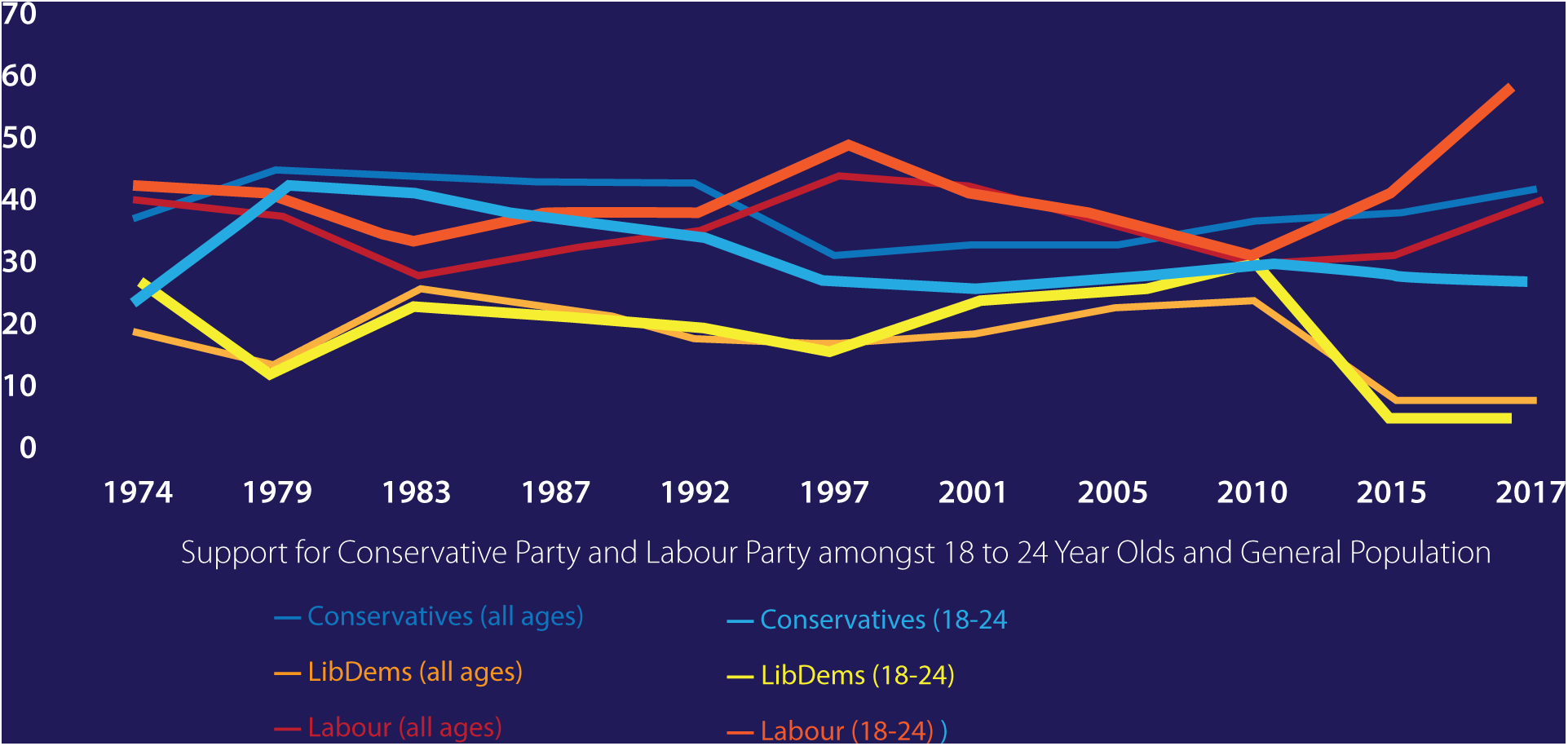
Party Support amongst 18-24 Year Olds and General Population
© Press Association
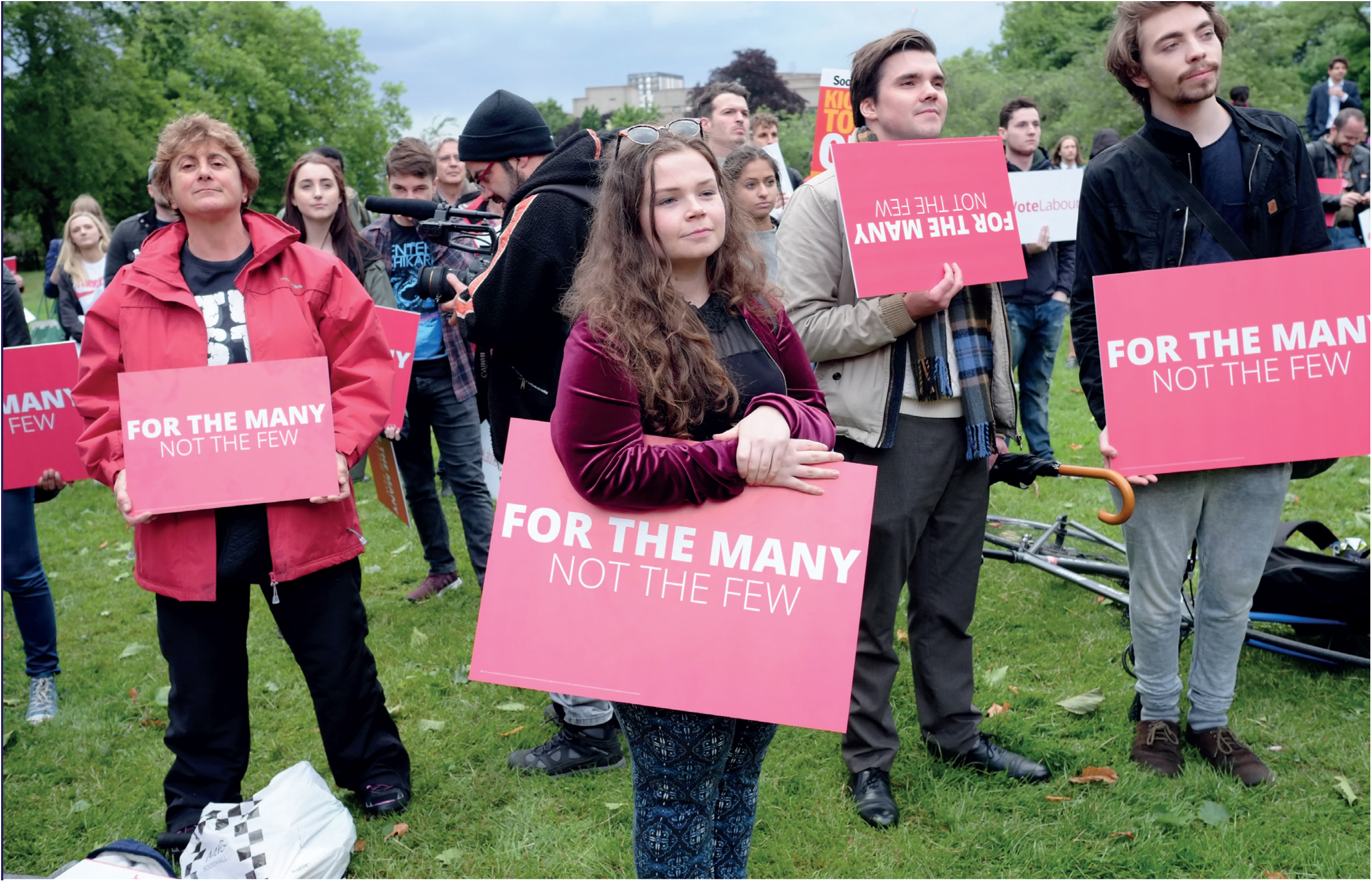
Another feature of the 2017 General Election, was the Labour party’s capture of third party support – particularly from the Liberal Democrats and the Greens. The Liberal Democrats failed to improve on their disastrous performance amongst younger voters in 2015 (collapsing from 30 per cent in 2010 to 4 per cent in 2015). Although the Liberal Democrats managed not to lose further support amongst 18-24 year olds in 2017, tactical voting and a further weakening of student support led to damaging defeats for Liberal Democrat incumbents in the university constituencies of Sheffield Hallam (Nick Clegg) and Leeds North West (Greg Mulholland). Labour also gained significantly from the Green party, whose share of the youth vote fell from 8 per cent in 2015 to just 2 per cent two years later.
Youth support for parties by class and gender
The Labour party’s emphatic lead amongst 18-24 year olds varied across different groups of young people (Figure 2). Labour gained greatest support from young women (73 per cent), and young people of a low social grade (70 per cent). Whilst we might expect, from previous elections, that social grade and student status have a large impact on party support, the scale of the Labour party’s appeal amongst young women was surprising. These results might be attributed to the effect of both Brexit and Corbyn (young women were very likely to vote Remain, and to sympathise with the Labour leader’s views on economic inequality and international relations). Interestingly, the large differences in party allegiance by gender and class were not present within the population as a whole (adults of all ages).
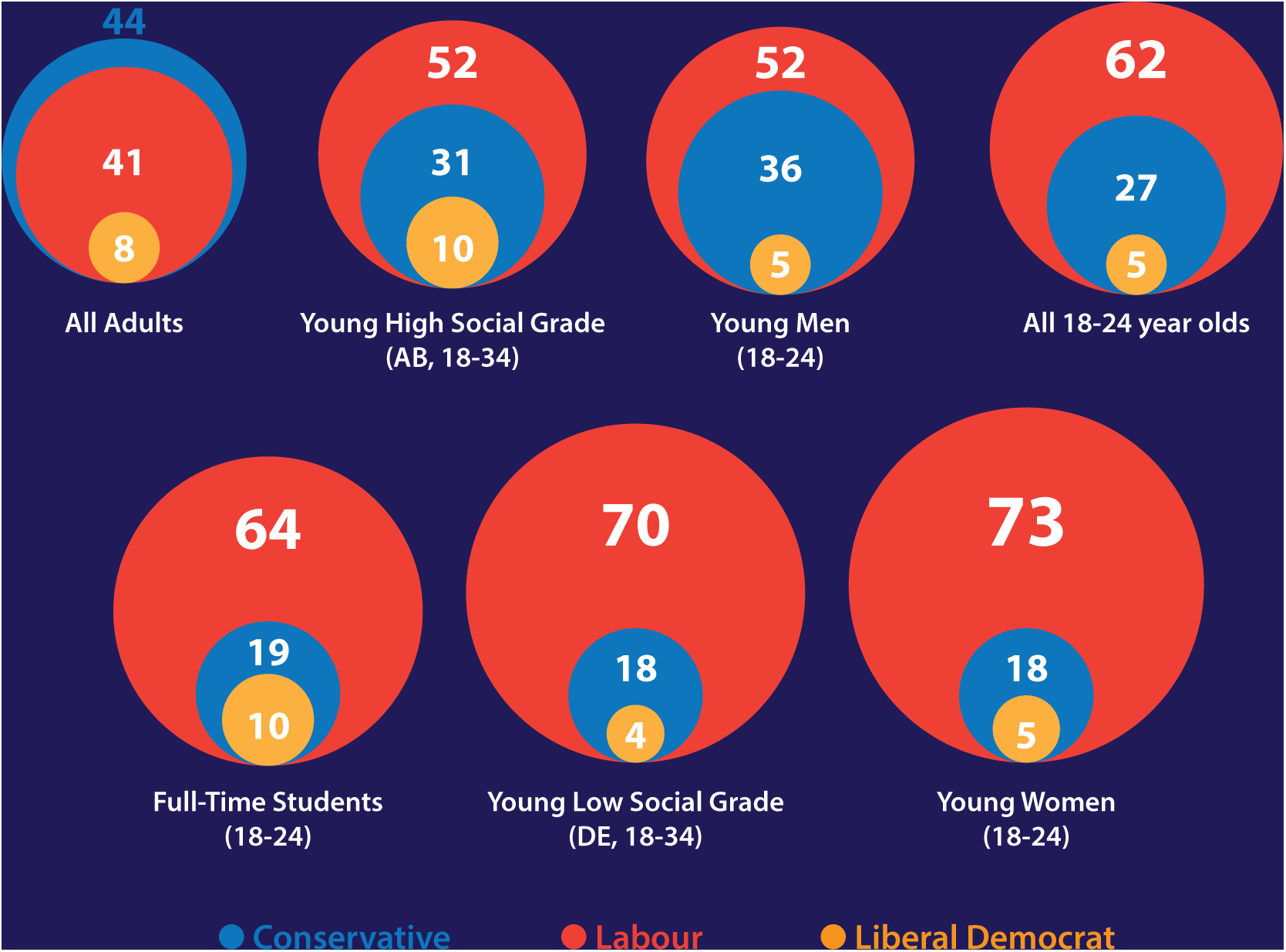
% Party support among Young People’
The influence of socio-economic status on voting intention has become more complex. In 2017, young people of a high social grade were more likely to support Labour than the Conservatives (by 52 per cent to 31 per cent), but to a smaller degree than the average 18-24 year old. However, full-time students were considerably more likely to vote Labour (by 62 per cent to 22 per cent).
Young Millennials – the new cosmopolitan-left
Figure 3 shows the policy preferences of young people (18-24 year olds) compared to the average UK citizen, and the over 65s. For the youngest cohort of voters, healthcare was considered to be the most important issue (27 per cent). This would naturally place Labour at an advantage over the Conservatives, with the former traditionally holding ownership of issues surrounding the NHS. The Labour manifesto promised extra funding for the health service. The second most important issue for young people was Brexit (15 percent of younger citizens prioritised this policy area) – another issue where younger voters were more closely aligned to the official Labour position than the official Conservative position – and education (10 per cent). The next priorities for 18-24 year olds was that of austerity, poverty and economic inequalities (13 per cent). In our Populus poll of 1,351 18-30 year olds, we also found that, ‘housing’ emerged as a key theme for young people. Whilst many of these issues may be long-term problems that have persisted for several decades, the polls suggest that young people associated austerity, economic inequalities and the increasingly unaffordable costs of housing, with seven years of Conservative-led government. Conversely, the Labour Manifesto included concrete pledges on greater investment in social housing, and the abolition of university tuition fees.
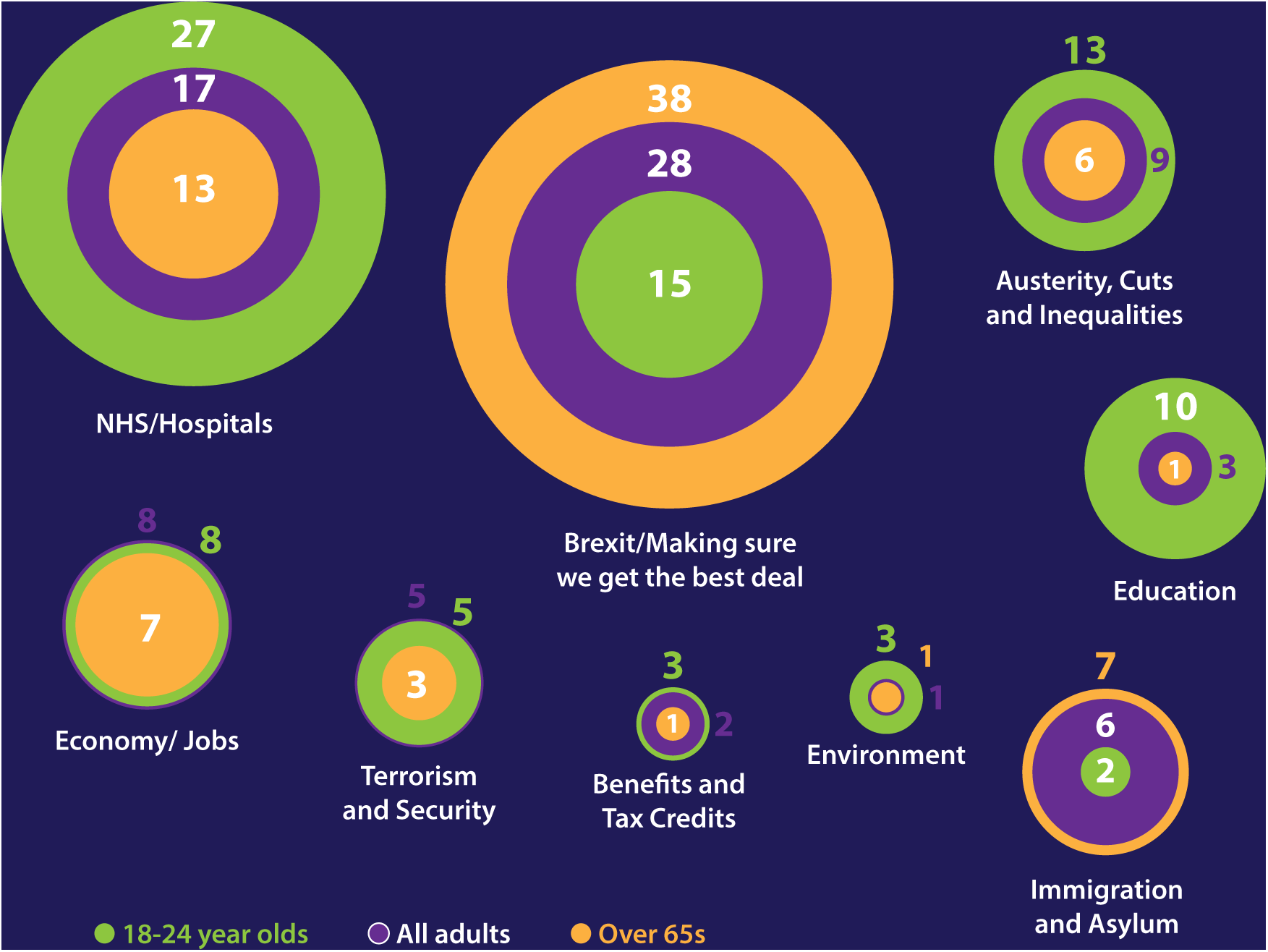
% Most Important Issue during 2017 Election Campaign
The perception of the ‘most important political issue’ clearly varies across generations. The differences between young and old were largest in the areas of Brexit (minus 23 percentage points), the NHS (plus 14 points), education (plus 9 points), austerity, cuts and inequalities (plus 7 points), and immigration and asylum (minus 5 points).
The cosmopolitan-left attitudes and sentiments of Young Millennials diverged remarkably from those of the over 65s. This relates not just to their policy priorities, but also to the positions adopted on the issues. This is particularly the case with regard to the political-cultural issues of Brexit and immigration. Our previous study of young people in the run-up to the 2016 EU referendum, found these two issues were underpinned by diametrically opposed attitudes towards cultural diversity amongst young and older citizens.
Online mobilisation
There is growing evidence to suggest that social media is increasingly trusted and consumed by young people, when it comes to accessing political information. We investigated the official accounts of the Labour party, Conservative party, Jeremy Corbyn and Prime Minister Theresa May across three platforms: Facebook, Twitter and Instagram.
The Labour party was more effective at communicating its messages amongst younger voters (Fletcher 2017). Boosted by his celebrity endorsements and the emergence of left-leaning, online news platforms (such as The Canary), Jeremy Corbyn achieved about three times as many Facebook likes (1.4 million) and Twitter followers (1.42 million) as Theresa May. And unlike May, Corbyn was more popular than his own party in these social media (by 400,000 Facebook likes and almost a million Twitter followers). The Labour social media communications strategy – pioneered during Corbyn’s party leadership bid by the grass-roots campaigning group, Momentum – provided an effective means of reaching out to younger voters through attractive, interactive content.
Profound changes
We believe that efforts to downplay the importance of youth participation in the 2017 General Election are too heavily focused on youth turnout. And, even on the subject of turnout, it is still possible that there were significant increases in youth turnout as a whole, in certain geographic locations, and amongst various sub-groups of young people (eg students).
It is also important to think carefully about the what constitutes a young person. Andy Furlong (2016) and many others in the field of youth studies have shown that young people’s transitions from youth to adulthood have become delayed and staggered in modern societies. Although we have focused in this article on 18-24 year olds, it may actually be more helpful to think of younger rather than young citizens.
It is generally accepted that in 2017, age replaced class as the key predictor of party choice. We propose two possible explanations for the large differences in voting for parties across age cohorts. First, the redistribution of resources away from younger citizens and youth-oriented public policy over the past ten years, has attracted more young people to the ideas of state intervention and increased public spending. Second, cultural differences across generations have deepened. Young people are more approving of cultural diversity, welcoming of European integration, and less concerned about immigration than older cohorts. Thus, younger voters were attracted by Corbyn’s opposition to austerity, his internationalist outlook and his acceptance of immigration and cultural diversity (in contrast to the nationalist-authoritarian populism of Nigel Farage and Donald Trump).
In the 2017 General Election and the 2016 EU referendum, support for the Labour party and Remain was particularly strong amongst citizens who were young, highly educated, female and supportive of cultural diversity in Britain. Younger voters were politically energised by Brexit and Jeremy Corbyn’s Labour party. In an echo of the 1960s, they expressed themselves as left-of-centre cosmopolitans, reacting both to austerity politics and the cultural conservatism found in older generations, and embodied by the Leave campaign in the EU referendum. If voting and voter choice is habit-forming, the mobilisation of younger voters by the Labour party in 2017, means that all political parties, particularly the Conservative party, need to try harder to develop a package of policies that can appeal to young people if they want to avoid the further ageing of their support base.
The Labour party also managed to engage many youth activists through its policy platform and the direct efforts of the party leader, Jeremy Corbyn, to interact with younger citizens. Labour certainly enjoyed a comfortable advantage over the Conservative party in the social media space where political information is relatively trusted and highly-consumed by Britain’s young people. This led to Conservatives, such as Robert Halfon, a former Minister for Education, to argue for a Tory-affiliated version of Momentum, to counter Labour’s domination in the digital space.
The 2017 General Election marked some profound changes in youth political participation. To suggest the youthquake was a myth, takes a reductionist approach to youth political participation. It also fuels a much more dangerous myth; that young people are apathetic and not interested in politics. This counter-narrative has the potential to undermine young people’s sense of political efficacy and undermine political support for youth-oriented public policy.
Footnotes
James Sloam is a Reader in Politics at Royal Holloway University. Rakib Ehsan is a Doctoral Researcher at Royal Holloway, University of London. Matt Henn is Chair of Social Research at Nottingham Trent University.