



Abstract


2019 might have been the ‘Brexit election’ but in Scotland independence remains the key political divide, as
From the moment that the exit poll predicted thumping wins for the SNP in Scotland and the Conservatives across the UK, the conversation immediately turned to what this meant for Scotland’s constitutional future. Not that the conversation had ever drifted far from that. Since 2014, the first question asked about any development in Scottish politics is what it means for independence.
Yet there is little point in interpreting the results of elections in Scotland in terms of support for independence. For one thing, there is too much else going on in any given campaign – the prominence of Brexit in 2019 being a good example.
We cannot read elections as if they were just a very expensive opinion poll about independence. In any event, we already have such polls. They are remarkably stable, with a discernible but very slow increase in support for independence. The fluctuations in the SNP vote meanwhile – 50 per cent in 2015, 37 per cent in 2017 and 45 per cent in 2019 – are plainly too large to be accounted for by such a smooth trend.
Reaction to the 2019 outcome focused instead on a second-order question: had the SNP won – or, as its supporters would prefer, retained – a mandate to hold another independence referendum? The quality of debate was not high. Much of it proceeded as if ‘mandates’ were a formal and verifiable feature of the British constitution, as opposed to a matter of subjective political claims. Valuable Christmas shopping time was wasted on semantic arguments about whether the SNP could be said to have won the election. And there was an ironic role-reversal, with the Conservative friends of first-past-the-post highlighting the SNP’s short-of-50-per-cent vote share while the PR-supporting Nationalists pointed to their landslide in seats. In the end, the SNP’s mandate for ‘indyref2’ had much in common with the Conservatives’ mandate to ‘get Brexit done’ – it would be contrary to assert one and deny the other. Both parties won a clear majority of the seats they contested with that pledge prominent in their manifesto, but neither could claim support from a majority of voters.
Arguments like these hinge on assumptions about what drives voters’ decisions. This is left ambiguous by election results but can be explored via surveys like our ESRC-funded Scottish Election Study (SES). A demographically representative sample of around 2,700 Scottish adults was surveyed online by YouGov both before and after polling day. With a larger sample and much more extensive questionnaire than standard opinion polls, the SES is well placed to identify the issues and attitudes that swung votes in 2019 and to give a more rounded picture of public opinion on the big constitutional questions. Here, we focus on two broad questions: what was the relative influence of Scottish independence and Brexit over vote choices? And where does this leave the mandate debate?
‘The Brexit election’ or ‘Another Indyref election’?
One way of answering this question is to ask respondents directly. Those who reported voting were asked the following: ‘There was debate about which mattered more for voters in the general election: the question of Scottish independence or the issue of Brexit. Regardless of which side you’re on when it comes to those two issues, which mattered more to you when deciding how to vote in 2019?’ The overall results point to a Brexit election. 42 per cent chose that option compared to just 22 per cent for Scottish independence. A further 24 per cent said ‘both equally’ while only 10 per cent said ‘neither’.
However, it wasn’t the Brexit election for everyone. Figure 1 shows answers to this question among those who voted for the three largest parties. While the EU issue was overwhelmingly the priority in Tory minds, those voting SNP were more likely to report that independence mattered more. This warns against the tendency to infer voters’ reasoning from parties’ campaigning. Judging by their slogans at the manifesto launches (and much other campaigning literature), the Scottish Conservatives’ core message was ‘no2indyref2’ while the SNP’s was ‘Stop Brexit’. But these were not the top priorities of their voters. Even those who stuck with Labour were largely resistant to their party’s call to refocus attention on bread-and-butter rather than constitutional issues.
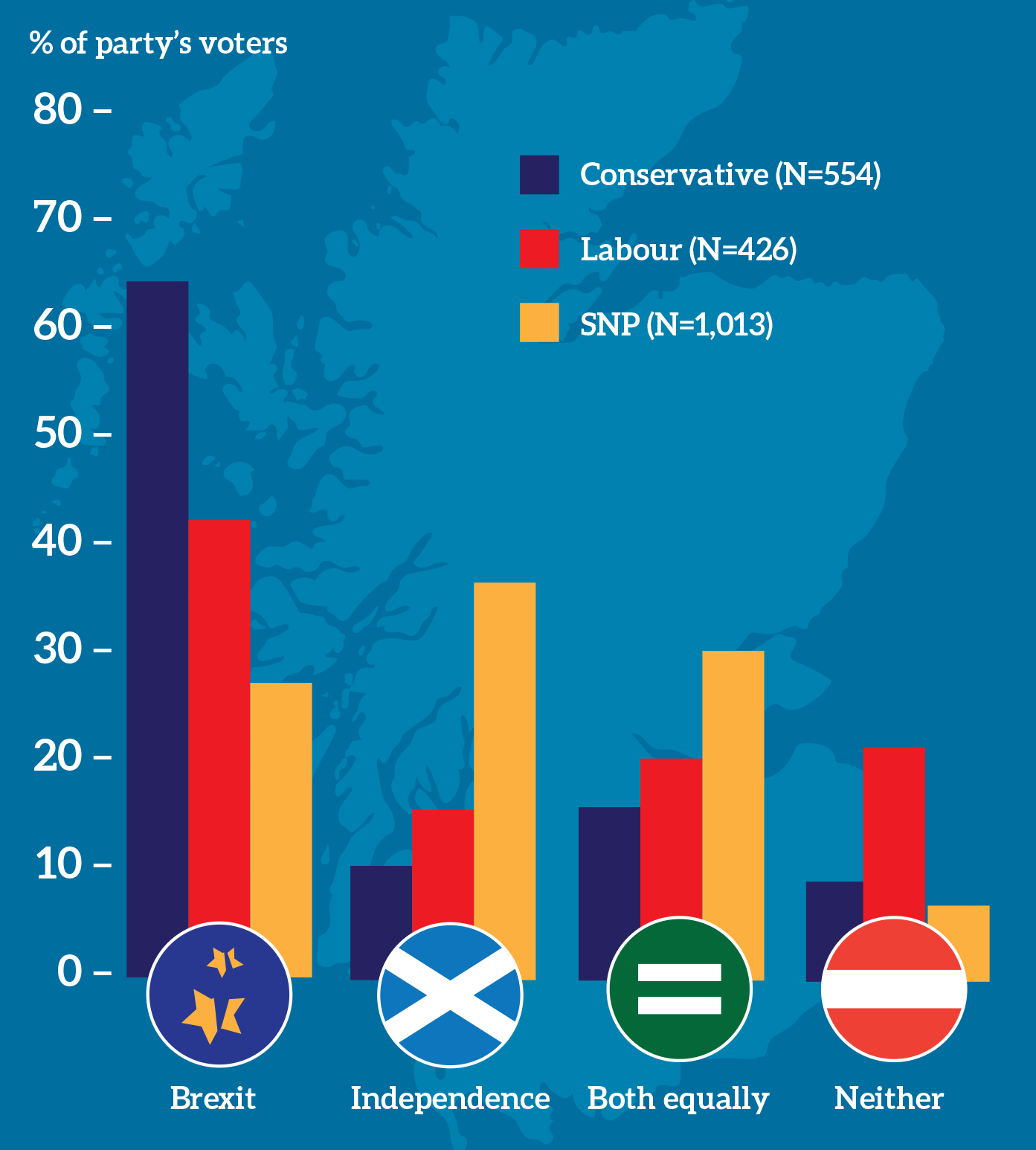
Reported importance of constitutional issues in voting decision by party
Another approach is to observe how closely party choice aligns with preferences on the two big issues. If knowing people’s stance on independence is a big help in predicting how they vote, then this provides good reason for supposing that that issue was more influential than Figure 1 might suggest. As it turns out, it is a very big help. Table 1 shows that 88 per cent of those who voted in 2019 chose a party that shared their stance on independence. The large majority of Yes supporters chose the SNP, and the overwhelming majority of No supporters rejected the SNP. By this measure, independence was actually slightly more important than Brexit. The difference is small, with 85 per cent consistency between people’s EU preference and their party choice in 2019. (This is based on classifying Labour as a pro-Remain party in 2019, which is how most voters saw it.) Such high levels of consistency on both issues are possible because many voters are not forced to choose. For example, most enthusiasts for independence also favour EU membership for Scotland, and so can vote for the SNP (or Green) without having to compromise on Brexit. The group most torn comprises those who want to leave both unions and the table makes clear that they typically went with a Scottish rather than a UK independence option: the SNP won far more Leavers than the Conservatives won Yes supporters.
Alignment of voting with constitutional preferences, 2019 and 2017

One response to this might be that, while independence explains stability in voting behaviour between 2017 and 2019, Brexit explains the change. SES data suggests that around one quarter of those who voted in both elections switched party between the two, and the bottom rows of data in Table 1 makes a prima facie case that this was driven by Brexit. In 2017, only 69 per cent of voters chose a party that shared their Brexit position. If this rose to 85 per cent two years later, an obvious explanation is that many switched to a party that agreed with them on Brexit. However, there is an alternative explanation. It may be that voters stuck with the same party and adopted its stance on Brexit in place of what had been their own.
Figure 2 is based on that 31 per cent of voters who in 2017 were thus ‘inconsistent’ on Brexit: that is, they voted for a party that didn’t share their position on the EU issue. There are three things that they might have done in 2019: maintain that inconsistency, switch party, or change their mind on Brexit. As the chart shows, the most popular option was to resolve the inconsistency by moving across the Brexit divide. For every 2017 Remainer who switched from the Conservatives to a Remain party in 2019, another two simply adopted the Tories’ Leave stance. And for every 2017 Leaver who switched from the SNP or Labour to the Conservatives, another two shifted instead to Remain. The reason why voters brought their Brexit view in line with that of their chosen party is not hard to find. It is because that party was typically chosen on the basis of independence, and independence remains the key divide in Scottish electoral politics.

Reactions in 2019 among voters whose Brexit position and party choice were inconsistent in 2017
The Mandate Question
If this was another independence election, then did it deliver a mandate for indyref2? The answer cannot be resolved by a dispute about the SNP’s majority of seats but minority of votes, however SES data can shed some light on the issue. The first thing to say is that, excluding don’t knows, a narrow majority – 54 per cent – of Scots support the right of the Scottish government to call that referendum when it wants to (rather than needing the UK government to give its agreement). Not surprisingly, these views are very strongly tied to overall constitutional preferences: that majority is 96 per cent among supporters and just 13 per cent among opponents of independence. That 13 per cent was enough to deliver the overall majority on the question, however, and it is an obvious target group for an SNP looking for long-term converts to independence.
Did this ‘right to decide’ argument win over any voters in 2019? One way to check this is to look at rates of switching to the SNP from the various parties, and whether they vary by answers to that question. Table 2 shows that they do. It looks first at long-term switching. Those who voted for a unionist party in 2017 but who believed by 2019 that the right to call indyref2 lay with the Scottish government were strikingly likely to switch to the SNP. There was almost no such switching among those ascribing that right to the UK government. Of course, some of those – especially the Labour voters – were already sympathetic to independence in 2017 or may have switched to Yes between the two elections, in which case they might well have gone to the SNP anyway. For that reason, it is instructive to look at the short-term switching. Strikingly, even in the few weeks between our pre-election survey and polling day, the SNP was able to pick up around one in six of those intending to vote Labour or Liberal Democrat but who agreed with the Nationalists on this question. This looks more like a winning campaign message.
Switching to SNP by beliefs about who has the right to call indyref2

That still leaves five in six of those voters sticking with Labour or the Lib Dems, of course. The reason is a familiar one: people still vote primarily along Yes or No lines, even if they take a less hardline stance on these constitutional process issues. Meanwhile, the vast majority of Conservative voters declare that the right lies with Westminster – a view unlikely to be have been changed by the outcome of the election – and so were unmoved anyway. Whatever the wider political sustainability of Boris Johnson’s resistance to a referendum, it looks unlikely to cost him any votes in Scotland.
2019 and Beyond
There is a lot going on in any election. Pithy summaries are always misleading given the many issues at play and the differing priorities of voters. For some, this was ‘the Brexit election’. Given the prominence of that issue both in the election campaign and in politics more generally since the referendum in 2016, it is not surprising that many declared it their top priority in 2019. Yet this could equally be called ‘another indyref election’: independence was no less prominent in the campaign and no less – indeed, more – influential over voting decisions. It might be said that Brexit was the weather while independence is the climate in Scottish politics. And, just as the weather is a poor guide to climate change, the short-term effects of Brexit in 2019 should not be mistaken for long-term change in Scottish attitudes towards independence. Such change has been glacial and, while the overruling of Scotland – whether over Brexit or the right to hold a second independence referendum – looks like the kind of argument that boosts support for Yes, it is put to a deeply divided electorate in which neither side has much appetite for hearing the other.
One sign of that polarisation is the speed with which the Brexit issue was ‘brought into line’ with independence preferences. The SNP is the party of Yes-Remain and the Conservatives are the party of No-Leave. Those two combinations accounted for just 48 per cent of the Scottish electorate at the time of the EU referendum but, by 2019, more than 70 per cent were in those camps. Just as the No-Remain tribe was squeezed, so was the Labour Party which had polled well among it in 2017. It didn’t help Labour that its positions on both Brexit and Scottish independence seemed more nuanced and less certain than either the SNP or the Tories. In heated and polarised debates, compromise may be the grown-up position but it is not an electoral winner. The strength and alignment of preferences on the big two constitutional issues look set to move Scotland further towards an angry two-party battle.
Footnotes
Rob Johns, Ailsa Henderson and Christopher Carman are Professors of Politics at the universities of Essex, Edinburgh and Glasgow, respectively. Jac Larner is a Researcher at the University of Edinburgh.