




Abstract

© Jeff Gilbert / Alamy Stock Photo
The annual round of English local elections at the beginning of May each year is always the subject of considerable interest. Polls may act as a barometer of public opinion, but real votes in real ballot boxes provide a vivid political picture that no set of dry polling statistics can match. This year’s contests were greeted with particular anticipation because they took place when the polls said for the first time since the 2019 election that the Conservatives were behind Labour in popularity – following controversy about the Prime Minister’s ethics and probity arising from the Owen Paterson affair and ‘partygate’. Perhaps the results would persuade Conservative MPs that it was time to seek a new leader?
No dramatic headlines
In truth, this year’s local elections were never likely to produce dramatic headlines of Conservative losses. The elections took place disproportionately in places where the Conservatives are relatively weak. In England, all of the seats on London’s borough councils were up for grabs, but London nowadays is dominated by Labour, which already had control of 25 of the 32 councils. Outside London, elections were primarily held in more urban – and thus more Labour – parts of England. This included all but three of the 36 metropolitan districts in and around England’s largest provincial cities, only three of which were in Conservative hands. And although elsewhere there were elections in 38 Conservative controlled councils, in most of England outside London only one-third (or occasionally one-half) of the council seats being contested were up for grabs, thereby arithmetically limiting the chances that control might change hands. All in all, in England, Labour were defending over 2,200 seats, while the Conservatives were only trying to retain 1,400.
Elections were also held for all of the seats on Wales’ 22 unitary councils, and for all the councillors on Scotland’s 32 councils. Neither country is, of course, an area of Conservative strength. In Wales, the party was defending just one council control and fewer than 200 seats, whereas Labour had seven councils and over 450 seats. In Scotland, use of the single transferable vote system of proportional representation both meant that no party was currently in control of any council and that any ups and downs in party popularity would have a more limited impact on the outcome in seats. The SNP went into the election with just over 430 seats, whereas the Conservatives had a little under 280.
The Conservatives were also fortunate that in England most of the 4,350 seats being contested were last fought over in a year, 2018, when the party had not been particularly popular. At the time the party was on average just two points ahead of Labour in the polls, while a projection for the BBC of what the pattern of local voting would mean if it had been replicated across the country as a whole, put the two parties neck and neck on 35 per cent each – an outcome that was Labour’s best local election performance during Jeremy Corbyn’s tenure as leader. Thus, although the Conservatives were now running on average six points behind Labour in the polls, there could still be only a three-point swing from Conservative to Labour in the local ballot boxes even if ‘partygate’ had indeed cost the party significant support.
That said, in both Scotland and Wales the previous round of local elections took place a year earlier, in 2017. In the wake of polls that put her party up to 20 points ahead, Theresa May had already decided to call a general election scheduled for the following month. In Scotland, the party had secured 25 per cent of the first preference vote, its best performance in local elections north of the border since 1982. In Wales too, the party recorded an advance – its 19 per cent of the vote was its best performance since the first election for the current system of unitary councils in 1995. In short, in both of these countries the Conservatives were defending a high-water mark and, consequently, the current electoral climate did point to potentially significant losses.
English swings
Table 1 above summarises the overall outcome in terms of net gains of councils and seats. Despite being held predominantly in non-Tory territory, in the event the Conservatives did suffer quite substantial losses. Although they only lost control of 11 councils across Britain as a whole, the party’s net loss of seats totalled 485, representing as many as one in four of all the seats that the party was trying to defend. Yet in England outside London at least, it was the Liberal Democrats, not Labour, who were the principal beneficiaries of the Conservatives’ misfortune. The Greens, meanwhile, also recorded net gains in all three countries, while the SNP strengthened their position somewhat north of the border. In London, the Conservatives suffered a net loss of two councils and 98 seats, both Labour and the Liberal Democrats made a net gain of 30 seats (but no net change in councils controlled), and the Greens seven seats. One council was gained by the Aspire Party.
Net Gains and Losses of Councils and Seats, 2022 Local Elections
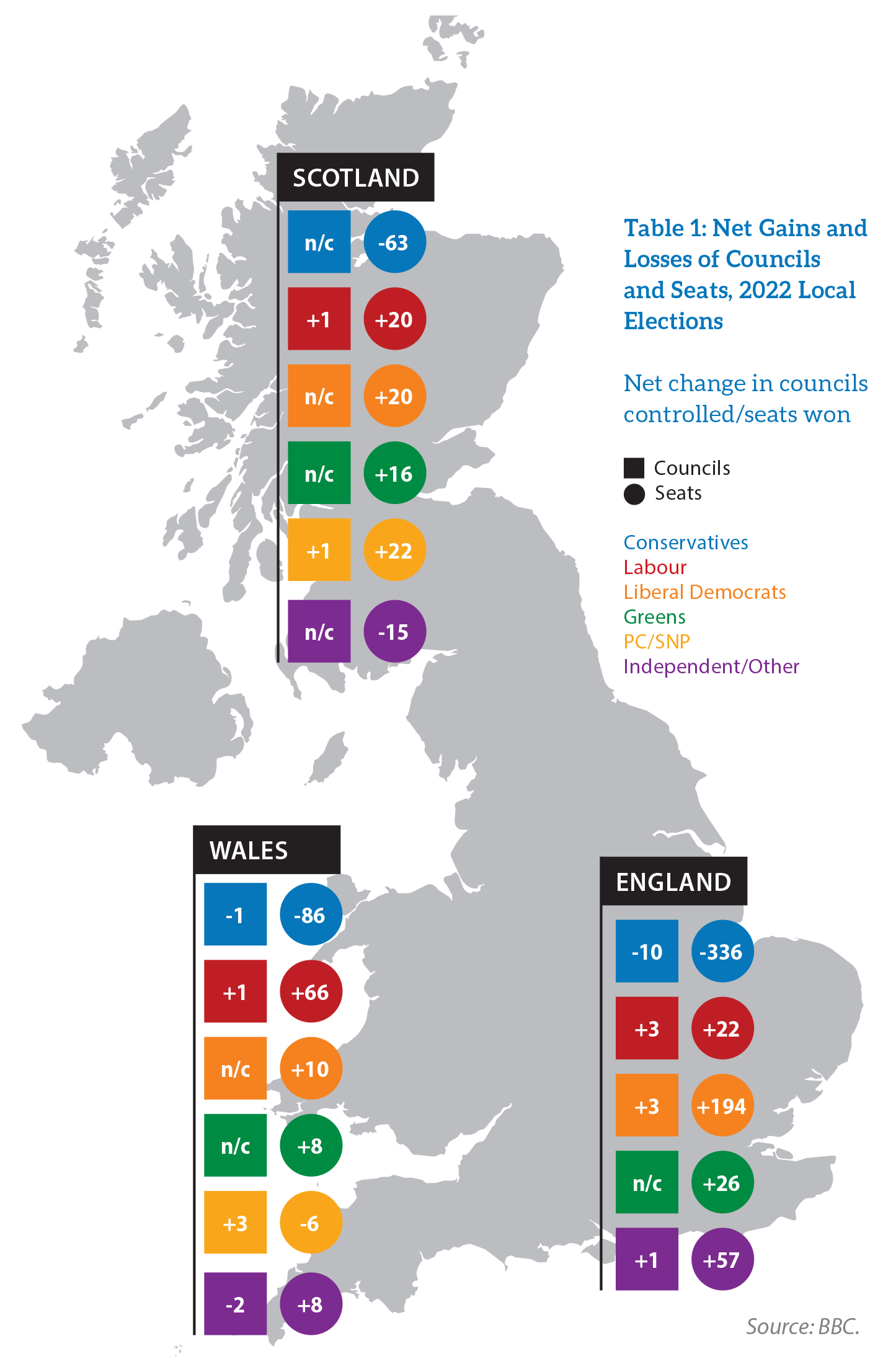
Change in council control is as compared with the position immediately prior to the election. Change in seats is as compared with the last regular election (in most cases 2018). In the case of local authorities where there were ward boundary changes, the comparison is with an estimate of what the outcome in seats would have been if the new boundaries had previously been in place.
However, the outcome of local elections in terms of council control and seats won can present an obscure picture. The figures are affected by the use of different electoral systems, differences between whole council and partial elections, differences in the sizes of wards, differences in the base year and so on. Moreover, comparison with the position four or five years ago tells us little about how the fortunes of the parties have changed since Boris Johnson won the 2019 General Election. For that we are better taking advantage of the fact that in England outside London the results of the 2022 elections can be compared with what happened in local elections that were held in the same places last year.
Consequently, our analysis in this article focuses on votes, not seats, and looks primarily at what happened in England. Our main source comprises the detailed voting figures that were collected by the BBC in just over 900 wards located in 49 different local authorities, most of which were wards contested by each of the Conservatives, Labour and the Liberal Democrats. Of course, as they represent only a sample of all the elections, we have to bear in mind that the figures are potentially subject to sampling error
As previously noted, the BBC’s national projection of the outcome of the local elections in England in 2018 was Conservative 35 per cent, Labour 35 per cent, while the Liberal Democrats (who always perform more strongly in English local elections than their current standing in the polls) were estimated to be on 16 per cent. The same exercise this time put Labour once again on 35 per cent, but the Conservatives down on 30 per cent, while the Liberal Democrats were on 19 per cent. The estimated five-point lead for Labour was similar to the six-point gap in the current polls, yet, as the outcome in seats implied, it was the Liberal Democrats whose support was higher than four years ago while Labour themselves were apparently doing no more than treading water.
Yet this was a very different result for Labour from the one 12 months previously. Then Labour were estimated to be standing at 29 per cent, six points below what they achieved this time around, while the Conservatives had been six points stronger on 36%. The outcome confirmed the message of the polls that the Conservatives have lost a lot of ground in the last twelve months and now appear to be in electorally choppy water for the first time since the 2019 General Election. Meanwhile, the Liberal Democrats’ 19 per cent tally was a couple of points up on where the party stood in last year’s local elections. Indeed, it represented one of the party’s best performances since the party entered into coalition with the Conservatives in 2010. The only comparable performance was in 2019, when the party’s anti-Brexit stance enabled it to profit from Theresa May’s failing attempt to secure support for her Brexit deal.
Cause for Conservative concern
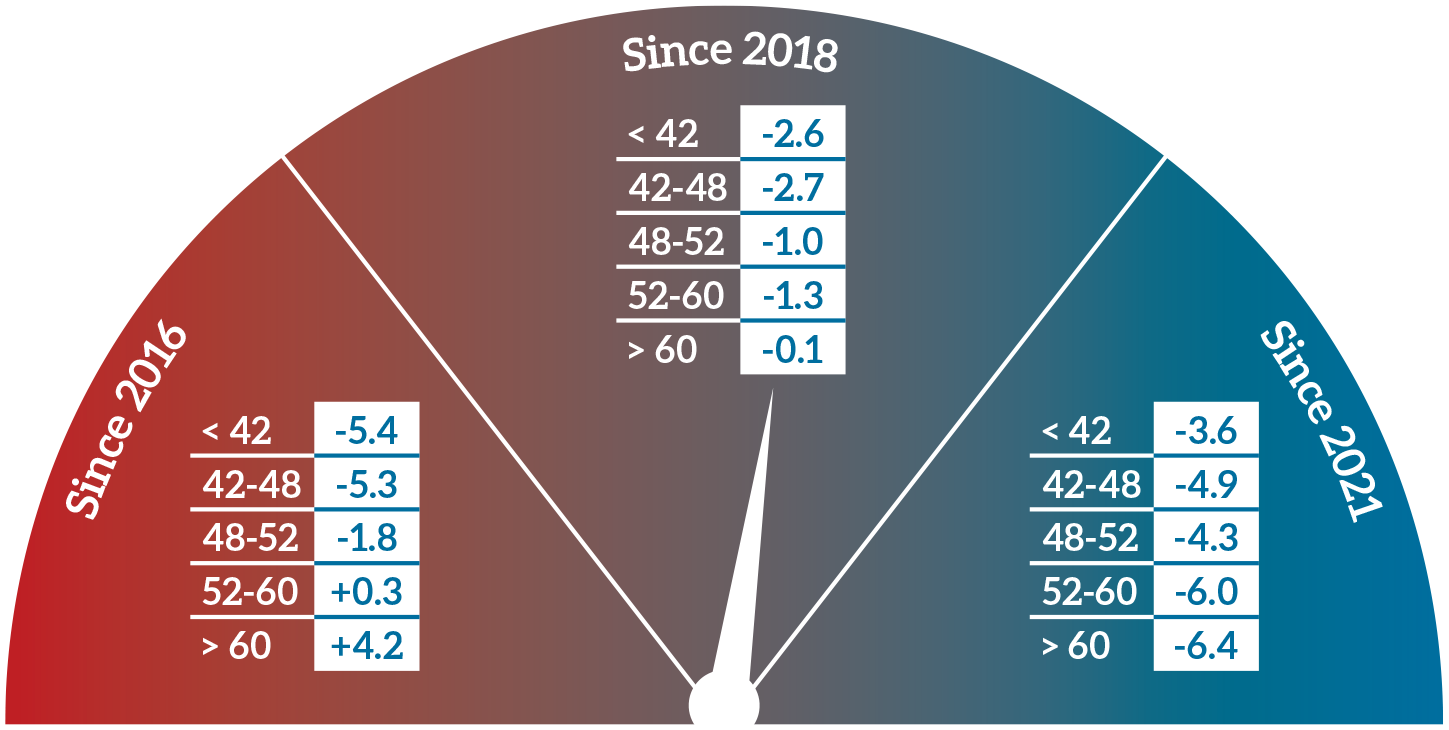
But behind these headline figures there were also two other patterns that might give the Conservatives cause for concern. The crucial foundation of the Conservatives’ victory in the 2019 General Election was their success in securing the support of most of those who had voted Leave in the 2016 referendum, whereas, in contrast, Remain voters divided their support between Labour and the Liberal Democrats (and in Scotland, the SNP) (Ford et al., 2021). As a result, the Conservatives advanced most strongly in parliamentary constituencies where most voters had backed Leave, in many cases building on progress that the party had already made in such seats in 2017 (Curtice et al., 2021). However, the polls have suggested that the recent decline in the party’s popularity has been particularly marked among Leave voters. Table 2 above appears to confirm that message.
Average Swing from Labour to Conservative since 2016, 2018 and 2021 by EU Referendum Vote
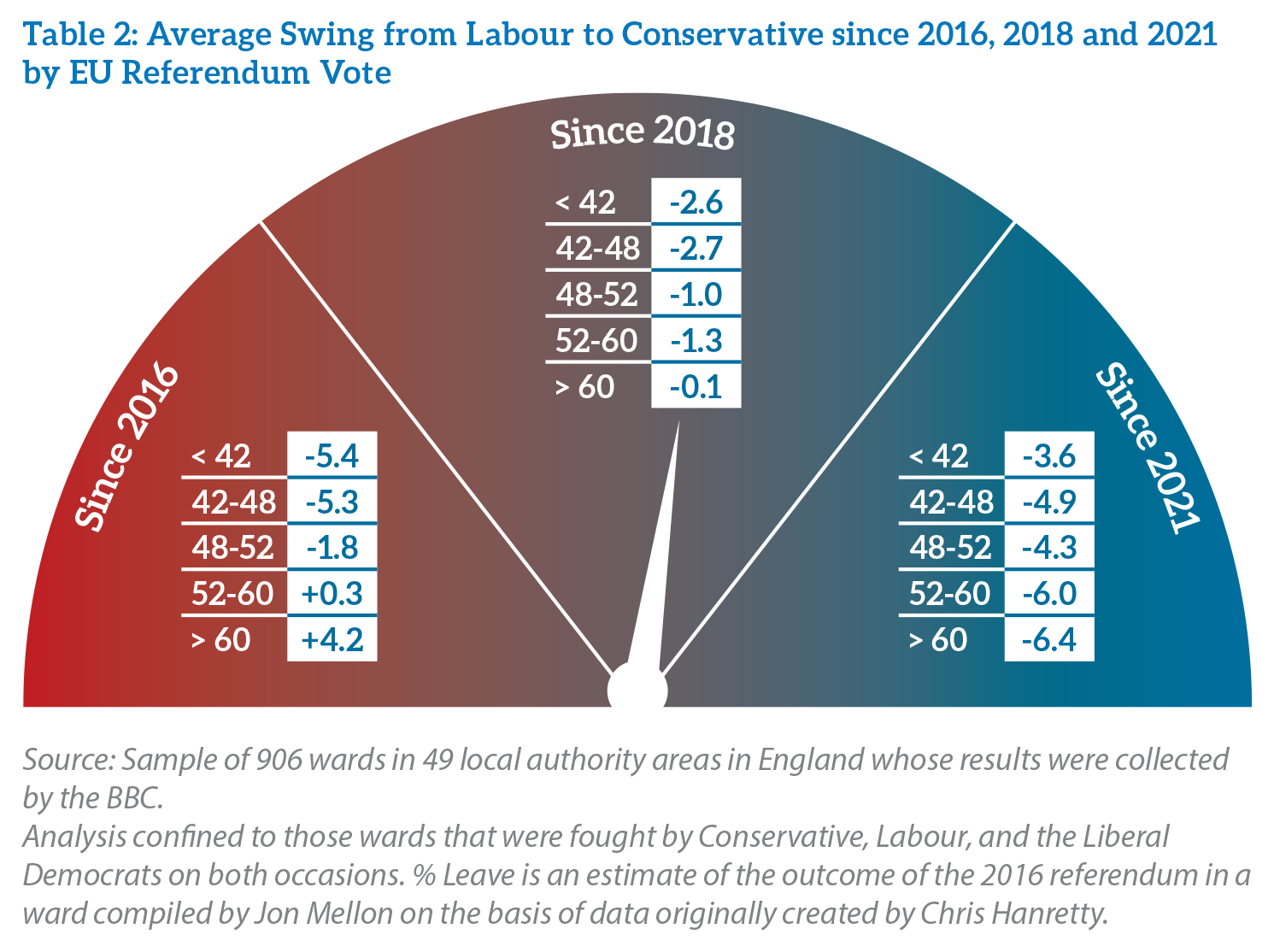
Source: Sample of 906 wards in 49 local authority areas in England whose results were collected by the BBC.
Analysis confined to those wards that were fought by Conservative, Labour, and the Liberal Democrats on both occasions. % Leave is an estimate of the outcome of the 2016 referendum in a ward compiled by Jon Mellon on the basis of data originally created by Chris Hanretty.
The table shows the average swing – that is, the net change in the balance of support for the Conservatives and Labour – since the local elections of 2016 (which took place shortly before the EU referendum), 2018 and 2021, broken down by the level of support for Leave locally in the EU referendum. The legacy of Brexit is very much apparent. As compared with 2016, there was still a swing to the Conservatives in the most pro-Leave wards, while Labour is now relatively stronger in the most pro-Remain places. Even if we compare the results with four years ago (when much of the movement to the Conservatives in pro-Leave areas had already taken place), the net swing to Labour is still somewhat greater in pro-Leave wards than in more pro-Remain places. However, as compared with last year the swing from Conservative to Labour is higher in wards that voted strongly for Leave. Although the legacy of Brexit in terms of the electoral geography of party support is still with us, it looks as though the Conservatives have lost some of their grip on the support of pro-Brexit Britain.
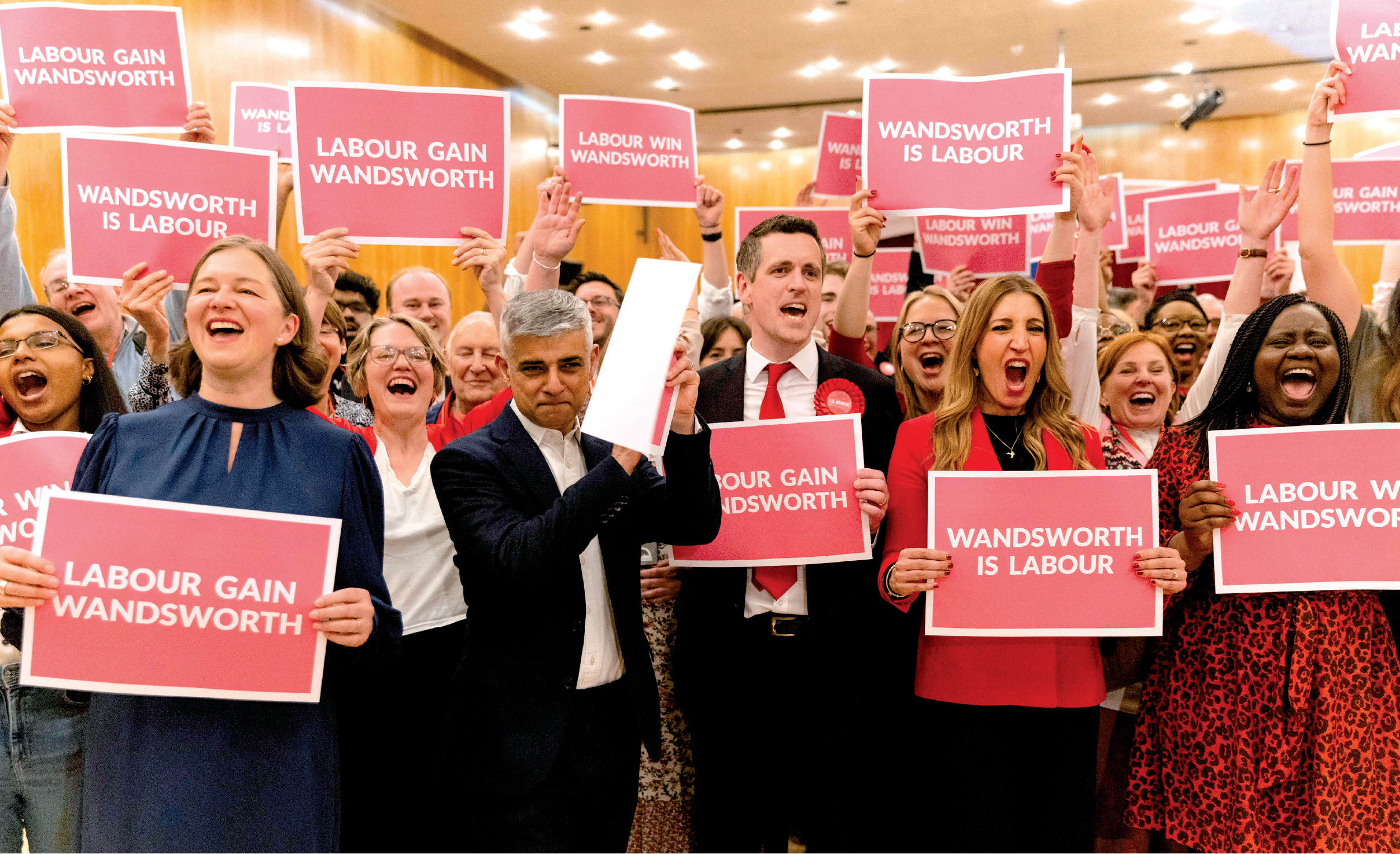
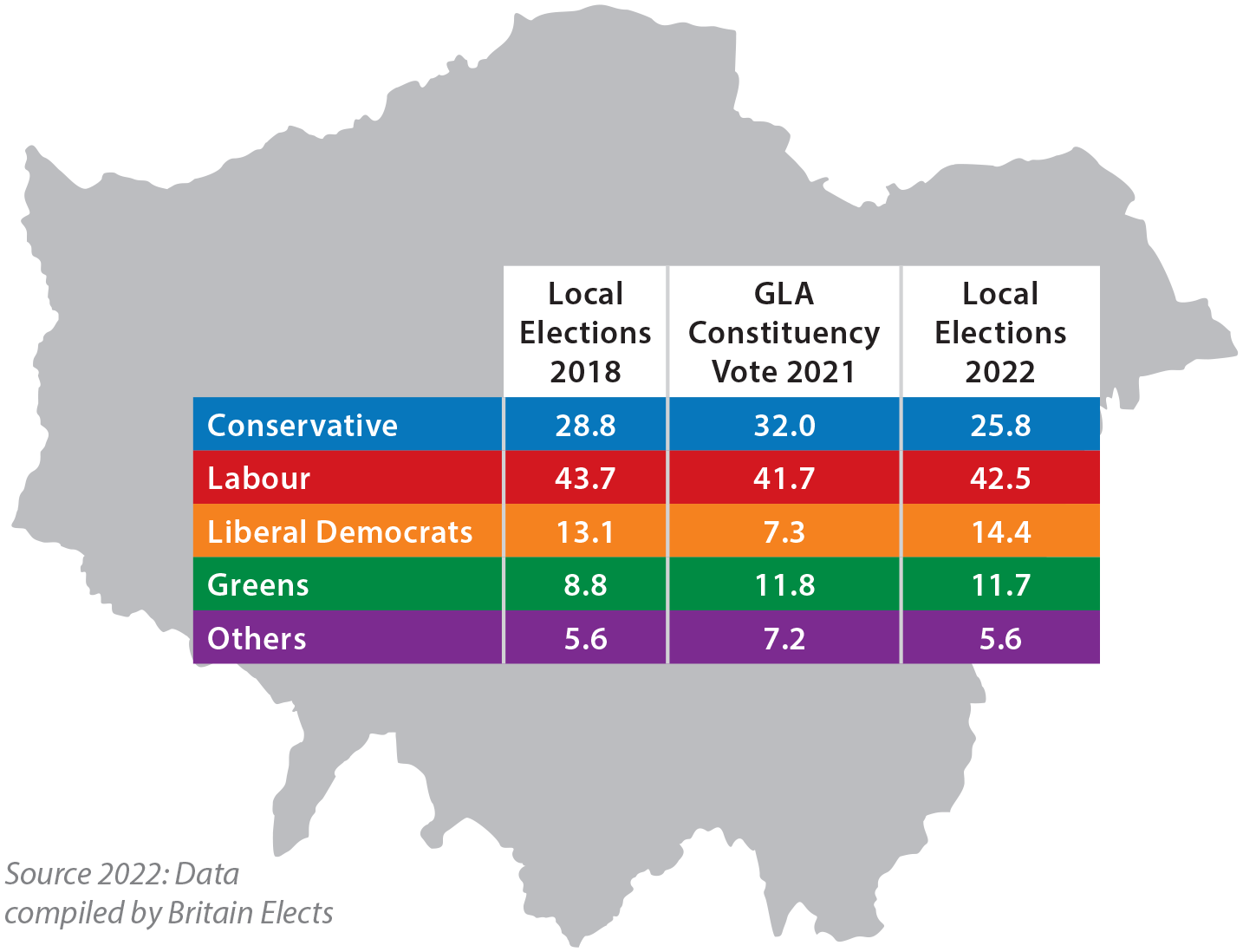
Consistent with this pattern was a relatively modest performance by Labour in London, which had voted by three to two in favour of staying in the EU. While Conservative support was down by three points on 2018, Labour’s support was also down by just over one point (despite the party’s iconic successes in gaining control of Wandsworth and Westminster). Meanwhile, although Conservative support was down by six points on the party’s vote in the London Assembly election last year, Labour’s vote was only up slightly, well below its performance nationally
Election Performance in London, 2018, 2021 and 2022 % vote

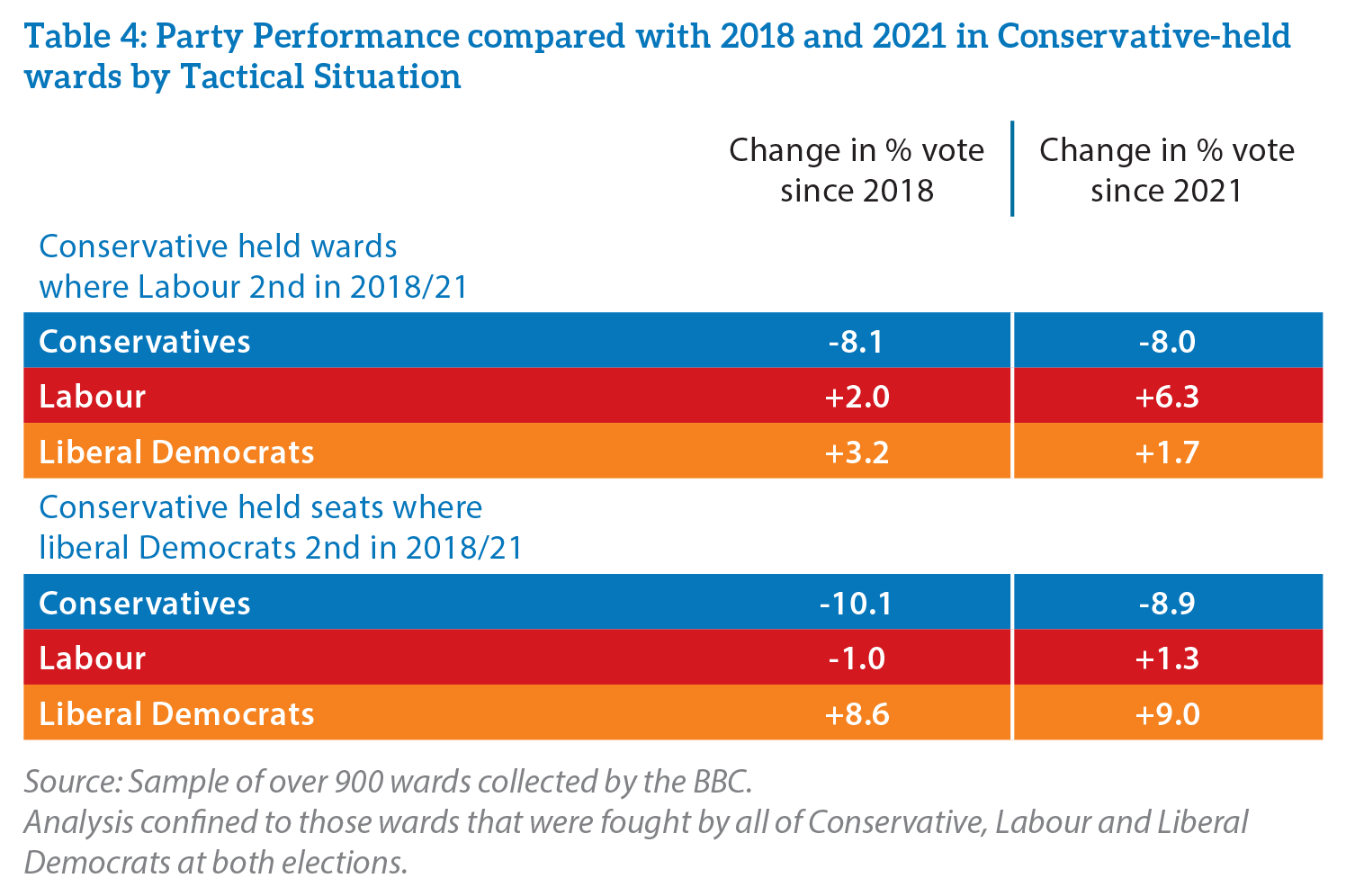
The second pattern that might set Conservative alarm bells ringing is evidence that voters have become willing to vote tactically for whichever of Labour and the Liberal Democrats are best able locally to defeat the Conservatives. This is illustrated in
Party Performance compared with 2018 and 2021 in Conservative-held wards by Tactical Situation
Source: Sample of over 900 wards collected by the BBC.
Analysis confined to those wards that were fought by all of Conservative, Labour and Liberal Democrats at both elections.
Such a pattern was not present in last year’s local elections. It suggests that the Conservatives’ difficulties in the last 12 months may not only have cost the party support, but also increased the motivation of their opponents’ supporters to cast an anti-Conservative tactical vote. The pattern in Table 4 is particularly strong in, though by no means confined to, those wards where a majority voted Remain in 2016. It may well help explain why the Conservatives lost as many seats as they did. Certainly, if replicated at the next general election it could have a significant impact on the party’s ability to secure another parliamentary majority. It is perhaps also a sign that voters’ perceptions of the Liberal Democrats are no longer necessarily coloured by the party’s decision to enter into coalition with the Conservatives in 2010.
The legacy of Brexit is very much apparent. As compared with 2016, there was still a swing to the Conservatives in the most pro-Leave wards, while Labour is now relatively stronger in the most pro-Remain places.
Lost ground in Scotland and Wales
As anticipated, the Conservatives lost significant ground in both Scotland and Wales. As Table 5 shows, the party ceded second place in votes to Labour in Scotland, having hitherto defeated it at every election since 2016. Similarly, in Wales the party was overtaken by Plaid Cymru, also for the first time since 2016 (other than in the 2019 European Election). That said, in both countries the party performed better than it had done in the local elections that took place a decade ago.
Local Election Vote Shares, Scotland and Wales, 2012-22
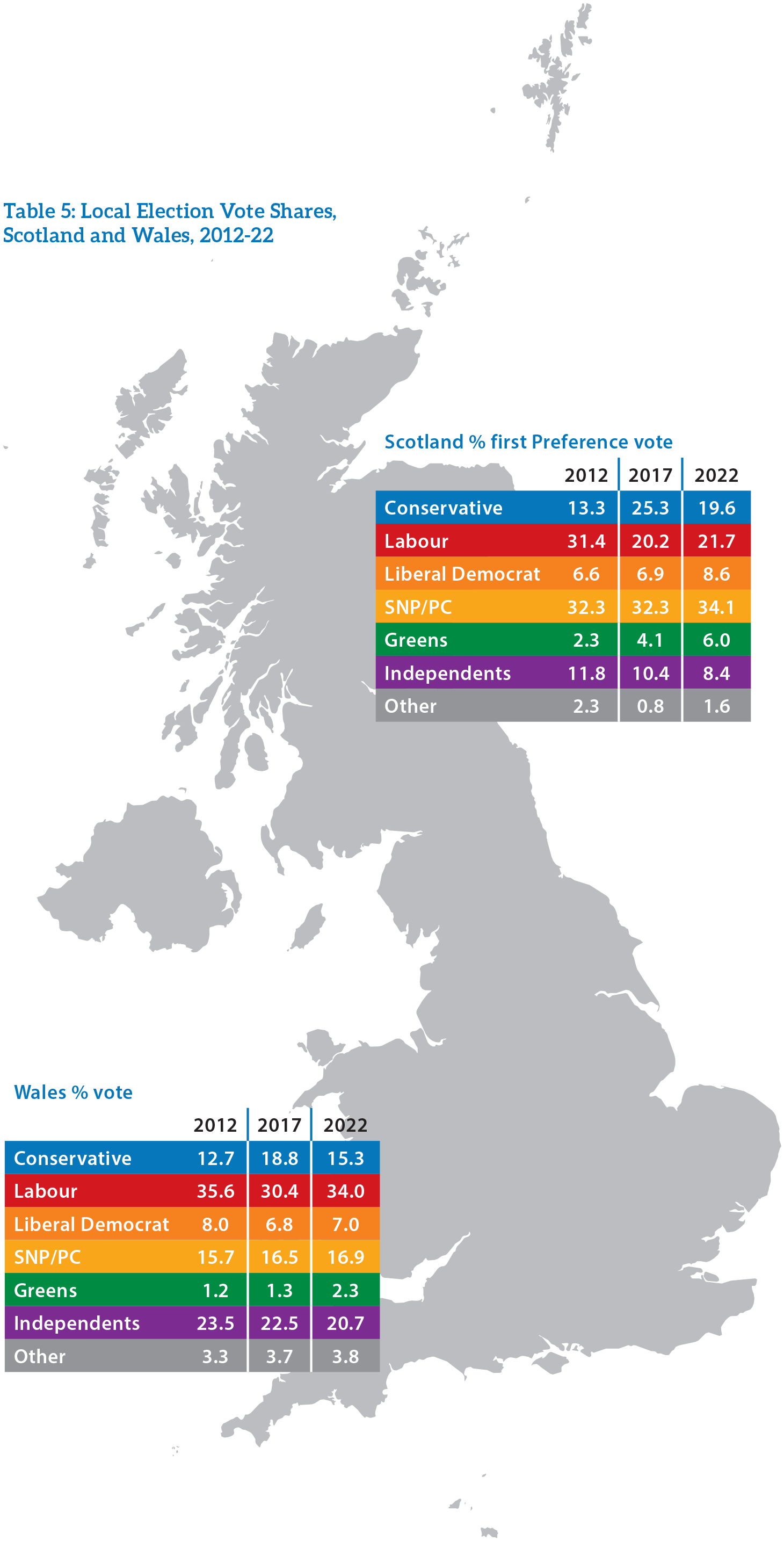
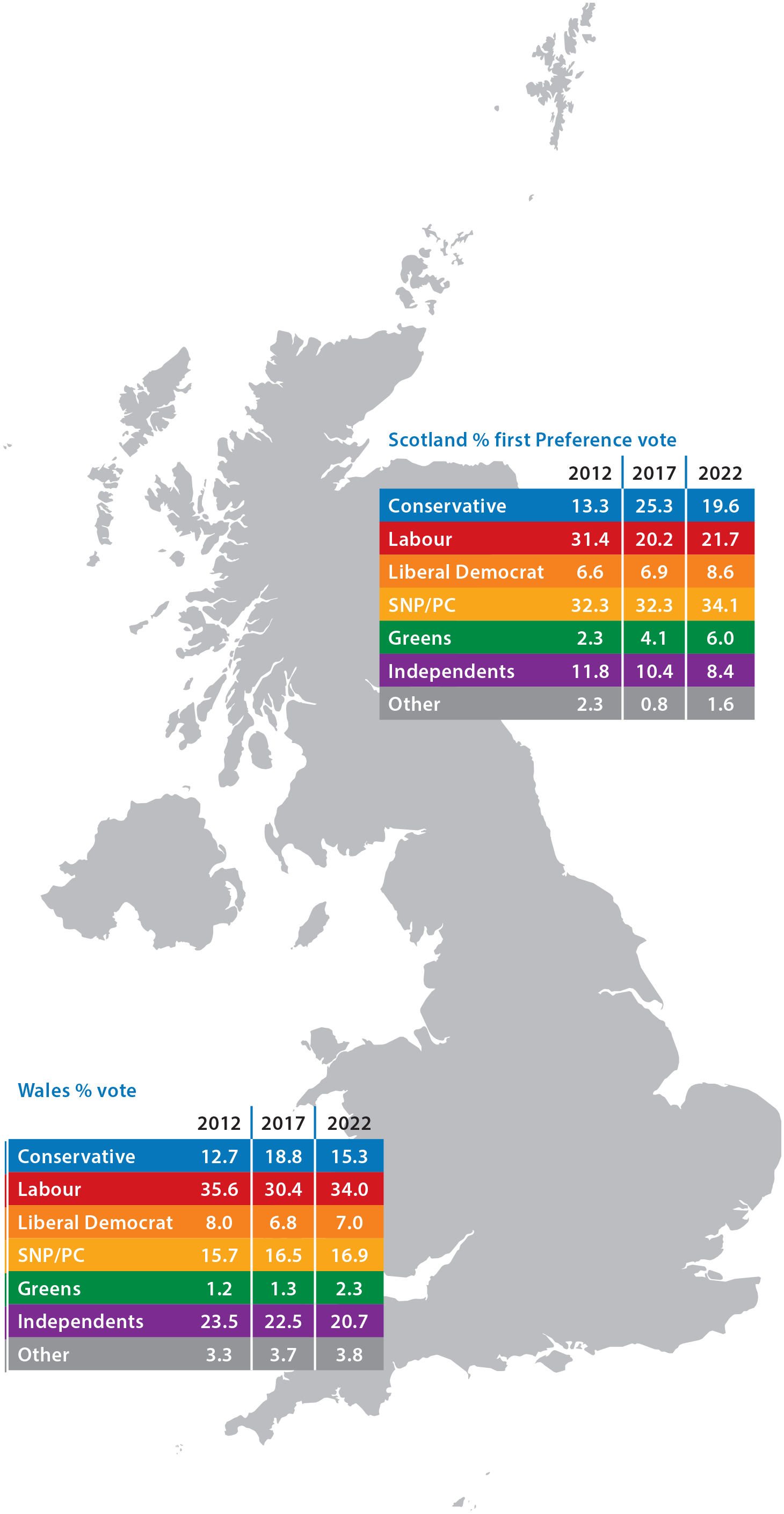
The Conservatives’ loss of second place in Scotland matters, given the determination of the SNP-led Scottish Government to attempt to hold another independence referendum, contrary to the wishes of the UK Conservative government. The political representation of the pro-Union argument in Scotland was already fragmented, but now the authority of the Conservatives has been weakened, while the Labour party has every incentive to pursue its own plans for reforming the governance of Scotland within the framework of the UK. Indeed, in a sign of the importance to the Conservatives’ fortunes of the battle with Labour for pro-Union voters, the party’s share of the vote fell more heavily, on average, by -5.8 points, in wards where Labour’s vote rose by more than two points, whereas the loss was stemmed to -3.5 points where Labour’s vote fell back on 2017. In contrast, neither the Conservatives’ performance nor that of Labour appeared to make any difference to the ability of the SNP to increase their share of the first preference vote, suggesting that neither party was having much success in winning over independence supporters.
The Conservatives’ loss of second place in Scotland matters, given the determination of the SNP-led Scottish Government to attempt to hold another independence referendum, contrary to the wishes of the UK Conservative government.

Conclusion
In the event, the outcome of the local elections did not result in a flurry of calls from Conservative MPs for Boris Johnson’s leadership to be put to the vote. Doubtless what was still a relatively modest performance by Labour that failed to demonstrate that the party could reach levels of popularity that it had not previously achieved under Jeremy Corbyn contributed to that mood. Yet, in truth, the results provided a number of warning signals to the party. It is now in electoral trouble for the first time in this Parliament, it has slipped back into third place in Scotland and Wales, its grip on the support of pro-Brexit Britain has weakened, while opposition voters have an apparent new-found willingness to cast an anti-Conservative tactical vote. A Conservative victory at the next election is still by no means impossible, but it has come to look more difficult to achieve.