




Abstract

© CLODAGH KILCOYNE / Alamy Stock Photo

May’s election brought a reordering of the biggest parties in Northern Ireland but little indication that the electorate’s verdict would be followed by political stability within functioning institutions, writes
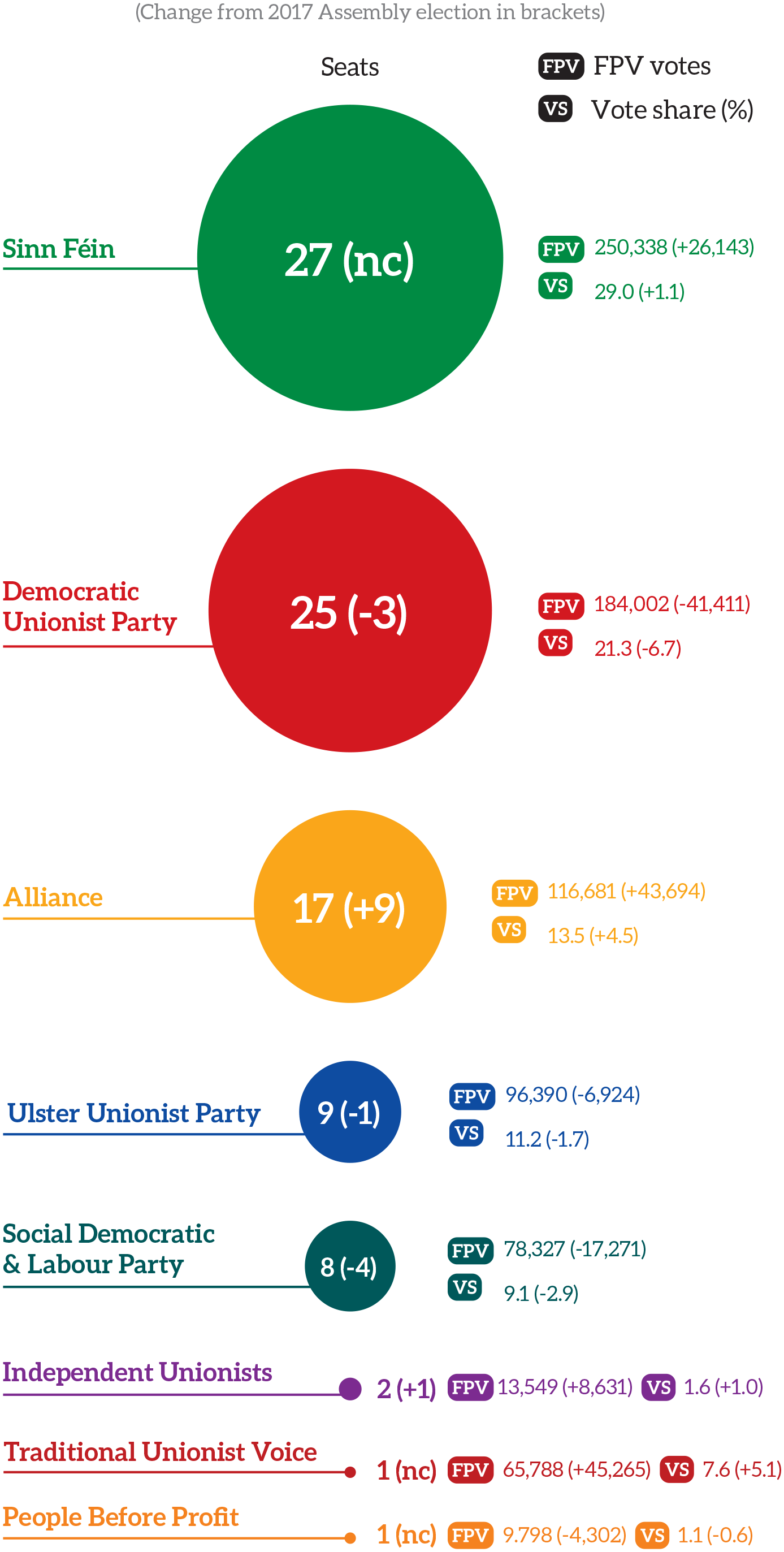
The 2022 Northern Ireland Assembly Election was one of the most dramatic in the region’s history. The rise of Sinn Féin from onetime political vehicle of the Irish Republican Army (IRA) to largest party, may have been predicted in the opinion polls but given the history of both organisation and polity, it was still extraordinary. Sinn Féin’s ascent may have dominated the headlines but the more immediate issue was whether the Democratic Unionist Party (DUP), which was ousted from first place to second largest within the Assembly, would return to devolved power-sharing government after the contest. The election also confirmed the rise of the cross-community Alliance to the third largest party, as the non-unionist and non-nationalist bloc enjoyed its best Assembly result to date.
The Rise of Sinn Féin
The growth of Sinn Féin from pariah to poll-topper had a long gestation. The party enjoyed the backing of one third of Catholic nationalist voters during the 1980s and the first half of the 1990s. Following the IRA ceasefires of the mid-1990s, Sinn Féin grew rapidly to become the larger of the two main nationalist parties by the 2001 General Election, overtaking the Social Democratic and Labour Party (SDLP). Sinn Féin’s status as the leading nationalist party meant it provided the Deputy First Minister (whose powers are equal to those of First Minister) following the return of devolved power-sharing government in 2007 (after its 2002-2006 collapse) until this year’s election when Sinn Féin’s status as largest party outright entitled it to nominate the First Minister.
Sinn Féin’s 2022 election manifesto demanded a date to be set for a border poll, a constitutional referendum on whether Northern Ireland should remain part of the UK or become part of a united Ireland. Nonetheless, the party’s northern leader and now First Minister elect, Michelle O’Neill, insisted that the election was not about Irish unity but rather the crisis in Northern Ireland’s health service and the rising cost-of-living. This focus upon immediate stringencies rather than aspirational goals paid dividends. There was consensus across the nationalist versus unionist divide that health and the economy were the most important election issues. Focusing on these concerns helped Sinn Féin hold all its Assembly seats and, against expectations, the party’s vote share rose. In this task, the party may have been unwittingly assisted by siren warnings from the DUP of the risks of a Sinn Féin First Minister. According to the DUP, this would mean perpetual talk of a border poll and much constitutional uncertainty. The DUP refused to confirm it would return to government, in which case, assuming it was the largest unionist party, a new Executive could not be formed. This focus upon a DUP versus Sinn Féin battle, with the DUP highlighting how it could veto the First and Deputy First Minister nominations angered some nationalists into voting for Sinn Féin and squeezed the SDLP. Many nationalists voted for the party best placed to take on the largest unionist vehicle. Indeed, the SDLP vote fell to its lowest ever level.
Opposition to an internal UK trade border registered high on unionist election concerns, albeit below health and the economy. This encouraged the DUP to adopt an increasingly tough stance against the Protocol.
Northern Ireland 2022 Assembly Election Result

No return to Stormont? The DUP
The DUP entered the election trumpeting a five-point plan, with proposals (similar to the nationalist parties) on growing the economy, creating more jobs, improving the health service and increasing free childcare hours. The plan also demanded the removal of the Irish Sea trade border created under the EU Northern Ireland Protocol. This border, designed by the EU to prevent a hardening of the border on the island of Ireland, requires that goods crossing from Great Britain to Northern Ireland be checked to ensure compliance with EU standards, given they are seen as at risk of heading south of the border and entering the EU Single Market.
Opposition to an internal UK trade border registered high on unionist election concerns, albeit below health and the economy. This encouraged the DUP to adopt an increasingly tough stance against the Protocol. After internal tumult which saw the ousting of Arlene Foster and then her successor Edwin Poots as DUP leader within the space of a month, Sir Jeffrey Donaldson took charge of the party in June 2021.
Donaldson had initially called merely for ‘meaningful reform’ of the Protocol. However, following his eventual emergence as DUP leader, the Traditional Unionist Voice (TUV) party, implacably opposed to the Irish Sea border, was outpolling the DUP according to a summer 2021 opinion poll conducted by Lucid Talk, with a one per cent lead over the DUP, trailing (at 13 per cent) in an unprecedented third place among unionist parties. The Ulster Unionist Party (UUP), opposed to the Protocol but not at the expense of devolved government, led on 16 per cent but Donaldson moved his party to a position where ‘removal of the Protocol’, not reform, was demanded, to recoup TUV votes. Donaldson improved his party’s fortunes and the party yet again comfortably beat the UUP. However, the DUP lost more than 40,000 votes at the election, whilst the TUV gained a similar number.
The DUP’s hardened stance on the Protocol was evident in February 2022, when the party withdrew its First Minister. Paul Givan, from the ruling Executive, to pressure the EU into backing down on the Protocol. Under the power-sharing rules, Michelle O’Neill, as Sinn Féin Deputy First Minister, lost her job and only a collection of ministers, not a fully devolved government remained in place, unable to spend money on new projects.
Given the withdrawal of its First Minister, there were always doubts whether the DUP would nominate a Deputy First Minister after the election without major Protocol concessions. It was little surprise when Donaldson duly declined. Having topped the poll in his Lagan Valley constituency, the DUP leader chose to remain at Westminster for the immediate future, rather than take his new Stormont seat, co-opting DUP former Member of the Legislative Assembly (MLA) and MP Emma Little-Pengelly into the Assembly berth. The DUP then declined to help elect an Assembly Speaker, a position requiring cross-community majorities. This meant the Assembly could not be established.
Beyond unionism and nationalism: The rise of the Alliance Party
A major feature of the election was the continued rise, to third largest party, of the cross-community Alliance Party, drawing upon Protestant, Catholic and non-religious identifiers for support. This added to the growth seen in the 2019 European, council and Westminster elections. Whilst Alliance’s first preference vote share of 13.5 per cent was below the 2019 high point of 18.5 per cent (in the European contest) it still represented sizeable progress from the single digit percentage vote garnered by the party at every previous Assembly election.
Alliance turned its much-improved first preference vote into spectacular seat gains, more than doubling its Assembly representation. These gains were aided by considerable lower preference transfer-friendliness. Alliance received vote transfers from a variety of sources: 23 per cent came from the UUP, 21 per cent from Sinn Féin and 16 per cent from the SDLP. However, much of Alliance’s electoral rise in recent years is due to tapping into support from those identifying as neither unionist nor nationalist. According to the latest annual Northern Ireland Life and Times (2021) survey, this category is the largest type of elector, at 38 per cent.
The difficulty for Alliance previously was that elections in Northern Ireland have always been contests for true believers, with unionists and nationalists much more likely to vote than ‘neithers’ who have little interest in the traditional binary. That binary still prevails in that four in every five first preference votes were cast for unionists or nationalists. Nonetheless, the centrist bloc vote is now substantial. In terms of Assembly seats, it is represented exclusively by Alliance, whose seats gains were partly at the expense of the Greens, who lost both MLAs. People Before Profit is the other Assembly party neither unionist nor nationalist, but as a radical left-wing party (which backed Brexit) it cannot be described as centrist. It supports a united Ireland.
Alliance’s capacity to capture transfers is helped by its constitutional agnosticism. Once regarded as a ‘small u’ unionist party, supportive of Northern Ireland’s place in the UK, the party is now neutral, saying it will decide a position only when a border poll becomes a reality. Meanwhile, Alliance wishes to break the sectarian logjams facilitated under the current rules of the Executive and Assembly. This would include changing how a First and Deputy First Minister are nominated. If the largest party in either the unionist or nationalist blocs refuses to nominate, this collapses the Executive under the current formula. Alliance also wants to replace the system by which MLAs are required to designate as unionist, nationalist or ‘other’ with no designations. Weighted majority voting, requiring key measures to have legislative support across a substantial section of the Assembly, would be used instead.
The election aftermath: An uncertain political future
The still-awaited new Executive will comprise Sinn Féin, with four seats, DUP three, Alliance two, UUP one. There was little incentive for the DUP to return quickly to power-sharing. Under legislation passed shortly before the election, the parties were allowed 24 weeks (previously it was supposedly seven days) to resolve the First and Deputy First Minister issue. If this was unachievable, the Secretary of State was obliged to call a new election, although this could be circumvented by emergency laws. In the immediate aftermath of the election, the DUP’s refusal to nominate a Deputy First Minister or nominate a Speaker meant there was neither a full Executive nor an Assembly. Political paralysis was not new of course. Sinn Féin had quit power-sharing in 2017 and that stand-off took three years to resolve. Overall, the Executive has been absent for 38 per cent of the time since powers were devolved in December 1999.
While there is little immediate prospect of a border poll, Sinn Féin’s advance raises longer-term questions. Opinion polls suggest the party may become the largest in the Irish Republic at the next election, in which case political pressure for a constitutional referendum will surely grow. The power to call a border poll in Northern Ireland rests purely with the British Secretary of State. The Good Friday Agreement declares that such a referendum must be called ‘if at any time it appears likely to him (sic) that a majority of those voting would express a wish that Northern Ireland should cease to be part of the United Kingdom and form part of a united Ireland’. Legal attempts to establish the criteria by which such a view will be formed have proved unsuccessful.
The difference in support for candidates on either side of the constitutional question was marginal at the election. Pro United Ireland parties and candidates won 41.6 per cent of the votes, whilst pro-union parties and candidates won 42.1 per cent. These figures include votes for independent unionist and nationalist candidates. Votes for constitutionally neutral parties and candidates totalled 16.2 per cent (140,050 votes). Assembly election votes since 1998 show slippage in the combined unionist party bloc vote, a static nationalist bloc and growth in support for the ‘others’, neither unionist nor nationalist, shown in Table 2.

The border poll issue remains for the future, however. The 2022 election brought a reordering of the biggest parties in Northern Ireland but little early indication that the electorate’s verdict would be followed by political stability within functioning institutions. Arguments over the EU Protocol and the continuing capacity of parties to deploy vetoes meant the polity was again dysfunctional.