




Abstract
The significance of the scientific subject lies in addressing the challenges related to the advancement of management systems and the automation of library services in schools across Kazakhstan, particularly within the framework of digitalizing school education and enhancing library and information systems. The article aims to analyze the prospects of modern automated library and information systems and book automation in Kazakhstani schools, exploring existing technologies, and developing methods to enhance management and book automation amidst the digitalization of education. The methodological approach of the study is based on methods of content analysis, synthesis, comparison, generalization of scientific and methodological base of prospects and technologies of development of the system of management and automation of books in Kazakhstan schools, methods of their improvement, graphic – for visual illustration and comparison of the results of research bibliographic databases in graphic images and tabular forms. Identified and evaluated the technological and methodological features of the process of management and automation of the book collection in schools in Kazakhstan through the prism of end result efficiency, the impact of automated library information systems on the practical implementation of management and automation of books in Kazakhstan schools. The analysis delves into the distinctive characteristics of database formation and the utilization of electronic information databases within schools in Kazakhstan, using a concrete example as illustration. Within the realm of scientific inquiry, the primary outcomes encompass the delineation, examination, and underlying principles of automated library and information systems within Kazakhstani educational institutions. Furthermore, the research delineates the technological approaches essential for the implementation of digitalization initiatives concerning the book inventory. The experimental findings and subsequent conclusions drawn by the authors provide valuable insights into avenues for enhancing management systems and automating book processes within schools in Kazakhstan. These insights are crucial for both library personnel and students, as they offer guidance on improving the efficiency and effectiveness of these systems.
Introduction
In the 21st century, rapid advancements across all sectors, particularly in education, define our era. The proliferation of digital technologies is driving a surge in information volume, technological innovation, and the digitization of educational resources. Society’s growing inclination towards self-directed learning further underscores this trend (Kovalchuk et al., 2021). Leading scholars highlight the imperative of providing unrestricted access to global information repositories as a pivotal criterion for library operations. Within Kazakhstan’s educational landscape, school libraries occupy a unique position within the broader library network. They serve as the primary hubs for schoolchildren, who are the future patrons of next-generation libraries. This underscores the pressing need to address the modernization and adaptation of library and information systems in Kazakhstani schools to meet the evolving needs of learners in the digital age (Sultanbaeva et al., 2017; The role of..., 2022). The realities of today in the context of the development of a digital society dictate the requirements of updating the system of management and automation of books in schools in Kazakhstan. To align with the State Program for the Development of Education and Science of the Republic of Kazakhstan for 2020-2025, school libraries need to improve their library services and information activities to meet new innovative standards (Decree of the Government of the Republic of Kazakhstan No. 988, 2019).
The establishment of a conducive learning atmosphere for students in Kazakhstan schools amidst the digitalization of education hinges on the integration of library technologies. This integration will enable the management and automation of books to operate at an innovative level. Enhancing the productivity and efficiency of staff, along with improving service quality to users, are crucial aspects of addressing the complexities inherent in managing and automating the library and information process. This is achieved through the adoption of automated systems tailored to work with electronic documents (Kovalchuk et al., 2022). One of the first scholars who gave the definition of “electronic document” is F.S. Voroiskyi (2002). According to R.S. Gilyarevsky and G.F. Gordukalova (2007), the concept of “electronic book” should be identified with the concept of “multimedia publication” with a developed system of hyperlinks. This viewpoint has captured the attention of a broad scientific community and sparked numerous discussions. Despite numerous publications and theoretical advancements in the field of management systems, automation of books, and the digitalization of libraries in Kazakhstani schools, there remains a lack of comprehensive research for the large-scale systematization and automation of books in these institutions.
Challenges and opportunities in digital libraries
Publications and scientific studies have highlighted technological challenges. However, insufficient attention has been given to improving the utilization of electronic documents in Kazakhstan’s school libraries. There is also a lack of focus on enhancing systematization and automation processes for books. Moreover, there is a need to establish models for organizing collections. Additionally, there has been limited theoretical analysis on electronic document adaptation issues. Finally, there is a lack of clarity regarding terminology introduced in state standards and legislative acts. Z.D. Shaimardanova (2009) and Zh. Shaimukhanbetova (2014) have extensively addressed key issues surrounding library management and automation within the context of Kazakhstan’s educational framework. While these Kazakh scholars provide valuable insights, the theoretical underpinnings of library development often draw from international research. Scholars like D. Goh (2001) and M.L. Pappas (2003) have delved into the conceptualization of digital libraries and their operational intricacies. Similarly, information retrieval within digital library systems has been explored by researchers such as J.M. Abbas (2002) and M.H. Kholief (2004), shedding light on user-oriented approaches to accessing digital resources. Furthermore, the navigation of digital library collections has been scrutinized by I.E. Gibson (2002), while J.M.N. Hey (2002) and F.E. Brody (2001) have examined the integration of print and electronic journals within hybrid digital library environments. Despite the breadth of studies in this field, certain aspects of the overarching problem remain underexplored.
Modernization of school libraries in Kazakhstan
N. Strishenets (2019, 2021) delved into the theoretical and practical facets of modern subject cataloging in scientific libraries, while scholars like H. Hristo et al. (2022) and D.E. Marsıäl et al. (2022) focused their research on digital technologies and e-learning. The authors emphasized in their works that in the context of the constant digitalization of the educational landscape, school libraries in Kazakhstan are faced with the task of creating a new generation of libraries. Libraries in schools in Kazakhstan need a comfortable educational environment for students, and the introduction of automated resource management systems (Kenzheguzin et al., 2005). There is a need to improve the automated library information system (ALIS) in schools in Kazakhstan. It is necessary to begin with the creation of a modern library catalog – an electronic catalog, which serves as the main reference and bibliographic unit of the library. The main task of the catalog is to display book collections, periodicals, articles on periodicals and collections of scientific materials, digital resources, audio, video materials, and other documents (Daribaeva, 2016; Gubeladze et al., 2021). In the study authors propose to consider the system Kazakh Automated Library Information System (KABIS) (2022), developed by Kazakh Soft and has its implementation in advanced libraries in Kazakhstan, as well as the author’s automated program for the librarian “Library”: the automation of business processes of library record keeping. The algorithm authors offer differs from KABIS in that it is intended only for school libraries and is connected with 1C: enterprise, which greatly simplifies the work of the librarian.
Methods
Establishment of theoretical framework
The primary focus of the methods revolved around investigating ways to enhance the management and automation of books in Kazakhstan’s schools. This included aspects such as fostering a positive psychological atmosphere, integrating cutting-edge technology, optimizing spatial environments, and promoting developmental opportunities. The research endeavors to identify efficient strategies for enhancing book management and systematization through the application of contemporary digital technologies. It is rooted in a carefully curated theoretical framework, providing a solid basis for subsequent investigations.
The presented research work was carried out in three main stages. The initial phase of the scientific investigation involved establishing the theoretical framework to guide subsequent research endeavors. During this stage, a comprehensive analysis, synthesis, and comparison of scientific and educational literature pertaining to the research topic were conducted. This process enabled the determination of the extent of scholarly advancement in the field, identified emerging trends in pedagogical concepts, and established the methodological foundation for addressing the research problem. Furthermore, the study outlined key issues that could be effectively and qualitatively addressed through the practical application of modern methods for expert assessments in the general education of students in Kazakhstan’s schools. Additionally, the selection of appropriate technologies to facilitate the efficient implementation of book reserve systematization in schools across Kazakhstan was methodically justified.
Analysis of digital technology implementation
The second stage involves analyzing the potential use of digital technology to streamline book management and automation in Kazakhstani schools. It includes comparing findings with other researchers’ conclusions in this field. An expert assessment method was employed, involving 86 school library and higher education institution employees, to determine improvement directions. A survey of 124 school librarians and teachers was conducted. The survey was conducted in order to determine the level of implementation of automated library and information systems in the practice of schools in Kazakhstan. Three schools of Astana city were surveyed, including secondary school No. 49, school-lyceum No. 11, school-gymnasium No. 31.
To enhance librarian skills in the education sector, the authors conducted seminars and a conference. They organized a conference titled “The Role of the Library in Raising an Educated Generation” for librarians on August 18, 2021. Additionally, a seminar on “Management of Electronic Resources” took place on December 13, 2021, followed by another seminar on “School Library Basic Documents” on April 6-7, 2022. Two competitions were also held: “Best School Librarian of the Year” for professionals and “A Reader is a Successful Person” for children and teenagers. Prior to these events, participants underwent training in basic knowledge and practical skills related to organizing and improving school library activities, including the use of the automated library information system “Library.” To effectively manage the development of the library, a pilot project on staff assessment was launched. The experiment involved 74% of the total number of employees of the libraries of the educational institutions involved in the experiment. It is quite a budgetary and technically easy type of assessment, allowing accurate results, based on which it is possible to implement quality management of personnel in the structural units and the library as a whole.
The final stage of the research work allowed to formulation of the conclusions of scientific research, acting as a final reflection of the results obtained and defining in general the main trends in the introduction of automated library and information systems in Kazakhstan schools and outlining the prospects for further research. The results of scientific research, as well as the conclusions formulated on their basis and the prospects for further research, can be used in the future as an effective scientific basis for improving the management systems and automation of books in Kazakhstan schools.
Results
The rapid advancement of digital technologies worldwide prompts significant transformations in Kazakhstan’s school libraries, affecting service methods, resource access, and information provision. Their primary objective is to establish a conducive educational environment, as emphasized by Borysenkova (2018). As part of modernizing education, automated library information systems play a crucial role in managing library collections, from acquisition to user services (Reitz, 2004). The development of school libraries in Kazakhstan aligns with national policies, including the “Information Kazakhstan-2030” program initiated by the President. This program aims to bolster library resources and expedite their automation, facilitating the creation of a Unified National Catalogue and Electronic Storage Facility at the National Academic Library in Astana (Plakhtii, 2019; Ye et al., 2021).
Results of peer review.
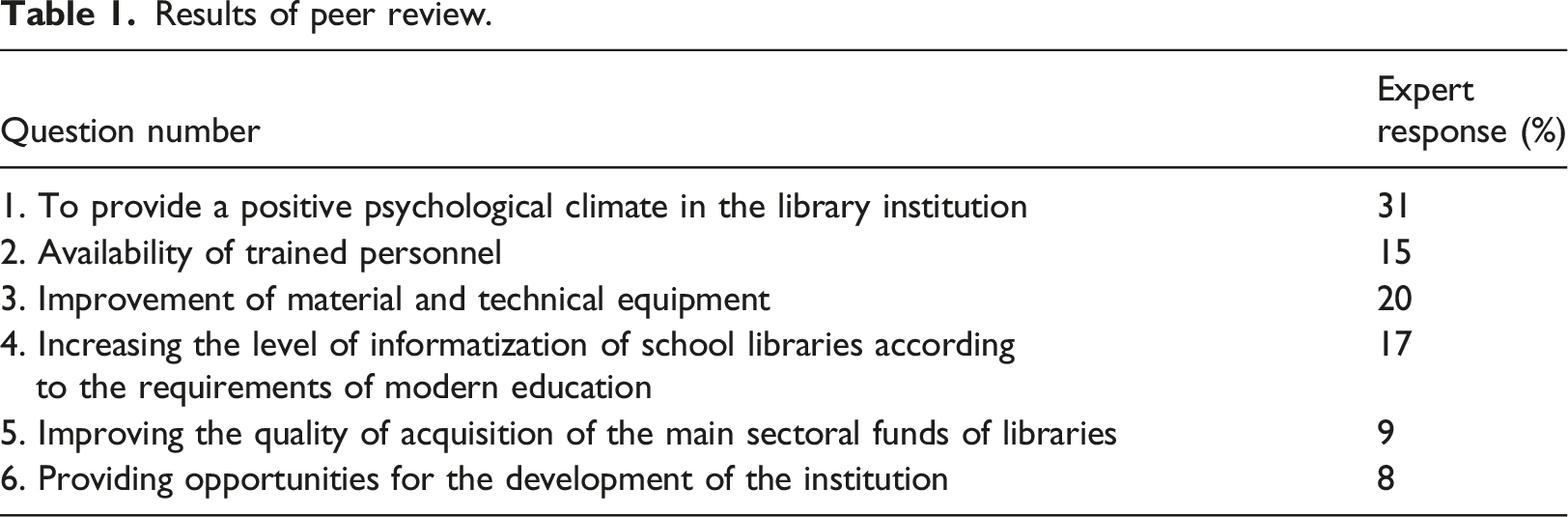
Based on the results of the expert assessment to improve the skills of school librarians and higher education institutions authors held seminars on the topic: “Management of electronic resources” (Electron Resources), “Basic documents of school library” (Mektep kitaphanasynyң negizi kuzhattary) and conference “Role of the library in the education of educated generation” (Bilimdі ұрпақ тәрbieleudeгі kitaphananyң рөlі), as well as held two competitions – professional mastery “The best school librarian of the year” and for children and youth “A man who reads is a successful man”. There were field courses on the topic “Digitalization of New Generation Libraries”, after which the participants received certificates. Working visits were made to the republic’s regions to study the level of library and information and bibliographic work, the implementation of modern information technologies, and the automation of library and information processes in school libraries (Tverytnykova and Salata, 2023). According to the results of the monitoring of school libraries’ activities conducted during the visits, it can be concluded that all the school libraries’ authors reviewed work traditionally. Library workers perform work with the main fund and the fund of school textbooks, library and reference bibliographic services, and organize and conduct mass library events on various educational topics. The libraries authors studied have specially equipped rooms where library and reference and information services are organized, there are rooms with large areas, which are equipped for lending, book saving, and reading rooms with a large number of seats, equipped with computers with high-speed Internet (Fatia and Farakhian, 2021; Ilmaz and Şımşek, 2021).
Results of the assessment of librarians’ acquired competencies for the results of the second chapter of the assessment letter.
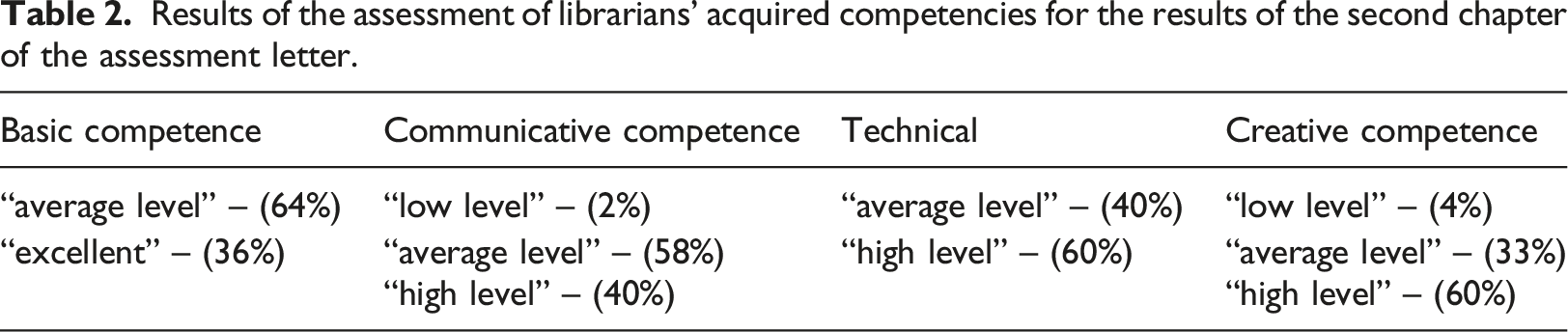
The third assessment letter “On the Availability of Publications” was aimed at determining the library staff’s ability to communicate, prove, defend their point of view, and improve their general cultural and professional outlook. The school staff was given the task of increasing their publication activity. According to the results of the third assessment letter, it can be concluded that only 30% of the employees had 1-2 publications during the period under observation. Particular attention should be focused on the main specialists, which according to the staff schedule in the library 40% of the total number of staff units. These are specialists with a rather long experience and experience of professional activity. Based on the analysis of the experimental data from the evaluation forms, it can concluded that the main specialists have low activity in their work, even though they perform their duties at a high professional level. At the initial stage of the digitalization of school libraries in Kazakhstan, we need specialists capable of generating creative ideas and innovations. The results of the staff assessment allow us to argue that at present there is a positive situation in the preparedness of library workers and teachers for the implementation of automated library and information systems.
The difference between the required and existing level of competence of employees suggests that it is necessary to work out individual plans of professional development, the results of which will be the subject of objective assessment by the management and will be taken into account during the planned certification. To intensify the work on the introduction of professional development courses it is necessary to use active ways of learning. The authors propose to hold classes permanently with a pre-designed schedule. To assess the preparedness of librarians and teachers of schools in Kazakhstan authors used criteria and indicators (objective and subjective), which are divided into professional; socio-psychological; and psycho-physiological. The authors used objective criteria. Behind objective indicators, the authors assessed the performance of labor activity and the activity of the staff. At the stage of development of the staff assessment process, authors recommend the use of subjective indicators – the satisfaction of staff from the work performed, understanding the importance of quality performance of individual tasks in the development of the library; and adaptation of young workers in the team. It is planned to conduct a self-assessment of each specialist and compare it with the assessment of his immediate supervisor. Therefore, assessment methods need gradual improvement (Akmeşe et al., 2021; Daribaeva, 2016).
Discussion
The importance of providing free access to information resources, both locally and globally, is widely acknowledged as a fundamental criterion for the effectiveness of libraries. School libraries in Kazakhstan, equipped with automated systems, play a crucial role in facilitating quick access to these resources, aligning with the evolving demands of information dissemination (Kunanets, 2008). Various scholars have delved into the exploration of enhancing management systems and automating library archives. For instance, Russian researcher Ya. Shrayberg (2000) views automation as a pivotal advancement within the library and information sector, while Polish scholar A. Radwanski (2007) emphasizes the significance of automation in addressing contemporary challenges faced by libraries. Radwanski suggests that the automation of library functions and the provision of diverse access to information forms are paramount in today’s library landscape.
V.M. Belinska (2009) underscores the critical role of university libraries as creative laboratories shaping the educational experience of students. Belinska’s perspective resonates with the broader discourse on the transformative potential of libraries in fostering educational excellence. In the study conducted by S.N. Hrypych et al. (2014), specific aspects related to the role and evolution of libraries in modern information environments were explored. While Hrypych et al.'s findings may offer valuable insights, it is essential to contextualize them within the broader scholarly discourse. Collaborative efforts to consolidate research findings and reconcile divergent perspectives can contribute to a more nuanced understanding of the challenges and opportunities facing library systems in the digital age (Lomachinskyi, 2023).
The formation of the national innovation system in Kazakhstan has been studied by Kazakh scientists A. Taubaev et al. (2012); the state and main directions of development of librarianship in the Republic of Kazakhstan were investigated by H. Balabekova (2012). In scientific works (Kilgour, 1968; Shrayberg, 2000) concerning the issues of automation and systematization of library processes, the features of interaction of internal library technologies and processes of the network environment of libraries are actively studied, the theoretical basis for the creation of an automated system of school libraries in Kazakhstan using Internet technologies is formed. Based on study authors have concluded that the system of management and automation of books in Kazakhstan schools should become a center of informal communication, a point of access to the latest technologies of working with information, a place of collective thinking and co-creation, a key element of reading infrastructure and continuing education, which requires the improvement of library education. The evolving educational landscape underscores the need for a flexible learning approach within an interactive educational setting. This model of continuing education encompasses collaborative workspaces, interactive educational content, and intelligent learning technologies (Klymenko and Sokur, 2019). Currently, there is a reassessment of the significance of library institutions within the contemporary information framework of schools. Their roles are expanding continuously, positioning them as active participants in communication processes and essential intermediaries amid the proliferation of diverse information and global resources (Plakhtii, 2019).
The active introduction of digital technologies into the education system of Kazakhstan schools has led to radical changes in all areas of library activities: from traditional tools to methods of service, access to resources, and forms of providing information (Kostyrko, 2020). During the rapid development of information society to effectively and efficiently implement the State Program for the Development of Education and Science of the Republic of Kazakhstan for 2020-2025 (Decree of the Government of the Republic of Kazakhstan No. 988, 2019) the task of school libraries to start their library and bibliographic and information activities at a new, innovative level and as a result create a modern school library of the new generation. For high-quality education of students in schools of Kazakhstan, school libraries require the creation of a comfortable and positive educational environment for the formation of students all the qualities of a modern person capable of competing in the labor market in the future. The results of statistical analysis regarding the quantitative indicators of school libraries in Kazakhstan suggest that as of January 1, 2021, the largest network of public school libraries in Kazakhstan had 6441 units, which is 90.8% of the total number of libraries in the education system. The total library stock of school libraries is 160,328,591, the number of readers is 2,996,557, the number of visits is 23,098,957, and the number of loans is 46,749,927 (The current state of school libraries in Kazakhstan, 2022). Based on the results of the study, it was found that the modernized school libraries of Kazakhstan have already actively implemented one of the innovative directions of information and library services – the media library.
The concept of a media library, as described by the N.A. Nazarbaev (2017), underscores the importance of modern information technology infrastructure within educational institutions. This aligns with the evolving landscape of education, where digital resources play a crucial role in facilitating cognitive, creative, and communicative activities among users. The integration of individual and remote information resources from various sources, including the Internet, CD-ROMs, audio, and video documents, enables educators and students to access a diverse range of materials to enrich the learning experience. The author emphasize the potential of media libraries to revolutionize teaching methodologies, enabling educators to deliver lessons in innovative ways. By harnessing multimedia resources, teachers can engage students more effectively and cater to diverse learning styles. Moreover, the availability of media libraries opens up avenues for independent learning and self-education, empowering students to explore topics beyond the confines of traditional classroom instruction (Grajcevci and Shala, 2021).
The core of automated library information systems (ALIS) is the planning of library resources used in processing the library collection, searching for the necessary literature, and issuing it to readers. ALIS ensures that the library’s document collection is processed, analyzed, and made available to users. Using automated library information systems, library staff maintains a database of acquisition of educational and industry literature, forming full-text teaching and learning sets (OCLC: Worldwide, member-driven library cooperative). In Kazakhstan, some school libraries, gymnasiums, and general education lyceums have created personal pages on the website of the educational organization. The advanced school libraries of Kazakhstan are working on the creation of the electronic catalog “Books” in an automated library information program. In general, most school libraries in Kazakhstan are using automated library information systems “ALIS – MARK SQL version for school libraries” and the Kazakh Automated Library Information System (2022), which work with electronic documents. (The role of the school library in the formation of citizenship, patriotism, social responsibility and the implementation of the national idea Mangilik el, 2022).
The Association of Higher Education Institutions of Kazakhstan recommends the KABIS (2022) system for effective automation of library processes as the best solution for Kazakhstani libraries. The system is run from a personal computer. Laser and matrix printers are used to print maps and source documents. At the core of the KABIS system software are the necessary modules that automate library processes. KABIS is supplied in two versions: 1. KABIS. Standard – has the following modules to get you started: Administration, Acquisitions, Cataloging, Periodicals Ordering and Registration, Articles Card Index, Reader’s Search; 2. KABIS. Full – includes almost all modules: Administration, Acquisition, Cataloging, Periodicals ordering and registration, Articles card, Readers search, Readers card, Book publisher, Digital library, barcoding support, Digital library.
KABIS (2022) boasts a notable level of integration, facilitating the exchange of bibliographic data with other library systems through communication formats like RUSMARC (Russian Machine Readable Cataloging) or UNIMARC (Universal Machine Readable Cataloging). This integration enables seamless collaboration in corporate projects between different systems. Moreover, the system offers the capability to download data in a customized format compatible with the Kazakh alphabet, streamlining the process of creating electronic catalogs. Unlike some Russian and other foreign systems that lack comprehensive support for the Kazakh language, KABIS allows for cataloging documents according to Kazakh alphabet standards. Additionally, cataloging features include spell-checking for Kazakh and other languages, along with the ability to input author’s names and classifiers such as UDC (Universal Decimal Classification) and LBC (Library-Bibliographical Classification) in Kazakh (Kostyrko, 2020; Trushaj, 2023; Vasenko et al., 2023).
Advantages of the Librari program.

KABIS (2022) is used at different levels of libraries. More libraries using KABIS are just now beginning to create electronic catalogs. However, some users have transferred from other library systems, such as IRBIS and Library 4, with a total of over 3.5 million records converted to KABIS. KABIS system successfully operates in more than 570 libraries, namely: numerous institutions of higher education, mass libraries and schools, among them: all school libraries of Almaty city (180 schools); all Nazarbayev intellectual schools from all over Kazakhstan (20 schools); Nursultan Nazarbayev Educational Foundation; state institution secondary school No. 25, city of Taldykorgan; Kainar school; special (correctional) boarding school No. 2 for children with gynecological disabilities; other private schools.
Research conducted by various scholars (Kilgour, 1968; National Academic Library..., 2022; Plakhtii, 2019) indicates that the existence of well-equipped libraries in Kazakhstan’s schools has a direct impact on the quality of education. As education in Kazakhstani schools undergoes digitalization, the role of school librarians is evolving. These professionals are now expected not only to curate information resources for students but also to possess expertise in the automation and digitization of educational materials. In Kazakhstan’s general education, school libraries have been assigned the role of educational support units, the purpose of which is literary and informational support of the educational process. However, the active digitalization of education requires a rethinking of libraries. On the basis of the study it was concluded that along with numerous achievements school libraries in Kazakhstan need to solve certain problems, such as: – shortage of qualified personnel; – the low level of material and technical equipment, but high requirements of modern education; – the lack of quality acquisition of the main branch funds of libraries.
The tasks of the modern school library, include: the implementation of educational process and self-education through library and information and bibliographic services to both students and other categories of readers; formation of reader’s skills of an independent library user: search and critical evaluation of information, book use skills; implementation of improvement of traditional and new library technologies. To effectively implement the pedagogical component of the school library librarians, need to learn and actively use a wide arsenal of library forms and methods, actively engage in reorienting conventional methods of work to achieve educational goals.
Study limitations
The limitations of the study include a number of factors that may affect its representativeness and overall objectivity of the results. It is important to note the limited geographical scope, which is confined to the territory of Kazakhstan, specifically the city of Astana and some of its schools. This may create limitations for generalizing the results nationally or to other regions. A second limitation is the number of participants, as even with a large number of surveys and expert assessments, there may be insufficient representation of the opinions and views of different schools and libraries. A limitation is the timeframe of the study, which may affect the relevance and representativeness of the data due to changes over time. Technical limitations, such as the availability of certain technologies or software, may also affect the objectivity of the results. Methodological limitations, such as the use of expert judgment, may cause certain restrictions on the objectivity and representativeness of the results. These limitations should be taken into account when interpreting the results of the study and in further research to ensure the accuracy and relevance of the findings.
Conclusions
The contemporary school libraries in Kazakhstan, outfitted with advanced automated systems for managing library resources, play a vital role within the well-established educational framework. Through analysis, it has become evident that amidst the digitalization of education, the primary objective for shaping library collections is to align them effectively with the evolving information needs of society. This underscores the imperative to reimagine the functions of school libraries, transitioning from conventional document management to the dynamic management of information flows. It emphasizes the importance of adapting to changing educational landscapes and harnessing innovative technologies to optimize the role of school libraries in facilitating knowledge dissemination and supporting learning outcomes. The results of surveys conducted among librarians and teachers show that the modern school library is undergoing a significant transformation. It is turning into an automated information center that provides unhindered access to a multitude of resources regardless of their location. It is substantiated that this transition is a necessity for school libraries in Kazakhstan to introduce innovative ways of interaction, increase user comfort and personalize services to meet the diverse needs of their visitors. The study emphasizes the need for continuous training and professional development of library staff and educators to effectively use automated library information systems, thereby maximizing their usefulness and impact in the educational environment.
Identified in the study areas to improve the process of systematization and automation of books in Kazakhstan schools should be developed at the interdisciplinary level through the exchange of ideas, best practices, joint conferences and seminars among schools in Kazakhstan. The work of school libraries to digitize library collections should be carried out systematically taking into account the goals and objectives of the library. Prospects for further research and scientific experimental research authors plan to implement in the following directions: search of ways of inclusion of school libraries of Kazakhstan in the general processes of modernization of education; creation of the Concept of development of libraries of general educational institutions of the Republic of Kazakhstan; development of the program of further modernization of school libraries of Kazakhstan.
Footnotes
Declaration of conflicting interests
The author(s) declared no potential conflicts of interest with respect to the research, authorship, and/or publication of this article.
Funding
The author(s) received no financial support for the research, authorship, and/or publication of this article.
