



Abstract
This study sought to analyze the extent of utilization of educational artificial intelligence in teaching and learning in public universities in Enugu State. The sample of the study was 111 lecturers. The study adopted descriptive survey research design. The instrument for data collection was a structured questionnaire. The data collected for this study was analyzed using mean and standard deviation, while null hypotheses were tested using independent sample t test at 0.05 level of significance. Findings from the study revealed that ChatGPT and Chatbot are most used to carry out educational functions in teaching and learning in public universities in Enugu State; and there is no significant difference in the mean ratings of male and female Vocational Education Lecturers on the extent of utilization of educational artificial intelligence tools in teaching and learning in public universities in Enugu State. It was therefore recommended among others that there should be regular orientation and re-orientation for vocational education lecturers inform of training on the use of educational artificial intelligence tool in teaching and learning.
Keywords
Introduction
Artificial Intelligence (AI) is a branch of computer science focused on creating systems capable of performing tasks that typically require human intelligence, such as reasoning, learning, and decision-making (Russell and Norvig, 2021). It encompasses various subfields, including machine learning, natural language processing, and robotics (Russell and Norvig, 2021). AI often refers to systems that can learn from data, recognize patterns, and make decisions with minimal human intervention enabling computers to improve their performance on tasks over time through experience and data analysis (Mitchell, 2022). According to Jurafsky and Martin (2023), AI plays a crucial role in natural language processing (NLP), enabling computers to understand, interpret, and generate human language that can be applied in language translation, sentiment analysis, and conversational agents like Chatbots (Jurafsky and Martin, 2023).
AI is integral to robotics, providing the cognitive abilities required for robots to navigate environments, recognize objects, and perform complex tasks (Siciliano and Khatib, 2019). AI enables real-time decision-making and navigation without human intervention. These systems rely on AI to process sensor data and react to changing conditions (Thrun, 2022). AI enhances human-computer interaction by making interfaces more intuitive and responsive. Through AI, devices can adapt to user behavior, recognize voice commands, and even predict user needs, leading to more seamless interactions (Shneiderman, 2023). Therefore, AI is a machine that mimics human beings in performing tasks such as reasoning, learning, and decision-making. AI can be used to enhance performance in teaching and learning through the use of Educational Artificial Intelligence tools.
Educational AI tools refer to the application of artificial intelligence technologies in education to create personalized learning experiences to adapt instructional content to meet individual learning needs, thereby enhancing student engagement and outcomes (Luckin et al., 2022). Educational AI tools encompass the development of Intelligent Tutoring Systems (ITS), which use AI to provide customized instruction and feedback to learners (VanLehn, 2023). The author opined that educational artificial intelligence systems simulate one-on-one tutoring by adapting to a student’s learning pace and knowledge level, improving educational effectiveness.
Educational AI tools involve the use of AI technologies to automate the assessment process, including grading and providing feedback. According to Balfour (2022), AI-driven tools can evaluate student work, such as essays and quizzes, with high accuracy, delivering immediate and detailed feedback that supports learning (Balfour, 2022). Kumar and Chaudhary (2023) stated that educational AI tools can be used for adaptive learning technologies that adjust the difficulty and type of educational content based on a student’s performance. These AI-driven systems help create a personalized learning environment, ensuring that each student progresses at an appropriate pace (Kumar and Chaudhary, 2023). Educational AI tools include the application of AI in educational data analytics, where AI tools analyze large datasets to identify trends and patterns in student performance (Siemens and Long, 2023). This analysis helps educators make data-driven decisions, improving instructional strategies and student outcomes (Siemens and Long, 2023).
Educational AI tools are AI-driven educational tools designed to provide personalized instruction to students. These systems adapt to the learner’s pace and understanding, offering customized feedback and targeted exercises to improve learning outcomes (VanLehn, 2023). Educational AI tools utilize machine learning algorithms to evaluate student performance more efficiently and can automatically grade assignments, quizzes, and even essays, providing instant feedback and freeing up educators to focus on more complex tasks (Balfour, 2022). Educational AI tools use AI to tailor educational content to individual students based on their learning styles, preferences, and progress. By analyzing data on student performance, these tools can suggest specific resources and activities that align with each learner’s needs (Pane et al., 2023). Educational AI tools are AI tools that dynamically adjust the difficulty level of learning materials based on a student’s performance. These tools help ensure that students are neither bored by overly simple tasks nor overwhelmed by overly challenging ones, promoting a more effective learning experience (Kumar and Chaudhary, 2023).
Educational AI tools are increasingly being used to create educational content, such as generating quizzes, lesson plans, and even textbooks. These tools can analyze large datasets to identify key concepts and generate relevant instructional materials that are aligned with curriculum standards (Luckin et al., 2022). According to OpenAI (2024), ChatGPT is one of the educational artificial intelligence tools used for educational content. The author stated that ChatGPT assists in generating educational content, such as lesson plans and assignments, by leveraging its natural language processing capabilities (OpenAI, 2024).
ChatGPT functions as a virtual tutoring assistant by providing instant, personalized feedback and explanations to students (Smith and Lee, 2023). It can answer questions across various subjects, helping learners understand complex topics and supporting their educational journey (Smith and Lee, 2023). In educational settings, ChatGPT is used to generate educational content such as lesson plans, quizzes, and interactive activities (Johnson, 2024). Its ability to process natural language and produce coherent text aids educators in creating diverse teaching materials efficiently (Johnson, 2024). ChatGPT serves as a conversational partner for language learners, offering practice in writing and speaking (Davis, 2023). It provides real-time corrections and suggestions, helping students improve their language skills through interactive dialogue (Davis, 2023). ChatGPT supports personalized learning by adapting its responses to individual student needs and learning styles (Wilson, 2023). The author further stated that Chatgpt tailors explanations and content recommendations based on students’ queries and progress, enhancing the overall learning experience.
In educational institutions, ChatGPT assists with administrative tasks such as scheduling, answering frequently asked questions, and managing student inquiries. This automation helps streamline administrative processes and allows educators to focus more on teaching (Garcia, 2023). Therefore, one of the educational artificial intelligence tools used in education sector is Chatgpt to enhance teaching and learning. According to Woolf (2023), another educational ai tools used for teaching and learning is AI Chatbots (Woolf, 2023).
AI Chatbots offer real-time assistance to students during online courses. These chatbots can answer frequently asked questions, provide explanations of concepts, and guide students through the course content, making online learning more interactive and accessible (Woolf, 2023). Chatbots can offer on-demand tutoring support by providing instant answers to students’ questions and explaining complex concepts (Smith, 2023). Chatbots assist tutors in managing their schedules by automating appointment bookings and sending reminders for upcoming tutoring sessions to help streamline administrative tasks and ensures that both tutors and students stay organized and punctual (Jones, 2024). Chatbots assist tutors in creating and managing educational content, such as quizzes, study materials, and lesson plans which help to generate content ideas and streamline the preparation process, enabling tutors to focus more on direct student interaction (Roberts, 2024). Therefore ChatGPT and Chatbot tools can be used to enhance performance in teaching and learning.
Teaching and learning involve engaging students directly in the learning process through activities like group discussions, problem-solving tasks, and hands-on projects which enhances student participation and retention of material by requiring them to apply concepts actively rather than passively receiving information (Freeman et al., 2017). Teaching is defined as the process of facilitating the construction of knowledge by students through engaging activities, discussions, and inquiry-based learning (Brusilovsky and Millán, 2021). This approach emphasizes the role of the teacher in guiding students to actively build their own understanding rather than merely delivering content (Brusilovsky and Millán, 2021). Learning is described as a process of personal growth where individuals acquire new skills, knowledge, and attitudes through experience and reflection (Illeris, 2022). Teaching is viewed as an interactive engagement process where educators use various strategies and tools to foster student participation and interaction (Hattie and Yates, 2014). Learning is defined as a process of contextualized problem solving, where learners apply knowledge to real-world situations and challenges which emphasizes the relevance of learning experiences and their application to practical problems (Wiggins and McTighe, 2021).
Teaching is characterized as scaffolded instruction, where educators provide temporary support structures that help students achieve higher levels of understanding and skill acquisition which focuses on the dynamic support provided by teachers to facilitate student learning (Wood et al., 2023). It is important to use educational AI tools for teaching and learning by vocational education lecturers. Vocational Education Lecturers are commonly mentioned to as lecturers or career technology lecturers (Merriam-Webster, 2021). The author stated that Vocational Education Lecturers teach skill-based occupational courses such as robotics, computer programming, software development, computer networking, computer hardware, computer software, data processing to mention but a few to students in universities, college of education (COE) & polytechnics. Vocational education lecturers are defined as industry experts who bring practical experience and current industry knowledge into the classroom (Smith and Johnson, 2022). They bridge the gap between theoretical knowledge and practical application, ensuring that students gain relevant skills and competencies required by the workforce (Smith and Johnson, 2022). Vocational education lecturers are seen as facilitators of skill development who design and deliver instructional programs focused on equipping students with specific trade or technical skills (Anderson and Miller, 2023). They employ hands-on training methods and real-world scenarios to enhance students’ practical abilities (Anderson and Miller, 2023). In the context of vocational education, lecturers are defined as curriculum developers who create and update training materials and educational programs (Gordon and Peterson, 2023). Their role involves ensuring that the curriculum aligns with industry standards and meets the evolving needs of both students and employers (Gordon and Peterson, 2023). Vocational education lecturers are also defined as career mentors who provide guidance and support to students in navigating their career paths (Taylor and White, 2023). They offer advice on industry trends, job search strategies, and professional development, helping students transition smoothly from education to employment (Taylor and White, 2023). Vocational education lecturers are described as assessors of competency who evaluate students’ skills and knowledge through various assessment methods (Williams and Chen, 2023). They ensure that students meet the required standards and are prepared for certification or licensing in their respective fields (Williams and Chen, 2023).
Statement of the problem
The rapid integration of Artificial Intelligence (AI) tools in education has significantly transformed teaching and learning processes worldwide. However, in Enugu State, Nigeria, particularly within public universities, there is a limited understanding of how vocational education lecturers are utilizing these AI tools. Despite the potential benefits of AI in enhancing educational outcomes such as personalized learning, efficient assessment methods, and improved student engagement, there is a lack of empirical data on the extent, effectiveness, and challenges of using these tools in vocational education settings.
The problem is compounded by the unique demands of vocational education, which emphasizes hands-on, practical skills that may not seamlessly align with AI-driven teaching methods. This raises questions about the readiness of lecturers, the suitability of AI tools for vocational subjects, and the overall impact on student learning outcomes.
Therefore, it is crucial to analyze the use of AI tools by vocational education lecturers in public universities in Enugu State to identify gaps, challenges, and opportunities for improvement. Understanding these aspects will help in optimizing the integration of AI in vocational education, ensuring that it meets the specific needs of both lecturers and students.
Purpose of the study
The main purpose of the study is to investigate on the Analysis of Educational Artificial Intelligence Tools Utilized by Vocational Education Lecturers in Teaching and Learning in Public Universities in Enugu State, Nigeria. Specifically, this study seeks to: 1. Analyze the extent to which vocational education lecturers in public universities in Enugu State utilize ChatGPT in teaching and learning practices. 2. Analyze the extent to which vocational education lecturers in public universities in Enugu State utilize Chatbot in teaching and learning practices.
Research questions
The following research questions guided the study. 1. To what extent do vocational education lecturers in public universities in Enugu State utilize ChatGPT in their teaching and learning practices? 2. To what extent do vocational education lecturers in public universities in Enugu State utilize Chabot in their teaching and learning practices?
Hypotheses
1. There is no significant difference between the mean ratings of male and female vocational education lecturers on the extent they utilize ChatGPT in their teaching and learning. 2. There is no significant difference between the mean ratings of male and female vocational education lecturers on the extent they utilize Chatbot in their teaching and learning.
Methodology
This study adopted descriptive survey. The area of the study was Enugu State and it was conducted in public universities. The population for the study is 111 lecturers comprised of male and female Vocational Education Lecturers working in University of Nigeria, Nsukka and Enugu State University of Science and Technology. The Population of Vocational Education Lecturers from University of Nigeria Nsukka is 101 while the population of vocational education lecturers from Enugu State University of Science and Technology is 10 making the total population 111. Total population sampling technique was used to select all the 111 vocational education lecturers in the study area since the population is relatively small and manageable. Structured questionnaire was developed by the researcher and used for data collection. The questionnaires consisted of two sections: I and II. Section I help the researcher to obtain the demographic information from the respondent. Section II was divided into parts, A to B. Part A elicited data from the extent Vocational Education Lecturers utilize ChatGpt in their teaching and learning in universities in Enugu State made up of 17 items; Part B contained information on the extent Vocational Education Lecturers utilize Chatbot in their teaching and learning in universities in Enugu State with 10 items. Each item in Part A - B has a 4 - point response options as follows: Highly utilized (HU) = 4, Utilized (U) = 3, Moderately Utilized (MU) = 2 and Not Utilized (NU) = 1.
The research instrument was face-validated by three experts. Two were from Computer and Robotics Education, University of Nigeria, Nsukka, while the third expert was from the Department of Business Education, University of Nigeria Nsukka. The participants were kindly asked to review and provide feedback on the items of the instrument related to the project focus, the study’s purpose, the accuracy of the scaling, and the appropriate use of language. The adjustments and recommendations provided by the professionals were then integrated into the final version of the instrument.
Reliability of the instrument was determined by administering the instrument to 20 lecturers in public universities in public universities in Anambra State which was outside the study area. The consistency of the instrument was obtained using Cronbach’s Alpha statistics which yielded 0.73 and 0.80 with the overall reliability co-efficient of 0.77. It was mostly used to determine internal consistency when there are multiple items in a questionnaire that form a scale. The data for this study was gathered by the researcher with the assistance of two research assistants. The research assistants were briefed on how to administer the questionnaire, conduct and retrieve the completed copies of the questionnaire from the respondents. The data collected from the respondents was analyzed using mean and standard deviation to answer the two research questions, while the hypotheses were tested using t test statistic at 0.05 level of significance using SPSS (Statistical Package for Social Sciences). The mean score was explained using the real limit of numbers as follows: Highly Utilized (HU) = 3.50 – 4.00, Utilized (U) = 2.50 – 3.49, Moderately Utilized (MU) = 1.50 – 2.49 and Not Utilized (NU) = 1.00 – 1.49. Any hypothesis whose significance “sig (2-tailed)” level is less than or equal to the stated 0.05 level of significance, the null hypothesis was rejected but the significance “sig (2-tailed)” level that is greater than 0.05 level of significance was accepted.
Results
Mean and standard deviation ratings on the extent Vocational Education Lecturers utilize ChatGPT in their teaching and learning in public universities in Enugu State.
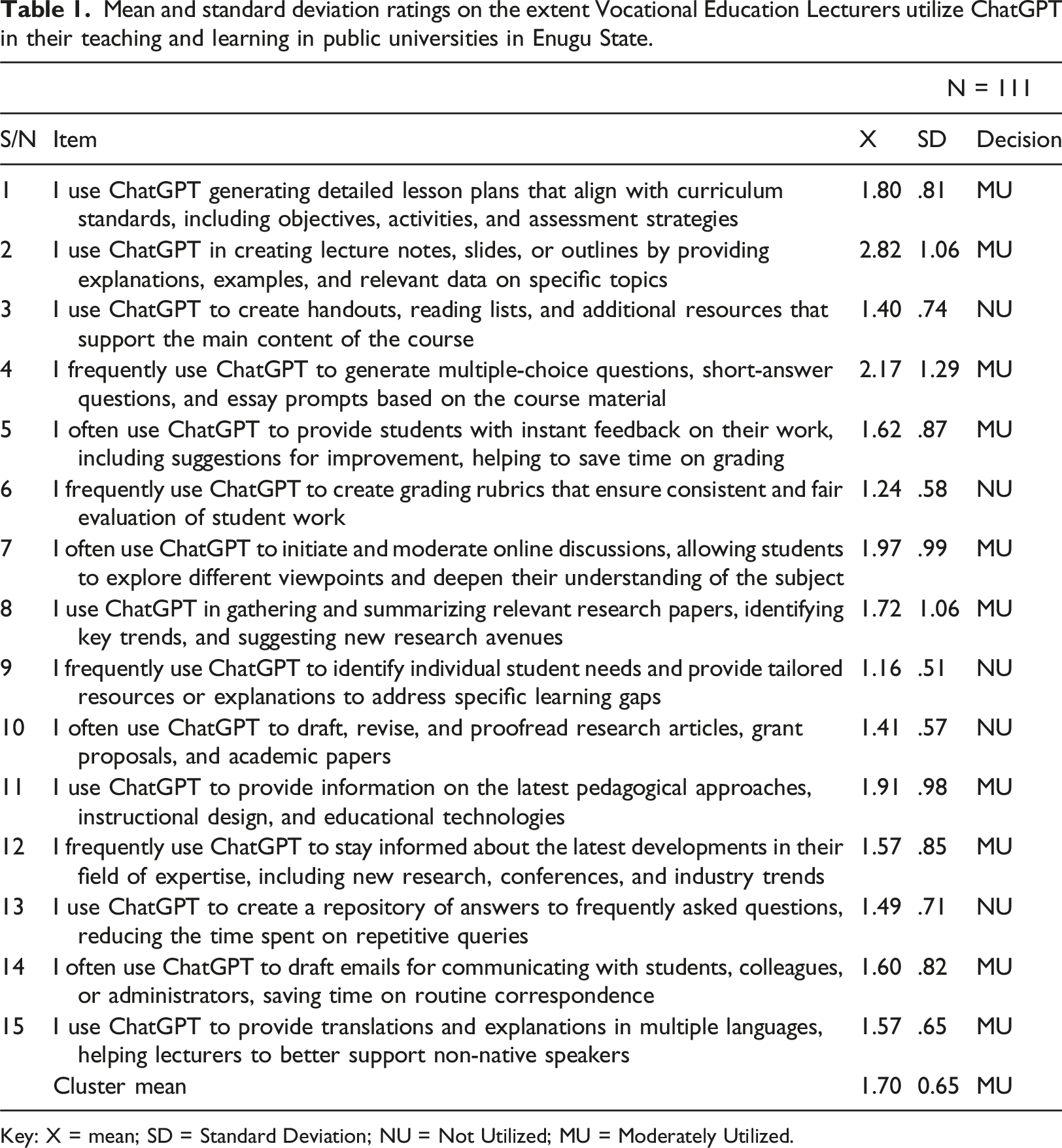
Key: X = mean; SD = Standard Deviation; NU = Not Utilized; MU = Moderately Utilized.
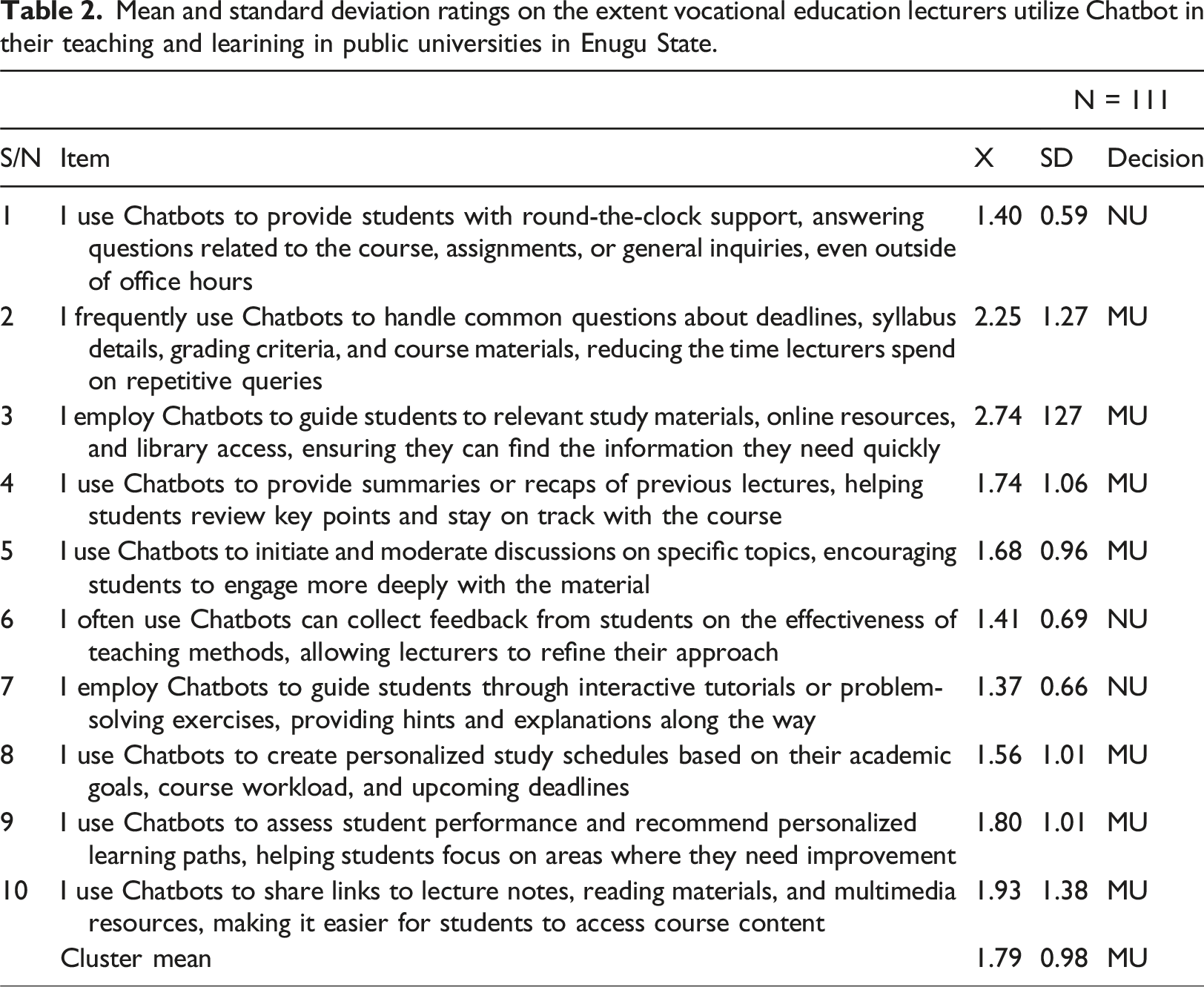
Mean and standard deviation ratings on the extent vocational education lecturers utilize Chatbot in their teaching and learining in public universities in Enugu State.
t test analysis of the mean responses of male and female Vocational Education Lecturers on the extent of utilization of ChatGPT in their teaching and learning in public universities in Enugu State.
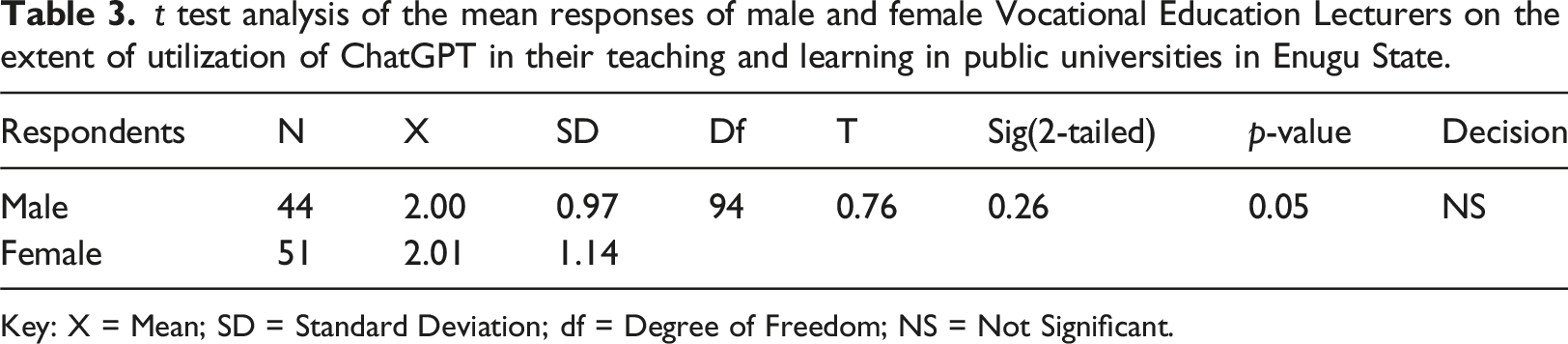
Key: X = Mean; SD = Standard Deviation; df = Degree of Freedom; NS = Not Significant.
Therefore, the null hypothesis of no significant difference in the mean ratings of the responses of male and female Vocational Education Lecturers on the extent of utilization of ChatGPT in their teaching and learning in public universities in Enugu State was not rejected.
t test analysis of the mean responses of male and female Vocational Education Lecturers on the extent of utilization of Chatbot in their teaching and learning in public universities in Enugu State.

Discussion of the findings
The data presented in Table 1 shows that five items out of 15 items have means ranging from 1.16 to 1.49 which indicate not utilized while remaining 10 items have their means ranging from 1.57 to 2.17 which indicate moderately utilized From the above results it can be discovered that most Vocational Education Lecturers moderately use ChatGPT to carry out their education functions in their teaching and learning. The findings also revealed that the Vocational Education Lecturers moderately utilize e-assessment platforms to conduct formative assessment of students learning outcomes. This can be seen from the overall mean ratings of the e-assessment platforms which is 1.79 within the boundaries of 1.50 to 2.49 indicating moderate utilization by Vocational Education Lecturers. From the test of hypothesis shown in Table 3 male Vocational Education Lecturers do not have a different opinion in the use of ChatGPT from the female Vocational Education Lecturers. It shows that the gender status of Vocational Education Lecturers do not have significant influence on the use of ChatGPT in their teaching and learning in public universities in Enugu State. Thus, the result of the finding agrees with the opinion of Johnson (2024) that Vocational Education Lecturers utilize ChatGPT in their teaching and learning to generate educational content such as lesson plans, quizzes, and interactive activities.
The findings on Table 2 revealed that most Vocational Education Lecturers use Chatbot in their teaching and learning. The result also shows that Vocational Education Lecturers moderately utilize Chatbot in their teaching and learning as seen from the overall mean ratings of the use of Chabot listed which is 1.79 within the boundaries of 1.50 to 2.49 indicating moderate utilization by Vocational Education Lecturers. From the test of hypothesis shown in Table 4 male Vocational Education Lecturers do not have a different opinion in the use of Chabot from the female Vocational Education Lecturers. It shows that the gender status of Vocational Education Lecturers do not have significant influence on the use of Chabot in their teaching and learning in public universities in Enugu State. Therefore, the null hypothesis is accepted. Additionally, this finding corresponds with Roberts (2024) viewpoint that Chabots are used to assist tutors in creating and managing educational content, such as quizzes, study materials, and lesson plans which help to generate content ideas and streamline the preparation process, enabling tutors to focus more on direct student interaction.
Conclusion
There are many educational artificial intelligence tools available to the Vocational Education Lecturers for utilization in their teaching and learning. The educational artificial intelligence include: ChatGPT and Chabot among others. In view of craving educational artificial intelligence tools, there is a need for the utilization of educational artificial intelligence tools by the Vocational education Students, as well as Vocational Education Lecturers and University Community. The use of educational artificial intelligence tools if properly maximized play major roles in helping Vocational Education Lecturers in their teaching and learning. However, Vocational Education Lecturers moderately utilize majority of the educational artificial intelligence tools and few were also not utilized in carrying out some educational functions.
Recommendations
Based on the findings of the study, the researcher made the following recommendations: 1. There should be regular orientation and re-orientation for vocational education lecturers inform of training on the use of educational artificial intelligence tool in teaching and learning. 2. Universities should invest in infrastructure and provide ongoing support to lecturers to facilitate the successful adoption of educational artificial intelligence tool for enhancing teaching and learning.
Footnotes
Acknowledgements
The authors appreciate the efforts of all the computer hardware operators, IT trainees, and Centre Managers who participated in this survey. The author also would like to appreciate the efforts of the administrative assistant, and peer reviewers for their significant contributions which further helped to improve the quality of this paper.
Author contributions
All the authors made substantial contributions to conceptualization of the study, literature review and research design. Eze, Angela Ogechi was responsible for data collection, collation and analysis, Onah, Bernadine Ifeoma performed all the editing and proofreading of the manuscript while all authors read and approved the final manuscript.
Declaration of conflicting interests
The author(s) declared no potential conflicts of interest with respect to the research, authorship, and/or publication of this article.
Funding
The author(s) received no financial support for the research, authorship, and/or publication of this article.
Ethical statement

Data availability statement
The data will be made available upon request.