




Abstract
The aim of this study was to explore innovative methods for teaching the literary works of folk poets. The research focused on the use of modern technologies to enhance the teaching of folk literature in secondary schools and higher education institutions in the Kyrgyz Republic. The study emphasized the cultural significance of teaching folk poetry, which enriches students’ cultural knowledge, instils moral values, promotes patriotism and respect for national traditions. The study proposed several innovative teaching strategies, including gamification (through role-playing and quests), integration of video and audio resources, use of social media platforms, project-based learning, and organizing meetings with folk culture and poetry experts. An example of implementing these approaches was provided using the works of Barpy Alykulov, a renowned Kyrgyz poet. Additionally, a comparison between traditional and innovative teaching methods was made, with recommendations for selecting appropriate techniques based on student age, interests, and developmental needs.
Introduction
The modern world is characterised by accelerated digitalisation and modernisation, which, on the one hand, has a positive impact on the accessibility of information, communication, and knowledge, and, on the other hand, changes the perception of the world around us, specifically the perception of culture and traditions of a given people. Digitalisation, modernisation, and globalisation can negatively affect cultural diversity, while modern ways of preserving and transmitting culture and traditions to the next generations can contribute to the loss and disappearance of folk literature, as oral ways of transmitting folklore disappear (Hong, 2023). Studying the works of folk poets in general education schools and higher education institutions can not only broaden students’ outlook. Still, it can also influence the preservation of traditions, culture, and folklore of the Kyrgyz Republic.
Imaralieva (2021) covered the role of studying folk literature in the education of schoolchildren and students, analysing the possibilities of fostering patriotism in students through studying folk literature. Turpanova (2022) also investigated approaches to teaching Kyrgyz literature. The study of folk literature is an essential part of education, both in general education schools and in higher education institutions, as it not only enriches students with knowledge, but also develops spirituality and patriotism, contributes to the passing down of folklore, culture, and traditions to the next generations. Studying folk literature can also develop students’ creativity and creative thinking, which positively influences not only the educational process but also the younger generation’s personality and physical and psychological state. The study of folk literature plays a significant role in multi-ethnic countries, including the Kyrgyz Republic. Thakur and Krishan (2023) investigated folklore in multinational states, covering the role of folk literature in multilingual countries, and Karabalayeva et al. (2024) analysed the integration of folk traditions into the educational system of the Kyrgyz Republic and the Republic of Kazakhstan.
In multinational and multilingual states, people of diverse cultures live, learn, and interact together, which demonstrates the need to preserve the folklore, culture, and traditions of all nationalities, as well as the folklore, culture, and traditions of the host country (Wang, 2023). Firstly, in conditions of multinationality, there is a high risk of losing one’s own cultural identity, and secondly, without having an idea of one’s own culture, it is difficult to learn the culture of others, and vice versa – without broadening the horizons of other cultures, it is difficult to fully learn one’s own (Shang, 2016). This demonstrates the need to investigate folk literature in educational institutions of the Kyrgyz Republic, as a multinational country in which the processes of digitalisation and modernisation are actively taking place.
However, digitalisation and modernisation also require innovative approaches to education, specifically new approaches to the study of the works of folk poets. Yusupov (2020) investigated the problem of studying folk literature in the modern world and using innovative technologies, covering the scientific and methodological foundations of teaching folk literature. Aimukhambet et al. (2023) analysed the influence of innovative technologies on the study of works of folk authors. Al-Khalil (2023) studied interactive methods in teaching literature. In the modern world, it is becoming increasingly difficult to foster patriotism and inclination to folk culture and traditions in students because of the high demands on the educational process, both from the schoolchildren themselves, who are not motivated by conventional teaching methods in the same way as before, and from the globalised society.
Modern requirements to the educational process include accessibility for all categories of students, high quality of education, its high efficiency, as well as the connection of conventional teaching methods with innovative ones, which is especially necessary when studying folk works (Maruzsenszki, 2023). The prospects of using modern teaching methods include high motivation of students to acquire new knowledge and skills, active involvement of all students in the learning process, the possibility of “immersion” in the studied literature, preservation of their own culture along with the preservation of multinational culture. Thus, Aimukhambet et al. (2023) conducted an experiment which demonstrated that students who were taught and assessed using modern technology performed better in the study of folk literature than students taught and assessed using conventional methods.
Thus, the study of folk literature is an essential part of the educational process due to its positive impact not only on students’ knowledge and skills but also on their spirituality, sense of patriotism, and cultural competencies. Furthermore, the study of the works of folk poets is important in multinational and multilingual countries such as the Kyrgyz Republic. Today’s generation of students, due to the modernisation of society and education, may lose folk literature and their cultural identity, which requires a change in approaches to teaching folk works within general and higher education institutions. In today’s world, conventional teaching methods are not as effective as they used to be; moreover, studying the works of folk poets requires the use of modern approaches to increase students’ motivation and interest in learning folklore and passing it on to subsequent generations. However, the sources analysed did not provide concrete new methods and approaches to studying folk works, nor did they provide examples of their use.
Proceeding from the above, the purpose of this study was to uncover contemporary approaches to teaching the students folk literature. The objectives of this study were to give an example of the use of the proposed approaches in the study of folk works and to provide recommendations for their effective implementation in the educational process.
Materials and methods
This study revealed approaches to teaching folk works and analysed the impact of innovative technologies on the effectiveness of this process, which helped to expand the understanding of the possibilities of studying folk literature in the modern world and to propose new teaching methods that would be effective for students and have a positive impact on the preservation of folk culture and traditions.
The first stage of the study was to analyse the current state of the educational process and analyse the situation of folk literature in the Kyrgyz Republic, to identify problems in teaching folk works in educational institutions of the Kyrgyz Republic, which helped to determine the relevance of the study, set its purpose and objectives. The second stage of the study was to analyse the term “folk literature”, as well as to determine the main principles and methods of building the educational process during the study of folk literature, and to determine the principal tasks of the literature lesson. The information obtained was used to identify the key stages of the lesson and key stages in the study of folk works and helped to outline the methods and approaches that educators use to teach students about literature. Based on this information, the role of each stage of the literature lesson and each stage of the study of folk works was determined, from which a conclusion was drawn about the approaches that can be used to improve the teaching of the works of folk poets. The next stage of the study was a detailed analysis of the proposed approaches to improving the process of teaching folk works, which helped to determine the possibilities of using each of them in the educational process, as well as their advantages and disadvantages. The proposed methods of teaching the works of folk poets were correlated, which helped to determine which would be more effective for different categories of students, specifically for secondary general education students and higher education students. A comparative analysis of the use of social media in teaching the works of folk poets was also performed. The possibilities of using social media such as Instagram, Facebook, TikTok, YouTube were correlated. The comparison was based on criteria such as potential for use in teaching, disadvantages, and advantages. The comparative analysis of social networks helped to understand how certain social networks can be used while teaching folk literature and to identify those that can be most effective in the educational process.
For a better understanding of the possibilities of using the described innovative technologies, an example of their application in teaching the works of poet Barpy Alykulov was offered and the role of his works in developing necessary knowledge, skills, and values in students was covered. This helped to understand the real possibilities of using the proposed approaches, their disadvantages and advantages, to determine which of the approaches would be more effective for secondary general education students, and which would be more effective for higher education students. The last stage of the study was to compare conventional methods of teaching the works of folk poets and innovative teaching technologies. The comparative analysis of conventional and innovative methods included the correlation of methods by stages of studying works of folk literature and was used to determine the advantages of innovative technologies in relation to conventional approaches, as well as to understand the changes that will occur in the educational process in case of introducing new approaches.
Based on analyses of tasks and stages of the lesson, stages of studying folk works, and based on the example of using innovative technologies in teaching the works of poet Barpy Alykulov and comparative analysis of conventional and innovative approaches, recommendations were given concerning the implementation of the proposed innovative technologies in the educational process. Proceeding from this information, conclusions were also drawn about the possible effectiveness of the proposed technologies in the educational process, the prospects for further research, and the possibilities of using the findings of this study.
Results
The study of folk literature is an essential part of the educational process, as it can not only broaden students’ outlook, but also strengthen their national and cultural identity, foster moral and ethical standards necessary for the development of their personality and society as a whole, form certain principles and a sense of patriotism, contribute to the preservation of folk culture and traditions, and influence modern culture and the unification of contemporary society. It is useful to consider the term “folk literature”. Thus, researchers consider folk literature as: • literary works rooted in the folk society (Zheng, 2021); • an oral form of narratives preserved from the current generation to the future (Thakur and Krishan, 2023); • works that are passed on by word of mouth and gradually become folklore (Gajjar, 2023); • literature created by collective creativity and passed on to subsequent generations within a particular community (Quy, 2024).
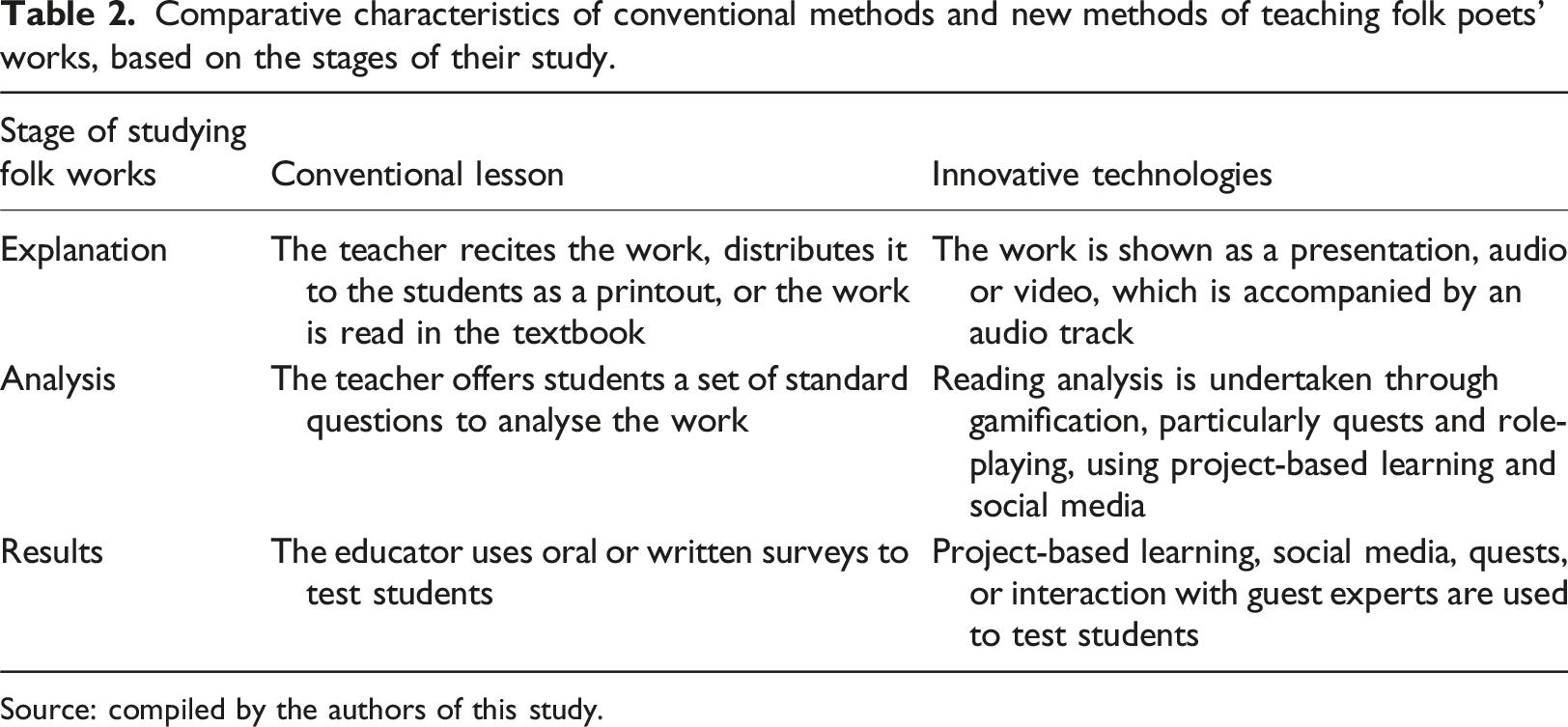
In this study, folk literature is considered as the result of folk creativity that is passed on to subsequent generations within the same culture. Studying such literature requires certain approaches and methods of impact on students but must be fulfilled through the lesson – the basic unit of the educational process. The lesson in which folk works are studied includes three stages (Figure 1). The described stages of the lesson can also be the main stages of studying folk works, thanks to which students will fully analyse the work under study and form certain knowledge and skills. At the explanation stage, the educator needs to provide students with the text that will be studied. Within the framework of conventional teaching methods, the text is most often either recited by the teacher, handed out to students as printouts, or available for reading in textbooks. This stage also includes familiarisation with the author of the text: their biography, the history of writing a given literary work, information about the realities of the time in which the writer lived, about the environment in which they were born and brought up, and which influenced their development and the formation of their works (Yusupov, 2020). This can demonstrate to students that each writer and poet is a unique personality whose work was influenced by the environment and historical events of those times, but despite this, their work has survived to the present time and should also be preserved and passed on to the next generation. Stages of a lesson on folk literature. Source: compiled by the authors of this study.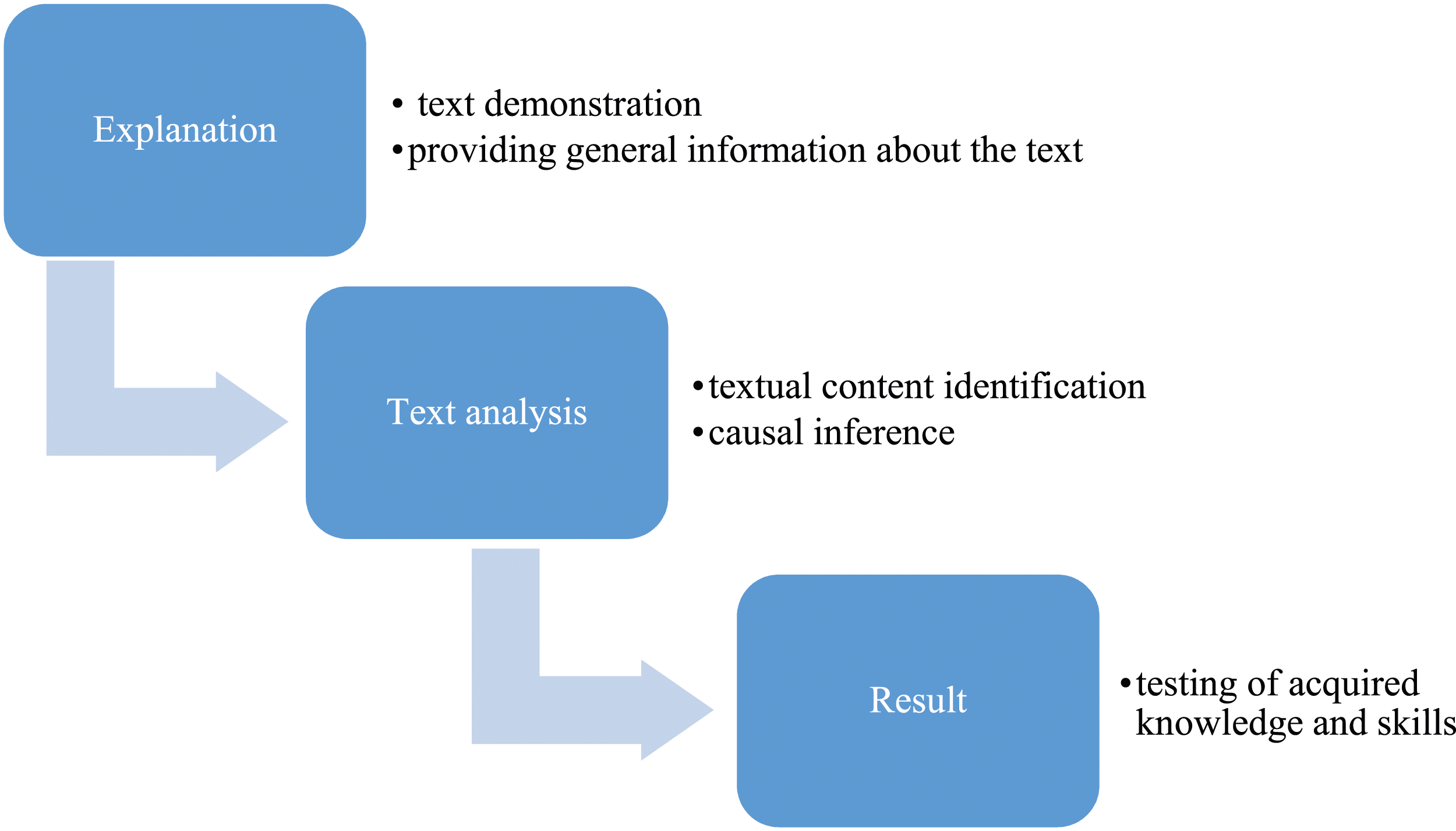
Next, after providing general information, the students analyse the text. Conventionally, to analyse a text, students ask themselves certain questions aimed at a deeper understanding of the work, namely: “What is this work about?”, “What is its main idea and purpose?”, “What mood did the author want to convey with their work?”, “What is the exposition, plot, climax, and denouement of the work?”, “What artistic techniques did the author use?”, “What feelings did this text evoke?”. At the end, the students need to demonstrate a certain result and the teacher needs to check the knowledge and skills acquired during the lesson. Conventionally, an educator may use oral or written questioning for this purpose. It is important to realise that, depending on the work, its complexity, size, and the needs of the students, these stages can take one lesson or be divided into several lessons within the study of one work and correlate with the objectives of the study of literature. The tasks of studying literature can be mental-communicative, axiological, educational-behavioural, entertaining-hedonistic, cognitive-gnoseological (Yusupov, 2020): (1) Mental-communicative tasks include developing students’ thinking and communication skills. To complete this task, students are encouraged to thoroughly analyse the texts they have read (to develop critical, logical, and problematic thinking, memory, and attention) and discuss them further (e.g., with a teacher or other students). (2) Axiological tasks include spiritual development and the development of values and principles. To complete these tasks, students are asked to determine what the moral of the work is, what the author wanted to convey with this work and what views the readers should form. (3) Learning-behavioural objectives include the development of skills and the formation of certain patterns of behaviour. To complete this task, students are asked to analyse the events taking place in the text, to analyse the characters, their actions, and the results of these actions with further reflection on this: what are the consequences of the characters’ actions, how could these consequences have been avoided or improved. (4) Entertaining and hedonistic tasks include gaining positive emotions from reading the work. To complete this task, students may be offered creative projects on certain works, field trips, and guided tours to places mentioned in the works or to the places of birth and establishment of their authors. (5) Cognitive and gnoseological tasks include broadening the mind through literature. To complete this task, students may be offered a variety of works in terms of genre, meaning, and construction.
As a result of studying folk literature, students are positively influenced: knowledge and skills are developed, a sense of beauty, moral and ethical standards are developed, patriotism is fostered, and interest in the literature, history, culture, and traditions of their country is increased. However, the conventional methods used during the lesson stages and phases of folk studies may not be relevant to the modern generation and may not motivate students to learn.
Based on the stages of studying literary works, tasks and results to be achieved within them, new technologies in teaching works of folk poets were proposed, namely: gamification, use of multimedia, project-based learning, use of social networks, organisation of meetings with experts in the field of folk literature. It is useful to consider each of the suggested teaching methods in greater detail. Gamification is understood by researchers as the process of transforming educational methods and approaches into a game (Mahadi, 2023). Using game functions in non-game environments to increase engagement in the educational process (Appiah et al., 2024). The purpose of gamification is to add components to the learning process usually found in games: a competitive component, a rewarding component, and a role-playing component. Thus, the competitive component includes elements of competition when teaching works of folk poets: who will read and analyse the text faster, who will find more artistic techniques used by the author in a given work, who will be the first to determine the plot, climax, and denouement of the work. In turn, the incentive component includes a system of rewards. Students can receive bonuses for quick completion of tasks and superiority, which can be exchanged for something at the end of the lesson/semester. It can be books, theatre or cinema tickets, and passes to events such as training, seminars, and meetings with experts. The competitive incentive component in the educational process can motivate students to study folk poets’ works and gain general knowledge.
Gamification can also include role-playing games and quests. During role-playing, students are given specific roles as characters from the works they are studying. The purpose of role-playing is to portray the essence of a work in a small skit or a full performance, using phrases from the work, preserving and conveying its atmosphere, mood, and meaning. Role-playing games can not only help students to gain a better understanding of the work being studied, the feelings and meanings the author wanted to convey, but will also contribute to the development of creative thinking, creativity, communication skills, and the ability to work in a team. Another method of gamification can be quests, which can be conducted both in a classroom setting and in an online format. The quests require students to complete tasks related to the works studied to achieve a certain goal: e.g., collecting all the fragments of a picture or a phrase. In quests, students can perform the same tasks as in conventional lessons: reading works, analysing them using certain questions. However, the need for a correct understanding of what is read and its correct analysis to achieve the goal of the quest, will contribute to a more in-depth study of the studied work, increase attention to detail, which can affect not only memorisation, but also a more accurate understanding of the meaning of the work, which is important for the formation of spiritual, moral, and patriotic values. An interesting and effective method of teaching the works of folk poets can be the use of multimedia materials during the lesson: video, audio, and presentations. Their use can enhance the effectiveness of the educational process and broaden students’ understanding of folk literature (Mu, 2021).
Videos can be aimed at acquiring knowledge and the moral and aesthetic pleasure of learning folk art. Thus, videos aimed at acquiring knowledge may contain information about the author’s biography, the formation of their work, and be accompanied by photographs of the author, photographs of places where they were born, studied, and created, accompanied by an audio track with the work being studied. Videos that aim to provide moral and aesthetic pleasure may include scenery accompanied by an audio track of the piece being studied. For the same purpose, it is also advisable to use audio materials, which include sounding out the works being studied against a background of soothing music. When using audio and video materials, it is advisable, if available, to include in the video fragments with the author of the studied works, and as audio to use their voice and their own recitation of their works.
Presentations can be used in two ways: as a teaching method and as a method of consolidating and testing knowledge. As a teaching method, presentations can be used by the teacher at the first stage of the lesson: explaining the material being learnt. Presentations may include: information about the author and their works, the work itself, a dissection of the work, critics’ reviews of the work, and video and audio clips. Such an approach to presenting information can increase students’ motivation to the educational process, interest them and contribute to studying folk literature. As a method of consolidating and testing knowledge, students may be asked to present an analysis of the studied work in the form of a presentation, which can broaden students’ outlook, promote better learning, and develop creativity. In this aspect, project-based learning may be more effective, enabling students to participate actively in the educational process, gaining theoretical knowledge and improving practical skills (Huang, 2023). This approach aims to create projects in which students independently research folk literature, analyse and systematise the information obtained and demonstrate it through videos, presentations, booklets and posters, and interviews. Project work can be either individual or group work.
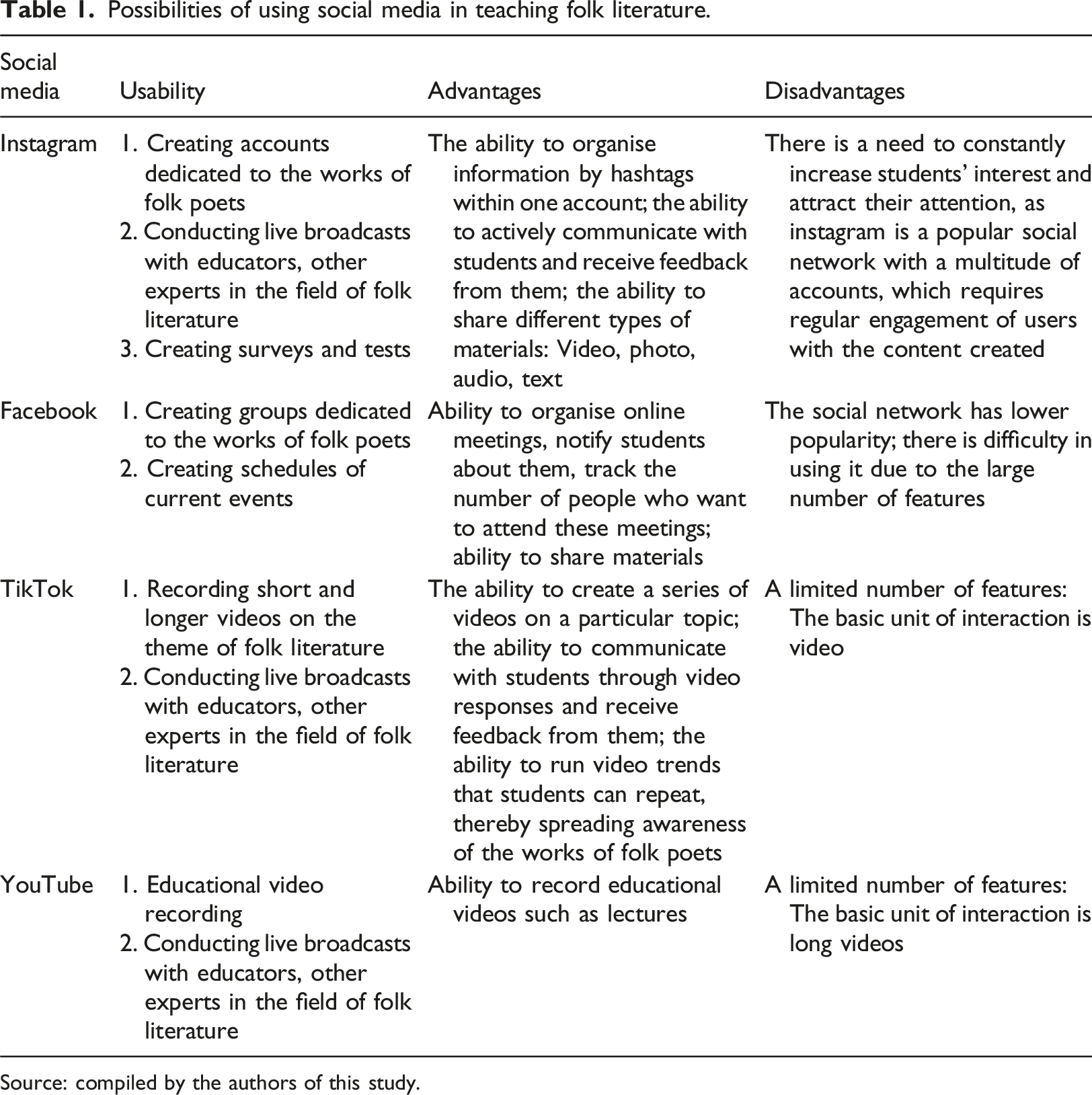
Possibilities of using social media in teaching folk literature.
Source: compiled by the authors of this study.
Thus, the most effective social media in teaching the works of folk poets can be Instagram and Facebook, as these social networks are characterised by a multitude of features and opportunities to disseminate information and interact with students. On social networks like TikTok and YouTube, videos are the main unit of interaction, and the use of other features is limited. The use of social networks in teaching can improve the effectiveness of the educational process, motivate students to study folk literature, preserve their culture and pass it on to the next generations, as a large number of modern youth are active users of the Internet.
To obtain additional information about folk literature, to understand its role in preserving culture, education of moral and ethical standards and patriotism, it is advisable to organise meetings with experts in the field: folklorists, musicians, writers, and poets in teaching the works of folk poets. Within the framework of these meetings, such topics may be raised as “What is folk literature?”, “The role of folk literature in the functioning of society”, “Possibilities of saving folk literature”. Together with experts, the teacher and students can discover the life path and formation of folk poets, study their work and discuss these topics. For a more detailed understanding of the possibilities of using the proposed technologies in teaching the works of folk poets, this study provided an example of their application in the study of the poetry of Barpy Alykulov, one of the outstanding poets of the Kyrgyz people.
The poetry of Barpy Alykulov is a source of moral, ethical, and aesthetic education for students, a way of activating mental development and the formation of patriotism (Karaeva and Zhaylobaeva, 2021). In his poetry, Barpy Alykulov describes not only his life, his thoughts, but also the life of the people at the time of his creative endeavours, the difficulties the people faced and how they coped with them, keeping optimism, faith in the future, and adhering to moral and ethical standards. In his works, Barpy Alykulov describes different people: good and bad, optimists and pessimists, those who believed in the future and those who despaired, good and fair people, and evil people who committed bad deeds. Such diversity of positive and negative characters, great variability of their characters and actions, can help students to understand themselves and the world around them, to find their own guiding stars, to form their own values, to understand the role of patriotism and moral and ethical norms in life and, as a result, to understand the role of folk literature in the existence and further development of their country, its culture and traditions, and their transmission to the next generations (Barpy Alykulov – Biography, 2016).
It is important to understand that most of Barpy Alykulov’s works have a profound philosophical meaning, requiring the selection of works to be studied separately for schoolchildren and university students. Some of the works may be difficult for perception by schoolchildren, while some of the works may be too simple for perception by university students, which will obstruct fully appreciating folk literature, understanding its essence and meaning. Thus, one of the works of Barpy Alykulov that can be offered to secondary general education students may be a song where he addressed the people, talking about his life, the life of his country, and the difficulties they face (Barpy Alykulov – Biography, 2016): “Ук, калайык, зарымды, Түшүнтөйүн алымды. Күйгөнүмдөн ыр кошуп, Аттанып чыктым жыйынга. Болуштар бийди кемсинтип, Салып жүрөт кыйынга. Эсен жүрүп жетилсем, Ырдармын билип сонунду, Тааныймын шондо жолумду.”
Instead of reciting this poem by a teacher, reading it in a textbook or on a paper printout, it is suggested to demonstrate this work in the form of a video, in which to add photos of the settlement in Maka-Torpok, where Barpy Alykulov first sings his songs. To analyse this work and test students’ understanding of it, instead of standard questions, it is advisable to use gamification, namely quests. The purpose of the quest can be to find all parts of Barpy Alykulov’s portrait and put them together, or to collect parts of quotes from Barpy Alykulov’s poetry and also put them together. The quest questions to be answered to get parts of the photo and/or quote can be as follows: “Whom does Barpy Alykulov address in his work?”, “What is the main meaning and the main essence of the work?”, “What tropes, metaphors does Barpy Alykulov use in his work?”, “What is the mood of this work?”, “What impressions do you have from this work?”, “What conclusions have you made about Barpy Alykulov’s work and what have you realised for yourself?”.
Another poem by Barpy Alykulov that can be offered to schoolchildren is the poem about the sun, in which the poet tells that the sun is always there, was and will be, and that the life of all living things on the planet depends on the sun (Barpy Alykulov – Biography, 2016): “Миң-миңдеген кылымга, Айта келсек, чынында, Жалгыз өзүң күбөсүң. Замандар өттү, сен калдың, Өлбөстүккө ашкере Түркүксүңбү бир өзүң?”
For a better understanding of this work, it is suggested to demonstrate it in the form of an audio track with soothing music, which will lead students to philosophical thoughts about the sun, its role in the existence of the planet and all life. To consolidate the acquired knowledge, it is advisable to offer pupils to act out a short skit based on the given work, to reflect its essence with the use of phrases, preserving and conveying its atmosphere, mood, and meaning.
As for teaching the works of folk poets to students, it is reasonable to offer the poems “Ынтымак” and “Бурак жан” (Karaeva and Zhaylobaeva, 2021). The work “Ынтымак” has a profound philosophical meaning, which is that only inner harmony can bring real happiness to a person, and the main meaning of the people is their unity and achievement of common goals: “Ынтымагы бар элдин Калага карды ток болот. Ынтымагы жок элдин Бирине-бири октолот. Ынтымагы бар элдин Адил болот улугу. Ынтымагы жок элдин, Ичинен чыгат бузугу. Ынтымактуу эл болсо, Душманга тиер ок болот. Ынтымаксыз эл болсо, Дыркырап качып жок болот. Ынтымактуу биригет, Ынтымаксыз бөлүнөт. Ынтымак элдин баркы бар, Бир-бирине баркы бар.”
The poem “Бурак жан”, in turn, epitomises the love for a woman, her youth and carefree nature. It is also filled with a lot of artistic devices, particularly mixed anaphors: “Топурак-Бел, Шыбак-Бел. Каттап жүрөм, Бурак жан. Калың элге жарыя Мактап жүрөм, Бурак жан. Белек алдым бир сизге, Сактап жүрөм, Бурак жан.”
Both poems have a profound meaning that school children may not understand due to their age, however for higher education students such poems are more accessible to understand, can develop their thinking, form the necessary values, and improve their understanding of themselves and the world around them.
To achieve these goals, students may be offered project-based learning in which they can understand these works in greater detail. Through project-based learning, students can develop an understanding of how Barpy Alykulov’s life and the events he encountered influenced his development as a poet and are reflected in his works. Specifically, during project-based learning, students can interview folklorists and hear their opinions on Barpy Alykulov’s works (for instance, the very same “Ынтымак” and “Бурак жан”), systematise the information obtained and present it in the form of a presentation or video, posters to be hung in the classroom or booklets to be distributed to other students. For a more detailed understanding of these works, it is advisable to organise meetings with experts in the field of folk folklore during the educational process. At these meetings students will be able to discuss the proposed works with folklorists, musicians, writers, and poets, enter into a discussion on the meaning and main ideas of Barpy Alykulov’s works. Furthermore, students are, more often than not, more confident and active users of the Internet and social media, which allows using them in teaching the poetry of Barpy Alykulov.
Comparative characteristics of conventional methods and new methods of teaching folk poets’ works, based on the stages of their study.
Source: compiled by the authors of this study.
However, it is important to realise that innovative technologies used to teach the works of folk poets must be selected for each group of students separately or even for each individual student. Proceeding from this, recommendations are made regarding the introduction of new technologies in teaching the works of folk poets. The methods of teaching the works of folk poets should be selected based on the age group of students, their interests, and the zone of immediate development.
Thus, for students at secondary general schools, due to the specific features of their cognitive development, the most suitable teaching method will be gamification of the educational process: quizzes, quests, role-playing games. Gamification can also be used in student learning, but it should be selected in such a way as to match the interests of students and their zone of proximal development. Thus, quests should be made more challenging, and role-playing games should be presented not just as skits, but, for example, as entire performances shown to a large audience. For the same reasons, project-based learning is a more suitable method for students because it requires established research skills that may not always be developed at a sufficient level in students. Social media can be used equally for both teaching school children and teaching students. However, it is important to recognise that some schoolchildren do not have access to social media or do not use it regularly, necessitating the use of additional teaching methods. Organising meetings with experts can also be used for both schoolchildren and university students. However, approaches to these meetings may differ for different age categories of students: expert meetings with schoolchildren may be more educational in nature and aimed at building knowledge about folk culture, traditions, and literature. Students may be more aware of the culture, traditions, and literature of their own country due to their age and higher educational level, and therefore their meetings with experts can be organised in the form of discussions or debates. Thus, all the proposed technologies can be used in teaching folk works both for schoolchildren and university students, the specifics of their use, forms, and orientation can change.
The study of the works of folk poets is important not only for the development of students’ knowledge, but also for their cultural identity, values, moral and ethical views, patriotism, and for the passing down of the culture, traditions, and folk art of the Kyrgyz Republic to the next generations. The study of works of folk literature consists of three stages: explanation, analysis, and result, at each of which the teacher uses certain methods and approaches to achieve the objectives of the study of literature. The study found that the available conventional methods of teaching the works of folk poets are irrelevant in the modern world, which requires the development of novel approaches. The following innovative technologies for teaching the works of folk poets were proposed: gamification, use of multimedia materials, use of social networks, project-based learning, organisation of meetings with experts in the field of folk culture. All the suggested methods can be used for teaching folk literature to both schoolchildren and university students. To enhance the effectiveness of the new methods, it was suggested to use them based on the age group and needs of the students. Thus, quests and role-playing games may be more suitable for schoolchildren, while project-based learning and meetings with experts – for university students. However, it is important to consider students’ interests: in case a group of students is more interested in putting on performances based on the studied works of folk poets than in carrying out project-based learning, this should be considered to increase the effectiveness of the educational process and achieve its goals.
Discussion
This study found that schoolchildren and students’ study of folk literature is a significant part of their general development, formation of necessary values, moral and ethical norms and patriotism. Furthermore, studying the works of folk poets shapes students’ understanding of the need to preserve their country’s culture and pass it on to the next generation. This makes teaching the works of folk poets an essential part of the educational process, although the approaches to it are outdated, which requires updating the methods of studying folk literature by schoolchildren and university students.
Rajapaksh and Nandasiri (2023) covered the role of teaching folk literature in the modern world and studied the necessity of folk literature in modern education. Elbay (2022) compared educational programmes for learning folk culture. The experts concluded that folk works are a prominent part of culture, national and historical heritage, which correlates with the findings of the present study. The study of folk literature can form moral and ethical standards in students, patriotism, which is important for the development of society and the state as a whole, while the study of folklore is an essential part of its preservation for future generations. This study determines that the study of folk literature is important for multilingual and multinational countries, which includes the Kyrgyz Republic. Xu (2023) reached analogous conclusions, covering problems in teaching folk songs. The researcher concluded that the study of folk works is a method of building intercultural competence, cultural exchange, and a method of building relationships between representatives of different nationalities who may live within the borders of one country, which correlates with the results of the present study. This demonstrates the need for schoolchildren and university students to study folk literature, specifically the works of folk poets, as they are a source of moral and ethical values, patriotic views, and the basis for building relationships between countries and representatives of other cultures. The present study found that conventional methods of teaching folk literature are ineffective, while the teacher’s task is to select such methods of teaching folk works that will stimulate students to study them, making this process interesting and easy.
The need for change in the process of teaching literature is also observed in the studies of Song (2024) who investigated the characteristics of teaching English and American literature, Albatool and Moneus (2023) who studied the interactive strategies of teaching literature, Luo and Onlamul (2024) who developed a programme for teaching folk works to schoolchildren and university students, Hou (2024) who studied the integration of folk culture in modern information teaching. The researchers noted that teaching literature is one of the most challenging tasks, since many students have difficulties in understanding the works they read, particularly in understanding their meaning and terminology, which may be outdated in folk works and virtually unused in modern works. The experts concluded that for a better understanding and absorption of literary works, it is necessary to include new strategies in the educational process that will motivate students. At this stage in the educational process, there is a gap between theory and practice. Students may receive theoretical knowledge of folk works, but not fully understand their essence, role, and significance, which confirms the need to develop novel approaches to teaching folk works.
However, the analysed studies focus on the fact that conventional methods of teaching folk works should not be completely excluded from the educational process, they should be integrated into new educational standards, within the framework of which new methods and approaches are supposed to be used. Thus, the findings of the analysed studies confirm the need for changes in approaches to the study of folk works and the use of modern technologies in the teaching process. The main problem in conventional teaching methods may be students’ low motivation to the learning process, the gap between theory and practice, the complexity of folk literature, and the terminology used within it (Rasulova, 2022). This study proposed the following approaches and innovative technologies to teaching folk works: gamification of the educational process, use of multimedia materials, social networks, project-based learning, and organisation of meetings with experts in the field of folklore. Chiluisa et al. (2024) studied gamification of the educational process and analysed the possibilities of preparing teachers for gamification in teaching literature. Mahadi (2023) investigated the possibilities of gamification as a new teaching method. Buda and Pesti (2024) covered the training of teachers to use gamification in the teaching process.
Researchers identify such advantages of gamification as active engagement of students in the educational process, less pronounced influence of failures on motivation to learn (since a game always offers an opportunity to try again), improvement of the atmosphere during the lesson, the ability to track the progress of learning, improvement of the initiative of students, which confirms its high effectiveness in teaching works of folk poets. According to experts, gamification’s disadvantages may be certain difficulties that a teacher may encounter, namely the selection of game methods and the specifics of their use. Gamification is a method that makes the study of folk literature more interesting for students, however, the introduction of game elements in teaching requires better training of educators as they may face certain difficulties in this process, which has not been sufficiently covered in the present study and requires further consideration. Furthermore, it is important to analyse the results of using gamification in the educational process and to use it in such a way that students really get the necessary knowledge and skills, because in introducing game elements, the educational process can turn into a competition for superiority, while the learning part becomes secondary.
In terms of the use of media materials, Mu (2021) studied their role in the educational process, covering the models of multimedia teaching of literature, while Li (2024a, 2024b) investigated the enhancement of students’ cultural sensitivity through innovative teaching methods. The experts concluded that multimedia technologies can help to place students in the atmosphere of folk art, to feel the culture and traditions of the times when folk works were created, which was also noted in the present study. Experts also point out the role of virtual reality in teaching folk works, which has not been covered in the present study. Virtual reality can immerse students in the atmosphere of a work, demonstrate its cultural significance and historical value, while increasing their interest in learning. The use of multimedia in the teaching of literature will help to create a learning environment where students will be more motivated to learn, will be able to gain lasting knowledge and develop comprehensively. However, Salehi and Salehi (2012), upon studying the problems of using information and communication technology in the educational process, concluded that the use of computer technology and multimedia has some difficulties, such as overabundance of information, lack of necessary skills to use multimedia, and their inappropriate use, which was not analysed in the present study. Thus, the use of multimedia is an essential part of the modern educational process. However, the same problems can be traced in their use as in gamification: unpreparedness of teachers to use them, which was not analysed in this study.
Another method of teaching the works of folk poets that was proposed in this study is the use of social media, which was investigated by Xiao et al. (2024), who studied the characteristics of digital dissemination of cultural heritage using folk literature as an example. The researchers concluded that social media in today’s world, where digitalisation and modernisation processes are actively taking place, is an effective method of teaching folk literature. The experts noted that through social media, folk works can be disseminated, discussions can be held, and it can be used as a way to revitalise and preserve culture, which correlates with the findings of the present study. However, it is important to take the same approach in the use of social media as in gamification: its use should not be the main method of learning, as the educational process can turn into a game, while the acquisition of knowledge and skills becomes a secondary task for students. Thus, the advantages of using the proposed methods of teaching folk literature are facilitating teaching, increasing the accessibility of the material, the possibility of making the educational process more interesting and diverse for students, which is confirmed by the findings of Turku (2024), who covered the teaching and learning of literature using innovative technologies. The disadvantages of the proposed methods may include the difficulties encountered by teachers during their implementation, teachers’ adherence to conventional teaching methods, and problems in students’ perception of innovative methods. Rosero et al. (2024) reached analogous conclusions in their study of interactive games in language and literature teaching, which confirms the findings obtained and demonstrates the need for further investigation of the preparation of teachers and students for the modernisation of the educational process.
Thus, the study of folk literature works affects students’ personalities and the state’s development. Folk works are a vital part of culture, national and historical heritage, which requires their preservation for the next generations. Furthermore, the study of folk works helps students from other countries to better understand the culture of the host country, which improves intercultural competences, cultural exchange, and cross-national interaction. The study of folk literature can be challenging for students because folk works have profound meanings that respond to the realities of the times in which they were created, which may not be fully understood by students. Furthermore, folk works may contain outdated terminology that may not be used in the 21st century and may not be understood by students. In addition, today’s youth are not motivated by conventional educational approaches, which requires updating the methods of teaching folk works. Researchers note the high efficiency of the proposed innovative teaching technologies in the educational process, but at the same time, such problems as difficulties in selecting modern technologies, difficulties in their use and application for educational purposes, and adherence of some teachers solely to conventional teaching methods were noted. This requires better preparation of teachers and students to introduce innovative technologies in the educational process to achieve its goals, preserve and transmit the folk culture of the Kyrgyz Republic to the next generations.
Conclusions
This study identified innovative approaches to studying folk literature in general education and higher education institutions of the Kyrgyz Republic. It was found that folk literature is the result of folk creativity, which is passed on to subsequent generations within the same culture. The study of folk literature contributes to the development of students’ knowledge, cultural competences, promotes spiritual development and patriotism, influences the formation of moral and ethical values, and affects the preservation and transmission of folklore to the next generations. However, for today’s high school and college students, using conventional methods of teaching literature may not be enough. The study of folk works is a complicated process because of the need to determine the meaning that the authors put into them, because of the large number of artistic techniques, and because of the use of outdated terminology in the works of folk poets that is not used in modern literature. This requires the identification of novel approaches to teaching the works of folk poets.
In the modern world it is important to use innovative approaches in the educational process, as new technologies can increase motivation to study folk literature, improve its memorisation, develop a personal opinion about it and the desire to learn further and develop the culture of their country. Such innovative methods as gamification, which includes role-playing games, quizzes, and quests; use of multimedia materials (audio, video, presentations); use of social networks (creation of pages, groups, conversations to discuss folk literature and its popularisation), project-based learning (creation of group or individual projects on the works of folk poets with their further demonstration) and project-based learning (creation of group or individual projects on the works of folk poets with their further demonstration) are proposed for studying the works of folk poets in general education schools and higher education institutions of the Kyrgyz Republic. An example of using the proposed methods in teaching the works of poet Barpy Alykulov is given, which helped to understand the real possibilities of using innovative technologies in the educational process.
To improve the effectiveness of the proposed methods in teaching the works of folk poets, the following recommendations were given: selection of methods based on the age group of students, their interests, and the zone of immediate development. Thus, gamification and the use of multimedia materials would be most suitable for secondary school students, while project-based learning and attendance at meetings with experts in the field of popular culture may be more effective for higher education students. Problems in the use of innovative technologies can include the unpreparedness of teachers and educators to use modern technologies in the educational process, difficulties in the selection of teaching methods for different categories of students, and adherence of teachers to conventional teaching methods, which requires additional training of teaching staff to modernise the educational process.
The limitations of the present study may include the lack of experimental verification of the effectiveness of the proposed methods, as well as the lack of detailed analysis of the problems that may arise in using the proposed innovative technologies, which could improve the findings of the study, provide more concrete and broader recommendations for their implementation in the educational process. The prospect of further research may also be the provision of methods for training teachers to modernise the educational process, specifically, to modernise approaches to teaching the works of folk poets.
Footnotes
Declaration of Conflicting Interests
The author(s) declared no potential conflicts of interest with respect to the research, authorship, and/or publication of this article.
Funding
The author(s) received no financial support for the research, authorship, and/or publication of this article.
