




Abstract
The development of sustainable early childhood education advocates for the holistic development of all children, including children with autism spectrum disorder (ASD). As an important indicator of children’s social development, peer relationships between children with and without ASD in inclusive kindergarten have not gained much attention. Adopting peer nomination, semi-structured interviews, and participant observations, this study described peer relationships between the two types of children in a Chinese inclusive kindergarten and explored its influential factors. Fourteen children with ASD, 12 children without ASD, 4 teachers, the principal of the kindergarten, and 4 parents of children with ASD participated in this study. The results indicated three types of peer relationships: rejected, neglected, and average. ASD children’s emotional and behavioral challenges, their limited social interaction skills, and teachers’ positive feedback on children with ASD were the major reasons for being labeled the above three types respectively. Furthermore, three protective factors (the rule of child pairing in the kindergarten, innovative curriculum and instructional design, and assistance from parents of ASD children) and three hindering factors (hierarchical roles of the children, the dominance of the medical model, and lack of professional knowledge and skills) of children’s peer relationships were identified. Implications and limitations are discussed.
Introduction
Providing an equitable and high-quality education for children with disabilities is a crucial component of the sustainable development of early childhood education. Over the past two decades, the number of children with disabilities has increased dramatically (Liang et al., 2020). Especially, the increase in the number of children with autism spectrum disorder (ASD) has drawn widespread attention. For example, about 1 in 110 children was identified with ASD in the United States in 2006; however, the prevalence was 1 in 44 in 2018 (Centres for Disease Control and Prevention, 2022). In China, there were more than 2 million children with ASD aged between 0 and 14, and more than 160,000 new children with ASD are added each year (Wucailu Autism Research Institute, 2017). ASD is a neurodevelopmental disorder, characterized by different degrees of impairment and deviance in the development of social communication, cognition and emotions, and presence of restricted, repetitive patterns of behaviors and interests as well as sensory processing problems (American Psychiatric Association, 2013). A great number of studies showed that raising and educating children with ASD brought about huge challenges for parents, teachers, and rehabilitation practitioners (Lindsay et al., 2013; Kinnear et al., 2016; Wang et al., 2022). Thus, enhancing the quality of service and education for children with ASD is an urgent task for the sustainable development of early childhood education.
Traditionally, children with disabilities (including those with ASD) were placed in segregated education environments, such as special education schools. Since the 1990s when inclusive education has become a global reform aiming at respecting diverse learners and promoting the equality of educational opportunities (Dalkilic and Vadeboncœur, 2016; Fabela-Cárdenas and Robles-Treviño, 2012), a variety of placement models (e.g., isolated rehabilitation institutions, partial inclusion, and full inclusion) were provided for children with disabilities (Deng and Zhu, 2007). For example, in addition to being educated fully in isolated education environments, children with ASD in China have three major ways of accessing regular early childhood settings. First, special education classes were set up in some regular kindergartens where children with ASD could fully integrate, partially integrate, or intermittently integrate into regular classes. Second, some rehabilitation institutions collaborate with regular kindergartens to receive children with ASD into half a day of rehabilitation training programs in institutions and half a day of education programs in regular kindergartens. Third, as an emerging but challenging practice to be explored in China, some regular kindergartens receive full-time children with ASD and place them in the same classrooms together with children without disabilities—such regular kindergartens are also termed inclusive kindergartens (Hu et al., 2016). However, there has long been a debate on the effectiveness of different placements for children with ASD (Ravet, 2011). For instance, some studies indicated that inclusive education contexts provided an ideal context for promoting the development of children with ASD by regarding children without disabilities as behavior modeling (Banda et al., 2010; Owen-DeSchryver et al., 2008), while others suggested that special education schools/institutions can provide professional interventions and specialized facilities to facilitate ASD children’s development (Rogers and Vismara, 2008; Zachor and Itzchak, 2010). Framed on the larger issue of the effectiveness of ASD children’s placement, the present study specifically focused on the effectiveness of placement in inclusive kindergartens toward supporting the social development of children with ASD.
Facilitating ASD children’s social development is one of the major objectives of providing inclusive early childhood education. Peer relationship is a key indicator of ASD children’s social development, and it has been intensively studied in Western inclusive educational settings in the past decades (Locke et al., 2010; Matthews et al., 2020; Orsmond et al., 2004; Rotheram-Fuller et al., 2010). However, Chinese ASD children’s peer relationships in inclusive educational settings remain unclear. Thus, this study aimed to explore peer relationships between children with and without ASD in a Chinese inclusive kindergarten. The findings contribute to understanding the effectiveness of placing children with ASD in inclusive education settings and considering practical implications on how to improve ASD children’s peer relationships.
Children’s peer relationships are usually studied at the dyadic level or group level (Gifford-Smith and Brownell, 2003). At the dyadic level, children’s peer relationships are mainly reflected in friendships, bully-victim relationships, and mutual antipathies or enemies; at the group level, children’s peer relationships focus on describing the social acceptance (e.g., rejection and popularity) of a child by the group members and the connections among children in a group network (Gifford-Smith and Brownell, 2003). Since the present study focused on ASD children’s peer relationships among a group of children without disabilities in an inclusive education setting, peer relationships in this study were defined at the group level.
Prior literature exploring peer relationships of children with ASD at the group level has yielded different results. Some reported the less effective results of peer relationships of children with ASD in inclusive education settings. For example, Rotheram-Fuller et al. (2010) found that compared to children without ASD, children with ASD in kindergartens and primary schools had fewer reciprocal relationships, and they were more likely to be isolated or peripheral within a classroom. Chamberlain et al.’s (2007) study suggested that compared to their peers without ASD, children with high-functioning autism or Asperger’s syndrome in grades 2 to 5 experienced lower acceptance, centrality, companionship, and reciprocity. Similarly, Ochs et al. (2001) and Matthews et al. (2020) found that children with ASD were less accepted in inclusive educational settings in relation to their classmates without ASD.
By contrast, some studies found positive results concerning peer relationships of children with ASD in inclusive educational settings. For instance, Kasari et al. (2011) discovered that twenty percent of high functioning children with ASD had reciprocated friendships and high social network status in inclusive classrooms. In a study by de Boer and Pijl (2016), it was found that children with ASD had more peer acceptance and less peer rejection than children with attention deficit hyperactivity disorder in inclusive secondary schools.
The different results concerning peer relationships of children with ASD in inclusive schools motivated researchers to further understand their influencing factors. On the one hand, existing studies explored the influencing factors from the perspective of children’s demographic factors, such as grades, gender, and types of diagnosis. Rotheram-Fuller et al. (2010) revealed that ASD children in the early grade group had higher rates of reciprocal best friendships than those in the middle and late grade groups. Dean et al. (2014) pointed out that compared to girls with ASD, boys with ASD were more socially excluded. No difference was found in social network centrality and reciprocal friendships between children diagnosed with Asperger syndrome and those diagnosed with autism (Kasari et al., 2011).
On the other hand, previous studies also explored how other stakeholders influence peer relationships of children with ASD. Parents and teachers have been recognized as two key stakeholders in helping ASD children establish peer relationships (Chamberlain et al., 2007). Calder et al. (2013) found that the majority of teachers reinforced inclusive principles in their classes and encouraged children without ASD to involve children with ASD in their games. Parents of ASD children adopted both direct and indirect ways to enhance their children’s peer relationships. For one thing, they provided detailed instructions to their children on how to interact with other children (Calder et al., 2013; Chamberlain et al., 2007). For another, they actively seek help from professionals to discuss how to promote their children’s peer relationships and create more opportunities of peer interactions (e.g., inviting children without ASD to their homes) for their children (Calder et al., 2013; Chamberlain et al., 2007; Estes et al., 2018).
Collectively, existing studies have well examined the peer relationships of school-age children with ASD in Western inclusive educational settings by using quantitative methods. However, Chinese ASD children’s peer relationships in inclusive kindergartens have not gained much attention, and children’s voices about their peer relationships are largely overlooked. This study has two major objectives: (1) describing peer relationships between Chinese children with and without ASD by identifying their types of peer relationships and triangulating the results through understanding their views, and (2) exploring the influential factors of peer relationships between children with and without ASD.
Methods
To achieve the above objectives, a case study design was adopted in this study. Although case study is one of the most frequently used qualitative research methods, there is no consensus on its design and implementation (Yazan, 2015). Yazan (2015) compared and synthesized three prominent methodologists’ works on the case study method: Yin (2002), Merriam (1998), and Stake (1995). This study followed Merriam’s (1998) definition of a case and case study. A person, an institution, a program, a process, or a social unit could be seen as a case as long as researchers can specify the phenomenon of interest and draw its boundaries (Merriam, 1998). A case study is conceived as an intensive, holistic description, and analysis of the bounded phenomenon (Merriam, 1998). In this study, a Chinese inclusive kindergarten where both children with and without ASD were enrolled was seen as a case to allow researchers to explore peer relationships between the two groups of children. Multiple sources of data (e.g., children, parents, teachers, and the principal) and different types of data collection methods (e.g., peer nomination, semi-structured interview, and participant observation) could help researchers conduct a rich description and intensive analysis and gain a holistic understanding of children’s peer relationships.
Participants
Critical case sampling, one of the purposive sampling strategies, was adopted in this study. A private kindergarten located in Southeastern China was the selected case. This kindergarten is one of the earliest kindergartens to implement inclusive education in China. It had 300 children in 11 classes (4 junior classes, 3 middle classes, and 4 senior classes). In China, children who are 3 years old normally enter kindergarten. In this private kindergarten, Children without ASD in junior classes are aged between 3 and 4 years old; those in middle classes are aged between 4 and 6 years old; those in senior classes are aged between 5 to 7 years old. Children with ASD are usually older than their classmates due to delayed enrolment. Senior class A was selected in this study for two reasons. First, children in senior classes have higher levels of cognitive ability to participate in peer nomination and interviews. Second, there were 14 children with ASD and 14 children without ASD in classroom A, with a 1 to 1 ratio. However, two children without ASD had to drop out for personal reasons during this study. Therefore, a total of 26 children participated in this study. The demographic information of all children is shown in Table 1.
Demographic information of children in classroom A.
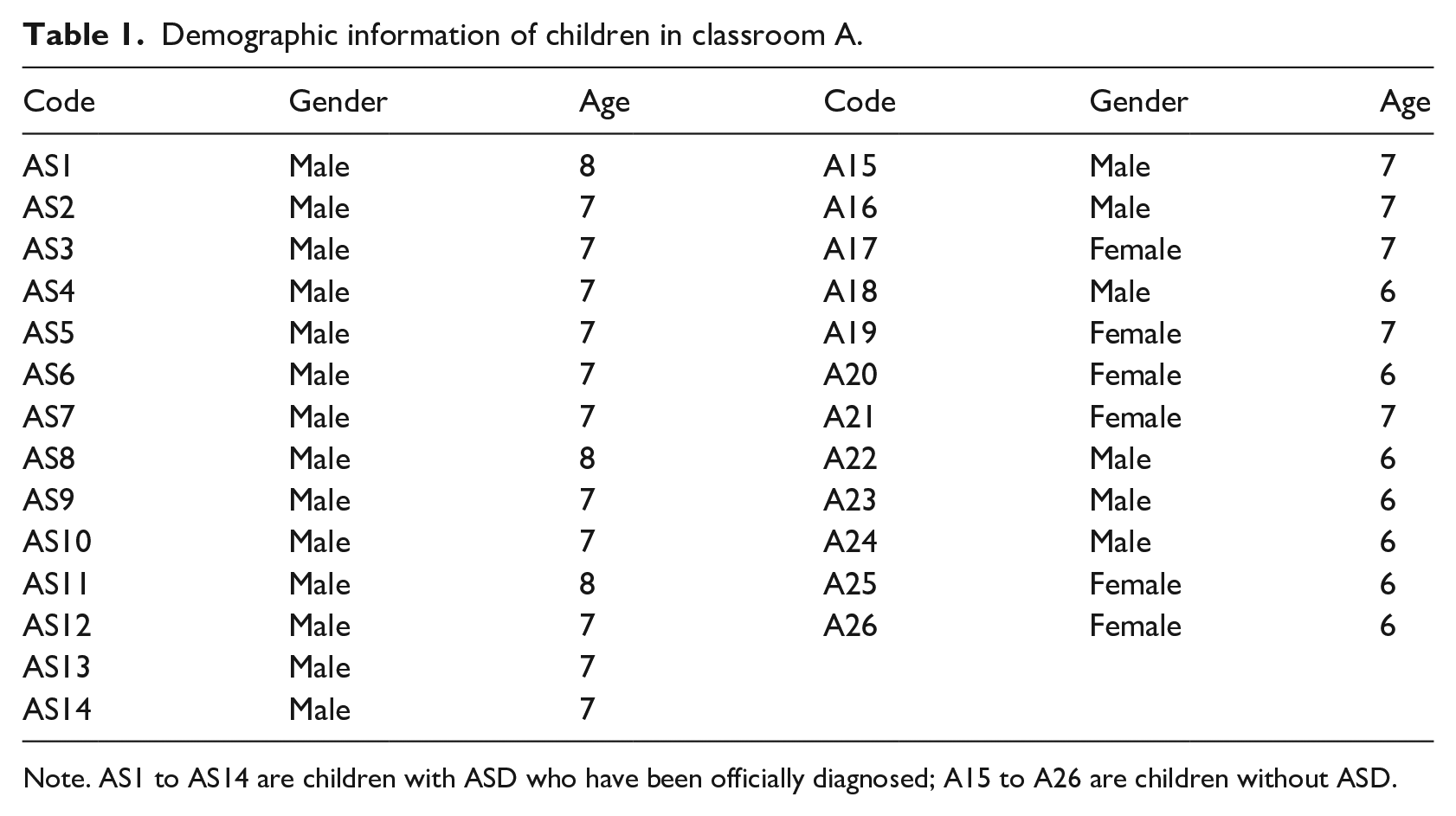
Note. AS1 to AS14 are children with ASD who have been officially diagnosed; A15 to A26 are children without ASD.
This kindergarten encourages parents of ASD children to accompany their children. In classroom A, four mothers of ASD children (i.e., AS2, AS6, AS8, AS11) who are housewives accompany their children every day. Thus, they were also invited to participate in this study. Although parents of other ASD children accompanied in kindergarten occasionally, they were not full-time accompanying parents; thus, they were not invited to take part in the study. The demographic information of the four mothers is presented in Table 2.
Demographic information of teachers and parents.

In addition, the principal of the kindergarten, all three teachers (one headteacher and two assistant teachers) in classroom A, and a special education teacher in this kindergarten participated in this study. Their demographics are also presented in Table 2.
The research gained ethics approval from Beijing Normal University. Consent forms were signed by the principal of the kindergarten, three teachers in classroom A, and all parents of children in classroom A. Since all children in this study were underage, following local cultural practices in China, their parents signed the consent forms. The participants were informed that their participation was totally voluntary and they could withdraw from this study at any time without any negative consequences. The information that they provided was strictly confidential and the names of the participants in this study were anonymous.
Procedure
To begin with, the first author contacted the principal of the kindergarten to seek collaboration. Then, the second and third authors entered the kindergarten with the permission of the principal and volunteered to serve for 2 months. During the first month of the volunteer work, the authors preliminarily got familiar with the kindergarten and established good relationships with the participants. During the second month of the volunteer service, first, the third author organized all 26 children to participate in peer nomination and analyzed the corresponding data. This procedure lasted for 1 week. Second, based on the results of peer nomination, two authors conducted semi-structured interviews and participant observations in the kindergarten for 3 weeks.
Data collection
Peer nomination
Developed by Coie et al. (1982), peer nomination is the most commonly cited procedure for describing peer relationships (Newcomb et al., 1993). Each child is typically asked to nominate three peers whom they like (positive nomination) and three whom they dislike (negative nomination) from a roster of their peers (Williams and Gilmour, 1994). The more times a child is nominated positively by peers, the higher is the degree of acceptance of this child by peers; the more times a child is nominated negatively by peers, the higher is the degree of rejection of this child by peers. According to Children’s scores on the positive nomination and negative nomination, five types of peer acceptance were identified: popular (children are well-liked by many peers and seldom disliked), rejected (children are frequently disliked and not well-liked), controversial (children are both liked and disliked), neglected (children who receive very few liked or disliked nominations), and average (children who do not fit one of the four aforementioned types) (Coie and Dodge, 1983). In this study, traditional paper-and-pencil tests were not used with some of the children with ASD due to the challenges they faced in reading, understanding, and writing. Alternatively, based on earlier studies (Szewczyk-Sokolowski et al., 2005), each child was required to choose three peers whom they like and three whom they dislike, from the photos of all their classmates provided to them.
Semi-structured interview
Semi-structured interviews were conducted among 26 children, the principal of the kindergarten, 4 teachers, and 4 accompanying mothers of ASD children. Interview protocols were designed, based on each type of participant. The purpose of interviews of both children with and without ASD was to explore their perceptions of peer relationships. The interview questions included their understanding of good friends and the reasons why they play or do not play with their peers. The purpose of interviews of the principal, teachers, and parents was to ascertain the positive and negative factors influencing peer relationships between the two types of children. The interview questions included their efforts to facilitate children’s peer relationships and the explanations of their behaviors that were observed. The participants were interviewed individually in the classroom or the playground of the kindergarten with no interruptions during the interviews. All interviews were audiotaped with the permission of the participants.
Participant observation
The major purpose of conducting participant observations was to triangulate the results from peer nomination and semi-structured interview through focusing on key events related to children’s peer relationships, including children’s indoor and outdoor games, their interactions at lunch breaks, teachers’ guidance during classroom teaching, and interactions between accompany mothers and children. Moreover, observations provided an important basis for interviews. For instance, when we observed that children without ASD refused an ASD child to join their games, we required the children without ASD to explain their reasons during interviews. All observations (e.g., verbal dialogues, actions, and facial expressions) were video recorded. We also took photos during observations.
Data analysis
To identify the types of peer relationships, SPSS 22.0 was used to convert the raw scores of positive and negative nominations to z-score. The z-score for positive nomination plus the z-score for the negative nomination of each child equals the child’s social impact score (the degree of children’s attention by peers); the z-score for positive nomination minus the z-score for the negative nomination of each child equals the social preference score (the degree of children’s acceptance by peers) (Peng, 2014). Based on the scores of positive nomination, negative nomination, social impact, and social preference, the peer relationships were divided into five types: popular, rejected, neglected, controversial, and average. The specific criteria (Coie and Dodge, 1983) for classifying peer relationships are shown in Table 3. In addition, Netdraw 2.0 was used to generate a social network map to visualize the position and impact of children in their classroom network (Kasari et al., 2011).
Types of peer relationships based on z-scores.

NVivo 11.0 was used to analyze the interview and observation data. All audio recordings from the interviews and video recordings from the observations were transcribed into text. Thematic analysis (Braun and Clarke, 2006) was adopted to analyze the qualitative data. First, all texts, videos, and photos were thoroughly reviewed to obtain a holistic sense of the ideas. Second, NVivo 11 was used to code the texts, videos, and photos. Third, the codes and their included excerpts were collated into initial themes. Finally, the three authors discussed the names of the themes (e.g., “children’s views on their peer relationships” and “protective factors for children’s peer relationships”) and sub-themes (e.g., “being rejected: emotional and behavioral challenges” and “the rule of child pairing in the kindergarten”), and checked if these themes worked in relation to the codes and the corresponding extracts.
To protect participants’ privacy, photos and videos were not shown in this article. When being reported in the results, excerpts from different sources of the data were marked as “type of data—code of the participant.” For example, “I-AS1” represents the data that were extracted from the interviews of an ASD child labeled AS1. “O-AT-Wang” indicates that the data were extracted from the observations of Wang, who is a teacher in classroom A.
Results
Types of peer relationships between children with and without ASD
Based on the scores of peer nomination, the types of peer relationships among 26 children are shown in Table 4. Children with ASD were labeled average (n = 6), neglected (n = 6), and rejected (n = 2). None of them were labeled as controversial or popular. On the contrary, five children without ASD were labeled as popular, and none of them were labeled as neglected.
Types of peer relationships.

AS1–AS14 are children with ASD; A15–A26 are children without ASD.
According to the results of peer nomination, a social network map produced by Netdraw 2.0 was used to visualize the peer relationships between the two types of Children. As shown in Figure 1, four children with ASD (i.e., No. 2, 3, 4, and 5) were outside the network and were not socially connected with any other children. It means that they were not nominated by any peers, and they did not receive any positive nominations from others. This result was consistent with that of types of peer acceptance shown in Table 4. That is, these four children were neglected (i.e., AS2, AS4, and AS5) and rejected (i.e., AS3) by their peers. Regarding children labeled No. 1, 6, 8, 9, and 10 in Figure 1, they were on the edge of social networks, and the connections between them and their peers were only indicated by single arrows, showing that they did not establish mutual relationships with their peers.

The social network map of classroom A.
Children’s views on their peer relationships
To triangulate the above results and further explore why children with ASD were labeled rejected, neglected, and average, semi-structured interviews were conducted between children with and without ASD.
Being rejected: Emotional and behavioral challenges
Two ASD children, namely AS3 and AS9, were labeled rejected. Some children without ASD explained why they rejected to establish friendships with them. For example, A15 said “He [AS3] always loses his temper, no matter in class or after class. I dare not mess with him” (I-A15).” When AS9 was nominated, A20 said “He likes to hit others. When we line up to drink water, he pushes others for no reason” (I-A20). A24 also said “when we play games, he [AS9] always destroys. We do not like him” (I-A24). Obviously, when commented AS3 and AS9, the major concern of children without ASD is ASD children’s emotional and behavioral problems.
Being neglected: Limited interaction skills and comprehension
Six ASD children were labeled neglected, which was consistent with our observations. For example, AS5 squatted alone in the corner while other children were playing games (O-AS5). When asked why he did not play with other children, AS5 said “They do not play with me.” We further asked who he usually plays with. However, AS5 did not answer. When the group of children finished their game, we asked A22 why he did not play with AS5. A22 answered “He [AS5] did not talk to me. I told him that it was his turn, but he still did not talk. . . We do not want him to join us” (I-A22). As another example, when AS10 was walking toward a group of children who were playing games, they took the toys and went to another play corner (O-AS10). A19 told us that “he [AS10] cannot understand the rules of the game” (I-A19). Both AS5 and AS10 showed lower levels of interaction skills and limited comprehension. These could be the reasons why they were neglected by other children.
Showing average: Getting positive feedback from teachers
Although some children with ASD were rejected or neglected by their peers without ASD, the remaining six were categorized into a more positive type (i.e., average) of peer relationships. When being described by their peers, the six ASD children showed a common feature—getting positive feedback from teachers. For example, A16, using teachers’ tone, said “AS11 is obedient and doesn’t make trouble. Teachers often praise him” (I-A16). A26 also said, “My teacher told us that we should learn from AS12 because he listens carefully in class” (I-A26). Thus, children’s positive views of ASD peers labeled average were largely affected by teachers’ positive evaluations of ASD children.
The above results of peer nomination and interviews showed both negative (i.e., rejected and neglected) and relatively positive (i.e., average) peer relationships between children with and without ASD. This motivated us further to detect the influential factors of children’s peer relationships. Based on the semi-structured interviews and observations from the principal, teachers, children without ASD, children with ASD and their mothers, two major themes (i.e., protective factors and hindering factors for children’s peer relationships) and their sub-themes emerged.
Protective factors for children’s peer relationships
The rule of child pairing in the kindergarten
In this inclusive kindergarten, an obvious characteristic is that the ratio of children with ASD and children without ASD in each class is nearly 1:1. The principal of this kindergarten explained that: If we did not take any measures, almost all the children without ASD seldom played with ASD children. An important way is to pair an ASD child with a child without ASD. The children without ASD can serve as role models for ASD children and help them in class and after class. In this way, both of them can interact with each other. That’s why the number of the two types of children in each class is as equal as possible. (I-Principal)
Indeed, the culture of child pairing has penetrated all aspects of children’s daily activities. For example, in a music class, teacher Wang said several times “Stand face to face with your good friend.” Then, children without ASD helped their paired ASD friend stand face to face with them (O-AT-Wang). “Good friend” is self-explanatory for both teachers and children. For a child without ASD, “good friend” refers to the paired ASD child with him/her and vice versa. Below were some interview clips between the interviewer and children, talking about “good friend.”
Interviewer: Who is your good friend? A17: AS4. Interviewer: Why is he your good friend? A17: My teacher told me that he is my good friend. Every child has a good friend. We should protect our good friends and help them. Interviewer: Why does he need your help? A17: Sometimes he cannot understand what teachers said. I explained to him. Interviewer: Who is your good friend? AS4: A17. Interviewer: Why is she your good friend? AS4: She teaches me to play games.
Under the rule of child pairing, teachers helped each child with ASD make friends with a child without ASD and guided them to care and help each other. Although such friendships were not established naturally by the children but were arranged by their teachers, child pairing improved the interactions and enhance the peer relationships between children with and without ASD.
Innovative curriculum and instructional design
Cultivating positive peer relationships has penetrated the kindergarten curriculum and teachers’ instructional designs. The kindergarten provides various curriculum forms, including the whole classroom, inclusive grouping, and individualized curriculum. According to the introduction of the principal (I-principal), the aim of the whole classroom curriculum is to enhance the holistic development of all children, especially the children without ASD, in the five domains (i.e., health, language, society, science, and arts) based on the national Kindergarten Education Guidance Outline. The inclusive grouping curriculum is the featured curriculum of the kindergarten aiming to improve ASD children’s social and cognitive development through the drive of children without ASD. Normally, each group has three ASD children with similar degrees of diagnosis and three children without ASD. Teachers usually integrate developing peer relationships into their instructional designs, as teacher Yang said: Peer relationship is an important topic in my inclusive grouping course. For example, I select some picture books concerning peer relationships and tell the story to them. Then, I invite them to play the roles in the story. When I prepared for this class, I decided on the role assignment based on the children’s abilities to ensure that all of them engage in the story. I recently attended sandbox games training and attempted to design group sandplay in my class. (I-AT-Yang)
The individualized curriculum is the specialized one for ASD children who need additional assistance. There are special education teachers working in a specialized classroom and they provide one-on-one instructions for ASD children. Teacher Zhang who is a special education teacher said: I often communicate with classroom teachers and parents of ASD children to determine what the children’s needs. Many children do not interact well with other peers, so I design some tasks to train their interaction skills. (I-ST-Zhang)
Assistance from parents of ASD children
Some parents volunteer to accompany their ASD children in kindergarten. In addition to helping children accomplish the tasks required by teachers, some also play important roles in facilitating peer relationships between their children and children without ASD. AS8’s mother said: My son is timid and shy. I hope that he can make more friends in kindergarten. Every day on the way to kindergarten, I tell him to say hello to other children. Sometimes I make desserts and ask my son to share them with other children. A25 is the “good friend” of my son. She is very nice and outgoing. I encourage her to invite my son to join their games. (I-PAS8)
Similarly, AS6’s mother also dedicates to helping her child establish peer relationships. When AS6 (an ASD child with delayed language development) played building blocks with A18, she found that A18 did not understand what AS6 said. Thus, she relayed her son’s meaning to A18 in time (O-AS6). Then, she asked AS6 to articulate his words again. She told us: AS6 often does not express himself clearly to others, which may cause other children to be reluctant to play with him. That’s why I help him explain to his partner immediately. You know, children are often impatient. . . At the same time, I also worry that A18 is not happy because I replace my son to speak to him. So, I ask my son to articulate himself again. I hope that it can bring A18 a sense of respect. (I-PAS6)
Hindering factors for children’s peer relationships
The protective factors of children’s peer relationships were enlightening. However, we also found three factors (i.e., hierarchical roles of the children, the dominance of the medical model, and lack of professional skills) that were not conducive to enhancing peer relationships between children with and without ASD.
Hierarchical roles of the children
Based on the rule of child pairing, teachers further assigned distinct roles for both types of children. Teacher Li said: We did not tell other children [children without ASD] what is autism and what is disability. We said that there are many things they [children with ASD] cannot accomplish by themselves or that they learn something slowly. You [children without ASD] are little teachers to them. They [children with ASD] are your little pupils. (I-AT-Li)
Little teachers are the role of children without ASD. However, this role made them often take advantage of their rights as little teachers when interacting with ASD children. For example, at lunchtime, AS1 picked up the spoon before teacher Wang’s instructions. A21 who is the little teacher of AS1 said seriously “Put down the spoon and sit properly. Otherwise, I will tell teacher Wang.” Then, A21 glanced at teacher Wang and smiled smugly (O-AS1). However, little teachers’ behaviors sometimes stimulated little pupils’ resistance. In an art class, A24 required AS13 to pick up the pen and paint. Seeing that AS13 was motionless, A24 picked up the pen and shoved it into AS13’s hand. Then, AS13 hit A24 while crying (O-AS13). Under the rule of “little teacher and little pupil,” peer relationships seem unequal and hierarchical, with children without ASD having the upper hand. Thus, inequality of roles exacerbates the conflict between the two types of children.
The dominance of the medical model
Many parents of ASD children paid more attention to rehabilitation. We noticed that AS7 came to kindergarten 3 days every week. Teacher Li told us: AS7 went to a rehabilitation centre twice a week. His mother told me AS7 needs to receive sensory integration training. Our kindergarten is equipped with a sensory integration training room. His mother hoped that we can provide more training for her son. . . We actually told his mother that AS7 should interact more with peers but not with professionals. However, she did not take my advice. (I-AT-Li)
Similarly, AS2’s mother, who accompanied AS2 in the kindergarten, also thought highly of rehabilitation. According to our observation, AS2 was riding a bicycle in a corner of the playground and his mother stood by to guide him. Meanwhile, other children were happily playing games (O-PAS2). When asked why she did not let the child play with other children, AS2’s mother said: My child’s muscles are weak. The doctor told me I need to train him. . . It does not matter if he plays with other children. Play less together and have less trouble. It is dangerous for children to chase each other. (I-PAS2)
From the above observations and interviews, parents of ASD children generally focus on the deficiency of their children. Compared to developing friendships, making up for children’s congenital underdevelopment is the parents’ primary goal.
Lack of professional knowledge and skills
“I don’t know what to do” frequently appeared in our interviews. AS11’s mother expressed her anxiety when accompanying AS11 in kindergarten: I am very nervous every day. I must constantly watch him to keep him safe and out of trouble. Other than that, I don’t know what else I can do. . . Sometimes his partner [A16] loses patience, but I do not know what to do. I am actually already grateful for A16. I cannot ask him for more. (I-PAS11)
The principal also confirmed what AS11’s mother said. She commented, “Although there are many accompanying parents, their role has not been maximized. Whenever their child has a problem, most of them don’t know what to do other than blame and apology.” (I-principal). Not only parents but also teachers felt lacking professional skills in many cases. For example, Teacher Wang said: I just learn a little knowledge about ASD after I work here. Every child with ASD is so different. When I confront them, I feel like I know them so little. . . I’d like to know what to do to benefit both types of children, especially when they have conflicts. It is unfair to only let children without ASD tolerate ASD children. (I-AT-Wang)
The above interviews indicated that parents of ASD children and teachers showed helplessness when dealing with issues of the interaction between the two types of Children. One of the primary reasons was that they lacked relevant knowledge and skills, which hindered helping children develop positive peer relationships.
Discussion
Placing children with ASD in inclusive education settings has become a common practice worldwide. To what extent they could benefit from inclusive education is still an ongoing debate (Ravet, 2011). This study focused on ASD children’s social development in inclusive early childhood education settings by exploring peer relationships between children with and without ASD. First, this study described the types of peer relationships between children with and without ASD and explored children’s views on their peer relationships. Second, this study examined the protective and hindering factors for children’s peer relationships. The results are discussed as follows.
With respect to the types of peer relationships, results indicated negative (i.e., rejected and neglected) and neutral (i.e., average) peer relationships between children with and without ASD. The social network map showed that most of the ASD children were peripheral or isolated in their classroom, and just a few reciprocal relationships were established by ASD children. These negative parts (i.e., rejected and neglected) of the findings are in line with previous studies with the participants being school-age ASD students (e.g., Chamberlain et al., 2007; Matthews et al., 2020). However, among 14 ASD children in this research, six were labeled average—a relatively positive type than the other two types. This result might imply that compared to school-age students, children with and without ASD in kindergartens more easily establish positive peer relationships. Rotheram-Fuller et al.’s (2010) study also confirmed that ASD children in the early grade (kindergarten and first grade) group could develop more reciprocal friendships with children without ASD than ASD children in middle and high grade groups. Therefore, to help ASD children establish good relationships with peers even with more people in mainstream society, these children could be placed in inclusive education settings as earlier as possible.
Interviews and observations of children with and without ASD further revealed that ASD children’s emotional and behavioral problems could be the major reasons for being rejected and that ASD children’s limited social interaction skills could be the major reasons for being neglected by children without ASD. The findings highlight the importance of improving ASD children’s interaction skills and guiding children without ASD on how to interact with their ASD peers. Future studies could develop intervention programs on the two aspects. Moreover, results showed that teachers’ positive feedback on ASD children was an important consideration for children without ASD when they developed peer relationships with ASD children. It implies that teachers’ attitudes toward ASD children play a crucial role in children’s peer relationships. The finding also supports the argument that teachers’ positive attitudes toward children with SEN are the key to implementing inclusive education successfully (Lautenbach and Heyder, 2019). Thus, enhancing teachers’ positive attitudes toward children with disabilities should be a major task for inclusive kindergartens.
To further understand how to facilitate ASD children’s peer relationships with children without ASD, this study explored the influencing factors for peer relationships. The results suggested that three protective factors, the rule of child pairing in the kindergarten, teachers’ innovative curriculum and instructional design, and assistance from parents of ASD children, were found to facilitate positive peer relationships between children with and without ASD. The results mean that, first, increasing acceptance of ASD children needs effort from the macro aspects of kindergartens, such as policy, management, and curriculum and instructional reform, which emphasizes the importance of organizational reform in the implementation of inclusive education (Mayrowetz and Weinstein, 1999). Second, in line with previous findings (e.g., Calder et al., 2013; Chamberlain et al., 2007), teachers and parents are the crucial stakeholders in shaping peer relationships between children with and without ASD. In particular, Tan and Perren (2021) also found that teachers’ strategies on embedding social skills in the curriculum and their creative modifications of activity design were effective in promoting peer interactions in inclusive preschools. Therefore, teachers are expected to continue to explore innovative measures to enhance children’s peer relationships, such as creating an inclusive classroom environment (Tan and Perren, 2021). Parents should be aware of guiding their ASD children to make friends with peers without ASD in daily life. They are also expected to collaborate with kindergarten teachers and actively participate in kindergarten activities (Tan et al., 2022). Future studies could further explore effective methods for teachers and parents to promote ASD children’s positive peer relationships.
In addition, this study identified three factors (i.e., hierarchical roles of the children, the dominance of the medical model, and lack of professional knowledge and skills) hindering ASD children’s peer relationships in inclusive kindergarten. First, the hierarchical roles of the children reflected unequal relationships between children with and without ASD. In terms of children without ASD, peer relationships with ASD children mean a task of helping the weak, which echoes the charity model of disability (Waltz, 2012). ASD children were placed in a weak position in which they should obey their peers without ASD. The characteristics of peer relationships (e.g., kindness, help, and hierarchy) may be shaped by the benevolence and hierarchy of Chinese Confucian culture (Deng and Su, 2012). Thus, in future practice, teachers should be aware of guiding the two types of children to establish equal friendships naturally. Second, parents of ASD children attached great importance to children’s one-on-one rehabilitation training to fix the deficiency. Some of them were not aware that they had the responsibility to help children develop peer relationships. It echoes that the medical model is still the dominant perspective on disability in most countries (Forber-Pratt et al., 2019). Therefore, it is encouraged that not only parents but also other practitioners need to shift from a medical perspective to a social perspective on disability. They should focus more on the advantages and potential of ASD children rather than their deficiencies. Third, as many studies (An et al., 2020; Liu et al., 2016) have pointed out, lacking professional knowledge and skills was a major difficulty for teachers and parents when they interacted with ASD children. Thus, it is urgent to train them in essential knowledge and skills for educating ASD children and for implementing inclusive education. Kindergartens, universities, and the local department of special education are encouraged to organize such training.
Overall, this study concluded that peer relationships between children with and without ASD in the selected inclusive kindergarten were not optimistic since their types of peer relationships were neglected, average, and rejected. It implies that there is much room for improvement in the effectiveness of inclusive educational environments in promoting the social development of children with ASD. Much effort could be made in terms of designing the rule, curriculum, and instructions of inclusive kindergarten and improving teachers’ and parents’ professional knowledge and skills concerning supporting children with ASD in inclusive education settings.
Limitations and future directions
This study adds to the existing international literature on the effectiveness of placing ASD children in inclusive kindergartens and provides implications for kindergartens, teachers, and parents of children with ASD to improve peer relationships between children with and without ASD. It should be noted that the present study has five limitations that need to be addressed in future research. First, this study was conducted in an inclusive kindergarten classroom where only children with ASD and children without disabilities were enrolled, with the number of the two types of children being nearly equal. This way of implementing early childhood inclusive education might not be a mainstream way in other cities in China and in other countries. Therefore, this kindergarten may not represent other inclusive kindergartens and the present findings should not be overgeneralized. Second, due to time constraints, this study only lasted for two months. Future studies could extend the research period to obtain more holistic data. Third, since all accompanying parents in this study were mothers of children with ASD, the voices of fathers of children with ASD were missing. Future studies in the context of China could engage fathers of children with ASD to understand their perceptions of children’s peer relationships. Fourth, the types of peer relationships between children with and without ASD fully yielded through children’s peer nomination. Future research could also consider examining ASD children’s peer relationships from teachers’ views. The last limitation of this study came from our self-reflections as researchers. When sampling and selecting research methods, inevitably influenced by our disciplinary practices, which traditionally are dominated by a medical and deficit view of disability (e.g., Psychology and Special Education), we did not fully consider more creative and inclusive ways to better elicit the voices of ASD children themselves. Future research should draw on interdisciplinary perspectives of disability to adopt a strength-based approach and develop child-friendly participatory activities (e.g., Wang, 2021) to better understand ASD children’s experiences and views of peer relationships.
Footnotes
Acknowledgements
Our very special thanks go to all of the research participants.
Declaration of conflicting interests
The author(s) declared no potential conflicts of interest with respect to the research, authorship, and/or publication of this article.
Funding
The author(s) received no financial support for the research, authorship, and/or publication of this article.
