



Abstract
An allegorical tale of economic geography’s ‘island life’, and some of its possible futures, is presented. There is much to be gained, it is suggested, from reciprocal intellectual trade with others in the archipelago of heterodox economic studies. Trading exchanges with the continental power that is orthodox economics, however, present special – and apparently growing – problems. It is not simply that the terms of trade are asymmetrical; the transactional relationship itself is beset with epistemological and ontological incompatibilities. The stance of largely indifferent, arm’s length cohabitation, laissez faire et laissez passer, may no longer be an option for economic geography, however. The renewed and active interest among the new breed of ‘geographical economists’ in some of the long-buried treasures on economic geography’s island raises the threat, previously experienced by anthropology and sociology, of selective intellectual colonization, if not inundation. Against the cognitive universalism and expansionist predispositions of orthodox theory, the challenge facing economic geography must be to build stronger and more meaningful alliances – indeed, reciprocal exchanges – across the kula rings of heterodox economic studies. Creative analytical, methodological, and political responses to ‘the market’ warrant strategic significance in this regard, within a pluralist, interdisciplinary project of comparative economy.
Introduction
Beginning with an allegorical account of the cultural form and prevailing practices of economic geography, this paper sets out to explore the potential for more purposive, heterodox approaches, conceived as positive intellectual projects. In a context in which relations with orthodox economics (the expansive, continental neighbor to economic geography’s relatively small island) seem set to become increasingly problematic, it is argued that there is still-to-be-realized potential in deepening relations with parallel strands of heterodox economic studies – an intellectual archipelago to which economic geography enjoys proximity but limited reciprocity. Meanwhile, as the imperial gaze of orthodox economics increasingly falls across economic geography’s island, the question of the field’s relationship with the continental hegemon is being opened up once again. However, foundational incompatibilities between economic geography and orthodox economics – theoretical pluralism versus theoretical monism; cultural-institutionalism versus market centrism; methodological eclecticism versus methodological individualism; grounded explanation versus parsimonious reasoning; open theorizing versus closed modeling; and so forth – seem set not only to limit but to distort whatever asymmetrical conversation might emerge. Realistically, colonial absorption is a much more likely outcome than any form of ‘conversion’ on the part of orthodox economics.
Rather than picking a David and Goliath fight with orthodox economics, a less futile and more constructive strategy would be to imagine the kinds of positive programs that might be developed, on a more sororal basis, with various traditions of heterodox economic studies. There are (and indeed should be) many ways to do this, but one approach that might have some potential is the half-forgotten Polanyian project of comparative economy. In addition to the self-evident methodological implications of this approach, different substantive problematics may appear in a new light too. To this end, the paper argues that objects of analysis that in many ways have been hidden in plain sight – heterogeneous markets – might provide one such fertile locus for intradisciplinary and interdisciplinary study. It is divided into four sections. The first briefly characterizes economic geography’s ‘island life’, in its contemporary, Anglophone form. The second focuses on the curious status of the market as an analytic concept, one which sits, practically unquestioned, at the center of the monistic universe of economics. A third section brings Polanyi back in, though not so much in his well-known guise as a critic of the market’s ‘satanic mill’, more as an advocate of a creative and open-ended form of comparative economy. Finally, and prior to the paper’s brief conclusion, the prospects for an ‘unbounded’ form of heterodox economic geography are considered.
Island cultures, and continental drift
There was a time, not so long ago, when the division of labor between economists and economic geographers was so marked that the lives of the two fields were detached to the point of mutual irrelevance, not to say incomprehension and indifference. It was as if a great ocean had come to separate them. The ascendancy, during the 1980s, of the New Classical Economics, of monetarism, and of the parallel ideology of market fundamentalism had occurred at the same time as economic geographers were turning abruptly in a metaphorically and literally opposing direction, towards various forms of (neo)Marxism and ‘restructuring’ studies, where the foundations were gradually laid for a subdisciplinary ontology premised upon axiomatic principles like uneven spatial development, social embeddedness, and crisis-driven disequilibrium. At exactly the same moment that Chicago-school economics secured a place in the corridors of power, geographers were joining the fight against deindustrialization and deregulation (Lovering, 1989; Peck, 2002). Economic geography’s journey across the choppy seas from regional science to political economy was accomplished in a remarkably short period of time (with but a few looking back), and soon a new base of operations had been established on an entirely different intellectual island.
Meanwhile, back in the continental heartlands of orthodox economics, a new kind of territorial expansion was underway. Not only was economics speaking to power in historically distinctive ways, it was beginning to strike audacious claims to explanatory purchase on a wide range of social phenomena, including family formation and criminal behavior (after Becker, 1976). This breached the disciplinary boundary with sociology, one that had been barely troubled since the 1930s. Interestingly, these presumptuous incursions were to trigger a more-than-defensive response on the part of sociology, most notably in the form of a resurgent economic sociology. Prompted also by the breakdown in Fordist-modernist forms of economic growth and distribution, which was generating new uncertainties and raising urgent questions, the new economic sociology was born (Beckert, 2009). This countermove into the territory of economics has since been highly productive, but its maturation into ‘network sociology’ has apparently been accompanied by an implicit pact of peaceful coexistence with the imperial orthodoxy, rather than active contestation (see Fourcade, 2007; Peck, 2005). 1
Getting on for three decades after these early skirmishes at the borders of economics and sociology, economic geography’s island life has been characterized by some quite remarkable forms of evolutionary proliferation, not least through productive engagements with feminism, institutionalism, and poststructuralism. Economic geography has absorbed a wide variety of heterodox influences, but none of its subsequent turns – cultural, institutional, relational, evolutionary – has amounted to a paradigmatic slam-dunk, obliterating all traces of previous commitments and affiliations. Increasing intellectual pluralism has been the outcome, and for the most part a spirit of neighborly coexistence has been maintained in what remains a relatively small intellectual community (Grabher, 2009; Scott, 2000; Sheppard, 2006). The local intellectual culture is characterized by a decentered, but somewhat bounded, pluralism, notable for its capriciousness and diversity, but also for enduring differences with the continental monoculture of neoclassical economics: ‘Unlike the economists, economic geographers have never settled on a canonical methodology, set of techniques, list of venerated luminaries, disciplinary problematic, or definitive definitions’ (Barnes and Sheppard, 2010: 200). Along the way, a few cues have been taken from the parallel project of the new economic sociology, but the frozen continent of orthodox economics yielded little influence. Economic geography, by and large, has been doing its own thing, its sedimented forms of practice resembling a palimpsest of mostly heterodox influences, accumulated in the course of these three decades.
Of course, there have been changes in the heartlands of orthodox economics during this time, too, but beyond technical improvements little has budged the prevailing disciplinary paradigm of market monism, which continues to display an almost glacial fixity. For more than a century, the practice of economics – which is hardly homogenous, of course – has nevertheless turned around this ‘implacable centre’ (Barnes and Sheppard, 2010: 199). None other than Ronald Coase has even taken to complaining that the fundamentals of the field have remained deadeningly ‘static’, such that a 21st-century offering of Econ 101, he pointed out, could quite conceivably make do with the first edition of Samuelson’s (1948) Economics, if not Marshall’s (1890) Principles, or indeed Smith’s (1776) Wealth of Nations. (Such concerns, coupled with the apparent detachment of orthodox economics from real-world concerns and problems, had earlier given rise to student protests in France, and to what became the ‘post-autistic’, and later ‘real-world’, economics movement; see Figure 1.) Even more damning, for Coase (2002: 5), was the failure of economists to demonstrate any significant interest in the actual ‘working of the economic system’, not to mention its complex ‘interrelationships’ with other spheres, causing him to liken the practice of orthodox economics to that of a biologist attempting to explain ‘the circulation of the blood without the body’. Having gently mocked those who had been trying to account for the economics of the internet with the aid of his Depression-era paper on the theory of the firm (Coase, 1937), he went on to reiterate that transaction costs must not be seen as an autonomous, self-acting system; instead, transaction costs are constitutively embedded in legal, political, and indeed cultural relations. Coase’s (2002: 6) conclusion was that not only did economics need to learn some humility, and rein in its imperialist tendencies, it should actively seek to reverse those colonial impulses altogether, by ‘enlisting the support of lawyers, sociologists, anthropologists, and others’ in the continuing quest of figuring out how economic systems actually operate.
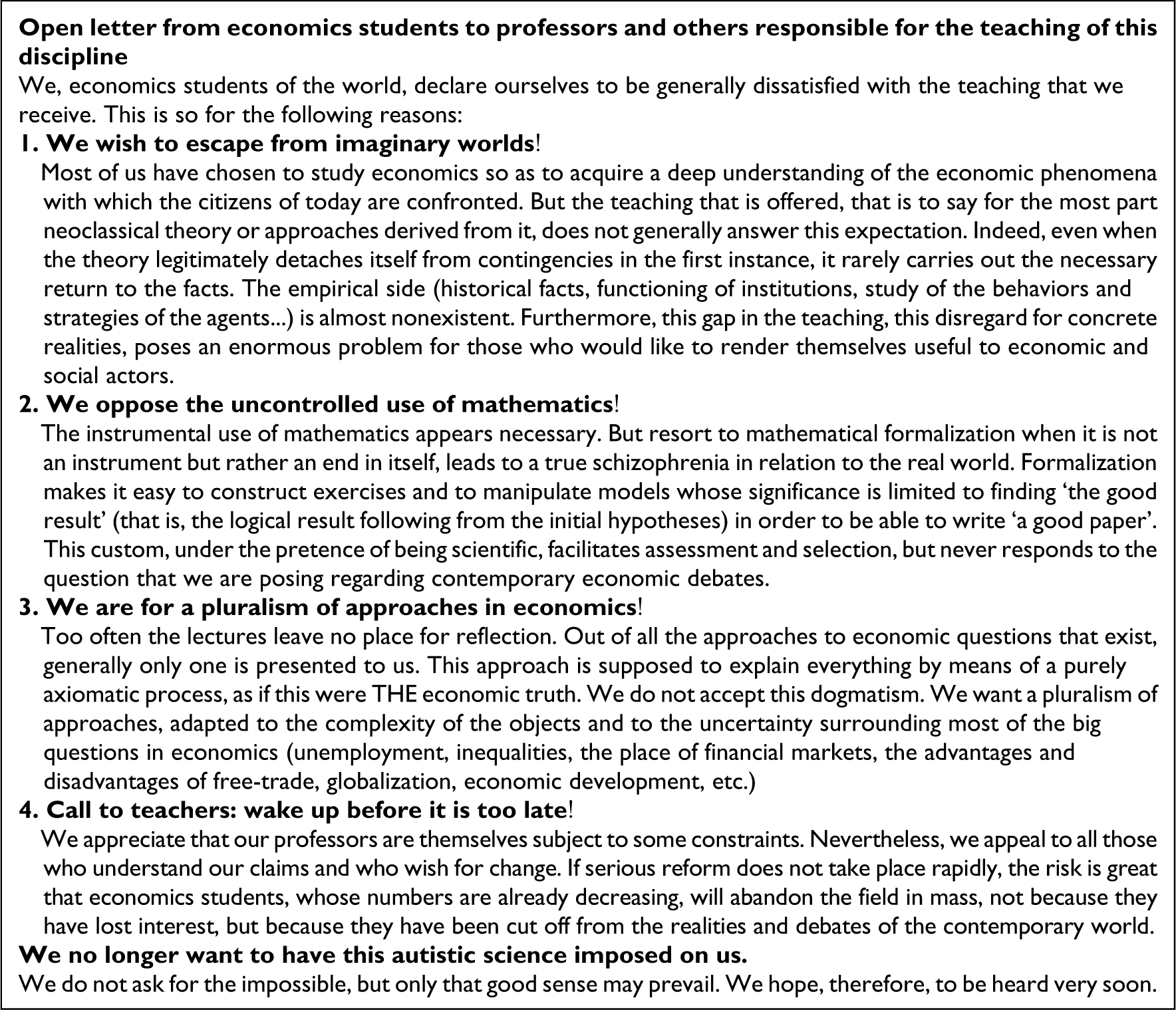
Demanding real-world economics: a petition from French economics students, 2000
Notwithstanding this warning, little has changed in the past decade. Indeed, the colonizing tendencies of orthodox economics seem to have continued largely unabated. A flag has even been planted on economic geography’s small island, as mainstream economics has taken an increasingly active interest in the very stuff of economic geography – spatial agglomeration, regional specialization, underdevelopment. The rise and rise of this new geographical economics (a.k.a. the ‘new economic geography’), which is fast acquiring the trappings of a sustained, subdisciplinary endeavor with its own centers of authority (see Table 1), found its seal of ultimate legitimacy in the award of the 2008 Nobel Prize to Paul Krugman, one of its principal architects. This was soon to be followed by a remarkable ‘spatial turn’ on the part of the World Bank, in the shape of the 2009 World Development Report, which promised nothing less than the Reshaping [of] Economic Geography, in the language of its subtitle. Economic geographers ‘proper’, for their part, have variously complained about the very old wine being served in these new bottles from Washington, DC, a vintage for which most on the island had lost their taste in the 1970s; about the narrowness of the orthodox economic gaze and its stubbornly asocial rationality; and, in terms ranging from the principled to the petulant, about the brazen effrontery implied by this most recent episode of intellectual imperialism (Martin, 1999; Peck and Sheppard, 2010). Adding insult to injury, the World Bank’s brand of monistic, new geographical economics seemed more like rehashing economic geography than reshaping it, and doing so in a manner designed emphatically to consolidate market-oriented patterns of development, logics of diagnosis/analysis, and modes of intervention (Harvey, 2009b; Scott, 2009), while effectively denigrating radical and reformist alternatives alike. What (economic) anthropology experienced in the 1970s and (economic) sociology experienced in the 1980s seems now to have become a reality for economic geography too. Having previously evolved quite endogenously (for all the borrowing from elsewhere), mostly minding its own business and doing its own thing, island culture has been suddenly confronted with uninvited exogenous pressures – arguably for the first time in living memory.
New economic geography on the old continent: top ranked programs in ‘economic geography’
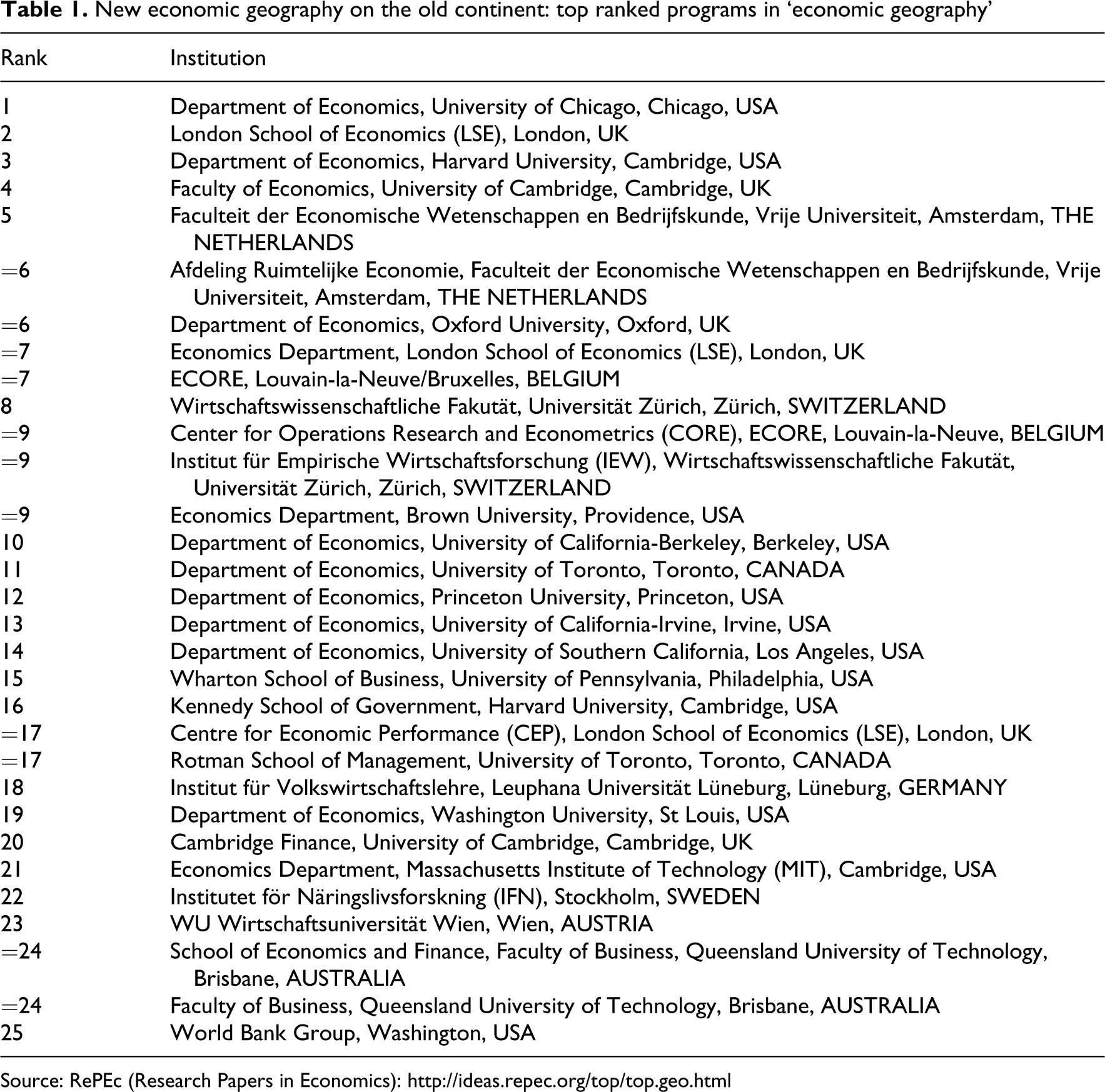
Source: RePEc (Research Papers in Economics): http://ideas.repec.org/top/top.geo.html
Markets, everywhere?
None of this should have come as a huge surprise. Orthodox economics, after all, is an expansionist project; it stakes knowledge claims that are universal and unifying, not partial or polyvalent; its intellectual technology is designed to roll over (if not flatten) borders, territorial and disciplinary. With the assistance of rigorously deductive reasoning and tightly specified models, orthodox economics aspires to ‘universally applicable hypotheses … which transcend institutional, systematic, and historical variations’ (Wilbur and Jameson, 1983: 32). The sprawling continent of the orthodox-economic imaginary remains, in this sense, practically featureless, but it continues to sprawl nevertheless. Borders are grudgingly acknowledged, usually only as impediments to the free flow of market forces; contextual influences are written off as little more than noise or ‘interference;’ spatial variations are reduced to mere frictions on the path to generalized equilibrium. The problem here runs deeper than a simple lack of humility, as Coase chose to portray it; this is a monochromatic intellectual vision that (literally) knows no limits.
Even in the new geographical economics, which on the face of it takes space more seriously, regionalized economies are stripped of their sociospatially constitutive character and conjunctural historical specificity, being portrayed as competitively fashioned configurations, if not mere way-stations in a Rostovian ascendency. Here, universal economic (or market) processes are seen to yield geographically differentiated outcomes, but these are typically differentiated merely by stage or by degree, not by kind or qualitative form; in other words, they do not possess constitutive spatialities per se. Within this framework, ‘local’ economies amount to no more than variations on a very familiar, universal theme; they are not characterized by locally defined (or ‘embedded’) capacities, logics, causal properties, tendencies, hybridities, intersectionalities, or even meaningful contingencies. Regions remain little more than containers for generalized – if not universal – market processes; they are bit-part players in the grand narrative of general-equilibrium-as-market-teleology. At the micro level, methodological individualism continues to hold sway. The underlying motives of economic behavior are traced to naturalized, utilitarian universals; they do not vary meaningfully from place to place. Not only does Homo economicus have a unpleasantly hedonistic psychology and a stunted social life, he is not even permitted to behave in different ways in different places (or times). He is Mister Universal.
As the font of instrumentalist rationality, the transcendent concept of the market lies at the heart of this (flat and flattening) world-view. Curiously, however, and even as the potent metaphors of market forces and motives work to secure the paradigmatic power of orthodox economics as a ‘strong discourse’ (Bourdieu, 1999; Fourcade, 2009; Harvey, 2009a), the market itself stands, almost naked, as one of the most inexplicably neglected concepts in orthodox economics. As the Chicago school’s Mr Micro, George Stigler (1982: 309) once observed, ‘the determination of the market has remained an underdeveloped area of economic research at either the theoretical or empirical level’. None of this, however, disrupts the presumption of markets on orthodox economics. So as Oliver Williamson (1975: 20) (in)famously put it, ‘In the beginning there were markets …’.
It is as if, as the object of such deference, the market must be placed above reach, beyond question. The practitioners of economic science choose to avert their eyes: preoccupied with the modeling of blood chemistry, back in the lab, few seem to dare to take a peek at the body. The market, as the principal arena of economic ‘law’, is therefore preserved in almost mythical form, as a practically indisputable belief system, defined in idealized terms. It stands as orthodox economics’ most presumptuous assumption. Rationally abstracted economic theories ‘assume a market economy and rationalizing or economizing behavior by the actors in such an economy [even as] these fundamental assumptions tend to be taken for granted, no longer questioned, no longer only possibly one alternative among different types of behavior’, Bernard Barber (1993: 218) has contested. ‘So it always is with the fundamental assumptions of highly successful, established scientific paradigms.’
The force of markets, in this sense, does not simply originate from materially realized ‘competitive pressures’, it derives just as much from the inherited cognitive frame of (free) market theory, its self-referentiality, and its boundless, encompassing logic. Jarring encounters with countervailing ‘realities’ do not even seem to make much of a difference, such is the autisme-like grip of the orthodox belief system (cf. Alcorn and Solarz, 2006; Mohn, 2010). Conveniently, however, the notion of a self-acting, externally driven economy is also one in which others very much want to believe – not least political elites. After all, even in the seismic disruptions of the most recent global economic crisis, market orthodoxy and market expertise were only fleetingly questioned in mainstream circles – for all their evident culpability (Lee and LiPuma, 2010). More sobering still, this temporary ideational/ideological vacuum was not filled with a compelling alternative (or diversity of alternatives). In fact, the Great Recession has been a prelude to the startlingly rapid reassertion of market discipline, and yet more austere competitive rationalities (see Fine, 2010; Mirowski, 2010; Peck et al., 2010). The market orthodoxy may have been (temporarily?) discredited, but it remains the orthodoxy.
Meanwhile, back on economic geography’s island, there is a growing sense that the tides may be turning – perhaps even rising. Just about everybody has noticed that the ‘new economic geography’ (an imperial designation if ever there were one) is on the horizon. Change appears to be in the air, to evoke a Marshallian metaphor. True, the island is not exactly awash with orthodox concepts, formulations, and methods, but amid the long-established culture of bounded pluralism, there is a palpable sense of shifting currents: some long-time island residents have swum out to more orthodox waters (despite their chilliness), though hardly any have yet to be welcomed onto the imperial shores; others have trekked to the higher ground of the alternative economy; a few Canutes can be heard shouting at the waves. The islanders have always seemed to enjoy their ‘turns’, at least when they were endogenously initiated, but the whiff of an intellectual takeover in the new economic geography project has been palpably more unsettling.
In truth, it is a long time since the inhabitants of economic geography’s island were to be found singing around the same campfire. While there have been some strands of epistemological unity and mutual concern in the ‘economic geography project’, this has been a rudely (and for the most part productively) decentered enterprise, at least since the ‘new economic geographies’ moment of the mid-1990s (Barnes and Sheppard, 2010; Lee and Wills, 1997; Sheppard, 2006). Many of the projects that have animated the field (political ecology, innovation studies, governance, production networks, labor geography, etc.) have been ‘cellular’ in form: intensely networked on the inside and often connected to (different) external constituencies, but only loosely integrated with one another (Foster et al., 2007). A modern ethnography of island life would reveal a series of (generally thriving) microcommunities, mostly located around the coast. Between these there has been some degree of interregional trade, but most of the more consequential transactions have been across the water, with neighboring islands in the heterodox archipelago, like institutionalism and evolutionary economics. Perhaps inevitably, these centrifugal tendencies have also been associated with a degree of detachment and dissipation, prompting calls for a (re)turn to more self-consciously engaged forms of pluralism, across the island, together with intellectual community-building efforts of various sorts (Barnes and Sheppard, 2010). There is a growing concern that, as economic geography has become a more polyglot project, vernacular forms of island-pidgin may be dying out.
Against this backdrop, some are arguing that it is (high) time for economic geography to become more conversant with the language of power, as spoken on the continent of orthodox economics. Bilinguality, to be sure, is always a virtue, and perhaps this goes for the orthodox father tongue too. But while there is considerable potential in developing more explicit commonalities of purpose with various communities of heterodox economic scholarship, with scope for mutual gain (Grabher, 2006, 2009; MacKinnon et al., 2009; Peck, 2005; Peck and Theodore, 2007), the unyielding and hegemonic formation that is orthodox economics surely constitutes a special and in many ways problematic case (cf. Sheppard, 2011).
This cannot simply be pegged to the overbearing, continental scale of the economics profession, or its unique alignments with key sources of financial, corporate, and state power – though both seem likely to continue to shape highly unequal terms of exchange with economic geography. The somewhat contrarian temperament of economic geography would certainly also get in the way here. In light of economic geography’s apparently generational shift towards more qualitative approaches, there may be language barriers and communication failures too. It is true that orthodox economics prefers to communicate in the language of numbers (enabled by parsimonious, ceteris paribus theorizing), and that some socio-economic phenomena (like socialization or trust or regulation) are difficult to quantify. But quantification per se is not the issue here: quantitative techniques can (and must) be used for many ends, including heterodox and radical ones (Plummer and Sheppard, 2001; Wyly, 2009). They cannot be allowed to die out, due to disuse, among the various island communities; a qualitative methodological monopoly would be no less problematic than a quantitative one.
The deeper problem lies elsewhere. More fundamentally, the language of economics is reflective of an intellectual culture-technology that not only is different to that found across the various projects of economic geography, but threatens to marginalize, erase, or obliterate the very foundations of those projects. There is a profound disconnect between the ontological predispositions and epistemological orientations of economic geography and orthodox economics. Paul Krugman’s (2010) tongue-in-cheek paper on the extension of orthodox trade theory to the intergalactic scale, first drafted in the late 1970s as an ‘oppressed assistant professor’, may contain at least one underlying truth – that the orthodox mission is ultimately about conquering space through the application of transcendent technologies. Space may indeed be the Final Frontier, but it is not space as economic geographers know it. At root, this is a problem of mutually negating rationalities: in a rational-actor universe, governed by the singular logic of neoclassical economics and the image of the transhistorical and isotropic market, economic geographers – if they can get a word in edgeways – are liable to be portrayed as the peddlers of idiosyncratic insights and contextual curiosities. (To borrow a phrase, ‘there is Economics; the rest is stamp collecting’ 2 ) There is no room for meaningful economic difference here; no time for imagining alternative pathways. Engagement can only take place on the terms (and in the language) of orthodoxy itself. But to engage in such a way is to run the risk of sacrificing the rich intellectual terrains of sociospatiality for the decidedly flat register of distance-and-concentration. Mapping minor exceptions to market rule, or developing nominally spatial components for the steamroller model of general equilibrium theory, are inherently self-limiting exercises. And the further one travels into neoclassical deep space, even gravitational forces (and gravity models) lose their pull.
If economic geography’s much more earthly gaze, in contrast, is uniquely fixed on the spatially variegated forms of economic practice/process, as Gordon Clark (1998) has suggested; if this implies that ‘local’ economies exhibit meaningful differences in kind, rather than merely degree, and if their narrowly ‘economic’ characteristics are actually co-constituted with, and predicated on, a panoply of nominally extra-economic conditions; if persistently uneven development is an integral rather than incidental feature of capitalist growth; and if local economies are relationally interconnected, yielding co-dependent and co-generative forms of development … then surely it follows that the ontological and epistemological foundations of the kinds of economic geography that have been practiced on the island lately remain orthogonally (if not antagonistically) positioned relative to those of orthodox economics. For the ‘grounded’ and diachronic endeavor of economic geography, which characteristically theorizes, openly and outwardly, from the vantage point of actually existing economic relations and formations, history signals more than the passage of time, while geography clearly represents much more than the friction of distance. It follows that the analytical object of the qualitatively heterogeneous, relationally variegated, and unevenly developed economy signifies, at the same time, a defining commitment for economic geography, but an anathema for orthodox economics. 3
This should not be taken as a license for a permanent disciplinary stance of intransigence, punctuated by the occasional polemic against the purveyors or market reason (though quietude on this score also has consequences). More constructively, it begs the question of how the promise and potential of economic geography as an energetic form of heterodox practice might be realized in the form of positive programs. It is in the very nature of such projects, of course, that they are plural in a much more than trivial sense. Heterodoxy requires polyvocality. But in the context of continuing intellectual pluralism, a case can be made that there is at least one object of analysis/critique that requires special (if not strategic) attention. Not coincidentally, this is the most sacred object for economic orthodoxy – that of the market. Economic geographers need not avert their eyes too; significant opportunities beckon, if markets – in all their hybrid, variegated, and heterogeneous forms – are seriously problematized as objects of study.
Curiously, though, explorations of diverse markets in real-world settings remain in their infancy in economic geography (though see Barnes, 2008; Berndt and Boeckler, 2009, 2012; Smith et al., 2006). There is certainly work here for economic geography to do, and this may also be another way to enrich the dialogue with other communities across the field of heterodox economic studies. Even though the conceptual and methodological maps for such a project have yet to be visualized, there are many sources of inspiration in the literature of heterodox economics (Aspers, 2011; Boltanski and Thévenot, 2006; Callon et al., 2007; Carrier, 1997; Ebner and Beck, 2008; Fligstein, 2002; Zelizer, 2011). Inevitably, the Polanyian legacy looms large in a great deal of this work. Mainly due to his posthumous status in economic sociology, the talismanic figure of Karl Polanyi has also been a recurring presence in economic geography of late. Polanyi does indeed provide one place to start, though not necessarily for the conventional reasons. This might be an occasion not so much to engage with Polanyi the critic of free-market utopias, a now-familiar figure, but to disinter Polanyi the comparative economist.
Pushing Polanyi
Polanyi knew a thing or two about island life. Malinowski’s classic work on the Trobriand Islands, especially the analysis of kula reciprocity networks, was a fundamental touchstone for his theorizing. The kula economy was read as an ‘intricate time-space-person system’, indeed a ‘stupendous organizational achievement’, which Polanyi would take to symbolize one (of several) alternative modes of economic organization to the market pattern. 4 And no less important, especially in his political formation, were formative years spent as a resident of the metaphorical island that was Red Vienna. 5 Forced to flee across the Channel to England in 1933, it was the beleaguered, relative condition of the working classes that he encountered there that would convince Polanyi of the historical significance of the Viennese experiment in municipal socialism – influencing the comparative historical vision later articulated in The Great Transformation (Block, 2003; Dale, 2010; Mendell, 1994; Peck, 2010; Polanyi, 2001 [1944]). His world-view, in fact, was to be shaped by disruption and dislocation, and by a series of situated readings of the historical consequences of (the British Isles-cum-colonial variant of) market fundamentalism. What he left behind was far from a seamless intellectual corpus, but the belatedly influential legacy includes the outlines of an alternative way of thinking economy.
Polanyi disinguished three distinct modes of market integration – reciprocity, redistribution, and market exchange – the first two of which were seen to be definitively embedded in social relations, such as kinship systems or state administration, while the third was represented (somewhat inconsistently) as the overriding organizational principle of ‘market society’, for the most part analyzed historically, not to say somewhat polemically. 6 Despite having bequeathed the social sciences the provocative (but somewhat abstruse) concept of ‘embeddedness’, Polanyi ironically failed to push his arguments around economies as ‘instituted processes’ to their logical (and arguably more radical) conclusion – that markets too are inescapably embedded systems (Krippner, 2001; Lie, 1991; Steiner, 2009). Perhaps the reason for this was that, while acutely aware of the downstream political and intellectual consequences of the ‘market mentality’, he was convinced that the destructive laissez-faire experiment of the Machine Century (1850–1950) would never be repeated. (The account of the pathologies of the oxymoronic ‘market society’ in The Great Transformation also strongly implied as much.) Materially, all that seemed to remain, by the end of the Second World War, was the ‘fading fabric of competitive capitalism’, while the market pattern of organization seemed likewise to be ‘on the downgrade’ (Polanyi, 1968 [1947]: 59–69). History was apparently on the side of more organized, regionalized, and planned economies, and certainly not of some (re)universalization of free-market capitalism (Polanyi, 1945; cf. Lacher, 2007). Realizing the potential of this moment, however, would mean once and for all throwing off the mental shackles of the ‘economistic prejudice’ and never again allowing ‘the market to grind the human fabric into the featureless uniformity of selenic erosion’; only then could ‘social imagination’ be truly liberated (Polanyi, 1968 [1947]: 75, 71–72).
Polanyi can be forgiven, surely, for misjudging humanity’s capacity to repeat the mistakes of the past. His indictment of the original, 19th-century version of market fundamentalism – vividly portrayed as a satanic mill – would have to be rehabilitated by a new generation of scholars in the age of neoliberalism. But even if Polanyi’s own critique of market exchange was theoretically truncated and historically bracketed, there remains unrealized potential in the suggestive analytical framework that he left behind, for all its ambiguities and inconsistencies (Beckert, 2009; Burawoy, 2003). This said, both Polanyi’s project and neoPolanyian sociology remain radically incomplete in respect of the treatment of the market itself. The concept of the ‘disembedded’ market, which lingered rather disruptively as an ‘overdrawn ideal type’ in the unfinished work that is The Great Transformation (Hann and Hart, 2009: 9), has yet to be comprehensively dismantled by the new generation of economic sociologists (see Krippner, 2001). Too often, the market’s ‘more social’ others appear as raggedly subordinate, messy alternatives to the pristine rationality of the competitive sphere, against which they are unequally contrasted according to a singular axis. Nevertheless, the continuing promise of the Polanyian project lies with the seductive notion of the always-and-everywhere embedded economy (Barber, 1995; Block, 2003; Peck, 2005). ‘For accumulation always and everywhere depends on a precarious balance between commodity relations and other forms of social organization [a form of co-dependence that] generates a complex, conflictual, and contradictory process involving recurrent shifts in the relative weight of commodification, decommodification, and recommodification’ (Jessop, 2008: 334).
A starting point must be to dispense with the misleading idea that some economies are freer (or less socially embedded) than others, or that the ‘social’ content of economic relations can somehow be decanted out and then quantified on a one-dimensional, sliding scale of market im/perfection. The fact, however, that no market exists in a social vacuum should not be taken to mean that there are no markets of any kind, or that the study of markets should be shunned in its entirety by the heterodox economic sciences. To the contrary, it means that the study of actually existing markets – in all their variegated and provincial forms, and in their various admixtures with other modes of socio-economic organization – actually warrants more searching, sustained, and systematic scrutiny. Markets themselves, of course, do not spontaneously spring to life as the coordinated outcome of instrumental actions; they are ‘social inventions’ (Lee and LiPuma, 2010), and as such are associated with specific conditions of production, reproduction, and failure. 7 They have both histories and geographies. Certainly, the wide range of domesticated, archaic, emergent, and crisis-torn forms that actually existing markets take seems, just on the face of it, to be too profoundly differentiated and contextualized (one might say embedded) to be shoehorned into the narrowly ‘economizing’ optic. 8 Markets, in other words, are just too important to leave to the economists, and they are much too variegated to be theorized monistically.
In the coming challenge of producing new ‘maps’ of the socially embedded economy, Polanyi’s pioneering insights may provide inspiration, but they can hardly be seen as a definitive guide. After all, while he may have ‘“discovered the lost continent” of the always embedded economy’, as Fred Block once put it (quoted in Krippner et al., 2004: 117), he was denied the time for its comprehensive exploration. A brilliant teacher but considerably more elusive as a writer, Polanyi may have been most successful in conveying the potential of his project to his students. As one of them recalled, his lectures were characteristically vivid and always overflowing, drawing on an encyclopedic knowledge of the vast array of ‘economies of record’, ancient and modern, while engaging at length with Marx, Malinowski, Weber, Menger, Thurnwald, Durkheim, and their ilk. It must have helped to be there. The sheer anthropological, geographical, and historical reach of these exegeses can be overwhelming when folded between the covers of a single volume: To discuss Ricardo’s England, Malinowski’s Trobriand Islands, and Hitler’s Germany in the same book (The Great Transformation), is to demand too much of the reader. And to expect the reader to follow him into Hammurabi’s Babylonia, Aristotle’s Greece, and eighteenth century Dahomey (Trade and Market), is to expect altogether too much. (Dalton, 1965: 1)
Notwithstanding these challenges of presentation, the cumulative effect of the Polanyian project was to relativize actually and previously existing economic formations. It amounted to a ‘political economy of contrast’, in Dalton’s (1965: 3) evocative words, one that was gradually establishing the foundations for an analytics of comparative economy: ‘The areas of fruitful comparison [must] be widened. Economic anthropology and economic history should be made part of a discipline called comparative economy’ (p. 2). (To this list one would surely today add economic geography, economic sociology, feminist economics, and political ecology, among others, though there seems little reason to extend the invitation to an unreformed orthodox economics – which has barely been able to summon the will to study divergences between its idealized vision of a market economy and real-world economies, let alone slicing and dicing the latter.)
Comparative economy should not assume, a priori, a particular grid of economic difference, but as an empirically oriented exercise working with real abstractions would document and develop contextualized interpretations of polyvalent economies, old and new. As Polanyi had always insisted, the contemporary cluster of industrialized economies was not, on its own, sufficient to the task of populating and energizing the comparative register – despite the fact that, at the time, it ran the gamut from communism to fascism, and from welfare-state to new-deal capitalism. His strategy was to evoke the widest range of historical as well as contemporary cases as a spur to the socio-economic imagination and, more particularly, ‘to dislodge the notion – so widely and implicitly held by economists – that markets are the ubiquitous and invariant form of economic organization; that any economy can be translated into market terms’ (Dalton, 1965: 4). Markets, of course, are present in all of these regimes, but their respective position and contribution should be an empirical matter, not one of theoretical predetermination.
The stultifying conceit of orthodox economics had been to unilaterally impose a singular ‘market shape of things’ on an evolving, institutionally variegated landscape of economic organization (Polanyi, 1977: xl). Recognizing the hybrid character of actually existing economic formations, Polanyi’s concern was to ‘open a debate about alternatives to the prevailing market-based form of economic organization’ (Jessop, 2008: 329). This called for methodological innovation too. The austere theoretical gaze and narrow methodological repertoire of orthodox economics rendered large swathes of economic life unintelligible or even invisible. As the development economist (and fellow-traveling comparative economist) Arthur Lewis once reflected: [E]conomists have concentrated on studying the market economy, and have left the study of the non-market economy to the anthropologist. Moreover, in studying the market economy, economists have tended to take institutions for granted, and have tended to neglect inter-actions and conflicts between the market and other social institutions. This has left a gap into which some anthropologists are now sliding. They slip into factories, and study how workers set up or react to production norms; they watch directors at work in the board-room; or they study the effects of prestige on occupations. It is clear that the anthropologist’s technique of observation, and his [sic] understanding of the inter-relations of social institutions, have an important contribution to make to the study of even the most advanced market economies … [T]he economist who studies the non-market economy has to abandon most of what he has learnt, and adopts the techniques of the anthropologist. (Lewis, 1962: vii–viii, emphasis added)
For Polanyi, this was more than a matter of finding a better fit between the strategies and objects of research; it entailed repeated methodological and interpretative engagements with real economic formations, ancient and modern. The problems of excessive deductivism in neoclassical economics in this regard were compounded by the analytical error of universalizing the ‘strictly time-bound phenomena’ of the market society, by propagating the fiction of an autonomous, singular, and unified economy, operating as a ‘self-acting device’, and thereby subordinating ‘the fate of man [sic] and nature to the play of an automaton running in its own grooves and governed by its own laws’ (Polanyi, 1968 [1947]: 61–62). Polanyi’s alternative strategy, in contrast, was to seek to ‘know the economic world’ through simultaneous acts of close observation and creative theorizing.
He was not alone, of course, in making these arguments. For example, T.E. Cliffe Leslie, a pioneering ‘economic sociologist’ of the English historical school, had argued – in the heyday of the market society, no less – that transcending the singular vision of the market economy called for a radical kind of comparative-exploratory method, indeed something akin to a geographical approach: To imagine that a clever man with his eyes shut can think out the laws of the economic world, is as reasonable as to suppose that he could in the same manner discover the laws of the physical world. In chemistry, in natural history, in physiology, in physical astronomy, discoveries are made every year by the all-case method – by neglecting no phenomenon as unworthy of observation, and investigating every case that presents itself, with a view to ascertaining its causes and laws. [This need not mean] that deduction has no place in economic science; every inference from or application of a general principle is a deduction. What is meant is that Political Economy has not reached the stage of a deductive science, that the fundamental laws of the economic world are still imperfectly known, and that they can be fully known only by patient induction … [T]he economic world is still in a great measure an unknown one, and … to know it, economists must explore it as geographers have explored the world of physical geography. (Leslie, 1879b: 946, 949, emphasis added)
9
What principles might guide such explorations of barely known economic worlds? For the disciples of Polanyi, they involved comparative ethnographic work on the sociocultural positioning of different modes of economic integration, in contexts selected deliberately to span a wide range of ‘marketless societies’, along with some in which markets might be playing ‘peripheral’ or more dominant roles (Bohannan and Dalton, 1962). This work would pay due attention to those ‘economic devices’ readily observable in the analytical foreground – like monetary objects, accounting procedures, trading facilities, or production arrangements – while at the same time making constant explanatory recourse to the wider patterns of economic integration within which these devices were embedded (their instituted context, the variant rules of the socio-economic game, and so forth). ‘It would be rash to conclude that because the USA and the USSR both use money, market places, accounting devices, and foreign trade they have basically similar economic organization’, Dalton (1965: 13) cautioned, just as it would be ‘even more egregious to conclude that because the USA and Malinowki’s Trobriand Islands both use money and foreign trade they have basically similar economic organization’. 10
Half a century later, in a period of deepening, market-meditated, and increasingly global economic integration, there remains much to be learned from the close-focus analysis of ‘market devices’ (Callon et al., 2007; Ong, 2006), locally situated, but at the same time the Polanyian axiom of embeddedness must be upscaled to consider the (more global) context of this context. Modes of integration (reciprocal, redistributional, market exchange, etc.) can certainly no longer be considered to be merely ‘internal’ characteristics of local or even national economies; they clearly also impinge upon relations between these economies. In as far as neoliberalization represents a historically specific attempt to reimpose a particular, instituted form of market rule, this must likewise be understood in macroregulatory terms, as well as a descriptor for localized practices, policies, and programs (Peck, 2010). Even as territorially defined economic formations continue to display idiosyncratic, polymorphic, and hybrid configurations (and even as it becomes increasingly evident that neoliberalization ≠ convergence), deep neoliberalization has been associated with geohistorically distinctive forms of macroregulatory integration between local economies (Brenner et al., 2010; Peck and Theodore, 2007).
In a further ironic twist, however, critical treatments of neoliberalism have been more inclined to recover Polanyi-the-polemicist than Polanyi-the-comparative economist. Merely tilting at the satanic mill of the market cannot be enough; the ever-more pressing need is to make sense of the satanic malls of globalizing, deeply networked, neoliberal capitalism. Now that we know that the late-20th-century revival of market fundamentalism was no flash in the pan, so it becomes increasingly imperative to make sense of the transformed socio-economic worlds(s) that the free-market counter-revolution has wrought, not to mention those that it has barely reached, and those places where it has been spurned. In principle, the notion of an autonomous, disembedded market society, something of a red herring in the 19th century, is no less of one now; yet at the same time new forms of market-patterned macro-integration – cultural, financial, logistical – continue to proliferate. In the face of predictions of the earth-flattening consequences of these developments, explorations of the barely charted world of the always-embedded economy must continue. In some respects, they are needed now more than ever.
Economic geography unbound
‘The market’, Viviana Zelizer (2011: 363) has observed, ‘is no longer a safe place to theorize’. If this is indeed true, how might the tasks of economic geography be reconceived in such a light? Perhaps it is time, finally, to take on the market, a much-mystified object that for too long has been hidden in plain sight in economic geography. A pertinent (yet demanding) question here is: what would it take to ‘provincialize’ the market? What would it take to move from the demonstration of one-off, singular, and possibly contingent exceptions to the universal market, and towards the elaboration of more sustained and systematic claims concerning the geographical form and constitution of this uniquely foundational economic category? The pursuit of these questions, moreover, might well open up new opportunities for mutually beneficial, reciprocal trade across the various kula rings of heterodox economic studies. Indeed, continuing to open, and use, these lines of dialogic communication – especially in conversations around contemporary forms of socio-economic construction and variegation – offers the potential for enriching and energizing island life in a number of ways.
But this time there is an external impetus as well. In the wake of the uninvited attentions of the new geographical economics, island life as we have come to know it may be in for a change anyway. This may, however, represent an opportunity, rather than a looming, existential threat. After all, the breaching of the boundaries between sociology and economics in the early 1980s generated much more than an indignant reaction; it was a spur to the positive intellectual program of the new economic sociology. Could economic geography be facing an analogous, crossroads moment of its own? If so, what is surely indisputable is that there is nothing to be gained from the defense of island turf for its own sake. Economic geography needs its positive intellectual programs too. This has to amount to something more than the accidental accretion of individual research agendas; it warrants the kind of programmatic attention that really draws on the social productivity of economic geography. None of this will be easy – in a generally under-resourced field populated by free spirits – but the fact that it has happened before (global commodity and production chains, postfordism, alternative economies, etc.) means that it surely can happen again.
If the World Bank’s (2009) World Development Report (WDR) represents one, rather dispiriting, version of what the economic-geographical future could look like, what positive alternatives can be imagined? A provocative thought experiment might seek to envision what an alternative WDR, 11 fashioned by economic geographers, would look like. Perhaps echoing Polanyi’s sprawling tomes, what would have to be a polyvocal and a disparate volume would demand much of its audience, if indeed it could be bound into a single volume at all. But even such an ‘unbounded’ economic geography would surely have contributions to make to the inchoate project of comparative economy. In fact, some of the resources necessary for such an endeavor may be quite readily available, in the various formulations of relational economic geography and geographical political economy that have been developing recently (Bathelt and Glückler, 2003; MacKinnon et al., 2009; Peck and Theodore, 2007; Sunley, 2008; Yeung, 2005). But there is much more to do.
Part of the challenge, no doubt, will be methodological (Barnes et al., 2007; Gertler, 2010). For the sake of interdisciplinary audiences, in particular, a premium will be placed on the development of crisply articulated and theoretically generative comparative research designs – still surprisingly rare in the field. This would certainly include the conventional ‘static’ comparison of pairs (or more) of territorially defined economic formations, along with multi-site analyses of various kinds. More ambitiously, it might also embrace the ‘relational’ analysis of cases-in-connection, linked by intersecting webs of production, reproductive circuits, institutional mutation, or by shared experiences of restructuring (see Collins, 2003; Hart, 2002, 2004; Lawson, 2010; Peck and Theodore, 2012; Yeates, 2009). The promise of probing, comparative research designs here is that they entail a decisive explanatory step beyond the identification of alternative, divergent, idiosyncratic economies, moving on to position these relationally, relative to their others. This way, they become more than free-floating cases, implicitly imagined as exceptions, or spots on an otherwise barely charted landscape. Instead, they would hold the potential of generating new explanatory transects across that landscape, evoking conceptually specified and empirically documented registers of meaningful economic-geographical difference.
Crucially, the explanatory scope of such studies must extend beyond the documentation of unsituated, provincial exceptions to the universalist claims of ‘standard’ market models. Economic geography may be replete with claims to the effect that socially constituted (or embedded) economies are also, by the same token, spatially constituted (or embedded) economies. In fact, some observers might say that this represents something of an article of faith within economic geography’s own island belief-system. Yet the number of critical-case substantiations of such claims, especially those that would be considered compelling to the residents of other intellectual islands, is soberingly sparse (Peck, 2005). It is almost as if they are implicitly made on the grounds of exceptionalism (against the foil of the supposedly universal rules of a spaceless economy or singular capitalism), and therefore in a sense defensively, rather than as positive (theory) claims. In practice, the documentation of ‘local’ exceptions (even their cumulative documentation) often leaves that foil, of the monological economy, substantially untroubled. On the contrary, these maneuvers actually keep the latter in ghostly circulation, albeit in pejorative terms, by defining exceptions case-by-case to the singular norm, rather than by establishing variegation, unevenness, or deviation more systematically. Furthermore, the relative paucity of research designs constructed to interrogate the contention – which has wide currency on the island but is much less often heard elsewhere – that locally embedded economies are associated with more-than-contingent capacities is surely part of the problem here. 12 This represents a significant methodological challenge for the project of comparative economy.
Then there is the question, more specifically, of how ‘variegated markets’ might be tackled in methodological terms. In many respects, the theoretical orientations and methodological proclivities of economic geographers have tended to suggest empirical research sites located in localized and nominally extra-market spheres, like the ‘hidden abodes’ of production and reproduction; the proximate spaces of corporate hierarchies, commodity networks, or industry sectors; the murky worlds of economic governance and policy-making. (It is almost as if an ‘anything but markets’ policy has been implicitly observed.) The task, however, is not one of developing a separate ‘economic geography of markets’, less still a market turn. Rather, what is required is a positive program that engages frontally with the multiplicity of market (and market-like) forms ‘in the wild’, in hybrid settings, and across multiple domains – finance, culture, trade, care, and so forth (see Barnes, 2008; Berndt and Boeckler, 2009; Lawson, 2010; Smith et al., 2006). The ultimate promise of such contextualized studies of real-world markets would not be simply to proliferate claims to (perfect) market exceptionalism, or to add to the library of accounts of markets behaving badly (and therefore simply replacing the singular, neoclassical market ontology with an unpatterned and unprincipled, merely kaleidoscopic array of alternatives); it would be to substantiate, systematize, and stabilize heterodox claims regarding the functioning of actual markets, along with their primary axes of socio-economic differentiation, defined in causal rather than taxonomical terms. Here, there is also a relatively open field of opportunities for the study of regionalized and multiscalar modes of economic coordination, beyond the staple methodological nationalism of heterodox economics (Peck and Theodore, 2007).
Finally, and as Polanyi would no doubt have been emphasizing, had he witnessed the second great transformation, there are pressing questions related to the present historical conjuncture. New generations of (often state-assisted) market making projects can be found all over the place, but geographical research on these proliferating neoliberal forms has tended to focus more on questions of institutional design and rationality than on organizational ecologies or distributional logics. If three decades of deepening neoliberalization have yet to yield anything approaching textbook market conditions, what can be concluded about the causes and consequences of these diverse (but interconnected) experiences of often state-assisted ‘marketization?’ Neoliberalization, marketization, commodification, and privatization may be just about everywhere, as endemic processes, but this is manifestly not producing singular or uniform outcomes. There is no evidence, then, that ever-more intensive forms of neoliberalization are leading inexorably towards a global regulatory monoculture; there is no appreciable movement in the direction of perfect markets; there is no sign of an imminent, unidirectional continental convergence towards some free-market Pangæa. Geographical differences persist – indeed are repeatedly being remade – but is this is no more than chaotic differentiation or ‘spatial noise?’
Neither has deep neoliberalization led to some rerun of the 19th-century experience of laissez-faire, free trade, and haute finance – simply played out on a yet grander scale. Rather, it must be understood as a historically and geographically distinctive form of socio-economic organization, constituted across and through multiple, integrally connected and yet hybrid forms of market(-like) governance. This continues to yield variegated and contradictory outcomes, not to mention lurching episodes of crisis-driven transformation. So this (let us say) more market-oriented world is anything but a ‘settled’ system, even if it possesses a series of recurring and systematic features. Perhaps Polanyi was right, then, to treat market exchange rather differently to those alternative forms of economic organization to which he devoted so much analytical effort, in light of the often (self-)destructive nature of market forces, their proneness to overreach and overflow into crisis, and the fact that they are apparently unable to operate autonomously, in the form of free-standing, self-regulating, free-market regimes (either in principle or in practice). Like orthodox economics, the market too apparently knows no limits.
On the other hand, Polanyi may have conceded too much, in failing to press the argument about the (necessarily but variably) embedded nature of market systems (Lie, 1991, 1997). If all forms of economic organization are characteristically ‘impure’ (Hodgson, 1984; Peck, 2005), even where one principle of integration is dominant, then it surely follows that one of the more significant analytical (not to say political) challenges in this moment of deep neoliberalization is to understand the contradictory cohabitation of marketized forms of exchange and governance with their multifarious ‘others’. It is not enough simply to declare that there is an infinite variety of such cohabitative arrangements, and leave it at that. Rather, it is necessary to document their recurrent forms, constitutive connections, and family resemblances, and to account for the scope and character of such revealed variegation. What are the tolerances and tendencies? How are ‘local’ hybrids embedded in, and constituted with, the evolving shape of neoliberalization as a global process (cf. Brenner et al., 2010; Gill, 1995; Ruggie, 1982; Silver and Arrighi, 2003)? An economic geography that begins to generate answers to these questions would really have persuasive things to say in the nascent, heterodox conversation around comparative economy.
Conclusion: Trafficking in economic geography
Change is coming to economic geography’s island life. (Even the Trobriand Islands, after all, now have an airport.) The visitors from the continent of Economics (some of whom apparently claim to have discovered the island) may display some passing interest in the locals’ colorful baubles, but there is almost no chance that they will be taken by island life for what it is, let alone be inclined to learn from it. Theirs is an intellectual technology, after all, associated with occupation, not dialogue. In this context, there is more than a little irony in the fact that economic geography’s own (belated) postcolonial awareness, which has included calls to provincialize economic-geographical knowledge and to develop alternative forms of comparison and collaboration (Pollard et al., 2009), has coincided, historically, with an ascendant effort to incorporate a reborn, immaculately conceived, ‘new economic geography’ into an all-encompassing neoclassical model. But recognizing such imperializing knowledge claims is one thing (Fine, 2002; Harvey, 2009a); doing something about them is quite another.
Constructively, this should be an occasion to rethink some established practices and the potential of alliances, old and new. There is a need to develop more active trading zones, not only across the island, but also with neighboring islands. There is much to be gained, it has been suggested here, from the establishment of more regular communications between the intellectual islands of the heterodox archipelago. Here, the conceptual and methodological gene pool is much richer and considerably more diverse; there are the rudiments of a shared language and certainly overlapping concerns; and prospects for positive evolutionary change are so much greater. In the face of the still-expansionist orthodox monoculture, the maintenance of productive diversity outside the imperial space of neoclassical economics will surely be essential, both for the collective resilience of these sundry communities of practice and, ultimately, for the capacity to leverage more ‘global’ changes in economic thought and practice. ‘The strength of the heterodox economic project lies precisely in the co-existence of competing positions, each challenging the still omnipresent logic of the perfect market in different ways’ (Berndt and Boeckler, 2009: 547; Fligstein and Dauter, 2007). If there is a meaningful alternative to capital-E Economics, it surely lies with the still-disarticulated network of small-e economic heterodoxies. But joining a loosely affiliated club called Not Economics cannot be enough, even if membership does typically come with an apt and absolutely necessary critique of both neoclassical theory and neoliberal policy. Purposeful, cross-disciplinary research programs will be required, including renewed engagement with the challenges of comparative economy – to which economic geography has the potential to make a distinctive contribution.
Again, this will not and cannot be a singular project, but if there is one issue that warrants more sustained attention – for political as well as analytical reasons – then this must be ‘the’ market itself, which in the heterodox literature is much maligned but often neglected. Developing meaningful alternatives to market monism cannot be about recoiling from the market as an object of critical inquiry, or eking out a fragile existence through the study of exceptions, in the long shadow of the continental orthodoxy. Neither can it just be about Economics-bashing for its own sake. It has been suggested here that there is much to be gained from the development of positive intellectual programs, especially where these engage explicitly with the problematics of comparative economy. There are, moreover, both intellectual and normative reasons for markets more seriously – in all their relativized, plural, and mongrel forms; and across the broadest range of constitutive contexts and cohabitative arrangements – in the service of economic geography’s continuing project of rethinking economy.
Footnotes
Acknowledgements
This paper had its origins at the 5th Summer Institute in Economic Geography, though it did not exist at the time. It has since benefited from the collective insights of UBC’s actually existing economic geographies reading group and the National University of Singapore’s Politics, Economies, and Space ‘free lunch’ group, and from the comments of Trevor Barnes, Christian Berndt, Christopher Muellerleile, and Nik Theodore. Ultimate responsibility for the arguments here is mine though.
Funding
The support of the Social Science and Humanities Research Council of Canada is gratefully acknowledged.