



Abstract

When I arrived in Vulturilor Street for the first time, I didn’t know anything of restitutions, anything of video making, and very little about the fight for the right to housing in Romania or Eastern Europe. I landed in Bucharest with the idea of exploring a specific set of issues – to do with homelessness and drug use (see Lancione, 2019, for an initial account) – but quite immediately I found myself dealing with something rather different and unexpected. By serendipity, my body was projected into the aftermath of a massive eviction: right at the edge of a new resistance-in-the-making. During those early days, in mid-September 2014, I still had no idea of what drove me to return to Vulturilor. I simply kept going back there, every late afternoon, either alone or with some friends from Carusel, a local NGO, to help with the distribution of food or second-hand clothes. However, I lacked a clear sense of direction. Compared to the local grass-roots activists of the Common Front for the Right to Housing (FCDL), who were engaged in organizing the resistance camp in its politics and direct actions, I was out-of-place. I was attracted to the community’s uncanny resistance, but at the end of the day, I did not know what to do. No one really needed me there. The help I provided was limited, the camera I always carried with me almost useless and my Westernized persona (male, White, PhD-carrying ethnographer) was insignificant.
Perhaps thanks to my ethnographic sensibility – which essentially pushes me to hang around interesting affections as much as Maliq’s ‘gypsy driver’ hangs onto the street – I persisted in showing up at the camp, entertaining kids, bringing new friends home to do their washing, as well as taking and sharing pictures. By being there, I became somehow part of the scenery and of its uncanny atmosphere, and finally, one day of November 2014, something powerful happened. Nicoleta Vişan, a working mother who emerged as the informal leader of the community’s resistance, approached me and said she wanted to talk. More or less, this is how the conversation unfolded 1 :
You took many pictures, from the beginning, right?
Yes, I have a lot!
And you have also video as well?
Some, but I can make more.
Here things are not moving. All it’s the same. And we need people to know. We need the media to know. We need to create some noise, or nothing will change!
What do you have in mind, Nico?
I don’t know. Why don’t you put these pictures online? Why don’t you send them to the media, the TV?
Because they won’t publish them. They are not interested in this stuff.
So let’s do a Facebook page! Let’s do a page where we write about life here, and you put your pictures, and we’ll tell everyone how we are living!
This is a great idea! Let’s do a blog.
Un jurnal?
Da, un jurnal!
The first blog post was published just a few days later at www.jurnaldinvulturilor50.org, where it can still be read. It is because of the blog that I became more systematic in my recollection of the visual material that then made it into the film, filtered through the collaborative approach to editing and storytelling that I’ve tried to establish with Nicoleta and the larger community. But Nico’s idea about the blog did something more profound and important for me: it gave my presence and my activism a scope that I hadn’t been able to find on my own. Nicoleta oriented me in the field of action and, by doing that, she provided me with a way to be relevant – to be of use in and for the struggle. 2 Embracing that proposition required effort and time, which were scarce resources as I was simultaneously undertaking a completely different fieldwork with drug users in a different part of the city. But despite the stress it generated and the essential burnout to which it led – due to over-working and the emotional cost associated with engaged grass-roots activism – that engagement is the most important thing that I ever did as an activist and an ethnographer.
For the community members, myself and many other comrades, the Vulturilor action-protest became a ground where a collective transformative political experience was forged, in everyday meetings, public rallies, bureaucratic entanglements and mundane chats and coffees’ around the camp’s fire. During the 2 years of that resistance, and thanks to that sustained and shared engagement, my way of thinking and doing politics changed – and for the better. The camp and its collective subject forced me to explore and then embrace my anarchist, feminist and anti-racist ethos in ways previously unknown to me, by means of dialectical confrontations and collective solidarities that came to define who I am, also as a scholar, today.
A key element in this whole process was played by the comrades of the FCDL, of which Nicoleta is part. When they asked me to join the movement and contribute to their fight through projects and actions that still continue today, I realized what being part of a movement truly means. It is about caring for the endurance of a collective struggle. Such endurance is not easy to undertake and it is not accommodating. It needs to be cultivated in ways that sometimes require enormous energies and shared efforts. But its meaning and impact are profound and lasting. I am grateful to my comrade Ana Vilenica, with whom I share another horizontally made project (the newly launched Radical Housing Journal 3 ), for pointing to the notion of ‘accompliceship’ to describe the radical nature of the ground upon which the camp, the online blog, the film and many other FCDL’s initiatives were (and are) assembled. That shared orientation, as Ana so poignantly highlights in her review, is the most important aspect of the film and of my personal involvement with Vulturilor and with similar struggles in Bucharest and elsewhere.
To understand the origins of evictions like that of Vulturilor, one has to dig through a complex history, which is rendered clear and accessible by the wonderful scholarship of friends like Chelcea (2006, 2012) and Vincze (2017). In his review of the film, Liviu clarifies where these evictions are coming from: it is not simply a matter of privatization but of racial histories and powerful cultural doxas. As he so brilliantly explains, it would be a mistake to essentialize this process as the outcome of some strange, exotic, Eastern-European backdrop (see also Popovici and Pop, 2016). What happened in Vulturilor is no exception, but defines the current urban condition for the many, globally. As Katherine Brickell reminds us in her contribution to this debate – and also as shown by her crucial work (Brickell, 2014; Brickell et al., 2017) – evictions are a lived and embodied matter defining the experience of home for millions of urbanites worldwide. This is a global urban context where displacement becomes the modality through which the urban itself – and city life – become assembled, in ways that encompass usual tales of capitalist accumulation by dispossession. This doesn’t mean that those tales, logics and processes aren’t at play, but it means that the experience and meaning of both evictions and related forms of resistance are complex matter encompassing racialized histories, patriarchal modalities of homing and forms of everyday endurance that exceeds narratives of annihilation or accounts pivoted around mere resilience. As AbdouMaliq Simone shows in his scholarship (Simone, 2004, 2018), it is only in paying attention to the everyday (un)makings of dwelling that one is be able to grasp what it means to live in the displaced and displacing city, and what that portends for the contemporary urban.
These notions already made sense to my scholar self before going back to Romania, but I was able to access them in full only through the lessons that I’ve learned on the grounds of Vulturilor: by seeing what the (un)making of home means when it is lived and felt; by grasping the affective charge that can spark from mundane acts of resistance; as well as by appreciating how all these processes have genealogies that cannot be taken for granted but need to be understood contextually in order to be contested. The academic work that I was able to produce through my involvement with the community of Vulturilor (Lancione, 2017b, 2018) is fundamentally indebted to their fight and to what I’ve exchanged with my FCDL comrades. In a sense, that work, the blog, the film, the dozens of community screenings that we have been organizing across Europe, 4 and the book that we are now producing with the support of the Antipode Foundation, 5 are not separated from the sharing of the food on the pavement, or the long conversations within the shacks, or on the open air of the street (Figure 1). All together they form an ‘accompliceship’, as Ana puts it, which takes different individual forms and intensities, but in its collective expression remains true to its shared politics.
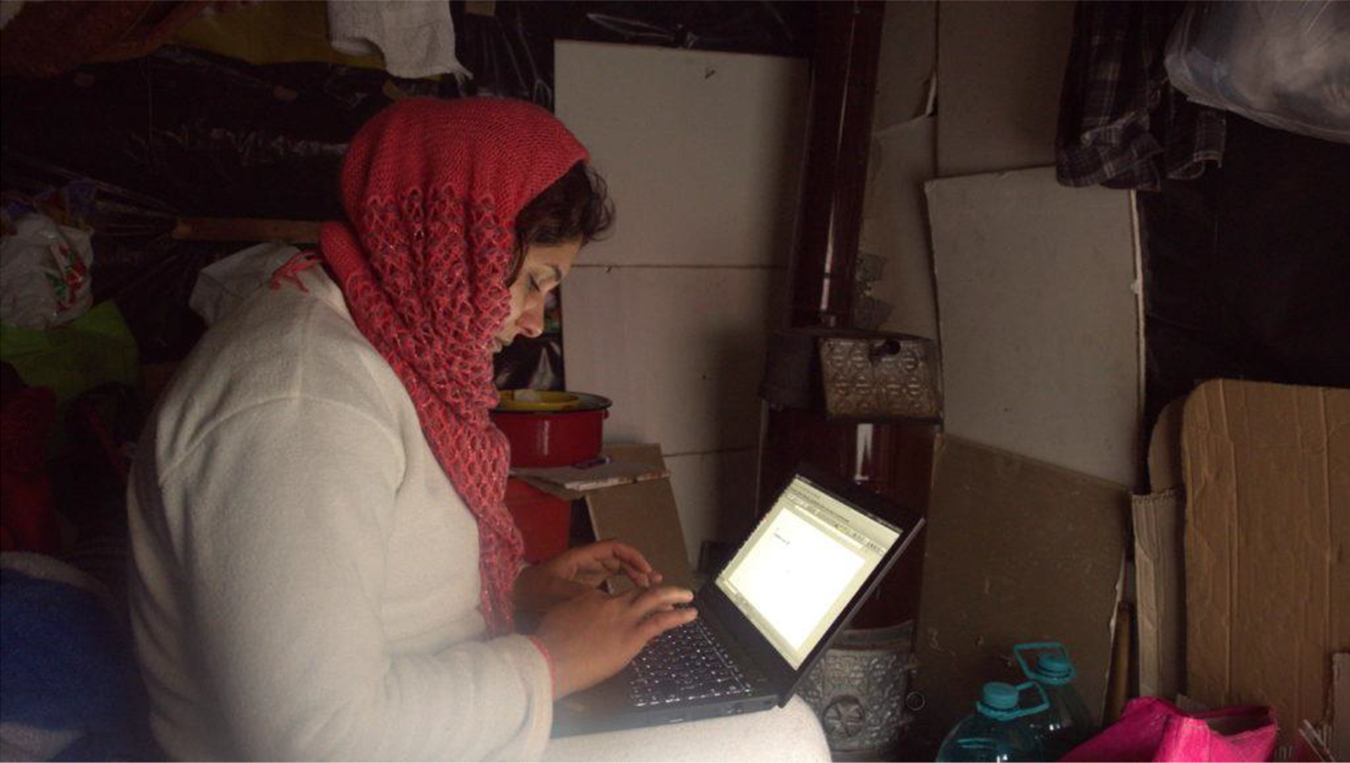
Nicoleta writing a blog post on my laptop, January 2015 (Photo by Michele Lancione).
That politics is the ‘undercommons’ that I would like to occupy more and more in my academic practice (Moten and Harney, 2004), exploiting its privileges and adapting them to the issue at stake. This does not mean to diminish the importance of the academic practice in itself but to truly embrace and cultivate it as a political and intellectual praxis. The latter is not an institutional given. Being a ‘public intellectual’, in this sense, is more than simply ‘bringing the research back to the public’. If one is serious about the academic work as a political and intellectual praxis, being a public intellectual is about the constitution of the public through the research engagement: it is about, in other words, the use of intellectual labour and privileges to work with others in the making of a shared ground of action, a public domain of struggle. In that making, the academic needs to allow for his/her displacement: as much as the struggle is transformative for the other, it needs to be for oneself and related institutional backing. I am thankful to my comrades and to the work of colleagues like Ana, Katherine, Liviu and Maliq for providing a constant source of inspiration to move this whole assemblage forward.