



Abstract
At a time of ecological emergency there are pressing reasons to develop more responsive wellbeing-led governance frameworks that engage with both human and more-than-human wellbeing. Attempts to incorporate wellbeing indices into wellbeing-led governance include the Sustainable Development Goals of the United Nations, the Gross National Happiness index of Bhutan, and a variety of emerging wellbeing-led governance frameworks in the Organisation for Economic Co-operation and Development. Some of these frameworks have begun to include more-than-human wellbeing indices in their toolkit, but like many geographers and Indigenous scholars, we are wary of the dangers of universalising and abstractionist ‘indexology’ ( Ratuva, 2016). In this paper, we review wellbeing-led governance frameworks with a view to more-than-human wellbeing and Indigenous knowledge. We outline an emerging pluriversal and prefigurative project where Indigenous scholars engage with partners in co-creation methods in place, incorporating Indigenous-Māori cultural perspectives into more situated and holistic wellbeing tools. We argue that while critique is important, so too is engaging in Indigenous-led research interventions for transformative metrics and tools, particularly in these times of socio-ecological crisis. As we ‘stay with’ this trouble ( Haraway, 2018), we hope to contribute to a culturally specific place-based set of wellbeing indices and tools to inform wellbeing-led governance for more-than-human wellbeing.
Keywords
Introduction
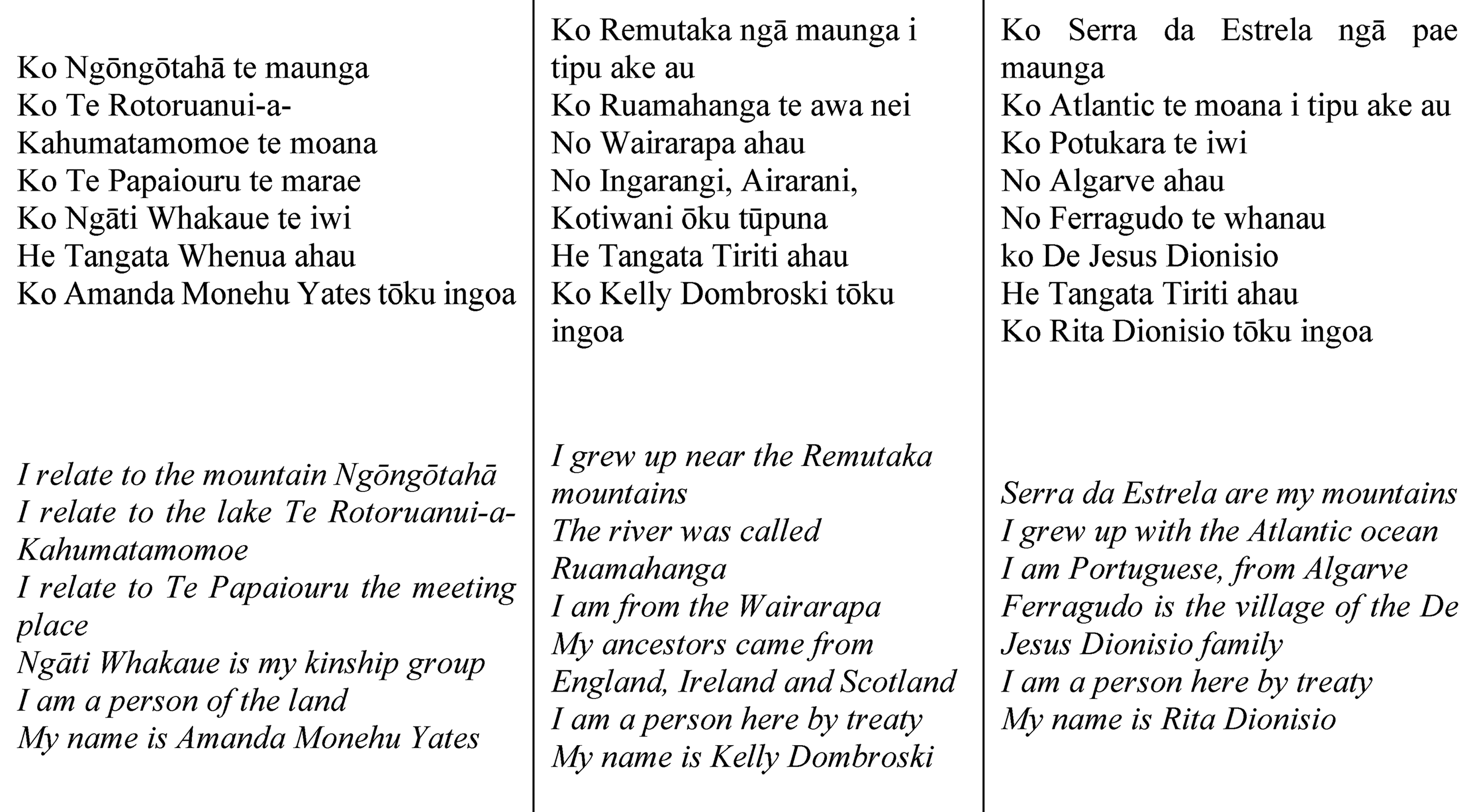
In this time of socio-ecological emergency, we begin by acknowledging the importance of the land with whom we live, who can be both ancestor and territory of tangata whenua, the Indigenous peoples (tangata) of this land (whenua). Before we begin our argument, we draw on the Māori custom of pepeha, short introductions that place us in the landscapes of our ancestors, to acknowledge our relationships with those who come before us. In the pepeha we acknowledge our positionalities as Indigenous-Māori, Pākehā New Zealand European, and a more recent European migrant, and the lands that have nourished us thus far. We acknowledge our interconnectedness with others in the wider human and more-than-human collective that has brought forth our collaboration with each other, the wider research teams, the iwi (kin group) organisation Te Tatau o Te Arawa and Ngāi Tūāhuriri hapū, and community partners and government organisations that have contributed to the work as we move into a new phase of place-based co-created research.
Such wider collectives are at the heart of the holistic wellbeing we seek to interrogate, imagine, and enable through this paper and our action research work in co-creating place-based governance frameworks with the goal of huritanga, transformation, in times of socio-ecological emergency. In short, we do not come to this dialogue in a neutral objective way; we do not seek to separate ourselves from the arguments we make and the research actions we engage in. Like Liverman (2018), who called for scholars and readers of Dialogues in Human Geography to engage with governance processes such as the SDGs, we seek to engage awkwardly in the essential change-making of our time of ecological crisis, rather than merely critiquing. We seek – with varying success – to stay in the place of immanence rather than transcendence. We choose to awkwardly engage (Tsing, 2005), to ‘stay with the trouble’ (Haraway, 2018), to ‘muck in’ (Wright, 2017), to be creative and collaborative with our community partners and our more-than-human relations in place. We aim in this research programme to do something, something more than critique, but yet to not be naïve in the fraught power relations of such an endeavour. This paper represents some of that story and sets a tūāpapa or foundation for our work as we move forward in co-creating wellbeing-led governance tools in place.
Wellbeing-led governance is well overdue. Decision-making centred on human and ecological wellbeing is a matter of crucial importance in the context of diverse and compounding worldwide crises – including those of climates, economies, urbanisation, pandemics, and accelerated extinction of species and cultures. Global governance approaches based on privileging gross domestic product (GDP) and export-oriented growth through global international divisions of labour are simply insufficient in fostering wellbeing for the vast majority of ecological systems and human societies. In the context of the ongoing COVID-19 pandemic, the utter inadequacy of some governance systems has been highlighted (Chapman and Blaschke, 2020; Hepburn et al., 2020; Oldekop et al., 2020), in particular, where wellbeing is not central to governance practices. The enormous importance and potential of wellbeing-led governance are starkly evident. Yet for too long, wellbeing governance practices have separated out the ‘social’ from the ‘economic’ from the ‘ecological’ from the ‘geological’, as if these dimensions were not interconnected and immanently present in a complex lifeworld that has always been more than ‘us’.
Governance, at its best, involves the coordination of societal interactions and outcomes that give effect to shared cultural concepts, values, and intentions (Yates, 2019b). In many Indigenous contexts governance is enacted for the vitality or wellbeing of ‘human/more-than-human hybrid collectives’ (Dombroski, 2016), rather than purely for and by humans. We use the term wellbeing-led governance here to refer to forms that directly address wellbeing as a core element of decision-making, thus representing a significant shift in governance orientation. Such governance has transformative potential as it coheres and holistically directs attention, analysis, and action towards what sustains life meaningfully (Yates, 2019b). In recent times there has been a burgeoning of wellbeing-led governance frameworks, including the United Nations Sustainable Development Goals (SDGs), the Organisation for Economic Co-operation and Development (OECD) Better Life index, and other national-level indexes. These frameworks are theoretical orientations, which are intended to assist decision-makers to consider the wellbeing implications of their decisions, via a variety of tracking tools and indices. The particular definitions of wellbeing used by decision-makers vary, but usually include elements of human wellbeing: material, physical, psychological, social, community, and occupational wellness (McKinnon et al., 2020; Wiseman and Brasher, 2008), with geographers paying attention to the places in which wellbeing is enabled or prevented (Conradson, 2003) and, increasingly, the wellbeing and agency of place itself (Bawaka et al., 2016; Larsen and Johnson, 2017).
Despite a colonial history of human-centred wellbeing, we can see examples of culturally diverse, place-based, ecological approaches landing in ways that are transformative. Ancient cultural paradigms are registering anew as Indigenous more-than-human wellbeing concepts and registers come to influence scholarly thinking (Singh, 2022) and governance frameworks in a variety of places. In recent times, the SDGs and Bhutan's Gross National Happiness index have come to soften the human-centred assumptions implicit in such governance frameworks through the inclusion of a wider range of environmental indicators. The Bolivian Government's recognition of Mother Earth and her wellbeing rights in 2010 (Natlex, 2010) provides hope for a more holistic understanding of wellbeing-led governance, as does the recent success of the Aotearoa New Zealand Whanganui iwi in gaining protective recognition for their river-ancestor, Te Awa Tupua, as a legal personage (Fisher and Parsons, 2020). These examples begin to incorporate Indigenous understandings of wellbeing and reality into national legislative and governing frameworks and provide some hope that the more-than-human can be legally recognised as more than a resource for humans, as it already is in Indigenous thinking (Watene and Yap, 2015). Such an order of change, where colonial conceptual frameworks are overturned, is transformative both in terms of the normalising of ecological-relational thought and the legislative support for wellbeing-led practices (Argyrou and Hummels, 2019; Charpleix, 2018; Collins and Esterling, 2019; Hutchison, 2014; Yates, 2019b). Rather than colonising or homogenising through performing the ‘great singularity’ of Western knowledge (de Sousa Santos, 2014), these are pluriversal (Escobar, 2018) approaches that activate culturally diverse, place-based ethics and actions for ecological and social wellbeing.
This paper outlines emergent approaches to wellbeing-led governance via analysis of wellbeing frameworks, with an aim to contribute to dialogues in wellbeing. After laying out some of the issues around wellbeing-led governance frameworks that draw on colonising Western notions of reality, we outline our own action research intervention, partnering with Indigenous organisations and drawing on Indigenous Māori concepts. An aspect of the research involves the co-creation of tools that can further embed more-than-human and human wellbeing into decision-making frameworks. This is research as prefigurative politics where we are consciously participating in performing the world, collaboratively enacting the change we want to see. We argue that such pluriversal immanent approaches to tool-making avoid some of the colonising pitfalls of hegemonic wellbeing-led governance frameworks and indices, while also having transformative potential with extensive effects. We describe emerging co-created tools that integrate more-than-human wellbeing into decision-making, and could enable a shift in paradigm from ecological disconnect to the immanent socio-cultural-ecological connection where wellbeing occurs in the connectivity of human and more-than-human (Yates, 2019a). For us and many others, such integrative or relational wellbeing frameworks are urgently needed at this time of ecological emergency.
Wellbeing-led governance frameworks
For too long, colonial governance frameworks have based decisions on simplistic economic tools such as GDP and GDP per capita. Such economic tools operate within governance frameworks that understand much of the natural world to be at the service of human needs, and even seem to see human needs as a function of a ‘healthy’ economy (Waring, 2018). GDP-based governance has prioritised the so-called wellbeing of the economy over both human and more-than-human wellbeing. Critiques of GDP-based governance have been widespread in geography, development studies, and other social sciences. Such critiques have shown how GDP is not statistically related to happiness, is only loosely connected with human health, and is completely dissociated from environmental health (Smith and Dombroski, 2021). GDP, it is clear, is not a good fit for governance and decision-making when human and environmental wellbeing is the core goal (Raworth, 2017). Other kinds of governance tools and frameworks have emerged over the last few decades, many of which offer more nuanced ways of making decisions based on wellbeing. Many of these governance tools and frameworks have embedded Eurocentric and universalist assumptions (Durokifa and Ijeoma, 2018), but what is of interest here is the fact that the frameworks attempt to centre wellbeing in decision-making over abstracted measures of economic health. This includes the United Nations’ Millennium Development Goals (MDGs) and Sustainable Development Goals (SDGs) and other wellbeing-led governance frameworks such as New Zealand's living standards framework and wellbeing budget and Bhutan's gross national happiness (GNH). Governance frameworks for indicator-based decision-making for wellbeing have also emerged in health boards and city councils (Waring, 2018; Wiseman and Brasher, 2008). While each of these frameworks centres (or claims to centre) wellbeing, they by no means define it in consistent ways. They do, however, visibly build consideration of ‘wellbeing’ into broader decision-making structures supported by specific tools such as indicators, indices, targets, and dashboards. This section briefly tracks the ways in which geographers and other scholars have responded to such shifts in governance frameworks and outlines some of the important critiques that have emerged.
The MDGs set out to eradicate poverty and improve social and economic wellbeing in a sustainable way (Giovannini, 2013). Scholars have noted how the MDGs focussed primarily on the so-called developing world, and were a governance framework aimed mainly at decision-making for and by developing countries (Liverman, 2018). The SDGs are built on a wider consultation process with a working group with representatives across more than 70 countries and are aimed at improving wellbeing in both developed and developing nations, with more extensive environmental wellbeing considerations (Liverman, 2018; Murray et al., 2017). Thus the SDGs, in contrast to GDP-led decision-making, seek to inform a wellbeing-led governance framework, where institutions can use SDG goals and targets to inform resource allocation and decision-making, and indicators to track outcomes at a number of different scales.
Yet, a number of critical scholars have pointed out that the SDGs are limited by their business-as-usual underpinnings (Hickel, 2015) and fail to mention or engage with Indigenous worldviews (Yap and Watene, 2019). Economic anthropologist Jason Hickel is scathing, particularly of the ways in which indicators of poverty are kept far too low in order to show ‘progress’ against the goals. He writes: Eradicating poverty of this magnitude would require more than just weeding around the edges of the problem. It would require changing the rules of the global economy to make it fairer for the world's majority. The SDGs fail us on this. They offer to tinker with the global economic system in a well-meaning bid to make it all seem a bit less violent. (2015: 1)
Postdevelopment scholars like Arturo Escobar (2004, 2018) and Boaventura de Sousa Santos (2014) argue that universalising sets of development goals are themselves violent, in that they violently erase other epistemologies and other ways of knowing and making a good life, such as buen vivir. In many ways such development goals could be seen to produce poverty even as they seek to fix it (Illich, 1992). Pacific studies scholar Steven Ratuva points out that many of the targets and indicators incorporated into global development indexes are based on ‘the selective choice of variables which tend to promote neoliberal and Western values and achievement’ (Ratuva, 2016: 220). Māori philosopher Krushil Watene and economic researcher Mandy Yap point out that despite active Indigenous resistance to indicator-based development strategies, Indigenous understandings of wellbeing and sustainable development are not meaningfully represented in the MDGs or SDGs (Yap and Watene, 2019). Feminist economic geographers Michelle Carnegie, Katharine McKinnon, and Katherine Gibson point out that many of the equity indicators in use globally are ‘not well suited to revealing the nuances of inequity at the local level or, crucially, reflecting the goals and aspirations of local communities across different places and cultures' (2019: 1). In short, large-scale sets of goals, targets, and indicators, set by powerful organisations in global contexts, depoliticise global inequality and reduce it to a universal to-do list, imagining each task can be checked off item by item as if it were an unrelated set of overdue tasks on an office whiteboard. Yet without addressing the underlying systems of exploitation, colonialism, and oppression that have created much of the wellbeing crises the SDGs are meant to address, how can such goals ever be achieved?
In this socio-cultural-political context, the SDGs are fraught. On the one hand, the SDGs represent a global agreement that the wellbeing of people and planet need to be at the core of global partnerships in decision-making – a worthy goal! On the other hand, this potential is defused through targets and indicators tied to global economic and political processes trapped in ever-increasing cycles of production, consumption, and resource extraction. Yet what interests us here is the widespread buy-in to a governance framework that ostensibly prioritises wellbeing for both humans and ‘the environment’. As Steele and Rickards argue, in many ways the SDGS are ‘an imperfect but crucial and collective witness statement to the unsustainability of our age’ (2021: 3). If we were to actually achieve the goals, as laid out in the targets and texts, it would require a ‘profound paradigm shift in the dominant cultural values and in economic, ecological, and political processes that shape and reproduce our shared world’ (Healy et al., 2019: 1). That is, business as usual could not continue.
The idea of making decisions based on measurable changes in wellbeing has promise as a kind of biofeedback mechanism. Could it be embedded meaningfully in place and culture, with meaningful discussions around what wellbeing entails and how to track it? A variety of wellbeing and happiness concepts and indices have begun to be used at different governance scales to assess status and orient governance (Mumaw et al., 2017; Musa et al., 2017; Musikanski et al., 2017). These include the UN Development Index, Happy Planet Index, World Bank World Development Indicators database, Gallup-Healthways Wellbeing Index, the United Kingdom's Measuring National Wellbeing Programme, and the OECD Better Life Index. These incorporate environmental wellbeing in variable ways, sometimes only implicitly (e.g. the OECD index relies on a concept of intergenerational wellbeing that makes futurity a key aspect of the model). In 2009, a globally influential report by development economists Joseph Stiglitz, Amartya Sen, and Jean Paul Fitoussi suggested a fundamental change from ‘measuring economic production to measuring people's wellbeing’ (Stiglitz et al., 2009). In 2018, the leaders of Scotland, Iceland, and New Zealand formed the Wellbeing Economy Governments (WEGo) group, whose goal was to: implement economic policies with the objective of delivering the collective wellbeing of their nations, looking at how happy the population is, not just how wealthier it is, creating fair work that is well-paid and based on worthwhile and fulfilling work, and which values a transition to longer-term sustainability. (McGlade, 2020: xiv)
The same dangers apply however, with regard to the use of indices in decision-making. In the context of security indices, Ratuva (2016) describes how even with a wide range of possible variables, those that end up being selected seem to always ensure that the Western states are always ranked above the states of the Global South, partly because of the inbuilt biases of those doing the selecting. Merry sounds a similar alarm around the use of indices: As indicators become increasingly central to global reform and global governance, it is critical to examine how they are produced and how the forms of knowledge they create affect global power relationships. They influence the allocation of resources, the nature of political decisions, and the assessment of which countries have bad human rights conditions. (Merry, 2011: 85)
It is clear that multiple scholars have engaged with the SDGs and other indicator-based wellbeing frameworks, primarily from a place of critique. Diana Liverman (2018) made a strong case for geographers and readers of Dialogues to engage more explicitly with global processes such as the creation of the SDGs, and to use our skills and knowledge of critique to participate in the process of metric creation. We would add that this participation is always political – and we must go in with full awareness of the colonising potential of such metrics. How can geographers and other scholars work with others to create place-appropriate or decolonising metrics? We can learn here from one of the earliest national-level attempts to create wellbeing governance indicators. The Himalayan kingdom of Bhutan led the world in its attempt to meaningfully develop culturally and place-appropriate indicators for collective happiness-led decision-making. Others, including New Zealand, have developed statistical indicators in collaboration with Indigenous communities in place (Yap and Watene, 2019), such as Statistics New Zealand's Te Kupenga process (Wereta and Bishop, 2006; Statistics NZ, 2019). We turn next to examine place-based attempts to derive indicators for wellbeing-led governance.
Pluriversal wellbeing-led governance tools
Avoiding the universalising tendencies of UN-led governance frameworks, Bhutan has for some time now developed and implemented an indicator-based wellbeing-led governance system that has emerged from and engaged in a single place. Bhutan's 4th King Jigme Singye Wangchuck famously stated in 1972 that gross national happiness is more important than the gross national product. Based on his understanding of the issues prevalent in the Western world (through his studies and travels), he expressed a desire to have Bhutan retain much of its national characteristics and unique culture and environment while beginning to engage with the economies of other nations. Recognising the limitations of measuring wellbeing based on the gross national product, his idea for GNH was taken up by researchers at the Centre for Bhutan Studies (Ura et al., 2012), who developed a sophisticated series of indicators and a framework through which to measure wellbeing according to the values of Bhutanese people. The GNH is expected to balance human and more-than-human needs, while also meeting the material, social, and spiritual needs of human beings (Pem, 2018). While Bhutan has taken up some new practices from other parts of the world, including becoming a parliamentary democracy, and the use of indicators to measure ‘progress’, it is also a rather unique example of the deliberate incorporation of a more-than-human ontology into a wellbeing governance framework.
The GNH recognises four pillars, which are considered core to the wellbeing of Bhutan. The pillars ‘are based on traditional Buddhist views and values, including respecting other humans and non-humans’ (Pem, 2018: 17). These core pillars include the preservation and promotion of Bhutanese cultural values, a wellbeing concern that Eurocentric goals such as the SDGs consistently overlook, particularly with regards to Indigenous peoples (Watene and Yap, 2015). Beginning with these pillars, the researchers then faced the task of working out how such values would be realised. The benefit of measuring wellbeing through something as simplistic as GDP is that change can be relatively easily measured over time using financial data, and track such change against policy. How then to measure changes in wellbeing using GNH as Bhutan opened its kingdom to the rest of the world? The researchers went through a very deliberate, representative process whereby the understanding of happiness was captured through a number of diverse indicators in each sphere, and minimum target levels were established. Amazingly, the researchers sampled 8700 people out of a country of only 300,000. People are recompensed a day's wages to be interviewed, a process which in the early stages of the methodology involves some 9 hours of questions (now down to 3 hours) (Mcarthy, 2018). The indicators – and the happiness changes thus tracked – are specific to the Bhutanese culture, however, and are less relevant to some of the minority groups in Bhutan such as Hindu minority groups and Indian migrant workers. 2 However, the fact of an alternative wellbeing-led framework, and the process of implementing such a framework are what interests us here. Going through the process of defining wellbeing according to cultural norms, developing a framework, using indicators and tracking change, give us insight into wellbeing governance frameworks based on other Indigenous ontologies (Pem, 2018). It disrupts the colonial ontologies of wellbeing governance as it both critiques Eurocentric ontological framings of wellbeing, and produces and performs a real-life alternative governance framework that emerges from the place. Could this be a productive example of a prefigurative and pluriversal politics?
Since then, other possibilities for pluriversal indicators have emerged. Marilyn Waring reviews a number of places in the world where time-use data and wellbeing indicators have been incorporated into data used in governance, including Canada and New Zealand (2018). In Aotearoa New Zealand, governance is informed by the Treaty of Waitangi, Te Tiriti, the 1840 agreement between Indigenous Māori (tangata whenua) and settler Europeans (tangata tiriti). Te Tiriti guarantees space for co-governance by Māori for Māori, and while this has been ignored and prevented by racist and colonial practices and ideologies, in recent times co-governance has emerged as a more widespread aspiration for both Māori and non-Māori (Charters et al., 2019; Kiddle et al., 2020). Indeed Statistics New Zealand, the government office responsible for developing statistical processes for governing the country, developed an additional framework for Māori wellbeing that uses post-census sampling to track Māori wellbeing on a set of indicators developed with reference to the values of Māori communities (Wereta and Bishop, 2006; Statistics NZ, 2019). A number of other tribal organisations in Aotearoa New Zealand have collaborated with researchers to develop place-based tools for tracking wellbeing, including He Tohu Ora, the indicators for wellbeing that the South Island iwi Ngāi Tahu developed in partnership with a District Health Board (DHB). 3 While the latter tool reports back to the iwi and DHB to inform decision-making, the former examples still mainly feed data back into national-level governance and policy-making. Other groups have been working to measure or reinstate environmental health, as part of a holistic approach to wellbeing that links ecological and socio-cultural health as one (Kahui-McConnell, 2019; Smith, 2012). What would it look like if more iwi, urban and local communities had access to the kind of data they need to track the effects of their decision-making, and to guide decisions for intergenerational socio-ecological wellbeing?
In what follows we describe emergent attempts to develop a customisable, place-responsive tool for wellbeing-led decision-making built on the holistic Māori wellbeing concept of mauri ora. We then move on to discuss the implications of such a project in wider wellbeing-led governance thinking in Aotearoa New Zealand and beyond.
Co-creating place-based tools for mauri ora and holistic wellbeing
This research programme builds on first author Yates’ Indigenous urban wellbeing research. Indigenous relational ontologies position multi-species co-existence and more-than-human wellbeing as foundational ‘realities’ – and therefore also structure urban conditions and obligations. The Māori concept of mauri ora is central to this work, which grounds and orients our research, along with co-creation methodologies (Dionisio et al., 2021). Mauri ora is a radically inclusive notion of wellbeing that pertains to all more-than-human entities, including mountains, rocks, rivers, atmospheres, birds, fish, and humans. Mauri has been described as an indissoluble ‘network of interacting relationships’ by leading Māori wellbeing researcher Mason Durie (Rangitane, Ngāti Kauwhata, Ngāti Raukawa) (see Durie, 2001: x). Mauri is the force of life which is ‘immanent in all things, knitting and bonding them together’ (Marsden, 2003a: 47). Mauri is connected with ora, referring to life and wellbeing: here the world, te Ao, is alive, dynamic, and relationally inter-connected. Life pervades through all things that might be considered ‘inanimate’ or not ‘alive’ in Western thinking, as a kind of life-field (Yates, 2016).
Mauri ora may be understood as ecosystemic integrity, the ‘ultimate vitality of ecosystems and resources’ (Smith, 2012: 21). But this interactive web of life is something more than an ‘ecosystem’, or, it is ecosystem as a familial network. Mauri ora interacts with whakapapa (genealogical connections), where Māori familial lineages are narrated back through multispecies lineages to Papatūānuku Earth and Ranginui Sky (Randerson and Yates, 2016). Māori have a sense of an ethical obligation to our more-than-human kin groups to enhance their lives and vitality (Watene, 2016; Yates, 2016, 2021). Critically the relationship is one of belonging to place rather than of extractive ownership. Such Māori narratives of obligation to the wellbeing of multi-species kin have enormous potential to be enacted as socio-cultural-ecological urban regeneration that holistically improves wellbeing (Yates, 2008, 2010, 2021). Such more-than-human wellbeing concepts can support the holistic wellbeing-led urban governance frameworks needed in this era of emergency (Yates, 2019a). While Western approaches to wellbeing-led transformation have been important, we agree with the assessment of Māori philosopher Krushil Watene (Ngāti Manu, Te Hikutu, Ngāti Whātua o Orākei, Tonga), who describes how both Amartya Sen's and Martha Nussbaum's approaches to wellbeing emphasise valuable participatory democracy principles but still exclude ‘nature’ in their restrictively human-centric wellbeing constructs (2016). As Watene notes, differences in cultural perceptions of nature relationships and obligations create differing definitions of what constitutes wellbeing – in theory and in practice. Such kin-based approaches to the more-than-human invite relational approaches to flourishing (Tschakert et al., 2021).
So how might governance shift through engagement with concepts of genuine and relational flourishing, mauri ora as human and more-than-human wellbeing, and an obligation towards multi-species justice? The example of the Whanganui river ancestor, Te Awa Tupua, recognised as a legal person in 2017, is instructive here again. Previous settlements between the New Zealand Government and iwi Māori under Te Tiriti (the Treaty of Waitangi) re-enacted Western understandings of property through transferring land, fishing quotas, and cash, despite Māori understandings of kinship with land and water (Muru-Lanning, 2016). The settlement for iwi in Whanganui, however, provided for recognition of their kinship relationship to the river through Te Awa Tupua (Whanganui River Claims Act) 2017 (Salmond et al., 2019). The agreement is highly significant in that it challenges the ontological foundations of the modernist New Zealand legal framework. The ‘ownership’ of the riverbed is now vested in the river itself (Charpleix, 2018; Collins and Esterling, 2019; Hutchison, 2014). While the legal definitions of ‘ownership’ or even ‘legal personhood’ do not coincide with Māori understandings of the relationship, the goal was to use the coloniser's legal framework to enact something closer to Māori realities (Salmond et al., 2019). This governance approach establishes legal and institutional grounding for adapting colonial governance structures to better interact with ancestor-rivers, and ancestral forest entities, as indivisible living entities whose wellbeing must be maintained alongside broader interdependent more-than-human systems. Such an approach begins to privilege more-than-human wellbeing concepts and shifts governance constructs in a way that acknowledges the agency of more-than-human actors. Since that time, researchers have begun to lay out the kinds of rights a river might have in and of itself that are not simply about its ‘services’ to humans, such as the right to flow, the right to diversity, and more (Salmond et al., 2019). 4
This prefigurative pragmatism – working within a colonising framework to effect meaningful change – is a fundamental aspect of a decolonising or transformative project, and of our research. While the discussion above refers to a New Zealand example, we can see how the SDGs might also be productively leveraged, deconstructed, and reconstructed to effect pluriversal change. New Zealand is a signatory to the SDGs but has developed the Living Standards Framework around national priorities and concerns that acknowledge, but do not line up directly with the SDGs. Treasury is currently developing wellbeing indicators to measure progress against the Living Standards Framework. In some ways, this reflects the same kind of pragmatism, although often consultants and scholars from other parts of the world ask in frustration why New Zealand always thinks it has to develop its own approach rather than adopt those developed elsewhere. In many ways, this is a bicultural nod to recognising that political and cultural reorientation is needed to register pluriversal differences and realities on the ground (e.g. Te Puni Kokiri, 2019). Prefigurative pragmatism is the context and practice of our research project as it begins to engage with Indigenous organisations to co-create indices and tools that enable such more-than-human wellbeing to be further centred in decision-making and practice. We outline below the first steps we have taken in such a project through co-creating a decision-making tool built on mauri ora thinking.
The Mauri Ora urban wellbeing research project we describe below is a key platform for Huritanga, 5 a stage two urban wellbeing research programme funded by Aotearoa New Zealand's Building Better Homes, Towns and Cities National Science Challenge. 6 The Huritanga Mauri Ora project builds upon stage one (2017–2019) mauri ora urban wellbeing research led by Yates, which involved: the development of a socio-cultural-ecological urban wellbeing framework; an outline urban wellbeing index, with culturally specific indices; and a future-focussed urban wellbeing ‘compass’ that visualises wellbeing indicators and directions (2019a, 2019b). For the second stage of the programme, the focus is on developing situated or place-based tools with communities. For this cultural place-based research Tiriti (Treaty of Waitangi) partnership and co-creation approaches are central to a research methodology guided by mauritanga (practices of integrated wellbeing) (Yates, 2021). The principles of whanaungatanga (trust-based relationships), and manaakitanga (care and ethics) are also key principles to give effect to Te Tiriti and enable mātauranga Māori-led governance approaches (Dionisio et al., 2021; Yates, 2021). Yates, Dionisio, Professor Angus Macfarlane (Ngāti Whakaue), Dr John Reid (Ngāti Pikiao), Dr Jay Whitehead (Ngāi Tahu, Ngāti Māmoe), and Grace Walker (Ngāruahine, Ngāti Kahungunu) are mauri ora urban wellbeing researchers contributing to bringing the tools to ground, in detail, in place.
Our research platform is built on an established working relationship with Rotorua 7 -based iwi (kinship group/s) through team members Dionisio and Macfarlane, who had worked with Te Tatau o Te Arawa, a Rotorua iwi group with a co-governance role with Rotorua Council, and Ngāti Whakaue iwi for a number of years on another urban research project. Yates and Macfarlane also whakapapa or relate to Ngāti Whakaue; the family relationships, long histories, and shared cultures enable a meaningful and layered collaborative relationship. Reid, a senior researcher with the Ngāi Tahu Research Centre at the University of Canterbury, has ongoing connections with Canterbury/Ōtautahi Christchurch 8 based Ngāi Tūāhuriri (kin- and Ngāi Tahu iwi (kin-group). Trust-based relationships were thus in place, through whakapapa and other relational connections, before co-creation even began.
The place-based tool-making process begins with a ‘kit of parts’, an outline set of urban social, cultural, and ecological indices or actions guided by the holistic mauri ora wellbeing framework of stage one (Yates, 2019b). Both the data indices tool and the compass offer different approaches to grounding a more holistic and situated socio-cultural-ecological wellbeing framework. The data indices tool maps holistic wellbeing indices visually to enable a summative understanding of key conditions or life-signs of place now. In the future-focussed wellbeing compass, the indices are reframed as actions for enhanced holistic wellbeing. Both data index and compass are framed around a zero-carbon energy economy, and consider the urban as a complex condition of hard and soft infrastructures and ecologies, and place-based, socio-cultural practices and knowledge systems. Both starter-kit tools are structured by strategic socio-cultural-ecological areas of concern identified by Yates in her previous work: wai-ora, vital water-based ecosystems; whenua-ora, vital land-based ecosystems; kāinga-ora, zero-carbon living buildings; waka-ora, active and zero-carbon transport systems; ōhanga-ora, circular zero-carbon bio-economies; and hapori-ora, connected communities. In the following, we discuss the co-development of a first place-based data indices tool and compass. 9
The ‘kit of parts’ is used in co-creation workshops with community partners. Through conversation, a suite of indices is assembled from kit-of-parts options or from new indices that arise in dialogue: together these visualise and put into relation key life signs or wellbeing actions. The holistic wellbeing data indices tool is intended to provide a live diagnostic data-display, visualising key urban activities in relation to their holistic wellbeing effects. The concept has been drafted into a design visualisation concept (Figure 1) which shows thresholds of wellbeing in each area of concern, expressed as mauri ora, ‘well’, or mauri mate, ‘unwell’. For example, indices enumerating te reo Māori language speakers identify cultural continuity; indices for local biodiversity can signal urban ecological health, and indices for zero-emissions energy represent the degree to which the local energy system is decarbonised. Critical global life signs can also be registered – biodiversity loss and climate change indices, for example – as part of holistic attention to the wellbeing of the mauri ‘life-field’ of this living planet.
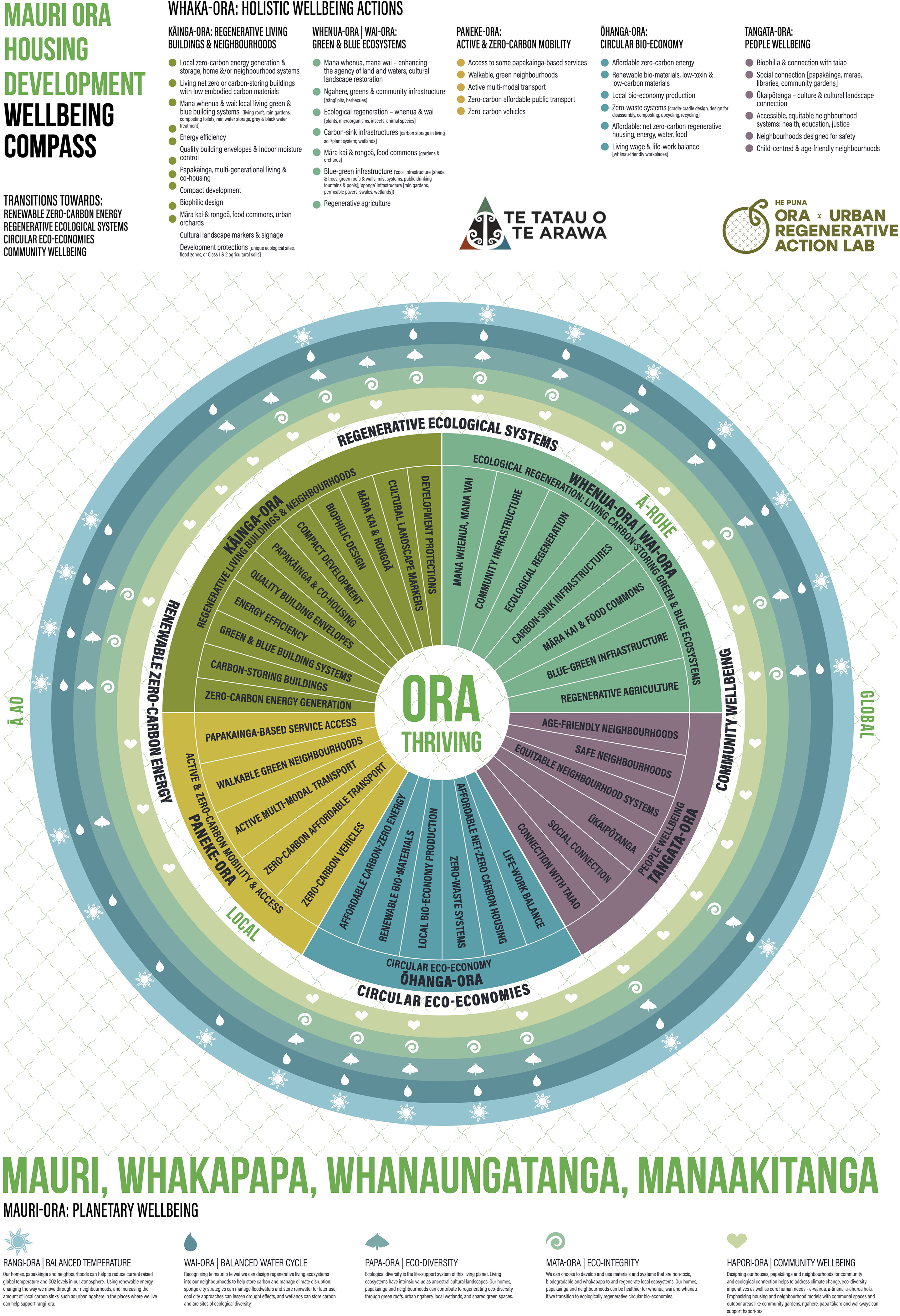
Te. Tatau Housing Development Mauri Ora Urban Wellbeing Compass. Co-design partner: Te Tatau o Te Arawa, with Huritanga Mauri Ora researchers. (Kit of parts designers: Amanda Yates, Kyra Clarke and Fiona Grieve).
In Ōtautahi Christchurch, Dr John Reid (Ngāti Pikiao) has begun a collaborative process of working with the highly detailed environmental management plans of local hapū Ngāi Tūāhuriri, to develop local socio-cultural-ecological indices and initiate a Christchurch-based tool. At this time the first collection of indices has been assembled by Reid and reviewed by Ngāi Tūāhuriri. In the next few months, we will begin to visualise these indices in a first place-based, iwi-partnered data display for discussion and further development. Place-based wellbeing indices or dashboards require consistent and particular data over time. Initial findings from city-level data searches have revealed a disrupted urban datascape where data-sets are discontinuous over time and between cities. Already we can see that this place-based dashboard can help to visualise culturally and ecologically specific indices and issues, and prompt more consistent local data-collection and usage.
The co-creation process with Rotorua-based Te Tatau o Te Arawa has also been grounded in published iwi plans. The Te Arawa Vision 2050 (2020) sets out key strategic directions for Te Arawa communities, economy and built and natural environment to 2050. Co-created through workshops, interviews and surveys with Te Arawa kin, the Vision focuses on mauri ora, holistic wellbeing, as the key strategic orientation. The Mauri Ora research team came to the collaboration with the kit of parts outline data tool and compass. Initial meetings, in 2019 and 2020, between Jude Pani, Director of Te Tatau, Dionisio, and Yates confirmed that we shared mutual interests and commitments to advance mauri ora strategies in urban settings. Having agreed that there were significant overlaps in approach and good potential synergies we then met together in 2020, in a Te Tatau governance group meeting to discuss our shared focus on mauri, the value of the Mauri Ora framework and tools (data and compass) as analysis/action or decision/delivery instruments, and the kind of small scale pilots we would like to see that would test out our collective wellbeing aims. Further meetings, in 2021, with Te Tatau researcher Jenni Riini, Pani, Macfarlane, Dionisio, and Yates discussed how the compass could be utilised by Te Tatau o Te Arawa as a means of grounding their Vision 2050: Te Tatau o Te Arawa subsequently decided to co-develop a housing development wellbeing compass.
In an initial housing wellbeing compass co-creation workshop in 2021 with Te Tatau and researchers we discussed the context of the compass, and the key components as they relate to housing. In a subsequent co-creation workshop with Te Tatau and a Kainga-Ora (New Zealand government's housing and urban development body) representative we went through identifying each indicator or wellbeing action that related to housing and its larger neighbourhood and ecological context. Te Tatau subsequently presented the housing compass to hapū (kin-group) representatives who supported the tool for its capacity to represent and ground what matters to them. Valuable feedback has been received in the form of suggestions to translate some of the more technical terms, to build local capacity, and to reference whakapapa (multi-species ecological lineage) as a primary context for the tool.
The Te Tatau neighbourhood and housing wellbeing compass articulate a detailed set of actions and approaches that enables the operationalising of the mauri-led Vision 2050 housing strategy. For example, the kāinga-ora zero-carbon living buildings section of the compass emphasises multi-generational co-housing initiatives like papakāinga, building-based or district renewable energy systems. The wai-ora and whenua-ora living ecosystems sections emphasise regenerating degraded landscapes, including key local cultural landscapes such as ancestral awa (rivers) or ngāwhā (hot springs), and emphasising ecological infrastructures such as functional wetlands for their multi-benefits – carbon storage, ecological remediation, and socio-cultural wellbeing effects.
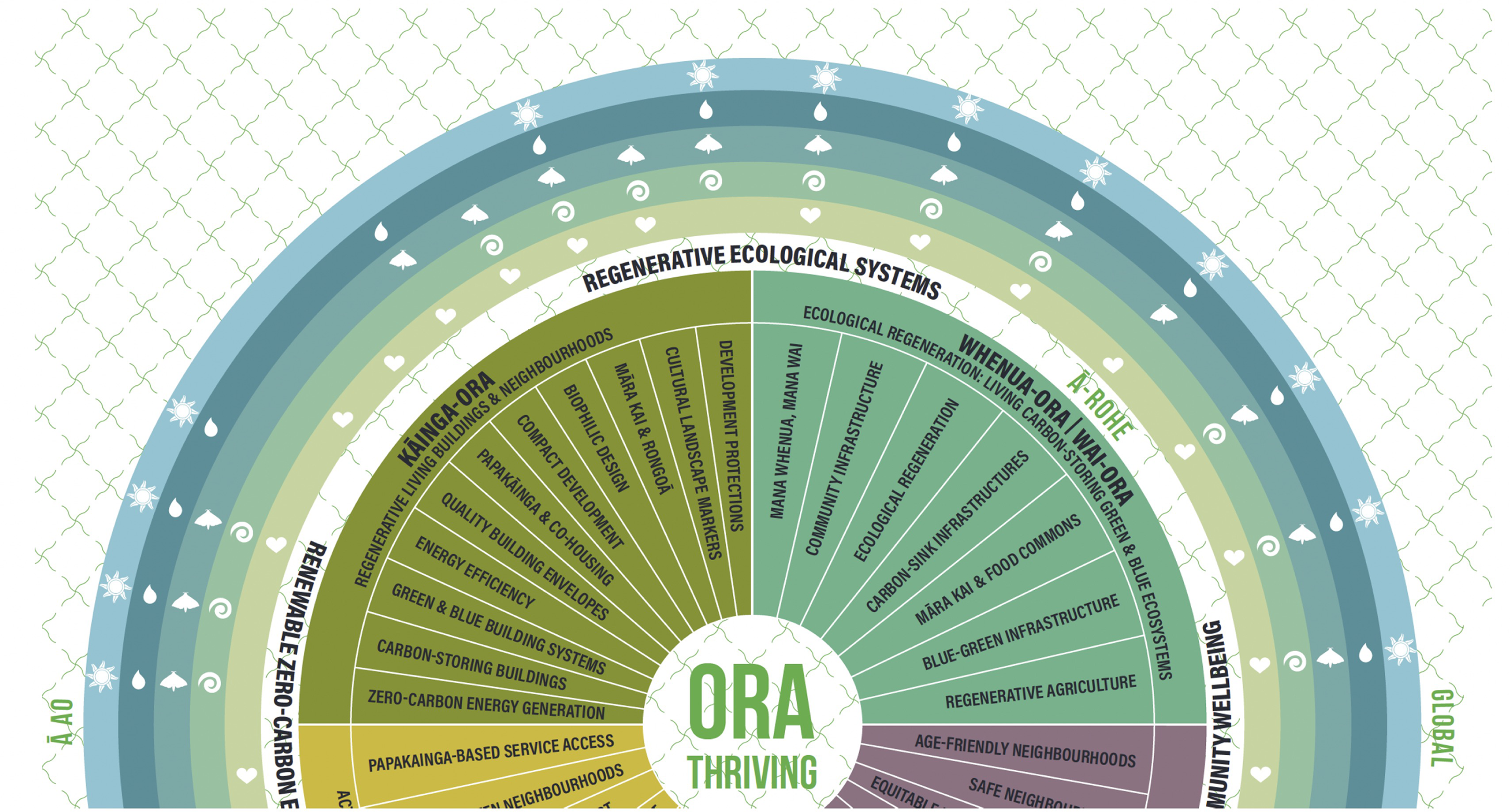
Detail: whaka-ora or holistic wellbeing actions.
The compass acts as a cultural communication tool between Te Tatau o Te Arawa and its governance and development partners such as the Rotorua Council and Kāinga Ora, as it presents a set of tactics to enhance mauri (social, cultural, and ecological wellbeing). Te Tatau will shortly begin to run workshops with hapū (smaller kin-groups) planning housing and neighbourhood development projects, and the research group will contribute to this ongoing engagement process.
In parallel, Te Tatau o Te Arawa and our Huritanga researchers are now working with Rotorua Council to add an urban layer to the holistic wellbeing compass. This collaborative urban wellbeing compass will help to coordinate urban strategy and actions towards holistic wellbeing. The shared compass will help to operationalise Te Arawa's aims for urban strategy development for the city of Rotorua and land Rotorua Council's strategic areas of focus that include wellbeing, urban regeneration, and housing provision.
Critically, in this stage two place-based research, the data indices tool and compass are coming to ground in specific communities as scaffolds that support the growth of community-held visions and plans for a more thriving future. The interface between the data indices dashboard and the future-focussed compass is strategic – the data indices identify key points for holistic wellbeing while the compass brings those transformative actions together to guide more positive practices. Used iteratively over time by activated communities these wellbeing indices and future-focussed compasses can support decision-making for system change. These are yes, an instrumental means by which to try to ground immanent place-based ontologies. As such, like the legislation that ascribes personhood to ancestral rivers or whenua (land), these tools are tactical and iterative prefigurative approximations. These aim at shifting existing policy and practice frameworks enough to register pluriversal place-based ways of knowing, develop culturally and ecologically specific wellbeing indices, indicators, and actions, and thereby afford a measure of more-than-human agency and wellbeing. These mauri ora tools disrupt colonial ontologies of wellbeing governance as they critique Eurocentric and human-centric wellbeing frameworks and produce and perform a pluriversal governance framework oriented to human and more-than-human wellbeing.
In dialogue: The possibilities of wellbeing-led governance in place
In this article, we have introduced an emerging mauri-led research programme. Here, co-creation processes focus on mauritanga (practices for holistic wellbeing) to enable place-based, pluriversal, community-led adaptations, and to unsettle the status quo of human-centric wellbeing governance. Expanding on critical geographies, we offer a critical practice that explores, speculates, adapts, and contextually grounds itself via co-creation processes that are inclusive to humans and more-than-human beings. This contributes to co-governance, co-design and co-management approaches (Fisher and Parsons, 2020; Ruru and Kohu-Morris, 2020), while expanding the possibilities for mauri ora, life-field wellbeing.
The work to develop and practice pluriversal ontologies in transformative wellbeing-led governance is ongoing at this time of ecological crisis. Decolonising wellbeing frameworks through thoughtful engagement and intersectional partnership in and with the place and with Indigenous peoples is critically important for everyone (Yap and Watene, 2019; Yates, 2019a, 2021). The intellectual paucity of the current anthropocentric framings of global wellbeing frameworks has become clearer to many. Recently geographers have better incorporated the more-than-human into wellbeing concepts. Such place-led wellbeing governance frameworks move beyond the abstractionist and Eurocentric governance frameworks that so often emerge from global processes. Co-creation processes have global and national significance, as they enable governance tools to be built in place with Indigenous knowledge systems, ontologies, and protocols of being with the more-than-human (Dionisio et al., 2021; Escobar, 2018; Puig de la Bellacasa, 2017; Yates, 2021). This is returning once again to our pluriversal foundation of co-creation with, for and as Indigenous and local knowledge systems.
For systems transformation to occur, we argue that pluriversal, co-developed wellbeing frameworks are crucial for both assessing change, and co-implementing it. When life-field wellbeing is built into place-based decision-making tools, wellbeing-led governance can become something more than business as usual, human-centred metrics. Place, in its entire human and more-than-human specificity, is not some peripheral oddity that falls under the SDGs or other global processes of change. Indeed, the scale of change is not from the global abstract to the local particular, but emerges from knowledge systems and ontologies embedded in place. The direction of change should certainly not always be radiating from the ‘West’ to ‘the rest’ in the way that many abstractified wellbeing-led governance frameworks might do. As researchers at this time and in this place, we should not only critique such frameworks, but also actively work at making something better. This paper has outlined some of our attempts to do this. We seek to create metrics that produce a pluriverse, that acknowledge and honour more-than-human wellbeing, and that are useable and adaptable for urban communities in a range of places.
Given the ontological importance of more-than-human kin here, a final question might be: to what degree are the more-than-human included in the process of governance, however, and who is governing whom? While place in all its human and more-than-human agency has a role in leading us to broader wellbeing concepts such as mauri ora, our position is that wellbeing-led governance is primarily a matter of ethical human activity. At this time we need to change dominant cultural systems, and relate better to all the entities that make up this living planet. Other entities have their own agency: Te Awa Tupua, the river ancestor mentioned earlier, is not for humans to govern, not a resource to manage but an ancestor and entity with the agency, able to self-repair and sustain others (Salmond et al., 2019), likewise Bawaka Country in what is known as Australia is such an active participant in its own ongoing story that it leads a team of co-authors in its writing (Bawaka et al., 2016). The question for humans is how to honour that agency, how to create governance frameworks that govern ourselves in ethical relations to entities such as Te Awa Tupua, and how to live in ethical relations to the mauri-infused ecosystems that support and sustain human life with generosity.
What does this mean for readers of Dialogues in places all over the world? As scholars and humans we can listen to the call to life in the places we dwell. We can develop scholarly practitioner frameworks that honour the call of these places, which refuse to be too abstract, too universalising, and which actively make space for other ontologies and more-than-human assemblages. Salmond, Brierly and Hikuroa (2019) refer to a Tūhoe Whanganui-based whakataukī (proverb) denoting intersectional identity: ‘ko au te awa, ko te awa ko au’, ‘I am the river, the river is me’, drawing attention to the connectivity of life. Such attention to connectivity and holistic wellbeing has led us to work in partnership with communities in place, not just in producing ideas for circulation and consumption, but also in trying to realise and practice those ideas in place in this time of ecological emergency. While governance frameworks and metrics can be problematic, abstractionist and colonising, we seek to engage and test out a pluriversal and prefigurative politics of action rather than merely critique. We aim to somehow contribute to transformative processes in this time where the action is needed from scholars and activists as part of larger communities of change. This is the work for us and other scholars in this dialogue: to engage in a messy and imperfect process of enacting our obligations as part of a wider more-than-human field, with whatever skills we have and can offer.
Ehara taku toa i te toa takitahi, engari he toa takitini – My strength is not as an individual but a collective.
Tihei mauri ora!
Footnotes
Acknowledgements
This research is part of an Urban Wellbeing research programme funded by the New Zealand National Science Challenge 11, Building Better Homes, Towns and Cities, which builds from previous research also funded by the Challenge. Huritanga: Towards Socio-Ecological Wellbeing-led Urban Systems in an Era of Emergency is a 4-year research programme funded by the Ministry of Business, Innovation and Enterprise. Amanda Yates and Rita Dionisio extend their warm thanks to Te Tatau o Te Arawa for engaging in this research collaboration, particular thanks to Jude Pani and Jenny Riiki. John Reid, Amanda Yates and Rita Dionisio acknowledge Ngāi Tūāhuriri and the productive collaboration to identify key place-based well-being indices. Kelly Dombroski would like to acknowledge Sonam Pem for enabling her 2018 visit to Bhutan and for familiarising her with many of the concepts around Gross National Happiness in situ and through her thesis work (all errors remain her own). We would like to thank current Challenge Co-Director (Tangata Tiriti), Dr Ruth Berry, former Challenge Co-Director Māori Dr Jessica Hutchings, and eminent researcher Prof. Angus Macfarlane for their intellectual contributions. We thank our three anonymous reviewers, and the generous feedback from Jocelyn Olcott, Riikke Prattes, Wendy Harcourt, Neera Singh, and Gradon Diprose on an early draft.
Declaration of conflicting interests
The authors declared no potential conflicts of interest with respect to the research, authorship, and/or publication of this article.
Funding
The authors disclosed receipt of the following financial support for the research, authorship, and/or publication of this article. This work was supported by the National Science Challenge Building Better Homes, Towns and Cities,

Supplemental material
Supplemental material for this article is available online.