



Abstract
In May 2016, it was more than 4 months, since the Ganitec University of Science and Technology went through an exercise for implementing an information system to manage the attendance, leave particulars and payroll of their employee. The management decided to replace their existing manual system with a new information system which was labeled “Cognitive Employee Management System.” In May 2016, spearheaded by a couple of faculty members, the Cognitive Employee Management System was finally implemented by a team of three students headed by the coordinator of the Information Systems Department of the Ganitec University of Science and Technology. Although the director envisaged lots of benefits, the changes were not really working out as he had foreseen. Why were people apprehensive about using the Cognitive Employee Management System when the benefits were apparent? How should the project rollout be planned in the Ganitec University of Science and Technology?
Profile of organization
Ganitec University of Science and Technology (GAST) was started as a private university in the late 1980s, and it is headed by an experienced academician who possesses significant research and administrative experience in higher education, both at the national and international universities of repute. GAST offers 17 undergraduate programs, 14 post-graduate programs and a strong doctoral program in science, engineering and technology.
As on April 2020, the teaching employee strength of the GAST stands at 365, while other technical and administrative employees were at 285. GAST is among the top private universities in India and is well recognized by its stakeholders—the students and the industry which recruits them, for their teaching and research. Every year, nearly 2300 graduates are graduated by this university and the gross revenue of the university is close to 230 million Indian rupees (US$3 million equivalent).
Structure of implementation team
The implementation of the CEMS was a project which was recognized by the senior management as one having strategic value and a long-term impact. It was seen to be a gradual move toward operational excellence. Due to this potential, the project implementation teams had frequent interaction with the top management of the organization.

Different employee management systems in practice
Different information systems (ISs) are available in the market for employee management like INTOWEB, HR Smart and WebERP4. These systems are expected to enable the top management check and track human resources utilization very easily. It makes the system easy to monitor and manage employees from different locations. This system helps in monitoring the workflow and productivity of employees. These systems also include a time-tracking system that helps to monitor the time spent by employees inside the office. All these features would certainly help the top management at the time of appraisals of the employees.
Implementation of a new IS project
The chairman of GAST, Helen, is always keen to transform the organization using emerging IS project implementations. Therefore, when he got to know about the CEMS, he was extremely upbeat and immediately decided to introduce the corporate practices into his educational institution to simplify and automate the existing processes of the attendance, leave, appraisal, new employee onboarding and payroll management of the employees. The chairman strongly believed that such automation would not only streamline and standardize their existing processes but also promote transparency, sincerity and punctuality among the employees. The plan of the chairman was to enable this business strategy by implementing a cost-effective IS project using the available infrastructure in the organization.
Initially, the chairman held several rounds of discussions with the Director, Peter, and the coordinator of the IS department, Jim. Most of such discussions focused on the cost of purchasing a suitable IT product along with necessary IT infrastructure. He also directed them to conduct a feasibility study for the implementation of a management information system (MIS) at GAST to meet the existing requirements. As a matter of policy, the management expects this new MIS to use cognitive automation for seamless workflow of their new system. Hence, this new system is expected to use artificial intelligence (AI) algorithms extensively in the background to provide data-driven insights for management. This should enable the senior management to take predictive decisions for the welfare of GAST, whenever needed.
After a few weeks, without conducting a very detailed feasibility study, Jim informed the Director that the cost of implementing an IS would be close to US$90,000 if outsourced but if developed in-house, the cost may become a third of the market rates. The director requested the coordinator of the IS department along with a couple of faculty members and students from his department to develop a similar platform to implement an MIS to manage the attendance and leave particulars of the employees and accordingly generate the payroll for them. They also named this futuristic IS solution as the “Cognitive Employee Management System (CEMS).” This reflects the director’s choice to go with the “make” decision while deliberating on the “make-versus-buy” decisions, including partnerships and alliances. This decision was, however, driven by the perception that a solution built in-house would have lower cost implications for the administration. The chairman was extremely happy and accepted the proposal put forth by Peter and Jim.
The director suggested to the project coordinator that the development of the CEMS should be completed within a short span of 4 months. Although this demonstrated his commitment well, to execute the decision of the chairman without any loss of time, the feasibility of the implementation remained less explored. This was further aggravated by Jim’s readiness to complete the project by just 3 months, 1 month ahead of the deadline fixed by the director.
In software estimation parlance, scope of work (also expressed in terms of business functionality provided) is one of the key inputs that determine the size of the final product being delivered. People playing the top managerial roles often confuse product size and duration. Peter is found to have used the “expert judgement” (Pressman, 2010) methodology to arrive at the duration of the project. This method does not involve any software engineering parameters that can be reasoned quantitatively, and the decision on the project duration relies on the expertise and domain knowledge of the people involved in IS projects.
The present IS implementation could be viewed as the strategy execution of the management of the GAST. In this case, the management plays the role of the strategy formulator and the IS department plays the role of strategy implementer and the expected outcome is improved services to the employees of the university through cost-effective IS implementation. If a company wishes to plan for a large software implementation project, it must define its needs in a sufficiently abstract way so that a proprietary solution is not pre-defined. This enables the actual contracting process by allowing multiple IS vendors to contest so that the actual requirements may be resolved without any major specific technology dependency.
Once a contract has been awarded to a specific IS project implementation partner, the partner must write a system definition for the client in more detail so that the client understands and can validate what the project is expected to deliver and what is within the scope of the project. Both these documents may be called the requirements document for the system. These documents help to address future challenges of project closure whereby the client needs to sign-off that the deliverables are met by the project implementation team as per requirements. For the implementation of CEMS, since the project is planned to be implemented in-house, the implementation partner was the coordinator of the IS department.
In January 2017, Jim formed a team, comprising two faculty members and three students from the IS department. Normally, the team size would depend on the size of the software system being developed. However, in this project, it is apparently visible that the coordinator Jim would like to keep his project team members intact so as to remain in a closed loop. The team members were entrusted with the responsibility of preparing the requirements for the development of the CEMS.
The IS coordinator commenced the requirements gathering process by involving the stakeholders such as university officials and some selective end users who were technically savvy and were also supportive of the project. In this exercise, Jim failed to capture some of the requirements surrounding the guidelines of the university for employees’ attendance, leave management and payroll. After elicitation, these requirements were prepared in the form of a comprehensive report. It should be noted that this report was not formally approved by the director of the university. Any IT solution built upon the requirements specification that is not formally approved by the client organization will normally land up in trouble (Pressman, 2010). This was also evident in the implementation of the CEMS.
As promised to the director, Jim completed the IS project by the end of April 2017, and demonstrated the functionalities of the CEMS in a session lasting an hour, to the director of the GAST. The implementation of CEMS requires software (developed by Jim and his team), a few smart card attendance system devices (also referred to as smart card readers) to be placed in selected spots in the university for attendance entry by the employees, a server (hardware) for database management and an application interface.
The database had an application for master data management which could provide a single correct 360-degree view of each employee. There were supervised and unsupervised algorithms which used AI and operated on the database which maintained the day-to-day transactions and operations of all employee interactions with the interfaces of the system. Further, the AI algorithms ran on the database where records are maintained after being sanitized. Such reports could be visualized through the dashboards which were enabled by the senior management. For example, by mining the leaves taken by employees, it was possible to develop association rules whereby if one employee seeks a leave for a particular date, what is the possibility that another employee will also seek leave on the same day. Further, it was possible to mine the log-in time and log-out time of employees and form clusters among employees based on the time they spent at work.
The AI engine also could bring out recommendations to the employees when they needed to undertake training programs for skill enhancements, based on their workload and training need analysis. The AI engine could also identify employees who were not undergoing training programs and had resistance toward learning new skills. These applications of the AI-based engine were fairly advanced, and there was a lot of apprehension to what extent they could be used, and if used, for what objective they would be used for.
A social platform was also available in the CEMS. Employees could ask questions surrounding challenges or other issues faced, and other employees could respond to the queries which were raised. Both the queries which were raise and the responses against queries could also be voted on a 5-point scale, based on how useful other employees felt this knowledge was. However, not many were keen to use this module, due to apprehension how such queries would be looked upon by the top management.
There were only very limited questions which were actually asked during the demonstration of the new CEMS. Jim managed to respond positively to most of the queries, and this actually would have made the director to skip a “pilot” run for this new system. After a week, decision on making the CEMS to “Go Live” in the GAST was taken by the chairman of the GAST and it was also seconded by the director. There was no arrangement to demonstrate the CEMS to the end users in the GAST. The announcement to implement the CEMS reached all the employees in the next few hours and it went live from 1 May 2016.
Reactions and problems
Initially, all the employees felt excited using the new system and started making their attendance through their smart card in the smart card reader installed at the main entrance of the GAST. Only a few such devices were installed, and these were not enough to manage the entry of hundreds of employees during the peak hours. This would have been due to the fact that, without any methodological survey, a number of smart card readers were purchased and installed in one specific spot. There are multiple entrances for the GAST; however, the smart card readers were installed only at the main entrance. This resulted in forcing the employees to wait indefinitely to mark their attendance at peak hours in the morning.
The CEMS will verify the attendance of every employee at the end of the day, and if no entry is found, it would automatically deduct leave from the employees’ available leave and intimate the same to the respective employee. Many of the employees resided far away from the university campus, and they became apprehensive of the outcome of this project. Late attendance by even a minute would also attract deduction of leave. It was possible to even identify habitual late comers over a period of time. This would also be reflected in their payroll by the CEMS every month and in the annual appraisals. The CEMS perfectly executed this programming which technically provided good accuracy, but stood far away from the realities and challenges faced by the employees.
The CEMS requires uninterrupted power, reliable server for data management and robust Internet connectivity for data transfer from the smart card reader to the software application interface. The IS coordinator did not pay due attention toward creating and maintaining these infrastructure in the university. This might be due to his claim made earlier to the director that he would implement a low-cost IS in the university. As a consequence, there were many missing attendance entries in the reports generated by the CEMS for several employees and, accordingly, automatic deduction of leave for these employees was also carried out by the CEMS. Despite these flaws, the employees continued to use the CEMS and showed only a limited resistance to this new system. Whenever they encountered problems, they would report it to the IS coordinator to resolve the issue. This practice started getting regularized as the CEMS was becoming famous for the erroneous data management.
The director who used periodically to review this newly implemented MIS was completely misled by the reports generated out of the CEMS. Thus, he was given an illusion that the CEMS has tremendously contributed to make the employees much more sincere and punctual than they were earlier. The stakeholders of CEMS have different reasons for supporting or opposing the implementation (see Exhibit 1 for list of stakeholders).
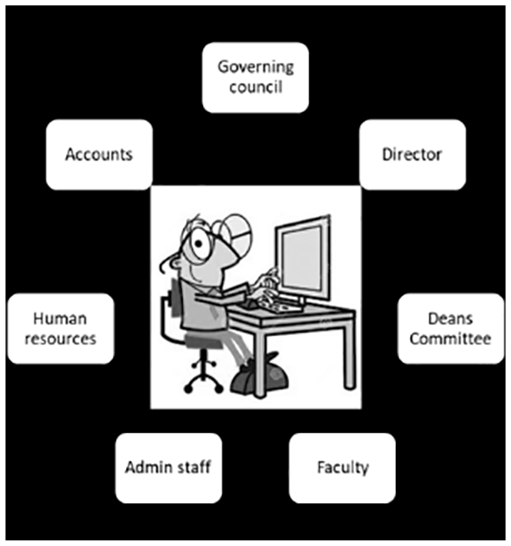
Stakeholders of the CEMS..
“RISE” and “FALL” of CEMS
The chairman and the Director of the university recognized the contribution of the coordinator Jim for the “successful” implementation of the CEMS and sanctioned him additional incentives and fringe benefits. Exactly after 1 year, in May 2017, some of the aggrieved and disappointed users (employees) of the GAST were surprised when they found out about the virtual attendance being given by a few of their colleagues due to the malfunctioning of the CEMS. When they raised these issues with the coordinator Jim, they were puzzled by his response, as he continued to defend the system implementation and outcomes.
After considerable debate, they brought this issue to the notice of their director and highlighted the misuse of the CEMS by a few of their colleagues. They also pointed out to him that several employees had to undergo mental agony due to the CEMS. They were found to have succeeded in establishing the “facts” before the director. Peter knew very well that Jim is not competent to manage the faults and the failures of the in-house developed CEMS. However, he believed that the system would be set right by Jim eventually and it could still function, despite its limitations. Although the director gave a patient listening to the arguments and reports put forth by few of their employees, he gave his final verdict favoring the usage of the CEMS in the university, as he believed that an implemented system should not be withdrawn halfway through. He also assured the employees that the issues raised by them would be fixed by the IS coordinator at the earliest possible time. What made the director to dismiss the reports submitted by couple of resistant users remains even now a million-dollar question among the employees of the GAST.
An employee murmured that the CEMS was designed and developed as an in-house product with the support and technical assistance from a few of their department faculty and students. Others did not have information about what kind of workflows were enabled in the system and what dashboards did it present to the administration. Given this situation, it was not clear as to how the university expected the employees to trust the functioning of the CEMS. Was the objective of CEMS to only augment decision-making for operational performance or were there many candies and sticks on the cards for selectively identified employees, based on the management’s preferences?
“ON” and “OFF” solutions
Although there was increasing dissatisfaction, all the employees continued to use the CEMS. In September 2018, the director was given a demonstration by Jim to showcase the upgraded CEMS. Although Peter was intelligent enough to understand that the upgraded version of the CEMS could not fix all the sensitive errors and faults, he still believed that the system would be set right by Jim in due course.
During the demonstration, Jim also assured the director that whenever a report on erroneous operation of CEMS is received from the end user, the same will be resolved by him immediately. This was simply a strategy adopted by the IS coordinator to transfer the burden of testing the CEMS from the development team to the employees. After the demonstration, the director informed all the employees that there was no room for abandoning the implementation of the CEMS. Further, the director insisted that CEMS should be seen as a problem solver and not as a problem creator. He also promised them that, in future, there would be no serious faults or failures during the usage of the CEMS. Thereafter, the testing process of the CEMS by the employees continued.
To attend to the serious errors reported by the employees, Jim decided to introduce ad hoc solutions so as to fix the errors readily. Some instances of the errors include the following:
An employee could not apply leave online during peak working hours of the university due to poor network bandwidth.
An employee marks his attendance through the smart card; however, the report shows that he is absent on that date.
Minor errors in the payroll. Jim started fixing the errors on an ad hoc basis and found comfortable to manage the situation and portray to the director that the CEMS was working perfectly.
Jim failed to understand that encapsulating ad hoc solution to fix the system errors of the CEMS would make the system risky and create further complications. One primary reason for this outcome is that any ad hoc solution to the CEMS would involve modification to the database, user interface design and the source code of the IT product of the CEMS. In some cases, to fix errors, the IS coordinator would temporarily discard some existing features of the CEMS or even a recently embedded ad hoc solution of it. Then, suddenly after a few weeks, these features would be restored.
Maintaining multiple versions of the data on the same entities became a huge challenge that he faced on a regular basis. However, there was no systematic approach through which he planned to address this due to a lack of bandwidth after meeting regular critical deliverables which required quick resolution. This kind of approach became inevitable for the IS coordinator as he had to respond to the queries raised by the end users. In these circumstances, after a few months, the CEMS was still found working with erroneous data.
Under these circumstances, a few of the employees again complained firmly to the director of the university that the further usage of the CEMS is insensible and meaningless, as the integrity and the reliability of the CEMS are easily debatable. There was a lot of apprehension that the reports which were available from the dashboards for the senior management may be misleading. However, Peter was found to have made up his mind long back to consider purchasing a similar IS system from a leading IT vendor who has already implemented successful IS solution in small- to mid-size enterprises and universities. Hence, after few weeks, he made an oral submission to the aggrieved employees that the management has initiated the process to purchase an MIS suit from a leading IT vendor that would cover all the primary functionalities related to employee management such as finance and accounting and human resource management. He appeared to have learnt that the people who are novice in IT or IS projects implementation should prefer “made-to-stock” products from IT vendors than “made-to-order” products through in-house development.
Helen and Peter were still not sure why CEMS had failed to impress all their employees? When they could recognize the importance of the CEMS in the university, they did not foresee the limitations of IT product developed in-house. Hence, they struggled in their initiative to implement a successful IS in their organization in their first attempt itself.
What is a CEMS?
A CEMS is an IS that consists of a smart card readers, chat application interfaces, employee application interface, Intranet-based social platform and a server (database). Organizations that use smart card attendance system provide their employees a special card called smart card in which employees’ information along with the access code is stored. What employees need to do is just to enter the smart card into the smart card attendance system device, where the assigned code is generated to enroll their attendances. The smart card was purchased from a vendor, and software was designed and developed by internal faculty members from the IS department and the students. The smart card enabled access to many other services within the organization like library, cafeteria and gymnasium.
Software was typically developed in Microsoft technologies anchored in the cloud server maintained by the university. The cloud computing will deliver a single application through the browser to thousands of customers using a multitenant architecture. On the customer side, it means no upfront investment in servers or software licensing; on the provider side, with just one app to maintain, costs are low compared to conventional hosting.
The CEMS was designed to work both in Intranet and Internet platform. The data that are entered may be analyzed by AI algorithms to provide insights for decision-making by the senior management. The AI-based algorithms which could do analysis like clustering, classification and association rule mining were inherently built behind these dashboards to provide the senior management predictive insights.
How does a CEMS work?
The CEMS collects the attendance entry of the employees marked through the smart card reader and transfers the data to the database and processes it. Also, it would handle the leave applied online by the employees and processes it. It allows you to keep track of the attendance of the employees of the GAST and also provides a comprehensive report of the attendance and leave particulars of the employees. Taking into account the attendance and the leave availed by the employees, the payroll will be generated.
A CEMS could also use the information of the employees past training, appraisal and leaves, and make recommendations to the senior management based on these data about the employees. These may help in employee life cycle management and overall development and retention of employees in GAST.
What is AI?
AI is based on the principle that human intelligence can be defined mathematically in a way that a machine can easily mimic it and execute tasks, from the most simple to those that are even more complex. The objective of using AI in a CEMS includes learning, reasoning and perception of employee data. This allows the system to use the data for providing consistent directions to otherwise complex problems based on internal rules which learn from the data.
What is cognitive automation?
Cognitive automation is based on software bringing intelligence to information-intensive processes. By leveraging AI technologies, cognitive automation extends and improves the range of actions that are typically correlated with robotic process automation (RPA), providing advantages for cost savings and customer satisfaction as well as more benefits in terms of accuracy in complex business processes that involve the use of unstructured information.
What are clustering, classification and association rule mining algorithms?
Data analysis in data mining is primarily carried out using supervised or unsupervised learning techniques. Clustering (unsupervised learning), classification (supervised learning) and association rule mining are some of the data mining techniques widely used in the industry by researchers for analyzing a given data set.
Clustering is grouping or partitioning data into some subsets. Clustering is computed in such a way that the object belonging to one cluster is similar to other objects in that cluster and is dissimilar to the objects belonging to other clusters. This grouping is undertaken for a set of objects in such a manner that objects in the same group are more similar than the object belonging to other groups.
Classification is a process of finding a model that describes the data classes or concepts. The objective of using classification is to predict the class of objects whose class label is unknown. This is a supervised learning approach where on the basis of past data, rules are developed which enables a new instance to be mapped to an existing group of actions or items. Classification rules typically work after groups among the data sets are already established (through clustering).
In comparison, association rule mining is about finding associations among items within large commercial databases, which co-occur together. Such co-occurrences may not have causality linkages but just have association in terms of occurrences in the data. Based on co-occurrences, recommendation engine generates rules which can have actionable outcome.
Questions for discussion are elaborated:
How would you define the business strategy for the implementation of an IS such as an enterprise resource planning (ERP) system for the Employee Management System shown in Exhibit 2?
How would you apply technology alignment models such as the Henderson and Venkatraman’s technology alignment model (Henderson and Venkatraman, 1993, Figure 1, p.476) for leveraging information technology for transforming organization?
What is the executive role of senior management for successful implementation of IS?
What is the roadmap for achieving a perfect business and IT alignment?
What are the implications for an IT product built in-house for future business operations?
How do you relate classification and clustering to decision-making in an IS?
How would you use AI to improve the efficiency of CEMS?
How do you feel the RPA extends the traditional approaches of IS implementation in organizations?
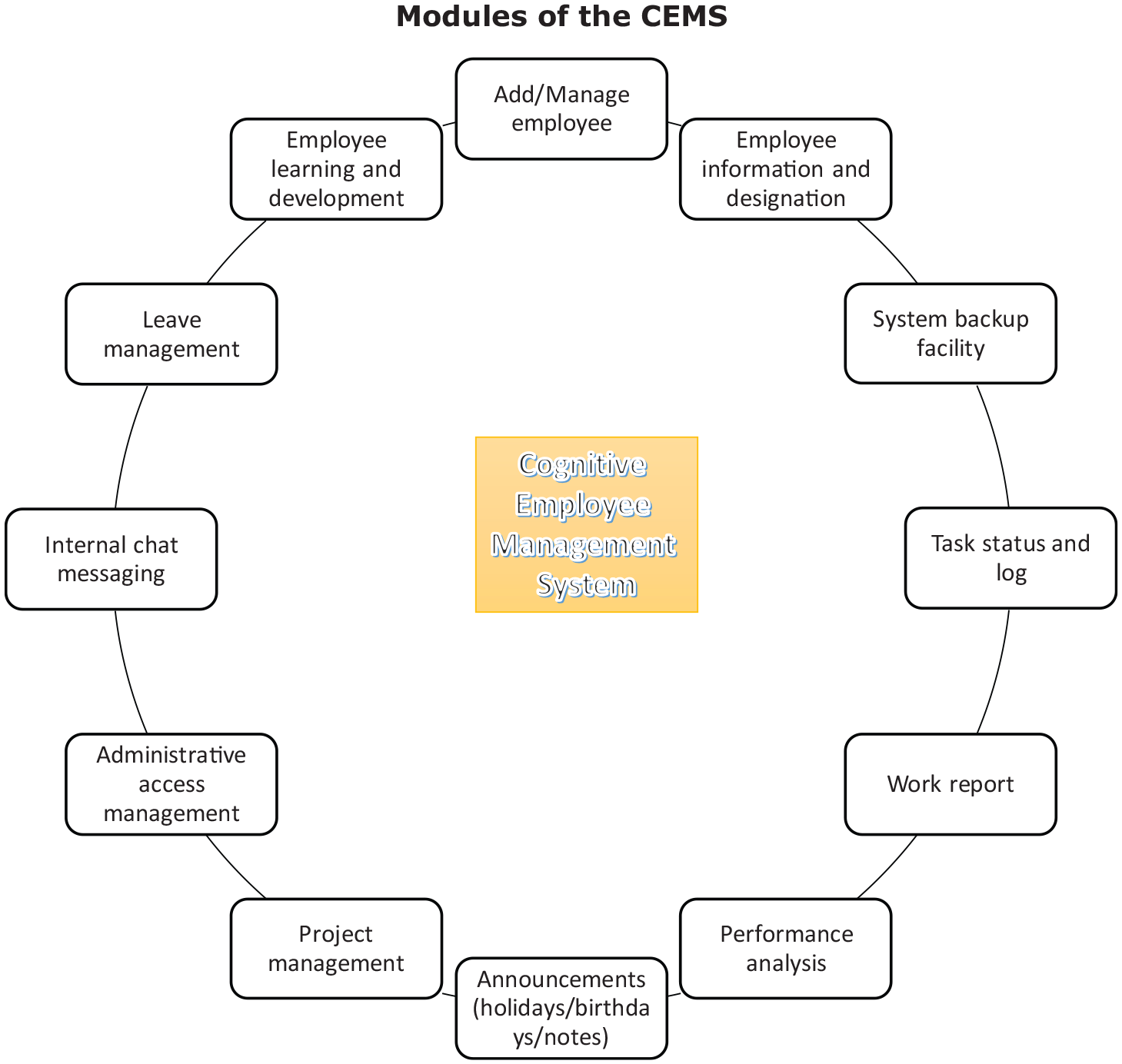
Modules of the CEMS.
Footnotes
Declaration of conflicting interests
The author(s) declared no potential conflicts of interest with respect to the research, authorship and/or publication of this article.
Funding
The author(s) received no financial support for the research, authorship and/or publication of this article.
